Spread the love

Original article by Max Colbert republished from DeSmog. Makes more sense now why Just Stop Oil and Extinction Rebellion are campaigning at UK Universities.

Revealed: Fossil Fuel Giants Have Committed £40.4 Million to UK Universities Since 2022

Major oil and gas companies including Shell, BP, and ExxonMobil have pledged huge sums in the form of research agreements, scholarships and more.

The University of Exeter, Cornwall Campus. Credit: Sic19 / Wikimedia CommonsCC -0

Major fossil fuel firms have committed tens of millions in finance to UK universities since 2022, DeSmog can reveal. 

Many of these commitments have been accepted by institutions that have actively pledged to divest from oil and gas companies. 

According to freedom of information requests submitted by DeSmog, more than £40.4 million has been pledged to 44 UK universities by 32 oil, coal and gas companies since 2022 in the form of research agreements, tuition fees, scholarships, grants, and consulting fees.

Most of the funding spans the current academic year, with a handful of projects running for a number years, up to as far as 2027.

The largest contributors were Shell, Malaysian state-owned oil company Petronas, and British Petroleum (BP). These three companies account for over 76 percent of the total figure awarded, having committed £20.98 million, £5.19 million, and £4.89 million respectively.

A further 10 companies made up nearly 20 percent of the remaining contributions during this period: Sinopec, Equinor, BHP Group, Total Energies, Eni SPA, Saudi Aramco, ExxonMobil, Kellas Midstream, Ithaca Energy, and Chevron.

Previous reporting from openDemocracy and the Guardian found that, between 2017 and December 2021, £89 million had been given to UK universities from some of the world’s biggest fossil fuel companies.

These partnerships have shown no sign of abating. DeSmog’s research shows an additional £40 million committed by fossil fuel firms since 2022, despite pledges from 102 higher education institutions to divest from the industry.

The universities in receipt of the most money were: Exeter, Imperial College London, Heriot-Watt, Manchester, Cambridge, Oxford, Royal Holloway, Queen Mary London, and Teesside.

“Young people care so deeply about protecting the planet because their futures are on the line,” said Green Party MP Caroline Lucas. “Yet fossil fuel giants are putting that future at risk with their planet-wrecking pollution, and then attempting to youthwash their reputation by handing over dirty money to universities”.

“If we’re going to tackle the climate emergency and secure a liveable future for the next generation, educational institutions should cut all ties with fossil fuel companies immediately.”

These figures do not include a total for Durham University, which declared that it had research agreements involving fossil fuel firms totalling £1.7 million but did not declare the sums that the oil and gas firms had contributed to these agreements. 

These figures also do not include the amount held in fossil fuel investments by these universities. Our research indicates that at least 18 higher education institutions held direct investments in 25 fossil fuel companies over the relevant time period, collectively worth a further £8.1 million.

Many top universities also hold stakes in high-value pooled investment funds that are pouring hundreds of millions into fossil fuel giants. Research conducted by the student campaign group People & Planet estimates that, as of July 2022, as much as £319 million was still held in these funds by universities across the UK, including some institutions that have made promises to divest.

More than 65 percent of the country’s higher education institutions have refused to make further fossil fuel investments. This would potentially remove £17.7 billion from the reach of the industry, while 51 universities have yet to divest from oil and gas

Laura Clayson, climate campaigns manager at People & Planet, told DeSmog: “we say to those 51 universities left to divest: the student movement will remain unwavering in its demands for justice until our victory list includes every single one of you.”

The Leaderboard

The University of Exeter has received the most from fossil fuel firms since 2022, having signed a £14.7 million, five-year deal with Shell in November, as revealed by Byline Times. The project is to work on “carbon storage and sequestration”, and continues a 15-year relationship between the university and the oil giant.

According to the contract award notice, the project is part of a “wider Shell-led research programme focused on sequestration which aligns with Shell’s target to be a net-zero emissions energy business by 2050”. 

Last year, Shell produced only 0.02 percent of its energy from renewable sources, analysis by Greenpeace has revealed. The company also recently abandoned plans to cut oil production by 1-2 percent each year until 2030, and will be investing £33 billion in oil and gas production between 2023 and 2035, compared to just £8-12 billion in “low-carbon” products. 

Shell claims that it has reduced oil production more quickly than expected, though the company’s planned emissions between 2018 and 2030 are estimated to account for nearly 1.6 percent of the global carbon budget

A spokesperson for the firm said: “We remain committed to becoming a net zero emissions energy business by 2050… It remains our view that global energy demand will continue to grow and be met by different types of energy – including oil and gas.”

New research from the University of Queensland shows that more than half of the world’s top fossil fuel producers will fail to meet climate targets unless they expand plans to decarbonise, while a major report from the UN has warned that the world will miss its climate targets unless it commits to “phasing out all unabated fossil fuels”.

A University of Exeter spokesperson said that its work with Shell will “contribute to the global race to net zero.”

Imperial College London has received the second most from fossil fuel firms since 2022. This follows a long association with oil and gas giants, which gave £54 million to the university between 2017 and 2021.

A spokesperson for Imperial told DeSmog that it pledged in 2020 it will only engage in research partnerships “with fossil fuel companies where the research forms part of their plans for decarbonisation, and only if the company demonstrates a credible strategic commitment to achieving net-zero by 2050”. 

The university has maintained a working relationship with 13 fossil fuel companies since 2022.

The largest beneficiaries of fossil fuel financial commitments since 2022

Exeter£14,700,000
Imperial College London£6,725,769
Heriot-Watt£6,005,844
Manchester£3,077,268
Cambridge£2,821,437
Oxford£1,209,221
Royal Holloway£740,657
Queen Mary London£587,956
Teesside£500,000

The University of Manchester houses the BP Centre for Advanced Materials (ICAM) research unit, a collaboration between BP and leading universities in the UK and US, including Manchester, Cambridge, and Imperial. The ICAM website states that the centre supports “BP’s ambitions to become a net zero company by 2050”. 

BP generated just 0.17 percent of its energy from renewable sources in 2022 and, in the first half of last year, the company spent more than 10 times more on new oil and gas projects than it did on “low carbon” energy. In 2022, 92.7 percent of all activity for both BP and Shell went into fossil fuel investment. 

As with Shell, BP posted record profits in 2022 worth some £23 billion. At the same time, it scaled back plans to cut emissions by 2050 on the grounds that it needs to keep investing in new oil and gas to meet consumer demand. BP did not respond to our request for comment.

The University of Manchester’s funding agreements with BP stretch back to 2008, when it was selected by the fossil fuel giant to run its Projects and Engineering College. 

Hundreds of people have subsequently completed BP’s courses at the university, with Manchester describing the partnership as a “strategic alliance that has a major impact on both organisations”. The university has also received money from Shell and TotalEnergies.

A spokesperson for Manchester told DeSmog: “Since 2019 all new research funded in the BP ICAM has been focused on topics in materials sciences that support the energy transition, providing research to support BP’s goal to become a net zero company by 2050.”

Since 2022, Durham University’s research projects have included contributions and commitments from BP, ExxonMobil, and the China Petroleum and Chemical Corporation (Sinopec). 

The university also previously partnered with the universities of Edinburgh and Leeds to form the Engineering and Physical Sciences Research Council’s Centre for Doctoral Training in Soft Matter and Functional Interfaces (SOFI CDT), which has been sponsored by industrial partners including Infineum, a joint venture between ExxonMobil and Shell. 

Durham University is also a sponsor of the GeoNetZero CDT, a PhD research and training programme focused on geoscience and the energy transition, which has 11 other university partners; Heriot-Watt, Aberdeen, Birmingham, Dundee, Exeter’s ‘Camborne School of Mines’, Keele, Newcastle, Nottingham, Plymouth, Royal Holloway and Strathclyde. 

From 2020 to 2022, CDT recruited 16 PhD students per year, funded in part by the oil and gas firm NEO Energy, which pledged £2.5 million alongside academic partners.

The centre is based out of the Shell Building at Heriot-Watt University’s School of Energy, Geoscience, Infrastructure and Society, and has nine core industry partners: BP, Cairn Energy, Chrysaor, China National Offshore Oil Corporation (CNOOC), Equinor, ExxonMobil, NEO Energy, Shell, and Total Energy. 

A spokesperson for Heriot-Watt told DeSmog: “Heriot-Watt University and our Centres for Doctoral Training (CDTs) are committed to a rapid and just energy transition, led by our world-class research and teaching… The GeoNetZero CDT is a new programme of PhD research and training set up to address key areas in geoscience and their role in the low carbon energy transition and challenge of net zero.

“We work in collaboration with the energy sector to develop education and research opportunities related to net zero, responsible consumption of oil and gas, and the transition to renewable energy sources.”

Studentships

Fossil fuel companies pledged to fund scholarships and tuition fees across at least 17 universities in 2022. 

The Italian multinational Eni funded a scholarship programme at the University of Oxford’s Saïd Business School in 2022 called the Africa Scholarship, as well as a scholarship programme with St Anthony’s College, Oxford. 

Oxford has previously said that it “receives funding from and donations from companies and organisations from the fossil fuel sector” typically at an average of £3 million a year in research funding and £2 million in philanthropic donations. It says that the research funding is equivalent to less than 1 percent of the university’s research turnover.

Kellas Midstream also funds a set of scholarships at Teesside University, while Cardiff receives over £870,000 from TotalEnergies for its OneTech Futures graduate programme, which began in 2018 and runs through to 2025.

Shell has given the University of Aberdeen £150,000 for new “Transition Scholarships” for the coming academic year, funding research into “key challenges around net zero and reducing emissions”.

The university, based in Europe’s “oil capital” on the coastline of the UK’s North Sea oil and gas fields, pledged to divest from fossil fuels in 2021 – saying that it planned on excluding fossil fuel extraction companies from its £52.7 million investment portfolio by 2025.

A report commissioned by the University of Cambridge and led by Nigel Topping, a former UN climate action champion, last year recommended that the institution halt all funding from fossil fuel companies, including for research or philanthropic purposes. Cambridge itself took £2.8 million from Shell, BP, and BHP Billiton in 2022, and has reportedly received around £3.3 million per year from the industry since 2017. 

A spokesperson told DeSmog: “The University of Cambridge only accepts funding from energy companies where it is sure that the resulting collaboration will help the UK and global society move to renewable or decarbonised energy. An enhanced set of criteria created in 2021 includes a written assessment from non-conflicted experts on whether the purpose of the proposed collaboration contributes meaningfully to the energy transition.”

A spokesperson for the University of Strathclyde said: “The University of Strathclyde is committed to supporting the energy transition to a sustainable, renewable energy system and the delivery of net zero targets by 2050. Much of the University’s work in the achievement of a sustainable and zero carbon economy is carried out in collaboration with industrial partners in the energy sector.”

A spokesperson for Royal Holloway, University of London, said: “At Royal Holloway, University of London, we are committed to developing and implementing activities that support environmental sustainability and a solution-based approach to net zero.”

The University of Bradford refused to reveal how much it received in partnerships with both Sinopec and the Saudi chemicals company SABIC, citing the commercial interests of the companies. 

A deal struck between the University of Surrey and BP, running from 2019-2022, was also withheld because of a non-disclosure agreement in place. 

A number of other universities refused our freedom of information requests or failed to respond to repeated requests for comment. This included the universities of East Anglia, Nottingham, Birmingham, Plymouth, Loughborough, Bishop Grosseteste, and Oxford Brookes.

Additional reporting by Joey Grostern and Sam Bright

UPDATE: 5 October 2023 – This article previously erroneously listed Scottish Power as a fossil fuel company. The firm has now been removed from the article and Strathclyde University removed from the largest recipients of fossil fuel funding.

Original article by Max Colbert republished from DeSmog. Makes more sense now why Just Stop Oil and Extinction Rebellion are campaigning at UK Universities.

Continue Reading

Jeremy Corbyn: “I Condemn Violence Against All Civilians, Why Can’t Keir Starmer?”

Spread the love

https://tribunemag.co.uk/2023/10/jeremy-corbyn-i-condemn-violence-against-all-civilians-why-cant-keir-starmer/

We should condemn the targeting of all civilian life, no matter who does it. That this is apparently controversial is testament to the depravity of a media and political class that shuts down, distorts and denounces calls for peace. The heinous attacks on civilians in Israel by Hamas were utterly deplorable.

This cannot justify the indiscriminate killing of Palestinians, who are paying a price for a crime they did not commit. All human life is equal. Why is it so difficult for our politicians to be consistent in this basic moral principle?

This is the question that many people in this country are asking when they express solidarity with the Palestinian people. They are not expressing support for Hamas. To deliberately conflate the two is a disgusting, cynical and chilling attempt to further erode our democratic rights, and wilfully ignores a very basic demand: to stop the killing of innocent people.

The global community has a responsibility to de-escalate this catastrophic situation. That means calling for an immediate ceasefire. That means the release of Israeli hostages. That means ending the siege of Gaza. And that means recognising the underlying roots of this tragic cycle of violence: the enduring occupation of the Palestinian people.

https://tribunemag.co.uk/2023/10/jeremy-corbyn-i-condemn-violence-against-all-civilians-why-cant-keir-starmer/

Continue ReadingJeremy Corbyn: “I Condemn Violence Against All Civilians, Why Can’t Keir Starmer?”

‘We Must Halt This’: US Progressives, Humanitarians Decry Israel’s Evacuation Order

Spread the love

Original article by JAKE JOHNSON republished from Common Dreams under Creative Commons (CC BY-NC-ND 3.0).

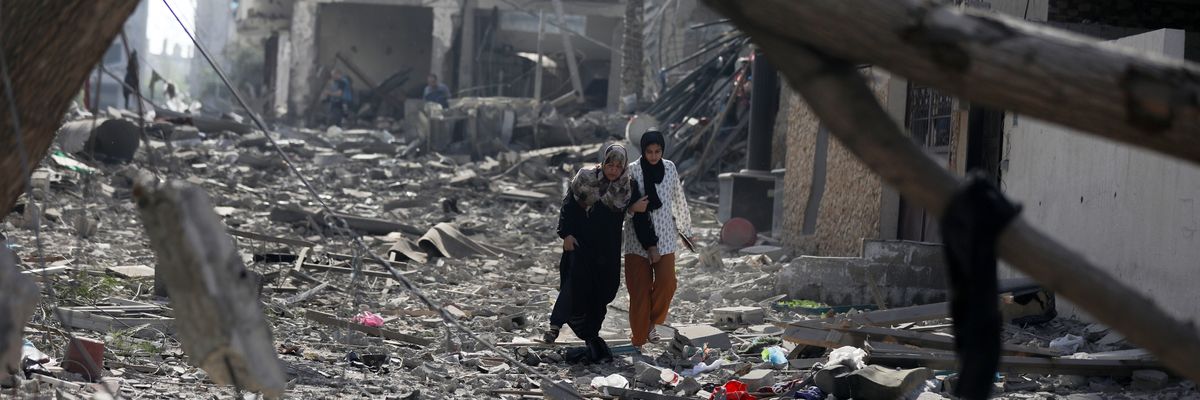
Palestinians walk through debris along a street in the aftermath of Israeli bombardment in al-Karama district in Gaza City on October 11, 2023. (Photo: Majdi Fathi/NurPhoto via Getty Images)

“The mass expulsion of over 1 million people in a day is ethnic cleansing,” said U.S. Rep. Ilhan Omar. “We must use all diplomatic tools to stop this.”

Progressive members of the U.S. Congress joined humanitarian groups and the United Nations on Friday in condemning Israel’s 24-hour evacuation order for the entire population of the northern Gaza Strip, a directive that will be impossible for many in the region to meet—particularly the thousands wounded by Israeli airstrikes.

“Any person can see that ordering 1+ million people to move in under 24 hours is not possible. It is unacceptable,” U.S. Rep. Alexandria Ocasio-Cortez (D-N.Y.) wrote on social media. “Humanity is at stake. Nearly half are children. We must halt this.”

More than 400,000 Palestinians have been displaced since Israel began its latest bombing campaign in Gaza following a deadly Hamas attack on October 7.

In the wake of Israel’s order—which came hours before the nation launched ground raids in Gaza—many panicked residents fled their homes in the northern part of the enclave, with some fearing another permanent displacement on the scale of the 1948 Nakba.

“As I am packing my things I am wondering, is this really another Nakba?” 56-year-old Arwa El-Rayes, an internal medicine doctor, told The New York Times shortly before fleeing her home in Gaza City. “I am taking my house key and thinking, will I ever return to my home, will I ever see my home again?”

Reuters reported that “several thousand residents could be seen on roads heading out of the northern part of the Gaza Strip, but it was impossible to tell their numbers. Many others said they would not go.”

A 33-year-old woman in Gaza City toldThe Washington Post that she’s staying along with dozens of family members, including her elderly parents.

“There are no cars to take us anywhere,” she said. “There is no gas in cars. Cab companies don’t have cars anymore. The streets are so, so, so, so crowded, it’s like it’s the Day of Judgement.”

U.S. Rep. Ilhan Omar (D-Minn.) argued that “the mass expulsion of over 1 million people in a day is ethnic cleansing.”

“We have to stop ignoring the thousands of Palestinian lives lost and millions at stake!” Omar added. “We must use all diplomatic tools to stop this.”

Echoing aid groups, the Minnesota lawmaker emphasized that many in northern Gaza—including people with disabilities and those wounded by Israeli bombs—”can’t simply pick up and leave” in compliance with Israel’s evacuation directive, which the U.N. said is untenable and should be rescinded.

“With communications and electricity shut down by Israel, the order cannot be communicated,” Omar wrote. “Roads are bombed and many cars are out of fuel, making fleeing impossible for many. Plus there has been no announcement of a pause in hostilities to allow for safe civilian evacuation, so people are afraid to leave and risk bombardment. Even if it were successful, there is no infrastructure in southern Gaza to receive an additional 1.1 million people.”

The Palestine Red Crescent Society underscored those warnings in a statement Friday, saying it doesn’t have “the means to evacuate the sick and the wounded in our hospitals, or the elderly and the disabled.”

“There are no safe areas in the whole of the Gaza Strip,” the group said. “The world must intervene to stop this catastrophe.”

Israeli forces have already been accused of targeting Gazans attempting to flee to the south with airstrikes.

Despite urgent appeals from lawmakers and aid organizations, officials in the U.S.—Israel’s top ally and leading supplier of weaponry—have provided no public indication that they will pressure Israel to reverse course.

The Israel Defense Forces (IDF) told people in Gaza City on Friday to “evacuate south for your own safety and the safety of your families” as it amasses tanks and troops for an apparently imminent full-scale ground invasion. Hamas has reportedly told Gazans to defy the IDF’s instructions.

Asked about Israel’s evacuation order during a CNN appearance on Friday, White House national security spokesperson John Kirby said he doesn’t want to get involved in “armchair quarterbacking” the situation, adding, “We understand what they’re trying to do.”

“Now it’s a tall order,” Kirby admitted. “It’s a million people, and it’s a very urban, dense environment. It’s already a combat zone. So I don’t think anybody’s underestimating the challenge here of effecting that evacuation.”

The White House’s soft-pedaling of Israel’s directive contrasts sharply with the assessments of human rights organizations, which argued the order amounts to a war crime that will worsen an already calamitous situation.

“The instructions issued by the Israeli authorities for the population of Gaza City to immediately leave their homes, coupled with the complete siege explicitly denying them food, water, and electricity, are not compatible with international humanitarian law,” the International Committee of the Red Cross (ICRC) said Friday. “When military powers order people to leave their homes, all possible measures must be taken to ensure the population has access to basic necessities like food and water and that members of the same family are not separated.”

“Gaza is a closed area of limited size and resources,” the ICRC added. “People have nowhere safe to go and many, including the disabled, elderly, and sick, will not be able to leave their homes. International humanitarian law protects all civilians, including those who remain. Today, it is impossible for Gazans to know which areas will next face attack.”

“There are no extra beds in any hospitals anywhere for people to move to. Most of the wounded are unstable, they’ll die en route.

Gaza’s health ministry toldThe Independent that it would be “impossible” to move the wounded in its care to southern Gaza, given that the entire territory’s healthcare system is overwhelmed and teetering on the brink of total collapse due to the rapid influx of airstrike victims and Israel’s blockade, which has cut off the enclave’s supply of electricity, fuel, and critical supplies.

More than 6,600 people in Gaza have been injured by Israel’s relentless aerial campaign, which dropped roughly 6,000 bombs on the occupied enclave over just a six-day period, leveling entire neighborhoods and damaging medical facilities, schools, and other civilian infrastructure.

“There are no extra beds in any hospitals anywhere for people to move to,” Gaza’s health ministry said. “Most of the wounded are unstable, they’ll die en route. All hospitals in Gaza, even after they’ve been expanded, are full.”

Tarik Jasarevic, a spokesperson for the World Health Organization, noted that “there are severely ill people whose injuries mean their only chances of survival is being on life support, such as mechanical ventilators.”

“So moving those people is a death sentence,” said Jasarevic. “Asking health workers to do so is beyond cruel.”

Meinie Nicolai, general director of Doctors Without Borders, said in a statement Friday that the Israeli military’s evacuation order is “outrageous.” The group said Israel has given Al Awda Hospital—where Doctors Without Borders staff are treating patients—just two hours to evacuate.

“This represents an attack on medical care and on humanity. We are talking about more than a million human beings,” said Nicolai. “‘Unprecedented’ doesn’t even cover the medical humanitarian impact of this. Gaza is being flattened, thousands of people are dying. This must stop now. We condemn Israel’s demand in the strongest possible terms.”

Original article by JAKE JOHNSON republished from Common Dreams under Creative Commons (CC BY-NC-ND 3.0).

Continue Reading‘We Must Halt This’: US Progressives, Humanitarians Decry Israel’s Evacuation Order

‘This Is Not What Fighting Hamas Looks Like’: Israel Orders All of Northern Gaza to Evacuate

Spread the love

“That’s obviously impossible. Israel is preparing for mass atrocities.”

Original article by JAKE JOHNSON republished from Common Dreams under Creative Commons (CC BY-NC-ND 3.0).

People in Gaza City begin moving to the south following an Israeli military evacuation order on October 13, 2023. 
(Photo: Ashraf Amra/Anadolu via Getty Images)

The Israeli military on Friday ordered the entire population of northern Gaza—roughly 1.1 million people—to evacuate to the southern half of the occupied territory within 24 hours, prompting fears of an even worse humanitarian catastrophe as Israel readies a ground invasion and continues its disastrous bombing campaign.

The order, initially issued to the United Nations, impacts nearly half of Gaza’s population and comes after hundreds of thousands of the enclave’s residents were already displaced by Israeli airstrikes, which have killed more than 1,500 people.

U.N. spokesperson Stéphane Dujarric said in a statement that the organization “considers it impossible for such a movement to take place without devastating humanitarian consequences.”

Dujarric added that the order must be “rescinded” to avert “a calamitous situation.”

News of Israel’s directive sparked alarm and confusion on the ground in northern Gaza, which includes densely populated Gaza City—home to the territory’s primary hospital.

Al Jazeera reported that one of its journalists in Gaza City “saw residents packing up whatever belongings they could as they began evacuating towards the south in cars, vans, and any other vehicle that was available.”

“In northern Gaza, residents early in the morning of Friday said the streets were empty as people stayed inside their homes trying to decide what to do next following Israel’s evacuation orders,” the outlet noted. “There were no cars on the road except for ambulances. Because of the internet outages and collapse of phone networks, Palestinians said information was scant and most still had not heard direct orders from the army to evacuate.”

“We fear that Israel may claim that Palestinians who could not flee northern Gaza can be erroneously held as directly participating in hostilities, and targeted.”

Aid groups and human rights organizations expressed horror in response to the Israeli military’s evacuation order, which observers warned is a prelude to “mass atrocities.”

Jan Egeland, secretary-general of the Norwegian Refugee Council, said that without “any guarantees of safety or return,” the order “would amount to the war crime of forcible transfer.”

“The collective punishment of countless civilians, among them children, women, and the elderly, in retaliation for acts of horrible terror undertaken by armed men is illegal under international law,” said Egeland. “My colleagues inside Gaza confirm that there are countless people in the northern parts who have no means to safely relocate under the constant barrage of fire.”

“We fear that Israel may claim that Palestinians who could not flee northern Gaza can be erroneously held as directly participating in hostilities, and targeted,” Egeland continued. “The United States, the U.K., the European Union, and other Western and Arab nations who have influence over the Israeli political and military leadership must demand that the illegal and impossible order to relocate is immediately rescinded.”

B’Tselem, an Israeli human rights group, said in response to the order that “a million people in northern Gaza are not guilty.”

“They have nowhere else to go,” the group added. “This is not what fighting Hamas looks like. This is revenge. And innocent people are being hurt.”

The order was delivered amid warnings that Gaza’s healthcare system is on the verge of total collapse, overwhelmed by the influx of thousands of airstrike victims and hampered by Israel’s total blockade, which has cut off the enclave’s supply of electricity, food, fuel, and other necessary supplies.

Gaza’s lone power plant has stopped operating due to a lack of fuel, forcing already-strained hospitals to operate on generators. The International Planned Parenthood Federation said Friday that “over 37,000 pregnant women will be forced to give birth with no electricity or medical supplies in Gaza in the coming months, risking life-threatening complications without access to delivery and emergency obstetric care services.”

The World Health Organization (WHO) said Thursday that “time is running out to prevent a humanitarian catastrophe if fuel and lifesaving health and humanitarian supplies cannot be urgently delivered to the Gaza Strip amidst the complete blockade.”

“Hospitals have only a few hours of electricity each day as they are forced to ration depleting fuel reserves and rely on generators to sustain the most critical functions,” the WHO said. “Even these functions will have to cease in a few days, when fuel stocks are due to run out. The impact would be devastating for the most vulnerable patients, including the injured who need lifesaving surgery, patients in intensive care units, and newborns depending on care in incubators.”

Despite such dire warnings, the U.S.—Israel’s largest supplier of weaponry and military aid—has thus far not called for a cease-fire or an end to the siege.

As The Associated Press reported Friday, “A visit by Secretary of State Antony Blinken, along with shipments of U.S. weapons, offered a powerful green light to Israel to drive ahead with its retaliation in Gaza after Hamas’ deadly attack on civilians and soldiers, even as international aid groups warned of a worsening humanitarian crisis.”

Original article by JAKE JOHNSON republished from Common Dreams under Creative Commons (CC BY-NC-ND 3.0).

Continue Reading‘This Is Not What Fighting Hamas Looks Like’: Israel Orders All of Northern Gaza to Evacuate

What You Are Seeing in Gaza Is Genocide and Ethnic Cleansing

Spread the love

Original article by YUMNA PATEL republished from Common Dreams under Creative Commons (CC BY-NC-ND 3.0).

A man carries a wounded child into Al Shifa hospital following Israeli strikes in Gaza City on October 10, 2023.
 (Photo: Mohammed Abed/AFP via Getty Images)

Seventy-five years of global inaction and Israeli impunity have led to this moment in which one of the most vulnerable populations on earth is pummeled by one of the world’s strongest military powers on a genocidal warpath.

Israel is planning on carrying out a genocide in Gaza.

The motions have been underway for days, as Israel has relentlessly bombed the Gaza Strip, one of the most densely populated places on earth.

In six days, Israel has dropped 6,000 bombs on the besieged coastal enclave, which is home to 2.3 million Palestinians. Half of them are children. This falls just short of the highest number of bombs dropped by the US in a year in the war on Afghanistan.

Over the past week, Israel has dropped internationally-prohibited white phosphorus on civilians in Gaza. It’s leveled entire residential neighborhoods. Wiped out families off the population registry, and killed more than 1,500 Palestinians. A third of the death toll are children.

Palestinians have been screaming at the top of their lungs for days that Israel is carrying out a genocide on them. Israeli leaders have only supported those fears, calling Gazans “human animals” and pledging to “wipe Hamas off the face of the earth.”

Today, everyone’s worst fears were confirmed.

On Friday, October 13, Palestinians in Gaza woke up to the news that the Israeli army was demanding that the more than 1.1 million Palestinians who live in the northern Gaza Strip “evacuate” to the southern part of the strip in the span of 24 hours.

Palestinians have been screaming at the top of their lungs for days that Israel is carrying out a genocide on them. Israeli leaders have only supported those fears, calling Gazans “human animals” and pledging to “wipe Hamas off the face of the earth.” Today, everyone’s worst fears were confirmed.

Let that sink in. This is half of Gaza’s population. The northern part of Gaza includes Gaza City – the most densely populated area within the Gaza Strip. It also includes two of Gaza’s eight refugee camps, the Jabalia and al-Shati refugee camps. Both have been bombed over the past few days. Both are home to hundreds of thousands of refugees. They were made refugees by Israel, 75 years ago.

The Israeli military reportedly sent a direct warning to residents of Gaza City, who number around 750,000, ordering them to leave the city, as it plans to destroy what it claims is an “extensive infrastructure” of underground tunnels used by Hamas beneath the city.

But the United Nations said it received a different, much broader order, saying Israel was given 1.1 million civilians in northern Gaza 24 hours to flee south. A UN spokesman called the order “impossible” to achieve “without devastating humanitarian consequences.”

The Israeli army reportedly ordered Gazans not to return to the north until the army says they are allowed to go back.

But will they ever be allowed to go back? And will there even be a Gaza left to go back to?

No one knows what Israel’s plans are when the 24-hour deadline expires. Will they launch a ground invasion? Or will they simply pummel Gaza from the skies, as they have been doing for the past 16 years?

Israel, with the support of the United States, is committing genocide right before our eyes. It has been ongoing, a slow genocide and ethnic cleansing, for 75 years.

Whichever way Israel decides to go about it does not matter.

What matters is that Israel, with the support of the United States, is committing genocide right before our eyes. It has been ongoing, a slow genocide and ethnic cleansing, for 75 years.

75 years of global inaction and Israeli impunity have led to this moment. The moment where we see one of the most vulnerable populations on earth, 77% of whom are already refugees, being displaced as one of the world’s strongest military powers goes on a genocidal warpath.

Many Gazans are vowing to remain, saying they refuse to be displaced yet again. Many Palestinians are saying it’s psychological warfare, akin to the Zionist radio broadcasts of 75 years ago, that spread fear amongst the population and caused many to flee their homes out of fear of the Zionist atrocities that would await them if they stayed.

But the images are already flooding in as people in Gaza begin to flee their homes in fear of what comes.

Men, women, and children, walking through the rubble of their destroyed land, holding onto whatever bags and belongings they can carry. A march to the south, not knowing if tomorrow, the south will be next.

A death march.

Palestinians have said for 75 years, that the Nakba of 1948 never ended. It has continued for 75 years, every single day. In the crowded refugee camps of Gaza, the alleyways of Jerusalem, the hills of Haifa, and the corners of Jenin.

But today feels different. As millions of Palestinians in the West Bank, Jerusalem, ‘48, and across the diaspora watch their people in Gaza be expelled en masse while Israel destroys their homes and slaughters those who remain, the only words that people can muster, is “it’s happening again.”

A second Nakba.

Original article by YUMNA PATEL republished from Common Dreams under Creative Commons (CC BY-NC-ND 3.0).

Continue ReadingWhat You Are Seeing in Gaza Is Genocide and Ethnic Cleansing