Interview: Why global support for climate action is ‘systematically underestimated’
Original article by SIMON EVANS republished from Carbon Brief under a CC license.
There is near-universal global public support for climate action, yet people systematically underestimate the commitment of their peers, according to a new study.
The research, published in Nature Climate Change, is based on a globally-representative sample of nearly 130,000 people in 125 countries.
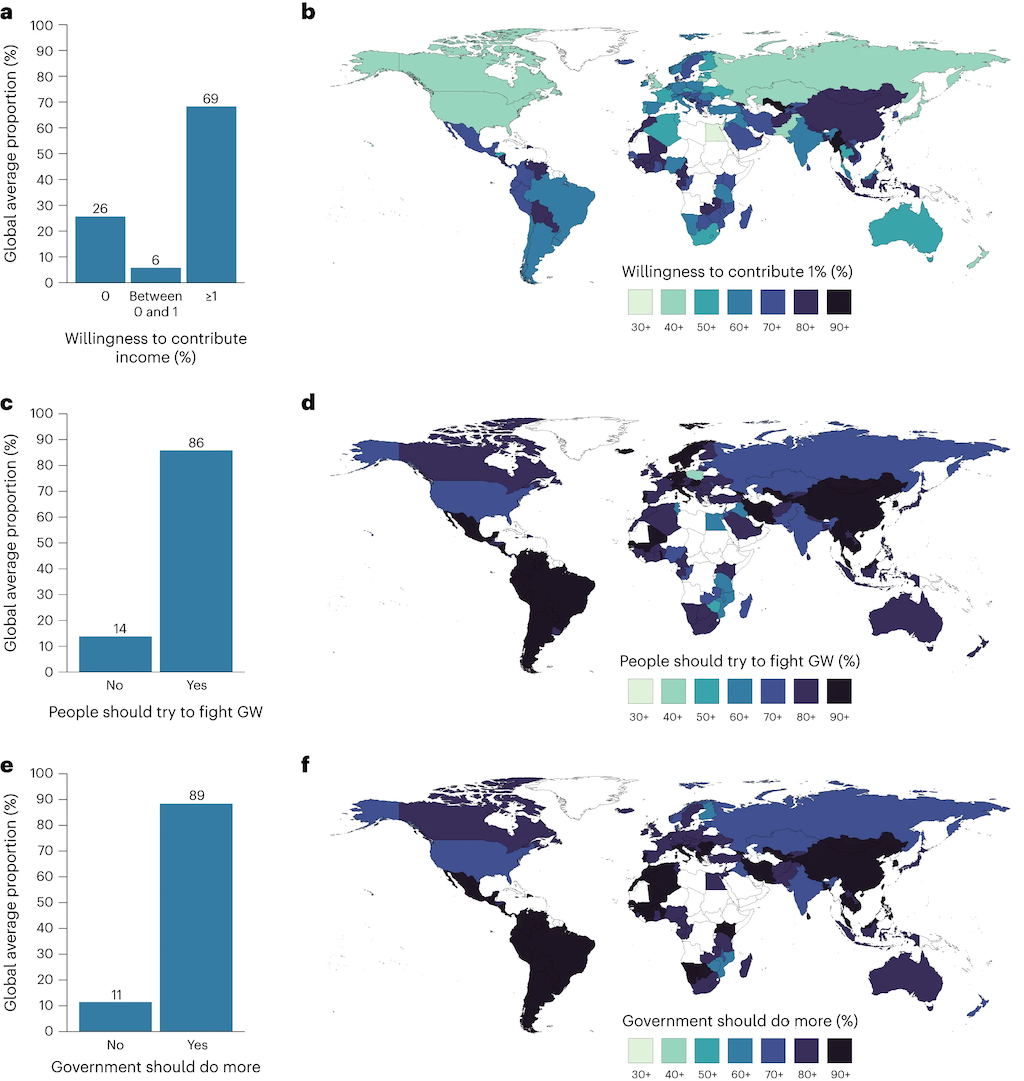
It finds that 86% of people “support pro-climate social norms” and 89% would like their governments to do more to tackle warming. Moreover, 69% say they would be willing to contribute 1% of their income to addressing climate change.
Yet respondents also “systematically underestimate the willingness of their fellow citizens to act”, according to the paper, creating a potentially challenging “perception gap”.
Carbon Brief interviewed the authors of the study to find out more. The questions and their answers are reproduced in full, below. An abridged version of the transcript was first published in DeBriefed, Carbon Brief’s weekly email newsletter. Sign up for free.
Carbon Brief: Your survey of nearly 130,000 people in 125 countries found “almost universal” support (86%) for climate action, with 89% wanting more from governments. Were you surprised?
Prof Peter Andre, Prof Teodora Boneva, Prof Felix Chopra and Prof Armin Falk: While we did expect to find high levels of approval for climate action in some of the countries that we studied, we were indeed surprised to find that the percentage of the population approving of pro-climate social norms and demanding more political action from their national government is very high in almost all countries in our sample. In 119 of 125 countries, the proportion of individuals who state that people in their country “should try to fight global warming” exceeds two-thirds. In more than half the countries in our sample, the demand for more government action even exceeds 90%.
We were probably misled by the same pessimism that we found to be so widespread across the globe. 69% of the world’s population is willing to contribute 1% of their monthly income to fight global warming. A broad majority of people across the globe is willing to pay a personal cost. In fact, in 114 out of 125 countries, a majority of respondents is willing to fight climate change. However, in 110 out of 125 countries, the majority thinks that they are in the minority: When asked about how many people in their country are willing to contribute, most respondents think that less than half of their fellow citizens would be willing to contribute.
[The figure below, taken from the new paper, shows: (top left) the share of respondents willing to contribute none, up to 1% or at least 1% of their income to tackling climate change; (top right) the same result broken down by country; (middle panel) the share believing that “people should try to fight global warming”; (lower panel) the share wanting governments to do more.]
CB: A large majority (69%) said they would be willing to contribute 1% of their income to fight global warming. Do you think this would hold for specific policies, such as a carbon tax?
PA, TB, FC and AF: The popular support for specific policies will depend on many details that we had to abstract from in the global survey. How effective is the policy? Is it perceived as fair? Who supports the policy in the public debate? So one cannot simply equate support in the survey with support for specific policy proposals. In a representative US sample, we do find that the general demand for more political action is strongly correlated with demand for specific climate policies, such as a carbon tax on fossil fuels, regulatory limits on the CO2 emissions of coal-fired plants, or funding for research on renewable energy. Overall, we think the important conclusion is the following: The large majority of people across the world expresses a general willingness to make costly contributions to fight climate change. This means that we can move the debate forward and focus on how we can best tap into this broad willingness to contribute to best tackle the challenges posed by climate change.
CB: There has been a resurgence of anti-climate rhetoric from politicians and the media in many countries. Do you think public opinion has shifted since your survey in 2021-22?
PA, TB, FC and AF: We do not detect any clear time trend within our samples from 2021 and 2022, but do not have data for the most recent months. If we were to speculate, we would not want to fall victim to the same pessimism one more time. We would expect that a large majority would still be in favor of climate action today, and this seems to be in line with more recent research. The year 2023 has been confirmed as the warmest calendar year in global temperature data records going back to 1850. In our study, we find that annual average temperatures strongly correlate with the proportion of people being willing to support climate action. Our best guess is that the support for climate action has increased rather than decreased in the last two years.
CB: You found stronger willingness to contribute among respondents in poorer, hotter and more vulnerable countries. Why do you think richer people are less willing to pay their way?
PA, TB, FC and AF: Two potential explanations come to mind. First, richer countries are still strongly dependent on fossil fuels. The adaptation costs could therefore be perceived as relatively high and the required lifestyle changes as too drastic. At the same time, richer countries may be more resilient: A country’s GDP per capita reflects its economic capacity to cope with climate change. The most direct and immediate consequences are likely to be concentrated in more vulnerable countries, which have fewer resources to mitigate the negative consequences of the climate crisis. However, it’s important to stress the positive message: the support for climate action is large even in the richest countries in our sample. In the wealthiest quintile of countries, the average proportion of people willing to contribute 1% is 62%.
CB: You found people systematically underestimated the willingness of their peers to contribute to climate action. Why do you think that is – and how could it be changed?
PA, TB, FC and AF: The reasons for this perception gap are likely to be manifold. In the past, media and public discussions have given a lot of focus to the small number of climate change sceptics and have fallen prey to the efforts of special interest groups. Moreover, climate change is difficult to tackle. People might mistakenly infer that the slow progress in combating climate change is due to a widespread lack of personal commitment.
In our view, correcting this perception gap is more important than understanding its origin. Humans are (what behavioral scientists call) “conditional cooperators”. They contribute more to the public good if they believe that others contribute as well. For this reason, pessimism about others’ contributions is harmful. It can constitute a critical obstacle for climate action. We thus conclude in the paper that, “[r]ather than echoing the concerns of a vocal minority that opposes any form of climate action, we need to effectively communicate that the vast majority of people around the world are willing to act against climate change and expect their national government to act”. We hope that our study sparks a debate on this topic, and increases awareness about the large global support for climate action.
Original article by SIMON EVANS republished from Carbon Brief under a CC license.