DIANE Abbott has had the Labour whip restored less than one day after Keir Starmer’s claims that an internal party probe into her was still “ongoing” were revealed to be untrue.
However, she is still to be banned from standing for the party at the next General Election, according to reports.
The PA news agency said that Abbott was given the Labour whip back following an internal investigation into comments she made suggesting that white minorities do not experience “racism” in the same way as others.
As Starmer used comments aimed at Abbott from Tory donor Frank Hester to attack his Conservative opponents in March, he also claimed she could not be given back the Labour whip because that internal probe into her was still ongoing.
However, the BBC reported on Monday night that the investigation had actually concluded in December, 2023.
SIR KEIR STARMER has been concealing the truth over Diane Abbott’s exclusion from Labour in Parliament, it was revealed today.
BBC Newsnight reported that the party probe into Ms Abbott’s offence — a brief newspaper letter for which she immediately apologised — finished last December.
She has since remained without the Labour whip entirely at the discretion of chief whip Alan Campbell, who is appointed by and answers to the Labour leader.
Yet Sir Keir has repeatedly claimed that the decision on Ms Abbott’s future — she cannot stand in the general election for Labour without the matter being resolved — was nothing to do with him.
This has now been exposed as a falsehood. The fact that Britain’s first black woman MP has remained suspended to the point where her career may be terminated has been a decision of the Labour leadership.
Ms Abbott has long ridiculed Sir Keir’s hands-off pretence, tweeting last week that the situation was “everything to do with him.”
IT is no surprise that so many big business leaders have come out in support of the Labour Party.
It reflects two things. One is the banal fact that Labour looks like winning, and it does corporate leaders no harm at all to be able to say “I backed you at the election” when sitting down opposite ministers in a couple of months’ time to beg for assistance of one sort or another.
…
Keir Starmer and shadow chancellor Rachel Reeves have bent over backwards to place themselves in the service of monopoly capitalism.
That has been reflected in their rhetoric, pledging the “most business-friendly government” in British history, which is a very high hurdle, but is a clear indication of their aspiration.
Sometimes this is extended by a commitment to be “pro-worker and pro-business” as if there were never a conflict between the two.
…
As Unite’s Sharon Graham says, Labour’s New Deal for Working People now “has more holes than a Swiss cheese.” One can only hope that unions will be able to plug some of those gaps in Labour’s manifesto negotiations.
But the pro-capitalist turn goes much wider than safeguarding the bosses’ sacred right to exploit labour. It has permeated all aspects of the Starmer-Reeves approach.
The 120 signatories to the Labour-backing letter will have noticed that their corporation tax rate is not going to rise under Reeves.
They will have noticed that there is to be no wealth tax — of the kind Starmer once promised — under the impending Labour dispensation.
They will have noticed that outside a railway sector already under semi-control by the state, there is to be no extension of public ownership.
And they have noticed that despite the campaign slogan of “change” in fact Labour is offering nothing of the sort, but rather “economic stability.” That might have marked a point of divergence from the excitable Liz Truss but it hardly differs from Rishi Sunak, whose election boast is that he has restored — economic stability.
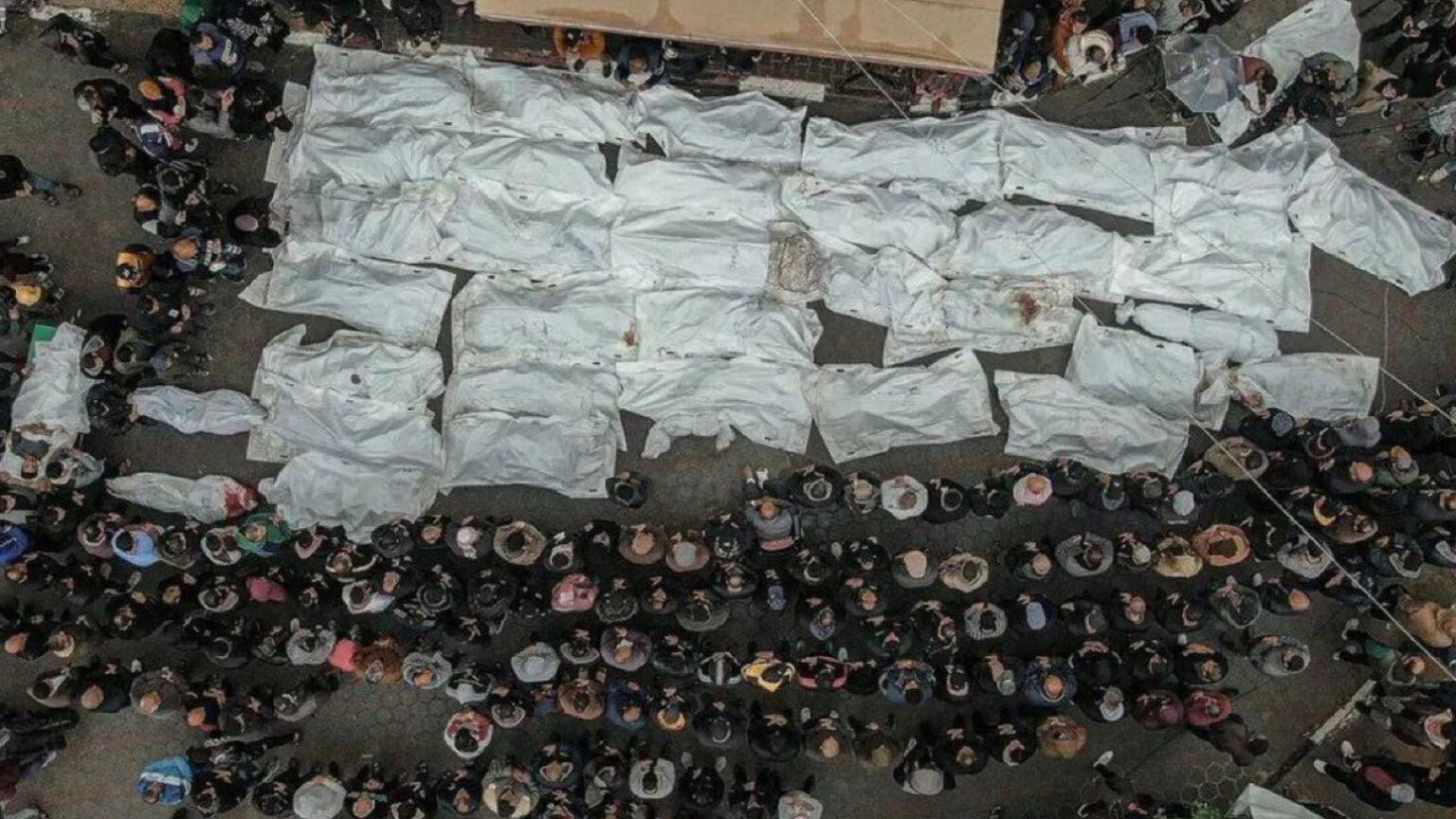
Palestinians perform funeral of victims of massacre in Rafah (Photo via Quds News Network/X)
Israel has intensified its attacks on Rafah in complete violation of the interim order of International Court of Justice (ICJ) on Friday, asking it to stop all attacks inside Rafah and open the border for greater humanitarian aid
At least 40 people, mostly women and children, were killed and scores of others were injured when Israel bombed a tent camp for displaced Palestinians in Rafah late in the evening on Sunday, May 26.
The tent camp in Tal al-Sultan was recently built by UNRWA to shelter the Palestinians forced to move by Israeli forces from other parts of Rafah, and was a designated “safe zone,” Wafa News Agency reported.
At least eight Israeli missiles struck the camp in the late evening, when most were sleeping in the tents, causing a massive fire. According to the Palestinian Red Crescent Society (PRCS) hospitals in the region were already overcrowded and were in no position to handle all the injured in the attack.
Videos and visuals of tents burning and people desperately trying to locate their loved ones in the chaos circulated on social media, along with a ghastly video of a headless body of a child, which volunteers pulled from the rubble.
The attack sparked worldwide condemnation, with even close allies such as France asking Israel to stop the attacks on Rafah.
Several Arab countries demanded immediate UN Security Council intervention to stop the Israeli genocide of Palestinians.
Chris Gunness, spokesperson of UNRWA told Al Jazeera that, “we are now seeing blatant disregard for the genocide convention. There is no exception to the Genocide convention. There are no excuses. This is a crime of crimes.”
Jeremy Cornyn wrote on X, “Palestinian children should wake up feeling excited to go to school and play with their friends. Instead, for those murdered in Rafah, their last moments on this earth were filled with unimaginable fear as bombs rained down on their tents. What a monstrous failure of humanity.
Ever since the beginning of the month, Israel has increased its attacks on Rafah, ignoring all the warnings and appeals made by the world community. It had ordered the evacuation of several eastern parts of Rafah, forcing nearly 800,000 Palestinians to relocate to new areas near the coast which do not even have basic facilities.
Four days ago @IDF told Palestinians in Rafah to move to an area it calls “Block 2371,” designating it a “safe area.” This is the area “Israel” just bombed REFUGEE TENTS, carrying out a massacre. pic.twitter.com/SvxJWEpchE
After claiming that the attack on Rafah was a response to Hamas’ attack, Israel termed it “very grave” and announced it has constituted an investigation in the attack on Tal al-Sultan in Rafah.
More than 36,000 Palestinians, mostly women and children, have been killed by Israel in the 233 days of the war. The Israeli war has also injured over 81,000 other Palestinians so far. At least 160 Palestinians were killed in Israeli bombings in different other parts of Gaza on Sunday alone.
ICJ asks Israel to cease attacks, open Rafah borders
Sunday’s attack was part of its increased assault on Rafah, particularly since the International Court of Justice (ICJ), as a provisional measure, asked Israel to stop such an attack on Friday. According to the Euro-Med Human Rights Monitor, Israel has struck Rafah at least 60 times since the ICJ order.
The ICJ, in its interim order, had asked Israel to stop its attacks and open the border crossing with Egypt, which has been shut by it since May 7, hampering the flow of humanitarian aid in the war ravaged region.
The ICJ issued a provisional measure asking Israel to comply with the Genocide Convention and “immediately halt its military offensive and any other action in Rafah governorate which may inflict upon the Palestinian group in Gaza conditions of life that would bring about its physical destruction in whole and in part.”
The decision was backed by 13 out of the 15 judges in the ICJ.
The court also asked Israel to submit a report on the measures taken to implement the order within a month.
The court was not convinced that Israel has taken enough measures to “enhance the security of civilians in the Gaza strip, and in particular those recently displaced from Rafah” as claimed by Israeli counsel during the hearing on the request made by South Africa in the court.
The provisional measures were granted in response to South Africa’s request made on May 10 under its original petition seeking action against Israel for its violations of Genocide Convention during the ongoing war in Gaza.
This was the third interim measure ordered by the ICJ since South Africa filed the petition in December. The Court issued an interim order in January asking Israel to take measures to prevent genocide in Gaza and increase aid delivery. A similar order was passed in March as well.
Rafah is a narrow region in the southernmost tip of Gaza. Its population density has drastically increased, as it now shelters nearly 1.4 million people, over half of the total population of Gaza. Most of these people have been forcibly displaced by Israeli airstrikes and ground offensives in other parts of Gaza since the beginning of the genocidal war in October of last year.
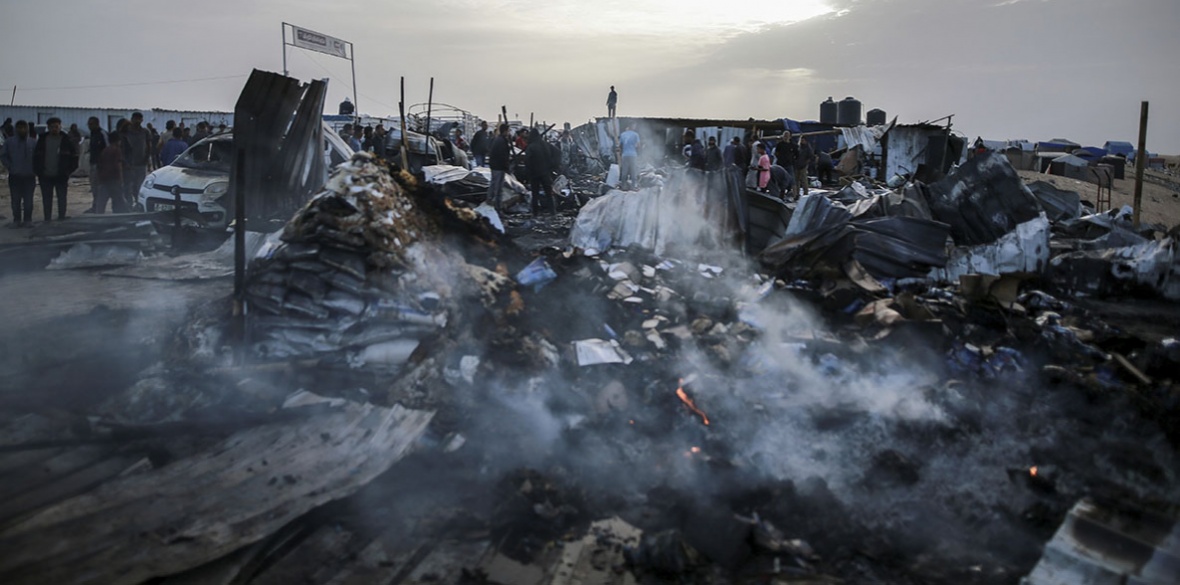
Palestinians look at the destruction after an Israeli strike where displaced people were staying in Rafah, Gaza Strip, May 27, 2024
ISRAEL faced fresh condemnation today for strikes on the southern Gaza city of Rafah that local health officials said had killed at least 45 Palestinians, including displaced people living in tents that were engulfed by fire.
The country has provoked a growing storm of international condemnation over its military action in the now devastated coastal strip, with even close allies expressing outrage at civilian deaths.
Israel is seeking to wipe out Islamist resistance group Hamas, but, showing that it’s far from beaten, the resistance group launched a barrage of rockets on Sunday from the city towards central Israel, causing no injuries.
Tel Aviv said today it was looking into the civilian deaths in Rafah after its forces struck a Hamas installation and killed two senior militants.
Sunday night’s attack, which appeared to be one of the deadliest since the start of the current violence, helped push the overall Palestinian death toll above 36,000, according to the Gaza Health Ministry.
“We pulled out people who were in an unbearable state,” said Mohammed Abuassa, who rushed to the scene in the north-western district of Tel al-Sultan. “We pulled out children who were in pieces. We pulled out young and elderly people. The fire in the camp was unreal.”