Oceans without sharks would be far less healthy – new research
Spread the love

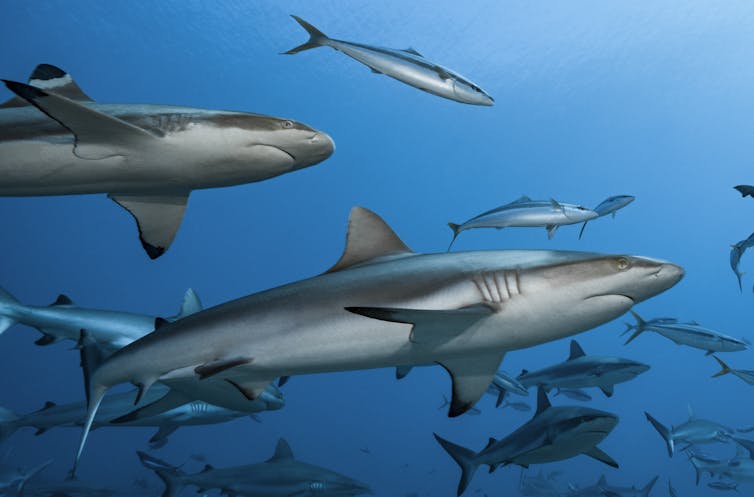
Gray reef sharks and blacktip reef sharks near Tahiti, French Polynesia. Alexis Rosenfeld/Getty Images

Michael Heithaus, Florida International University

There are more than 500 species of sharks in the world’s oceans, from the 7-inch dwarf lantern shark to whale sharks that can grow to over 35 feet long. They’re found from polar waters to the equator, at the water’s surface and miles deep, in the open ocean, along coasts and even in some coastal rivers.

With such diversity, it’s no surprise that sharks serve many ecological functions. For example, the largest individuals of some big predatory species, such as tiger and white sharks, can have an oversized role in maintaining balances among species. They do this by feeding on prey and sometimes by just being present and scary enough that prey species change their habits and locations.

In a newly published study, colleagues and I surveyed decades of research on sharks’ ecological roles and considered their future in oceans dominated by people. We found that because sharks play such diverse and sometimes important functions in maintaining healthy oceans, their current decline is an urgent problem. Since 1970, global populations of sharks and rays have decreased by more than 70%.

People are killing many types of sharks at unsustainable rates, mainly through overfishing. We see a need for nations to rethink where and how to conserve sharks for healthy oceans. https://www.youtube.com/embed/rB4zSDv3oSk?wmode=transparent&start=0 Sharks and rays are overfished as food sources and for oils produced in their livers. Fishing has extended into ever-deeper waters, where many little-studied species live.

How sharks foster seagrasses

Along the remote coast of Western Australia, more than two decades of work shows that the mere presence of tiger sharks shapes the entire seagrass ecosystem by changing where and how big grazers, such as sea turtles and sea cows, feed.

Having tiger sharks nearby protects wide swaths of seagrass from being overgrazed, allowing it to grow into thick underwater meadows that provide habitat for juvenile fish and shellfish. These species are important food for other animals and for humans.

A thick carpet of seagrass underwater with light shining down from the surface.
A healthy seagrass bed in Shark Bay, Western Australia, protected from overgrazing by the presence of tiger sharks. Michael Heithaus, CC BY-ND
A sandy bottom with sparse tufts of seagrass
This seagrass bed in Australia’s Shark Bay is in an area with few sharks. It has been heavily grazed and offers little cover for fish or other species. Michael Heithaus, CC BY-ND

In places where tiger sharks have declined and turtle populations have expanded, seagrasses are being overgrazed. In Bermuda, for example, the exploding turtle population has led to an almost total collapse of seagrasses.

White sharks produce some of the same effects. Along the California coast, where white shark numbers are increasing, otters are spending more time in the safety of protected inland waters and less time in the open waters of Monterey Bay. The otters prey on crabs, which in turn feed on grazing invertebrates such as sea slugs that clean algae from seagrasses. More otters means fewer crabs, more grazers and healthier seagrasses.

Kelp forests and reefs

Kelp forests are dense stands of large brown algae that grow in shallow zones near coasts. Along the U.S. West Coast, overhunting drove local populations of sea otters to extinction by the early 1900s. This caused huge kelp forest losses by allowing sea urchins – a favorite food of otters – to spread and consume kelp.

Over the past 50 years, otter populations have rebounded with federal protection. But as white sharks expand their ranges northward, they are preventing otters from expanding their range because there aren’t kelp forests for the otters to hide in.

The otters will likely expand their ranges only once kelp forests become established. This complicates restoration efforts, since otters won’t be removing enough urchins for kelp to become established.

When sharks are present near coral reefs, fish avoid the sharks by sticking close to the safety of the reef. This reduces grazing on seagrasses and algae across wide areas. There is still much to learn, however, about when, where and how sharks might be important for coral reef health.

Food and nutrient sources

Sharks can also be prey. Some, including large species like white sharks, are important food sources for some killer whale populations around the world. Smaller sharks, including blacktip sharks, can be key menu items for larger sharks, such as great hammerheads.

As sharks consume prey in one place and excrete waste elsewhere, they move nutrients throughout the ocean. In the Pacific, for example, gray reef sharks move nitrogen from the offshore waters where they feed to the coral reefs where they spend their days, providing important fertilizer for ocean food webs.

In Florida’s coastal waters, young bull sharks feed during brief visits to the ocean, then return to safer, nearly freshwater rivers, where they spend most of their time and release nutrients in their waste.

Sometimes sharks’ presence helps other fish. In the open ocean, sharks’ rough scales make perfect scratching posts for fish to remove parasites.

Protecting sharks’ roles

Our review makes clear that sharks play diverse roles in maintaining healthy oceans. We see important implications for shark conservation.

Step 1 would be to set goals beyond simply ensuring that there are sharks in the oceans and to target species that have key ecological roles.

Within populations, it is important to protect certain types of individual sharks. For example, the largest tiger sharks are the ones that shape the behavior of turtles and sea cows, benefiting seagrass ecosystems. Intensive fishing worldwide makes it extremely challenging for large sharks that can live for decades or even centuries to survive and grow to ecologically important sizes.

Working with local communities in coastal areas could build support for protecting these large ocean predators, much as conservationists are working on land to protect iconic predators such as wolves. Nations could build networks of large protected areas that forbid shark fishing, focusing on key areas where individual sharks may roam. https://www.youtube.com/embed/8cQK9b6RAxo?wmode=transparent&start=4 Redesigning fishing gear to target desired species and reduce catch of sharks and other nontarget species can make fishing more sustainable.

Research shows that sharks benefit from creating protected areas, limiting shark catch outside these zones and restricting use of fishing gear that does the most harm to sharks, such as gill nets and longlines. With a clearer understanding of sharks’ ecological value, my colleagues and I hope to see focused action at all levels to protect these essential animals.

Michael Heithaus, Executive Dean of the College of Arts, Sciences & Education and Professor of Biological Sciences, Florida International University

This article is republished from The Conversation under a Creative Commons license. Read the original article.
Continue ReadingOceans without sharks would be far less healthy – new research

Earth has just ended a 13-month streak of record heat – here’s what to expect next

Spread the love

Christopher Merchant, University of Reading

A 13-month streak of record-breaking global warmth has ended.

From June 2023 until June 2024, air and ocean surface water temperatures averaged a quarter of a degree Celsius higher than records set only a few years previously. Air temperatures in July 2024 were slightly cooler than the previous July (0.04°C, the narrowest of margins) according to the EU’s Copernicus Climate Change Service.

July 2023 was in turn 0.28°C warmer than the previous record-hot July in 2019, so the remarkable jump in temperature during the past year has yet to ease off completely. The warmest global air temperature recorded was in December 2023, at 1.78°C above the pre-industrial average temperature for December – and 0.31°C warmer than the previous record.

Global warming has consistently toppled records for warm global average temperatures in recent decades, but breaking them by as much as a quarter of a degree for several months is not common. The end of this streak does not diminish the mounting threat of climate change.

So what caused these record temperatures? Several factors came together, but the biggest and most important is climate change, largely caused by burning fossil fuels.

What caused the heat streak

Temperatures typical of Earth 150 years ago are used for comparison to measure modern global warming. The reference period, 1850–1900, was before most greenhouse gases associated with global industrialisation – which increase the heat present in Earth’s ocean and atmosphere – had been emitted.

July 2024 was 1.48°C warmer than a typical pre-industrial July, of which about 1.3°C is attributable to the general trend of global warming over the intervening decades. This trend will continue to raise temperatures until humanity stabilises the climate by keeping fossil fuels in the ground where they belong.

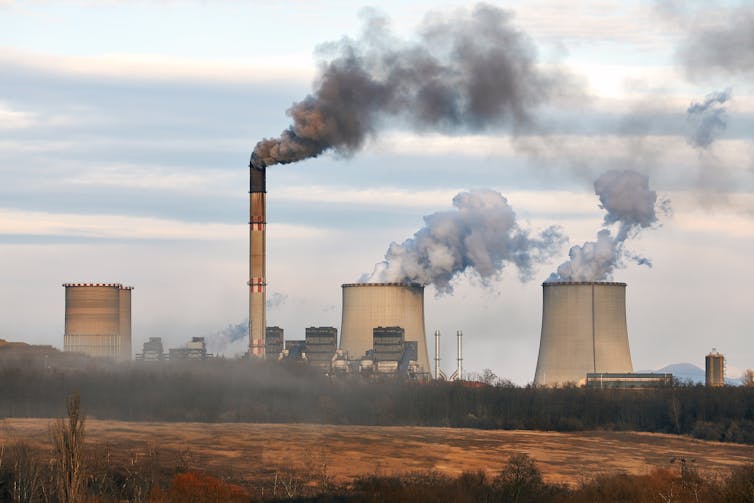
A power plant emitting dark smoke.
Coal, oil and gas are the main culprits of climate change. Peter Gudella/Shutterstock

But global warming doesn’t happen in a smooth progression. Like UK house prices, the general trend is up, but there are ups and downs along the way.

Behind much of the ups and downs is the El Niño phenomenon. An El Niño event is a reorganisation of the water across the vast reaches of the Pacific Ocean. El Niño is so important to the workings of worldwide weather as it increases the temperature of the air on average across all of Earth’s surface, not only over the Pacific. Between El Niño events, conditions may be neutral or in an opposite state called La Niña that tends to cool global temperatures. The oscillation between these extremes is irregular, and El Niño conditions tend to recur after three to seven years.

The warm El Niño phase of this cycle began to kick in a year ago, reached its peak around the end of 2023 and is now trending neutral, which is why the record-breaking streak has ended.

The 2023/2024 El Niño was strong, but it wasn’t super-strong. It doesn’t fully explain the remarkable degree to which the past year broke temperature records. The exact influence of other factors has yet to be fully untangled.

We know there is a small positive contribution from the Sun, which is in a phase of its 11-year sunspot cycle in which it radiates fractionally more energy to the Earth.

Methane (also a byproduct of the fossil fuel industry, alongside cattle and wetlands) is another important greenhouse gas and its concentration in the air has risen more rapidly in the past decade than over the previous decade.

Scientists are also assessing how much measures to clean up air pollution might be adding to warming, since certain particulate air pollutants can reflect sunlight and influence the formation of clouds.

A temperature ratchet

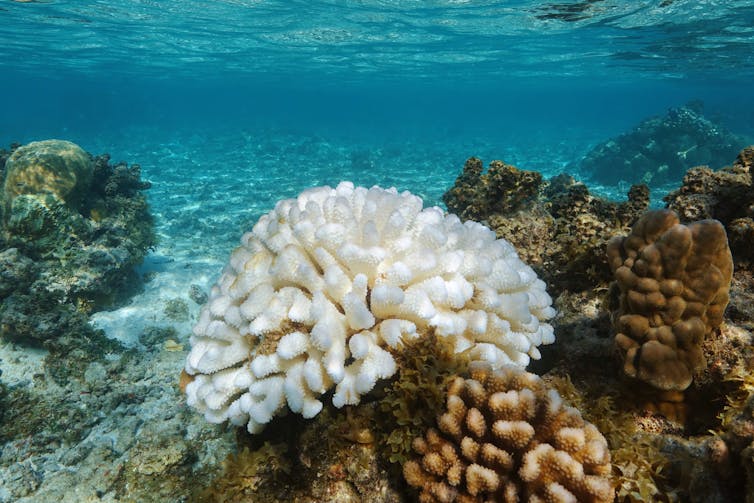
Across the global ocean, 2023 was a devastating summer for coral reefs and surrounding ecosystems in the Caribbean and beyond. This was followed by heavy bleaching across the Great Barrier Reef off Australia during the southern hemisphere summer. While it is El Niño years that tend to see mass mortality events on reefs around the world, it is the underlying climate change trend that is the long-term threat, as corals are struggling to adapt to rising temperature extremes.

A multi-lobed tropical hard coral bleached white.
Corals stressed by hot water eject nourishing algae and can die without swift relief. Damsea/Shutterstock

As the Pacific Ocean is now likely to revert towards La Niña conditions, global temperatures will continue to ease back, but probably not to the levels seen prior to 2023/24.

El Niño acts a bit like a ratchet on global warming. A big El Niño event breaks new records and establishes a new, higher norm for global temperatures. That new normal reflects the underlying global warming trend.

A plausible scenario is that global temperatures will fluctuate near the 1.4°C level for several years, until the next big El Niño event pushes the world above 1.5°C of warming, perhaps in the early 2030s.

The Paris agreement on climate change committed the world to make every effort to limit global warming to 1.5°C, because the impacts of climate change are expected to accelerate beyond that level.

The good news is that the shift away from fossil fuels has started in sectors such as electricity generation, where renewable energy meets a growing share of rising demand. But the transition is not happening fast enough, by a large margin. Meeting climate targets is not compatible with fully exploiting existing fossil-fuel infrastructure, yet new investment in oil rigs and gas fields continues.

Headlines about record breaking global temperatures will probably return. But they need not do so forever. There are many options for accelerating the transition to a decarbonised economy, and it is increasingly urgent that these are pursued.


Imagine weekly climate newsletter

Don’t have time to read about climate change as much as you’d like?
Get our award-winning weekly roundup in your inbox instead. Every Wednesday, The Conversation’s environment editor writes Imagine, a short email that goes a little deeper into just one climate issue. Join the 35,000+ readers who’ve subscribed so far.


Christopher Merchant, Professor of Ocean and Earth Observation, University of Reading

This article is republished from The Conversation under a Creative Commons license. Read the original article.

Continue ReadingEarth has just ended a 13-month streak of record heat – here’s what to expect next

After a streak of record-breaking global temperatures, the climate is on a knife-edge

Spread the love

Jack Marley, The Conversation

For 13 consecutive months, global average air and ocean temperatures were probably the hottest they have been in human history.

This streak of extraordinary heat ended last month, the EU’s Copernicus Climate Change Service reported, as July 2024 was only the second hottest ever recorded – 0.04°C cooler than a record set the previous July.

In its wake are thousands of heat-related deaths, ailing ecosystems and a planet firmly on the precipice of a profoundly altered climate.


Imagine weekly climate newsletter

This roundup of The Conversation’s climate coverage comes from our award-winning weekly climate action newsletter. Every Wednesday, The Conversation’s environment editor writes Imagine, a short email that goes a little deeper into just one climate issue. Join the 35,000+ readers who’ve subscribed.


“Global warming has consistently toppled records for warm global average temperatures in recent decades, but breaking them by as much as a quarter of a degree for several months is not common,” says Christopher Merchant, a professor of ocean and Earth observation at the University of Reading.

Air temperatures peaked in December 2023, when the Earth was 1.78°C hotter than the pre-industrial average for that time of year. Buoy-based sensors confirmed that the ocean was also record-warm at the time.

So what caused this stretch of unusually high temperatures on land and at sea?

“Several factors came together,” Merchant says. “But the biggest and most important is climate change, largely caused by burning fossil fuels.”

Big Oil and the little boy

When scientists refer to Earth’s pre-industrial temperature, they typically mean a global average taken between 1850 and 1900. Factories and power plants still existed in the second half of the 19th century, especially in Europe and North America, but the vast majority of greenhouse gas emissions generated by human activity had yet to be emitted. What’s more, meteorologists have a fairly good temperature record for this period with which to compare modern warming.

What this comparison tells us is that July 2024 was 1.48°C warmer than a typical July before the mass burning of coal, oil and gas, Merchant says. Roughly 1.3°C of that is directly attributable to global heating caused by these fossil emissions and land-use changes (deforestation, livestock farming) over the intervening decades.

The remainder, which caused the sudden temperature spike beginning in June 2023, was largely the result of a natural cycle in the climate known as El Niño.

“An El Niño event is a reorganisation of the water across the vast reaches of the Pacific Ocean. El Niño is so important to the workings of worldwide weather as it increases the temperature of the air on average across all of Earth’s surface, not only over the Pacific,” Merchant explains.

El Niño has ended, and with it, the run of record global average temperatures. Merchant expects temperatures to ease back slightly, but says there is no going back to the pre-2023 norm.

“A plausible scenario is that global temperatures will fluctuate near the 1.4°C level for several years, until the next big El Niño event pushes the world above 1.5°C of warming, perhaps in the early 2030s,” he says.

Over? Shoot!

Since the 2015 Paris agreement, the political consensus on climate change has been to strive to limit warming to 1.5°C. A slew of catastrophic and potentially irreversible changes to the systems that keep Earth habitable are more likely to occur once this long-term average has been crossed.

It’s possible that this process has already started for one system in particular: tropical coral reefs. Earth’s largest, the Great Barrier Reef off Australia, has suffered five mass bleaching events in the past nine summers and recently endured its worst heat in at least 400 years.

The new plan, if one exists among the world’s governments (approving new oil and gas production is still a normal feature of governing), would seem to accept the 1.5°C target being breached at least temporarily.

“The question is, how do we manage this period of ‘overshoot’ and bring temperatures back down?” asks Jonathan Symons, a lecturer in international relations at Macquarie University.

In autumn last year, a commission mainly composed of former government ministers from several countries published a report on the implications of overshooting 1.5°C. The report argued that high-emitters like Australia should now aim for “net-negative emissions” and begin urgently removing carbon from the air – by restoring habitats and deploying carbon capture and storage technology.

Symons summed up their reservations with both:

“The commission worries many carbon removal approaches are phoney, impermanent or have adverse social and environmental impacts.”

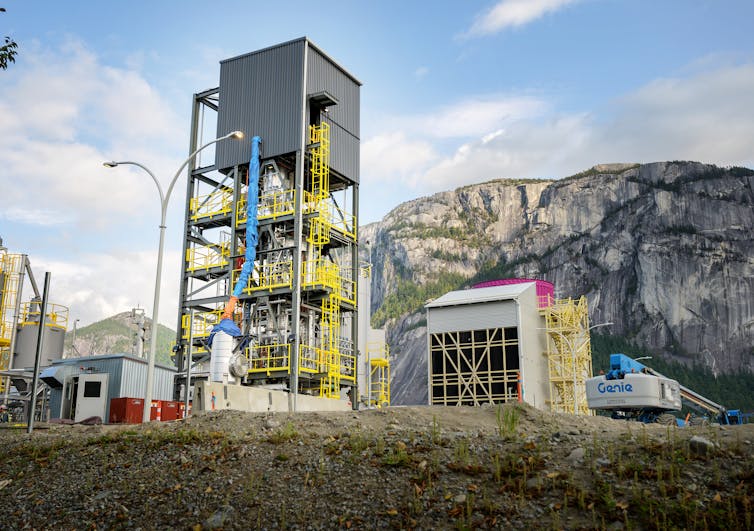
A tall metal structure within an industrial scene.
A direct air capture plant in British Columbia, Canada. David Buzzard/Shutterstock

One drastic option the Climate Overshoot Commission ruled out was “solar radiation management”: reflecting some of the Sun’s heat and light back to space by injecting reflective particles into the atmosphere, among other techniques. Academics continue to debate whether this is now an unpleasant necessity or more reckless vandalism of the atmosphere.

In lieu of a radical change of course, present global climate policy could breach the 1.5°C target by a degree Celsius or more according to an analysis published in Nature Climate Change on Monday.

The world seems to be delaying the end of fossil fuels, gambling that nature will hold its breath. Research has so far condemned this wishful thinking: computer models predict “waves of extinctions” and ecological damage spanning centuries from even a brief sojourn at 2°C.

Jack Marley, Environment + Energy Editor, The Conversation

This article is republished from The Conversation under a Creative Commons license. Read the original article.
Continue ReadingAfter a streak of record-breaking global temperatures, the climate is on a knife-edge