A proposed security bill in the Italian parliament aims to criminalize activism and penalize acts of solidarity
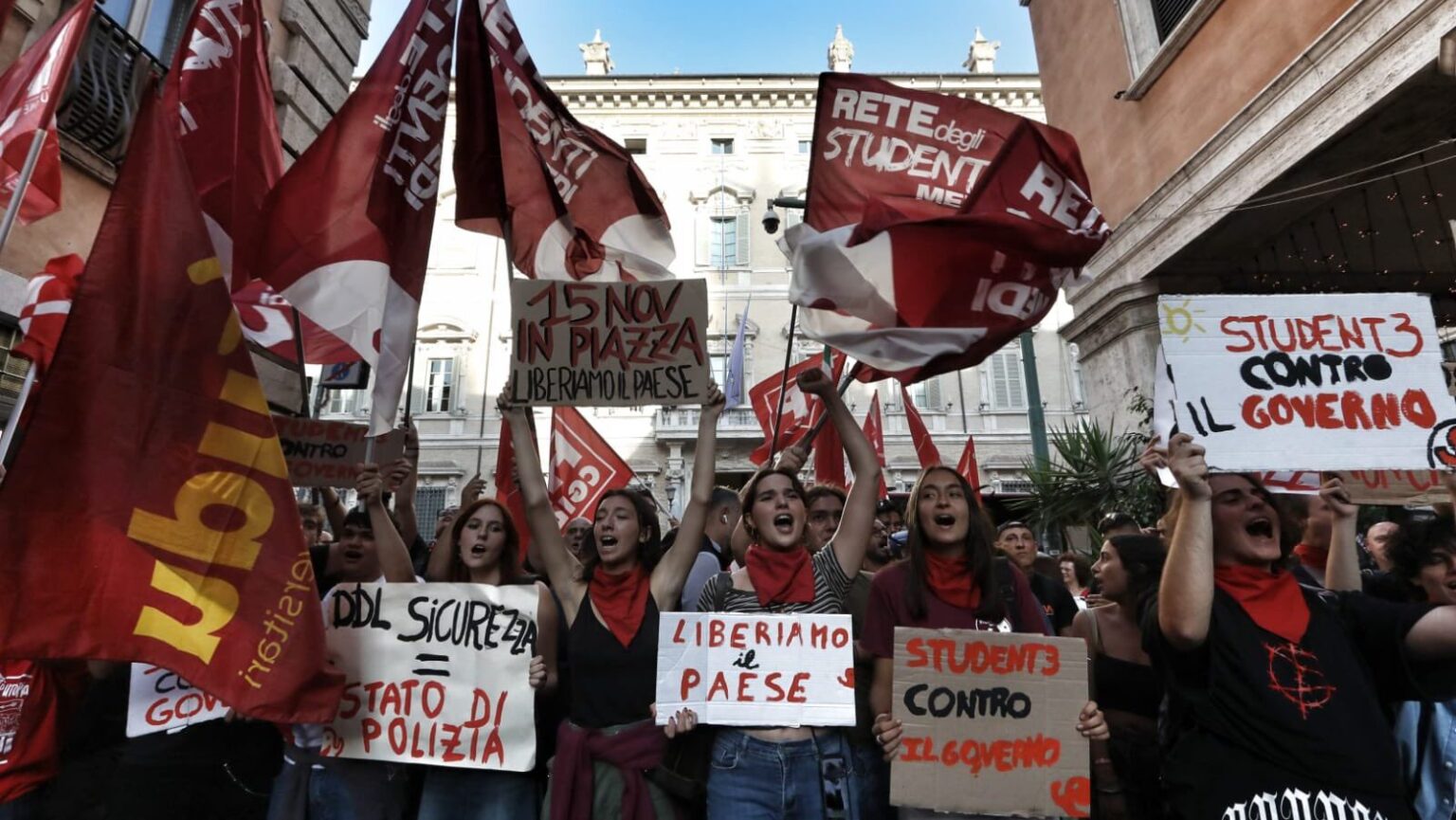
Giorgia Meloni’s government is on a rampage against popular dissent with a new bill under discussion in the Italian parliament. The proposed legislation seeks to penalize solidarity and criminalize activism, with the working class, migrants, and climate activists particularly at risk. In recent days, widespread protests have erupted, with trade unions, anti-fascist networks, and student groups all vowing to resist Meloni’s plans.
Giuliano Granato, a member of the left political party Power to the People (Potere al Popolo), criticized the bill’s framing as security legislation. He argued that it should instead be called the “Repression Bill” because “it responds to the country’s social needs only with more imprisonment and crime.”
“The government is saying that dissent and dispute are crimes in this country,” Granato added. “We believe they are the essence of democracy, and every achievement made over the decades is thanks to the struggles of the working classes.”
One of the bill’s most significant provisions is a crackdown on activists who block roads or railways during protests. Initially seen as targeting climate activists known for these tactics, the left has warned that it will also affect workers’ struggles. Granato pointed out that workers have also used such methods to protest, including during industrial action at Whirlpool factories over the last years.
Italy’s largest trade unions have echoed these concerns. The Italian General Confederation of Labor (CGIL) criticized the bill, arguing it represents an attack on trade union mobilizations aimed at protecting jobs and addressing company crises. In a joint statement with ANPI, the national anti-fascist network, the CGIL wrote: “The right wing continues to regard security only in terms of repression and punishment of social struggles.” Both organizations were at the forefront of protests held in several Italian cities on Wednesday, September 25.
The bill’s impact would extend beyond activists and workers, with prisoners facing harsh consequences. It proposes penalties for peaceful protests in prisons, such as sit-ins. Furthermore, limited protections currently granted to specific groups, like pregnant women or mothers of infants under one year of age, would be taken away. This would mean that babies would remain jailed with their mothers, despite only a handful of facilities being equipped to accommodate them. Legal and psychological experts have warned of the shocking impact this would have on children’s development even if capacities were expanded.
Migrants, the poor, and those showing solidarity with them are also at risk under the proposed law. Anti-eviction actions and those refusing to vacate spaces under threat of homelessness would be criminalized. Migrants without residence permits would be barred from legally obtaining SIM cards, their only connection to family and friends at home. Merchants who disobey this provision would face temporary closures.
While most describe the security bill as paving the way for a permanent police state, some groups might be looking forward to it. Approximately 300,000 police and security personnel would be granted the right to carry unofficial weapons in both private and public spaces – an idea that is likely to instill fear, rather than a sense of security, in the vast majority of the population.
Opposition to Meloni’s security bill is converging with ongoing resistance to her other policies, including the controversial differentiated autonomy reform. On Thursday, September 26, over 1 million signatures calling for a referendum against the reform were submitted by trade union and social movement leaders. These groups have vowed to remain in the streets, defending their right to protest and express dissent despite the government’s attempts to suppress them.
Pro-Palestinian protesters take part in a Palestine Solidarity Campaign demonstration as they march to the Labour Party conference venue on September 21, 2024 in Liverpool, England. [Ian Forsyth/Getty Images]
It’s difficult to comprehend the horrors of what’s happening in Gaza, Lebanon and beyond in the Middle East. The heartbreaking scenes of dirt-encrusted toddlers screaming as they’re pulled from the rubble of what was once their homes; the small children carrying plastic bags containing the remains of their slain siblings; the white-bandaged bodies of whole families laid out next to hospitals in their hundreds; the shaking youngsters trying to hide as Israeli soldiers fire indiscriminately at anything that moves. Surely, feeling a deep, painful empathy for the victims of such savagery, especially the children, is part of what gives us our humanity.
This isn’t the same for everyone, of course. Not for the perpetrators, who use their cutting-edge western-manufactured machines of death to extinguish these innocent lives. Nor, in most cases, for politicians here in Britain. For Prime Minister Keir Starmer, these scenes are even the set up for a joke.
During the new prime minister’s triumphant speech at this week’s Labour Party conference, a heckler dared to challenge the Dear Leader on his lack of empathy for Israel’s victims. After Starmer said that, “Every child, every person, deserves to be respected for the contribution they make,” Labour member Daniel Riley, 18, shouted in response: “Does that include the children of Gaza?”
“This guy’s obviously got a pass from the 2019 conference,” quipped the smug Starmer, in a reference to years when Labour was led by pro-Palestinian Jeremy Corbyn. The more sycophantic element of Starmer’s congregation, stronger than ever thanks to Sir Keir’s purges of the left, lapped up the jibe.
It’s become a cliché to respond to such things with variations of “imagine the response if Corbyn had said something like that about Israeli children,” but sometimes you can’t help but be stunned at the double standards. Corbyn would never have said such a thing, but if he had it would have been frontpage news; irrefutable proof of his alleged anti-Semitism.
But they weren’t Israeli children. They were Arabs. And in mainstream western discourse, they don’t count. They don’t suffer. They don’t have dreams. They’re abstract numbers, if that.
They’re just Arabs, unworthy of our empathy.
To really hammer home the hypocrisy, the words “genocide” and “apartheid” had already been banned from the Labour conference. The Palestine Solidarity Campaign was forced to remove both words from the title of its fringe meeting. Some activists responded by painting the words “genocide conference” on the windows of the venue.
In many ways, the Labour government, elected in July after 14 years in the wilderness, is an improvement on their Conservative predecessors regarding Palestine. But that’s a pretty low bar. Starmer may have banned his MPs from attending the huge protests against the war on Gaza, which often numbered hundreds of thousands of people, but he didn’t go as far as former home secretary Suella Braverman, who branded them “hate marches”.
Pro-Palestinian protesters campaign near Downing Street in London, UK, on Wednesday, July 24, 2024. [Betty Laura Zapata/Bloomberg via Getty Images]
And despite Labour’s top team repeating the mantra that “Israel has the right to defend itself” like a broken record whenever the issue comes up, it has at least (and belatedly) called for a ceasefire and the establishment of a Palestinian state (however problematic that demand in itself is).
The Labour government has also drawn the ire of Israel for dropping its opposition to the International Criminal Court’s bid for an arrest warrant against Benjamin Netanyahu. A further schism was seen when the UK resumed its £21 million funding to the Palestinian refugee agency, UNRWA. Again, it was a low bar.
Much has also been made of the new government’s decision to block arms sales to Israel (although this is limited to a pitiful eight per cent of exports). Unsurprisingly, the Palestine solidarity movement says it’s not enough. And so do the British public: in May, 55 per cent of the British public wanted arms sales to Israel to be suspended until the war against the Palestinians in Gaza ends.
Even less surprisingly, it was met with fury from Israel. Benjamin Netanyahu said that it was “sending a horrible message” to Hamas. Starmer responded to Netanyahu’s comment during an interview on LBC Radio over the conference period. “No, he’s not right about that,” he tried to reassure the audience. “We had to comply with international law and our domestic law in relation to that. I’ve always been clear, I support Israel’s right to self-defence, I’ve been robust about that… I’ve taken blows in relation to that – there’s no doubting that support – but it’s got to be done in accordance with international law.”
In other words, “I’m really sorry, and I’m not saying you’re committing war crimes, it’s just that it would be a bad look for a former lawyer to end up in The Hague.”
Foreign Secretary David Lammy was also questioned on LBC during the conference about why the other 92 per cent of arms sales to Israel had not been banned, including the export of parts for F-35 fighter jets, which Israel has used, among other things, to bomb heavily-populated refugee camps in Gaza. Lammy said that a full embargo would limit Israel’s ability to fight the Houthis in Yemen “and other proxies”.
“I think that would be a mistake,” he added. “It would lead to a wider war and an escalation that we here in the UK are committed to stopping, so I’m afraid I disagree with that position.”
In Lammy’s eyes, war is peace.
By coincidence, two of the arms companies currently selling their merchandise to Israel for use in Gaza were also at the conference. According to Private Eye magazine, BAE Systems, which makes parts for the F-35, hosted a high-profile meeting with defence secretary John Healey. A separate event, featuring armed forces minister Luke Pollard, was sponsored by US arms firm Northrop Grumman. Northrop Grumman makes parts for the F-35, the F-16 and the Apache helicopter. All are being used to massacre civilians in Israel’s war in Gaza and the wider region.
To ensure compliance with the Zionist narrative, Israeli politicians came to the conference themselves. Among them was opposition leader Yair Golan, who has said that Palestinians should “starve to death” until the hostages are released. He was granted audiences with several ministers, including Lammy, and attended a meeting hosted by Labour Friends of Israel.
Nevertheless, the conference did at least spark some hope for the Palestine cause, albeit inadvertently. During its opening weekend, 15,000 protesters gathered in Liverpool to send a message to Labour over its appalling support for the occupation state.
And that’s where the hope is. The Labour government won’t stand up to Israel’s devastating behaviour without pressure. If what we’ve seen already isn’t enough to make them change this attitude, I’m not sure what would. If Israel invaded London, Keir Starmer would probably still be trying to sell them the weapons to do it with.
Labour has pretty much always backed wars that align with the needs of the British and now US empires, from the First World War to Vietnam. It wants to preserve the British state, its crown and its interests, albeit in a way that slightly improves life for its working-class base. It’s currently in the interests of the British ruling class to cling to the coattails of the United States. The US, in turn, needs Israel as its outpost in the Middle East. This is all hardwired into Establishment politics.
Politicians who deviate from such norms, such as Corbyn, are vilified. That’s not how we do grown-up politics in this country, don’t you know?
Starmer is no radical. He’s not really much at all.
His main use was to seize back control of the Labour party from the left and return it to the hands of the Establishment. He did this by standing on a left-wing manifesto during his leadership election only to abandon it, ally himself with the right of the party and purge the left once he assumed the leadership.
His domestic agenda is hampered severely by his unwillingness to tax the rich to repair the devastation left by the Conservatives. Instead, he is removing winter fuel allowances from pensioners and maintaining benefit restrictions on anyone with more than two children. These, he keeps saying, are “tough choices”, even though they are the easiest choices for him, as he is so scared of upsetting the rich and powerful.
He’s desperate to be seen as an effective manager for the British state, which means maintaining the easy ride enjoyed by the wealthy and aligning himself with US-led geopolitical interests. Moreover, the British Establishment that Starmer works for is fully behind the US and its Middle Eastern proxy, Israel.
Just as a middle manager at a fast food company would enthusiastically and unquestioningly promote its unhealthy products, despite their harmful effects on consumers, Starmer is hardwired to enthusiastically and unquestioningly execute the will of the people with real power over Britain. That’s not the electorate.
Tales of children suffering in Gaza are as irrelevant to him as children suffering under his benefit restrictions in Britain. Elderly people freezing in makeshift shelters in Lebanon are as irrelevant to him as elderly people freezing in Britain because they can’t afford to pay their energy bills.
And all the while, Starmer enjoys the patronage of the powerful. His bewilderment at a recent outcry over major donations of cash, designer clothes and tickets to football matches and concerts to him and his top team reveals his belief that he should be reaping the rewards of his subservience as much as any effective manager.
The Labour party conference showed us a government that will continue to stand firmly behind Israel, no matter what the state does or the wider horrors it looks set to unleash. Mild reprimands aside, Labour under Starmer will not abandon the apartheid state without huge pressure.
That’s why real opposition to Israel’s crimes remains in the hands of those outside parliament who take to the streets, occupy their universities and speak up loudly in defence of Palestinians. The Labour leadership’s limited concessions to Palestinian rights would not have been made without that pressure from below. It’s only when actions like these begin to challenge Starmer’s tentative grip on power that he will be forced to offer any sort of meaningful opposition to Israel’s barbarism.
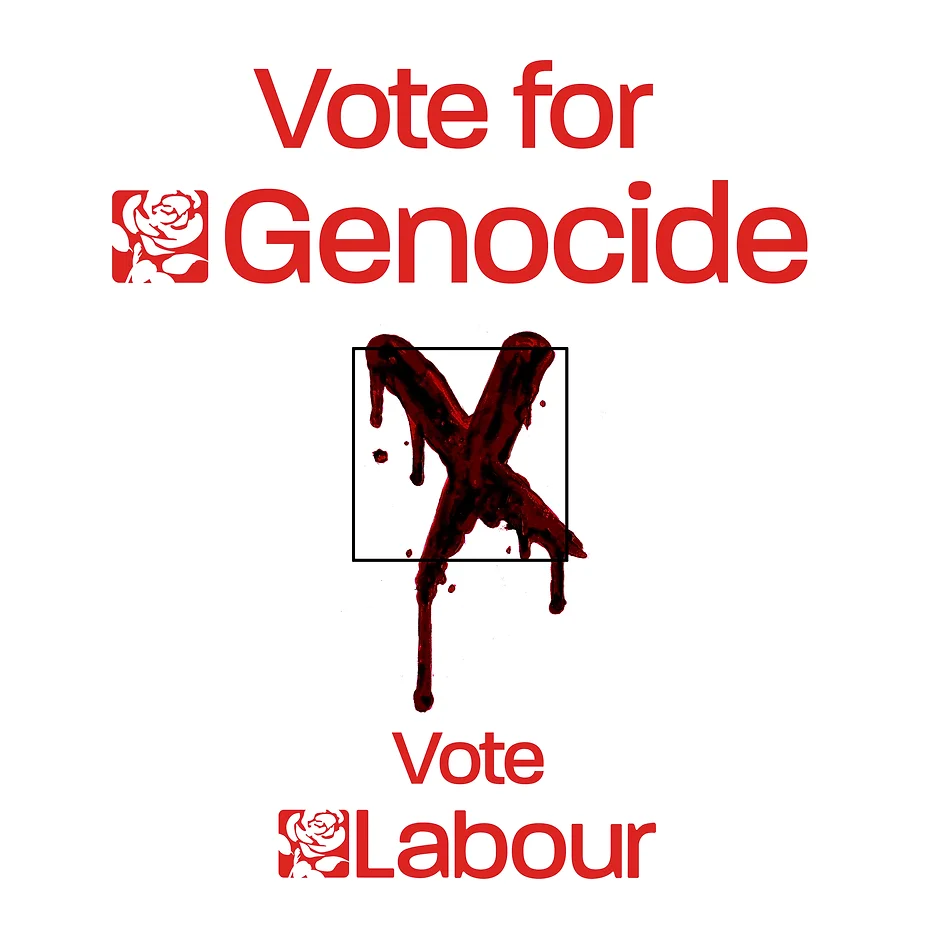
Zionist Keir Starmer is quoted “I support Zionism without qualification.” He’s asked whether that means that he supports Zionism under all circumstances, whatever Zionists do.Vote For Genocide Vote Labour.UK Foreign Secretary David Lammy says that UK is suspeding 30 of 350 arms licences to Israel. He also confirms the UK government’s support for Israel’s Gaza genocide.
New research from Ipsos assesses whether the public believes that the Prime Minister and MPs earn too much money, and how the public perceives the acceptability of gifts offered to the PM
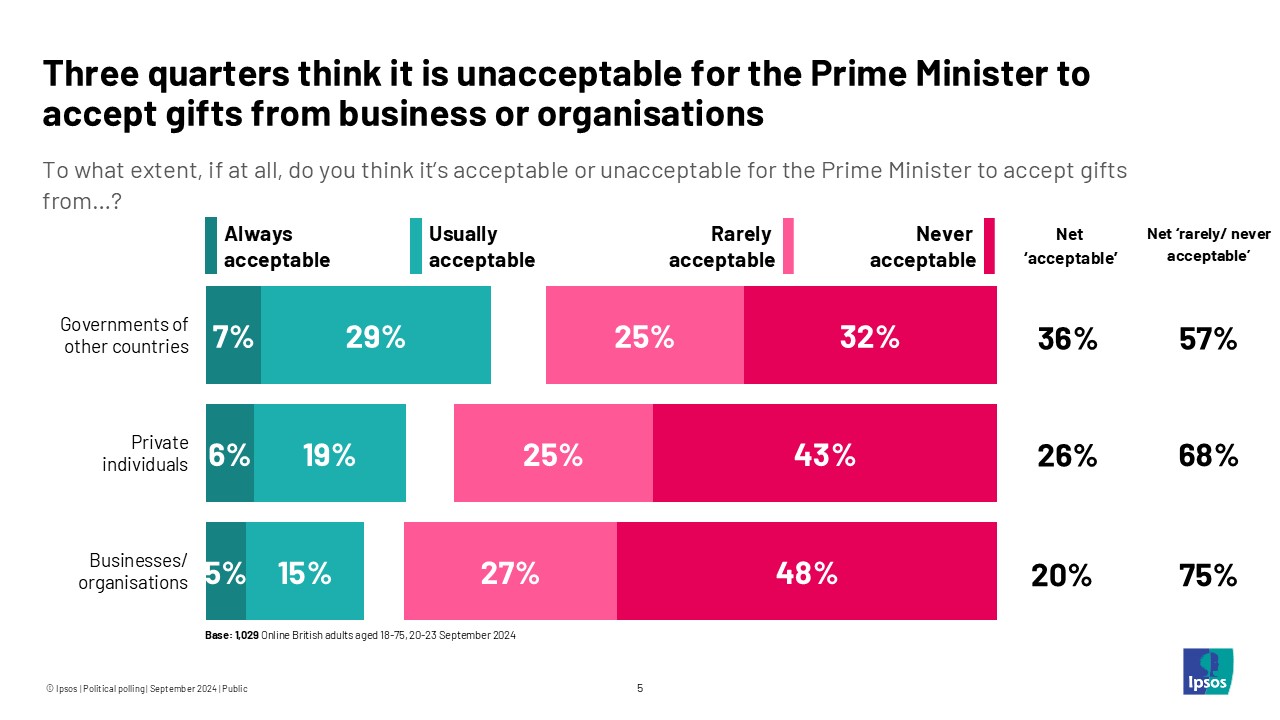
Three quarters (75%) of Britons say that it is rarely or never acceptable for the Prime Minister to accept gifts from businesses or organisations.
More than two-thirds say the same about accepting gifts from private individuals (68%).
New research from Ipsos, carried out 20-23 September, has assessed whether the public believes that the Prime Minister and Members of Parliament (MPs) earn too much money, and how the public perceives the acceptability of gifts offered to the Prime Minister.
…
[R]espondents were asked for their views on whether it is acceptable for the Prime Minister to accept gifts from a range of sources. Three quarters (75%) of Britons say that it is rarely or never acceptable for the Prime Minister to accept a gift from businesses or organisations. 68% say it rarely or never acceptable for the Prime Minister to accept gifts from private individuals, and 57% say the same regarding gifts from the governments of other countries (though 36% say this is usually or always acceptable). If we take out the proportion that say ‘rarely acceptable’ we find that 48% say it is ‘never acceptable’ to accept gifts from businesses / organisations, 43% say it is never acceptable to accept gifts from private individuals and 32% say it is never acceptable to accept gifts from governments of other countries.
We also know that the company behind it invest themselves in the worst of the worst. However, for a final sting in the tail, look no further than what this hedge fund does with some of the cash it makes.
Labour Party: £4m in slush funding…?
As openDemocracy revealed:
The Labour Party’s largest-ever donation came from a Cayman Islands-registered hedge fund with shares worth hundreds of millions of pounds in fossil fuels, private health firms, arms manufacturers and asset managers.
While the £4m donation by Quadrature Capital is the sixth-largest in British political history, it is noteworthy not just for its size, but also its timing.
Of course, no one should really be surprised that Keir Starmer’s Labour Party is accepting donations from hedge funds registered in tax havens. However, there were further revelations from openDemocracy. These include the fact that Quadrature had investments in fossil fuel, arms, and private healthcare companies.
However, the donation got its reward for Quadrature.
Interesting. Labour's new climate envoy Rachel Kyte is co-chair of climate advisory board of Quadrature Climate Foundation, linked to Quadrature hedge fund based in the Cayman Islands which invests in fossil fuel firms. Quadrature gave Labour £4m on 28 May, at the start of the…
dizzy: The on-the-take shower of sihts that currently govern us probably see nothing wrong with a rich offshore hedge fund buying a plump government role to promote it’s own interests. Years ago it was called corruption.
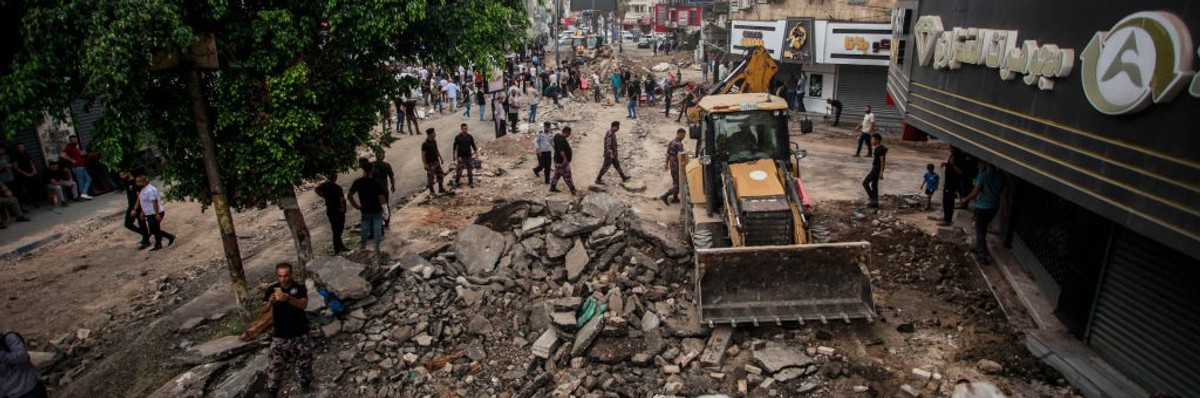
Palestinians walk around the damage in Jenin’s city center after an Israeli military raid in the occupied West Bank on September 6, 2024. (Photo: Nasser Ishtayeh/SOPA Images/LightRocket via Getty Images
“We watched their bulldozers tear up streets, demolish businesses, pharmacies, schools,” said one local leader. “They even bulldozed the town soccer field, and a tree in the middle of a road.”
As the world watched Israel’s assaults on Lebanon and the Gaza Strip, The New York Times on Wednesday also directed attention to the West Bank, detailing how “Israeli military bulldozers tore up mile after mile” of Jenin and Tulkarm in recent weeks.
While “nearly nightly raids” by the Israel Defense Forces (IDF) “have become the norm” in the West Bank since the Hamas-led October 7 attack, the military last month “launched one of its most extensive and deadliest raids” in the illegally occupied Palestinian territory in years, the newspaper reported, citing videos and interviews with residents.
“We watched their bulldozers tear up streets, demolish businesses, pharmacies, schools. They even bulldozed the town soccer field, and a tree in the middle of a road,” said Kamal Abu al-Rub, governor of Jenin. “What was the point of all of this?”
In addition to ground operations in the West Bank, the IDF has increased airstrikes that critics say run afoul of international law. The military defended the strikes and told the Times that in recent raids, troops found weapon stockpiles and killed or arrested dozens of militants—but also caused some “unavoidable harm to certain civilian structures.”
In response to videos included in the reporting, freelance journalist Pete Tucker accused Israeli soldiers of “methodically laying waste to” the West Bank.
Malini Ranganathan, an associate professor at American University’s School of International Service, said on social media that “Israel’s criminality knows no limits. IDF bulldozers have been obliterating the West Bank, even tearing up roundabouts.”
Israeli forces have damaged homes, shops, and roads along with internet, electricity, phone, water, and sewage lines in the West Bank. Emergency crews have been unable to respond to hundreds of calls per day, because they can’t reach people in need.
“They are imposing conditions, materially and psychologically, that make people feel: Gaza is coming to you,” Al Haq director Shawan Jabarin told the Times. “There is a feeling among Palestinians across the West Bank that what is coming is very bad—that it will be a plan to kill and expel us.”
Since the October 7 attack on Israel that killed more than 1,100 people, Israeli forces have slaughtered at least 41,455 Palestinians in Gaza and 716 in the West Bank. Across the Palestinian territories, over 100,000 others have been injured over the past year. The bloodshed led to an ongoing genocide case at the International Court of Justice (ICJ).
The ICJ in July issued a nonbinding advisory opinion that Israel’s decadeslong occupation of Gaza and the West Bank, including East Jerusalem, is illegal and must end “as rapidly as possible.” Instead, Israel has ramped up attacks on not only the Palestinian territories, but also Lebanon, home to the political and paramilitary group Hezbollah.
This week’s bombing campaign in Lebanon—which has killed at least 569 people—sparked fresh calls for the Biden administration to finally cut off weapons to Israel, as did the new reporting from the Times, which has been accused of pro-Israel bias in its coverage of the assault on Gaza.
Meanwhile, Israeli destruction in the West Bank continues. The International Middle East Media Centerreported that “on Wednesday, Israeli soldiers invaded the town of Beit Ula, west of Hebron in the occupied West Bank’s southern part, [and] bulldozed over 20 dunams of land, uprooting more than 600 fruit-bearing trees, and demolishing several agricultural structures and wells.”