People take part in a national demonstration for Gaza from Russell Square to Whitehall in London, June 8, 2024
SCOTLAND YARD has been urged to abandon plans to impose new orders that would seriously disrupt Saturday’s March for Palestine demonstration in London.
Palestine Solidarity Campaign (PSC), union leaders, MPs, peers and coalition partners expressed concern over the force severely restricting the protest in an open letter today.
The Met was accused of employing tactics “to deter people from attending” the 18th national peaceful demonstration against the Gaza genocide since last October.
…
On Monday, the Met was accused of refusing to participate in negotiations in a “transparent and accountable” way with the march’s organisers.
Signatories of PSC’s letter raised concerns over the eleventh-hour announcement that the Met wanted the march delayed by nearly two hours “without explanation or rationale” and its refusal to allow Pall Mall as an assembly point.
They added: “We worry that these kind of delays, and late challenges and conditions to the plans of what are entirely peaceful demonstrations, are forming a pattern.”
Introducing a wealth tax would indicate this is a progressive government. But that seems unlikely
Taking as his theme the need to “fix the foundations” after “14 years of rot” under Tory rule, new Labour prime minister Keir Starmer this week delivered a message that should bring discomfort to everyone in the months and perhaps years to come.
Those “14 years of rot” are of no surprise to voters; indeed, they helped ensure a landslide Labour victory in the election in July. But Starmer’s plans to resolve them appear likely to be far harsher than many voters expected.
The chancellor of the Exchequer, Rachel Reeve, has made numerous hints that hard times are ahead. Her October budget will be uncompromising in its commitment to raising revenue to help fill a fiscal hole reckoned to be around £20bn – but much of this money seems likely to be taken from the poorer sections of society, not the rich.
Labour will retain unpopular policies introduced by the Conservatives – the ‘bedroom tax’ and limiting child benefit allowances to the first two children, for example – while introducing its own cost-cutting measures, such as reducing the winter fuel allowances for many pensioners.
These actions contribute to a growing sense that the Starmer government will prove to be decidedly right-of-centre in a country beset with deep divisions of wealth and poverty. Some areas may see an improvement, such as labour rights, but even there, it is a matter of the devil in the detail.
One area where the government does apparently have cash to spash, though, is military spending, which is set to be substantially increased despite the manifest failures in Afghanistan, Iraq and Libya, and the deeply unpopular Israeli wars on Gaza and the West Bank.
Labour’s attitude to Israel is certainly unlikely to change, with the Department for Business and Trade reporting on efforts to strike a new trade deal with the country, saying: “Our teams will be entering negotiating rooms as soon as possible, laser-focused on creating new opportunities for UK firms.” An official from the British Embassy in Israel also recently wrote of the “tremendous opportunity for collaboration between Israeli and British companies”.
A full-scale Strategic Defence Review is also underway, and there are few if any indications that it will start by addressing the grievous failures of the past two decades. If previous experience is anything to go by, it will likely also omit the main challenge to international security: climate breakdown. Without that, the review will not be worth the paper it is written on. Net zero secretary Ed Miliband may be doing his best to maintain the idea of a green transition but the issue would be sidelined by any major increase in government spending.
On the domestic front, less than two months into the new Labour government the contrast between Food Bank Britain and the ludicrous levels of runaway wealth is apparent. It was coincidentally yet powerfully illustrated just four days before Starmer’s pre-budget speech, by a full-page property advertisement from Sotheby’s in the Financial Times.
Of the seven properties on sale, one was a relatively modest three-bedroom apartment in Chelsea, on sale for a mere £5m, while the others included a six-bedroom house in Belgravia offered at £18m and a nine-bedroom/five-bathroom place near Regent’s Park for £20m. Another Regent’s Park number was on sale for £25m million, which at least had 7 bathrooms for the 6 bedrooms. Trumping all was a triplex number in Knightsbridge – £50m with exclusive access to Hans Place Gardens.
While we have to wait for the October budget announcements, we can be reasonably sure that there will be some attempts to raise modest amounts from the wealthier sectors of society, possibly involving changes in capital gains and inheritance taxes. But the best indicator of a changed government would be one willing to bring in wealth taxes, especially those directed at the super-rich.
Onee of Britain’s largest trade unions, Unite, recently proposed a 1% per annum tax on those with net assets of over £4m, which would include property, shares and bank holdings but not mortgaged property. That is estimated to yield £25bn a year but would be bitterly opposed, with the Daily Mail informing us that: “Millionaires are looking to flee the UK in their droves to escape Labour’s tax raids – with a record number of wealthy Britons tipped to leave the country this year.”
As things stand, the budget is expected to include substantial cuts in public spending that could be at least partly avoided by such a wealth tax, and it is worth noting that some European countries such as Switzerland and Spain have already introduced them. At least Britain’s wealthy won’t be fleeing “in their droves” to those countries.
If adopted in October, in even a modest form, a wealth tax would be a reasonable marker for a progressive government. If not, then an opportunity will be missed for placing Labour in a more progressive place in the political spectrum than currently seems at all likely.
Keir Starmer confirms that he is continuing Tory policies and that he’s proud to be a red Tory.Keir Starmer says pensioners can freeze to death and poor children can starve and be condemned to failure and misery all their lives.
Starmer announces plan to stop the boats in May 2024 | Dan Kitwood/Getty Images
The UK immigration system is racist by design. The Border Security Bill will make it worse
Over the past few years of increasingly hostile migration policies, many in the migrant, including refugee, charity sector have looked to the dawn of a new government with eager anticipation. Surely, a Labour government would undo so many of these cruel anti-migration laws and mark a more ‘progressive’ chapter in migrant rights?
While the new government wasted little time in scrapping the infamous Rwanda Plan (and rightly so) it has diverted funds from that scheme into yet another anti-migrant policy in the form of the Border Security, Asylum and Immigration Bill. The announcement of this bill proves our caution was completely justified. It’s simply a continuation of the UK’s track record of enacting immigration policies that disproportionately impact people of colour.
We only have to look at the record of the last Labour government to see that they are no different to the Conservatives in embedding anti-migrant policies and rhetoric. Let’s not forget it was a Labour home secretary who first coined the term ‘hostile environment’ and it was New Labour that brought in the restrictive Immigration and Asylum Act 1999 and Nationality, Immigration and Asylum Act 2002, which laid the foundation for the hostile environment policies of the past 14 years.
In the past year itself, now-prime minister, Keir Starmer, has made plenty of not-so-subtle signs indicating what approach his government would take towards people seeking safety, including a promise to treat so-called ‘smugglers’ like “terrorists”.
Fast forward one year and these ideas have materialised in the form of the new Border Security Bill. The bill was announced as part of the King’s Speech and is part of a turn towards approaching migration through counter-terror, making space for even greater surveillance of and denial of rights for migrants, including refugees.
This dangerous bill would introduce powers previously been confined to alleged terror offenders, including travel bans and restrictions in the UK and abroad, restrictions on access to the internet and banking, and the ability to apply these measures before someone is even convicted of smuggling offences.
UK’s immigration policy has always been racist
Successive UK governments have essentially tried to ‘outdo’ each other when it comes to making the lives of migrants, including refugees, and racialised communities unbearable. In fact, these rafts of policies stem from a long history of targeting ‘unwelcome’ groups based on colonial constructions of the ‘threat’ and who are considered to be of ‘good character’.
In the Migrants’ Rights Network’s new Hostile Office report, we demonstrate that from the 1905 Aliens Act to the inhumane Migration Act 2023 (Illegal Migration Act), as well as the suffering of the Windrush victims and the government’s ability to deprive people of their citizenship, it should be evident to all of us that immigration laws are underpinned by a desire to limit the presence and freedom of racialised people in the UK.
Proposed powers in the new Border Security Bill would enable border force officers to search people and examine and seize their belongings, including copying data from and retaining people’s mobile phones, without a requirement for reasonable suspicion. It mirrors Schedule 7 of the Terrorism Act 2000, where someone can be arrested and convicted for refusing to hand over sensitive and personal information, including passcodes to devices, in addition to failing to answer all questions or refusing to provide biometric data – all without the need for reasonable suspicion.
However, implementing counter-terrorism policies into immigration is hardly surprising or new. It marks just another chapter of an increasingly cruel, racist and Islamophobic trajectory in the immigration system.
Take citizenship laws, for example. Deprivation of citizenship and counter-terror laws are linked: most cases of deprivation on ‘public good’ grounds have been justified using counter-terror legislation. We have been campaigning against the expansion of deprivation of citizenship powers and highlighting the racist, Islamophobic nature of them.
Since the 2003 ‘Hamza amendment’ to the British Nationality Act 1981 (an amendment that was passed specifically to deport one man, Abu Hamza, a naturalised British citizen), of those who have had their citizenship revoked since 2002, the majority of people affected have been British Muslims.
Our findings show that between 2002 and 2022, 85% of those stripped of their citizenship had, or were deemed to have, nationalities of countries in Africa, South Asia or West Asia (the Middle East) and 83% were from former British colonies. Of this, 41% were South Asian, all being Pakistani or Bangladeshi.
It is, therefore, not a huge leap to understand that the presence of counter-terror measures serves to limit the freedom, security and sense of belonging for racialised people in the UK, particularly those from a Muslim background.
Meanwhile, in December 2023, the Home Office published an Independent Review of Prevent’s report and the government’s response by William Shawcross (Independent Reviewer of Prevent) in which he recommended the Government explore extending Prevent into the immigration and asylum system. Make no mistake, linking the racist criminal (in)justice and counter-terror systems will further the harm and punishment to people seeking safety and a new life. It will do nothing to target the true roots of why people migrate and are forced to make dangerous border crossings.
The answer to a lack of safe routes is not further criminalisation through the introduction of counter-terror powers, which are often opaque and almost impossible to challenge. This lack of safe routes is why brokers exist, to capitalise on people’s desperation.
The Border Security Bill, and the counter-terrorism approach as part of a package deal, will just continue a long tradition of punishing people of colour at the UK border.
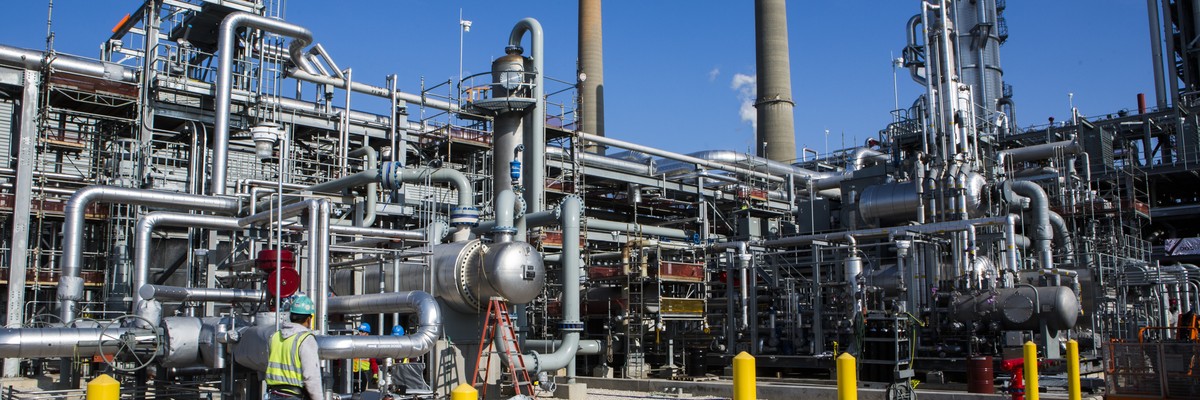
The Petra Nova Carbon Capture Project is seen on December 20, 2016 in Houston, Texas. (Photo: Marie D. De Jesus/Houston Chronicle via Getty Images)
“The fossil fuel industry delays climate action, distracts from real solutions that would end the fossil fuel era, and does everything in its power to squeeze the last drops of profit from a dying industry, at the expense of all of us.”
Among the world’s wealthiest countries, the U.S. leads the way in spending public money on so-called climate “solutions” that have been proven to “consistently fail, overspend, or underperform,” according to an analysis released Thursday by the research and advocacy group Oil Change International.
The group’s report, titled Funding Failure, focuses on international spending on carbon capture and fossil-based hydrogen subsidies, which continues despite ample data showing that the technological fixes have “failed to make a dent in carbon emissions” after 50 years of research and development.
The report details how five countries account for 95% of all carbon capture spending, with the U.S. investing the most taxpayer money in the technology, at $12 billion in subsidies over the last 40 years.
Norway comes in second with $6 billion going to carbon capture and storage, while Canada has spent $3.8 billion, the European Union has spent $3.6 billion, and the Netherlands has poured $2.6 billion into the technology, with which carbon dioxide emissions are compressed and utilized or stored underground.
“It is nothing short of a travesty that funds meant to combat climate change are instead bolstering the very industries driving it.”
Harjeet Singh, global engagement director for the Fossil Fuel Non-Proliferation Treaty Initiative, told The Guardian that the subsidies amount to a “colossal waste of money.”
“It is nothing short of a travesty that funds meant to combat climate change are instead bolstering the very industries driving it,” said Singh.
While proponents claim carbon capture and storage reduces planet-heating carbon emissions, OCI notes, it was originally developed in the 1970s “to enhance oil production, and this remains its primary use,” with the technology “barely” reducing emissions.
High-profile carbon capture failures in the U.S. include the Petra Nova project in Houston, Texas, which cost nearly $200 million in taxpayer funds and whose captured emissions were later used for crude oil production, and the FutureGen project, “which swallowed $200 million and never materialized.”
“Investing in carbon capture delays the transition to renewable energy,” reads OCI’s report. “Instead of wasting time and money on technologies that do not work, governments must commit to justly and urgently phasing out fossil fuels before it’s too late.”
Despite the lack of data supporting the use of carbon capture, the group said, countries including the U.S. are “preparing to waste hundreds of billions of taxpayer dollars on these ineffective technologies, further benefiting the fossil fuel industry.”
OCI highlighted how the U.S. and Canada, while ostensibly fighting the climate crisis, have spent a combined $4 billion in public money to explicitly “pay oil companies to produce more oil,” with the subsidies going to carbon capture for “enhanced oil recovery.”
The report also found that in addition to the $12 billion in taxpayer funds the U.S. has spent on carbon capture and fossil hydrogen—a leak-prone gas produced through energy-intensive processes that cause their own emissions—the government has spent an estimated $1.3 billion on the 45Q tax credit, which allows companies to write off tax for every ton of carbon dioxide they store underground.
The Inflation Reduction Act (IRA) increased the amount given to companies in 45Q tax credits from $35 to $60 per ton, meaning that the subsidy could grow to over $100 billion in the next 10 years.
OCI’s Policy Tracker shows that overall public spending on carbon capture and hydrogen could grow by between $115 billion and $240 billion in the coming decades.
“We need real climate action, not fossil fuel bailouts!” said OCI in a post on social media.
The group’s report also highlights that fossil fuel giants such as ExxonMobil have shifted from carbon capture skeptics to outspoken proponents of the technology—with the company bragging to investors that carbon capture and hydrogen would help its Low Carbon Business Unit make “hundreds of billions of dollars” and grow to be “larger than ExxonMobil’s base business.”
Exxon didn’t launch its carbon capture efforts until 2018, having spent several years and hundreds of millions of dollars on another “climate solution” that ultimately failed: the use of algae to make biofuels.
Since then, Exxon has “pushed for direct government funding for carbon capture, particularly at the U.S. Department of Energy (DOE),” successfully lobbying for $12 billion allocated in the Bipartisan Infrastructure Bill in 2021 for “carbon management research, development, and demonstration.”
Exxon also lobbied for the increased rate of the 45Q tax credit in the IRA and “played a ‘central role’ in drafting a 2019 DOE-sponsored report on carbon capture that determined Congress would need to create an incentive of around $90 to $110 per ton to support carbon capture deployment,” according to OCI.
The Guardian on Thursday reported that Exxon still “chases billions in U.S. subsidies for a ‘climate solution’ that helps drill more oil,” describing how the oil giant hosted an event at the Democratic National Convention earlier this month where senior climate strategy and technology director Vijay Swarup praised the IRA for helping Exxon pursue carbon capture and said: “We need new technology and we need policy to support that technology. We need governments working with private industry.”
Exxon’s enthusiasm for carbon capture, said OCI, is an example of how “the fossil fuel industry delays climate action, distracts from real solutions that would end the fossil fuel era, and does everything in its power to squeeze the last drops of profit from a dying industry, at the expense of all of us.”
A visit to a seabird colony in summer is an assault on the senses. First there’s the noise, then the overwhelming ammonia smell that stains the memory, and then the swirl of colour and activity on the white-washed cliffs.
When you’re standing hundreds of metres above the crashing sea, there can be hundreds or thousands of breeding seabirds in the air or on the sea below, or precariously perched on poorly made nests or ridiculously narrow ledges.
In these seabird cities you can spot tender moments, like an auk delicately turning its single egg for incubation while another feeds its oversized youngster. Brutality is never far either: a chick snatched to feed a bigger brood, an incoming parent robbed of its hard-won fish supper by a piratical gull, a dead bird bobbing face down on the sea.
All life is here in the seabird colony, and the British Isles is particularly rich.
This string of islands in the North Atlantic is home to nearly 30 species of seabird and hosts large portions of their total populations. Most of the world’s Manx shearwaters (90%), northern gannets (70%) and great skuas (60%) nest here, as do more than 20% of the European population of nine seabird species.
British people have a special responsibility to protect these birds that are a harbinger of ocean health, sitting as they do at the top of a delicate food chain.
Sadly, a new scientific assessment has reported alarming declines over the last 25 years in the UK’s seabird populations. Five new species have joined the “red List”, which denotes the highest category of conservation concern: Leach’s storm-petrels, common gulls, great black-backed gulls, Arctic terns and great skuas. These join the already listed kittiwakes, herring gulls, roseate terns, Arctic skuas and puffins, which are all highly threatened.
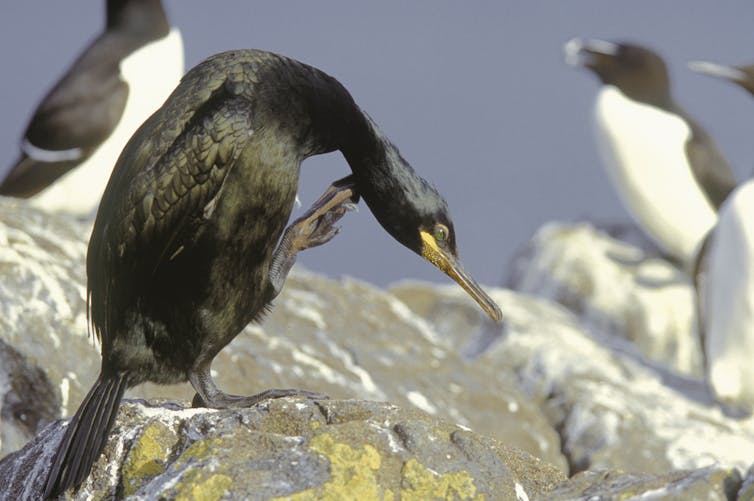
On the upside, if there is an upside, two seabirds were judged to be less threatened based on new data. Shags and black guillemots moved to the amber and green list respectively, though both are gradually declining. Nearly 40% of breeding seabirds are now red-listed in the UK – and 73 bird species overall (30% of the UK total).
A silver lining: shags have recovered enough to be removed from the red list. Andy Hay
Looking down
Seabirds face many threats. Among the gravest are changes to their food supply linked to overfishing and climate change.
Ocean warming disrupts and shifts the life cycles of seabird prey, such as sandeels, and the resulting scarcity can cause populations to collapse. Increasingly severe winter storms and summer heatwaves also kill seabirds.
The broader effects of climate change and the warming of the ocean are difficult to predict, but the associated increase in acidification and lower oxygen levels are certain to upset food webs.
Entanglement in fishing gear, invasive predators and collisions with offshore turbines present yet more challenges.
On top of all this came the highly pathogenic HPAI H5N1, a new strain of the avian influenza virus that was first detected in the UK in 2021 and has resulted in the deaths of tens of thousands of seabirds and affected almost every seabird species.
HPAI H5N1 was first identified in domestic waterfowl in southern China in 1996 and rapidly spread into their wild relatives. Migratory species carried the virus around the world, and still do. Thankfully, human deaths remain extremely rare. The jump into seabirds was unexpected as, until then, it was found mostly in wild waterfowl and domestic poultry.
Seabirds such as terns, gulls, auks and northern gannets were hit hard but the impact on great skuas was most striking. Their numbers are down by over 70% from the last census, which was taken between 2015 and 2021.
A great skua at nest on Handa Island off the west coast of Scotland. Louise Greenhorn
Seabird lifestyles predispose them to infectious disease and make it hard for them to recover. Seabirds typically produce just a few young (often only one) in a single brood each year. At least these birds are long-lived and can continue to breed throughout their lives. But living in dense, crowded colonies at a few sites that they can fly between means diseases can easily spread and take hold.
Looking up
The story is not all doom and gloom – much is happening to aid their recovery.
The UK and Scottish government decided to close sandeel fisheries in the English North Sea and all Scottish waters from 2024. Many seabirds, including kittiwakes and puffins, depend on sandeels to feed their chicks, and so the moratorium is a positive move that should be sustained.
Far-sighted projects to remove invasive predators, especially rats, from seabird islands across the UK are also showing great results. The removal of brown and black rats from Lundy Island, Devon, led to the immediate return of breeding Manx shearwaters and puffins after an absence of many years.
Atlantic puffins remain on the red list, but will benefit from a sandeel fishing ban. Katie Nethercoat
Marine protected areas such as Lyme Bay on the south coast of England are proof that sustainable fishing and conservation can go hand in hand (even if these sites are typically tiny). Trawlers were excluded from Lyme Bay in 2008 and the area has been managed by the local fishing industry and conservationists. A decade on from the ban, bottom-living seafans, rare corals, shellfish and fishes have all bounced back wonderfully.
More is needed to reverse the fortunes of seabirds. Well-resourced national seabird conservation strategies should protect colonies from invasive predators, extend and improve the country’s patchwork of marine protected areas, encourage more nature-friendly marine development (including for renewables) and better manage fisheries to ensure there is enough for seabirds to eat and less accidental bycatch in fishing gear, which kills thousands of seabirds in UK waters each year.
Our seabirds are special in many ways. I’d recommend a visit to a seabird colony, to drink in the spectacle and reflect on the lives of these birds and our responsibilities to them.