Members of Israeli forces prepare to enter in an armoured vehicle during a military operation in the West Bank refugee camp of Nur Shams, Tulkarem, August 29, 2024
CAMPAIGNERS are demanding that Britain stops arming Israel’s genocide against Palestinians amid Tel Aviv’s largest military assault on the West Bank in more than two decades.
Hundreds of ground troops, supported by fighter planes and drones, began targeting Jenin, Tulkarem, Nablus, and Tubas early on Wednesday.
Soldiers have besieged hospitals in Jenin and Tulkarm, while bulldozers have destroyed roads and razed critical infrastructure, including water and electricity networks.
Several refugee camps have also been targeted.
…
Ministers have so far rejected calls to suspend arms, instead issuing 108 licences to Israel since it escalated its attacks in October.
Foreign Secretary David Lammy has refrained from publishing legal advice on whether the exports are being used to facilitate international war crimes.
Deputy director of the Palestine Solidarity Campaign Simon Foster said: “This is the largest Israeli invasion of the Palestinian territories in the West Bank since 2002.
“Israel’s Minister of Foreign Affairs has openly called for the forcible displacement of Palestinians.
UK Labour Party Shadow Foreign Secretary repeatedly heckled at a speech to the Fabian Society over his and the Labour Party’s support for and complicity in Israel’s genocide of Gaza.
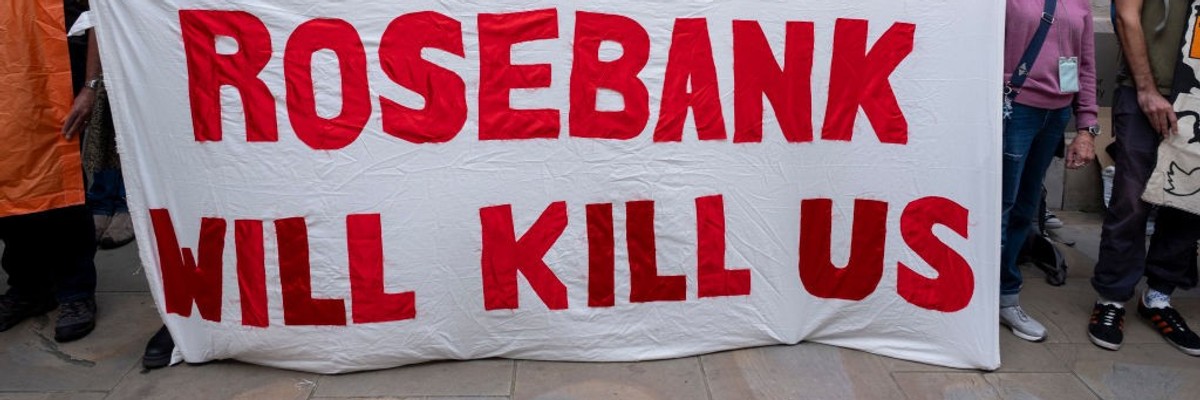
Activists hold a white sign reading “Rosebank will kill us” on September, 27, 2023 in London, United Kingdom. (Photo: Mike Kemp/In Pictures via Getty Images)
Oceana U.K.’s leader called the decision “a massive win for campaigners and another step towards… a cleaner, greener future for our seas, planet, and climate.”
Climate campaigners celebrated Thursday after the United Kingdom’s new Labour government announced it will not legally defend decisions to allow controversial offshore drilling in a pair of areas in the North Sea.
The two sites are Shell’s Jackdaw gas field and the Rosebank oil field, owned by Equinor and Ithaca Energy. Both projects have been loudly criticized by international green groups as well as U.K. opponents.
“This is amazing news and a BIG WIN for the climate. The government must now properly support affected workers and prioritize investment in green jobs,” declared Greenpeace U.K., which along with the group Uplift had demanded judicial reviews.
The approvals for both North Sea sites occurred under Conservative rule—in 2022 for Jackdaw and last year for Rosebank, the country’s biggest untapped oil field. Voters handed control of the government back to the Labour Party in May.
Then, as The Guardian detailed, “in June, the cases against the oil and gas fields received a boost when the Supreme Court ruled in a separate case that ‘scope 3’ emissions—that is, the burning of fossil fuels rather than just the building of the infrastructure to do so—should be taken into account when approving projects.”
“Now we need to see a just transition plan for workers and communities across the U.K. and an end extraction in the North Sea for good!”
The U.K. Department for Energy Security and Net Zero, led by Secretary Ed Miliband, cited the “landmark” Supreme Court ruling in a Thursday statement that highlighted the government’s decision not to defend the approvals “will save the taxpayer money” and “this litigation does not mean the licences for Jackdaw and Rosebank have been withdrawn.”
“Oil and gas production in the North Sea will be a key component of the U.K. energy landscape for decades to come as it transitions to our clean energy future in a way that protects jobs,” the department claimed, while also pledging to “consult later this year on the implementation of its manifesto position not to issue new oil and gas licenses to explore new fields.”
Welcoming the U.K. government’s acceptance of the recent high court ruling, Uplift founder and executive director Tessa Khan said on social media that “the immediate consequence… is that the Scottish Court of Session is very likely to quash the decision approving Rosebank, although we’re likely to have to wait a while before that’s confirmed.”
“If Equinor and Ithaca Energy decide they still want to press ahead with developing the field,” Khan explained, “then the next step will be for them to submit a new environmental statement to the [government] and regulator… that includes the scope 3 emissions from the field.”
“If you need reminding, those emissions are massive: the same as 56 coal-fired power plants running for a year or the annual emissions of the world’s 28 poorest countries,” she added. “If Equinor and Ithaca try to push Rosebank through again, the U.K. [government] must reject it.”
The government has made the right decision not to waste time and money trying to defend the indefensible.
The oil and gas industry will fight back. But the days where they can cause such devastating harm while everyone else pays the price are over.
Greenpeace similarly stressed that “Rosebank and Jackdaw would generate a vast amount of emissions while doing nothing to lower energy bills,” and “the only real winners from giving them the greenlight would be greedy oil giants Shell and Equinor.”
“To lower bills, improve people’s health, upgrade our economy,” the group argued, the government must: increase renewable energy; better insulate homes; and boost support for green jobs.
Celebrations over the government’s decision and calls for further action weren’t limited to the groups behind the legal challenges.
Oceana U.K. executive director praised the “incredible work” by Greenpeace and Uplift, and called the government dropping its defense “a massive win for campaigners and another step towards… a cleaner, greener future for our seas, planet, and climate.”
“There is no defending more fossil fuel extraction,” the organization said. “Now we need to see a just transition plan for workers and communities across the U.K. and an end extraction in the North Sea for good!”
Global Witness similarly celebrated the government’s move, declaring on social media that “this is brilliant news!”
“New oilfields are an act of climate vandalism,” the group added. “Governments must prioritize people, not polluters’ profit.”
The Petra Nova Carbon Capture Project is seen on December 20, 2016 in Houston, Texas. (Photo: Marie D. De Jesus/Houston Chronicle via Getty Images)
“The fossil fuel industry delays climate action, distracts from real solutions that would end the fossil fuel era, and does everything in its power to squeeze the last drops of profit from a dying industry, at the expense of all of us.”
Among the world’s wealthiest countries, the U.S. leads the way in spending public money on so-called climate “solutions” that have been proven to “consistently fail, overspend, or underperform,” according to an analysis released Thursday by the research and advocacy group Oil Change International.
The group’s report, titled Funding Failure, focuses on international spending on carbon capture and fossil-based hydrogen subsidies, which continues despite ample data showing that the technological fixes have “failed to make a dent in carbon emissions” after 50 years of research and development.
The report details how five countries account for 95% of all carbon capture spending, with the U.S. investing the most taxpayer money in the technology, at $12 billion in subsidies over the last 40 years.
Norway comes in second with $6 billion going to carbon capture and storage, while Canada has spent $3.8 billion, the European Union has spent $3.6 billion, and the Netherlands has poured $2.6 billion into the technology, with which carbon dioxide emissions are compressed and utilized or stored underground.
“It is nothing short of a travesty that funds meant to combat climate change are instead bolstering the very industries driving it.”
Harjeet Singh, global engagement director for the Fossil Fuel Non-Proliferation Treaty Initiative, told The Guardian that the subsidies amount to a “colossal waste of money.”
“It is nothing short of a travesty that funds meant to combat climate change are instead bolstering the very industries driving it,” said Singh.
While proponents claim carbon capture and storage reduces planet-heating carbon emissions, OCI notes, it was originally developed in the 1970s “to enhance oil production, and this remains its primary use,” with the technology “barely” reducing emissions.
High-profile carbon capture failures in the U.S. include the Petra Nova project in Houston, Texas, which cost nearly $200 million in taxpayer funds and whose captured emissions were later used for crude oil production, and the FutureGen project, “which swallowed $200 million and never materialized.”
“Investing in carbon capture delays the transition to renewable energy,” reads OCI’s report. “Instead of wasting time and money on technologies that do not work, governments must commit to justly and urgently phasing out fossil fuels before it’s too late.”
Despite the lack of data supporting the use of carbon capture, the group said, countries including the U.S. are “preparing to waste hundreds of billions of taxpayer dollars on these ineffective technologies, further benefiting the fossil fuel industry.”
OCI highlighted how the U.S. and Canada, while ostensibly fighting the climate crisis, have spent a combined $4 billion in public money to explicitly “pay oil companies to produce more oil,” with the subsidies going to carbon capture for “enhanced oil recovery.”
The report also found that in addition to the $12 billion in taxpayer funds the U.S. has spent on carbon capture and fossil hydrogen—a leak-prone gas produced through energy-intensive processes that cause their own emissions—the government has spent an estimated $1.3 billion on the 45Q tax credit, which allows companies to write off tax for every ton of carbon dioxide they store underground.
The Inflation Reduction Act (IRA) increased the amount given to companies in 45Q tax credits from $35 to $60 per ton, meaning that the subsidy could grow to over $100 billion in the next 10 years.
OCI’s Policy Tracker shows that overall public spending on carbon capture and hydrogen could grow by between $115 billion and $240 billion in the coming decades.
“We need real climate action, not fossil fuel bailouts!” said OCI in a post on social media.
The group’s report also highlights that fossil fuel giants such as ExxonMobil have shifted from carbon capture skeptics to outspoken proponents of the technology—with the company bragging to investors that carbon capture and hydrogen would help its Low Carbon Business Unit make “hundreds of billions of dollars” and grow to be “larger than ExxonMobil’s base business.”
Exxon didn’t launch its carbon capture efforts until 2018, having spent several years and hundreds of millions of dollars on another “climate solution” that ultimately failed: the use of algae to make biofuels.
Since then, Exxon has “pushed for direct government funding for carbon capture, particularly at the U.S. Department of Energy (DOE),” successfully lobbying for $12 billion allocated in the Bipartisan Infrastructure Bill in 2021 for “carbon management research, development, and demonstration.”
Exxon also lobbied for the increased rate of the 45Q tax credit in the IRA and “played a ‘central role’ in drafting a 2019 DOE-sponsored report on carbon capture that determined Congress would need to create an incentive of around $90 to $110 per ton to support carbon capture deployment,” according to OCI.
The Guardian on Thursday reported that Exxon still “chases billions in U.S. subsidies for a ‘climate solution’ that helps drill more oil,” describing how the oil giant hosted an event at the Democratic National Convention earlier this month where senior climate strategy and technology director Vijay Swarup praised the IRA for helping Exxon pursue carbon capture and said: “We need new technology and we need policy to support that technology. We need governments working with private industry.”
Exxon’s enthusiasm for carbon capture, said OCI, is an example of how “the fossil fuel industry delays climate action, distracts from real solutions that would end the fossil fuel era, and does everything in its power to squeeze the last drops of profit from a dying industry, at the expense of all of us.”
A photo shows a World Food Program vehicle damaged by Israeli gunfire. (Photo: World Food Program)
“This is totally unacceptable and the latest in a series of unnecessary security incidents that have endangered the lives of WFP’s team in Gaza.”
The World Food Program said Wednesday that it was forced to suspend the movement of its employees in Gaza after the Israeli military fired on one of the United Nations agency’s teams as its clearly marked vehicle advanced toward an Israeli checkpoint in the Palestinian enclave.
The agency said in a statement that the WFP team was returning from a mission with two armored vehicles “after escorting a convoy of trucks carrying humanitarian cargo routed to Gaza’s central area.”
“Despite being clearly marked and receiving multiple clearances by Israeli authorities to approach, the vehicle was directly struck by gunfire as it was moving towards an Israeli Defence Forces (IDF) checkpoint,” WFP said. “It sustained at least ten bullets: five on the driver’s side, two on the passenger side, and three on other parts of the vehicle. None of the employees onboard were physically harmed.”
While the WFP’s statement doesn’t explicitly attribute the gunfire to Israeli forces, U.N. spokesperson Stéphane Dujarric told reporters Wednesday that the food agency’s vehicle was “struck 10 times by IDF gunfire, including with bullets targeting front windows.”
Cindy McCain, WFP’s executive director, said the attack was “totally unacceptable and the latest in a series of unnecessary security incidents that have endangered the lives of WFP’s team in Gaza.”
“As last night’s events show, the current deconfliction system is failing and this cannot go on any longer,” said McCain. “I call on the Israeli authorities and all parties to the conflict to act immediately to ensure the safety and security of all aid workers in Gaza.”
The Israeli military’s latest attack on aid workers in Gaza came as famine continued to spread across the strip, which Israel has strangled with a blockade that has restricted the flow of food and other necessities.
Kenneth Roth, the former executive director of Human Rights Watch, characterized the WFP attack as part of “Israel’s starvation strategy.” Israeli forces have repeatedly targeted humanitarian workers in Gaza, making the enclave the most dangerous place in the world for aid agency employees.
Chef José Andrés, the founder of a nonprofit whose Gaza team came under deadly attack by Israeli forces earlier this year, expressed solidarity with the WFP in a social media post late Wednesday.
No NGO employees or civilians or press corps can be never ever be targeted by anyone while delivering humanitarian aid! My support to @WFP @WFPChief @UN for their efforts and proud that we’ve work side by side in many countries! https://t.co/jl2hzplsyB
WFP did not say how long its pause on employee movement would stay in place, but any disruption to the agency’s humanitarian operations could be disastrous for starving Palestinians.
In its statement Wednesday, the U.N. food agency said that Israel’s “frequent and ongoing evacuation orders continue to uproot both families and food relief operations intended to support them.”
“Last week, WFP lost access to its third and last operational warehouse in Gaza’s middle area, while five of WFP’s operated community kitchens had to be evacuated,” the agency said. “This week, on Sunday 25 August, the evacuation orders impacted the main WFP operating hub in Deir al-Balah, forcing our team to relocate for the third time since the war started.”
IOF attacks in Al-Fara’a Camp in Tubas. Photo: Wafa News Agency
Israel continues to close all possible doors to a ceasefire in Gaza and de-escalation in the West Asia region, intensifying military operations and provocations in the West Bank and Gaza
The Israeli Occupation Forces (IOF) launched the largest military operation across the occupied West Bank on Tuesday, August 27, aiming at crushing the Palestinian armed resistance groups. According to Israeli media outlets, the operation is the largest assault carried out by the Israeli military since 2002 at the peak of the Second Intifada. The operation involves hundreds of Israeli ground soldiers, warplanes, drones, and bulldozers.
On Tuesday night, the IOF ordered the residents of Nour Shams refugee camp, in the city of Tulkarm north of the West Bank to evacuate the camp. Israeli forces also established a military checkpoint to search the residents before leaving. The IOF has resorted to similar evacuation orders in the Gaza strip during the 11-month Israeli genocidal aggression on the Palestinian people there.
Israeli Foreign Minister Israel Katz wrote on X on Wednesday, August 28, “We must deal with the threat just as we deal with the terrorist infrastructure in Gaza, including the temporary evacuation of Palestinian residents and whatever steps are required. This is a war for everything and we must win it.”
Katz added regarding the expanded operation, which the IOF carried out in the cities of Jenin and Tulkarm overnight, that the Israeli military has been working “to thwart Islamic-Iranian terror infrastructure that was set up there.”
The large-scale Israeli military operation that started on Tuesday night is intended to continue for several days, according to media reports. The operation also included the West Bank cities of Nablus, Tubas and Ramallah. At least 10 people have been killed in the last 24 hours. The death toll in the West Bank, including occupied Jerusalem, has surpassed 660 people since October 7 attacks.
While storming different parts of the West Bank, the IOF has been committing flagrant violations of human rights against civilians and medical staff. According to the Palestinian News and Information Agency Wafa, the Israeli military seized the house of Palestinian resident Hamada Odeh Al-Barghouthi in the town of Beit Rima, northwest of Ramallah since Tuesday night. They turned the house into a field investigation center and a military barracks, where a number of Palestinian young men from the town, neighboring towns and villages have been detained.
The Palestine Red Crescent Society (PRCS) also reported that the IOF stormed a medical facility in the Al-Far’a refugee camp south of the city of Tubas, and detained and assaulted its staff, while shooting live ammunition inside the facility.
As Israeli incursions have been taking place in the West Bank, the massacres in Gaza and elsewhere in the region have not stopped. On Wednesday, August 28, IOF struck the Al-Manfalouti school, where displaced people were sheltering in Deir al-Balah in central Gaza strip, killing at least 8 Palestinians and injuring several others. At least 4 people have been killed in an Israeli air strike that targeted a car in Syria near the border with Lebanon. The Israeli Army claimed that Palestinian Islamic Jihad Movement’s top commander Faris Qasim was killed in the attack, without any confirmation by Islamic Jihad that Faris could have been assassinated.