Labour’s disdain for conducting impact assessments on the effects of its cuts and austerity reaches the ‘MSM’ – 11 months after Skwawkbox exclusively revealed it
The Telegraph has today reported that right-wing Labour Chancellor Rachel Reeves carried out ‘no impact assessment’ before ‘withdrawing winter fuel payments for 10 million pensioners, the Telegraph can reveal’.
The right-wing rag is a little late to the party. Skwawkbox revealed exclusively eleven months ago that Labour undertook no impact for any of its plans on vulnerable people, whether pensioners, the disabled, the poor, the ill or children.
Boeing, Palantir and Babcock listed as sponsors for fringe events run by New Statesman Media Group
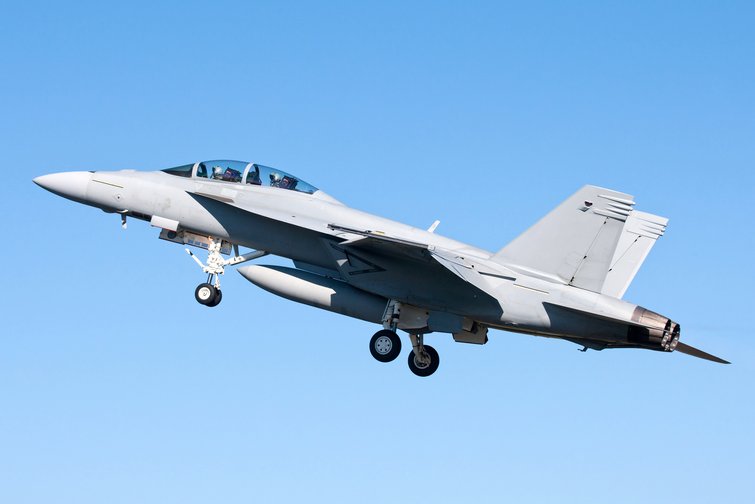
Boeing FA-18F Super Hornet Fighter Aircraft | Getty Images / Boeing.
Weapons manufacturers, fossil fuel companies and a spy-tech firm are among those sponsoring events at this year’s Labour Party conference.
Boeing and Babcock, manufacturers of missiles or missile compartments, and Palantir, a controversial spy-tech firm funded by the CIA, will sponsor fringe events hosted by centre-left media company the New Statesman Media Group.
Fossil fuel companies, private health firms, major banks and the International Airlines Group, which owns British Airways, are also among those paying to have a presence at the party’s annual conference in Liverpool, which will host politicians and policy makers – and is Labour’s third in person since Keir Starmer took over as leader.
The party has been slammed for playing host to these industries by environmental groups and anti-weapon groups, who call the sponsorships “disgusting and disappointing.” Its own MP Clive Lewis has also questioned why Labour is “cosying up” to some of the organisations involved.
The events, announced today, boast “Labour Party’s biggest names and most exciting talents,” and cover subjects such as the move to net zero, the housing crisis and healthcare. Speakers include shadow health secretary Wes Streeting, as well as Labour’s chair of the levelling up committee Clive Betts and deputy London mayor Tom Copley.
UK-based Babcock, which has arms deals with the government and has recently signed a deal with Israel Aerospace Industries (IAI), will sponsor a talk entitled “Sovereign capability: How can we make, buy and sell British?”. Speaking on the panel will be Babcock’s chief corporate affairs officer, John Howie, alongside Labour’s shadow minister for defence procurement Chris Evans and the party’s shadow international trade minister Nia Griffith.
Spy-tech firm Palantir, whose owner has donated to Donald Trump’s political campaign, will sponsor a talk on Ukraine called “How can we hold aggressors accountable for war crimes and deter future conflict?” Its executive vice president for the UK and Europe will appear on the panel.
Palantir, which has built software to support drone strikes and immigration raids, is tipped to win a £480m deal this year to build a single database that will eventually hold all the data in the NHS.
Energy company SSE, which has been accused of misleading the public over “green investments,” is sponsoring a “Delivering net zero” talk. Its own managing director of corporate affairs, regulation and strategy, will speak on the panel.
Cadent Gas will sponsor an event entitled “How can the energy sector support customers on the journey to net zero?”. Its chief strategy and regulation officer will speak on the panel.
Other events at next month’s conference will be sponsored by companies such as Offshore Energies UK (formerly known as Oil and Gas UK), National Gas, Ovo Energy and housing developer Taylor Wimpey.
Clive Lewis MP told openDemocracy that “people want change under a Labour government” and hosting some of these firms signals that “the same palms are going to be greased”.
“I do not think that organisations like Palantir and others are necessarily the kind of organisations that Labour in the year before a general election should be cosying up to,” said Lewis. “I think they should be saying: ‘Look, we’ll deal with you but frankly, some of you are part of the problem’.
“I think it’s entirely possible to be on the side of entrepreneurs…without necessarily having to get into bed with big oil companies, big corporations or the likes of Palantir – and the Labour Party should be really clear about that.”
He added: “I think there are questions there for the New Statesman and why they’re accepting sponsorship and funding from some of these ethically and morally questionable corporations.”
Campaigners against the arms industry have condemned the decision to allow weapons manufacturers to have a presence at the conference.
“It is disgusting and disappointing to hear that arms companies will be sponsoring talks at the Labour Party conference,” Emily Apple, media coordinator at Campaign Against Arms Trade (CAAT), told openDemocracy. “These companies should not be given this legitimacy or the opportunity to lobby policy makers in order to continue making profits for their shareholders from a deadly trade that causes destruction and misery around the world.”
She added: “Accepting sponsorship from these companies sends a bleak message to anyone thinking a future Labour government will adopt any kind of ethical stance towards the arms trade.”
Environmental groups have also spoken out, warning Labour against forming relationships with oil and gas companies.
“The fossil fuel lobby is no stranger to cosying up with policymakers – they’ve had a lot of success and made a lot of cash from doing so in the past,” Greenpeace UK’s policy director, Doug Parr, told openDemocracy. “But Labour must not make the same costly mistakes as the Conservatives by giving these self-serving climate-wreckers the opportunity to launder their political reputation.
“The next government must have bold policies and a strong commitment to tackling the climate crisis, not another one that ends up in the back pocket of polluters and dodgy operators.”
The New Statesman’s events arm advertises a partnership with the media company as an opportunity to “showcase your brand, generate leads, nurture relationships,” with “policy makers and politicians.”
It also hosts private round table events that are not publicly advertised, which openDemocracy understands can cost a sponsor over £15,000.
openDemocracy has approached the Labour Party and New Statesman Media Group for comment.
Update, 24 August 2023:This article has been amended to reflect that Babcock does not make missiles but missile components and launch systems.
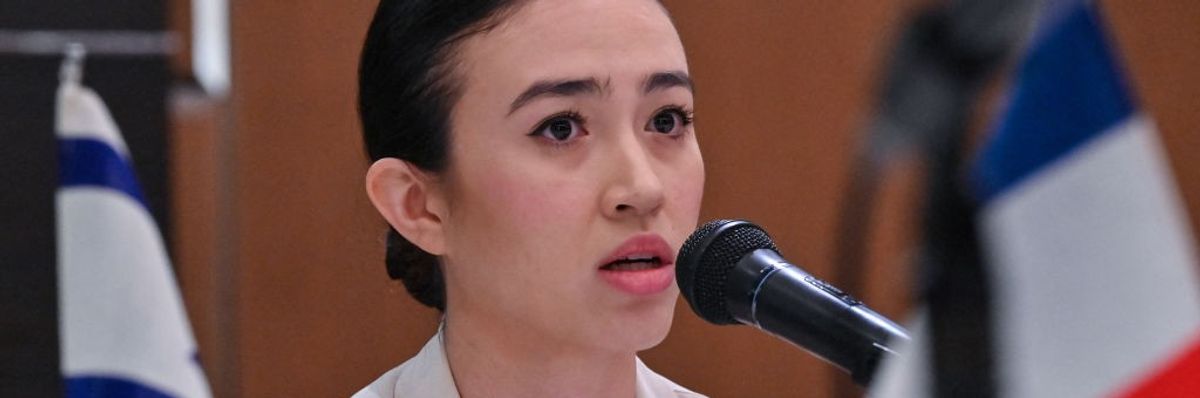
Noa Argamani, an Israeli woman who spent 245 days in Hamas captivity in Gaza after being kidnapped last October 7, meets with representatives of Group of Seven nations in Tokyo on August 21, 2024. (Photo: Richard Brooks/AFP via Getty Images)
“I cannot ignore what happened here over the past 24 hours, taking my words out of context,” said Noa Argamani. “As a victim of October 7, I refuse to be victimized once again by the media.”
An Israeli woman kidnapped by Hamas militants on October 7 and held hostage for 245 days before being rescued lashed out on Friday at Israeli media outlets that twisted her words to make it seem as if she was wounded by her captors when in reality she was injured in an attack by the military in which she once served.
Responding to reports in outlets including The Jerusalem Post—which on Thursday ran the headline “Hamas Beat Me All Over”—Noa Argamani said on Instagram that “I can’t ignore what happened in the media in the last 24 hours.”
“Things were taken out of context,” the 26-year-old navy veteran from Be’er Sheva said of her earlier comments to Group of Seven diplomats in Tokyo. “I was not beaten… I was in a building that was bombed by the Air Force.”
“I emphasize that I was not beaten, but injured all over my body by the collapse of a building on me,” Argamani added. “As a victim of October 7, I refuse to be victimized once again by the media.”
Israeli media is scrambling to remove the “Hamas beat me” references 💨 Screenshots and the internet archive are forever 🥲 pic.twitter.com/u0Cx5LKzlK
Argamani was partying with her boyfriend Avinatan Or at the Nova rave near the Gaza border when the festival was attacked by Hamas-led militants in the early morning hours of October 7. In now-famous video footage, she is seen begging, “Don’t kill me!” as her captors whisk her away toward Gaza on a motorcycle. Or was also kidnapped and is believed to still be in Hamas custody.
“Every night, I was falling asleep and thinking, this may be the last night of my life,” Argamani said Thursday of her time in captivity.
Argamani was one of four Hamas captives rescued during a June raid on the Nuseirat refugee camp in Gaza, an operation in which Israeli forces killed at least 236 Palestinians, most of them women and children. Three other Israeli hostages taken from the Nova rave were also rescued in the raid.
“It’s a miracle because I survived October 7, and I survived this bombing, and I also survived the rescue,” Argamani said in Tokyo on Thursday.
Argamani’s rescue fulfilled a dying wish from her mother, who had terminal cancer, to be reunited with her daughter before she passed. Argamani was also freed on the birthday of her father, Yakov Argamani, who, from the start of the hostage ordeal, urged Israeli leaders to eschew revenge after the October 7 attack.
There are believed to be around 109 Israelis and others still held captive by Hamas in Gaza. Argamani implored the government to make freeing them its top priority.
“Avinatan, my boyfriend, is still there, and we need to bring them back before it’s going to be too late,” she said Thursday. “We don’t want to lose more people than we already lost.”
More than 1,100 Israelis and others including Thai farmworkers were killed on October 7, at least some of them in so-called “friendly fire” attacks by Israeli forces. The Israel Defense Forces (IDF) employed a protocol known as the “Hannibal Directive” authorizing lethal force against Israeli soldiers in order to prevent them from being taken prisoner by enemy forces. More than 240 Israelis and others were abducted by Hamas and other militants.
Freed hostages have recounted being fired upon by Israeli aircraft as they were being taken by Hamas militants to Gaza. One former captive said in December that “every day in captivity was extremely challenging. We were in tunnels, terrified that it would not be Hamas, but Israel, that would kill us, and then they would say Hamas killed you.”
Numerous Israeli hostages have been killed by their would-be rescuers, including a trio of men who managed to escape from their captors and were waving white flags and shouting for help in Hebrew when they were shot dead by IDF soldiers in Gaza in December, and five Israelis who likely suffocated to death due to a fire sparked by an Israeli assault six months ago on the tunnel where the hostages were being held.
In contrast to former Palestinian prisoners held by Israel—who, along with Israeli whistleblowers, have reported systemic torture, rape, starvation, and even murder committed by their captors—numerous Israelis kidnapped by Hamas have reported being relatively well treated. Other former hostages said they were physically, sexually, and psychologically abused.
Taking civilian hostages is a war crime in itself.
Israel’s 322-day retaliation for October 7 has left at least 144,000 Palestinians dead, wounded, or missing. Nearly all of Gaza’s 2.3 million people have been forcibly displaced by Israel’s bombardment and invasion, which has flattened much of the coastal enclave. A crippling siege has pushed hundreds of thousands of Gazans over the brink of starvation, with at least dozens of children dying of malnutrition, dehydration, and lack of medical care. Preventable diseases including measles, hepatitis, and polio threaten public health not only in Gaza but also in Israel and other neighboring nations.
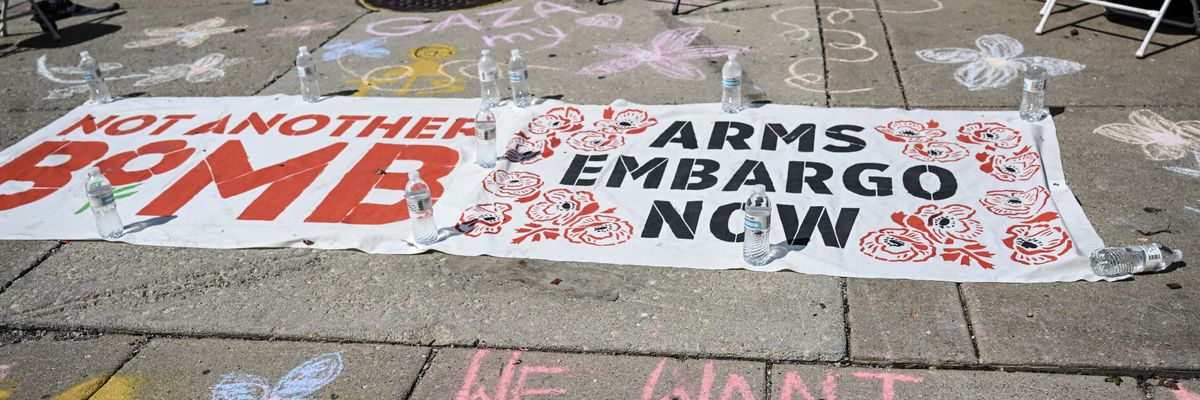
A banner calling for an arms embargo against Israel is pictured outside of the Democratic National Convention in Chicago on August 22, 2024. (Photo: Fatih Aktas/Anadolu via Getty Images)
“Harris called for a cease-fire in Gaza, but she failed to commit to the change in policy that would secure a cease-fire: ending weapons transfers to Israel,” said one Palestinian rights group.
During her speech Thursday night accepting the Democratic Party’s 2024 nomination, Vice President Kamala Harris decried the “heartbreaking” suffering that Gazans are experiencing after 10 consecutive months of Israeli bombardment.
But Harris didn’t acknowledge, let alone condemn, the central role the United States has played in fueling the humanitarian emergency in the Palestinian enclave, where civilians face indiscriminate bombings daily as well as famine and appalling disease outbreaks—including a possible polio epidemic.
Instead, Harris repeated a line that has become commonplace for the White House and its allies, declaring that “President [Joe] Biden and I are working around the clock” to secure a cease-fire in the Gaza Strip.
“Harris wanted to portray herself as strong and brave, but when she had to switch to passive voice (“What has happened in Gaza”) to avoid calling out Israel’s war crimes, she showed stunning cowardice,” said Palestinian American political analyst Yousef Munayyer.
Declining to break with the administration in which she currently serves, the vice president did not express support for a policy shift that would pressure Israel’s far-right government to accept a cease-fire agreement, such as an arms embargo of the kind supported by United Nations experts, leading human rights groups, and a majority of U.S. voters.
“I will always stand up for Israel’s right to defend itself, and I will always ensure Israel has the ability to defend itself,” said Harris, condemning the Hamas-led October 7 attack.
“If you really wanted a cease-fire, you’d just stop sending the weapons. It is that simple.”
Abbas Alawieh, a co-founder of the Uncommitted National Movement, toldReuters following the vice president’s speech that she did not deliver what was badly needed as the disaster in Gaza worsens by the minute: “courageous leadership that breaks from the current approach.”
The IMEU Policy Project, an affiliate of the Institute for Middle East Understanding, echoed Alawieh’s assessment, saying in a statement that “with Vice President Kamala Harris’ nomination, the party had an opportunity to move in a new direction.”
“Tonight Harris called for a cease-fire in Gaza, but she failed to commit to the change in policy that would secure a cease-fire: ending weapons transfers to Israel,” the group said. “To be clear: There is no way to end this bloodshed while supplying Israel with billions of dollars in weapons as it indiscriminately bombs Palestinian families, schools, hospitals, refugee shelters, and places of worship.”
“It must be noted that Harris’ call for ‘dignity, security, freedom, and self-determination’ for the Palestinian people received thunderous applause,” the organization added. “However, words are not enough. Democratic voters are increasingly united in their demand for a change in policy on Gaza and in support of Palestinian safety and freedom broadly; it is time for the Democratic Party leadership to catch up.”
Vice President Harris’ call for Palestinian dignity and freedom received thunderous applause.
The voters are increasingly united in their demand for a change in policy on Gaza and Palestinian freedom.
It's time for Democratic Party leadership to catch up.
Denied a speaking slot on the convention stage, Palestinian American delegates and their allies made their voices heard in the hallways of Chicago’s United Center and outside of the facility, where they held a sit-in to protest the DNC’s rejection of their demands.
Calls for a Palestinian American speaker on the DNC stage drew broad support from Democratic lawmakers and their allies, including Chicago Mayor Brandon Johnson and the United Auto Workers.
Lily Greenberg Call, a Jewish Biden political appointee who resigned in May over the administration’s Gaza policy, said late Thursday that she was “so sad and disappointed” that the DNC chose to “silence Palestinian American voices and exclude them from the convention stage.”
“VP, I want you to win in November,” Call added. “You must do better.”
Layla Elabed, a co-founder of the Uncommitted National Movement and the sister of Rep. Rashida Tlaib (D-Mich.), said Thursday that “Michigan voters want to vote for Harris, but we need to shift policy.”
“Many of us know the impact of U.S.-funded bombs firsthand,” said Elabed.
Rep. Ilhan Omar (D-Minn.), one of the lawmakers who showed solidarity with uncommitted delegates as they staged a sit-in outside of the DNC earlier this week, clearly articulated the U.S. Palestinian rights movement’s position during a press conference on Wednesday, a day before Harris took the stage in Chicago.
“If you really wanted a cease-fire, you’d just stop sending the weapons,” said Omar. “It is that simple.”
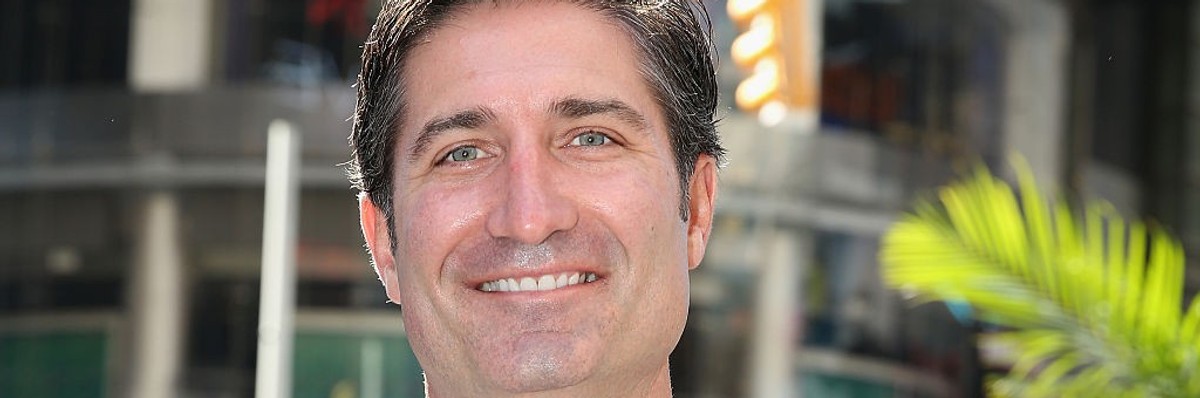
Brian Niccol, seen here in a 2015 photo, is Starbucks’ new CEO. (Photo: Robin Marchant/Getty Images)
“These jets are a stark symbol of social and climate injustice, where a privileged few indulge in the most environmentally damaging form of travel for mere convenience,” said one Greenpeace campaigner.
Green groups’ anger percolated this week after it was revealed that Brian Niccol, Starbucks’ new CEO, will “supercommute” approximately 1,000 miles between one of his homes in California and the coffee giant’s Seattle headquarters three times a week.
A Starbucks spokesperson said earlier this week that “while Brian will have an office in Southern California, his primary office and a majority of his time will be spent in our Seattle Support Center.”
“When he is not traveling for work, he will be in our Seattle office at least three days a week, in alignment with our hybrid work policies,” the spokesperson added. “He will also have a home in Seattle.”
“A private jet flight causes about 10 times more CO2 emissions than a regular flight per flight per person.”
Greenpeace—which for years has been running a campaign to ban private jets and regularly stages protests against them at airports around the world—led condemnation of Niccol’s harmful commute.
“As the world faces unprecedented heatwaves, droughts, floods, and other dire consequences of an accelerating climate crisis, it is unjustifiable for companies to offer company aircraft as employee perks,” Greenpeace campaigner Clara Thompson told The Washington Post on Thursday.
“These jets are a stark symbol of social and climate injustice, where a privileged few indulge in the most environmentally damaging form of travel for mere convenience,” Thompson added.
While most of us are being encouraged to choose a bike or public transport for our commute, these guys are taking a private jet to get to work.
A private jet flight causes about 10 times more CO2 emissions than a regular flight per flight per person, and 50 times more than the average train ride. Eighty percent of the world’s population have never flown, yet they’re the ones most impacted by the climate crisis. In just one hour, a single private jet can emit two tons of CO2. The global average energy-related carbon footprint is around 4.7 tons of CO2 per person per year.
While private jets account for a tiny fraction of global greenhouse emissions, the world’s richest 1% produce more than double the emissions of the poorest 50%, and a single billionaire produces a million times more emissions than an average person, according to a 2022 Oxfam study.
Some critics accused Starbucks—which in 2020 set a goal of reducing carbon emissions by 50% this decade—of hypocrisy, with one social media user contrasting Niccol’s private jet commute with the company’s introduction of widely despised and environmentally dubious paper straws. Another eagle-eyed observer spotted a book titled How to Avoid a Climate Disaster on display in Niccol’s office in a Wall Street Journal article photo.
Shameful for @Starbucks & CEO to fly private jet 1000miles 3x each week. Our forest are on fire; oceans are dying and glaciers are melting. Performative sustainability of banning plastic straws isn't enough
Starbucks CEO faces backlash over 1000mile commute by private jet