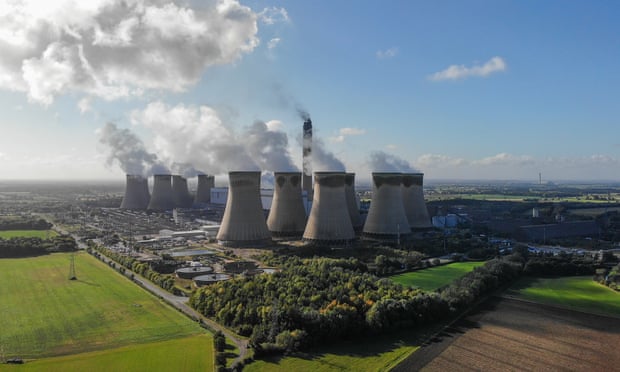
Wind turbines at Loftsome Bridge, East Yorkshire, with Drax Power station in the distance
ACTIVISTS slammed the police today for diverting resources away from tackling racist riots and targeting peaceful climate protesters instead.
Protesters opposing Drax power station, Britain’s largest carbon emitter, were due to set up a protest camp today.
But police pre-emptively arrested 22 activists under public order offences, including conspiracy to interfere with key national infrastructure.
Police seized tents, toilets, a track for wheelchairs and other equipment to make the peaceful protest safe and accessible, organisers Reclaim the Power said.
The Silver Commander for the police operation, Supt Ed Haywood-Noble, admitted that police resources were “stretched nationally,” but still thought it was “essential” that the operation go ahead.
He claimed: “Policing is not anti-protest, we are anti-crime, and we are here to protect the public.”
The protest organisers hit back at the force for making the “unfathomable decision” to divert resources away from communities under attack in the racist violence sweeping Britain.
They accused the police of prioritising the arrest of peaceful protesters over “locating and arresting people who are actually organising far-right riots with bricks, knives and other weapons.”
I’m wondering why the police are seizing “tents, toilets, a track for wheelchairs and other equipment to make the peaceful protest safe and accessible”. Is that part of their job too?
A firefighter working to put out a fire in the Pantanal in Mato Grosso do Sul, Brazil on 7 July 2024. Credit: Xinhua / Alamy Stock Photo
Human-caused climate change made the “unprecedented” wildfires that spread across Brazil’s Pantanal wetlands in June 2024 between four and five times more likely, according to a new rapid attribution study.
South America’s Pantanal – the world’s largest tropical wetland – experienced exceptionally hot, dry and windy conditions in June, causing blazes in the region to soar.
The World Weather Attribution (WWA) service finds that the month was the hottest, driest and windiest year in the 45-year record.
The team conducted an attribution study to find the “fingerprint” of climate change on these weather conditions.
They find that, in a world without climate change, these conditions would be very rare – occurring only once every 161 years.
In today’s climate, which has already warmed by 1.2C above pre-industrial temperatures as a result of human-caused warming, these conditions are a one-in-35 year event.
The authors also explore how wildfires in the region could continue to worsen as the planet warms.
They find that if that planet reaches warming levels of 2C, the likelihood of these conditions could double, to once every 18 years.
Soaring fires
The vast Pantanal wetland extends across Brazil, Bolivia and Paraguay.
It is one of the most biodiverse places on earth, home to more than 4,700 plant and animal species.
Every year, hot and dry weather conditions make the wetland prone to wildfires – usually between July and September.
By June this year, intense wildfires were already soaring. The number of Pantanal fires increased by 1,500% in the first half of this year compared to the same period in 2023, according to data from Brazil’s National Institute for Space Research reported by the Brasil de Fato newspaper.
This amounts to more than 1.3m hectares of the wetland burned so far this year – an area around eight times the size of London.
A firefighter working to put out a fire in the Pantanal in Mato Grosso do Sul, Brazil on 7 July 2024. Credit: Xinhua / Alamy Stock Photo
Around 2,500 fires were identified in June, which is the highest number since 1998 and more than six times the level reported in 2020, which was “known as the ‘year of flames,’ when wildfires ravaged the area and sparked widespread outcry”, the Associated Press said.
The region is currently experiencing its worst drought in 70 years, which Brazil’s government has said is being “intensified by climate change and one of the strongest El Niño phenomena in history”.
Prolonged dry periods, high temperatures and land-use change all contribute to wildfire conditions, says Dr Maria Lucia Barbosa, a postdoctoral researcher at the Federal University of São Carlos in Brazil, who was not involved in the attribution study. She tells Carbon Brief:
“While fires are a natural part of the Pantanal ecosystem, the recurrence of extreme fire seasons – such as the current one, shortly after the devastating 2020 fires – suggests that, alongside climate change, a new fire regime may be emerging in the ecosystem, characterised by increased severity and frequency.”
Hot, dry and windy
Wildfire intensity and duration are influenced by a wide range of factors, including weather, vegetation and fire management strategies.
The authors of the new study focus on a metric called the “daily severity rating” (DSR), which combines information on maximum temperature, humidity, wind speed and precipitation. Dr Clair Barnes – a research associate at Imperial College London’s Grantham Institute and author on the study – told a press briefing that this metric “indicates how difficult it is likely to be to control the fire once it starts”.
High temperatures and wind speeds, as well as low humidity and rainfall, are very conducive to wildfires spreading and, therefore, produce a high DSR.
The map below shows the average DSR in the Pantanal in June 2024. It reveals that most of the Pantanal was experiencing wildfire risk above the 1990-2020 average over that month.
DSR in the Pantanal in June 2024. Light red indicates a low DSR and low fire risk conditions. Dark red indicates high DSR and high fire risk conditions. Source: WWA (2024)
The weather conditions in the Pantanal in June 2024 were “really unusual for the time of year”, Barnes said.
To investigate how atypical the weather conditions in June 2024 were, the authors analysed temperature, windiness, rainfall and humidity data from the past 45 years.
The chart below depicts annual average rainfall and annual average daily maximum temperature in the Pantanal over 1979-2024. It shows that over the past 45 years, the average temperature in the Pantanal has been steadily increasing and total rainfall has been decreasing.
Annual average rainfall and annual average daily maximum temperature in the Pantanal region over 1979-2024. Each dot indicates one year. Green indicates years between 1979-99, yellow indicates 2000-18, orange shows 2019-23 and dark red shows 2024. Source: WWA (2024)
The authors find that June 2024 was the hottest, least rainy and windiest June since records began. They also find that the relative humidity was the second lowest on record.
Annual rainfall across the Pantanal has been decreasing over the past 40 years, the authors note. They point out that natural variability and deforestation are known to impact rainfall patterns across South America, but add that climate change “may also be influencing the drying trend”.
Attribution
Attribution is a fast-growing field of climate science that aims to identify the “fingerprint” of climate change on extreme-weather events, such as heatwaves and droughts.
To conduct attribution studies, scientists use models to compare the world as it is today to a “counterfactual” world without human-caused climate change. In this study, the authors investigated the impact of climate change on DSR in the Pantanal region.
They find that in today’s climate – which has already warmed by 1.2C as a result of human activity – fire weather conditions like the ones that drove the wildfires in the Brazilian Pantanal during June 2024 are a “relatively rare event”, and would be expected to occur roughly once every 35 years.
However, they say, if the planet continues to warm, these events could become more likely. If the climate warms to 2C above pre-industrial levels, the likelihood of these fire conditions will double compared to today.
The graphic below shows how often June fire weather conditions, such as those seen in the Brazilian Pantanal in June 2024, could be expected under different warming levels.
The square on the left shows a world without climate change, in which these DSR levels would happen once every 161 years. The middle square shows that in today’s climate, the DSR is a one-in-35 year event. And the square on the right shows that in a 2C world, a June DSR like that of 2024 could be expected once every 18 years.
How often June fire weather conditions – such as those seen in the Brazilian Pantanal in June 2024 – could be expected under different climates: (from left to right) pre-human-caused climate change, today and under 2C warming. Each dot indicates one year, and pink dots indicate years in which June DSR matches or exceeds the levels seen in 2024 in the Brazilian Pantanal. Source: WWA (2024)
The authors also investigate how climate change affected DSR “intensity”. They find that human-induced warming from burning fossil fuels increased the June 2024 DSR by about 40%.
The authors add that as the climate continues to warm, this trend is likely to worsen. The authors warn that if warming reaches 2C above pre-industrial temperatures, similar June fire weather conditions will become 17% “more impactful”.
(These findings are yet to be published in a peer-reviewed journal. However, the methods used in the analysis have been published in previous attribution studies.)
Fire impacts
Wildfires have wide-ranging impacts on people and nature in the Pantanal. In one example, a 2021 study found that around 17m vertebrates were “killed immediately” by the fires in 2020.
Wildfires can “devastate [the] livelihoods” of people living in the Pantanal and “pose significant health risks” from the resulting smoke, Barbosa says.
She notes that wildfires release CO2 into the atmosphere, contributing to climate change, and they “lead to widespread loss of habitat, endanger wildlife and disrupt ecological balances”. She tells Carbon Brief:
“Species that are already threatened or have limited ranges are particularly vulnerable to habitat destruction caused by fires.
“Repeated fires can push fire-sensitive vegetation into a state of permanent degradation, further threatening the ecological integrity of the region.”
Some fires are permitted for agricultural purposes – such as to burn degraded pasture – during the rainy season, from around November to April. This practice is banned in the drier summer months, but a 2020 piece from Mongabay notes that “in reality, the ban is not always respected and enforcement is haphazard”.
A jaguar in an area scorched by wildfires at the Encontro das Aguas park in the Pantanal wetlands in Mato Grosso, Brazil on 17 November 2023. Credit: Associated Press / Alamy Stock Photo
Filippe Santos, a researcher at Portugal’s University of Évora and one of the authors of the study, told a press briefing that “fire is part of the dynamics” of the Pantanal – when it is controlled.
Low-intensity fires allow animals “time to leave” the area, he said, adding:
“What we see with wildfires, is that this does not happen, because the fire is so intense and on such a large scale that animals don’t have time to run away.”
The “highly intense” wildfires also “don’t give nature enough time to recover”, Santos says.
In June, Brazil’s environment minister, Marina Silva, told the government news agency Agencia Brasil that the country is “facing one of the worst situations ever seen in the Pantanal”, adding that the fires are heightened by climate extremes and criminal activities.
Most Pantanal fires are caused by human activity, a 2022 study found. Police in Brazil are investigating the “possible culprits” behind 18 fire outbreaks in the region, Silva said last month.
A plane dropping water as part of firefighting efforts in an area of the Pantanal affected by forest fire in Mato Grosso do Sul, Brazil on 5 July 2024. Credit: Xinhua / Alamy Stock Photo
In recent weeks, a law to improve coordination on tackling fires took effect in Brazil.
Barbosa says it will be a “challenge” to implement this policy. She would like to see a “comprehensive national early warning system for multiple hazards to ensure risk reduction” for a range of threats – including wildfires. She tells Carbon Brief:
“Collaboration with local communities, firefighters and brigades is crucial for prevention and response efforts…A coordinated approach that integrates all stakeholders, along with the establishment of a national fund dedicated to fire management, is essential for mitigating the impacts of future fire seasons.”
Drax was responsible for 11.5m tonnes of CO2 last year, or nearly 3% of the UK’s total carbon emissions. Photograph: SOPA Images/LightRocket/Getty Images
Drax received £22bn in subsidies despite being UK’s largest emitter in 2023, though company rejects ‘flawed’ research
The Drax power station was responsible for four times more carbon emissions than the UK’s last remaining coal-fired plant last year, despite taking more than £0.5bn in clean-energy subsidies in 2023, according to a report.
The North Yorkshire power plant, which burns wood pellets imported from North America to generate electricity, was revealed as Britain’s single largest carbon emitter in 2023 by a report from the climate thinktank Ember.
The figures show that Drax, which has received billions in subsidies since it began switching from coal to biomass in 2012, was responsible for 11.5m tonnes of CO2 last year, or nearly 3% of the UK’s total carbon emissions.
Drax produced four times more carbon dioxide than the UK’s last remaining coal-fired power station at Ratcliffe-on-Soar in Nottinghamshire, which is due to close in September. Drax also produced more emissions last year than the next four most polluting power plants in the UK combined, according to the report.
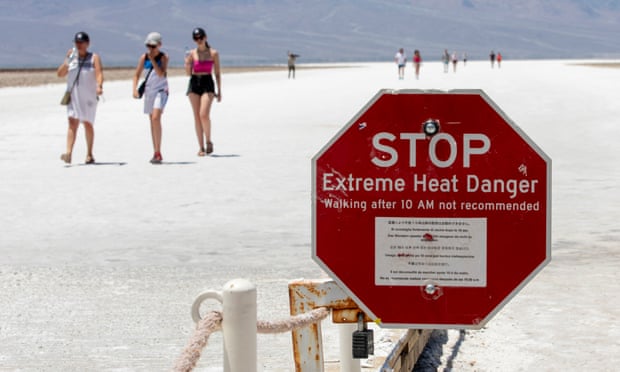
A sign warns tourists of extreme heat in Death Valley national park in July in California. Photograph: Daniel Jacobi II/AP
Climate scientists say that the world is continuing to warm, despite brief respite in record breaking temperatures
Earth’s string of 13 straight months with a new average heat record came to an end this past July as the natural El Niño climate pattern ebbed, the European climate agency Copernicus announced on Wednesday.
But July 2024’s average heat just missed surpassing last year’s July, and scientists said the end of the record-breaking streak changes nothing about the threat posed by the climate crisis.
“The overall context hasn’t changed,” Copernicus’s deputy director, Samantha Burgess, said in a statement. “Our climate continues to warm.”
Human-caused climate change drives extreme weather events that are wreaking havoc around the globe, with several examples just in recent weeks. In Cape Town, South Africa, thousands were displaced by torrential rain, gale-force winds, flooding and more. A fatal landslide hit Indonesia’s Sulawesi island. Beryl left a massive path of destruction as it set the record for the earliest category 4 hurricane. And Japanese authorities said more than 120 people died in record heat in Tokyo.
Those hot temperatures have been especially merciless.
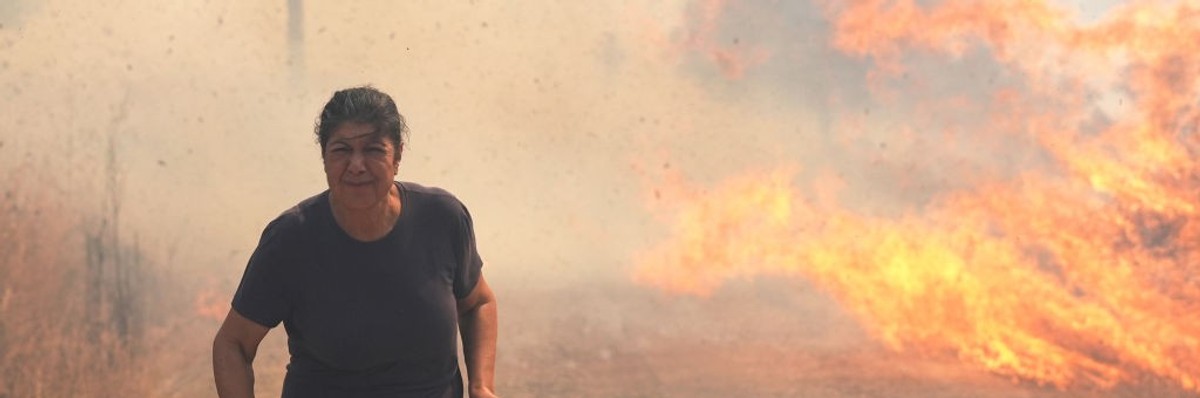
Civilians flee a forest fire that broke out close to residential areas at Cesmealti in Urla district of Izmir, Turkey on July 31, 2024. (Photo: Mahmut Serdar Alakus/Anadolu via Getty Images)
“We need to tackle the root cause and get serious about reducing record levels of greenhouse gas emissions,” said the head of the World Meteorological Organization.
As scientists around the world on Thursday released new data about recent record-smashing heat, one United Nations adviser placed blame for the lack of ambitious climate action on the fossil fuel industry’s decadeslong disinformation efforts.
“There is this prevailing narrative—and a lot of it is being pushed by the fossil fuel industry and their enablers—that climate action is too difficult, it’s too expensive,” Selwin Hart, a special adviser to the U.N. Secretary-General António Guterres and assistant secretary-general of the Climate Action Team, told The Guardian‘s Fiona Harvey.
“It is absolutely critical that leaders, and all of us, push back and explain to people the value of climate action, but also the consequences of climate inaction,” said Hart, former executive director of the Caribbean at the Inter-American Development Bank and Barbados’ ambassador to the United States and the Organization of American States.
We need to talk about this much more – heard the one about EVs being as bad as petrol cars? or that one about gas being a clean transition fuel? Misinformation from the fossil fuel industry's mouths to your ears. https://t.co/dQC6GYeZUD
Investigations by academics, journalists, and lawmakers as well as ongoing legal battles have exposed how Big Oil not only has heated and polluted the planet but also knew about the devastating impacts of fossil fuels decades ago and opted to spread lies so shareholders could make massive profits—which they continue to rake in today.
“Climate appears to be dropping down the list of priorities of leaders,” Hart said, pointing to polling that shows people around the world want a rapid transition to clean energy. “But we really need leaders now to deliver maximum ambition. And we need maximum cooperation. Unfortunately, we are not seeing that at the moment.”
According to The Guardian:
[Hart] warned that the consequences of inaction were being felt in rich countries as well as poor. In the U.S., many thousands of people are finding it increasingly impossible to insure their homes, as extreme weather worsens. “This is directly due to the climate crisis, and directly due to the use of fossil fuels,” he said. “Ordinary people are having to pay the price of a climate crisis while the fossil fuel industry continues to reap excess profits and still receives massive government subsidies.”
Yet the world has never been better equipped to tackle climate breakdown, Hart added. “Renewables are the cheapest they’ve ever been, the pace of the energy transition is accelerating,” he said.
Hart’s comments came as the European Union’s Copernicus Climate Change Service (C3S) announced that last month “was the second-warmest July globally in our data record, with an average ERA5 surface air temperature of 16.91ºC,” or 62.44ºF.
From June 2023 to June 2024, each month was the hottest on record, according to C3S. Samantha Burgess, the agency’s deputy director, noted that now, “the streak of record-breaking months has come to an end, but only by a whisker.”
“Globally, July 2024 was almost as warm as July 2023, the hottest month on record,” Burgess stressed. “July 2024 saw the two hottest days on record. The overall context hasn’t changed, our climate continues to warm. The devastating effects of climate change started well before 2023 and will continue until global greenhouse gas emissions reach net-zero.”
The U.N.’s World Meteorological Organization (WMO) said Thursday that the new C3S data “underlines the urgency of the Call to Action on Extreme Heat” issued by Guterres last month, shortly after July 22 became the hottest day ever recorded.
“Widespread, intense, and extended heatwaves have hit every continent in the past year,” said WMO Secretary-General Celeste Saulo in a statement. “At least 10 countries have recorded daily temperatures of more than 50ºC in more than one location. This is becoming too hot to handle.”
Saulo highlighted that “Death Valley in California registered a record average monthly temperature of 42.5ºC (108.5ºF)—possibly a new record observed for anywhere in the world. Even the remote frozen ice sheets of Antarctica have been feeling the heat.”
“The WMO community is committed to responding to the U.N. secretary-general’s Call to Action with better heat-health early warnings and action plans,” she pledged. “Recent estimates produced by WMO and the World Health Organization indicate that the global scale-up of heat-health warning systems for 57 countries alone has the potential to save an estimated 98,000 lives per year. This is one of the priorities of the Early Warnings for All initiative.”
“Climate adaptation alone is not enough,” she added. “We need to tackle the root cause and get serious about reducing record levels of greenhouse gas emissions.”
C3S wasn’t alone in releasing new data on Thursday; the U.S. National Oceanic and Atmospheric Administration (NOAA) also shared some key points for the country’s climate in July, with the full report set to be released on Tuesday.
NOAA’s top takeaways were:
The average temperature of the contiguous U.S. in July was 75.7ºF, 2.1ºF above average, ranking 11th warmest in the 130-year record.
The Park Fire is the fourth-largest wildfire in California history as of August 6; beginning on July 24, it burned approximately 401,000 acres and destroyed over 560 structures.
On July 15, a derecho that spawned 32 tornadoes broke the Chicago-area record for most tornadoes in a day.
On July 1, Beryl became the earliest Category 5 hurricane and the second Category 5 on record during the month of July in the Atlantic Ocean.
Other major events in July included California’s Thompson Fire, which forced over 13,000 people to evacuate, and Washington, D.C. enduring 101ºF on July 17, tying a record for the longest streak of temperatures above 100ºF. NOAA also found that “for the January-July period, the average contiguous U.S. temperature was 54.5ºF, 3.2ºF above average, ranking second-warmest on record.”