‘Progressive Realism’ Foreign Secretary David Lammy and Benjamin Netanyahu.
…
Regarding the ICC, the case presented by the previous government effectively argued that no international court had the authority to hold Israel to account for its actions in Gaza, no matter how barbaric, as any right to prosecute Israelis had been surrendered by Palestinians during the Oslo negotiations. This very argument has now been directly addressed and demolished by the ICJ, which held that such agreements — between occupied and occupier — cannot deprive people of their rights under international law. Similarly, the ICJ judgment adds extra weight to the demand for an arms sale ban. Following the ICJ’s injunction that states must not aid and abet Israel’s illegal occupation, it is impossible to see how the government can continue to trade arms with Israel. This now sits alongside the responsibility to prevent genocide that flows from the ICJ ruling in January. The same holds with any form of trade that supports these illegal acts. In its judgement, the ICJ also rejected the argument so often used by those who are opposed to pressing Israel to end its occupation — its supposed need for security guarantees — by making clear that security needs cannot justify the acquisition and annexation of territory by force.
Israel is already making clear that it will ignore the judgment just as it ignored the ruling in January and the previous ICJ judgement in 2004 ruling the separation wall to be illegal. It is relying on the standard claim that those calling its occupation illegal and charging it with the crime of genocide and apartheid are liars motivated by antisemitism. It must now convince the world that this argument holds against the ICJ and ICC as well as Amnesty International, Human Rights Watch, and the dozens of states who made submissions to the courts. To give any credence to such claims is quite simply not ‘realism’, neither progressive nor any other kind.
The past few months have shown just what the consequences of not holding Israel to account are. At least 40,000 killed in Gaza, the population there on the brink of famine, and as Unicef reported this week, a Palestinian child in the West Bank killed every two days since October. Continuing on such a path, as seems to be the intention of the Labour government, means abandoning any framework of international law. The clarity of the ICJ’s recent rulings makes the test for Lammy’s ‘progressive realism’ very simple — either you stand against occupation, annexation, genocide and apartheid, or you are complicit with it.
Demonstrators demand higher taxes on the rich in Paris, France on June 23, 2024. (Photo: Laure Boyer/Hans Lucas/AFP via Getty Images)
“The richest 1% of humanity continues to fill their pockets while the rest are left to scrap for crumbs.”
The richest sliver of the global population hauled in more than $40 trillion in new wealth over the past decade as countries around the world cut taxes for those at the very top, supercharging inequality that poses a dire threat to democracy and the planet.
An Oxfam analysis released Thursday ahead of a meeting of G20 finance ministers estimated that over the past 10 years, the global 1% has accumulated $42 trillion in new wealth. That’s “nearly 34 times more than the entire bottom 50% of the world’s population,” the group observed.
“That is disgusting,” Michael Taylor, founder of the Australian Independent Media Network, wrote in response to the new figures.
The analysis comes amid a growing push by current and former world leaders for rich countries to enact a global tax on billionaire wealth that would begin to reverse the damage done by decades of regressive policy. Oxfam found in a separate analysis released earlier this year that economic and political elites’ global “war on fair taxation” has slashed taxes for the rich by 32% since 1980.
Oxfam said Thursday that global billionaires “have been paying a tax rate equivalent to less than 0.5% of their wealth.”
“Inequality has reached obscene levels, and until now governments have failed to protect people and planet from its catastrophic effects,” Max Lawson, Oxfam’s head of inequality policy, said in a statement Thursday. “The richest 1% of humanity continues to fill their pockets while the rest are left to scrap for crumbs.”
“Momentum to increase taxes on the super-rich is undeniable, and this week is the first real litmus test for G20 governments,” Lawson added. “Do they have the political will to strike a global standard that puts the needs of the many before the greed of an elite few?”
A recent report by renowned economist Gabriel Zucman of the University of California, Berkeley outlined how nations could go about implementing a 2% minimum tax on the wealth of global billionaires—a policy change that he shows would raise up to $250 billion in annual revenue that could be used to support a range of priorities, from climate investments to education and healthcare programs.
“Thanks to recent progress in international tax cooperation, a common taxation standard for billionaires has become technically possible,” said Zucman. “Implementing it is a question of political will.”
The economist’s report was commissioned by the government of Brazilian President Luiz Inácio Lula da Silva, who has championed a global billionaire tax in the face of resistance from powerful nations, including the United States—which has more billionaires than any other country. In 2018, U.S. billionaires paid a lower effective tax rate than working-class Americans.
But reporting indicates that the leaders of G20 nations—which are home to roughly 80% of the world’s billionaires—are likely to rebuff Lula’s push for billionaire wealth tax, opting instead to pursue what Bloombergdescribed as “research on taxation and inequality that could take years to deliver results.”
Reuters similarly reported Wednesday that G20 finance ministers meeting in Brazil “are preparing a joint statement for Thursday in support of progressive taxation that will stop short of endorsing the hosts’ proposal for a global ‘billionaire tax.'”
The global billionaire wealth surge comes in the context of growing misery for large swaths of the world’s population. A report released Wednesday by the United Nations’ Food and Agriculture Organization (FAO) estimated that one out of 11 people around the world—or up to 757 million people—”may have faced hunger” last year.
“The world’s poorest people are paying the highest price of hunger,” Eric Munoz, Oxfam’s food policy expert, said in response to the FAO report. “We need deeper, structural policy and social change to address all of the drivers of hunger, including economic injustice, climate change, and conflict.”
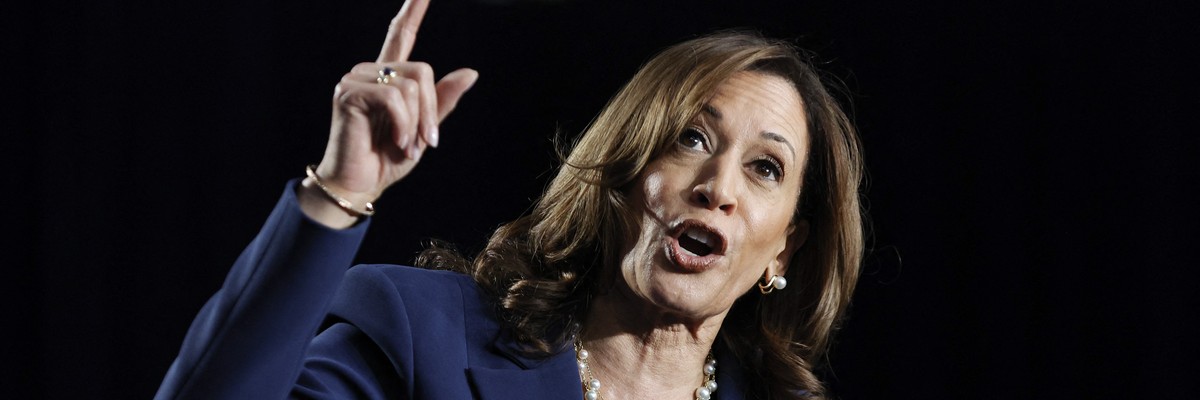
U.S. Vice President Kamala Harris, the presumptive Democratic presidential candidate, speaks at West Allis Central High School during her first campaign rally in Milwaukee, Wisconsin, on July 23, 2024. (Photo: Kamil Krzaczynski/AFP via Getty Images)
“Trump’s promises to Big Oil would sacrifice good-paying jobs that are driving an American energy and manufacturing boom,” said the campaign.
U.S. Vice President Kamala Harris on Wednesday seized on Republican presidential nominee Donald Trump’s close ties to oil executives, taking aim at the promises Trump has directly made to billionaires who have contributed nearly $26 million to his campaign.
Responding to a report from The Wall Street Journal about the record-breaking donations Trump has received from oil magnates for his 2024 campaign as he’s pledged to help them “make an absolute fortune” by continuing to drill for planet-heating fossil fuels, Harris’ newly launched presidential campaign put it bluntly.
“Oil barons are salivating because climate denier Donald Trump promised to do their bidding while asking them to bankroll his run for the presidency,” said Joseph Costello, a spokesperson for the campaign.
The spokesperson noted that Trump has offered oil billionaires the chance to all but control his energy policy should he win a second term, telling them directly at a dinner in May that he would dismantle the oil and gas regulations introduced by Harris and President Joe Biden if the industry raised $1 billion for his campaign.
The Democratic vice president launched her campaign this week after Biden, who had faced pressure to step aside due to his age and health, endorsed her.
“These Big Oil donations solicited by Trump are being investigated as a ‘blatant quid pro quo’ by Senate investigators,” noted Harris in an email to supporters.
In addition, said Costello, “Trump’s promises to Big Oil would sacrifice good-paying jobs that are driving an American energy and manufacturing boom, and instead give billion-dollar handouts to corporations at the expense of working families and a healthy future for our children.”
“These Big Oil donations solicited by Trump are being investigated as a ‘blatant quid pro quo’ by Senate investigators.”
As the U.S. Energy and Employment Report found in 2022, under the Biden administration, renewable energy jobs have grown faster than the overall U.S. economy, paying higher than average wages, and have made up for rising unemployment in the fossil fuel industry.
“Under the Biden-Harris administration, America is more energy independent than ever,” said Costello. “Vice President Harris cast the tie-breaking vote on the Inflation Reduction Act, creating hundreds of thousands of good paying energy jobs and making the biggest climate investment in world history. But Trump promises to dismantle all this progress and sell out America’s future for his own personal gain.”
The vice president condemned the “ready-made executive order” oil lobbyists have already begun drafting for Trump in order to secure “tax handouts, increase costs on Americans, and pollute our environment,” a day after four national climate groups announced their endorsement of Harris.
The League of Conservation Voters Action Fund, the Natural Resources Defense Council (NRDC) Action Fund, the Sierra Club, and Clean Energy for America Action expressed confidence that if she wins the presidency in November, Harris will “raise climate ambition to make sure we confront the climate crisis in a way that makes the country more inclusive, more economically competitive, and more energy secure.”
The Wall Street Journal‘s reporting confirms that “the oil barons have their candidate” in Trump, said Matt Compton, chief of staff for Climate Power. “Thank God those of us who care about a clean energy future have Kamala Harris.”
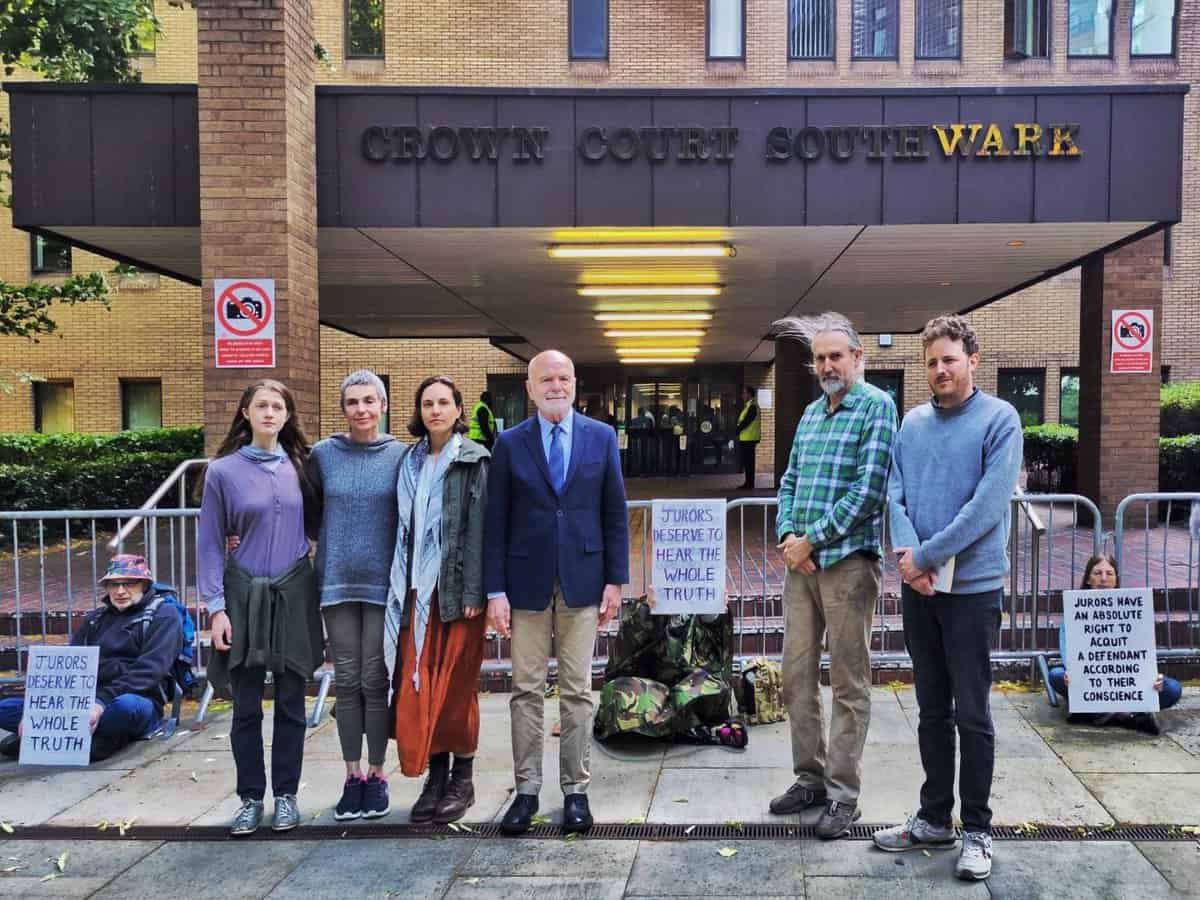
UN Special Rapporteur on Environmental Defenders under the Aarhus Convention Michel Forst attended the trial of five Just Stop Oil supporters at Southwark Crown Court. He attended as an observer because of his serious concerns.
For planning to block a motorway encircling London, five Just Stop Oil activists were recently sentenced to a minimum of four years in prison.
Just Stop Oil wants to end the extraction and burning of coal, oil and gas in the UK by 2030. The group’s demands are consistent with what scientists have said is necessary to limit climate change. The same scientific advice underpins international agreements the UK has signed.
Just Stop Oil’s methods, which include stopping traffic by sitting on roads, are also peaceful. So why are its members facing a long stretch behind bars?
Such a severe sentence for non-violent protest has “no equivalent in modern times” according to Graeme Hayes and Steven Cammiss. Hayes is a reader in political sociology at Aston University while Cammiss teaches law at the University of Birmingham. Both have sat in on several high-profile climate protest cases.
Protesters facing prosecution in England and Wales were once partially protected by what’s known as Hoffman’s bargain. This maintained that the state would show restraint and offer lenient sentences to non-violent protesters deemed to be acting proportionately. Last week’s ruling seems to show that this meagre allowance is now dead.
Just Stop Oil has vowed to continue its campaign of disruptive protest.
The Court of Appeal reaffirmed that Hoffman’s bargain should apply to such cases in 2021 with a ruling that exonerated the Stansted 15, protesters who obstructed a Home Office deportation flight in 2017. However, the court rejected the Stansted 15’s “necessity defence”, the argument that they were obliged to do what they did to avoid a greater harm. This precedent has been upheld in subsequent cases, including climate protest trials.
Conspiracy to cause public nuisance, which the Just Stop Oil five were found guilty of, is a relatively new offence (introduced in the Police, Crime, Sentencing and Courts Act 2022) that carries a maximum prison term of ten years. People who feel compelled to take part in disruptive protest due to the existential threat of climate change risk a decade in jail without being able to explain their actions to a jury.
“The legal philosopher Antony Duff suggests that criminal cases are a means of holding fellow citizens to account for their behaviour,” Hayes and Cammiss say.
“A trial fails in this regard if it doesn’t let defendants account for their behaviour in ways that are meaningful to them.”
UK anti-protest law is now so restrictive that even minor concessions seem like major victories. Retired social worker Trudi Warner was cleared of contempt of court in April for holding a placard outside London’s Old Bailey, affirming the right of juries to acquit based on their conscience. The result was lauded as a “huge win for democracy” by civil liberty campaigners.
The reality is far from comforting and should in fact trouble everyone, says Emily Barritt, a senior lecturer in environmental law at King’s College London:
“Punishing protesters won’t solve the problems that they are highlighting. Lethal air, filthy rivers, collapsing food chains, the climate crisis – these problems will all continue unabated, and soon become much more inconvenient than having to get off the bus to walk the last mile to work.”
Roads are sacred, the climate less so
Should the right of motorists to travel unimpeded take precedence over a collective demand for a liveable climate? Whatever most people think, the archetypal “angry motorist” is a constituency which Britain’s political elite appear eager to woo.
Labour proclaimed itself the only party “truly on the side of drivers” at the recent election, fending off an accusation from the Conservative party that Keir Starmer had “declared war on motorists across Britain”.
Matthew Paterson, a professor of international politics at the University of Manchester, sees this as a strategy of the political right to remain relevant as the climate crisis unfolds – a bet that the public will baulk at the necessary disruption of decarbonisation.
Yet channelling Britain’s road rage did not prevent an electoral wipeout for Rishi Sunak and the Conservatives. Rebecca Willis, a professor in energy and climate governance at Lancaster University, was unsurprised.
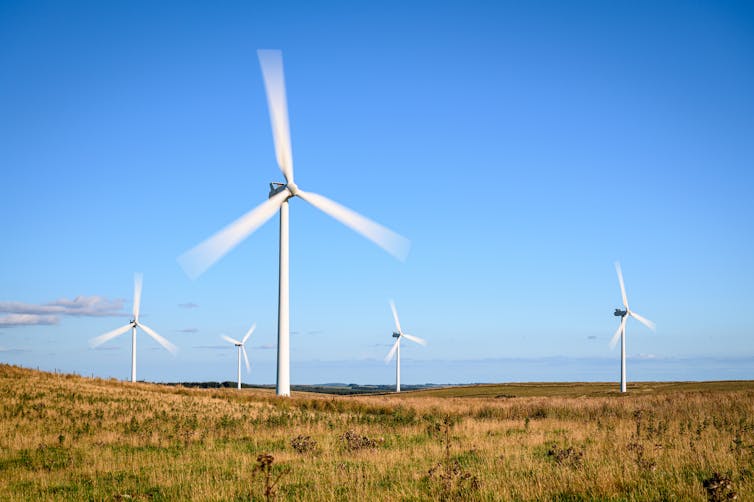
Action on climate change commands broad public support in the UK. Dave Head/Shutterstock
“The Conservatives’ private polling must have confirmed what public opinion research has consistently told us: there are vanishingly few votes to be won through an agenda of delaying action on climate change,” she says.
Hayes and Cammiss also note the result of a snap poll which showed 61% of respondents considered the record jail sentences for the five Just Stop Oil activists too harsh.
Public consent for the UK’s crackdown on peaceful protest cannot be taken for granted. Even so, Oscar Berglund, a researcher in political economy at the University of Bristol, expects more and longer prison sentences for protesters.
“These are political sentences and climate activists [have] become political prisoners,” he wrote via email.
“Removing the politics of climate change from the courtroom doesn’t change that.”
The Conversation would like to thank our readers and subscribers for their continued support after Imagine won best science newsletter of the year at the Publisher Newsletter Awards.
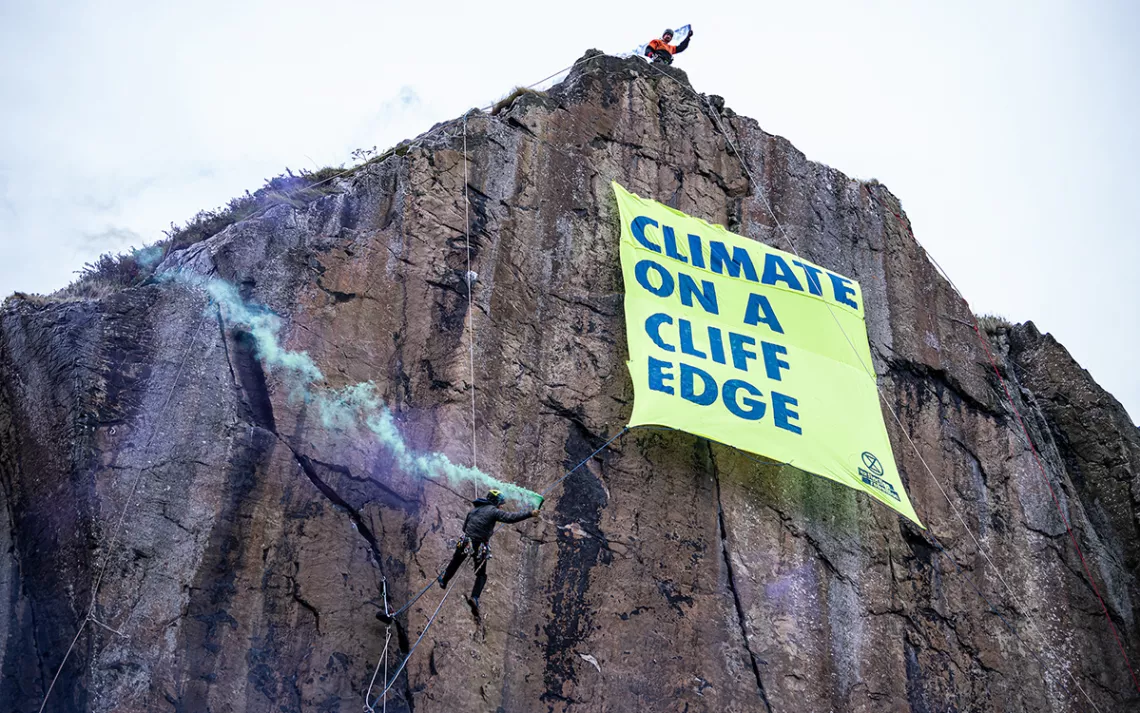
Experienced climbers scale a rock face near the historic Dumbarton castle in Glasgow, releasing a banner that reads “Climate on a Cliff Edge.” One activist, dressed as a globe, symbolically looms near the edge, while another plays the bagpipes on the shores below. | Photo courtesy of Extinction Rebellion and Mark Richards