With the UK creeping out of recession, here’s an economist’s brief guide to improving productivity

Spread the love
Keep on digging. kstuart/Shutterstock

Nigel Driffield, Warwick Business School, University of Warwick

At the end of last year, the UK was officially in recession. The economy shrank by 0.3% between October and December 2023, after a previous contraction between July and September.

New figures for January 2024 show a slight improvement. But there is nothing to indicate that the UK has made meaningful progress when it comes to productivity growth – and how the UK needs to produce more goods and services if living standards and wages are to improve.

Productivity growth in the UK has been virtually non-existent since the financial crisis of 2008. It lags significantly behind countries like Germany and France, and even further behind the US.

Growing productivity is not easy. Having researched this area of the economy extensively, I’m acutely aware of the the challenges facing firms which are trying to be more productive. They include everything from investment levels and access to research and development to regional inequality and a shortage of skills.

But there are some things that could be done to improve the situation. And two of the most important ones are greater investment, and a more localised approach to the national economy.

For example, one major problem in the UK is that its labour market prioritises what economists call “flexibility” – allowing firms to hire and fire employees fairly easily (compared say with France, where it is more difficult) – and getting people into entry-level jobs. It is much less focused on training and development.

Major investment in training at all levels, from basic skills through to high-level technical and managerial skills, would make workers more productive. It would allow greater job mobility, which in turn leads to a better match between demand and supply.

The UK also needs to invest in what’s known as “capital equipment” – the stuff that businesses use to produce things. For a building company this might mean buying a JCB digger instead of shovels, or for a dressmaker it could be buying a sewing machine. Put simply, if UK industries had more kit, productivity would improve.

A recent change to capital allowances which allows firms to offset investment against tax is welcome. But companies need to know that this will stay, and not be subject to political changes and inconsistent economic policy.

Freedom to grow

So money needs to be spent, and investments need to be made. But another crucial element is that the money needs to be invested locally, in the places where people actually live and work.

To be truly beneficial, this needs close collaboration between local authorities, education providers and the private sector. Local knowledge about where certain sectors are being held back, what skills are required and where they are needed, is fundamental.

Local authorities should be able to address these issues, rather than having to constantly defer to London. This means doing two more things (neither of which have ever had national government support).

The first is simplifying the workings of local government, which is notoriously complex and a constant drag on regional productivity.

And the second is helping those local governments financially, not just in terms of the current funding crisis, but also by allowing then to plan investments in skills and infrastructure over the long term, rather than having to bid piecemeal for short term funding.
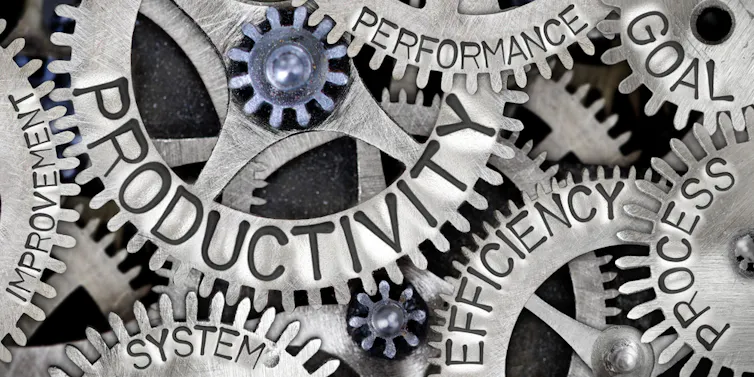
Labelled cogs in a machine.
Everything connects. EtiAmmos/Shutterstock

It is clear to me from the work I have done in the West Midlands area of England that the UK economy is far too centralised. Everything from access to finance and venture capital, to investment in skills and infrastructure is heavily skewed towards the south east.

Away from that region, the UK has a low level of what economists call “aglomeration economies”, where a particular industry is concentrated within a geographical area, and supported by decent infrastructure and a good supply of skilled workers.

Compared to Germany or France, public transport in the UK is expensive and patchy, meaning people in towns often can’t access employment opportunities in cities which are relatively close by. This means that we see high levels of inequality over short distances, where poverty exists close by to great wealth.

This kind of imbalance could be addressed by combining increased investment (both public and private) with a much greater willingness to understand the various British regions which make up a currently disunited kingdom. These two steps would make the whole economic system more resilient, and in the long term, more productive.

Nigel Driffield, Professor of International Business, Warwick Business School, University of Warwick

This article is republished from The Conversation under a Creative Commons license. Read the original article.
Continue ReadingWith the UK creeping out of recession, here’s an economist’s brief guide to improving productivity

Tens of thousands demand end to child poverty and Israel’s massacre at Durham Miners’ Gala

Spread the love

https://morningstaronline.co.uk/article/tens-of-thousands-demand-end-to-child-poverty-and-israel-massacre-at-durham-miners-gala

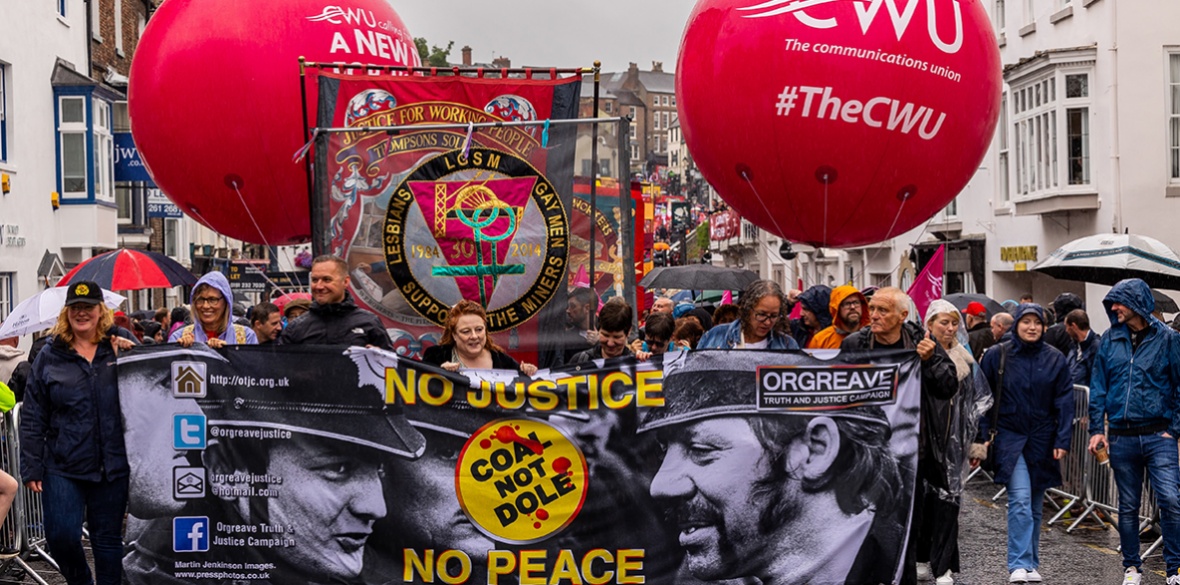
Marchers at the Durham Miners’ Gala, July 13, 2024 Photo: Neil Terry / neilterryphotography.co.uk

DEMANDS for action by the Labour government to end child poverty, end arms sales to Israel and abolish all Tory anti-trade union laws were cheered at the 138th Durham Miners’ Gala.

The gala crowd of tens of thousands roared on Saturday as speakers called on Labour to use its record 172-seat majority in the Commons to transform society for working people in Britain.

Speakers called on the government to end arms sales to Israel and Britain’s complicity in the continuing slaughter in Gaza.

The 138th Durham Miners’ Gala began with the traditional marching of dozens of proudly raised trade union and campaign banners and brass bands through the streets of the city to the gala field for Durham Miners’ Association’s (DMA) Big Meeting.

The gala celebrated the 40th anniversary of the miners’ strike against pit closures, and Matt Wrack, general secretary of the Fire Brigades Union (FBU), praised the courage of the miners for the strike which he said “has been vindicated ever since.”

He said the strike had also seen the power of the state unleashed.
“They used the press to lie, the police to batter, the courts to lock people up for defending their jobs and communities,” he said.

He warned: “That was the message from the boss class in 1984-5.

https://morningstaronline.co.uk/article/tens-of-thousands-demand-end-to-child-poverty-and-israel-massacre-at-durham-miners-gala

Continue ReadingTens of thousands demand end to child poverty and Israel’s massacre at Durham Miners’ Gala

London calls on incoming Labour government to end Israel’s genocide in Gaza

Spread the love

Original article republished from peoples dispatch under a Creative Commons Attribution-ShareAlike 4.0 (CC BY-SA) license.

July 6 was the 16th national march which took place in London since the genocide in Gaza began on October 7.

On July 6th, more than 100,000 people marched in London, UK, in solidarity with the people of Palestine. Organized by the Palestine Solidarity Campaign and the Stop the War coalition, the event also saw participation from five recently elected independent MPs, who focused their campaign on the struggle for Palestinian liberation. The demonstrators called on the newly elected Labour government, led by Keir Starmer, to take action to end the genocide. Here is our report from the ground.

Original article republished from peoples dispatch under a Creative Commons Attribution-ShareAlike 4.0 (CC BY-SA) license.

Continue ReadingLondon calls on incoming Labour government to end Israel’s genocide in Gaza

Macron alleges “nobody won” French elections, sparking ire

Spread the love

Original article by Ana Vračar republished from peoples dispatch under a Creative Commons Attribution-ShareAlike 4.0 (CC BY-SA) license.

Emmanuel Macron and Keir Starmer at NATO summit, July 2024. Source: Emmanuel Macron/X

In a letter to voters, Emmanuel Macron appears to downplay the results of the general election in France and stated that “nobody won”

“In the end, nobody won,” President Emmanuel Macron remarked in an open letter published on July 10, describing the outcome of France’s general election. However, the New Popular Front (NFP), a left-progressive coalition, secured over 180 seats in Parliament, emerging as the largest group. As most would put it, the NFP won the elections.

Macron’s letter has sparked rage and incredulity, with many claiming that the president is undermining essential democratic mechanisms. At the very least, he seems to be gaslighting millions of voters who mobilized to keep the far-right from power.

Despite their victory, the NFP lacks an absolute majority. This means that the left would have to build support for its program among opposition parties. Failure to do so could plunge France into chaos and exacerbate the cost of living crisis and other issues (largely stemming from Macron’s policies), according to mainstream analysts.

Capitalizing on this fear, Macron is now calling on political forces that “uphold republican institutions, the rule of law, parliamentarianism, a European orientation, and French independence” to set aside differences and form a joint program for the country’s benefit. His appeal excludes the far-right National Rally, the third-largest group in parliament, but also appears to marginalize the left-wing France Unbowed (LFI).

During the campaign, Macron and his allies repeatedly equated the “far-left” with the far-right, despite an ongoing agreement that the priority of the election was preventing a National Rally victory. Yet, voters strongly supported France Unbowed, making it the most represented partner in the NFP. In response to Macron’s so-called call for unity, France Unbowed members reiterated their commitment to the existing NFP program, which gained significant voter support but excludes Macron’s ideas.

“We were told we won’t be able to achieve unity, and we did. We were told we won’t be able to come up with a program. We did, and we’re the only ones to have numbers to back it. We were told we wouldn’t win, and we won. We will succeed in proposing a prime minister and a government,” Éric Coquerel from France Unbowed stated on Thursday.

Read more: Macron delays mandate for New Popular Front

Since the election results were announced at the beginning of the week, Macron has taken steps to delay the scenario Coquerel describes. He has asked current Prime Minister Gabriel Attal to stay on a bit longer after offering his resignation. By publishing the letter, Macron may be buying more time to see if parts of the NFP can be persuaded to abandon the mandate given to them by the people and join the liberals, excluding France Unbowed. Signs of his success will emerge in the coming days, with the NFP’s potential announcement of a prime minister candidate and the first parliamentary session on July 18.

Original article by Ana Vračar republished from peoples dispatch under a Creative Commons Attribution-ShareAlike 4.0 (CC BY-SA) license.

Continue ReadingMacron alleges “nobody won” French elections, sparking ire

Government urged to crack down on protest by ‘independent’ pro-Israel adviser

Spread the love

https://morningstaronline.co.uk/article/government-urged-crack-down-protest-independent-pro-israel-adviser

People take part in a pro-Palestine march in central London organised by the Palestine Solidarity Campaign, July 6, 2024

LABOUR Friends of Israel’s former chair Lord Walney called on ministers today probe candidate intimidation in the run-up to the general election.

The government’s so-called independent adviser on political violence alleged that a series of events before July 4 were part of a “concerted campaign by extremists.”

Aka John Woodcock, the former MP — who switched to Boris Johnson’s Tories in 2019 — has urged parliamentarians to to take a “zero-tolerance approach” with pro-Palestine groups and climate protesters, as well as accepted Israel lobby funding amid the Gaza genocide.

In a letter shared with the BBC, he has called on Yvette Cooper and Security Minister Dan Jarvis to commission a short inquiry to find out if groups in different constituencies were working together and to document what he calls the “dark underbelly” of abuse.

He wrote that evidence in the past few months suggested an intentional campaign “by extremists to create a hostile atmosphere for MPs” within their constituencies to pressure them to “cave in to political demands.”

It comes as pro-Israel Labour figures were accused of mischaracterising questioning by Palestine protesters in a bid to shirk political accountability for their support of the ongoing Gaza massacre.

https://morningstaronline.co.uk/article/government-urged-crack-down-protest-independent-pro-israel-adviser

Continue ReadingGovernment urged to crack down on protest by ‘independent’ pro-Israel adviser