Nearly one million people only £10 a week away from poverty, study finds

Spread the love
Image of cash and pre-payment meter key

https://www.bigissue.com/news/poverty-uk-joseph-rowntree-foundation-general-election/
There have been six prime ministers since this country last made sustained progress on reducing poverty

Nearly one million people in the UK are only £10 a week away from poverty, a study has found, in what has been called a “stain on the moral conscience of our nation”. 

Analysis from poverty charity Joseph Rowntree Foundation (JRF) has revealed that alongside the estimated 14.2 million people in poverty in the UK, further millions are “teetering on the edge” and unable to afford essentials. 

The JRF’s research found that just under a million people, including 200,000 children, are now within £10 a week from the poverty line. 

An additional 3.2 million people in the UK – equivalent to the population of Wales – are only £40 a week from deep poverty. 

The charity added that seven million households across the country had gone without essentials, like showers, toiletries or adequate clothing, in the last six months – or had gone hungry, or cut or skipped meals in the last 30 days. 

For those already in poverty, large numbers are close to “deep” or “very deep” poverty lines, meaning they are living on incomes of less than 50% or 40% of the UK average.

Around six million people were reported as living in very deep poverty in 2022/23, which is 1.5 million more than two decades ago.

Politicians are missing a ‘level of urgency’ on poverty

The JRF’s CEO Paul Kissack called on the government to act on rising poverty levels, as well as those “teetering on the edge” of poverty, telling whoever wins the general election on 4 July to “make reversing this dismal trend a priority”. 

“There have been six prime ministers since this country last made sustained progress on reducing poverty,” he explained, referencing when poverty last fell consistently in the UK, between 1999/2000 and 2004/2005 under Tony Blair. 

“During that time we’ve seen a sustained rise in the number of people in deep poverty, with hardship and destitution growing even faster.”

He added: “Our political leaders must be specific and ambitious about how they will tackle poverty. But so far there hasn’t been anything like the level of urgency from either Rishi Sunak or Keir Starmer that we need to see. Pointing to future growth as a panacea just won’t cut it.  

“Tonight’s (4 June) debate is a chance for both leaders to set out their plans and demonstrate they are serious about addressing hardship. Failure to act is a political and moral choice ≠ and one they should expect to be judged on.” 

https://www.bigissue.com/news/poverty-uk-joseph-rowntree-foundation-general-election/
Continue ReadingNearly one million people only £10 a week away from poverty, study finds

Conditions ‘Unspeakable’ as Israeli Onslaught Forces Over 1 Million to Flee Rafah

Spread the love

Original article by EDWARD CARVER republished from Common Dreams under Creative Commons (CC BY-NC-ND 3.0). 

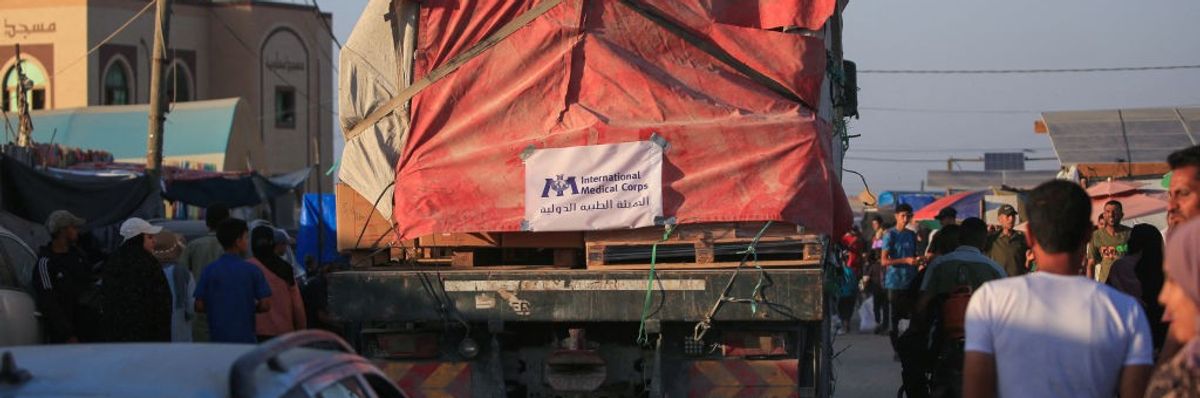
A truck is used to evacuate the International Medical Corps American field hospital in Rafah in the southern Gaza Strip on June 2, 2024.
 (Photo: Eyad Baba/AFP via Getty Images)

“Public health concerns are beyond crisis levels” in the areas where Palestinians have been forced to shelter, and “the sounds, the smells, the everyday life, are horrific and apocalyptic,” a U.N. official said.

More than 1 million Palestinians have fled Rafah as the city comes under a continued Israeli assault, forcing many to shelter in badly damaged buildings in the nearby city of Khan Younis, according to the United Nations.

The assault on Rafah, a city in the southern Gaza Strip, has left the displaced in “unspeakable” conditions, the United Nations Relief and Works Agency for Palestine Refugees in the Near East (UNRWA) said on social media. Approximately 1.7 million displaced people are now in Khan Younis and “Gaza Middle Areas,” according to UNRWA.

Khan Younis, which saw sustained fighting earlier in the war, still does not appear to be a safe zone: Israeli military vehicles entered the city in recent hours after advancing to two towns just east of Khan Younis with “heavy gunfire and artillery shelling,” Al Jazeerareported.

Since early May, the Israel Defense Forces (IDF) has issued evacuation orders for parts of Rafah, telling people to go to an “expanded humanitarian zone” in Al-Mawasi, located roughly 12 miles from the city.

Israeli forces subsequently launched attacks on designated safe zones, including in Al-Mawasi. Two strikes killed 45 and 21 people last week, mostly women and children. The first of the attacks, known as the “tent massacre,” was carried out with U.S. weapons, later analysis showed.

Many of the people fleeing Rafah are having to move for at least the second time during the war. Roughly 1 million Palestinians who’d been displaced elsewhere had gone to Rafah for refuge earlier in the war. They began to leave Rafah nearly four weeks ago as Israeli started its assault on the city. Before the war, Rafah’s population was about 275,000, but the governorate reached a population of 1.4 million by February as Israel ordered Palestianians to move there from northern Gaza. This meant squeezing more than half of Gaza’s prewar population of 2.3 million into one governorate, NPR reported.

More than 18,500 pregnant women have been forced to leave Rafah, while about 10,000 pregnant women remain in the city in “desperate conditions,” the U.N. reported.

“They’re exhausted, traumatized, dehydrated, and malnourished,” the U.N. Population Fund wrote on social media of pregnant women dealing with “Israel’s terrifying military operation in Rafah.”

“Pregnant women in Gaza are living in an unrelenting nightmare,” the agency added.

After successive operations last month, Israel now controls the entire Gaza-Egypt border. Humanitarian corridors have shut down, with many agencies and aid groups pausing operations in Rafah due to lack of supplies and security concerns.

“We are living and working precariously in the south,” Matthew Hollingsworth said, World Food Program (WFP) country director in Palestine, said late last week, the U.N. reported. The areas where the displaced have been forced to shelter are nightmarish, he said.

“Public health concerns are beyond crisis levels” and “the sounds, the smells, the everyday life, are horrific and apocalyptic,” Hollingsworth added.

More than half of the structures in the Gaza Strip have been damaged, destroyed, or possibly destroyed during the eight-month Israeli assault, the United Nations Satellite Centre (UNOSAT) concluded, in findings released Monday.

The mass displacement from Rafah continued as the Biden administration sought to arrange a cease-fire after after being pressured for months to end its military support for Israel’s onslaught. President Joe Biden called for an end to the war on Friday and backed a roadmap to a deal, which drew praise from Palestine defenders—the Council on American-Islamic Relations called it “long overdue” and a “positive step”—as well as criticism that it did not address the root causes of the conflict.

Israeli Prime Minister Benjamin Netanyahu said Monday that the deal would not stop the war, which could not end until “total victory” had been achieved, according to Israeli National News.

Original article by EDWARD CARVER republished from Common Dreams under Creative Commons (CC BY-NC-ND 3.0). 

Continue ReadingConditions ‘Unspeakable’ as Israeli Onslaught Forces Over 1 Million to Flee Rafah

The World’s Largest Funder of Fossil Fuel Expansion

Spread the love

Original article by ALEC CONNON republished from Common Dreams under Creative Commons (CC BY-NC-ND 3.0). 

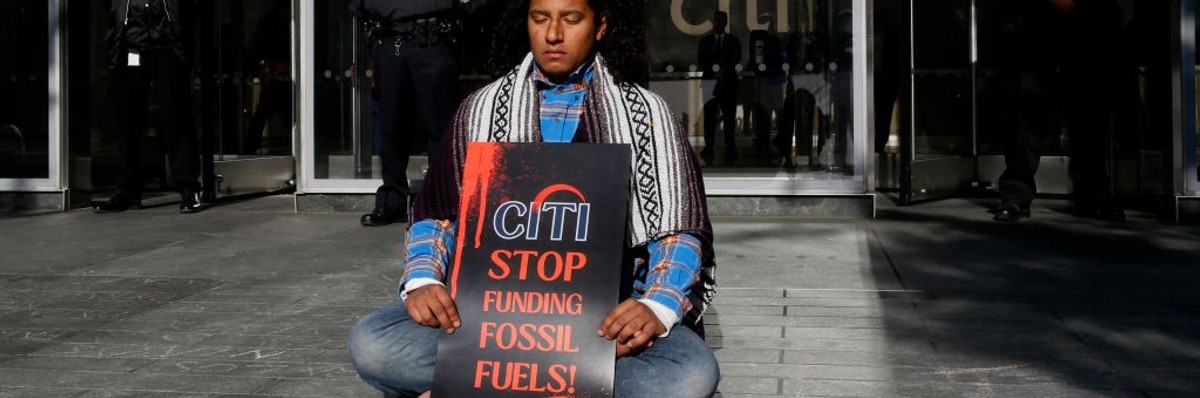
Environmental activist protest outside CitiBank Headquarters in New York City on April 25, 2023, calling for an end to fossil fuel financing.
 (Photo by Leonardo Munoz / AFP via Getty Images)

Here’s why we will be using our bodies to shut down Citibank’s global headquarters over and over again, this summer.

This summer, along with dozens of others, I’ll be helping to run the Summer of Heat on Wall Street, a campaign of sustained nonviolent civil disobedience against the banks, investors, and insurance companies financing fossil fuel expansion.

As we have written about here already, our plan is simple: using our bodies, we will continually blockade the New York headquarters of the Wall Street giants bankrolling coal, oil, and gas expansion; week after week, we will disrupt the companies disrupting our climate and our planet.

We’re targeting several companies―including the insurance company, Chubb, and the private equity group, KKR―but our number one target will be Citigroup. Here’s why.

Since the adoption of the Paris Agreement in 2015, Citi has provided $204.46 billion in financing to the company’s most rapidly developing new coal, oil, and gas fields. Remarkably, Citi has provided more money to those oil and gas companies than even JPMorgan Chase―the bank that climate activists like to call the “Doomsday Bank.”

To be clear, I’m talking here only about the financing Citi has provided for companies developing new oil and gas reserves, not merely investing in infrastructure to keep the oil pumping from existing reserves. When we take into account financing to all fossil fuel companies, Citi has provided a little shy of $400 billion to coal, oil, and gas companies since 2015. But focusing on expansion is important.

Numerous climate experts, from the International Energy Agency to the Intergovernmental Panel on Climate Change, have made it clear that to stave off the worst of climate catastrophe, there must be no investment in new fossil fuel expansion. But last year alone, Citibank provided $14.6 billion to the companies most rapidly expanding their coal, oil, and gas operations.

Citibank’s financing of fossil fuel expansion not only drives climate chaos, it also results in environmental racism. To give just one example, 70% of the air pollution generated by ExxonMobil is dumped on communities of color, contributing to the higher levels of heart disease, strokes, cancer, and other illnesses that are widely associated with living near oil and gas infrastructure.

Citibank’s top fossil fuel client is ExxonMobil. Yet when asked by Congress if she knew what environmental racism was, Citi CEO Jane Fraser replied: “Only vaguely.”

Not content with merely financing fossil fuels, Citi also works to block climate action both from its own investors and the U.S. government.

CEO Jane Fraser is chair of a group called the Financial Services Forum and a board member of the Bank Policy Institute, groups that have fought tooth and nail to weaken climate-financial regulation advanced by the Biden Administration. Citi also donates to several high-profile politicians who work against action on climate, including Congressman Andy Barr who has led the charge in a series of fossil fuel-backed, right-wing attacks designed to prevent the financial industry from taking action on climate.

For the past three years, Citi has faced a shareholder resolution from investors calling for a report on how the bank ensures that the oil, gas, and mining companies it finances respect Indigenous rights and sovereignty. Yet, in spite of Ms. Fraser’s previous claims in 2020 that Citi was committed to being ”an anti-racist institution,” Citi has fought the resolution each year, urging investors to vote against it, even as they remain one of the world’s largest funders of oil and gas in the Amazon rainforest.

Besides its role in the climate crisis and environmental racism, there are plenty other reasons to be angry at Citibank, too. In the early 20th century, Citi actively lobbied the US government to invade and occupy Haiti, which it promptly did, resulting in decades of bloodshed and misery for Haitians. A century later, Citi did as much as any bank to cause the financial crisis of 2008, which led to nearly 3.8 million Americans losing their homes; no bank received a larger bailout from the government than Citi.

And then there’s the fact that Citi is the foreign bank with the largest presence in Israel and a major financier of weapons manufacturers that are currently providing Israel with fighter jets and missiles being used to massacre Palestinians.

All of this is why Citibank is our number one target this summer.

To kick off the campaign, we will disrupt and shut down Citibank’s headquarters in Manhattan every day, all week long. We start on Monday, June 10th. We hope that you join us.

Original article by ALEC CONNON republished from Common Dreams under Creative Commons (CC BY-NC-ND 3.0). 

‘Just The Beginning’: 50+ Arrested For Blockading Citigroup Bank Over Climate Crimes ›

Continue ReadingThe World’s Largest Funder of Fossil Fuel Expansion

Greens call for real change to deliver energy security

Spread the love
Green Party Co-leader Adrian Ramsay. Wikipedia CC.

Responding to Labour’s announcement on energy and security, Green Party co-leader Adrian Ramsay said:  

“The road to national energy security must lead to real change – a turn away from fossil fuels and a massive investment in renewable energy generation and energy saving programmes like home insulation delivered through local authorities right across the country. 

“Anything less – and Labour is offering much less – will leave people with higher bills and do nothing to solve the climate crisis that is leaving communities up and down the land vulnerable. 

“It is Labour’s lack of ambition and refusal to make the real change needed that is leaving us all less secure. 

“Compared to Labour’s original commitment to spend £28bn a year on green investment, Labour plans to spend just £8.3bn over the course of the parliament.  

“That is nowhere near enough to deliver energy security.   

“Labour’s targets focus on the electricity supply. However, to achieve net zero we need to see the electrification of home heating. This aim was ditched when Labour cancelled its £28 billion investment pledge.” 

Continue ReadingGreens call for real change to deliver energy security