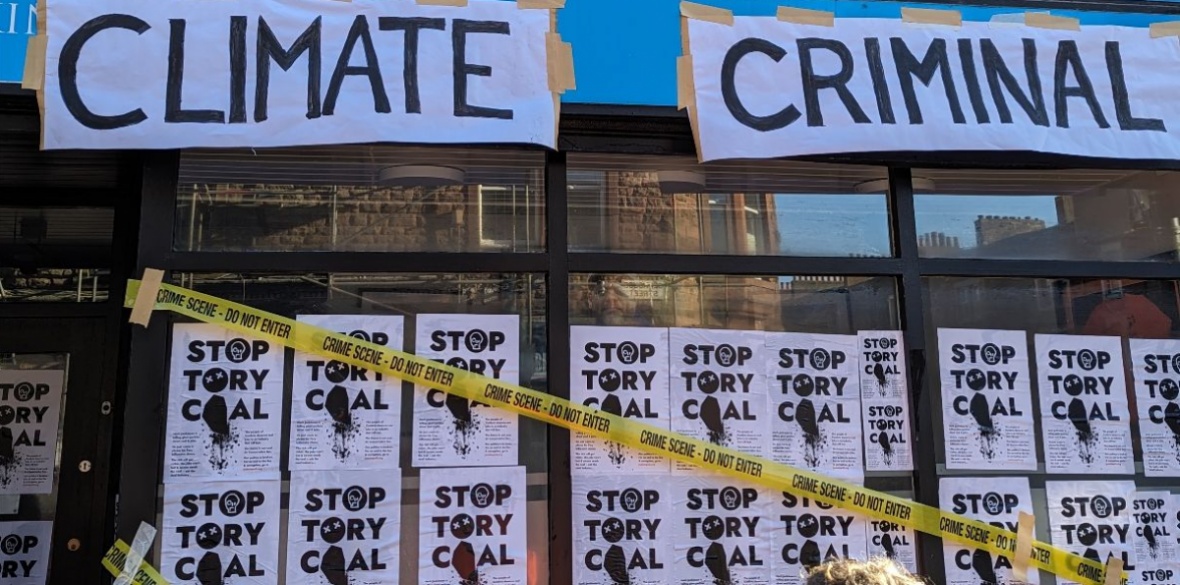
A TORY MP clashed with protesters after arriving at his office to find it plastered with posters and swathed in police “crime scene” tape over his support for a new coalmine in Cumbria.
Police were called as Workington MP Mark Jenkinson challenged Just Stop Oil campaigners outside his office this morning.
Plans for a coalmine in Cumbria have sparked repeated protests including by environment campaign Friends of the Earth and Mr Jenkinson’s own constituents.
Government approval for the mine was given in 2022.
Mr Jenkinson is an outspoken supporter of the project, arguing that it is needed to supply the steel industry.
Protester Alison Parker, 41, who is one of Mr Jenkinson’s constituents, said: “I am sick of Mark Jenkinson telling constituents like me that the coalmine is needed by the steel industry, and that it will be carbon-neutral.
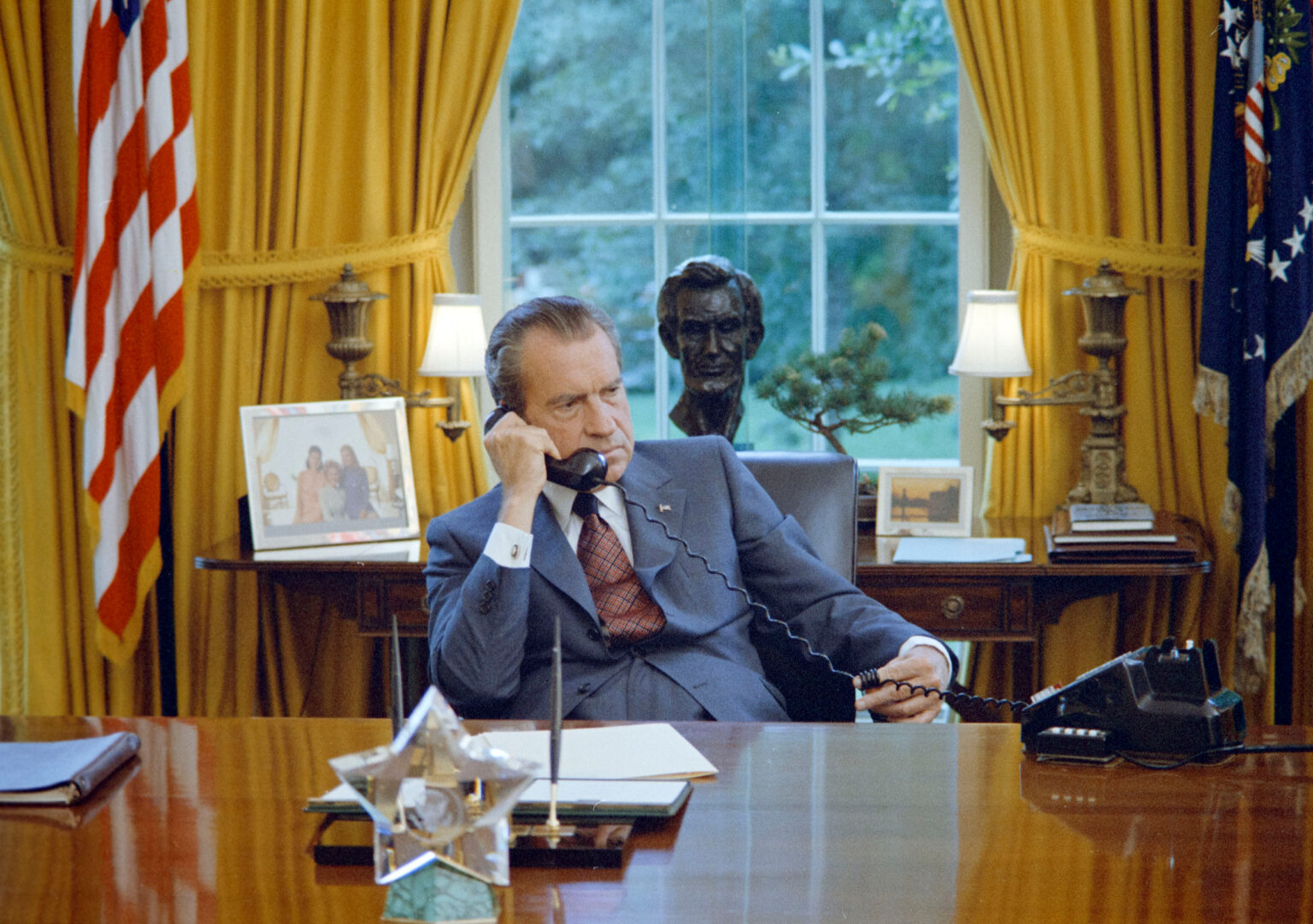
A newly revealed research proposal from 1971 shows that Richard Nixon’s science advisors embarked on an extensive analysis of the potential risks of climate change. Credit: Oliver Atkins/National Archives
A 1971 plan for a global carbon dioxide monitoring network never came to fruition. The proposal is detailed in a document newly unearthed by the National Security Archive.
In 1971, President Richard Nixon’s science advisers proposed a multimillion dollar climate change research project with benefits they said were too “immense” to be quantified, since they involved “ensuring man’s survival,” according to a White House document newly obtained by the nonprofit National Security Archive and shared exclusively with Inside Climate News.
…
It has long been known that Nixon’s advisers warned him of the risks of global warming. A tranche of documents released by the Nixon Presidential Library in 2010 showed that his then-adviser Daniel Patrick Moynihan urged his administration to engage with the issue as early as 1969. Moynihan, who later served 24 years as U.S. Senator from New York, noted that sea level rise of 10 feet was possible with a 7-degree Fahrenheit (3.9-degree Celsius) temperature increase. “Goodbye, New York,” he wrote. “Goodbye Washington, for that matter.”
But the newly revealed Dec. 20, 1971, research proposal by the White House Office of Science and Technology shows for the first time that Nixon’s science advisors embarked on an extensive analysis of the potential risks of climate change and an assessment of the data needs.
…
“No analysis is feasible. Benefits are immense, but not quantifiable, since this element contributes to ensuring man’s survival.”
Under a section marked “cost-benefit analysis,” the authors wrote, “No analysis is feasible. Benefits are immense, but not quantifiable, since this element contributes to ensuring man’s survival.”
Nixon’s aides proposed that the government embark on development of new instruments using lidar, or light-detecting and remote sensing—a technology then less than a decade old—to better measure carbon in the atmosphere. They were correct on the advantages of lidar, but it would be more than four decades until scientists at NASA and around the world began to implement its use to study not just the concentration of carbon dioxide, but its global distribution and daily variations.
“I felt like this document was really ahead of its time,” Santarsiero said.
Decades before a scientific consensus emerged on climate change, Nixon’s science advisers conveyed an understanding of the risks. Research, they wrote, would assist in “taking of protective measures against potential natural disasters such as large-scale inundation of low-lying coastal regions, broad extensions of ice sheets and severe health hazards.”
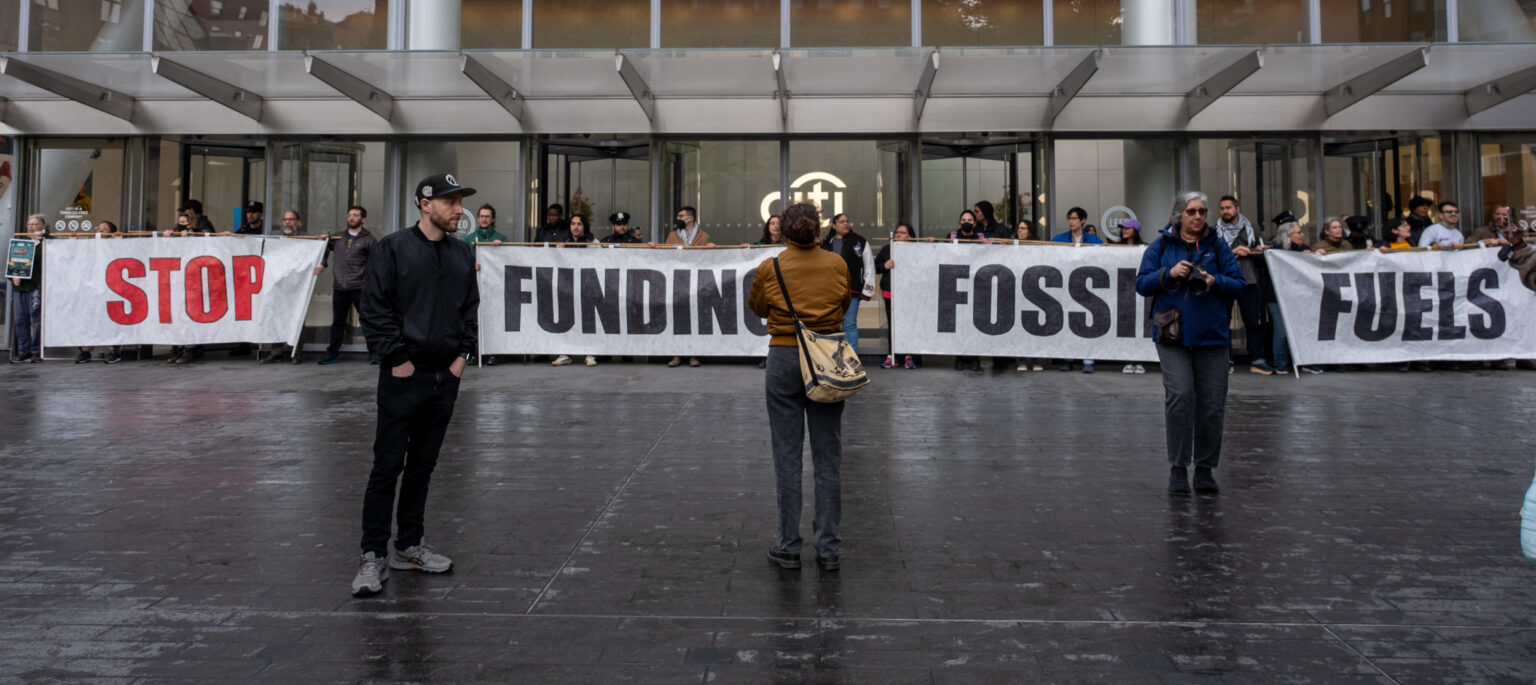
During a demonstration at Citibank’s headquarters in Manhattan on Wednesday, 33 protesters were taken into custody, including Rachel Rivera (center), a board member with New York Communities for Change. Credit: Keerti Gopal/Inside Climate News
Campaigners pressuring Citibank say they see the bank as potentially movable on its funding of fossil fuels, citing the company’s commitments to sustainability.
NEW YORK—Climate demonstrators blocked entrances to Citibank’s headquarters in Manhattan at the start of the workday on Wednesday and Thursday, part of a series of Earth Week actions pressuring the bank to end its financing of fossil fuels. On both mornings, it took the New York Police Department less than 10 minutes to start making arrests.
Climate activists, citing Citibank as the second largest financier of fossil fuels in the world, are engaged in a multi-year campaign to pressure the bank to stop financing oil, gas and coal projects. The week’s protests follow a mock environmental justice hearing at a New York church on Monday, where advocates spoke about the health harms and human rights violations of Citibank-financed fossil fuel projects in Peru, Canada and domestically. The New York demonstration was timed alongside actions in Seoul, South Korea, Melbourne, Australia, Jakarta, Indonesia, Belfast, Northern Ireland, and Dallas that also targeted Citibank’s financing of coal, oil, natural gas and military projects.
At about 8:15 Wednesday morning, activists holding four large white banners that together read “Stop Funding Fossil Fuels” blocked the main entrance to Citibank’s headquarters while smaller groups of demonstrators stood outside other entrances to the building. Police began taking protesters into custody at 8:30 and arrested approximately 33 activists for disorderly conduct at Wednesday’s protest, according to activists and the office of NYPD’s deputy commissioner of public information.
Protesters barricaded the main entrance to Citibank’s headquarters in Manhattan on Wednesday morning. Credit: Keerti Gopal/Inside Climate News
…
Campaigners have said that, since 2016, Citibank has provided $332 billion in fossil fuel financing, and calculate that the bank has given $1.85 billion in financing to oil and gas operations in the Amazon since 2009 and $1.78 billion in financing to ConocoPhillips, the company behind the contentious Willow Project.
‘Served its purpose’: Humza Yousaf ends power-sharing deal with Greens – video
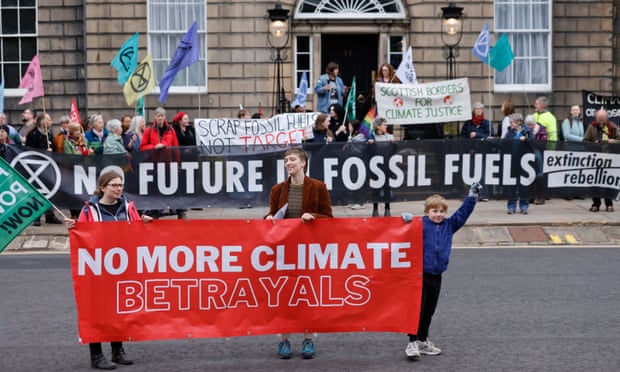
The historic power-sharing agreement between the Scottish National party and Scottish Greens is to end after a crisis over the government’s climate strategy.
Scotland’s first minister, Humza Yousaf, said he had told the Scottish Green co-leaders he was terminating the Bute House agreement with immediate effect.
It means the Green co-leaders, Lorna Slater and Patrick Harvie, are no longer part of the Scottish government and the SNP will operate as a minority administration.
The Bute House agreement was signed in August 2021 by the then SNP leader, Nicola Sturgeon, and Harvie, bringing the Greens into government for the first time in the UK.
Yousaf, Sturgeon’s successor as first minister, convened an emergency cabinet meeting early on Thursday after SNP backbenchers began openly attacking the deal.
Coordinated withdrawal agreed after several member states and UK have quit energy charter treaty
European lawmakers have voted to escape a treaty that lets investors sue governments in private courts for pursuing policies that stop the planet from heating.
Fossil fuel companies have used the energy charter treaty (ECT), an international trade agreement from the 1990s, to demand billions of euros of taxpayers’ money in opaque tribunals set up to protect investors.
Several European countries have already announced their exit from the treaty but efforts to coordinate an EU-wide withdrawal had met resistance from member states.
Anna Cavazzini, a German MEP from the Green group who was in charge of the proposal, said the “absurd” treaty had slowed down climate protection and cost billions in taxpayers’ money.
“International fossil fuel investors no longer have the option of bypassing ordinary courts and attacking climate policy with extrajudicial lawsuits,” she said.
Energy companies have sued governments for profits that they expect to have lost through decisions such as phasing out coal and banning offshore oil exploration.
Even as scientists have warned that the supply of fossil fuels must drop sharply to prevent extreme weather from growing more violent, governments seeking to curb the industry’s expansion have found themselves under attack from investors.