Industry Elites Applaud Saudi Aramco CEO for Calling Oil Phaseout a ‘Fantasy’

Spread the love

Original article by JAKE JOHNSON republished from Common Dreams under Creative Commons (CC BY-NC-ND 3.0).

Saudi Aramco CEO Amin Nasser speaks during the CERAWeek oil summit in Houston, Texas on March 18, 2024.  (Photo: Mark Felix/AFP via Getty Images)

“The fossil fuel industry has always pursued a strategy of delay when it comes to the climate crisis,” said one campaigner. “First, it was focused on casting doubt on the science. Now, it’s all about casting doubt on the solutions.”

The CEO of the world’s largest oil company said Monday that calls to phase out fossil fuels are a “fantasy” that policymakers should abandon, a remark that drew applause from energy elites gathered in Houston, Texas for a major industry conference.

“We should abandon the fantasy of phasing out oil and gas and instead invest in them adequately reflecting realistic demand assumptions,” Saudi Aramco chief executive Amin Nasser told CERAWeek attendees, dismissing the International Energy Agency’s projection that global fossil fuel demand will peak by 2030.

“Peak oil and gas is unlikely for some time to come, let alone 2030,” Nasser said, suggesting oil consumption could continue growing through 2045. That scenario would serve the interests of Saudi Aramco, which in 2022 posted the largest-ever annual profit for a fossil fuel company.

Power Shift Africa, a climate think tank, called Nasser’s comments “outrageous.”

Jamie Henn, director of Fossil Free Media, noted that “the fossil fuel industry has always pursued a strategy of delay when it comes to the climate crisis.”

“First, it was focused on casting doubt on the science,” he observed. “Now, it’s all about casting doubt on the solutions.”

“It’s clear that not only are they not committed to reducing emissions, they’ve actually come to CERAWeek to continue promoting fossil fuel production and extraction and delaying the transition to a just, clean energy future.”

Climate scientists say that a rapid, global transition away from fossil fuel production and toward renewable energy is necessary to avert the worst of the planetary emergency, which is driving increasingly destructive and deadly extreme weather events, sea-level rise, ocean warming, and other alarming phenomena.

But Nasser claimed technologies such as carbon capture—which has repeatedly proven to be ineffective and even harmful—are better at lowering emissions than “alternative energies,” Reutersreported. Nasser specifically criticized wind, solar, and electric vehicles and said that “we should phase in new energy sources and technologies when they are genuinely ready, economically competitive, and with the right infrastructure.”

Just one day after Nasser’s remarks, the World Meteorological Organization (WMO) released a report showing that “renewable energy generation, primarily driven by the dynamic forces of solar radiation, wind, and the water cycle, has surged to the forefront of climate action for its potential to achieve decarbonization targets.”

The WMO said Tuesday that renewable energy capacity increased nearly 50% last year compared to 2022.

But the continued production and burning of fossil fuels is wreaking global havoc, the WMO found, pushing planet-warming greenhouse gas emissions and temperatures to all-time highs.

In the face of such alarming findings, the major oil and gas industry players have rolled back their own weak emissions commitments and—in the case of ExxonMobil CEO Darren Woods—blamed the public for fueling the climate crisis.

“For years we’ve demanded action, not empty words, from Big Oil,” Josh Eisenfeld, campaign manager of corporate accountability, said in a statement before the Houston conference kicked off on Monday. “If you look at their actions, it’s clear that not only are they not committed to reducing emissions, they’ve actually come to CERAWeek to continue promoting fossil fuel production and extraction and delaying the transition to a just, clean energy future.”

Original article by JAKE JOHNSON republished from Common Dreams under Creative Commons (CC BY-NC-ND 3.0).

Gore Calls Out Fossil Fuel Industry ‘Shamelessness’ in Lying to Public

‘North Sea Fossil Free’: Activists in 6 Countries Protest ‘Unhinged’ Oil and Gas Development

Fury Over $500 Million US Export-Import Bank Loan to Bahrain ‘Climate Bomb’
Continue ReadingIndustry Elites Applaud Saudi Aramco CEO for Calling Oil Phaseout a ‘Fantasy’

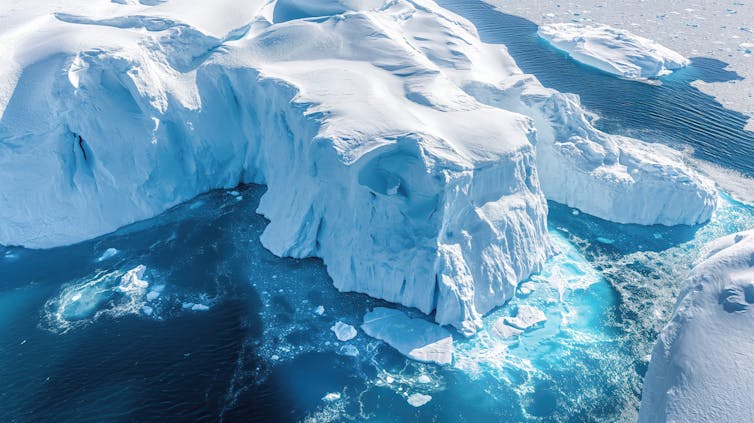
Climate change is speeding up in Antarctica

Spread the love

Mongkolchon Akesin / Shutterstock

Sergi González Herrero, Universitat de Barcelona

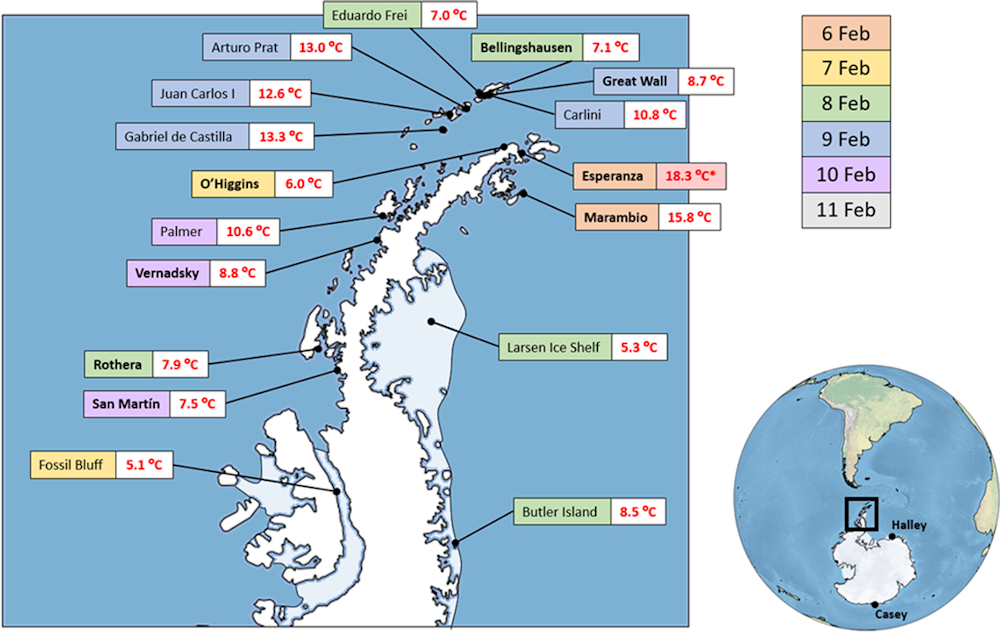
In recent years, Antarctica has experienced a series of unprecedented heatwaves. On 6 February 2020, temperatures of 18.3C were recorded, the highest ever seen on the continent, beating the previous record of 17.5C which had only been set a few years earlier.

Around February 2022, another strong heatwave in Antarctica led to record-breaking surface ice melt. In March of the same year, East Antarctica saw its strongest ever heatwave, with temperatures soaring to 30C or 40C higher than the average in some areas.

Over the last year, we have seen the lowest levels of Antarctic sea ice coverage since records began.

Record-breaking temperatures during the heatwave on 6 February 2020.
González-Herrero et al. (2022)

Events in recent years have bordered on the unbelievable, and it is difficult not to link them to climate change. In fact, studies have already emerged that clearly attribute some of these heatwaves to global warming: one of our investigations strongly suggests that without the influence of climate change, 2020’s record-breaking temperatures would not have occurred.

Antarctica’s changing climate

In 2009, a study quantified the speed of ecosystem migration due to climate change on a global scale, and documented, essentially, the speed at which certain species have to move to ensure their survival. It concluded that biomes were moving at a speed between 0.8 and 12.6km per decade, with an average speed of 4.2km per decade.

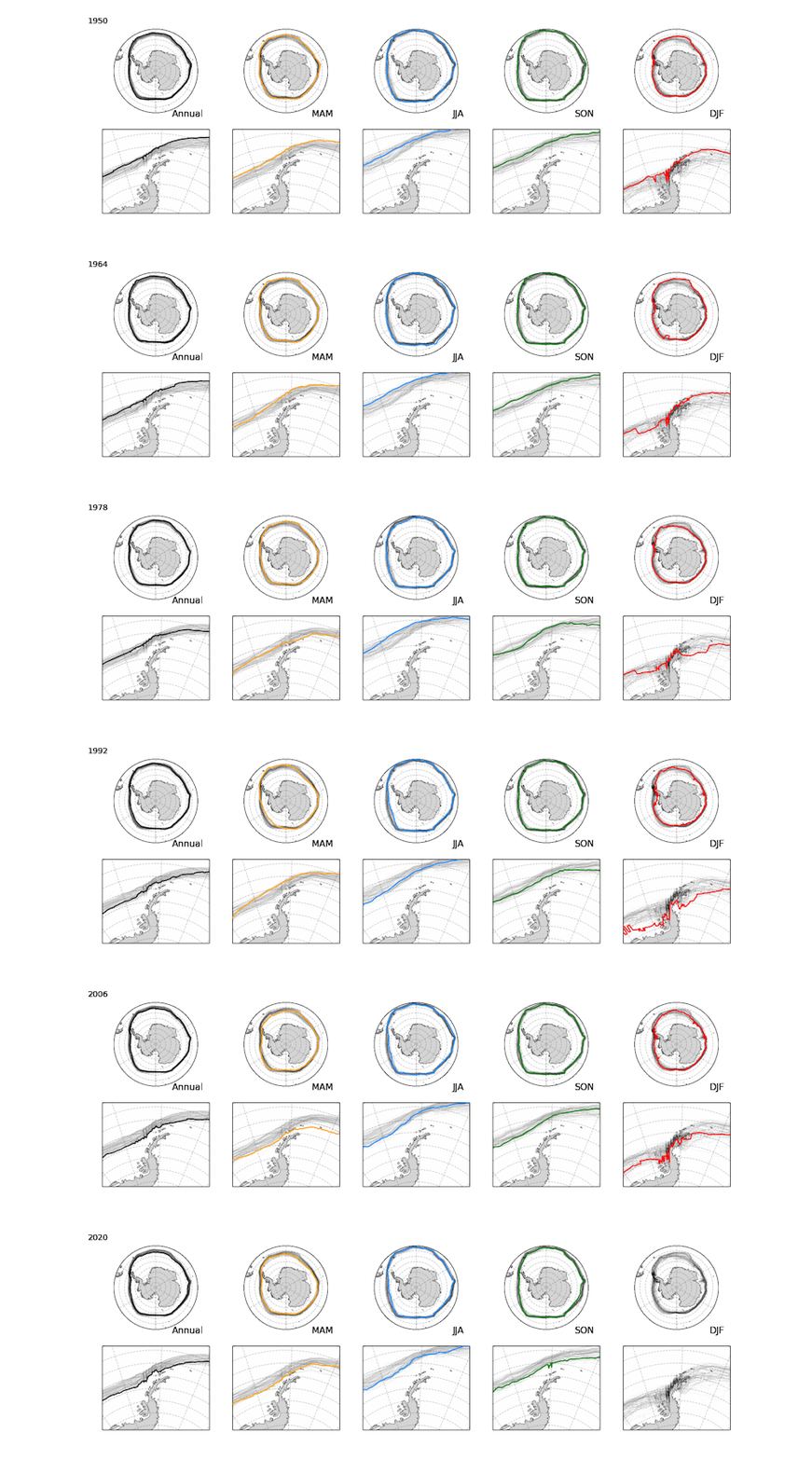
In our more recent study, published in February 2024, we adapted this measurement of speed and applied it to the edges of Antarctica. To do this, we tracked the southward migration of the zero-degree isotherm.

The zero-degree isotherm is an imaginary line that encloses the areas that are at zero degrees or lower. Its southward movement means that the area with temperatures below zero Celsius in Antarctica is getting smaller and smaller. Given that water freezes at zero degrees, this movement will have serious consequences for ecosystems and for the cryosphere (areas of the Earth where water is frozen).

Our calculations show that the zero-degree isotherm has moved at a speed of 15.8km per decade since 1957 in the area surrounding the Antarctic, while on the Antarctic peninsula itself it has moved at 23.9km per decade. As a result, it now sits over 100km south of where it was in the mid 20th century.

These measurements show that the speed of climate change on the edge of Antarctica is four times faster than the average of other ecosystems.

Evolution of the annual and seasonal position of the zero-degree isotherm in Antarctica between 1957 and 2020. The initials indicate the seasons for each measurement. MAM: autumn, JJA: winter, SON: spring, DJF: summer.
González-Herrero et al. (2024)

The effects of emissions

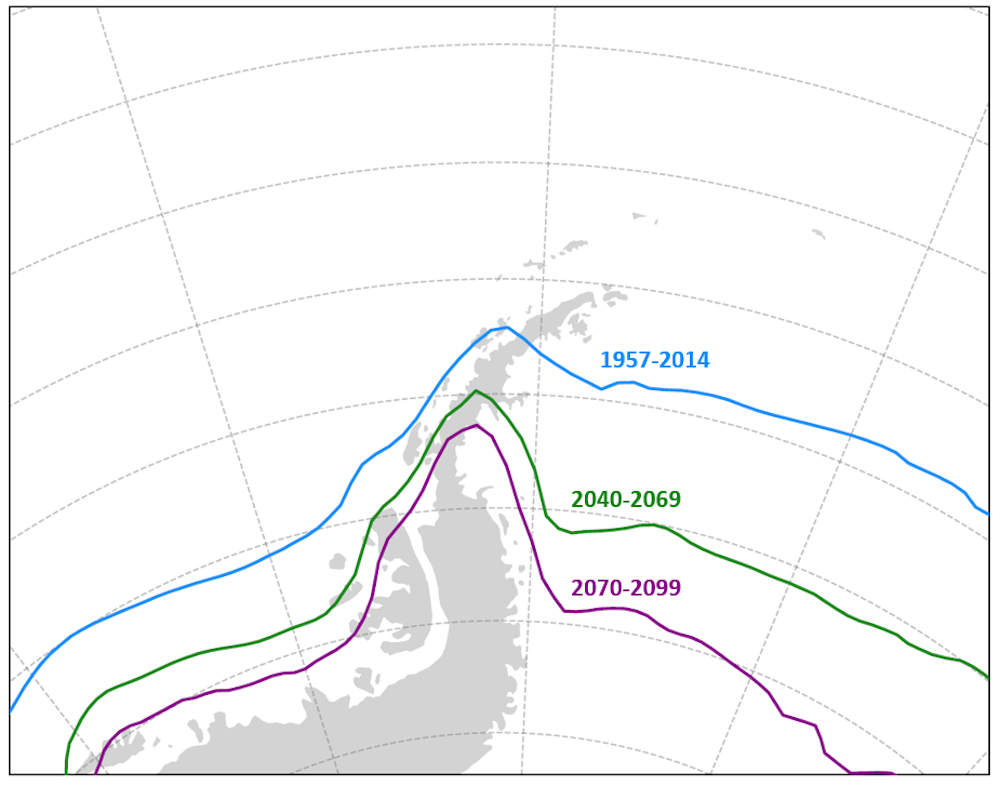
To predict the consequences of the southward migration of the zero-degree isotherm, we ran our data through twenty different climate models. Although there is some variation in the shift of the isotherm among the models, all agree that it will move significantly further southward over the next few decades.

The models also predict that, over the coming decades, the isotherm’s movement will accelerate regardless of emissions. However, the extent of its southward movement in the second half of the 21st century will depend on how much carbon we emit.

If we continue at our current rate of emissions, the zero-degree isotherm will continue to advance at a similar rate before slowing down during the second half of the 21st century. However, if emissions are higher, the isotherm’s migration will accelerate continuing its southward movement until the end of the century.

Change in the summertime position of the zero-degree isotherm over the course of the 21st century. Based on IPCC climate scenario SSP5-8.5, whereby current emission levels are approximately doubled by 2050.
Adapted by González-Herrero et al. (2024)

Impacts on the cryoshpere and ecosystems

The zero-degree isotherm’s southward movement will not remain solely in the atmosphere, it will also affect the cryosphere (all of the frozen areas of Antarctica) and the biosphere (the species that live there).

Changes in the isotherm’s position will mean more liquid rain instead of snow in the outermost regions of the continent, though it may in fact cause increased snowfall in other areas.

Reduced snowfall on the frozen sea – which acts as insulation – may lead to accelerated loss of sea ice during summer thaw periods.

Although the effects on permafrost, ice shelves and continental ice are still uncertain, it will undoubtedly affect the peripheral glaciers of the Antarctic Peninsula. These constitute one of the largest potential sources of sea level rise in the coming decades.

Changes in the cryosphere will also lead to changes in ecosystems. New areas will become habitable thanks to thawing ice, but with more areas above zero degrees, invasive species from warmer, more hospitable continents may be able to settle, and they will compete with native species for resources.The Conversation

Sergi González Herrero, Científico atmosférico, Universitat de Barcelona

This article is republished from The Conversation under a Creative Commons license. Read the original article.

Continue ReadingClimate change is speeding up in Antarctica

‘Sirens Are Blaring’: WMO Says 2023 Shattered Key Climate Metrics

Spread the love

Original article by OLIVIA ROSANE republished from Common Dreams under Creative Commons (CC BY-NC-ND 3.0). 

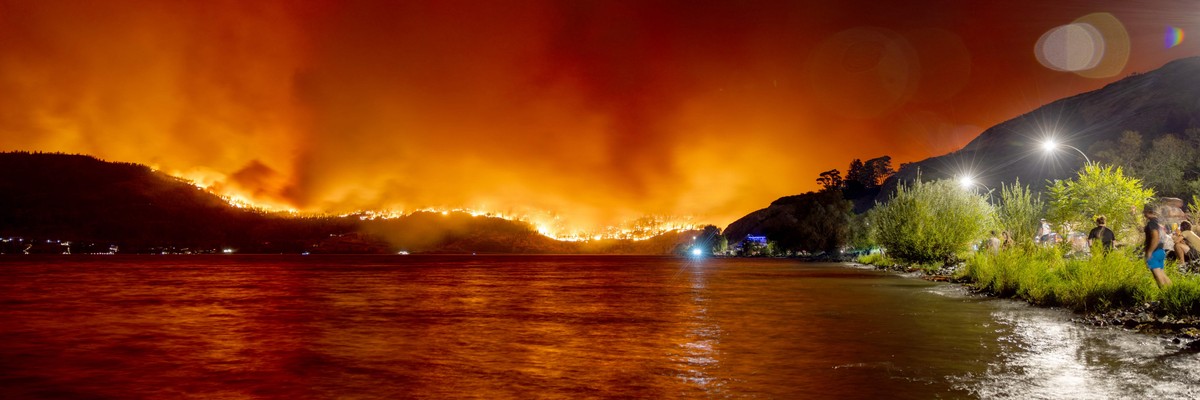
Residents watch the McDougall Creek wildfire in West Kelowna, British Columbia, Canada, on August 17, 2023 from Kelowna.
 (Photo: Darren Hull/AFP via Getty Images)

“Fossil fuel pollution is sending climate chaos off the charts,” U.N. Secretary-General António Guterres said.

Last year broke records for several key climate indicators, including surface temperatures, ocean heat, sea-level rise, and the loss of Antarctic sea ice, the World Meteorological Organization found in its State of the Global Climate 2023 report, released Tuesday.

The agency confirmed that 2023 was the hottest year on record and said it gave an “ominous” new meaning to the phrase “off the charts.”

“Earth is issuing a distress call,” United Nations Secretary-General António Guterres said in a video statement. “The latest State of the Global Climate report shows a planet on the brink. Fossil fuel pollution is sending climate chaos off the charts. Sirens are blaring across all major indicators.”

“The climate crisis is THE defining challenge that humanity faces and is closely intertwined with the inequality crisis.”

2023 saw an average global near-surface temperature of 1.45°C, the report found, making 2023 the hottest on record and the cap on the warmest 10-year period on record.

Never have we been so close—albeit on a temporary basis at the moment—to the 1.5°C lower limit of the Paris agreement on climate change,” WMO Secretary-General Celeste Saulo said in a statement. “The WMO community is sounding the red alert to the world.”

The European Union’s Copernicus Climate Change Service and European Center for Medium-Range Weather Forecasts had found separately that January 2024 capped a 12-month period that exceeded the 1.5°C target for the first time.

2023 was also a particularly alarming year for ocean heat, with nearly a third of the ocean in the midst of a marine heatwave at any time during the year. Global sea-surface temperatures reached record heights for April and every month after, with July, August, and September especially hot. Ocean heat content also broke records, and more than 90% of the ocean experienced a heatwave for at least a portion of the year.

The world’s glaciers and sea ice did not fare any better. Glaciers lost the most ice in any year since record-keeping began in 1950, and Antarctica’s sea-ice extent at the end of winter smashed the previous record by 1 million square kilometers.

“Because of burning fossil fuels, which leads to CO2-induced global heating, we have impacted the polar regions to such a degree that 2023 saw by far the greatest loss of sea ice in the Antarctic and of land ice in Greenland,” University of Exeter polar expert Martin Siegert told Common Dreams. “The world will feel the detrimental effects now and into the future because the changes observed will lead to ‘feedback’ processes encouraging further change.”

“Our only response must be to stop burning fossil fuels so that the damage can be limited,” Siegert added. “That is our best and only option.”

2023 also saw record sea-level rise and ocean acidification.

“Climate change is about much more than temperatures,” Saulo said. “What we witnessed in 2023, especially with the unprecedented ocean warmth, glacier retreat, and Antarctic sea ice loss, is cause for particular concern.”

Records were broken too for the main cause of all this warming and melting—the levels of greenhouse gasses in the atmosphere. Carbon dioxide, methane, and nitrous oxide all reached record levels in 2022, and data indicates that the atmospheric concentrations of all three continued to rise in 2023, with carbon dioxide levels 50% higher than before the industrial revolution.

The report also considered the impacts of global heating on extreme weather events: 2023 saw several especially devastating climate-fueled disasters, including lethal flooding from Cyclone Daniel in Libya; Tropical Cyclone Mocha, which displaced 1.7 million people in the region around the Bay of Bengal; an extreme heatwave in southern Europe and North Africa; a record wildfire season in Canada that smothered several North American cities in heavy smoke; and the deadliest U.S. wildfire in more than 100 years in Hawaii.

In addition to claiming lives and forcing people from their homes, these disasters have several other impacts on peoples’ well-being. For example, the report noted that the number of people suffering from acute food insecurity had shot up to 333 million in 2023, more than two times the 149 million before the pandemic. While the root causes of this are war and conflict, economic downturns, and high food prices, extreme weather events can make the situation worse. When Cyclone Freddy, one of the longest-lasting cyclones ever, struck Madagascar, Mozambique, and Malawi in February, it flooded vast swaths of agricultural fields and damaged crops in other ways.

“The climate crisis is THE defining challenge that humanity faces and is closely intertwined with the inequality crisis—as witnessed by growing food insecurity and population displacement, and biodiversity loss,” Saulo said.

Guterres, meanwhile, said the impact of extreme weather on sustainable development was “devastating.”

“Every fraction of a degree of global heating impacts the future of life on Earth,” he said.

There was some positive news in the report, mainly that renewable energy increased new capacity by nearly 50% in 2023 compared with 2022, the highest rate of increase in 20 years. Global climate finance nearly doubled from 2019-2020 to almost $1.3 trillion, but this was still only 1% of global gross domestic product.

To have a shot at limiting warming to 1.5°C, finance needs to increase by nearly $9 trillion by 2030 and another $10 trillion by 2050, but this is much lower than the estimated cost of doing nothing, which would be $1,266 trillion from 2025-2100, though the WMO said this was likely a “dramatic underestimate.”

Guterres said it was still possible to limit long-term global temperature rise to 1.5°C, but it required swift action; leadership from the G20 nations toward a just energy transition; countries proposing 1.5°C-compliant climate plans by 2025; increased climate finance flows toward the developing world, including for adaptation and Loss and Damage; universal coverage by early warning systems by 2027; and “accelerating the inevitable end of the fossil fuel age.”

“There’s still time to throw out a lifeline to people and planet,” Guterres said, “but leaders must step up and act now.”

Original article by OLIVIA ROSANE republished from Common Dreams under Creative Commons (CC BY-NC-ND 3.0). 

Continue Reading‘Sirens Are Blaring’: WMO Says 2023 Shattered Key Climate Metrics

Court of Appeal Rules Climate Crisis A Matter of ‘Opinion’

Spread the love

Original article by Tim Crosland republished from DeSmog.

When environmental defenders are tried in future they will be barred from giving evidence of climate impacts to the jury to explain their motives, writes Tim Crosland, director of climate justice charity Plan B Earth.

Environmental activist Trudi Warner is ejected from the Royal Courts of Justice on February 21. Credit: Defend Our Juries

The Court of Appeal this week delivered another blow to the rights of climate activists to defend themselves in court.

The case centred on a jury’s decision to acquit a group of activists last year after hearing evidence of the consequences of climate breakdown as part of the defence.

It was one of a number of “not guilty” verdicts in similar cases, which showed how seriously juries take such evidence – as long as they are allowed to hear it.

For the climate movement, It was a major boost to see that the public, in the form of juries, was on its side.

But on Monday, following an appeal by Attorney General Victoria Prentis, Lady Justice Carr delivered a ruling to the effect that the juries should not be allowed to hear that evidence in the future.

What this amounts to is that from now on, when environmental defenders are tried for criminal damage in the future, they will no longer be able to give climate impacts as evidence to explain their motives.

‘Show Trials’

This defence was one of the last available to activists in an increasingly hostile climate that has seen the UK, under Rishi Sunak’s administration, dish out some of the most punitive sentencing for peaceful protest in recent history.

The implications are grave. From now on, we will see jury trials turn into show trials, in which the defendants are banned from explaining to the jury their principled motivation for taking action.

Lady Justice Carr’s ruling was made even though the relevant legislation (the Criminal Damage Act of 1971) expressly provides for a jury to take into account the “circumstances” of environmentalists’ action. 

The key question here is what counts as the “circumstances” of criminal damage, which is often the crime of which peaceful protestors stand accused. That might take the form of causing damage to property with graffiti, say by spray-painting #ShellKnows onto the oil company’s headquarters.

In this example, climate activists would argue they do this in order to hold those responsible for climate breakdown – and that the message serves to highlight the company’s decades-long knowledge and obfuscation of the impacts of fossil fuels on global heating.

The legal ‘logic’ of the new ruling is that “circumstances” refers to objective matters and therefore excludes a defendant’s beliefs. In the words of Lady Justice Carr, who read out the ruling of the court:

“The circumstances would not include the political or philosophical beliefs of the person causing the damage … Evidence from the defendant about the facts or effects of climate change would be inadmissible.”

The flaw in this logic is obvious. The climate crisis is not a matter of belief. It is a terrifying and objective reality. Not just according to scientists or the British parliament, but as evidenced by the well-documented destruction and mass loss of life that is already occurring across Europe and around the world. 

Lady Justice Carr might try explaining that the climate crisis is all in their minds to the UK home-owners, whose properties are now uninsurable due to repeat flooding, or the mothers whose children’s bodies washed up on a Libyan shore after dams collapsed in the wake of heavy rains.

Sadly, this ruling, which is based on such obviously flawed reasoning, was widely predicted. 

That’s because the ruling perpetuates an antagonism within the justice British system that has become impossible to ignore. 

‘Embarrassment to the State’

On the one hand you have the juries, who represent our communities. They keep acquitting environmental defenders when they hear the full story.

And then you have some judges, paid by the state, who are taking increasingly bizarre measures to prevent the juries from giving not guilty verdicts (Judge Silas Reid has even banned the use of the words ‘climate change’ in court proceedings).

In February 2023, a jury acquitted campaigners who had splashed pink paint over Conservative and Labour Party HQs. In October, another acquitted a group who sprayed the Treasury with fake blood; and in November, yet another acquitted the HSBC 9, who broke windows to protest the bank’s £80 billion investments in fossil fuels since the Paris Agreement.

Such jury acquittals come as an embarrassment to the state. Since juries are composed of randomly selected members of the public, they expose a media-constructed fiction. The public doesn’t want the government to get tough on those taking measures against climate breakdown, they want it to take measures to stop climate breakdown. 

As long as juries are allowed to hear evidence about a) the extreme danger of the climate crisis, b) the government’s systematic failure to follow the pathways that science dictates, and c) the efficacy of nonviolent direct action, it follows that those activists who are acting on the science are acquitted.

The British legal system, however, seems increasingly determined to prevent juries hearing the full facts. Judge Silas Reid has not only banned the words, he has sent people to prison simply for saying “climate change”.

At the end of February, almost as if he’d been tipped off on the Court of Appeal’s likely ruling, he used his office to cast doubt on the objective reality of the climate crisis:

“The circumstances of the damage do not include any climate crisis which may or may not exist in the world at the moment… Whether climate change is as dangerous as each of the defendants may clearly and honestly believe or is not, is irrelevant and does not form any part of the circumstances of the damage.”

Reid then threatened the jury with criminal charges if they applied their conscience to the case. 

But such oppressive rulings are backfiring. The public, as evidenced by jury acquittals, knows that the climate crisis is real and urgent. When courts suggest otherwise the legal system loses public support, undermining the social contract and the rule of law.

Last year hundreds of people demonstrated outside Crown Courts across England and Wales in solidarity with Trudi Warner, who was arrested for holding a sign outside court that explained the right of juries to acquit a defendant as a matter of conscience. Many actively invited the Attorney General to prosecute them for contempt of court. 

In February, more than a hundred members of the public staged a ‘peaceful makeover’ of the Royal Courts of Justice, conducting a lawful assembly into the courts’ erosion of democratic freedoms, until they were forcefully ejected by court security.

For as long as judges believe they can rule away our collective desire to live and to protect those we love, the situation will only escalate.

Tim Crosland is a former government lawyer and director of the climate justice charity Plan B.Earth.

Original article by Tim Crosland republished from DeSmog.

dizzy: The climate crisis is of course a matter of established fact. 2023 is the warmest year ever, climate records are getting broken monthly, they’ll be getting broken daily again in the summer. Capitalism has destroyed the climate and intends to destroy it more, fossil fool companies are pursuing more oil and gas extraction ignoring the established fact that it’s destroying the climate – so that rich cnuts get richer. Courts are supposedly independent, impartial and separate from the state instead of clearly part of it.

7.30am Equinox update: It’s a totally irrational denial of reality mirroring Rishi Sunak UK government’s own legislating that black is white, up is down, in is out. There’s a psychological term – reaction formation – that applies. The problem is that judges are meant to make wise, considered decisions and here they are instead behaving totally irrationally.

Image of InBedWithBigOil by Not Here To Be Liked + Hex Prints from Just Stop Oil's You May Find Yourself... art auction. Featuring Rishi Sunak, Fossil Fuels and Rupert Murdoch.
Image of InBedWithBigOil by Not Here To Be Liked + Hex Prints from Just Stop Oil’s You May Find Yourself… art auction. Featuring Rishi Sunak, Fossil Fuels and Rupert Murdoch.
Continue ReadingCourt of Appeal Rules Climate Crisis A Matter of ‘Opinion’

Israel is starving Palestinians to death while the world watches

Spread the love

Original article by Abdul Rahman republished from peoples dispatch under a Creative Commons Attribution-ShareAlike 4.0 (CC BY-SA) license.

Children waiting for food in Gaza. Photo: UNRWA

Israel has deliberately slowed the flow of aid to Gaza with hundreds of trucks stranded on the Egyptian side of the Rafah border at a time when over two dozen Palestinian children have died of malnutrition

UN agencies have repeatedly condemned Israel’s refusal to expedite the process of aid delivery to Gaza which has been under siege by Israel for nearly six months. This is despite repeated calls for urgency in the context of critical humanitarian conditions which are becoming worse with each passing day.

According to the latest alerts issued by the Integrated Food Security Phase Classification (IPC) on March 18, most of northern Gaza would move into the category five indicating the highest stage of food insecurity or catastrophic levels of hunger. The IPC explains that this would mean that Palestinian households would face “an extreme lack of food and extremely critical levels of acute malnutrition.”

The IPC has assessed that the region which continues to face Israeli bombing and ground offensive already faces category four levels of malnutrition with huge gaps between need and actual availability of food.


UNRWA has already confirmed that one in three children in northern Gaza are malnourished. In the last few weeks over 25 children have died due to the same. The situation in other parts of Gaza is approaching similar levels at an alarming speed.

The same day that the IPC released its findings, Philippe Lazzarini, the head of UNRWA, was denied entry to Gaza by Israeli authorities. In a post on X, Lazzarini wrote, “UNRWA has by far the largest presence among all humanitarian organizations in Gaza. My visit today was supposed to coordinate & improve the humanitarian response.”

He added, “This man-made starvation under our watch is a stain on our collective humanity. Too much time was wasted, all land crossings must open now. Famine can be averted with political will.”

The UNRWA head also noted that over 1.1 million people in Gaza facing phase five levels of starvation “is the highest number of people ever recorded as facing catastrophic hunger and is double the number of just three months ago.”

Beth Bechdol, deputy director general of the UN Food and Agricultural Organization (FAO) told Al-Jazeera on Tuesday that, almost half of the total population of Gaza is at the acute level of malnutrition and at the risk of ultimately death.

The United Nations Children Fund (UNICEF) stated on Sunday that thousands of Palestinian children in Gaza are so malnourished that they do not have enough “energy to cry.”

Over 13,000 Palestinian children have been killed in the Israeli war on Gaza which began on October 7. According to different UN agencies, as many children have been injured and now hundreds of thousands are being forced into starvation by Israel.

UNICEF’s Executive Director Catherine Russell had earlier made similar assertions saying that there are “very great bureaucratic challenges” which prevent the humanitarian aid to reach two million Palestinians in Gaza.

Israel has restricted the entry of the aid through land borders using different kinds of excuses, for example presence of scissors in the aid boxes or alleged overcrowding of Palestinians at aid distribution centers among others.

James Elder, UNICEF spokesperson, called the blocking of aid supplies to Gaza “outrageous.” He posted on X showing hundreds of trucks with humanitarian aid stranded at the Rafah border as Israel has not allowed them to enter Gaza.

Adele Khodr, UNICEF’s regional director for the Middle East and North Africa called for the opening of all crossings. “The world’s inaction is shocking as more children succumb to slow death. All border crossing must open now to allow unfettered access to humanitarian aid” Khodr said in the tweet on Tuesday.

Original article by Abdul Rahman republished from peoples dispatch under a Creative Commons Attribution-ShareAlike 4.0 (CC BY-SA) license.

Continue ReadingIsrael is starving Palestinians to death while the world watches