A large number of tanks belonging to the Israeli army were are deployed near the Israeli border on December 4, 2024. [Mostafa Alkharouf – Anadolu Agency]
The Israeli army continues to violate the ceasefire agreement with Hezbollah in Lebanon, with 12 new violations on Wednesday, bringing the total to 129 since the agreement began a week ago, according to data from the National News Agency.
Local sources reported today that occupation army bulldozers constructed earth barriers on the road between Shebaa and Birkat Al-Naqqar, protected by Merkava tanks, with the aim of preventing the Lebanese army from reaching a previously-occupied position. This move comes a day after the Lebanese army redeployed to three locations on the western edge of the town of Shebaa, after withdrawing from this area about two months ago towards the Janam axis north of the town. As part of its escalation, the Israeli army today blew up houses in the Al-Harsh area in the town of Yaroun, in Bint Jbeil District.
Moreover, Lebanese civil defence teams in Naqoura were subjected to Israeli artillery shelling this afternoon while they were working to remove the rubble and search for victims of earlier bombing, according to the official Lebanese News Agency, which explained that Israeli forces detonated a booby-trapped drone near the teams, which prompted them to withdraw.
In a new statement, the Israeli army announced today that it has imposed a ban on the residents of 62 villages in southern Lebanon returning to their homes or moving south from a line that passes around these villages, in a move that constitutes a clear violation of international law and the right of civilians to return to their homes.
This comes amid Lebanese reports indicating a possible visit to Beirut by US envoy Amos Hochstein, who played a pivotal mediation role to follow up on the launch of the five-party ceasefire monitoring mechanism. Such a visit would come after warnings that delaying the activation of the mechanism may give Israel an opportunity to achieve what it did not achieve during the war.
The Lebanese army announced today that its units will carry out operations between 10:00am and 4:00pm to detonate unexploded ordnance left over from the Israeli invasion. The army statement indicated that the explosions will take place in the Qlaila-Tyre and Arnoun-Nabatieh fields, in addition to the Shabriha-Tyre area and the outskirts of Ras Baalbek.
The International Criminal Court (ICC) building is pictured on November 21, 2024 in The Hague. [LAURENS VAN PUTTEN/ANP/AFP via Getty Images]
US officials have sparked controversy by invoking the so-called “Hague Invasion Act” in response to the International Criminal Court’s (ICC) arrest warrants for Israeli Prime Minister, Benjamin Netanyahu, and his former Defence Minister, Yoav Gallant, Anadolu Agency reports.
Matthew Hoh, Associate Director of the Eisenhower Media Network – a group of former US military, intelligence and national security officials that provides analysis of Washington’s foreign policy — criticised the threats for Anadolu, highlighting their implications for international law.
Hoh reflected on the origins of the act and its renewed relevance following the decision by the ICC.
The 2002 law, officially titled the “American Service-Members’ Protection Act,” was enacted during President George W. Bush’s administration to shield the US and its allied nationals from ICC prosecution.
Known informally as the “Hague Invasion Act”, it authorises the US to use all means, including force, to protect its nationals from ICC jurisdiction.
Hoh explained that the legislation was originally designed to block ICC investigations into potential US war crimes.
The ICC’s past investigations into US personnel in Afghanistan drew similar threats, with the US imposing sanctions on the Court and its officials.
He said the law resurfaced in the American Congress after the ICC issued arrest warrants for Netanyahu and Gallant.
‘Decision-makers within the US are doing to hasten the end of the US Empire’
Hoh criticised the US response as an overreach to protect Israel.
“The US has, within its own law, the authorisation to use military force against institutions like the ICC,” he said. “Certainly this action […] contravenes the US’ own stated desires, its own slogans [..]. that it believes in such things as international law.”
Hoh also noted the broader implications of the US’ confrontational approach toward the ICC.
“By doing this, by reacting this way to the International Criminal Court and by requiring its allies to do so, it is giving more credence, more validity, more reason for alternative institutions, alternative mechanisms, alternative alliances to grow and expand against the American Empire,” he said. “Decision-makers within the US are doing to hasten the end of the US Empire.”
Double standards in the US approach to the ICC have drawn further scrutiny. Hoh pointed out the stark contrast in US reactions to ICC warrants against Russian President, Vladimir Putin, and Netanyahu.
“When the ICC issued arrest warrants for Vladimir Putin, the President of Russia, the Americans across the board, political class, media class, military class, so on and so forth, were excited about that development and they were very pleased to see the arrest warrants,” he said.
When it comes to Israel, the response is different, he noted.
Hoh said the West sees international law as a tool not to be used against those in power. He argued it is there to be used against those in the “developing world, those who do not have power, those who are not within the upper levels in the imperial world order.”
He added that international law is meant to keep people other than “white people” in check, to keep nations out of power and under the subjugation of the existing world order.
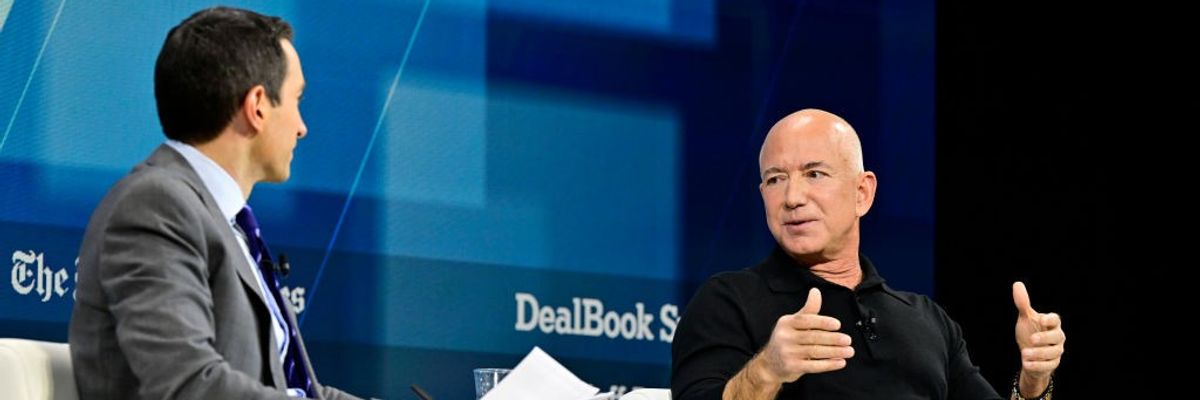
Journalist Andrew Ross Sorkin speaks with billionaire businessman Jeff Bezos during The New York Times Dealbook Summit on December 4, 2024 in New York City. (Photo: Eugene Gologursky/Getty Images for The New York Times)
“Shockingly another one of the richest guys on Earth wants to defund our government and scrap regulations.”
Billionaire Amazon founder Jeff Bezos on Wednesday expressed his optimism about U.S. President-elect Donald Trump’s next term and suggested he would “help” the Republican gut regulations.
“If we’re talking about Trump, I think it’s very interesting, I’m actually very optimistic this time around… I’m very hopeful about this—he seems to have a lot of energy around reducing regulation,” Bezos told The New York Times‘ Andrew Ross Sorkin during the newspaper’s DealBook Summit.
“And my point of view, if I can help him do that, I’m gonna help him, because we do have too much regulation in this country. This country is so set up to grow,” he continued, suggesting that regulatory cuts would solve the nation’s economic problems.
After complaining about the burden of regulations, Bezos added, “I’m very optimistic that President Trump is serious about this regulatory agenda and I think he has a good chance of succeeding.”
The comments came during a discussion about Bezos’ ownership of The Washington Post, which also addressed the billionaire’s recent controversial decisions to block the newspaper’s drafted endorsement of Democratic Vice President Kamala Harris and have it stop endorsing presidential candidates.
Bezos said Wednesday that he is “very proud” of the move, that the Post “is going to continue to cover all presidents very aggressively,” and the decision did not result from fears about Trump targeting his companies.
As Inc. reported Thursday: “Trump had railed against Bezos and his companies, including Amazon and The Washington Post, during his first term. In 2019, Amazon argued in a court case that Trump’s bias against the company harmed its chances of winning a $10 billion Pentagon contract. The Biden administration later pursued a contract with both Amazon and Microsoft.”
Bezos owns Blue Origin, an aerospace company and a competitor to Elon Musk’s SpaceX. Musk—the world’s richest person, followed by Bezos, according to the Bloomberg and Forbes trackers—has been appointed to lead Trump’s forthcoming Department of Government Efficiency (DOGE) with fellow billionaire Vivek Ramaswamy.
Bezos’ remarks at the Times summit led Fortune‘s Brooke Seipel to suggest that he may be the next billionaire to join DOGE.
Musk and Ramaswamy headed to Capitol Hill on Thursday to speak with GOP lawmakers about their plans for the government.
“Despite its name, the Department of Government Efficiency is neither a department nor part of the government, which frees Musk and Ramaswamy from having to go through the typical ethics and background checks required for federal employment,” The Associated Press noted. “They said they will not be paid for their work.”
This article was originally posted 6/12/24 but was deleted probably by mistake.
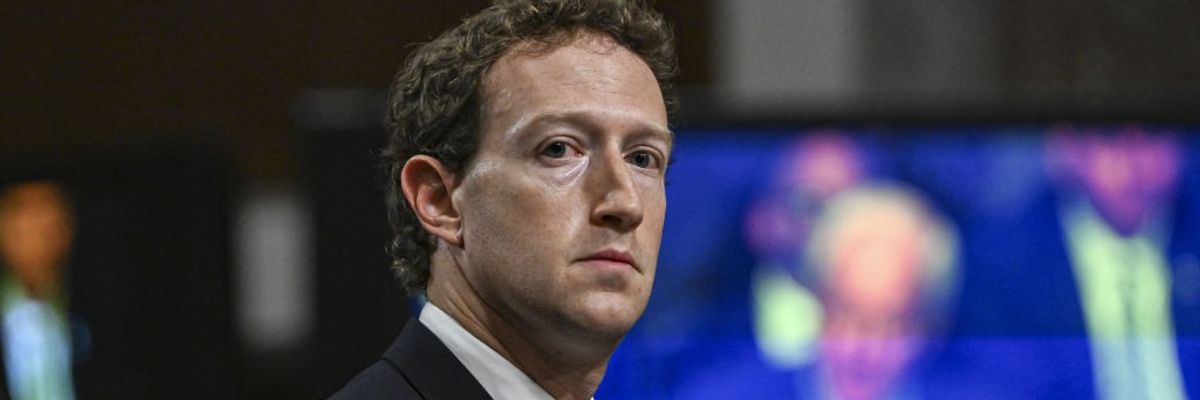
Mark Zuckerberg, CEO of Meta, testifies before a U.S. Senate Judiciary Committee hearing on January 31, 2024, in Washington, D.C. (Photo: Celal Gunes/Anadolu via Getty Images)
“In the blind sprint to win on AI, Meta and the other tech giants have lost their way,” said a leader at Environment America.
Environmental advocates this week responded with concern to Meta looking for nuclear power developers to help the tech giant add 1-4 gigawatts of generation capacity in the United States starting in the early 2030s.
Meta—the parent company of Instagram, Facebook, WhatsApp, and more—released a request for proposals to identify developers, citing its artificial intelligence (AI) innovation and sustainability objectives. It is “seeking developers with strong community engagement, development, …permitting, and execution expertise that have development opportunities for new nuclear energy resources—either small modular reactors (SMR) or larger nuclear reactors.”
The company isn’t alone. As TechCrunch reported: “Microsoft is hoping to restart a reactor at Three Mile Island by 2028. Google is betting that SMR technology can help it deliver on its AI and sustainability goals, signing a deal with startup Kairos Power for 500 megawatts of electricity. Amazon has thrown its weight behind SMR startup X-Energy, investing in the company and inking two development agreements for around 300 megawatts of generating capacity.”
In response to Meta’s announcement, Johanna Neumann, Environment America Research & Policy Center’s senior director of the Campaign for 100% Renewable Energy, said: “The long history of overhyped nuclear promises reveals that nuclear energy is expensive and slow to build all while still being inherently dangerous. America already has 90,000 metric tons of nuclear waste that we don’t have a storage solution for.”
“Do we really want to create more radioactive waste to power the often dubious and questionable uses of AI?” Neumann asked. “In the blind sprint to win on AI, Meta and the other tech giants have lost their way. Big Tech should recommit to solutions that not only work but pose less risk to our environment and health.”
“Data centers should be as energy and water efficient as possible and powered solely with new renewable energy,” she added. “Without those guardrails, the tech industry’s insatiable thirst for energy risks derailing America’s efforts to get off polluting forms of power, including nuclear.”
In a May study, the Electric Power Research Institute found that “data centers could consume up to 9% of U.S. electricity generation by 2030—more than double the amount currently used.” The group noted that “AI queries require approximately 10 times the electricity of traditional internet searches and the generation of original music, photos, and videos requires much more.”
Meta is aiming to get the process started quickly: The intake form is due by January 3 and initial proposals are due February 7. It comes after a rare bee species thwarted Meta’s plans to build a data center powered by an existing nuclear plant.
Following the nuclear announcement, Meta and renewable energy firm Invenergy on Thursday announced a deal for 760 megawatts of solar power capacity. Operations for that four-state project are expected to begin no later than 2027.
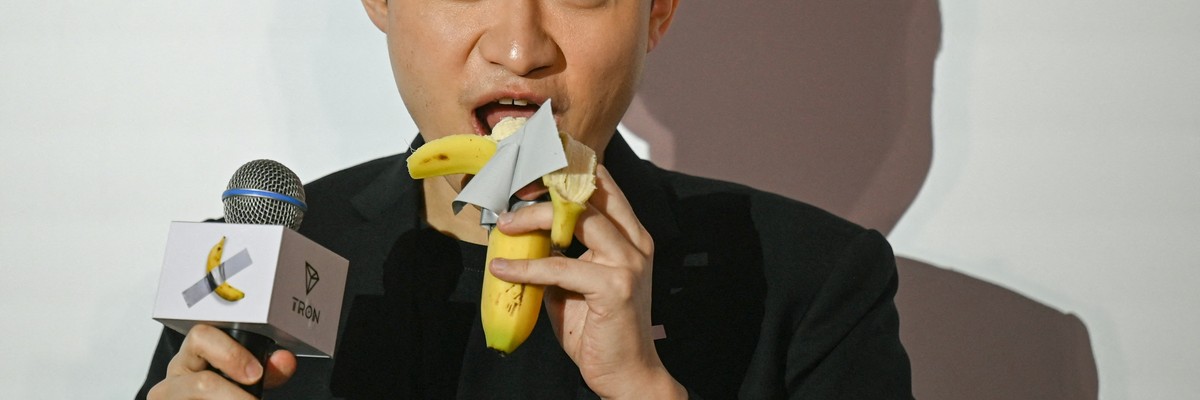
Chinese-born crypto founder Justin Sun eats a banana artwork composed of a fresh banana stuck to a wall with duct tape, in Hong Kong on November 29, 2024, after buying the provocative work of conceptual art by Italian artist Maurizio Cattelan at a New York auction for $6.2 million. (Photo: Peter Parks/AFP via Getty Images)
Billions upon billions give our world’s wealthiest an overabundance of mind-boggling political power, and right now they’re wielding that power to protect their fortunes at the expense of our planet’s future.
Looking to find something special this holiday season for that mega-millionaire in your life? The Italian retailer Valextra has just what you may need: a cocktail set that offers a “vision of design fluidity and discreet luxury.” Just $13,400 for a leathered and lacquered box that includes “a shaker, cocktail tools made from silvered brass, and two martini glasses.”
Or maybe you’re looking for a nice, new waterfront condo in South Florida. The private-equity movers and shakers at Apollo Global have just advanced the $307 million needed to plop 92 sumptuous residences on Florida’s “Millionaire’s Mile” near Pompano Beach. Each of these seaside palaces will enjoy “direct access to a private beach with food and beverage service.”
Or do you have your heart set on a thrilling new artistic experience? The billionaire crypto king Justin Sun certainly delivered one last Friday. Two days earlier, at a Sotheby’s auction, Sun had outlasted six other bidders and won—for $6.2 million—an artwork from an Italian absurdist artist. Sun proceeded to work up an appetite and then, before a packed news conference at a pricey Hong Kong hotel, ate his historic acquisition: a banana duct-taped to a wall. Only a video of the banana remains.
What wealthy nations do take seriously: the interests of their wealthy. And that seriousness is setting the world up for abject climate failure.
For Justin Sun and his fellow billionaires, no artwork or beachfront palace or luxury gift can make more—at worst—than a modest dent of their grand personal fortunes. Today’s global billionaires, a new report from the world’s top commercial tracker of grand fortunes calculates, more than doubled their combined wealth last year, to a record $12.1 trillion.
These 3,323 billionaires make up, the new data from researchers at Altrata show, less than 1% of our world’s “ultra-high net worth” population, those wealthy worth at least $30 million. But these few thousands of billionaires are sitting upon 25% of global ultra-high net worth.
Billionaires worth over $10 billion, add Altrata’s analysts in their latest annual Billionaire Census, make up only 6% of the billionaires who call our Earth home. These fortunate few hold 41% of billionaire wealth.
Billionaires who call the United States home, meanwhile, once again dominate Altrata’s latest global wealth stats. Americans hold a full third of the world’s billion-dollar fortunes, over three times the share of China, the world’s second-largest billionaire hotspot.
Another sign of America’s billionaire dominance: The world’s four richest individuals—Elon Musk, Jeff Bezos, Mark Zuckerberg, and Larry Ellison—all just happen to be Americans. The Bloomberg Billionaires Index is now listing their combined net worth at nearly $1 trillion.
Fortunes as massive as these don’t just give our richest plenty of pocket change for the world’s most extravagant luxuries. These billions upon billions give our nation’s—and our world’s—wealthiest an overabundance of mind-boggling political power, and right now they’re wielding that power to protect their fortunes at the expense of our planet’s future.
Some of our world’s most perceptive climate journalists have been tracking that wielding this past month at two pivotal global conferences.
The first of these, in Rio de Janeiro, involved what have become known as the “G20” nations, a grouping that includes some 19 top national economic powers and two regional bodies, the European Union and the African Union. Different countries chair the G20 each year, but none have done their chairing more aggressively than Brazil, this past year’s chair.
Under Brazil’s progressive president, the former union leader Luiz Inacio Lula da Silva, this home to the endangered Amazon rainforest has spent 2024 pushing the G20 to get serious about taxing the world’s super rich—and using the proceeds from those taxes to address the world’s deepening climate calamity.
Earlier this year, Brazil brought before a meeting of the G20’s national finance ministers the famed E.U. Tax Observatory economist Gabriel Zucman, one of the world’s top experts on tax-the-rich options. Zucman proceeded to make a powerful case for an annual global 2% tax on the fortunes of the world’s wealthiest.
On paper, Brazil’s tax advocacy has made a real impact. The final declaration that nations attending last month’s 2024 G20 summit in Rio adopted is overflowing with admirable egalitarian sentiments.
“We live in times of major geopolitical, socioeconomic, and climate and environmental challenges and crises, which require urgent action,” the G20 nations solemnly declared. Added their official statement: “We recognize that inequality within and among countries is at the root of most global challenges that we face and is aggravated by them.”
This noble G20 summit declaration, notes350.org climate activist Kate Blagojevic, shows that Brazil and other G20 environmentally conscious nations have essentially “gained consensus for one of the most logical solutions to one of the world’s most pressing issues—taxing billionaires to pay for climate action.”
But now, stresses Blagojevic, G20 governments “must build on the growing popular support for taxing extreme wealth by putting words into action.”
Those rich holding that extreme wealth, agrees Emma Seery, Oxfam’s lead on development finance, have plenty of billions they could be sharing.
“Today,” Seery notes, “the world’s 16 richest individuals would still be billionaires even if 99% of their wealth vanished overnight.”
Those super rich a bit below that top-16 status have ample quantities of wealth to share as well. Since 1980, Seery points out, the G20’s richest 1% “have seen their tax rates fall by roughly a third” over the same years their share of global income was jumping by 45%.
Despite stats like these, several key G20 powerhouses—most notably the United States and Germany—have been showing little interest in moving expeditiously in any significant tax-the-rich direction. “Some” G20 leaders, as the Brazilian environment minister Marina Silva has cautiously acknowledged, have objections “to issues linked to the climate agenda, to the financing agenda, above all to the issue of taxing the super rich.”
These objections turned out to be far more upfront at last month’s second pivotal global gathering on climate chaos, the United Nations annual climate “Conference of the Parties,” COP for short, a huge assembly held this year in Baku, the capital of oil-rich Azerbaijan. This year’s COP29 ended a few days after the G20 session and focused on the pivotal questions of how much fighting climate change is going to cost and who ought to be footing the bill.
What makes these two questions so absolutely pivotal?
“Without help,” as Heated World’s Arielle Samuelson puts it, “poorer countries will be unable to transition away from fossil fuels, driving up emissions for the whole planet.”
The poorer of the nearly 200 nations attending COP29 did considerable pushing for at least $1.3 trillion a year in climate aid, an outlay that, Fiji deputy prime minister Biman Prasad observed, “pales in the face of the $7 trillion” wasted annually on subsidies for fossil fuels and the corporations they enrich.
In the end, “after marathon talks and bitter recriminations,” COP29 did produce a consensus of sorts. The gathered nations agreed on the need for $1.3 trillion in help for developing nations, but only $300 billion of that total will come in grants and low-interest loans. All the rest, reportsTheGuardian’s Fiona Harvey, “will have to come from private investors” and unspecified new sources of revenue.
This COP29 outcome, sums up a disgusted Mohamed Adow of the think-tank Power Shift Africa, amounts to a “disaster for the developing world,” a “betrayal of both people and planet by wealthy countries who claim to take climate change seriously.”
What wealthy nations do take seriously: the interests of their wealthy. And that seriousness is setting the world up for abject climate failure.
The governments of wealthy nations, as the British economist Michael Roberts reflects, ought to be bankrolling shifts to renewable energy, a power source that’s continuing to get ever less expensive. But the world’s most powerful governments are insisting instead “that private investment should lead the drive to renewable power,” and that insistence is crippling the move to renewables.
Why? Private investors, Roberts explains, only invest when investing figures to pay—in healthy profits. With prices for renewables falling, these healthy profits aren’t materializing. Investors, consequently, are making no rush to invest in renewables. They might as well, many of these wealthy have come to believe, double down on fossil fuels.
Given all these dynamics, will all the rest of us be able to save our planet? Maybe—if we double down on saving our planet from our plutocrats.