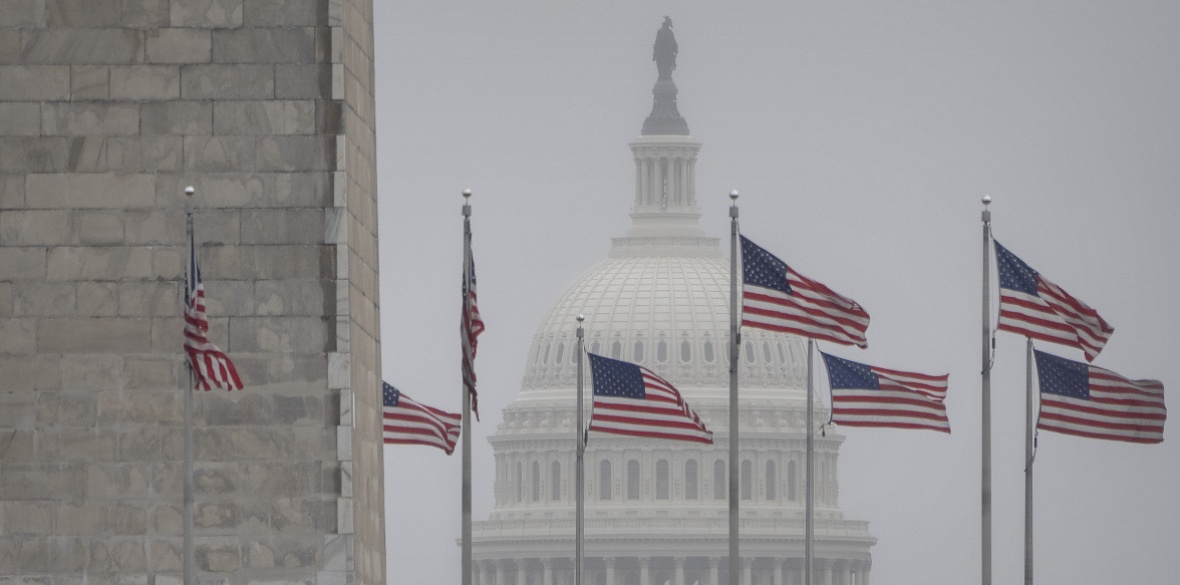
The dome of the Capitol is seen in the distance on a rainy morning, March 5, 2024, in Washington
THE US presidential election increasingly resembles a ghoulish farce without anything resembling an amusing punch line to anticipate.
Barring some unexpected turn, Joe Biden and Donald Trump will face off against each other once more, two elderly men both displaying clear signs of cognitive impairment. Each routinely confuses countries and people, indicating unfitness for office without taking other considerations into account.
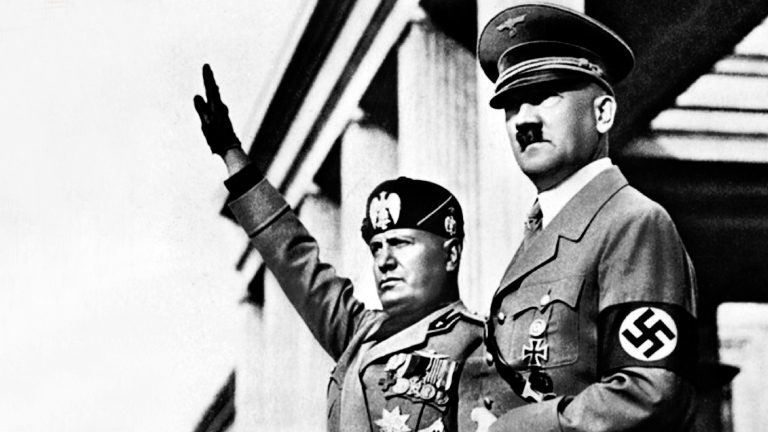
Much comment focuses on the risks for democracy in the US of a Trump victory, given his evident Mussolini-like tendencies. Indeed, the US is an unhappy marriage of an archaic and unworkable constitution and extreme culture war polarisation, presided over by a ruling class wallowing in its own cupidity.
However, the risks for the rest of the world are at least as great, given the outsize role the US plays in world affairs, expressed in the course of this century through a series of military aggressions.
On this front, the choice is just as unappealing. Joe Biden’s full-throated support for Israel’s genocide in Gaza reminds us that US liberalism is a political expression of imperialism.
Indeed, even before the Gaza crisis, the Biden administration had continued the main lines of Trump’s policy in the Middle East, with the exception of a fruitless attempt to revive the nuclear deal with Iran which his predecessor had recklessly scrapped.
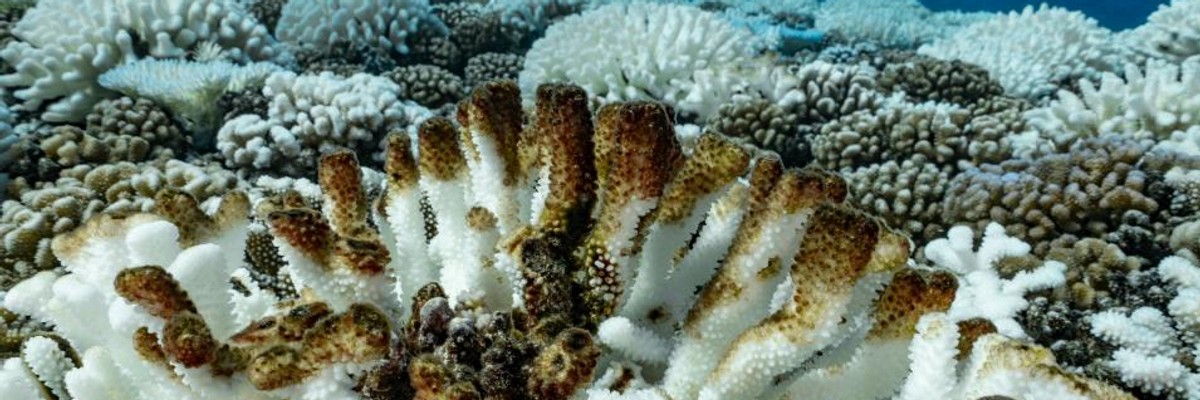
A view of major bleaching on the coral reefs of the Society Islands on May 9, 2019 in Moorea, French Polynesia. (Photo: Alexis Rosenfeld/Getty Images).
“It’s looking like the entirety of the Southern Hemisphere is probably going to bleach this year,” one scientist said.
Driven by sustained climate-fueled oceanic heating, the planet is on the brink of another mass coral bleaching event that marine biologists warn could kill large swaths of tropical reefs including significant areas of Australia’s Great Barrier Reef.
Scientists are sounding the alarm following months of record ocean temperatures exacerbated by the planetary emergency and the El Niño climate pattern in the Pacific Ocean.
“It’s looking like the entirety of the Southern Hemisphere is probably going to bleach this year,” Derek Manzello of the National Oceanic and Atmospheric Administration’s (NOAA) Coral Reef Watch told Reuters. “We are literally sitting on the cusp of the worst bleaching event in the history of the planet.”
When water is too warm, corals will expel the algae (zooxanthellae) living in their tissues causing the coral to turn completely white. This is called coral bleaching. When a coral bleaches, it is not dead. Corals can survive a bleaching event, but they are under more stress and are subject to mortality.
In 2005, the U.S. lost half of its coral reefs in the Caribbean in one year due to a massive bleaching event. The warm waters centered around the northern Antilles near the Virgin Islands and Puerto Rico expanded southward. Comparison of satellite data from the previous 20 years confirmed that thermal stress from the 2005 event was greater than the previous 20 years combined.
Following the planet’s hottest summer on record last year, the Caribbean suffered its worst recorded bleaching event. The last worldwide bleaching occurred in 2014-17, when scientists say approximately 15% of all reefs experienced major coral deaths. Nearly a third of the Great Barrier Reef’s coral perished during the bleaching.
In the Southern Hemisphere, where summer is ending and ocean temperatures are at or near their annual peaks, there is “basically bleaching all over the place,” according to Manzello.
Matthew England, a professor at the University of New South Wales in Australia who studies ocean currents, recently told TheNew York Times that “the sea ice around the Antarctic is just not growing” and “the temperature’s just going off the charts.”
“It’s like an omen of the future,” he added.
It’s a similar story in the North Atlantic, which “has been record-breakingly warm for almost a year now,” University of Miami hurricane expert Brian McNoldy told the Times. “It’s just astonishing. Like, it doesn’t seem real.”
A 2018 report from the United Nations Intergovernmental Panel on Climate Change estimates that global heating of 1.5°C is likely to result in the loss of 70-90% the planet’s coral reefs over the coming decades.
Current emissions-based forecasts have Earth on track for at least 1.5°C of warming, which researchers say is likely to trigger five climate tipping points: melting of the Greenland and Antarctic ice sheets, mass die-off of warm-water coral reefs, thawing of Arctic permafrost, and collapse of the North Atlantic Subpolar Gyre circulation.
The European Environment Agency’s long-term forecasts for 2071-2100 predict worldwide oceanic heating of 0.5°C-3.8°C, depending on future greenhouse gas emission scenarios.
Scientists say the best way to avert worst-case outcomes for both coral reefs and the climate is to swiftly transition from fossil fuels to renewable energy. Reducing land-based pollution and overfishing are also critical to reef preservation.
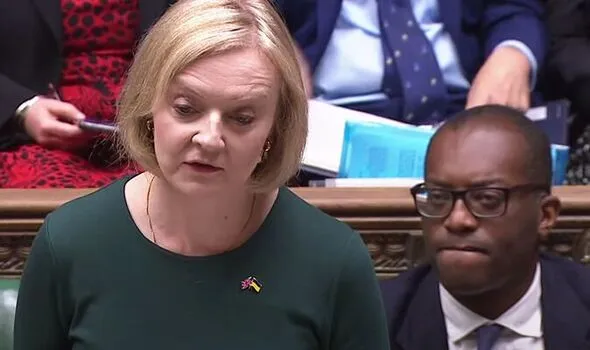
Conservative MPs seem increasingly willing to use the rhetoric of conspiracy. Recently, Liz Truss claimed that her brief tenure as prime minister had been ended by the deep state – shadowy forces within the British establishment and the media.
A few days later, Lee Anderson, the Conservative party’s former deputy chairman, asserted that London’s mayor, Sadiq Khan, is being controlled by Islamists. He was adding his own twist on a similar conspiracy theory put forward by former home secretary Suella Braverman, who claimed in a Telegraph article that Islamists are in charge of the whole country.
Why do politicians make conspiracy claims like these? It seems strange for MPs whose party has been in government for almost 14 years to imply that they aren’t really in control and that power is wielded by hidden actors.
Maybe Truss and Anderson mean what they say, and say what they mean. But even if they do believe that Britain is governed by a deep state or Islamist plotters, knowing a bit about rhetoric can help us to see that there is more going on when politicians use the language of conspiracy.
Context matters
A good politician will adapt what they say to fit the moment and their audience. For example, Truss’s deep state comments were made at CPAC, a conference for American conservatives. She was speaking in part to promote her new book, Ten Years to Save the West, and so had little reason to do anything other than give her audience what it likes. Conspiracy theories have become prominent in American conservatism (think QAnon and the claims that the 2020 presidential election was stolen), so echoing the rhetoric is an obvious way for a CPAC speaker to ingratiate themselves with an audience.
Anderson, though, was speaking in the UK, where conspiracist language is more unusual. His comments were seen by many as deliberately divisive and Islamophobic, and quickly landed him a suspension from his party. That said, government ministers were evasive when asked why his comments were wrong and whether they were Islamophobic.
Part of the brand
Courting controversy carries risks, as Anderson’s suspension shows. But it can also thrust a politician into the limelight, giving them a chance to speak to a broader audience and potentially gain new supporters. Much of the time, politicians make their own character – or ethos, as it is known in classical rhetoric – part of their pitch.
In her comments alleging a deep state conspiracy, Truss took on a populist tone. She portrayed herself as an anti-establishment figure fighting for the British people against the elites. She didn’t mention her party’s long period in government in charge of the civil service that allegedly made her tenure so impossible. Nor did she refer to the economic problems brought about during her fleeting administration.
Speaking to an audience which is likely to be less familiar with her political career, Truss was able to present herself as the protagonist in a David and Goliath narrative – albeit one in which David is defeated.
Similarly, Anderson used the controversy around his comments to present himself as a man of the people. Rather than giving any evidence to back up his claims about Islamists controlling Khan, Anderson instead justified his views by citing the positive reaction he had received from his constituents. When told in an interview with Channel 4 News that people were puzzled by his refusal to back down, Anderson replied: “If you go and speak to people in Ashfield [Anderson’s constituency] and ask them if they’re puzzled about it, no they’re not.”
In the aftermath of the controversy, Anderson told GB News: “When I went into pubs in Ashfield at the weekend, Friday, Saturday, Sunday, I got a round of applause when I went in. And these are normal working-class people.”
Such comments can be seen as part of a broader trend. Politicians have learned to cite the opinions of ordinary people in order to justify spurious claims. Rather than explaining anything about how he came to view Islamists being in charge of London, Anderson’s response to questions has been to use them as an opportunity to present himself as an outsider to the political establishment – a man in tune with what voters really think.
Pitting ‘us’ against ‘them’
This focus on presenting a certain persona and using it to justify baseless comments tells us something important – that identity is a key ingredient in conspiracist rhetoric.
It enables a politician to construct a conflict between an in-group and an out-group – a struggle between “us” and “them” – and asks the audience to pick a side. Rather than focusing on policies or ways of improving life for the British population, this rhetoric wants the audience to identify with the speaker’s character and join them in opposing a threatening enemy.
In this way, conspiracist rhetoric is much like the Conservatives’ attacks on “woke ideology” – it deflects attention away from their record in government, and rallies their supporters against an enemy at a time when the party is down on its luck.
Counteracting this is no easy task. Rhetoric is an art, not an exact science. One strategy could be to focus more on what politicians are trying to achieve when they use conspiracist rhetoric. While it is important to determine whether or not they really believe in a deep state or Islamist conspiracy, we also need to challenge the personas that politicians craft for themselves, as well the us-against-them divisions they construct.
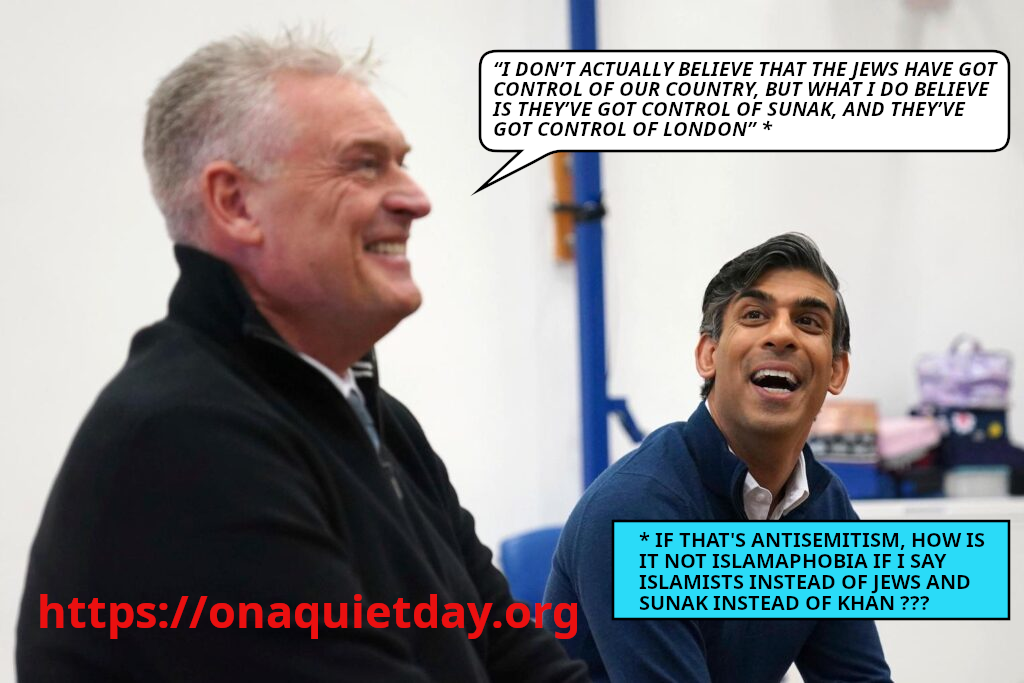
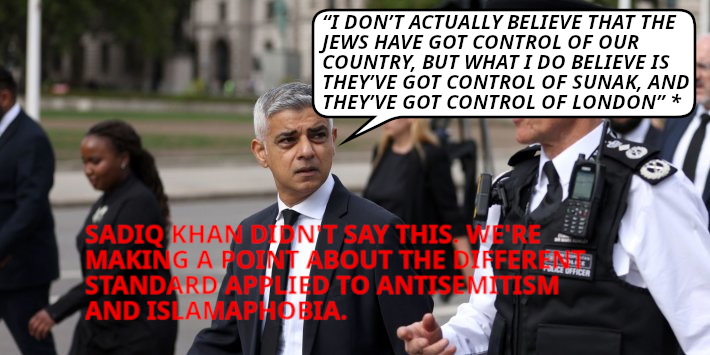
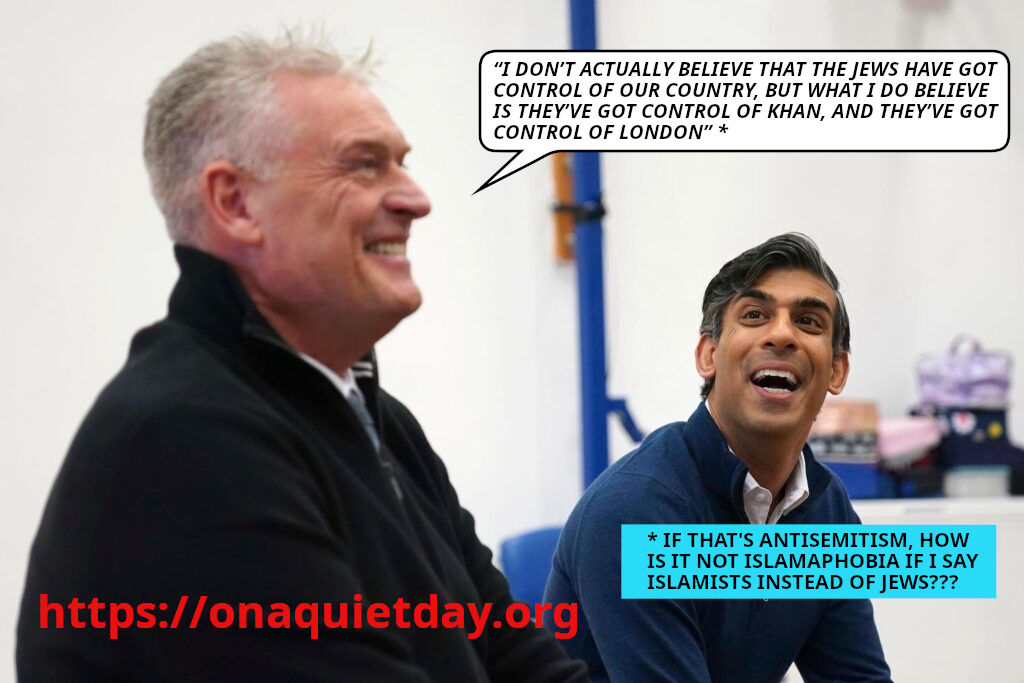
Lee Anderson and Rishi Sunak. Anderson makes more antisemitic remarks to highlight the double standard of antisemitism and Islamaphobia. Sadik Khan’s remarks coming soon ;)Parody remarks attributed to Sadiq Khan highlights the double standard applied to Antisemitism and Islamaphobia.