Ofgem’s announcement of a 12% drop in energy bills for April to June is welcomed, but National Energy Action warns that six million UK households will still face fuel poverty
Despite this reduction, National Energy Action (NEA) cautions that 6 million UK households will continue to grapple with fuel poverty.
This figure marks a significant increase from the 4.5 million households affected at the onset of the energy crisis in October 2021.
The persistent challenge of fuel poverty is exacerbated by the fact that current energy bills remain 49% higher than pre-crisis levels.
Adam Scorer, Chief Executive of NEA, said: “This is, of course, good news – any fall in energy bills is welcome. However, the drop coming in April still leaves bills significantly higher than they were before the energy crisis began.
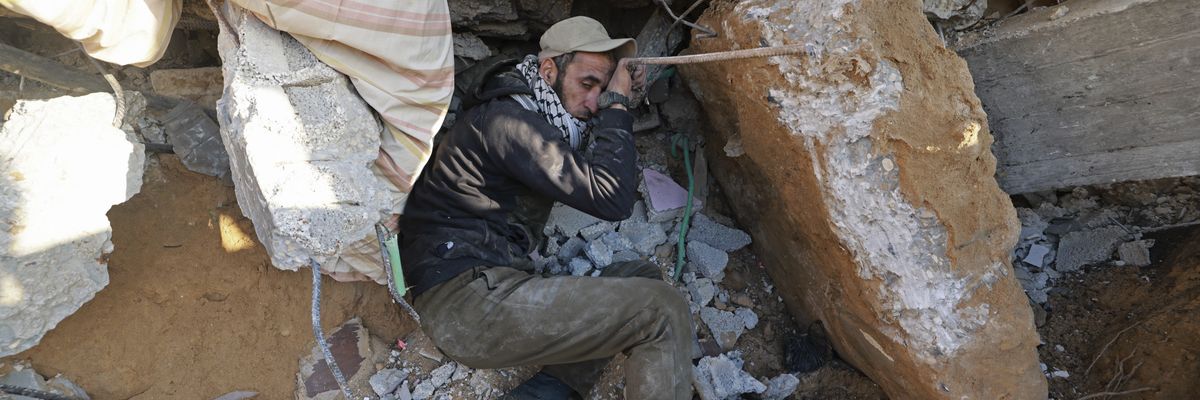
A man looks for survivors amid the debris of destroyed houses in the aftermath of Israeli airstrikes in Rafah in the southern Gaza Strip on February 22, 2024. (Photo: Mohammed Abed/AFP via Getty Images)
“State officials involved in arms exports may be individually criminally liable for aiding and abetting any war crimes, crimes against humanity, or acts of genocide.”
Dozens of United Nations experts on Friday called for an immediate arms embargo on Israel and warned that countries and private companies still sending weapons to the Israeli military during its assault on Gaza could be complicit in crimes against humanity.
The experts—including special rapporteurs on education and the rights of displaced people—said in a joint statement that “any transfer of weapons or ammunition to Israel that would be used in Gaza is likely to violate international humanitarian law and must cease immediately.”
“Such transfers are prohibited even if the exporting state does not intend the arms to be used in violation of the law—or does not know with certainty that they would be used in such a way—as long as there is a clear risk,” they said. “State officials involved in arms exports may be individually criminally liable for aiding and abetting any war crimes, crimes against humanity, or acts of genocide.”
The U.N. experts noted that the United States and Germany are “by far” Israel’s largest arms suppliers, though France, the United Kingdom, Canada, and Australia also export weapons to the Israeli government, which the International Court of Justice (ICJ) ruled is plausibly committing genocide in the Gaza Strip.
The ICJ’s interim ruling, which Israel has disregarded, has “heightened” the need for an arms embargo, the experts said, noting that compliance with the Genocide Convention of 1948 “requires states parties to employ all means reasonably available to them to prevent genocide in another state as far as possible.”
The experts also said that “arms companies contributing to the production and transfer of arms to Israel and businesses investing in those companies bear their own responsibility to respect human rights, international humanitarian law and international criminal law.”
“They have not publicly demonstrated the heightened human rights due diligence required of them and accordingly risk complicity in violations,” they said.
“All states must not be complicit in international crimes through arms transfers. They must do their part to urgently end the unrelenting humanitarian catastrophe in Gaza.”
The statement comes two weeks after a Dutch court ordered the Netherlands’ government to stop exporting jet parts to Israel, citing the “clear risk” that the aircraft might be used to “commit serious violations of international humanitarian law.” The government is appealing the ruling.
Other countries, including Italy and Spain, have said they have suspended arms sales to Israel since its latest assault on Gaza began—though a Spanish newspaper reported earlier this month that the country exported $1.1 million worth of ammunition to Israel in November.
The U.S., meanwhile, is reportedly planning to send additional weaponry to Israel and has refused to attach conditions to its arms exports even as top officials—including President Joe Biden—publicly voice concerns about the rising death toll in Gaza and Israel’s looming ground invasion of Rafah, where more than half of the enclave’s population is currently sheltering.
According to The Wall Street Journal, the latest proposed arms shipment “includes roughly a thousand each of MK-82 bombs, KMU-572 Joint Direct Attack Munitions that add precision guidance to bombs, and FMU-139 bomb fuses.”
“The arms are estimated to be worth tens of millions of dollars,” the Journal added. “The proposed delivery is still being reviewed internally by the administration, a U.S. official said, and the details of the proposal could change before the Biden administration notifies congressional committee leaders who would need to approve the transfer.”
Israel has used U.S. weaponry to commit atrocities in the Gaza Strip, including airstrikes on homes full of children. An Amnesty Internationalinvestigation released earlier this month found that a January 9 Israeli airstrike on a residential building in southern Gaza killed 18 civilians, including 10 children.
Based on ordnance fragments recovered from the rubble, the weapon used in the attack was identified as a GBU-39 Small Diameter Bomb—made by the U.S. company Boeing.
On Friday, Gaza’s health ministry said that Israeli airstrikes killed more than 100 people over the past 24 hours and injured at least 160 more. Israeli strikes on the severely overcrowded city of Rafah on Thursday destroyed a mosque and several homes, killing or wounding many people and leaving others trapped under the rubble.
“International law does not enforce itself,” the U.N. experts said Friday. “All states must not be complicit in international crimes through arms transfers. They must do their part to urgently end the unrelenting humanitarian catastrophe in Gaza.”
As the Nuremberg Tribunal and U.S. law make clear, it is the responsibility of the people to halt crimes that the courts have proved impotent to prevent.
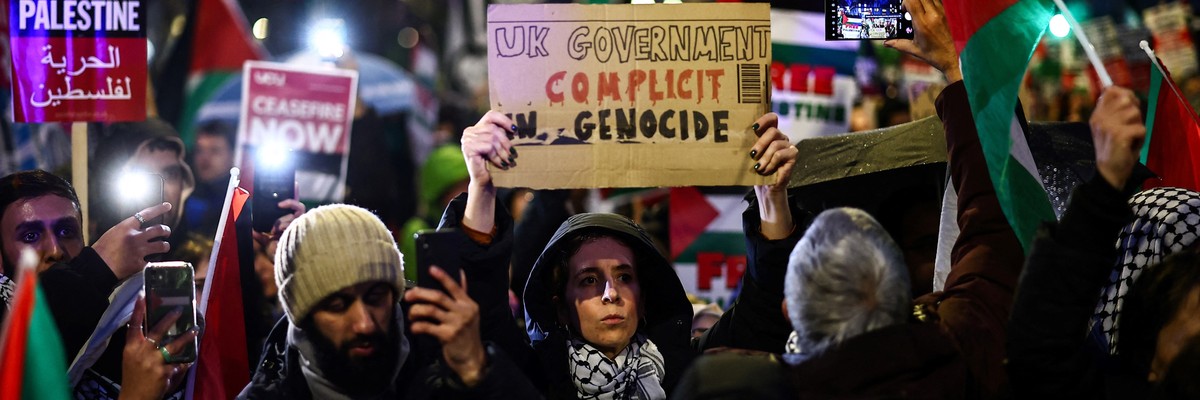
Pro-Palestinian demonstrators hold a protest in Parliament Square in London on February 21, 2024. (Photo: Henry Nicholls/AFP via Getty Images)
“It is a disgrace that there has been so much playground politics in Parliament this evening, while so many lives are at stake.”
What was supposed to be a debate over a motion demanding an immediate cease-fire in the Gaza Strip quickly descended into mayhem and partisan bickering on Wednesday as members of the U.K. Parliament jockeyed for position—all while Israel continued dropping bombs on starving Palestinians.
Wednesday’s debate was started by the Scottish National Party (SNP), which introduced a motion calling for an immediate cease-fire in Gaza, the release of all hostages, and “an end to the collective punishment of the Palestinian people.”
The Conservative and Labour parties both put forth amendments aimed at watering down the SNP motion. House of Commons Speaker Lindsay Hoyle moved to allow a vote on all three motions, angering Tories who said the decision violated convention.
Ultimately, as The Associated Press reported, “many Conservatives and SNP members walked out, and in their absence the Labour version of the cease-fire call passed on a voice vote—by calls of ‘Aye’—without a full formal vote.” The Labour amendment dropped the SNP motion’s call for an end to collective punishment.
Diane Abbott, an MP for Hackney North and Stoke Newington, said she entered Parliament on Wednesday to support the SNP motion, which she called “the only genuinely meant cease-fire motion on the order paper.”
“Instead things descended into a shambles,” said Abbott. “Meanwhile Israel’s military continues to kill 250 Palestinians a day.”
Jeremy Corbyn, an independent MP for Islington North and the former leader of the Labour Party, wrote Thursday that “yesterday was an appalling day for British Parliament.
“It was much, much worse for the people of Gaza, who are dying slowly and painfully from dehydration, disease, and starvation,” Corbyn added. “We must end this systematic slaughter—the existence of the Palestinian people is at stake.”
“An immediate and permanent cease-fire is the only solution to stop this devastating cycle of bloodshed.”
Oxfam GB’s head of advocacy, Katy Chakrabortty, also voiced outrage over Wednesday’s proceedings, saying in a statement, “It is a disgrace that there has been so much playground politics in Parliament this evening, while so many lives are at stake.”
“The people of Gaza can’t wait for our politicians to stop squabbling,” said Chakrabortty. “Much of the country lies in ruins and Rafah, where many Palestinian families have been forced to flee, is under threat of a full-scale military offensive. Children in the North of Gaza are dying from hunger because no aid can reach them due to Israel’s continued assault and restrictions on access.”
“An immediate and permanent cease-fire is the only solution to stop this devastating cycle of bloodshed, to ensure the safe release of hostages, and to allow urgent aid to reach all of those in desperate need,” Chakrabortty continued. “Many MPs spoke passionately tonight of the horrors in Gaza and we thank those who raised their voices. The government must listen and support U.N. votes for a cease-fire and end the sale of arms to Israel.”
Citing unnamed sources, The Guardian on Wednesday reported that the U.K.’s Tory government “will consider suspending arms export licenses to Israel” if the country’s military goes ahead with a ground invasion of Rafah, a severely overcrowded city near Gaza’s border with Egypt.
The U.K. has licensed more than £474 million worth of military exports to Israel over the past decade, according to Human Rights Watch (HRW).
In December, HRW and other rights groups warned that “the U.K. risks being complicit in and facilitating serious violations of international humanitarian law if it fails to halt arms exports to Israel immediately.”
“Our organizations demand an immediate suspension of arms transfers to all parties to the current conflict,” the groups wrote in a joint letter. “For the U.K. government, this requires a halt to the arming of Israel. Failure to do so risks the government breaching its own laws and being complicit in grave abuses.”
dizzy: While this is a very good account of what happened, I’m going to emphasize some extra issues. While the Speaker is supposed to be impartial he is acually an MP, currently a Labour MP. Labour Leader Keir Starmer acted improperly by effectively ‘lobbying’ the Speaker in person yesterday. Starmer has said that he didn’t threaten or impose pressure on the Speaker. I suggest that lobbying him in any way is out of order. The Speaker claims that he was concerned for MPs safety, that they are getting confronted by their constituents.
The winner from yesterday’s events is Keir Starmer since huge numbers – perhaps a hundred – of Labour MPs were expected to vote for the SNP’s motion against their party’s instruction. I consider that the Speaker should not be concerned with MPs’ safety and that they should be expected to be confronted by their constituents. The point here is that if you don’t want to be accused of complicity in genocide don’t be complicit in genocide.
24/2/24 I’ve used the wrong term ‘lobbying’. MPs are whipped by their own parties to follow their party’s chosen course of action.
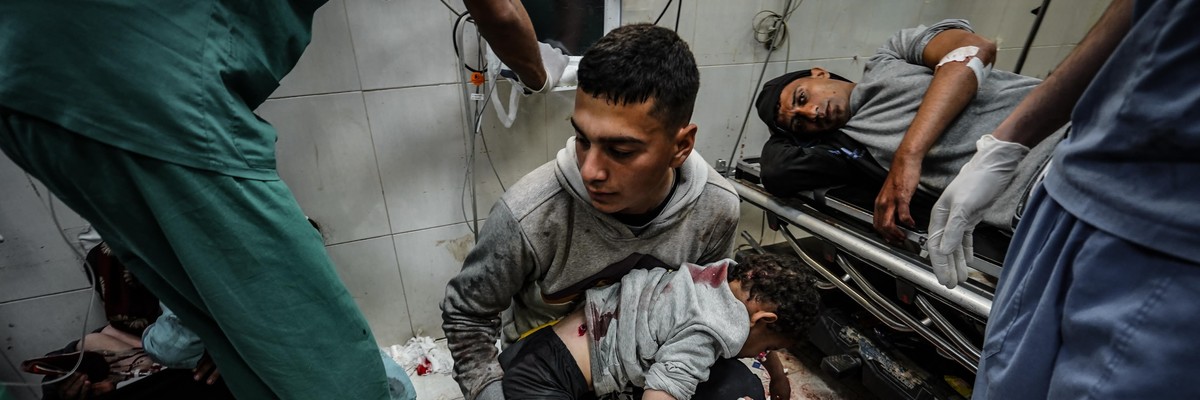
Injured Palestinians, including children, are brought to Nasser Hospital to receive medical treatment following Israeli attacks in Khan Younis, Gaza, on January 22, 2024. (Photo: Belal Khaled/Anadolu via Getty Images)
If we can’t find the morality to stop, we may find we have created a world in which no one can count on upholding basic human rights.
Many decades ago in Chicago, my favorite of several part-time student jobs was operating the “old-style” telephone switchboard at a small hospital called Forkosh Memorial. The console of coils and plugs included a mirror so operators could keep an eye on the hospital entrance, which on weekends and evenings was also monitored by an elderly, unarmed security guard named Frank. He sat at a classroom style desk near the entrance with a ledger book.
Over the course of four years, on weekends and evenings, “security” at the hospital generally consisted solely of Frank and me. Fortunately, nothing much ever happened. The possibility of an attack, invasion, or raid never occurred to us. The notion of an aerial bombardment was unimaginable, like something out of War of the Worlds or some other sci-fi fantasy.
Now, tragically, hospitals in Gaza and the West Bank have been attacked, invaded, bombed, and destroyed. News of additional Israeli attacks is being reported on a daily basis. Last week, Democracy Now! interviewed Dr. Yasser Khan, a Canadian ophthalmologist and eye surgeon who recently returned from a humanitarian surgical mission at the European Hospital in Khan Younis in Gaza. Dr. Khan spoke of bombings taking place every few hours resulting in a constant influx of mass casualties. The majority of patients he treated were children from age 2 to 17. He saw horrific eye injuries, shattered faces, shrapnel wounds, abdominal injuries, limbs severed above the bone, and traumas caused by drone-launched laser-guided missiles. Amid the overcrowding and chaos, healthcare workers tended to patients while lacking basic equipment, including anesthesia. Patients lay on the ground in unsterile conditions, vulnerable to infection and disease. Most of them also suffered from severe hunger.
At Forkosh Hospital in the 1970s, I had a mirror to see what was happening behind my back, but everyone on Earth can see, directly, the horror of U.S. support for a genocidal event happening on our watch.
Normally, a child who undergoes an amputation faces as many as 12 additional surgeries. Khan wondered who would do the follow-up care for these children, some of whom have no surviving relatives.
He also noted sniper fire prevented doctors from going to work. “They’ve killed healthcare workers, nurses, paramedics; ambulances have been bombed. This has all been systematic,” Khan explained. “Now there are 10,000 to 15,000 bodies decomposing. It’s the rainy season right now in Gaza, so all the rainwater mixes with the decomposing bodies and that bacteria mixes with the drinking water supply and you get further disease.”
According to Khan, Israeli forces have kidnapped 40 to 45 doctors, specifically targeting specialists and hospital administrators. Three healthcare professional organizations have issued a statement expressing deep concern that the Israeli military has abducted and unlawfully detained Dr. Khaled al-Serr, a surgeon at the Nasser Hospital in Gaza.
On February 19, WHO Director-General Dr. Tedros Adhanom Ghebreyesus described conditions in the Nasser hospital after Israel ordered evacuation of Palestinians from the complex. “There are still more than 180 patients and 15 doctors and nurses inside Nasser,” he said. “The hospital is still experiencing an acute shortage of food, basic medical supplies, and oxygen. There is no tap water and no electricity, except a backup generator maintaining some lifesaving machines.”
Eight years ago, in October of 2015, the United States military destroyed Afghanistan’s Kunduz hospital, run by Médecins sans Frontières (Doctors Without Borders). For more than an hour, a C-130 transport plane repeatedly fired incendiary devices at the hospital’s emergency room and intensive care unit, killing 42 people. Thirty-seven additional people were injured. “Our patients burned in their beds,” read the MSF’s in-depth report. “Our medical staff were decapitated or lost limbs. Others were shot from the air while they fled the burning building.”
The horrific attack outraged war resisters and human rights groups. I remember joining a group of activists in upstate New York who assembled outside a hospital emergency room with a banner proclaiming, “To bomb this site would be a war crime.”
In 2009, on a smaller, yet still horrific scale, I witnessed an Israeli onslaught in Gaza called “Operation Cast Lead.” In the emergency room of the Al Shifa hospital, Dr. Saeed Abuhassan, an orthopedic surgeon, described experiences similar to Khan’s. This surgeon grew up in Chicago, very close to the neighborhood where I lived. I asked him what he would want me to tell our neighbors back home. He listed a litany of horrors, and then he stopped. “No,” he said. “First, you must tell them that U.S. taxpayer money paid for all of these weapons.”
Taxpayer money feeds the bloated, swollen Pentagon budget. U.S. Senators, last week, cowed by AIPAC, decided to send Israel an additional $14.1 billion to boost military spending. Only three Senators voted against the bill.
From Palestine, Huwaida Arraf, a Palestinian-American human rights attorney, wrote on X: “The scary part is not that Israel is planning the forcible transfer of the Palestinians it hasn’t slaughtered, but that the so-called ‘civilized world’ is allowing it to happen. The ramifications of this coordinated evil will haunt its collaborators for generations to come.”
At Forkosh Hospital in the 1970s, I had a mirror to see what was happening behind my back, but everyone on Earth can see, directly, the horror of U.S. support for a genocidal event happening on our watch. Gravely distorted versions of what occurred on October 7, cannot—even if believed—justify the scale of the horrors being reported in Gaza and the West Bank each day.
The U.S. government continues enthusiastically to bankroll Israel’s systemic and inhumane destruction of Gaza. U.S. advisers make feeble attempts to suggest Israel should pause or at least try to be more precise in their attacks. In its quest for hegemonic superiority, the United States tears into ever tinier shreds whatever remains of a commitment to human rights, equality, and human dignity.
What kept Forkosh Hospital secure, decades ago, was a social contract that presumed safety for a small hospital serving the local population.
If we can’t find the morality to stop supplying weapons for ongoing Israeli onslaughts against Gaza and its places of healing, we may find we have created a world in which no one can count on upholding basic human rights. We may be creating intergenerational wounds of hatred and sorrow from which there will never, ever be any safe place to heal.
A version of this article first appeared on The Progressive website.
A final investment for the plants is planned before the next election | Carl Court/Getty Images
LONDON — The U.K. government is mulling plans which would hike household energy bills to help pay for a new nuclear energy plant.
Ministers are considering tweaking the funding deal for Sizewell C, a proposed £20 billion nuclear plant in Suffolk, as they scramble to attract investors.
Under one proposal being looked at in Whitehall, the development would be part funded by electricity suppliers — and those firms “would be expected to pass these costs onto consumers through their electricity bills,” according to a consultation paper on the plans.
The Department for Energy Security and Net Zero is set to publish its response to that consultation later this week, according to two industry figures granted anonymity to discuss the process.
Officials insist potential additional charges to consumers would be low. But any move leading to higher bills would be controversial during a cost-of-living crisis driven by two years of rising energy costs.