South Africa to file legal action with ICJ against UK, US, for war crime complicity

Spread the love

Article republished from the Skwawkbox

South Africa’s legal team at the ICJ last month

Nation whose case put Israel formally on trial for genocide joins Nicaragua in turning its sights on accomplices in genocide

A team of almost fifty South African lawyers is preparing a legal case to bring to the International Court of Justice (ICJ), the United Nations’ top court, against the US and UK, for their complicity in Israel’s array of war crimes in Gaza and the occupied West Bank.

South Africa’s successful ICJ case against Israel last month led to Israel being put formally on trial for genocide and resulted in a string of binding orders on Israel to stop its slaughter of Gazans and even to protect Palestinians from harm, as well as to ensure adequate aid reaches the strip’s 2.5 million people, many of whom are now starving and homeless.

Israel has flouted the rulings, continuing and even intensifying the mass murder and blockade, and is being supported in its flagrant disregard for international law by the UK and US, who are providing both material and financial aid, and giving political cover by refusing to condemn Israel’s actions or to call its crimes what they are, instead casting doubt on the mass deaths and brutality and denigrating the Court’s ruling.

South Africa joins Nicaragua in taking action against the UK and US. The Central American nation has also filed a case against Germany, Canada and the Netherlands.

The team of lawyers, which already numbers around fifty, is likely to grow further as more lawyers are set to join from other nations. Wikus van Rensburg, who is leading the action, said that it was time for the US and other complicit nations to “be held responsible for [their] crimes”.

Article republished from the Skwawkbox

Continue ReadingSouth Africa to file legal action with ICJ against UK, US, for war crime complicity

Labour abandons £28 billion green investment plan – Greens call it a massive backward step for climate and economy

Spread the love
Image of the Green Party's Carla Denyer on BBC Question Time.
Image of the Green Party’s Carla Denyer on BBC Question Time.

Responding to news that Labour is abandoning its policy of spending £28bn a year on its green investment plan, Carla Denyer, co-leader of the Green Party, said:

“This is a massive backward step – for the climate, for the economy and for good quality jobs. Both the security of our planet for future generations and the UK’s future prosperity is dependent on greening our economy and that requires large scale investment.  

“Labour have chosen to wear their fiscal rules as a millstone around their neck. A different approach through tax reforms, in particular by introducing a wealth tax on the super-rich, could help pay for the green transition. There is more than enough money in the economy to pay for this. Indeed, the Green Party would go further and faster, investing at least double what Labour originally pledged, so we can turbo charge the transition to a green economy.  

“Greens recognise that investing in a green future will provide people with economic, social and environmental security. By decarbonising industry, insulating buildings, and ramping up renewable energy infrastructure, the UK can drastically reduce emissions, cut household bills and create new, good quality, well-paid and secure jobs in every corner of the country.   

“Investing in this secure future is a political choice. By ditching its green investment plan, and making a series of other U-turns, Labour has clearly signalled that it is turning its back on a fairer, greener future.

The Labour party is expected to make a further announcement today.

Continue ReadingLabour abandons £28 billion green investment plan – Greens call it a massive backward step for climate and economy

Green peer Bennett tables ‘fatal motion’ vs govt plan for ‘physicians’ with no medical training

Spread the love

https://skwawkbox.org/2024/02/07/green-peer-bennett-tables-fatal-motion-vs-govt-plan-for-physicians-with-no-medical-training/#comments

Former Green Party leader says Labour’s support is needed for chance of defeating DHSC move to push ‘associate’ roles that look like doctors but don’t have medical training

Green peer and former Green Party leader Natalie Bennett has heeded the calls of doctors – and independent MP Claudia Webbe, the only MP to speak against the government’s backdoor legislation when it was pushed through – to stop the government’s dangerous new move to have ‘physician associates’ (PAs) and ‘anaesthetist associates’ (AAs) regulated by the General Medical Council (GMC), despite them not having medical training.

90% of doctors believe this move puts patients at risk and at least two patients have died after PAs, who the patients thought were doctors, dismissed serious medical conditions as a muscle strain and a panic attack respectively.

https://skwawkbox.org/2024/02/07/green-peer-bennett-tables-fatal-motion-vs-govt-plan-for-physicians-with-no-medical-training/#comments

Continue ReadingGreen peer Bennett tables ‘fatal motion’ vs govt plan for ‘physicians’ with no medical training

BP and Shell’s spending on renewables flatlines in 2023

Spread the love

https://www.energymonitor.ai/finance/corporate-strategy/weekly-data-oil-majors-bp-and-shells-spending-on-renewables-flatlines-in-2023/

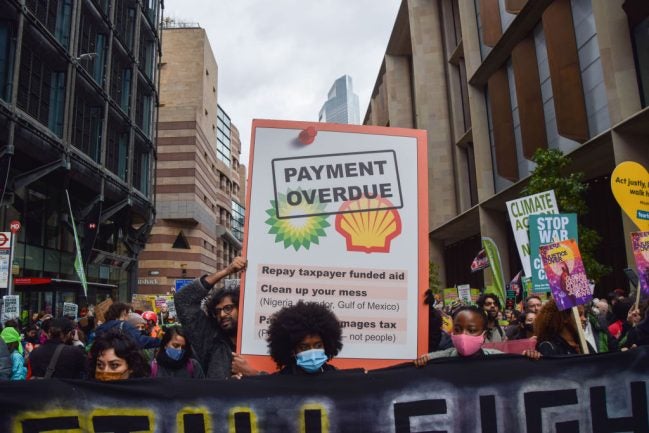
Protestors call out bp and Shell during a demonstration in the City of London in 2021. Credit: Vuk Valcic/SOPA Images/LightRocket via Getty Images.

Shell decreased spending on “renewables and energy solutions” last year, while bp’s spending on “low carbon energy” has flatlined, finds an Energy Monitor analysis of fourth-quarter results.

On Tuesday, UK oil major BP reported that in 2023 it raked in $13.8bn (£10.93bn) in profits. This represented its second-highest annual profit in a decade – despite it being nearly half the record-breaking $27.7bn bp amassed in 2022 after oil prices spiked following Russia’s invasion of Ukraine. Days earlier, Shell also reported better-than-expected profits of more than $28bn, following a record-breaking $40bn in 2022. Yet both oil majors’ spending on renewables has flatlined, finds Energy Monitor‘s analysis of the companies’ filings.

Shell’s annual results show that investment in “renewables and energy solutions” fell from $3.5bn in 2022 to just $2.7bn last year. The company spent just 11.7% of its total capital expenditure (capex) on renewables in 2023 compared with 15.3% in 2022.

By contrast, bp slightly increased its spending on “low carbon energy” from $1.02bn in 2022 to $1.26bn in 2023, although as the chart below shows, spending on renewables by both companies has flatlined over the past five years.

https://www.energymonitor.ai/finance/corporate-strategy/weekly-data-oil-majors-bp-and-shells-spending-on-renewables-flatlines-in-2023/

Greenpeace activists display a billboard during a protest outside Shell headquarters on July 27, 2023 in London.
Greenpeace activists display a billboard during a protest outside Shell headquarters on July 27, 2023 in London. (Photo: Handout/Chris J. Ratcliffe for Greenpeace via Getty Images)
Continue ReadingBP and Shell’s spending on renewables flatlines in 2023

North Sea oil and gas assets a risky bet for private equity, think tank warns 

Spread the love
North Sea oil rigs in Cromarty Firth, Scotland. Credit: joiseyshowaa (CC BY-SA 2.0)

https://www.energymonitor.ai/finance/corporate-strategy/north-sea-oil-and-gas-assets-a-risky-bet-for-private-equity-think-tank-warns/?cf-view&cf-closed

North Sea oil and gas production is expected to plummet in the coming years, as renewables become increasingly competitive. Now, a new report by the think tank Carbon Tracker argues that private equity companies invested in North Sea (UK and Norway) oil and gas assets are particularly vulnerable to losses as demand falls. Private equity’s presence in the North Sea has grown steadily since the 2014 oil price crash. 

In 2010, just 8% of North Sea assets were held by private companies, with the remainder owned by publicly listed oil majors and state-owned utilities. Currently, 29.7% of North Sea equity licences are held by current or former private equity-backed ventures, according to recent analysis from the Common Wealth think tank. 

Carbon Tracker argues that while all upstream investors risk being saddled with stranded assets as demand for hydrocarbons falls, private equity companies are particularly vulnerable. For starters, the private equity industry is already facing “serious headwinds” as the low interest rate environment that “buoyed private markets” for the last decade “has, at least temporarily, come to an end”. 

https://www.energymonitor.ai/finance/corporate-strategy/north-sea-oil-and-gas-assets-a-risky-bet-for-private-equity-think-tank-warns/?cf-view&cf-closed

Continue ReadingNorth Sea oil and gas assets a risky bet for private equity, think tank warns