The BlackRock letters: inside Labour’s ‘close partnership’

Spread the love

Original article by Ethan Shone republished from Open Democracy under a Creative Commons Attribution-NonCommercial 4.0 International licence

Keir Starmer and Rachel Reeves hosting an investment roundtable discussion with BlackRock CEO Larry Fink and members of the BlackRock executive board at 10 Downing Street  | Frank Augstein – WPA Pool/Getty Images

Jonathan Reynolds told the investment bank that he looked forward to working together to “change the face of our UK”

Senior executives from BlackRock, one of the world’s most controversial companies, last week sat down opposite Keir Starmer and chancellor Rachel Reeves in Downing Street.

The government’s laser-focus on private investment as the key means of driving economic growth has inevitably led to a reliance on the world’s big money machines, such as BlackRock. But this is a relationship that Labour initially developed in opposition – and which has only become cosier since the party entered government.

The meeting on Thursday between Starmer, Reeves, investment minister Poppy Gustafsson and several members of BlackRock’s board was not the first time that senior figures from the world’s largest asset manager have met with ministers in recent months.

BlackRock CEO Larry Fink also made a star turn at Labour’s investment summit in October and posed for pictures with the prime minister when he visited New York in September. Senior BlackRock figures also attended a summer reception for business leaders at No 10, as openDemocracy revealed previously.

‘On a personal note’

As Starmer’s cabinet ministers were appointed in July, hundreds of companies contacted them to offer their congratulations, pitch their value to the government, and request meetings. Inevitably, some had more success than others in obtaining access to their targets. BlackRock was one of them.

With around $10tn (yes, trillion) under its management, BlackRock is among the most powerful financial institutions on the planet. To many, it is also among the most “evil”, because it continues to pump billions into fossil fuels and arms companies, and its reach extends into almost every aspect of the economy and society.

At 5pm on Monday 8 July, a managing director at the investment giant emailed Jonathan Reynolds, who’d been appointed the UK’s new secretary of state for business and trade just a few days earlier.  

“Dear Secretary of State,” the executive wrote, “on behalf of all of us here at BlackRock, please find attached a formal letter of congratulations from myself and our UK Chair, Sandra Boss. 

“And may I add, on a personal note, it is a pleasure after all these years to address you as such!”

The BlackRock executive was Anthony Manchester, a former senior civil servant who held roles across various government departments between 2001 and 2015, including the Treasury and Cabinet Office.

The attached letter began with the same pleasantries and congratulations expressed by Manchester, before highlighting BlackRock’s broad range of clientele and the scale of their footprint across the breadth of the UK economy, name-dropping British Airways, Rolls Royce and AstraZeneca as investments. 

Next came the key point: 

“As you know, we also share the government’s view that infrastructure investment can play a critical role in improving economic growth and productivity. We believe infrastructure is poised to become one of the fastest-growing segments in private markets globally.

“As our Chairman and CEO Larry Fink has recently written, private capital market financing, combined with policy pragmatism, are necessary to meet countries’ infrastructure needs and thereby enhance economic growth and productivity.

“We would welcome the opportunity to meet with you to discuss our work on funding the projects and enterprises that drive the economy and building the UK’s case as an investment destination. We will work with your team to get this meeting in the diary.

“Until then, congratulations once again on your appointment.”

Cutting through the corporate glaze, we can roughly understand the point being made here. In effect, BlackRock is highlighting that Labour’s entire political project rests on the willingness of companies like BlackRock to plough private capital into the foundational components of our society (and extracting massive profits in the process). 

Reynolds’ reply to BlackRock, when it eventually came in August, gushed with praise for the firm and the wider financial services sector. 

“Partnership with the Financial Services sector will be critical to developing and delivering on our industrial strategy and supporting small businesses. The sector underpins UK investment and trade, and its continued success is critical to lay the strong foundations for economic growth that this country needs.”

Reynolds added: “I would like to thank you for your long-standing investment in the UK, and partnership in driving growth, jobs and innovation. Blackrock has an impressive reach driving investment into the UK across sectors of our economy and your work is vital to economic growth. Funding our priority projects and investment in infrastructure is an important part of this…”

“We do not underestimate the importance of the UK’s Financial Services sector to the wider economy, or its potential to help deliver social value and the clean energy transition. To succeed we need everyone to play their part. I am looking forward to working with you in this common endeavour of national renewal. 

“Together, we will change the face of our United Kingdom for the better.

“Thank you for your kind offer to meet. I would be delighted to accept this invitation. My Private Office will be in touch with you to arrange a suitable time. Thank you once again for writing and I look forward to working with you.”

‘Getting BlackRock to rebuild Britain’

In the asset management space, BlackRock has historically been a fairly hands-off investor, the bulk of its holdings being significant but typically not controlling shares in many of the world’s biggest companies – generally between 5-10% – according to Brett Christopher’s survey of the industry, Our Lives in Their Portfolios: Why Asset Managers Rule the World.

Think of an industry, then think of the top companies within it, and there’s a fairly good chance that BlackRock has shares in it. Christophers notes that, as a proportion of its overall holdings, investments placed in infrastructure – things like the electricity grid, water systems, and toll roads – were relatively small. 

But in January this year, the firm announced it would purchase Global Infrastructure Partners, which controls around $170bn worth of assets worldwide, including Gatwick Airport and Hornsea 1, a project to build the world’s largest offshore windfarm in the North Sea. This purchase, which was completed last month, reportedly makes BlackRock the second largest asset manager in the infrastructure space, after ‘the vampire kangaroo’, Macquarie. 

Critics will argue that when asset managers own significant chunks of infrastructure, their priority is their investors (including sovereign wealth funds and pension funds), rather than society, or even the planet. The primary purpose of infrastructure, the argument goes, becomes the generation of profit, rather than providing a working, reliable service. In practice, this might mean cutting investment while raising prices.

BlackRock and its ilk buying up the UK’s infrastructure would be controversial enough, but the way in which Labour is seeking to encourage this process is even worse. Writing in The Guardian ahead of the general election, economist Daniela Gabor said Labour’s plan for getting back into government amounted to: “get BlackRock to rebuild Britain”. 

She wrote: “Labour’s strategy raises a bigger set of questions about the type of state we want. Starmer’s vision for government-by-BlackRock reduces the question of state capacity to ‘how do I get BlackRock to invest in infrastructure assets?’ This model involves the state in effect subsidising the privatisation of everyday life.” 

In simple terms, the government’s plans to use public funds to ‘derisk’ private investment means that the taxpayer takes on much of the risk involved, while the private sector stands to reap most of the benefits. This is particularly true of essential infrastructure, which the government cannot let fail and so must step in to cover losses in the event that something goes wrong.

Gabor continues: “This doesn’t only make it harder to bring public goods back into public ownership; it also allows big finance to tighten the grip on the social contract with citizens, and to become the ultimate arbiter of climate, energy and welfare politics, which will have profound distributional, structural and political consequences.”

Immediately after the Downing Street meeting yesterday, Starmer took to social media to trumpet his sitdown with BlackRock. His message echoes the tone and substance of BlackRock’s letter to Reynolds months prior.

He wrote that the government’s mission, to “deliver growth, create wealth and put more money in people’s pockets” can “only be achieved by working in close partnership with businesses and investors”. 

The prime minister continued: “BlackRock has a big footprint in the UK, and supports thousands of jobs across the country. Their insight on how we can put the UK on the world’s stage as a top investment destination and turbocharge growth is invaluable. Delighted to welcome them to Downing Street today to continue my government’s partnership with leading businesses.”

Exactly which people’s pockets are about to be filled with more money remains unclear. 

Original article by Ethan Shone republished from Open Democracy under a Creative Commons Attribution-NonCommercial 4.0 International licence

Keir Starmer, Angela Rayner and Rachel Reeves wear the uniform of the rich and powerful. They have all had clothes bought for them by multi-millionaire Labour donor Lord Alli. CORRECTION: It appears that Rachel Reeves clothing was provided by Juliet Rosenfeld.
Continue ReadingThe BlackRock letters: inside Labour’s ‘close partnership’

Calls for energy support intensify as temperatures expected to plunge

Spread the love

https://morningstaronline.co.uk/article/calls-energy-support-intensify-temperatures-expected-plunge

The temperature control of a radiator in a domestic home

DEMANDS for more energy support for vulnerable households intensified today as temperatures are expected to plummet this week.

Some areas rose above 16°C on Sunday, but the Met Office forecast a sharp drop by last night, with temperatures potentially plunging to -8°C in parts of Scotland.

Meteorologists warned that the cold spell would continue tomorrow, with parts of England becoming as chilly as -3°C.

The cold snap comes just over a month after energy regulator raised the price cap by 10 per cent, while 6.5 million households remain trapped in fuel poverty.

Peter Smith of National Energy Action said: “Millions of people will endure these freezing conditions at the same time as unaffordable energy bills and unmanageable energy debt.

“At this exceptionally difficult time for vulnerable households, we see a desperate need for a larger energy discount or a new social tariff to provide long-term protection.

https://morningstaronline.co.uk/article/calls-energy-support-intensify-temperatures-expected-plunge

Continue ReadingCalls for energy support intensify as temperatures expected to plunge

‘Monumental Victory for the Ocean’: Norway Halts Plans for Deep-Sea Mining

Spread the love

Original article by Olivia Rosane republished from Common Dreams under Creative Commons (CC BY-NC-ND 3.0). 

Kirsti Bergstø, leader of the Socialist Left Party, speaks at a protest against deep-sea mining outside Norwegian Parliament.  (Photo: Greenpeace)

One campaigner called it “a testament to the power of principled, courageous political action, and… a moment to celebrate for environmental advocates, ocean ecosystems, and future generations alike.”

Environmental organizations cheered as Norway’s controversial plans to move forward with deep-sea mining in the vulnerable Arctic Ocean were iced on Sunday.

The pause was won in Norway’s parliament by the small Socialist Left (SV) Party in exchange for its support in passing the government’s 2025 budget.

“Today marks a monumental victory for the ocean, as the SV Party in Norway has successfully blocked the controversial plan to issue deep-sea mining licenses for the country’s extended continental shelf in the Arctic,” Steve Trent, CEO and founder of the Environmental Justice Foundation, said in a statement. “This decision is a testament to the power of principled, courageous political action, and it is a moment to celebrate for environmental advocates, ocean ecosystems, and future generations alike.”

“Today, thanks to the SV Party and all those around the world who spoke up against this decision, the ocean has won. Now, let’s ensure this victory lasts.”

Norway sparked outrage in January when its parliament voted to allow deep-sea mining exploration in a swath of its Arctic waters larger than the United Kingdom. Scientists have warned that mining the Arctic seabed could disturb unique hydrothermal vent ecosystems and even drive species to extinction before scientists have a chance to study them. It would also put additional pressure on all levels of Arctic Ocean life—from plankton to marine mammals—at a time when they are already feeling the impacts of rising temperatures and ocean acidification due to the burning of fossil fuels.

“The Arctic Ocean is one of the last pristine frontiers on Earth, and its fragile ecosystems are already under significant stress from the climate crisis,” Trent said. “The idea of subjecting these waters to the destructive, needless practice of deep-sea mining was a grave threat, not only to the marine life depending on them but to the global community as a whole.”

“Thankfully, this shortsighted and harmful plan has been halted, marking a clear victory in the ongoing fight to protect our planet’s blue beating heart,” Trent continued.

In June, Norway announced that it would grant the first exploratory mining licenses in early 2025. However, this has been put on hold by the agreement with the SV Party.

“This puts a stop to the plans to start deep-sea mining until the end of the government’s term,” party leader Kirsti Bergstø said, as The Guardian reported.

Norway next holds parliamentary elections in September 2025, so no licenses will be approved before then.

The move comes amid widespread opposition to deep-sea mining in Norway and beyond. A total of 32 countries and 911 marine scientists have called for a global moratorium on the practice. More than 100 E.U. parliamentarians wrote a letter opposing Norway’s plans specifically, and the World Wide Fund for Nature (WWF) has sued to stop them.

“This is a major and important environmental victory!” WWF-Norway CEO Karoline Andaur said in a statement. “SV has stopped the process for deep seabed mining, giving Norway a unique opportunity to save its international ocean reputation and gain the necessary knowledge before we even consider mining the planet’s last untouched wilderness.”

Haldis Tjeldflaat Helle, the deep-sea mining campaigner at Greenpeace Nordic, called the decision “a huge win.”

“After hard work from activists, environmentalists, scientists, and fishermen, we have secured a historic win for ocean protection, as the opening process for deep-sea mining in Norway has been stopped,” Helle said in a statement. “The wave of protests against deep-sea mining is growing. We will not let this industry destroy the unique life in the deep sea, not in the Arctic nor anywhere else.”

https://twitter.com/Greenpeace/status/1863553791758565560?ref_src=twsrc%5Etfw%7Ctwcamp%5Etweetembed%7Ctwterm%5E1863553791758565560%7Ctwgr%5Ea3413baf36f0c5699fefd01a7c8808124e45c27c%7Ctwcon%5Es1_c10&ref_url=https%3A%2F%2Fwww.commondreams.org%2Fnews%2Fnorway-halts-deep-sea-mining

Sorry, this content could not be embedded. [X/twitter embed still broken … Is there a work-around?]
X

However, Norway’s Arctic waters are not entirely safe yet.

Prime Minister Jonas Gahr Stoere, of the Labour Party, toldTV2, on Sunday, “This will be a postponement.”

The government said that other work to begin the process of deep-sea mining, such as drafting regulations and conducting environmental impact surveys, would move forward. Norway is currently governed by the Labour and Center parties. The two parties leading in polls for September’s elections—the Conservatives and Progress Party—also both back deep-sea mining, according toReuters.

“If a new government attempts to reopen the licensing round we will fight relentlessly against it,” Frode Pleym, who leads Greenpeace Norway, told Reuters.

Other environmental groups tempered their celebrations with calls for further action.

Trent of the Environmental Justice Foundation said that “while today is a cause for celebration, this victory must not be seen as the end of the struggle.”

“We urge Norway’s government, and all responsible global actors, to make this a lasting victory by enshrining protections for the Arctic Ocean and its ecosystems into law, and coming out in favor of a moratorium or ban on deep-sea mining,” Trent added. “It is only through a collective commitment to sustainability and long-term stewardship of our oceans that we can ensure the health of the marine environment for generations to come.”

Trent concluded: “Today, thanks to the SV Party and all those around the world who spoke up against this decision, the ocean has won. Now, let’s ensure this victory lasts.”

Andaur of WWF said that this was a “pivotal moment” for Norway to “demonstrate global leadership by prioritizing ocean health over destructive industry.”

As WWF called on Norway to abandon its mining plans, it also urged the nation to reconsider its exploitation of the ocean for oil and gas.

“Unfortunately, we have not seen similar efforts to curtail the Norwegian oil industry, which is still getting new licenses to operate in Norwegian waters, including very vulnerable parts of the Arctic,” Andaur said. “Norway needs to explore new ways to make money without extracting fossil fuels and destroying nature.”

Greenpeace also pointed to the role Norway’s pause could play in bolstering global opposition to deep-sea mining.

“Millions of people across the world are calling on governments to resist the dire threat of deep-sea mining to safeguard oceans worldwide,” Greenpeace International Stop Deep-Sea Mining campaigner Louisa Casson said. “This is a huge step forward to protect the Arctic, and now it is time for Norway to join over 30 nations calling for a moratorium and be a true ocean champion.”

Original article by Olivia Rosane republished from Common Dreams under Creative Commons (CC BY-NC-ND 3.0). 

dizzy: Welcome back BTW, hosting server was down for an hour or so 9.30 – 10.30 a.m. GMT. Seems fast now.

Continue Reading‘Monumental Victory for the Ocean’: Norway Halts Plans for Deep-Sea Mining

Protesters demand government end ‘green’ subsidies for Britain’s largest carbon emitter

Spread the love

https://morningstaronline.co.uk/article/protesters-demand-government-end-green-subsidies-britains-largest-carbon-emitter

Greenpeace, Axe Drax, Friends of the Earth and Stop Burning Trees Coalition protest outside DESNZ to call for an end to Drax subsidies and for genuine clean power Photo: © Chris J Ratcliffe / Greenpeace

PROTESTERS descended on Westminster today to demand that the government stop using taxpayers’ money to bankroll the destruction of forests.

More than 100 environmental activists from groups including Axe Drax, Fossil Free London and Greenpeace gathered outside the Department of Energy Security and Net Zero, calling for an end to the vast subsidies granted to the Drax biomass power plant.

The North Yorkshire plant is Britain’s largest carbon emitter, yet receives almost £1.5 million a day for burning biomass wood chips, a fuel source that Drax claims is “carbon neutral.”

As part of the action, a choir celebrated Christmas trees in song and handed out origami trees to civil servants entering the building.

Four people dressed as tree-like creatures representing the millions of trees burned by Drax presented the department with a Greenpeace petition, bearing the signatures of over 120,000 people, calling for an end to the subsidies.

The power plant burned six million tonnes of wood pellets last year, equivalent to about half a billion Christmas trees.

In February, a BBC Panorama investigation revealed that Drax had continued to burn wood from rare primary forests in Canada, after the programme first made the discovery two years ago.

The plant was then forced to pay £25 million to Ofgem for failing to provide adequate data on the type of wood it sources.

https://morningstaronline.co.uk/article/protesters-demand-government-end-green-subsidies-britains-largest-carbon-emitter

Continue ReadingProtesters demand government end ‘green’ subsidies for Britain’s largest carbon emitter

Group That Calls CO2 ‘Essential’ Praises Trump Energy Secretary Pick Chris Wright

Spread the love

Original article by Geoff Dembicki republished from DeSmog

Climate denier Gregory Wrightstone (left) has nothing but praise for Trump’s energy secretary pick, Chris Wright (right). Credit: DeSmog

The head of the CO2 Coalition tells DeSmog that Wright agrees carbon dioxide is “not the demon molecule, it’s the miracle molecule.”

Donald Trump’s pick to lead the Department of Energy, Chris Wright, is receiving enthusiastic approval from a climate obstruction organization that argues global carbon dioxide emissions should be increasing because the gas is “essential for life.” 

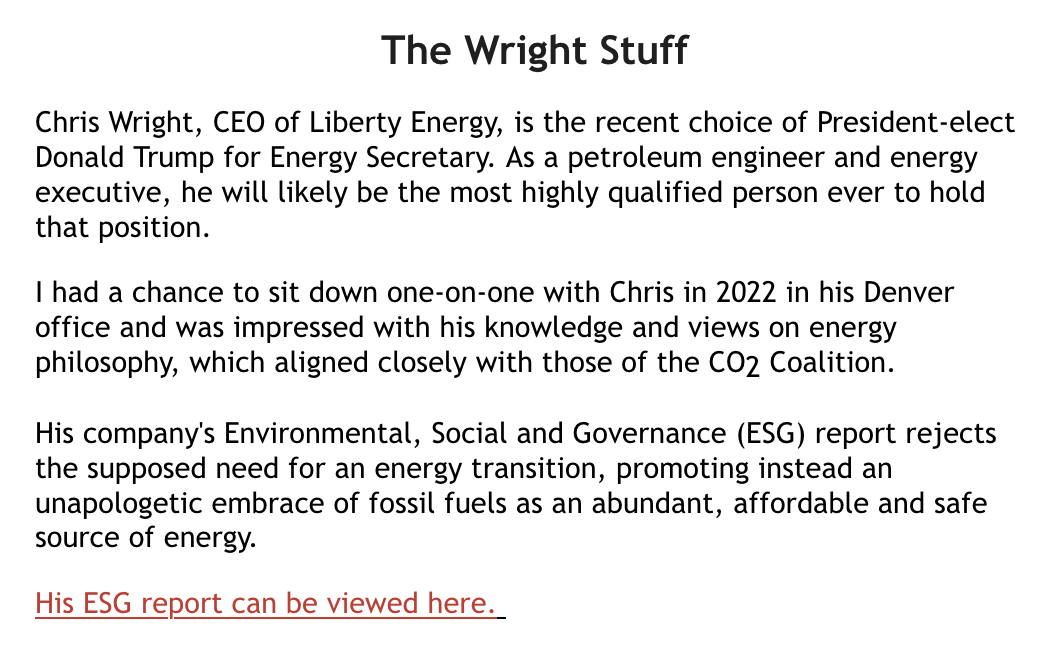
“I had a chance to sit down one-on-one with Chris in 2022 in his Denver office,” claimed Gregory Wrightstone, executive director of a group called the CO2 Coalition. For nearly a decade, the organization has publicly disputed the fundamentals of climate science while receiving donations from foundations linked to corporate backers, including the oil and gas billionaire Charles Koch

Wrightstone, who detailed the encounter with Wright in a recent newsletter, “was impressed with his knowledge and views on energy philosophy, which aligned closely with those of the CO2 Coalition.”

In a phone interview with DeSmog, Wrightstone elaborated on that alignment, explaining that “the main thing that he and I and the CO2 Coalition agree on is that increasing CO2 is a net benefit, it’s not the demon molecule, it’s the miracle molecule.”

Wright is currently the CEO of the fracking services company Liberty Energy and would bring no political or government experience to the role of energy secretary. Yet Wrightstone concluded that because Wright is “a petroleum engineer and energy executive, he will likely be the most highly qualified person ever to hold that position.” 

After Trump announced the nomination last week, some industry observers hailed the appointment as a sign of political moderation within the Republican cabinet, with the head of the Colorado Oil and Gas Association arguing that Wright is “a pragmatic problem solver” and “not a climate denier.”

Yet the full-throated praise that Wright is receiving from the likes of Wrightstone raises serious questions about whether the future energy secretary even thinks climate change is a problem worth addressing, said Connor Gibson, an independent research specialist who’s spent years tracking the CO2 Coalition and other groups that obstruct climate action including for Greenpeace USA. 

“The CO2 Coalition has been a persistent voice undermining the ABCs of climate change — that it’s happening, that it’s caused by human fossil fuel use, and that it’s going to be dangerous,” he told DeSmog. 

Wright didn’t respond to questions via his company Liberty Energy nor via the Trump-Vance transition team. 

Screenshot from CO2 Coalition emailed newsletter. Credit: CO2 Coalition

Backed by Koch

In email correspondence with DeSmog, Wrightstone explained how his meeting with the future nominee for energy secretary came about several years ago: “I was speaking at an event in Denver and set up a meeting in his office,” he wrote.

“We had a wide-ranging conversation, but I can’t recall any particular details,” he added during a phone interview. Yet Wright made a positive impression on the executive director of the CO2 Coalition. “The key takeaway is that he’s a big supporter of the continuing use of fossil fuels, including coal, oil, and natural gas,” Wrightstone said. 

According to Wrightstone, he and Wright’s views align on other key points, including the factually incorrect or dubious claims that “there is no man-made climate crisis,” “science is not consensus and consensus is not science,” “fossil fuels cannot be replaced by intermittent and unreliable solar and wind power,” and “history tells us that warmer periods have been beneficial, while cold periods have been horrific to humanity.”

These talking points have for years been disseminated by the CO2 Coalition, which was recently cited by Alberta’s United Conservative Party in a resolution that abandoned the oil-producing Canadian province’s net-zero targets and officially recognized “that CO2 is a foundational nutrient for all life on Earth.”

Gibson referred to the CO2 Coalition in a recent report he co-wrote along with Robert Brulle of Brown University as an “organization solely focused on disputing climate change science.”

During the first Trump administration, William Happer of the CO2 Coalition was appointed to the National Security Council but exited after only a year. White House advisors reportedly feared that his extreme views were a liability to Trump’s reelection. In 2017, Happer argued that the “demonization” of carbon dioxide “really differs little from the Nazi persecution of the Jews, the Soviet extermination of class enemies, or ISIL slaughter of infidels.”  

Nevertheless, the CO2 Coalition received more than $76,000 from foundations linked to the oil and gas billionaires Charles and David Koch during Trump’s first term, according to Gibson’s report. Greenpeace calculations show the group got $620,000 in Koch-related contributions between 2004 and 2015. 

“We have not received Koch Industries money since I’ve been here,” Wrightstone, who took over in 2021, said when asked about Koch contributions. 

Gibson argues that Wright, as a fossil fuel executive, is slightly more nuanced in expressing his views on climate change than his supporters at the CO2 Coalition. Wright acknowledges that human-caused global heating is real and potentially a problem while saying in a video posted to his LinkedIn last year that “there is no climate crisis.”

“It seems to me to be the calculated words of a CEO who recognizes that there is a potential liability of telling an outright lie to the public,” Gibson said. “Yet the effect of his comments is to leave people with the impression that climate change is not happening.”

Original article by Geoff Dembicki republished from DeSmog

Continue ReadingGroup That Calls CO2 ‘Essential’ Praises Trump Energy Secretary Pick Chris Wright