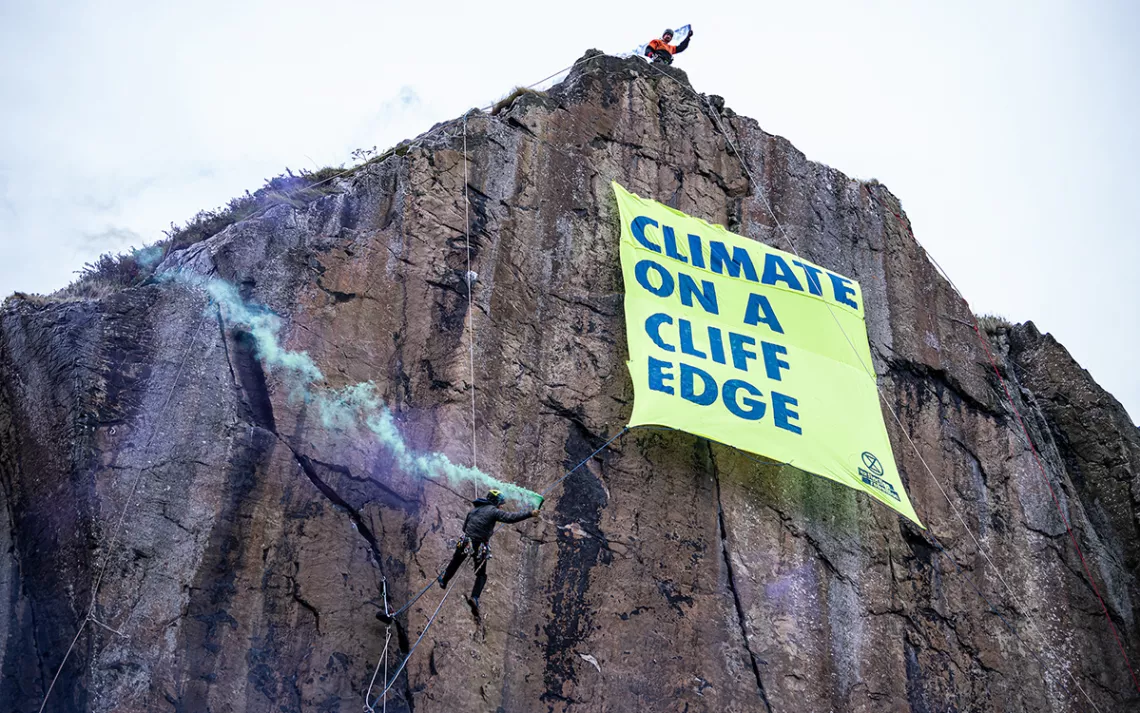
Experienced climbers scale a rock face near the historic Dumbarton castle in Glasgow, releasing a banner that reads “Climate on a Cliff Edge.” One activist, dressed as a globe, symbolically looms near the edge, while another plays the bagpipes on the shores below. | Photo courtesy of Extinction Rebellion and Mark Richards
Nobody’s going to do this Revo for young people except young people. I would expect young people to fight like their lives depended on it – a fight of life or death – which is exactly it.
Hasn’t Keir Starmer proved that he’s unfit to be prime minister yet? The real truth is that lying and cheating and enriching your friends is nothing really compared to facilitating genocide. [ed: the previous Tory government facilitated genocide too.] [later ed: I think that it might be worse now because genocide is far more confirmed by Israel’s actions & Starmer & co have not once criticised Israel’s actions (actually actively participated and provided military support)] Continuing
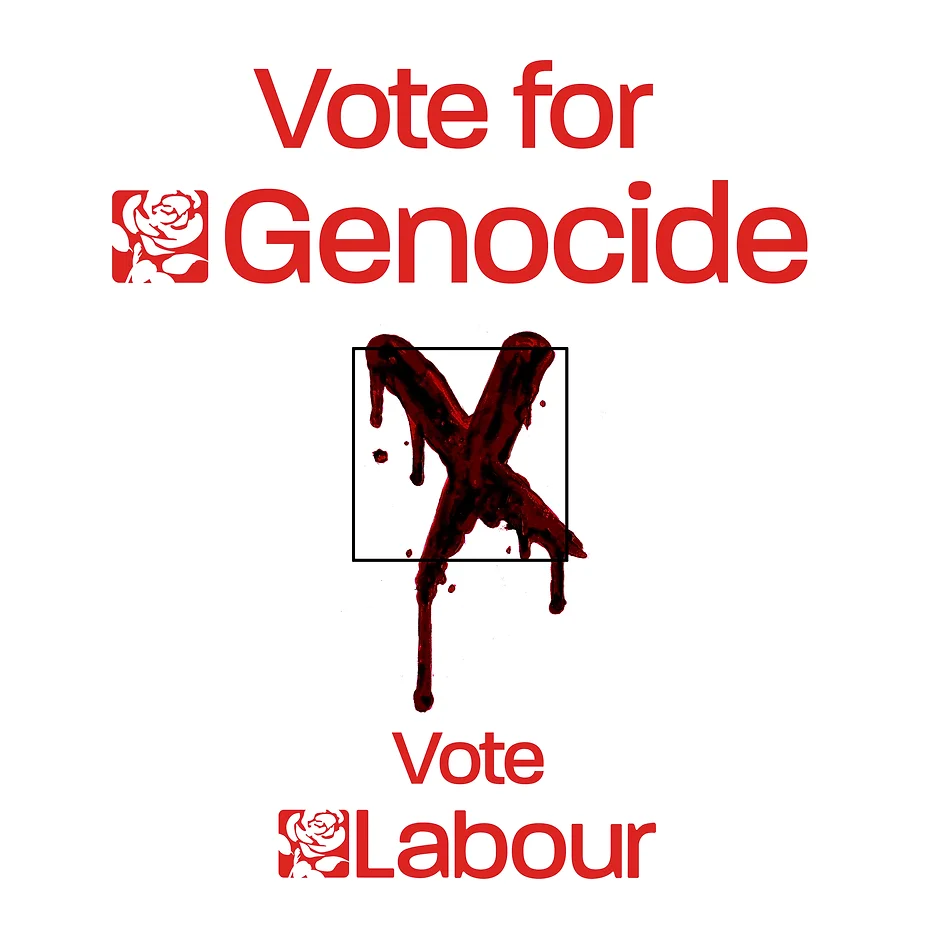
Zionist Keir Starmer is quoted “I support Zionism without qualification.” He’s asked whether that means that he supports Zionism under all circumstances, whatever Zionists do.UK Foreign Secretary David Lammy says that UK is suspeding 30 of 350 arms licences to Israel. He also confirms the UK government’s support for Israel’s Gaza genocide.Vote For Genocide Vote Labour.
Original article by Brett Wilkins republished from Common Dreams under Creative Commons (CC BY-NC-ND 3.0).
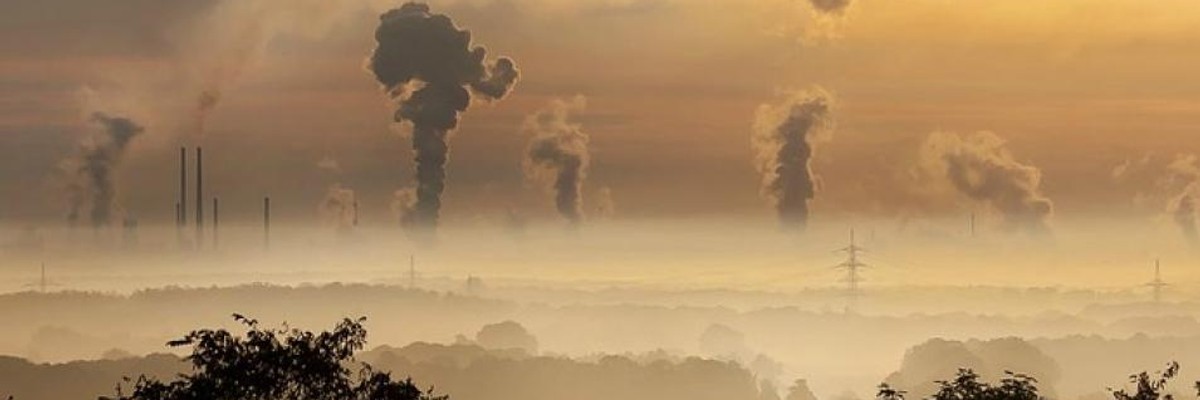
Carbon emissions and haze are seen near factories and a power plant. (Photo: Pixabay/Creative Commons)
“Closing the emissions gap means closing the ambition gap, the implementation gap, and the finance gap,” said U.N. Secretary-General António Guterres. “Starting at COP29.”
The world’s nations must commit to dramatically slashing greenhouse gas emissions in the near future or risk a “catastrophic” rise in global average temperatures, a key United Nations climate report published Thursday warned.
“It is still technically possible to meet the 1.5°C goal” set out in the Paris agreement, “but only with a G20-led massive global mobilization to cut all greenhouse gas emissions, starting today,” the United Nations Environmental Program (UNEP) said in a summary of its annual Emissions Gap Report.
“Nations must collectively commit to cutting 42% off annual greenhouse gas emissions by 2030 and 57% by 2035 in the next round of Nationally Determined Contributions (NDCs)—and back this up with rapid action—or the Paris agreement’s 1.5°C goal will be gone within a few years,” UNEP warned.
“Failure to increase ambition in these new NDCs and start delivering immediately would put the world on course for a temperature increase of 2.6-3.1°C over this century,” the agency said. “This would bring debilitating impacts to people, planet, and economies.”
New UNEP emissions gap report highlights a "massive gap between rhetoric and reality" and calls for a "quantum leap" in ambition to deliver Paris goals, as the world is way off-track today.
UNEP said “solar, wind, and forests” have the potential to help the world “get on a 1.5°C pathway.” However, “sufficiently strong NDCs would need to be backed urgently by a whole-of-government approach, measures that maximize socioeconomic and environmental co-benefits, enhanced international collaboration that includes reform of the global financial architecture, strong private sector action, and a minimum six-fold increase in mitigation investment.”
“G20 nations, particularly the largest-emitting members, would need to do the heavy lifting,” the agency added.
The task is daunting—according to the report, human emissions of greenhouse gases—CO2, methane, nitrous oxide, and fluorinated gases—reached a record 57.1bn tons of CO2 equivalent (GtCO2e) last year.
“The emissions gap is not an abstract notion,” U.N. Secretary-General António Guterres stressed in a video message on the UNEP report. “There is a direct link between increasing emissions and increasingly frequent and intense climate disasters.”
“Around the world, people are paying a terrible price,” he continued. “Record emissions mean record sea temperatures supercharging monster hurricanes; record heat is turning forests into tinder boxes and cities into saunas; record rains are resulting in biblical floods.”
“Today’s Emissions Gap report is clear: We’re playing with fire; but there can be no more playing for time,” Guterres added. “We’re out of time. Closing the emissions gap means closing the ambition gap, the implementation gap, and the finance gap. Starting at COP29.”
Annual greenhouse gas emissions reached an all-time high last year.
The U.N. chief was referring to the United Nations Climate Change Conference, which is set to take place next month in Baku, Azerbaijan—a nation that is “aggressively” expanding fossil fuel production.
UNEP Executive Director Inger Andersen said in a statement:
Climate crunch time is here. We need global mobilization on a scale and pace never seen before—starting right now, before the next round of climate pledges—or the 1.5°C goal will soon be dead and well below 2°C will take its place in the intensive care unit. I urge every nation: No more hot air, please. Use the upcoming COP29 talks in Baku, Azerbaijan, to increase action now, set the stage for stronger NDCs, and then go all-out to get on a 1.5°C pathway.
Even if the world overshoots 1.5°C—and the chances of this happening are increasing every day—we must keep striving for a net-zero, sustainable, and prosperous world. Every fraction of a degree avoided counts in terms of lives saved, economies protected, damages avoided, biodiversity conserved, and the ability to rapidly bring down any temperature overshoot.
Climate scientists and green groups expressed alarm over the UNEP report.
“The Emissions Gap Report is yet another clear warning about what needs to be done and fast,” Andreas Sieber, associate director of policy and campaigns at 350.org, said in a statement. “Last year at COP28, nations agreed to transition away from fossil fuels. The report makes it crystal clear that governments must translate this decision into action in their national climate pledges if they are serious about the just energy transition.”
Greenpeace International climate politics expert Tracy Carty said that “for 15 years, the UNEP has been sounding the alarm on the great chasm between political will for climate action and the worsening emissions trajectory fuelling rising temperatures.”
“These reports are a historical litany of negligence from the world’s leaders to tackle the climate crisis with the urgency it demands, but it’s not too late to take corrective action,” Carty continued. “We challenge leaders to embark on wholesale change in their 2035 climate plans, to come to COP29 prepared to finance climate action and to make up for lost time.”
The UNEP Emissions Gap Report 2024 is out, and it highlights the urgency for countries to raise their 2030 climate targets and act swiftly.
Rachel Cleetus, policy director and a lead economist in the Climate and Energy Program at the Union of Concerned Scientists, issued a statement arguing that the new UNEP report “forcefully confirms that nations’ efforts to cut heat-trapping emissions have been grossly insufficient to date.”
“Global heating records are being topped year after year, and people and ecosystems worldwide are suffering the devastation of unrelenting climate change disasters and increasingly irreversible impacts,” she noted. “To put it bluntly, decades of inadequate action have put the 1.5°C goal further out of reach and world leaders are failing their people. The consequences are profound—but the policy choices decided now are as crucial as ever to limit future harm.”
Cleetus continued:
The best way forward is to implement sweeping changes to the global energy system by phasing out the destructive products fossil fuel companies are peddling and investing big in renewable energy solutions to sharply curtail heat-trapping emissions. Also urgent are scaled-up investments in climate resilience to cope with impacts already locked in. Rich, high-emitting nations—including the United States—are most responsible for these calamitous circumstances. Those living in climate-vulnerable, low-income countries that contributed very little to the fossil fuel pollution driving this crisis need more than hollow words; they need wealthy countries and other major emitters to live up to their responsibilities.
“At the upcoming U.N. climate talks, wealthy nations must significantly grow the amount of climate financing available to ensure all countries can slash their global warming emissions and prepare for the more frequent and severe climate impacts that are the punishing consequence of a warming world,” Cleetus added.
Original article by Brett Wilkins republished from Common Dreams under Creative Commons (CC BY-NC-ND 3.0).
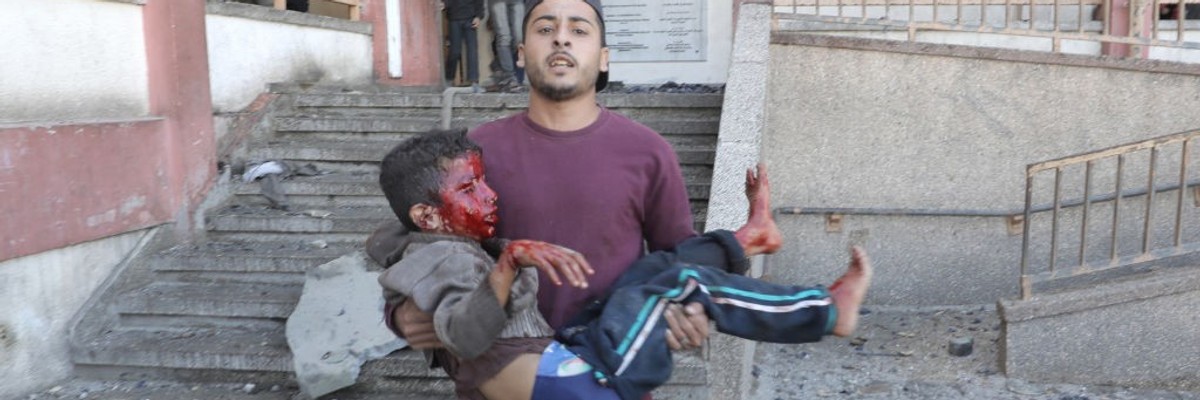
A man carries a child wounded in an Israeli strike on a school housing forcibly displaced Palestinians in the Nuseirat refugee camp, on October 24, 2024 in Deir al-Balah, Gaza, Palestine. (Photo: Moiz Salhi/Anadolu via Getty Images)
“Our ambulances can’t transfer wounded people,” said one overwhelmed hospital director. “Those who can arrive by themselves to the hospital receive care, but those who don’t just die in the streets.”
A devastating wave of Israeli airstrikes across the Gaza Strip on Wednesday and Thursday have killed or wounded hundreds of Palestinians, including many children, according to local and international media reports.
Citing Gaza Civil Defense officials, Palestine’s Quds News Network reported Thursday that at least 150 Palestinian civilians were killed or wounded by Israel Defense Forces (IDF) bombardment of around a dozen apartment towers on Al-Houja Street in the Jabalia refugee camp in northern Gaza.
Local and international media outlets earlier reported at least 17 Palestinians were killed and dozens more wounded by an IDF strike on the al-Shuhada school in the Nuseirat refugee camp in central Gaza.
At least 17 Palestinians, including children, were killed and a number of others were injured in an Israeli bombardment that targeted a school housing displaced people in the Nuseirat camp in the central Gaza Strip. pic.twitter.com/GY1cGLd45I
Medical staff at the al-Awda Hospital in Nuseirat—where many people killed and wounded in the strike were taken—told Al Jazeera that 13 children under age 18 and three women were among the dead.
The IDF said the strike targeted a Hamas command-and-control center. However, survivors and eyewitnesses said that all of the dead were women and children.
Gaza Notifications published the names of 16 people killed in the attack, including at least five children—the youngest of whom was a baby, just 11 months old.
The outlet said a total of 203 Palestinian civilians have been killed so far on Thursday, and that “all medical and rescue operations have been completely halted by the military administration.”
“The Israeli army has warned that ambulances and rescue teams will be directly targeted if they attempt to continue their operations, effectively blocking any humanitarian efforts,” the site added.
Gaza’s Government Media Office reported 34 Palestinians including 11 children were burned alive in an IDF strike on a youth club-turned shelter in the al-Maghazi refugee camp in central Gaza.
Israeli forces have also reportedly attacked hospitals and healthcare workers throughout Gaza. The Palestine Chronicle reported that IDF troops opened fire on Kamal Adwan Hospital in Beit Lahia, “with sick children inside.”
Hussam Abu Safia, the hospital’s director, told Al Jazeera that IDF tanks surrounded the facility and “directly targeted” it, severely damaging the intensive care unit. On Wednesday, Abu Safia said there were more than 150 wounded people in the hospital, including 14 children in the ICU or neonatal ward.
“There is a very large number of wounded people, and we lose at least one person every hour because of the lack of medical supplies and medical staff,” he said. “Our ambulances can’t transfer wounded people. Those who can arrive by themselves to the hospital receive care, but those who don’t just die in the streets.”
The Palestinian Ministry of Health also said several of its employees were wounded by Israeli artillery strikes on Thursday.
Earlier this month, the United Nations Independent International Commission of Inquiry on the Occupied Palestinian Territory released a report detailing how “Israel has perpetrated a concerted policy to destroy Gaza’s healthcare system as part of a broader assault on Gaza, committing war crimes and the crime against humanity of extermination with relentless and deliberate attacks on medical personnel and facilities.”
Israel’s ongoing offensive in northern and central Gaza has killed or wounded more than 2,000 Palestinians this month alone, according to Gaza officials. Since last October, Israel’s war on Gaza—which is the subject of a South Africa-led genocide case at the International Court of Justice—has left more than 153,000 Palestinians dead, maimed, or missing; millions more forcibly displaced, starved, or sickened; and most of the coastal enclave in ruins.
GAZA HEALTH MINISTRY: 42,847 Palestinians have been killed, and 100,544 wounded in Israel’s ongoing genocide in Gaza starting on October 7, 2023. pic.twitter.com/IUGklWnyYT
Thursday’s strikes came as U.S. Secretary of State Antony Blinken traveled to the Middle East, where he is set to take part in cease-fire negotiations with officials from Israel, Egypt, and Qatar in the Qatari capital Doha.
“Going back to the negotiations on ceasefire and the hostages, one of the things we’re doing is looking at whether there are different options that we can pursue to get us to a conclusion, to get us to a result,” Blinken said Thursday.
The United States is Israel’s primary international backer, providing billions of dollars in military aid and diplomatic cover including multiple vetoes of United Nations Security Council cease-fire resolutions.
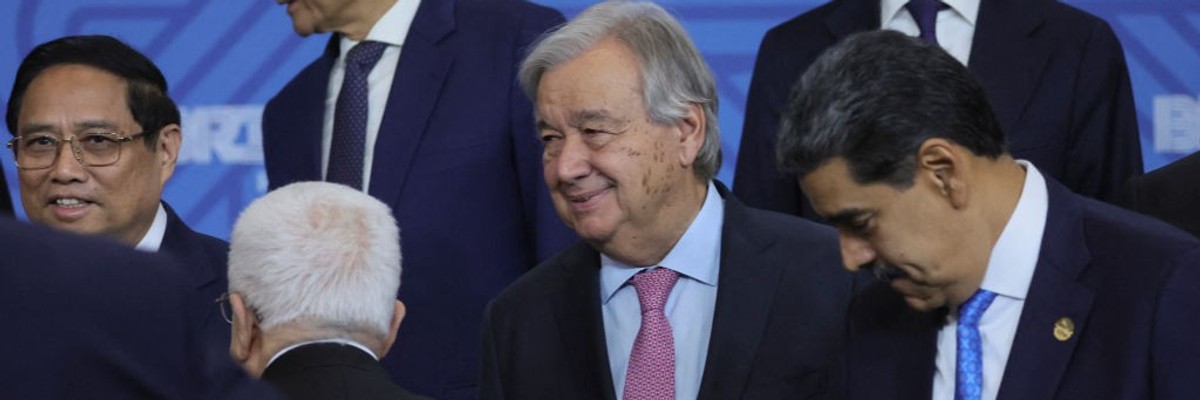
United Nations Secretary-General Antonio Guterres, center, stands with other dignitaries at the BRICS Plus conference in Kazan, Russia, on October 24. 2024. (Photo: Maxim Shipenkov/POOL/AFP via Getty Images)
“We need peace in Ukraine,” U.N. Secretary General Antonio Guterres said, speaking before Russian President Vladimir Putin.
United Nations Secretary-General Antonio Guterres, speaking in Russia on Thursday, called for peace in Ukraine and “across the board” as wars also rage in Gaza, Lebanon, and Sudan.
Guterres spoke before Russian President Vladimir Putin and other leaders from “BRICS Plus” countries gathering in Kazan, a city roughly 500 miles east of Moscow.
“Across the board, we need peace,” Guterres said.
“We need peace in Ukraine,” he added. “A just peace in line with the U.N. Charter, international law, and U.N. General Assembly resolutions.”
After the speech, Guterres renewed his call for a cease-fire in Lebanon and Gaza.
“We need a cease-fire in Lebanon—as we need a cease-fire in Gaza and the immediate release of all hostages,” he wrote on social media. “Escalation after escalation is leading to the unimaginable for the people of the region.”
We need a ceasefire in Lebanon – as we need a ceasefire in Gaza and the immediate release of all hostages.
Escalation after escalation is leading to the unimaginable for the people of the region. pic.twitter.com/YhwLkSbXzV
Putin presided over the closing ceremonies of the BRICS conference on Thursday, saying the group provided a counterbalance to the “perverse methods” of the West. Brazil, Russia, India, and China formed the group in the 2000s, with South Africa joining in 2010; BRICS recently expanded to include a number of other developing countries.
The conference drew the largest gathering of international diplomats into Russia since Putin’s forces invaded Ukraine in February 2022, escalating a conflict that had begun in 2014.
Ukraine’s foreign ministry criticized Guterres for attending the conference and noted that he did not attend Ukraine’s global peace summit in Switzerland in June.
“This is a wrong choice that does not advance the cause of peace,” according to the ministry’s social media account. “It only damages the U.N.’s reputation.”
Guterres has repeatedly called for a cease-fire in Gaza in the last year. The Israeli government declared him persona non grata earlier this month, barring him from entering the country on the grounds that he had not strongly condemned an Iranian barrage of missiles into Israel—an accusation Guterres denied, saying he did forcefully condemn the Iranian attack.
For U.N. Day, celebrated annually on October 24, Guterres issued a video statement calling for the world’s nations to keep the “beacon of hope” that is the U.N. “shining.”
The U.N. has had only limited success in stopping or slowing the wars in Ukraine, Gaza, Lebanon, and Sudan, which are among many dozens of conflicts across the world and have brought mass death and destruction.
The total number of Ukrainians and Russians who’ve died since February 2022 has reached roughly one million, The Wall Street Journalreported last month.
In Gaza, more than 42,000 people have been killed by Israeli forces in roughly the last year, following the Hamas-led October 7 attack that killed about 1,200 Israelis. More than 2,500 people have been killed by Israeli forces in Lebanon over the same period, including 1,900 in the escalation that’s occurred in the last five weeks, according to Lebanon’s health ministry. Dozens of Israelis have also died in that conflict.
A U.N. official said last month that the death toll in Sudan, which has been ravaged by civil war since April 2023, is at least 20,000 and could be much higher. The country is facing the prospect of a large-scale famine, with Save the Children on Tuesday raising the alarm that conditions there are worsening.
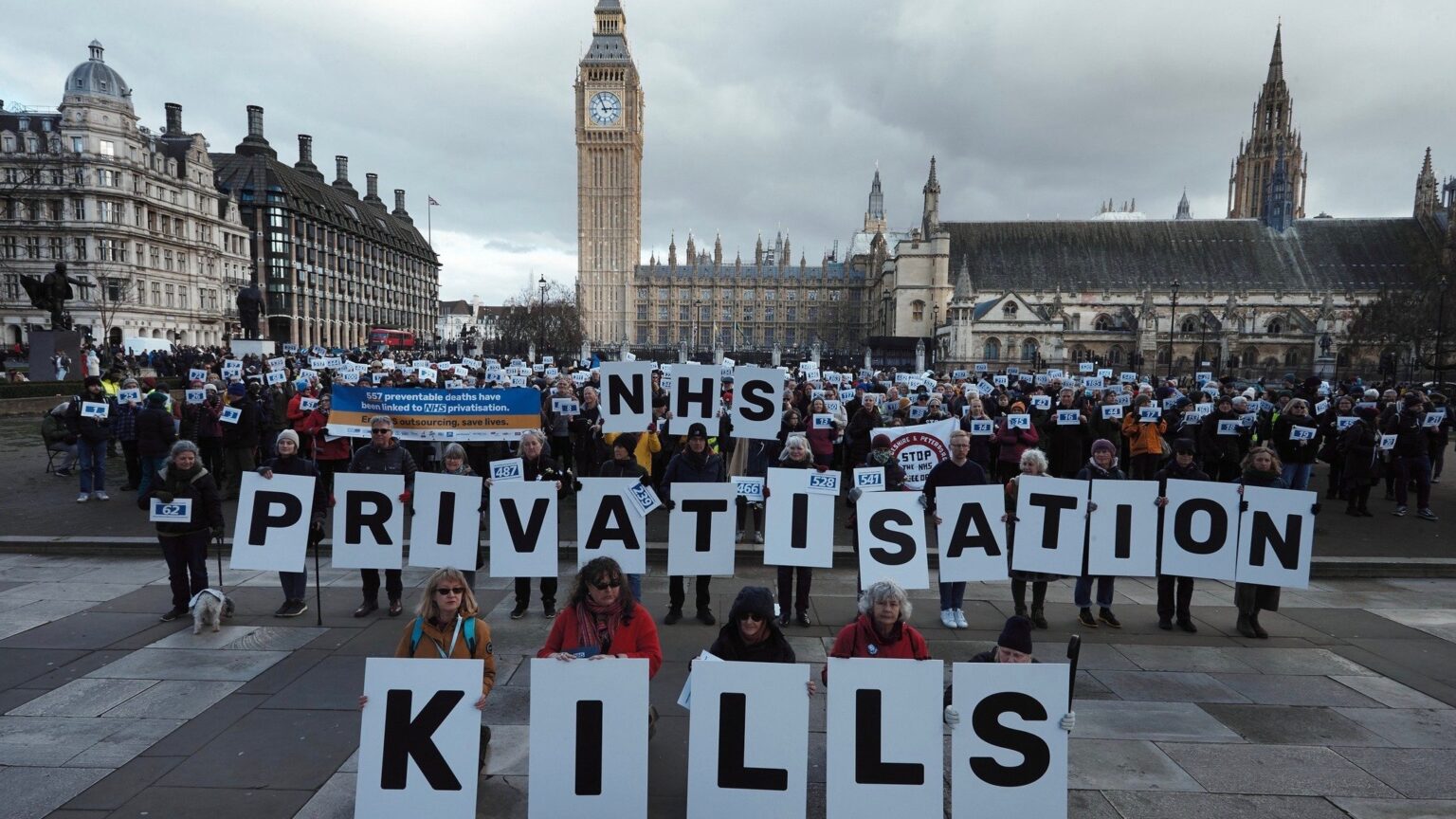
Protest against privatization of the NHS in the UK, February 25, 2023. (Photo: We Own It)
The UK Labour government is considering increasing the role of private healthcare providers, weakening NHS capacities
The Labour Party is considering a major expansion of the private sector’s involvement in the National Health Service (NHS) as it attempts to reduce waiting lists in the United Kingdom. Recently, the Independent Healthcare Providers Network (IHPN) wrote to Keir Starmer’s government, stating that private providers are ready to spend £1 billion to accommodate more NHS patients—if the government guarantees them long-term work.
While the offer has been welcomed by officials from the Department of Health, health activists have raised alarms over the plan. The We Own It campaign warned that a resurgence of the Private Finance Initiative (PFI) policy, as essentially proposed by the private sector, would lead to higher debt, staffing shortages, and diminished NHS training capacities.
This wouldn’t be the first time private capital has been welcomed by a Labour administration. When Tony Blair was Prime Minister, PFI entrusted the private sector with financing the construction of hospitals to fill gaps in the NHS network. The NHS would then pay back the costs of building such infrastructure—with interest—over the course of 25 years or more, eventually becoming the owner.
However, earlier reports indicated that while the NHS gained £13 billion in assets through PFI, it also ended up with £80 billion in debt. This meant that until at least 2022, some NHS trusts spent more on servicing debt to the private sector than on medical supplies.
There is no indication that the current government would introduce stronger safeguards when implementing a new phase of the initiative, dubbed PFI 2.0. If anything, the situation might worsen. While the previous round of PFI left some infrastructure for the public sector, PFI 2.0 foresees nothing of the sort. The additional capacities would be entirely private, with the only public involvement being the money paid to them.
“PFI 2.0 would not only drastically expand private provision in the health service, it will also dramatically increase how much is sucked out of the NHS in profits,” We Own It suggested in its analysis. Currently, private companies siphon £10 million weekly from the NHS. Guaranteeing even more private contracts would add to that burden, leaving fewer funds to invest in the NHS’s own capacities.
Labour fails to grasp importance of publicly-owned NHS
According to a recent inquiry, these capacities are in dire need of strengthening, as health activists have claimed for decades. The inquiry indicated that years of austerity have left a deep mark on the NHS, and it was this—not staff inefficiency—that led to the crisis. Unfortunately, the inquiry failed to underline the importance of breaking ties with the private sector and keeping the NHS publicly-owned, according to the group Keep Our NHS Public.
Even if it did, it is highly likely that Health Secretary Wes Streeting would not understand the importance of such a strategy. Speaking at a party conference in September, Streeting expressed enthusiasm about “reform,” a code word used by governments for “anything but public investment in public capacities.”
“Reform or die. We choose reform,” the Health Secretary said. His approach has left activists understandably worried that the government is sticking to a vague health reform agenda instead of making material commitments to protect the NHS.
Rather than pursuing a shift from “analog to digital,” Keep Our NHS Public argued, the government should pledge to move away from underfunding, fragmentation, and outsourcing. As health workers and their trade unions have raised multiple times, a true strategy to protect the NHS must also include a commitment to improving working conditions and ensuring fair salaries.
If the private sector’s role is expanded, this would not be a realistic option. “The private sector does not have its own staff,” We Own It warned. “They steal staff, trained at huge public expense, from the NHS.”
Further involvement of the private sector would also reduce the NHS’s capacity to train new staff, the group stated. The procedures usually handled by the private sector are often critical for the hands-on experience needed by medical trainees. With fewer procedures of this kind being performed in NHS hospitals, these learning opportunities would disappear, condemning new generations of health workers to lower-quality education and undermine patient care.
“If PFI 1.0 was one of the nails in the coffin of the NHS as we know it, PFI 2.0 is the true end of our NHS as a public service that works for patients, not profit,” We Own It warned.
People’s Health Dispatch is a fortnightly bulletin published by thePeople’s Health Movement and Peoples Dispatch. For more articles and to subscribe to People’s Health Dispatch, clickhere.