‘Pure Incitement’: Google Allows Israeli Sponsored Propaganda Aimed at Global Sumud Flotilla
Original article by Jon Queally republished from Common Dreams under Creative Commons (CC BY-NC-ND 3.0).
“It is clear that Israel is paving the ground for an attack on the flotilla. World public opinion needs to mobilize against Israel’s next war crime. Now!”
Evidence posted over the weekend online appears to show that tech giant Google has allowed the government of Israel to purchase sponsored content spots so that online users searching on the Global Sumud Flotilla will be shown inaccurate, propagandized content accusing the flotilla particpants as being allied with violent, terrorist elements.
The Sumud Flotilla—a group of international humanitarians and peace activists sailing toward the coast of Gaza with over 40 vessels in its fleet as a way to break the unlawful blockade of life-saving supplies imposed by Israel and its allies amid an ongoing genocide—has no documented connection to any terrorist organization and has made clear repeatedly that it is a completely nonviolent effort by independent groups and individuals who want to see an end to the suffering, starvation, and death taking place in the besieged Palestinian enclave.
In Arabic, sumud translates as steadfastness and resilience. On its website, the groups says, “We are a coalition of everyday people—organizers, humanitarians, doctors, artists, clergy, lawyers, and seafarers—who believe in human dignity and the power of nonviolent action.”
David Adler, an American economist and co-coordinator general of Progressive International who is traveling as part of the flotilla, posted a screenshot Saturday of search results showing the sponsored content, calling it “very terrifying.” Many others online reported getting the same results, though the appearance of the sponsored content seemed to depend on the user’s location or other variables.
Yanis Varoufakis, the former finance minister of Greece and co-founder of Progessive International, posted a similar screenshot earlier in the day, describing the coordinated ad buy as part of an escalating “smear campaign against the flotilla” by the Israeli government.
“First, they called it the Hamas Flotilla, deploying the usual tactic of slapping the Hamas logo on anyone whom they are about to murder, maim or mutilate,” said Varoufakis. “Now, with the full cooperation of Google, they are ensuring that top search results—received by anyone who Googles ‘Global Sumud Flotilla’—identify the brave women and men who are sailing to Gaza to end the blockade and genocide of 2 million people are people ‘harboring terror.’ It is clear that Israel is paving the ground for an attack on the flotilla. World public opinion needs to mobilize against Israel’s next war crime. Now!”
DropSite News noted on Satuday that a team of its journalists reported earlier this month that Google “was in the middle of a six-month, $45 million contract with Israeli Prime Minister Benjamin Netanyahu’s office to run ads and spread online propaganda, including on YouTube.”
“A search for the Global Sumud Flotilla humanitarian convoy carrying aid to break the Gaza siege shows the Israeli government’s incitement as the top result,” the outlet noted on Saturday, pointing to Adler’s post. “The campaign has also promoted content denying the Gaza famine.”
Earlier this week, Israel’s Ministry of Foreign Affairs characterized the flotilla—which has now been targeted at least twice by drone attacks—as a “jihadist initiative,” which led to immediate concerns that Israel was trying to build a case in the arena of public opinion for what would eventually be an Israeli attack on the ships or an interdiction at sea.
On Tuesday, as Common Dreams reported, the foreign ministers of 16 nations—Bangladesh, Brazil, Colombia, Indonesia, Ireland, Libya, Malaysia, Maldives, Mexico, Pakistan, Qatar, Oman, Slovenia, South Africa, Spain, and Türkiye—warned against “any unlawful or violent act against the flotilla” and called on all parties “to respect international law and international humanitarian law.”
The ministers said that “any violation of international law and human rights of the participants in the flotilla, including attacks against the vessels in international waters or illegal detention, will lead to accountability.”
Original article by Jon Queally republished from Common Dreams under Creative Commons (CC BY-NC-ND 3.0).


Trump’s New Restrictions on Pentagon Reporters ‘Should Alarm Every American’
Original article by Jon Queally republished from Common Dreams under Creative Commons (CC BY-NC-ND 3.0).
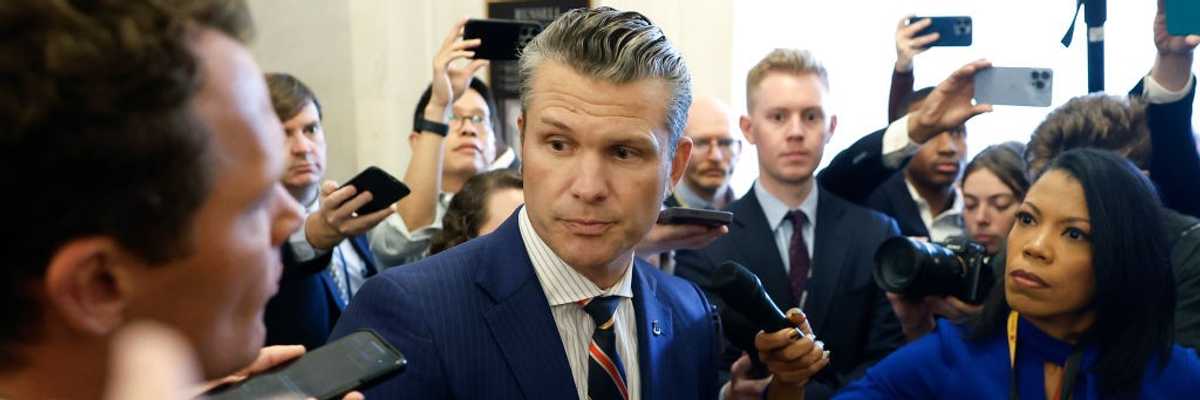
“If the news about our military must first be approved by the government, then the public is no longer getting independent reporting,” warned the National Press Club after journalists told of rule changes.
Journalists and defenders of press freedom are expressing alarm and condemnation after the Pentagon, under the command of President Donald Trump and Secretary of War Pete Hegseth, announced new restrictions on reporters that include pre-approval of stories that include even unclassified material and a new pledge to not publish any material without permissions from government officials.
The New York Times, among the first to report on a 17-page memo detailing the new rules, noted how the “move could drastically restrict the flow of information about the U.S. military to the public.” The National Press Club (NPC) was quick to rebuke the restrictions as an assault on the public’s right to know and fundamental journalistic freedoms.
“The Pentagon is now demanding that journalists sign a pledge not to obtain or report any information—even if unclassified—unless it has been expressly authorized by the government,” said Mike Balsamo, president of the NPC, in a statement. “This is a direct assault on independent journalism at the very place where independent scrutiny matters most: the U.S. military.”
Balsamo continued:
For generations, Pentagon reporters have provided the public with vital information about how wars are fought, how defense dollars are spent, and how decisions are made that put American lives at risk. That work has only been possible because reporters could seek out facts without needing government permission.
If the news about our military must first be approved by the government, then the public is no longer getting independent reporting. It is getting only what officials want them to see. That should alarm every American.
Independent reporting on the military is essential to democracy. It is what allows citizens to hold leaders accountable and ensures that decisions of war and peace are made in the light of day. This pledge undermines that principle, and the National Press Club calls on the Pentagon to rescind it immediately.
Seth Stern, director of advocacy at Freedom of the Press Foundation, explained to the Times that the government is prohibited by law from demanding journalists surrender their right to investigate the government in exchange for access or credentials.
“This policy operates as a prior restraint on publication which is considered the most serious of First Amendment violations,” Stern said. “The government cannot prohibit journalists from public information merely by claiming it’s a secret or even a national security threat.”
In comments to the Washington Post, Katie Fallow, deputy litigation director at the Knight First Amendment Institute at Columbia University, called the new policy part of “the Trump administration’s broader assault on free speech and press freedom.”
Any journalist, she added, “who publishes only what the government ‘authorizes’ is doing something other than reporting.”
Kenneth Roth, former executive director of Human Rights Watch and now a visiting professor at Princeton University, put it this way: “In Trump’s Pentagon, journalists who venture beyond reporting official propaganda now risk having their credentials revoked.”
Individual journalists, including veteran reporters who have covered the Pentagon for years or decades, also chimed in.
Konstantin Toropin, the Pentagon correspondent for the Associated Press, expressed alarm and dismay at the new restrictions.
“The Pentagon, which has claimed to [have] aspirations of being the most transparent in history, is once again cracking down on basic press access,” Toropin said in a social media post. “Denying access to the Pentagon makes covering our military, our troops, and our actions abroad harder. Full stop.”
Toropin said the rule forbidding the unapproved release of unclassified material, sometimes marked with the acronym “CUI,” is “an incredibly broad and ill-defined rule that could be easily abused.”
As his colleague Brian Everstine, the Pentagon editor at Aviation Week, noted:
At a time when Trump is being accused of severe abuses of power, including a series of attacks on alleged illegal drug runners in the Caribbean Sea, which international law experts have condemned as ”extrajudicial executions,” further restrictions on the ability of journalists to report on the internal workings of the president’s military operations are seen as particularly dangerous.
Barbara Starr, who worked as CNN’s chief Pentagon correspondent for many years who is now a senior fellow at the University of Southern California Annenberg Center for Communication, Leadership and Policy, told ABC News that the entire effort “is extremely troubling because it’s being done in an era of unprecedented public hostility from the secretary of defense to the news media.”
Original article by Jon Queally republished from Common Dreams under Creative Commons (CC BY-NC-ND 3.0).


Israel’s Strike on Yemen Newspaper Offices Was ‘Deadliest Global Attack’ on Journalists in 16 Years: Press Freedom Group
Original article by Stephen Prager republished from Common Dreams under Creative Commons (CC BY-NC-ND 3.0).
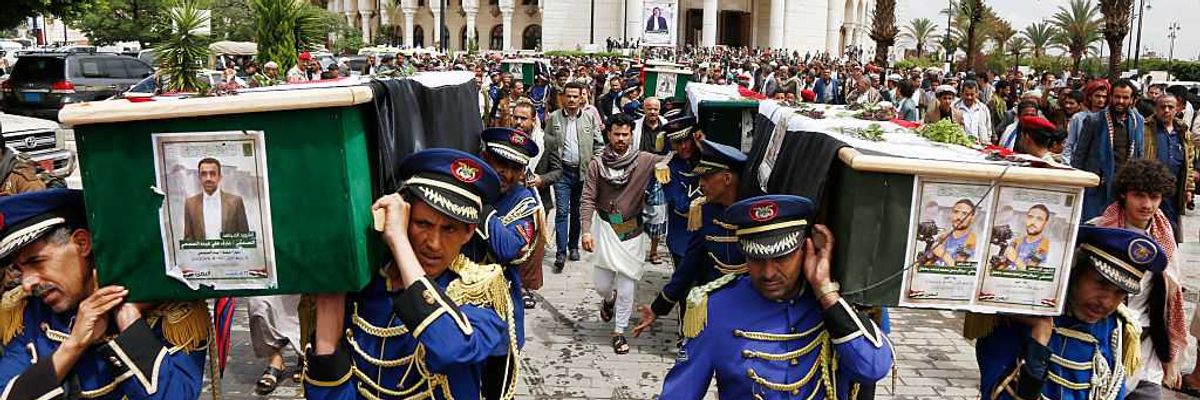
(Photo by Mohammed Hamoud/Getty Images)
The Committee to Protect Journalists said Israel’s attack on a media complex in Sana’a last week killed 31 journalists.
Israel’s airstrikes on a media complex in Yemen last week resulted in the largest single attack on journalists the world has seen in 16 years, according to the Committee to Protect Journalists.
In a report released Friday, the group said that 31 journalists from two government-run newspapers based in Sana’a were killed in the strikes on September 10, along with four others, including one child.
Nasser Al-Khadri, editor-in-chief of the newspaper 26 September, called the attack on his newsroom an “unprecedented massacre of journalists.”
“It is a brutal and unjustified attack that targeted innocent people whose only crime was working in the media field, armed with nothing but their pens and words,” Al-Khadri told the CPJ.
According to CPJ, it was the second-largest attack on the press they’ve ever recorded, and the worst since 2009, when 32 journalists were massacred as part of a political ambush in the Philippines.
The Israeli government has often defended its attacks on civilian infrastructure by claiming that it houses militants. But in these strikes, the IDF’s media desk acknowledged that it was targeting what it referred to as the “Public Relations Department” for the Houthis, also known as Ansar-Allah.
Shortly after Israel’s genocidal war in Gaza began in 2023, the militant group, which controls large parts of Yemen, began to launch drone and missile strikes against shipping vessels in the Red Sea and directly against Israel in what they have described as an effort to support Palestinians under fire. They have said they will stop these attacks when Israel reaches an agreement with Hamas to end the war in Gaza.
Israel has repeatedly bombed Yemen in recent weeks, including launching a strike on its main airport and large amounts of civilian infrastructure. On the same day it bombed the media complex, it also hit residential areas in Sana’a as well as a medical facility.
In a post on X, the official account for the Israel Defense Forces justified striking the newspapers by saying that they are “responsible for distributing and disseminating propaganda messages in the media, including speeches by Houthi leader Abdul-Malik and statements from spokesman Yahya Saree.” For this reason, Israel described the journalists as “military targets.”
But the CPJ says that “as civilians, journalists are protected under international law, including those working for state-run or armed group-affiliated outlets, unless they take direct part in hostilities.”
Niku Jafarnia, a Bahrain and Yemen researcher for Human Rights Watch, explained in more detail on Monday:
Radio and television facilities are civilian objects and cannot be targeted. They are legitimate targets only if they are used in a way that makes an “effective contribution to military action.” However, civilian broadcasting facilities are not rendered legitimate military targets simply because they are pro-Houthi or anti-Israel, or report on the laws of war violations by one side or the other, as this does not directly contribute to military operations.
Al-Khadri said that Israel’s strikes hit his newsroom around 4:45 pm, right when staff were finishing up the publication of the weekly paper.
Mohammed al-Basha, a Yemen analyst, noted that “Since it is a weekly publication, not a daily one, staff were gathered at the publishing house to prepare for distribution, significantly increasing the number of people present in the compound.”
The CPJ classified the 31 journalists killed in the strike as having been “murdered” by Israel, meaning that they were deliberately targeted specifically for their work. Over the past decade, the group says, 1 in 6 of the world’s murdered journalists have been killed by Israel.
While estimates from different groups vary, Israel’s war in Gaza is considered by far the deadliest conflict in the world for journalists, with more killed than any other conflict in the world combined. In August, the CPJ reported that 192 journalists, nearly all Palestinians, have been killed since October 7, 2023, while other groups put the death toll even higher.
In attacks last month that drew similar worldwide condemnation, Israel conducted what was described as a “double tap” strike on Khan Younis’ Nasser Hospital aimed at killing first responders who arrived after the first strike. Twenty people were killed in total, including rescue workers and at least five journalists.
Not long before, Israel carried out the targeted assassination of Al Jazeera correspondent Anas al-Sharif and five other journalists, claiming without evidence that they were part of “a Hamas terrorist cell.”
“Since October 7, 2023, Israel has emerged as a regional killer of journalists, with repeated incidents in Gaza, Lebanon, Iran, and now Yemen confirming Israel’s longstanding pattern of labeling journalists as terrorists or propagandists to justify their killings,” said CPJ regional program leaderSara Qudah.
“Israel’s September 10 strikes on two newspaper offices in Yemen marks an alarming escalation, extending Israel’s war on journalism far beyond the genocide in Gaza,” Qudah said. “This latest killing spree is not only a grave violation of international law, but also a terrifying warning to journalists across the region: no place is safe.”
Original article by Stephen Prager republished from Common Dreams under Creative Commons (CC BY-NC-ND 3.0).
- Yemen’s Health Ministry Says Majority of 53 Killed in US Strikes ‘Were Women and Children’ ›
- Gaza Journalists Demand End to Israel’s Impunity for ‘Genocide Against Us’ ›
- Reporters Without Borders Urges UN Action After Israel Massacres Gaza Journalists ›
- Group Files New ICC Complaint Over Journalists Killed by Israel in Gaza ›
- The Gaza Project Exposes Israel’s ‘Chilling Pattern’ of Killing Journalists ›
- US Rights Group Urges Media to Condemn Israel’s Killing of Journalists in Gaza ›
- ‘Blatant and Premeditated Attack on Press Freedom’: Israel Assassinates Five Gaza Journalists ›
- ‘We’ll Come for You Next’: Israel Threatened to Kill Teen Journalist in Gaza—Then Did ›
- ‘What a Live-Streamed Genocide Looks Like’: 5 Journalists, 4 Health Workers Among 21 Killed by Israel Hospital Bombing ›
- As Press Freedom Groups Decry Latest ‘Murder’ of Journalists by Israel, Fury Grows Over Impunity ›
- Israel Calling Journalists Terrorists Decried as ‘An Attempt to Preemptively Justify Their Murder’ ›
- Trump Bombs Yemen After Houthis Revive Blockade on Israeli Ships ›
Call for police probe into claim PM’s top aide Morgan McSweeney hid £700,000 of donations to boost Keir Starmer’s political career

…
in a letter to the Electoral Commission, Tory chairman Kevin Hollinrake said the party has new information to justify the commission ‘initiating a formal inquiry and then to refer the incident to the police’ relating to ‘the breach of political finance laws’.
Mr Hollinrake said advice from lawyer Gerald Shamash written in 2021, which appeared to have been ‘passed from within the Labour Party to outside sources’, revealed discussion about how to handle the Commission – and admitted it would not be easy to explain Labour Together’s position.
Mr Hollinrake said Mr McSweeney was advised that Labour Together should blame the non-reporting of donations on an administration error.
But the Tory chairman believed the donations weren’t declared to protect the donors’ identities.
The row comes ahead of the publication next month of The Fraud, by journalist Paul Holden, which will include a detailed account of Mr McSweeney’s role in Labour Together.
The think-tank was a key plank of the drive by Mr McSweeney and his allies – including Lord Mandelson, who was sacked as US ambassador this month over links to paedophile Jeffrey Epstein – to topple Mr Corbyn from the party leadership.
…