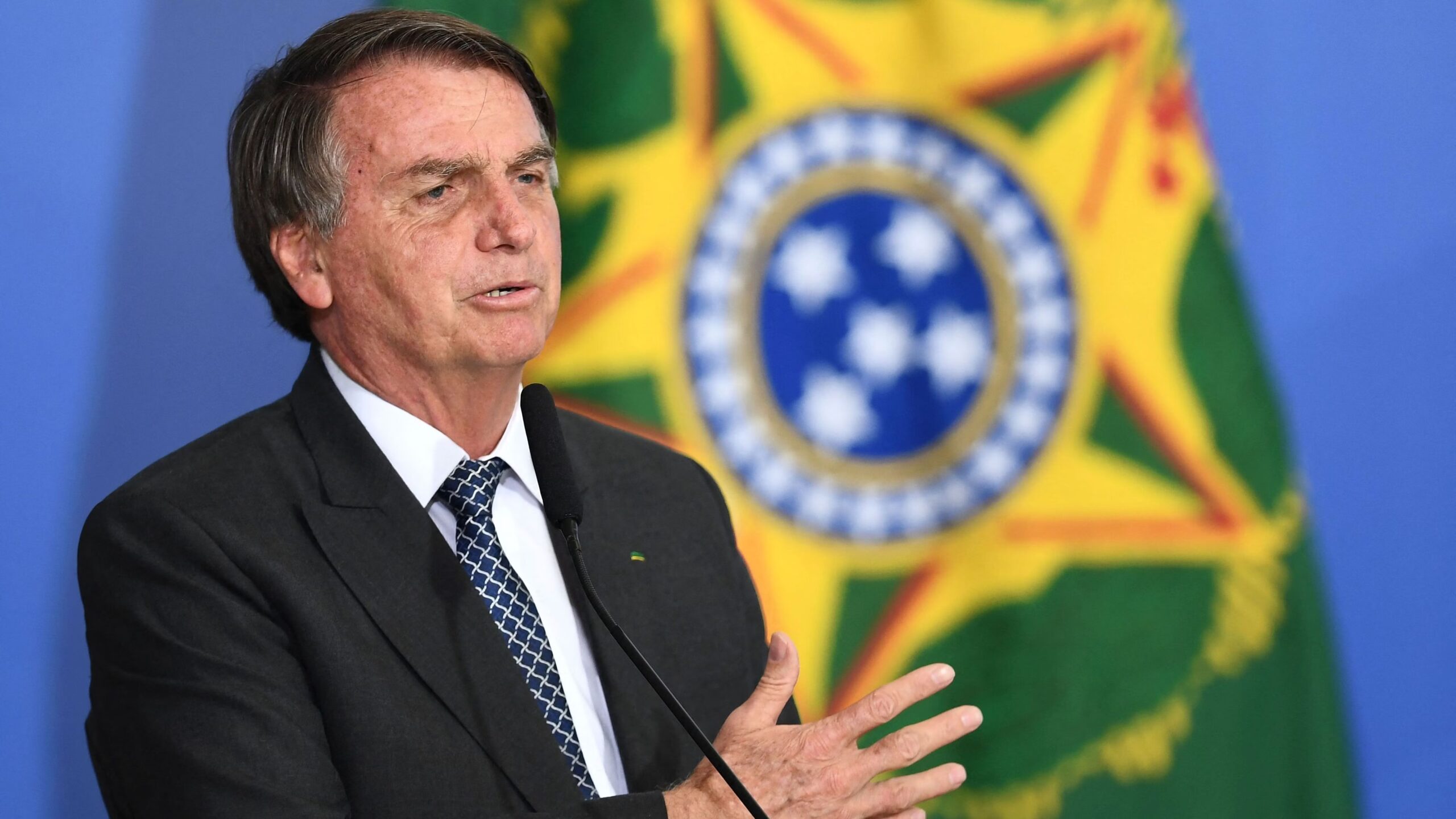
Former Brazilian President Jair Bolsonaro. Photo: Huete
He is already under house arrest, but if convicted, he would be taken to a cell only after the sentence becomes final.
The answer to the question is yes. In fact, former Brazilian President Jair Bolsonaro is already under house arrest after failing to comply with precautionary measures imposed by the reporting judge in the criminal case investigating the attempted coup in Brazil, Alexandre de Moraes, such as the prohibition on using social media.
Lawyer Ney Strozake states that preventive detention could be imposed if there is a risk of flight. “If he [Bolsonaro] flees or takes actions that clearly demonstrate that he is going to flee, what could happen is that the Attorney General’s Office could request preventive detention and Alexandre Moraes could order preventive detention. But [only] because he is preparing to flee or because he has fled, which is the case with [Carla] Zambelli. She is already abroad and has announced that she has fled. Then her preventive detention was ordered. In Bolsonaro’s case, this could also happen,” explained the lawyer.
However, these are preventive measures, which are primarily aimed at ensuring the smooth running of the proceedings and are unlikely to be taken on the eve of a sentence. The final arrest, in compliance with a possible sentence established by the First Panel of the Supreme Federal Court (STF), will still take a little more time, and this depends on how the five ministers will vote.
Possibilities for appeals
If there are at least two disagreements among the justices regarding the merits of the case, that is, regarding the conviction or acquittal of the defendants, the defense may file appeals to bring the case to the full court, known as infringements. The deadline for the defense to file these appeals is ten days, and there is no deadline for the court to decide whether to accept them.
If there is not this minimum number of disagreements on the merits, the defense will be limited to only one possibility of appeal: the so-called motions for clarification. In this case, there is no possibility of changing the majority decision, but lawyers may contest or even request clarification regarding any measure imposed in the sentence, or request, for example, immediate progression to house arrest for health reasons. For this type of appeal, the deadline for filing defenses is five days after the sentence, and the judge in the case has the same amount of time to rule on them.
Jail only after the final judgment
According to the understanding established by the STF, those convicted will only begin serving their sentences after the so-called final judgment, that is, when there are no more possibilities for appeals.
Former President Jair Bolsonaro and seven other defendants are identified by the Attorney General’s Office (PGR) as the “crucial nucleus” of the coup plot. They are accused of the crimes of armed criminal organization, attempted violent abolition of the Democratic Rule of Law, coup d’état, damage qualified by violence and serious threat, and deterioration of listed heritage.
Together, the penalties related to the crimes identified by the Attorney General’s Office could total 43 years in prison, considering the maximum penalties for each crime and the possibility of aggravating circumstances.
In addition to the former president, seven other men, all close allies during his administration, are being tried this week. They are: Alexandre Ramagem (former head of the Brazilian Intelligence Agency, Abin, and now a federal deputy for the Liberal Party in Rio de Janeiro); Almir Garnier Santos (former Navy commander); Anderson Torres (former Minister of Justice); Augusto Heleno (Army general and former Minister of Institutional Security); Mauro Cid (Bolsonaro’s former aide-de-camp); Paulo Sérgio Nogueira (who, like Braga Netto, was also Minister of Defense); and Walter Braga Netto (Army general and former Minister of Defense and Chief of Staff).
Among the eight defendants, Ramagem is the only one charged with three crimes, rather than five, as the charges of aggravated damage and deterioration of listed property (relating to January 8) were suspended, since he was already a certified congressman at the time and therefore had parliamentary immunity.
With the exception of whistleblower Mauro Cid, who has confessed to the charges, the others claim innocence.
This article was first published in Brasil de Fato in Portuguese.
The price of eggs has more than doubled in the past eight years, which isn’t great, but at least you can eat eggs. The price of US government subsidies for the fossil-fuel industry has also more than doubled in that time, which is far, far less great. Welfare for an industry that makes billions of dollars in profits and pollutes the climate is worse than useless. It’s self-destructive.
The federal government gives oil, gas and coal producers at least $34.8 billion in subsidies each year, according to a new study by the research and advocacy nonprofit Oil Change International. In 2017, OCI estimated these gifts at $14.7 billion annually. This doubling in federal largesse has taken place under both Democratic and Republican political administrations, highlighting the difficulty of stopping its growth, much less reversing it.
In fact, some of the most recent extensions of federal aid have made it possible for these subsidies to explode in the future, threatening to reach trillions of dollars. When the world needs exponential growth in clean-energy investments to avoid the most catastrophic effects of global heating, the US government will be bankrolling fossil-fuel expansion and stoking the emergency.
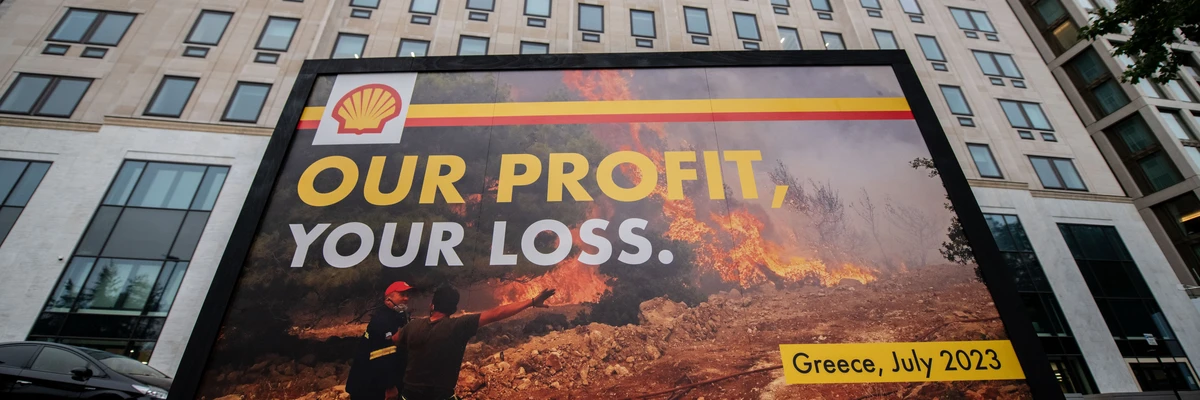
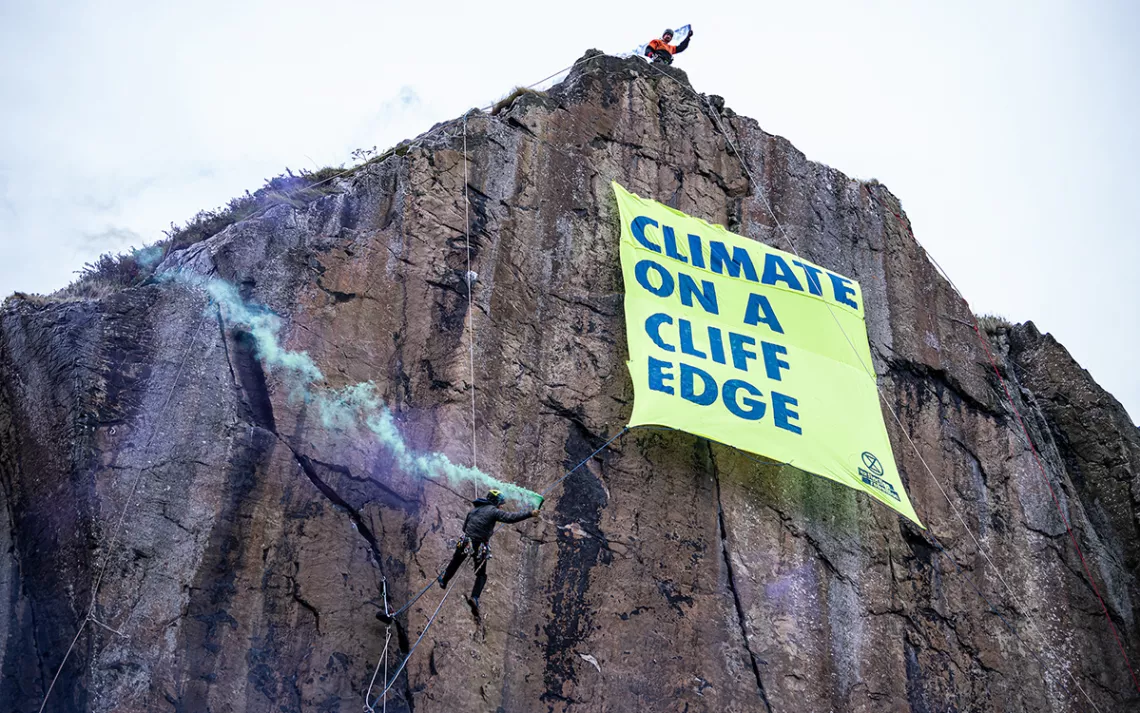
Donald Trump urges you to be a Climate Science denier like him. He says that he makes millions and millions for destroying the planet, Burn, Baby, Burn and Flood, Baby, Flood.Greenpeace activists display a billboard during a protest outside Shell headquarters on July 27, 2023 in London. (Photo: Handout/Chris J. Ratcliffe for Greenpeace via Getty Images)Experienced climbers scale a rock face near the historic Dumbarton castle in Glasgow, releasing a banner that reads “Climate on a Cliff Edge.” One activist, dressed as a globe, symbolically looms near the edge, while another plays the bagpipes on the shores below. | Photo courtesy of Extinction Rebellion and Mark Richards
Global warming linked to the world’s biggest oil and gas companies made all “major” 21st century heatwaves more intense and frequent.
This is according to new research, published in Nature, which uses “extreme event attribution” to assess the impact of climate change on all 21st-century heatwaves that were classified as “major disasters”.
The authors find one-quarter of the 213 heatwaves would have been “virtually impossible” without human-caused global warming.
They add that the effect of climate change on heatwave frequency and intensity is becoming more pronounced as the planet warms.
The study estimates the emissions stemming from the operations and production of more than 100 “carbon majors”, such as ExxonMobil, BP, Saudi Aramco and Shell.
The fossil fuels produced by these companies account for 60% of all human-caused CO2 emissions over 1850-2023, the study says.
The authors find that heatwaves recorded over 2000-23 were made, on average, 1.7C hotter due to climate change, with half of this increase due to the emissions originating from carbon majors.
This study “could be used to support future climate lawsuits and aid diplomatic negotiation”, according to a scientist not involved in the research.
The EM-DAT database catalogues all “major disasters” that have been reported since the year 1900 – defined as events that cause at least 10 fatalities, affect at least 100 people, or result in the declaration of state of emergency or a call for international assistance.
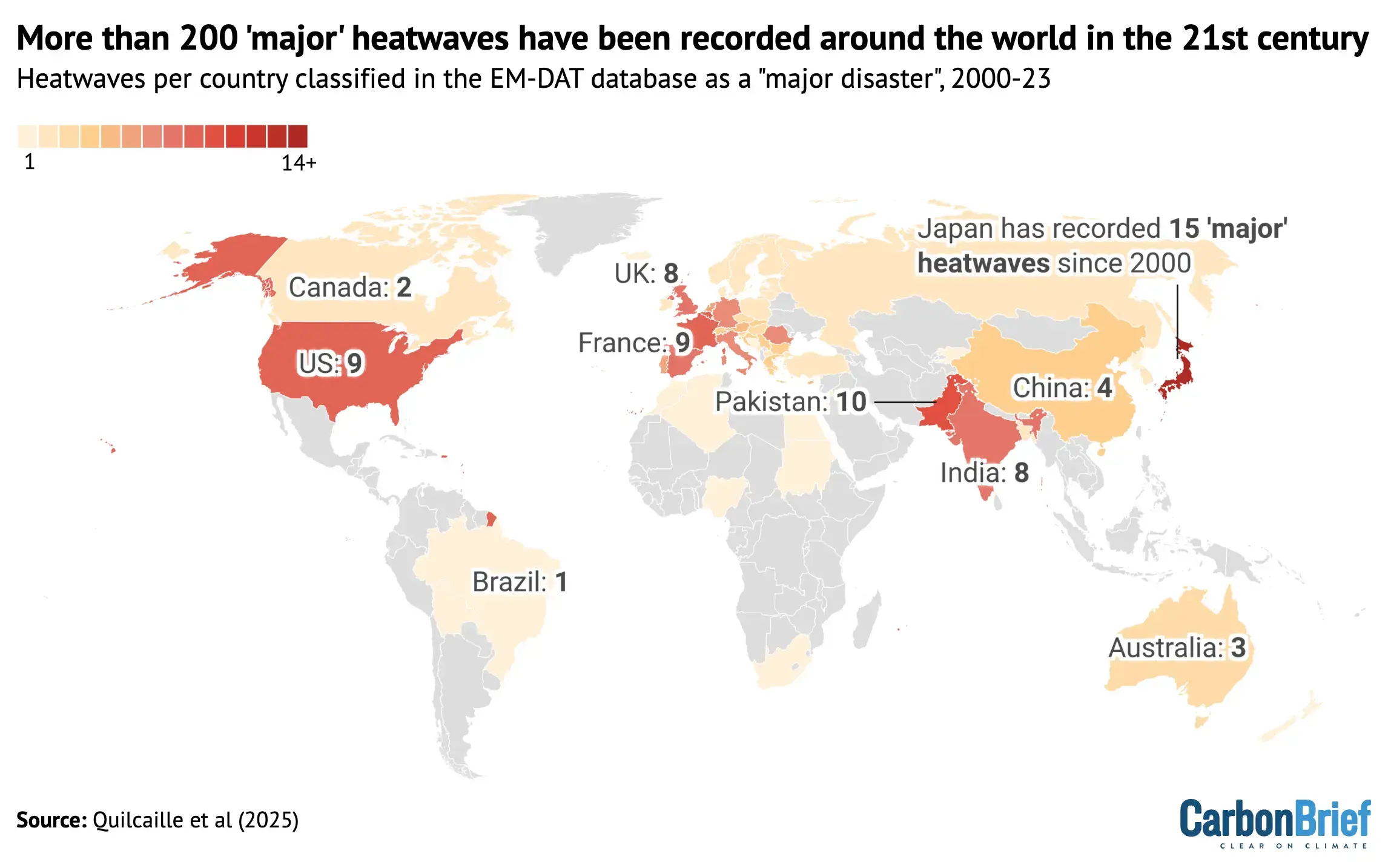
Between 2000 and 2023, the database lists more than 200 heatwaves. These are shown on the map below, where darker pink indicates a greater number of heatwaves. Countries with no reported heatwaves are shown in grey.
The map below shows the number of heatwaves per country recorded over 2000-23 on the EM-DAT database. Data: Quilcaille et al (2025).
The study authors acknowledge that heatwave reporting is “highly uneven”, with only nine of the heatwaves reported in the database since the year 2000 in Africa, Latin America or the Caribbean. (This is largely because extreme heat events in these regions are not routinely monitored.)
They then carried an attribution analysis on each heatwave to identify whether it was made more likely or intense due to human-caused climate change.
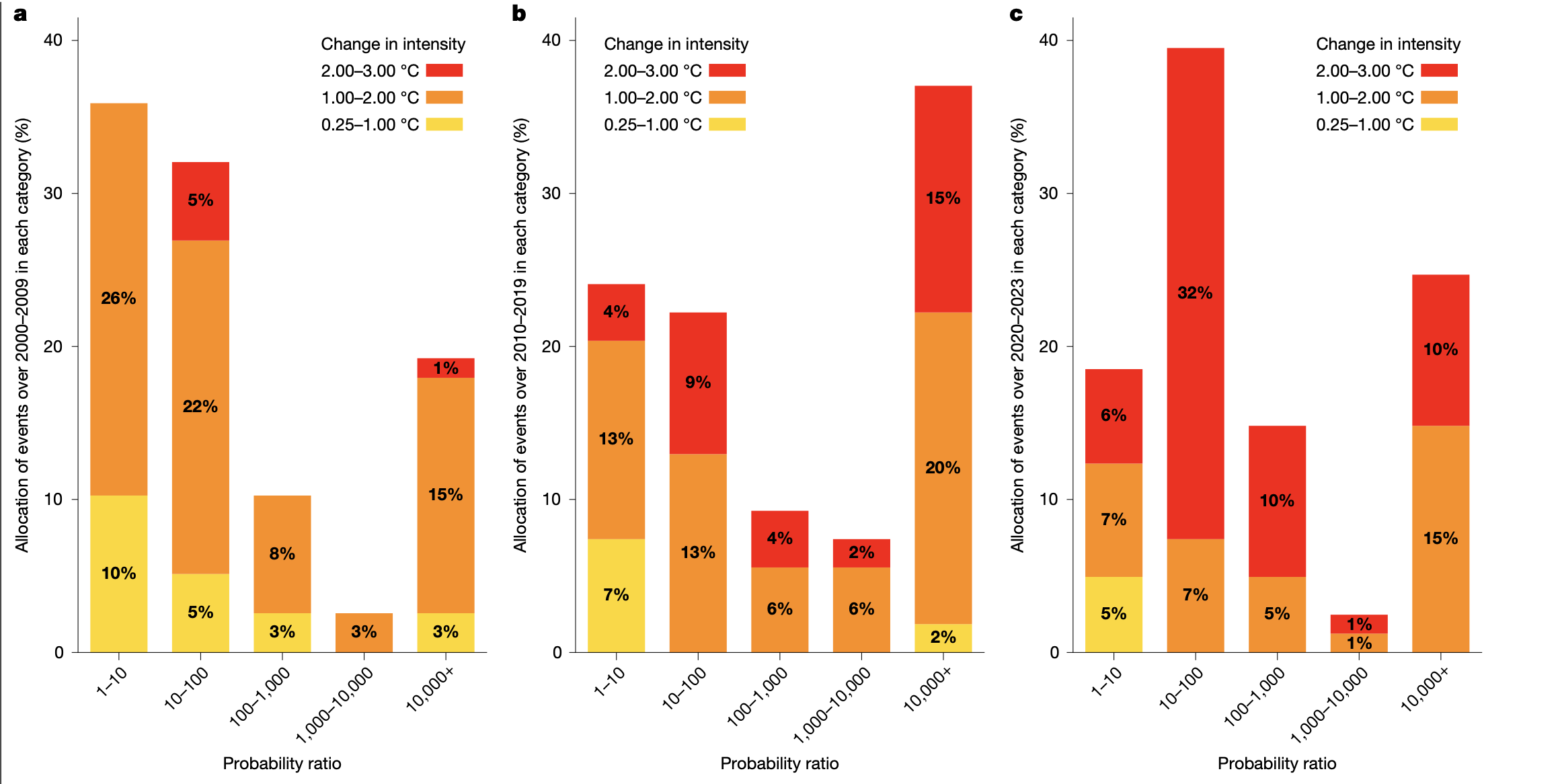
The chart below shows how climate changes increased the intensity and frequency of the 78 heatwaves assessed over 2000-09 (left), 54 heatwaves assessed over 2010-19 (middle) and 81 heatwaves assessed over 2020-23 (right).
The authors find that climate change increased the intensity and probability of all 213 heatwaves in the study. They add that the influence of climate change on heatwaves is strengthening over time.
In each panel, the bars show the percentage of heatwaves in that time period that were made 0.25-1.0C (yellow), 1.0-2.0C (orange) or 2.0-3.0C (red) hotter due to climate change.
The position of bars indicate the change in likelihood of the heatwaves. This ranges from those made 1-10 times more likely due to climate change (left-most bar in each panel) to those made more than 11,000 times more likely (right-most bar in each panel).
The extent to which climate changes increased the intensity and frequency of the 78 heatwaves assessed over 2000-09 (left), 54 heatwaves assessed over 2010-19 (middle) and 81 heatwaves assessed over 2020-23 (right). These are shown by colours and bar heights respectively. Source: Quilcaille et al (2025).
Heatwaves recorded over 2000-09 were, on average, 20 times more likely due to climate change, according to the authors. Meanwhile, those recorded over 2010-19 were about 200 times more likely.
Similarly, 2000-09 heatwaves were 1.4C hotter due to human-caused climate change on average, according to the study, while 2010-19 heatwaves were made 1.7C hotter.
The study finds that human-caused climate change made 55 heatwaves at least 10,000 times more likely. According to the authors, this is “equivalent to saying that they would have been virtually impossible” without the influence of human activity.
Carbon majors
To assess the contribution to heatwaves by oil and gas companies’ products, the authors use a database of carbon dioxide and methane emissions from 180 carbon majors over 1854-2023. This includes direct emissions from the companies, as well as the emissions released when the oil and gas they produced is used by others.
The 180 carbon majors in the database represent 60% of all human-caused CO2 emissions, including land use, over 1850-2023, according to the study. The paper adds that 14 companies, including ExxonMobil, BP, Saudi Aramco and Shell, are responsible for almost half of these emissions.
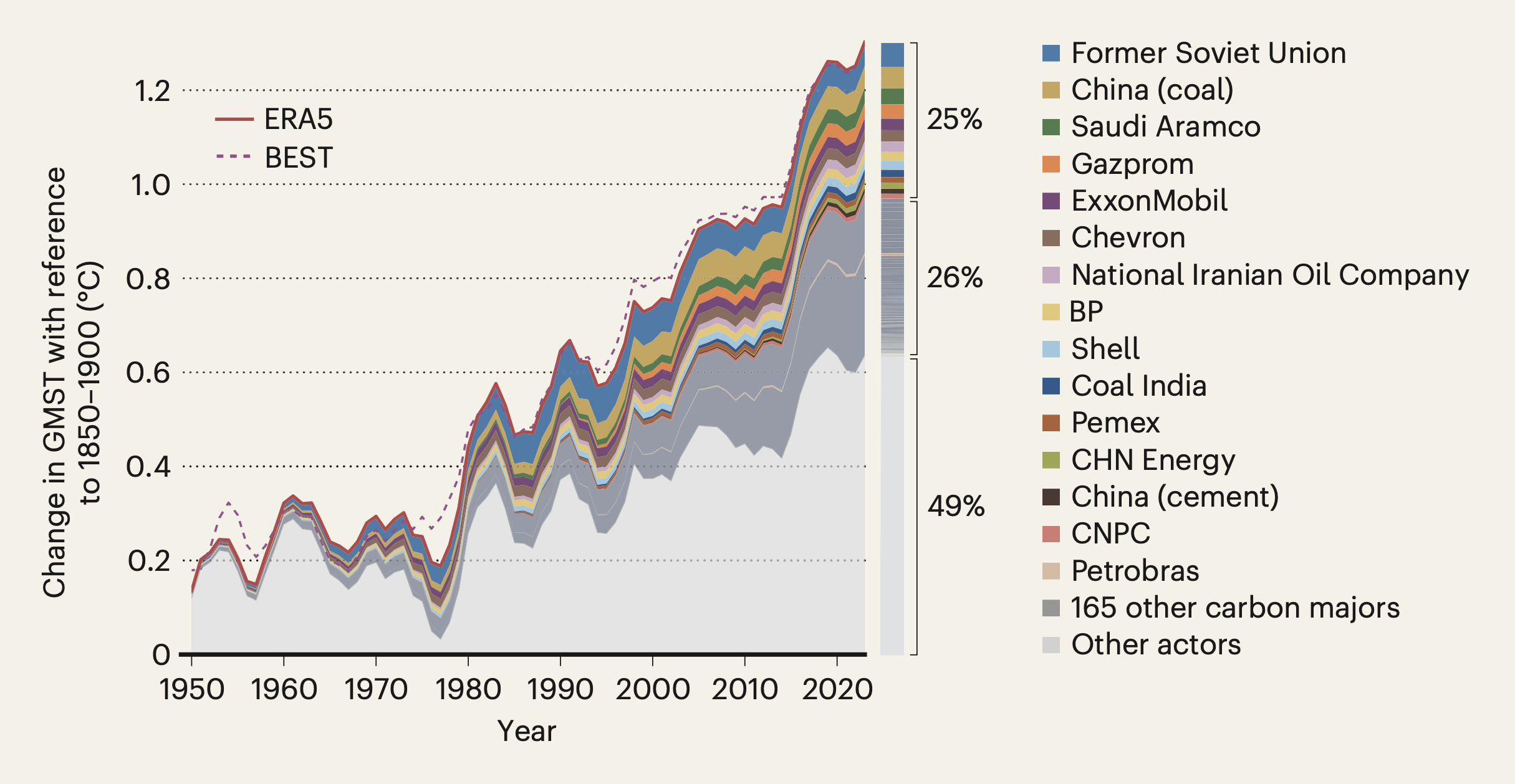
Using the Earth system model OSCAR, the authors estimate that global average surface temperatures increased by 1.3C between the 1850-1900 average and the year 2023.
They find that 0.7C of this increase was linked to the carbon majors, with 0.3C due to the emissions of the 14 largest.
The chart below, taken from an accompanying Nature “news and views” article, shows the contribution of oil and gas companies’ products to increasing global average surface temperatures over 1950-2023, compared to the 1850-1900 average.
Each colour indicates a carbon major, while grey indicates other sources of temperature increase, such as land-use change.
The contribution of oil and gas companies to increasing global average surface temperatures over 1950-2023, compared to the 1850-1900 average. Each colour indicates a company, while grey indicates other sources of temperature increase. Source: Haustein (2025).
Heatwaves recorded over 2000-23 were, on average, 1.7C hotter due to climate change, according to the study. The authors find that emissions originating from carbon majors and their products contributed about half of the increase in intensity of heatwaves seen since pre-industrial times.
The authors then break down the contribution of emissions from each carbon major on each heatwave in their analysis.
For example, they find that the emissions linked to Saudi Aramco made 51 heatwaves at least 10,000 times more likely. They add that on average, emissions tied to the company made the 213 heatwaves 0.04C hotter.
Legal action
Attribution studies already play an important role in courts by providing evidence that helps judges to determine liability.
Dr Rupert Stuart-Smith is a research associate in climate science and the law at the University of Oxford’s Sustainable Law Programme. He was not involved in the study, but has published separate work showing that the emissions linked to each of the six largest corporate emitters cause one heat-related death in Zurich alone, every summer.
Stuart-Smith tells Carbon Brief that the new paper is a “high-quality analysis and a meaningful step forward for the field of climate change attribution”. He adds:
“With more and more lawsuits aiming to hold high-emitting companies responsible for their contributions to climate change impacts or compel state and corporate actors to reduce their emissions and prevent rising climate harms, work like this provides the basis for well-informed judicial decision-making.”
Dr Yann Quilcaille is a researcher at ETH Zürich and lead author of the study. He stresses the importance of attribution research for court cases, telling Carbon Brief that he hopes his work “can be used by legal practitioners”.
However, he also says that his role as a scientist is not to assign “responsibility” for climate change, but to “provide information to governments for decision making and to courts for litigation”.
Mankin tells Carbon Brief that the new paper is “very closely” linked to his research.
Callahan says the new paper is “an important contribution to an emerging literature that illustrates how individual emitters can be linked to the change risk of extreme climate conditions and human impacts”.
He explains that “this kind of evidence will be important in courtrooms – holding emitters legally accountable requires demonstrating a causal nexus between that emitter and a particularised harm suffered by a plaintiff”.
Attribution
The cutting-edge field of extreme weather attribution seeks to establish the role that human-caused warming played in these events. Attribution studies have been carried out on hundreds of heatwaves all around the world, as shown in Carbon Brief’s interactive map.
The new paper uses one of the earliest and most commonly used methods of attribution, called “probabilistic attribution”.
The authors first chose a temperature “threshold” to define their heatwave.
They then used a global climate model to simulate two worlds – one mirroring the world as it was during the heatwave and the other using the climate of 1850-1900. This second scenario is used to represent the climate in a world without human-caused climate change.
The authors run their models thousands of times in each scenario. As the world’s climate is inherently chaotic, each model “run” – individual simulations of how the climate progresses over many years – produces a slightly different progression of temperatures. This means that some runs simulate the heatwave, while others do not.
The authors count how many times the threshold temperature was in each model run. They then compared the likelihood of crossing the threshold temperature in the world with – and a world without – climate change.
For example, they find that the 2021 Pacific north-west heatwave was made 3.1C hotter due to human caused climate change and more than 10,000 times more likely.
(A study by the WWA at the time of the heatwave found that the heatwave was made 150 times more likely. The discrepancy is due to differences in the definition of the event, as well as its “very unlikely nature” according to the study authors.)
Dr Frederieke Otto is a professor at Imperial College London and founder of the WWA initiative. She tells Carbon Brief that the new study is “very similar to some other recent studies on impacts, based on the hazard attribution method used by WWA”, but says that “this is the most high profile and wide-reaching one”.
Otto adds:
“I do hope that many more impact attribution studies will follow, based on our or other extreme event attribution studies. We need more research on this.”
Donald Trump urges you to be a Climate Science denier like him. He says that he makes millions and millions for destroying the planet, Burn, Baby, Burn and Flood, Baby, Flood.Nigel Farage urges you to ignore facts and reality and be a climate science denier like him. He says that Reform UK has received millions and millions from the fossil fuel industry to promote climate denial and destroy the planet.Greenpeace activists display a billboard during a protest outside Shell headquarters on July 27, 2023 in London. (Photo: Handout/Chris J. Ratcliffe for Greenpeace via Getty Images)Experienced climbers scale a rock face near the historic Dumbarton castle in Glasgow, releasing a banner that reads “Climate on a Cliff Edge.” One activist, dressed as a globe, symbolically looms near the edge, while another plays the bagpipes on the shores below. | Photo courtesy of Extinction Rebellion and Mark Richards
Charlie Kirk was a founder of far right group Turning Point USA and a key Trump backer
…
On 5 April 2023, Kirk told a rally, “I think it’s worth it to have the cost of, unfortunately, some gun deaths every single year so that we can have the Second Amendment to protect our other god given rights.”
His podcast, The Charlie Kirk Show, was a cesspit of far right lies, vile racism, transphobia and anti-abortion bigotry that he built his career on.
He has 1.8 million followers on Twitter/X. But even Twitter once blocked Kirk for “violating rules against posting misleading information about voting” when he tweeted lies about supposed election fraud in Pennsylvania.
…
Nine months ago Luigi Mangione became a folk hero when he shot Brian Thompson, CEO of UnitedHealthcare. The sector was notorious for declining to pay out policies for dying people.
The US establishment will wring their hands about political violence. But the US ruling class is responsible for far more violence, death and destruction than any political terrorist. They are complicit in the genocide in Gaza and in enabling the continuing horror of mass shootings in the US.
Axel Kicillof and other Peronist leaders in Buenos Aires celebrating their victory on Sunday, September 7. Photo: Fuerza Patria / X
Despite the president taking a front-line role in the election campaign and predicting victory for his party (“Buenos Aires will be painted purple,” Milei claimed), the figures speak for themselves. Voter turnout is estimated at almost 61%.
On September 7, 2025, the province of Buenos Aires dealt a crushing defeat to the right-wing libertarian project of President Javier Milei, who, after learning the results of the provincial elections, said: “Today we have suffered a clear defeat and we must accept it.”
The people of Buenos Aires province, which accounts for 38% of the country’s population, elected senators, deputies, and delegates of their municipalities. Peronism decided to join forces and form a large anti-Milei alliance called Fuerza Patria (Homeland Force), which, according to official data, obtained almost 47% of the valid votes. Meanwhile, La Libertad Avanza, Milei’s party that allied itself with the PRO (the party of former president Mauricio Macri), reached almost 34%. In third and fourth place were the centrist SOMOS and the Left Front, respectively, which each obtained almost 5%. The rest of the votes were divided among the other contenders.
In other words, Peronism won by more than 13 points over the far right, allowing it to take six of the eight electoral districts. La Libertad Avanza only managed to win the fifth and sixth districts. In addition, Peronism swept the municipal elections, winning 95 of the 135 municipalities in the province.
Milei says he will not back down
Despite the resounding defeat, Milei stated that while the necessary political mistakes must be corrected, he will not back down from his neoliberal project. “We will not back down one millimeter in the government’s policy; we will accelerate the course even more. If we have made political mistakes, we will process them and do better to win in October… We will continue to defend fiscal balance.”
He also took the opportunity to criticize his primary opposition, “They have put all the Peronist apparatus that they have been managing for 40 years into play, and this [result] is the floor for us and the ceiling for them.”
Peronism celebrates
For its part, the main opposition force, Peronism, celebrated the results. Former President Cristina Fernández, who is currently under house arrest, wrote on her X account: “Did you see that, Milei? Trivializing and vandalizing the ‘Never Again’ movement, which represents the darkest and most tragic period in Argentine history, does not come without a price. Neither is laughing at the death and pain of your opponents. But pointing fingers and stigmatizing the disabled, while your sister charges a 3% kickback on their medications, is lethal. And I’d better not even tell you how the rest (of those who still have jobs) are doing. Indebted for food, rent, expenses, or medications, and on top of that, with maxed-out credit cards. Get out of your bubble, brother.”
The Peronist governor of the province of Buenos Aires, Axel Kicillof, said to his supporters after learning the results: “The message from the polls is that you can’t govern for outsiders, for those who have the most. Milei: You have to govern for the people.” Furthermore, looking ahead to future elections, including the presidential election, Kicillof stated: “The elections have shown that there is another way, and today we are beginning to follow it.”
What is the reason for the crisis of ultraliberalism?
There are several elements which can help explain the defeat of Milei and his party on Sunday.
Other interpretations also point to an increasingly difficult management of the economy. The government has implemented a radical neoliberal policy that is in line with the demands of the International Monetary Fund (IMF). This has brought some stability to inflation, but it has also caused enormous social unrest, such as that of retirees who have taken to the streets every week to protest against government cuts to health care and freeze pensions.
In this regard, journalist Federico Rivas Molina wrote in El País: “The economic team is finding it increasingly difficult to maintain the value of the peso against the dollar. To prevent the dollarization of peso portfolios, it first raised rates to 80%, triple the inflation forecast for this year. Then it raised bank reserve requirements to 50% to reduce the amount of pesos in circulation. In the middle of last week, the floating bands it had agreed with the International Monetary Fund and sold dollars from the Treasury. Milei then blamed the turbulence on what he called ‘the kuka risk,’ that is, the fear of a Kirchnerist victory that had investors terrified. With the prophecy fulfilled, the scenario is now much more hostile than it was on Friday.”
Along these lines, Erika Gimenez, a journalist at ARG Medios, told Peoples Dispatch that Milei’s economic plan is not working and the people know it. She explained, “No one feels that their economic situation has improved under Milei’s government; quite the contrary: inflation is rising, salaries are insufficient, pensions for retirees and disabled people are being cut, among other cruel policies implemented by Milei. He is not convincing a sector that previously voted for him.”
She also expressed her opinion that Peronism, which has several internal tendencies (not always compatible), could sustain this alliance in the medium term thanks to the emergence of a figure who can bring together the different internal forces: “I think that Axel Kicillof’s leadership [in Peronism] is indisputable.”
Regarding the immediate future of Milei’s government, Gimenez said that a process of internal crisis is coming: “The figure of his sister is weighing on Milei, and despite this, he is not going to remove her. In addition, some ministers are going to resign or be fired, although it is not known which ones. There is a kind of political instability and instability in the Milei government’s economic project. It is most likely that between now and October, when there will be national legislative elections in which everyone in the country votes, political and economic stability will be at stake.”