Trump’s military escalation against Venezuela repeats the Iraq War blueprint

Spread the love

Original article by Manolo De Los Santos republished from peoples dispatch under a Creative Commons Attribution-ShareAlike 4.0 (CC BY-SA) license.
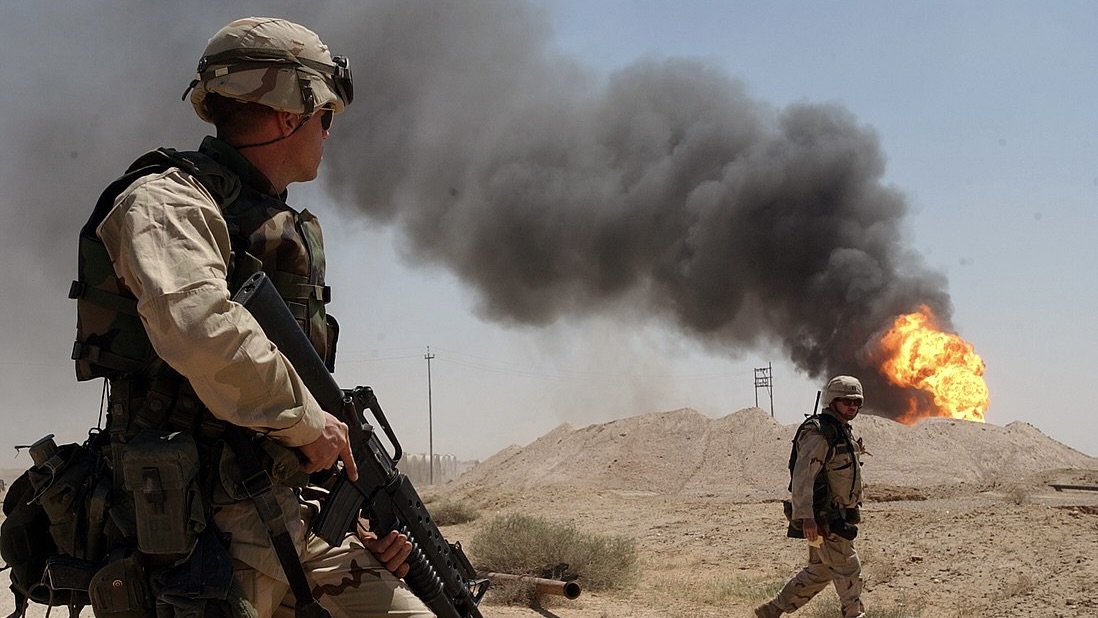
A US Army soldier watching a burning oil well at Rumaila oil field in Iraq in April 2003. Photo: US Navy

With the suspension of dialogue between the US and Venezuela, the sighting of US B-52 bombers in Venezuelan airspace, and the further lethal US strikes in the Caribbean, the US seems to be accelerating its drive towards war with Venezuela

Lee en español aquí

The mood in the Caribbean grows increasingly tense, as the United States intensifies its military threats. Beneath the deceptive shroud of the “war on drugs,” the United States is actively executing a blueprint for military intervention in Venezuela, employing lethal force and projecting power in a manner that legal institutions and regional leaders have condemned as a profound threat to international order. This aggression is not a law enforcement operation; it is the negation of law, a neocolonial revival of the Monroe Doctrine, designed to shatter the sovereignty of Venezuela, seize control of the world’s largest oil reserves, and install a compliant regime.

A license to kill: the precedent of state murder

A chilling adoption of extrajudicial violence has marked the current escalation. The Trump administration has ordered unilateral military strikes against private vessels near the Venezuelan coast, allegedly to stop drug trafficking. To launch these alarming attacks, the US military has deployed a massive naval force of warships, drones, and special operations forces.

These strikes have resulted in the summary execution of at least 27 people as of recent reports. The most recent lethal strike in the Caribbean resulted in the “elimination” of 6 more people. This is not law enforcement; it is extrajudicial murder and a campaign that now stands as part of a war plan against Venezuela. The administration has characterized the victims, without credible proof, as drug traffickers and “terrorists,” a claim that, even if true, provides no legal authority for the US president to execute whomever it decides.

Read more: Trump chooses war over diplomacy in the Caribbean

Legal and human rights organizations have been unequivocal in their condemnation of this profound and dangerous policy, which replaces established law enforcement procedures with premeditated lethal force. The New York City Bar Association (NYCBA), a key voice on international legal ethics, has strongly denounced these actions. The NYCBA stated explicitly that “Because the recent attacks on Venezuelan vessels and their crews were unauthorized by US law and in violation of binding international law, they were illegal summary executions – murders.” They further argued that these actions violate the fundamental international principle that “No one shall be arbitrarily deprived of his life” under the International Covenant on Civil and Political Rights.

The US government possesses ample legal authority for the Coast Guard to interdict and search vessels suspected of carrying narcotics, followed by prosecution in US courts according to due process requirements. However, in the case of the Venezuelan vessels, the Coast Guard’s Congressionally authorized police function was bypassed; instead, the crews were simply targeted and executed by overwhelming military force. Regional leaders, including Colombian President Gustavo Petro, have condemned the extrajudicial killings, highlighting the profound anxiety across Latin America over a return to unilateral US military action under the cover of anti-narcotics policy.

Read more: Trump’s smokescreen on Venezuela: Exposing the “narco-state” accusation

Escalation: B-52s and the threat of war

Beyond the lethal strikes, the US government has engaged in significant military posturing that amounts to a direct challenge to Venezuelan sovereignty. The sighting of US B-52 bombers in Venezuelan airspace, flying in close range, is a significant escalation. This warmongering has nothing to do with the “war on drugs” and everything to do with regime change to plunder Venezuela’s oil. This reckless push for war is a criminal act of international aggression.

The Trump Administration’s unilateral drone strikes in the Caribbean, combined with the White House’s termination of all negotiations with Venezuela, appear as a precursor for a full-scale regime change operation. This is a critical moment. We must sound the alarm: there is a risk of a new, catastrophic conflict in the region.

The US government’s own officials continue to escalate the crisis with bellicose rhetoric and actions. Secretary of State Marco Rubio, a key architect of the regime-change policy, has consistently refused to rule out a military option, asserting that the Maduro regime has become a “threat to the region and even to the United States.”

Venezuela’s response has been one of principled defense of its sovereignty. Ambassador to the UN, Samuel Moncada has repeatedly sounded the alarm on the global stage, arguing that the US military deployment in the Caribbean is a massive propaganda operation that seeks “excuses to fabricate a conflict” to seize the country’s oil wealth. Moncada affirmed that, “The United States believes that the Caribbean belongs to it because it has been using the expansionist Monroe Doctrine for over 100 years, which is nothing more than a remnant of colonialism.”

President Nicolás Maduro has called on Washington to resume dialogue, stating, “Our diplomacy isn’t the diplomacy of cannons, of threats, because the world cannot be the world of 100 years ago,” while simultaneously mobilizing national defense exercises to ensure the country is prepared for any direct assault. The NYCBA warned that attacks against Venezuelan vessels and reported threats against the Venezuelan government violate the nation’s obligations under the United Nations Charter, with the risk of escalating to open hostilities.

Parallels with the Iraq War: oil, ideology, and deception

The current situation is chillingly reminiscent of the lead-up to the 2003 invasion of Iraq. In that case, the Bush administration justified unilateral action on the basis of “weapons of mass destruction,” but this was a pretext. The true objectives were not limited to oil, but also included achieving profound ideological and political goals – overthrowing a government to reshape Middle Eastern politics and assert dominance.

Read more: In the name of the “War on Drugs”, the US continues to target Venezuelan boats

Washington must learn the lessons of this history. The Bush administration promised a quick victory in Iraq. Instead, the invasions and occupation claimed countless Iraqi lives, resulted in tens of thousands of American soldiers killed or wounded, and destabilized the region. The notion that the US can carry out military invasions into the heart of Latin America without a massive blowback is outlandish.

In the case of Venezuela, the “war on drugs” and the labeling of the government as a “threat” serve as the new rhetorical pretexts. The US interest is multifaceted: it involves securing the world’s largest proven oil reserves and achieving the ideological and political goal of overthrowing a socialist government to assert dominance and reshape Latin American politics. The US seeks to dismantle the Bolivarian Revolution and eliminate a major center of anti-imperialist politics in the hemisphere.

The current escalation is not about law enforcement or counter-narcotics; it is about regime change and plunder. While members of Congress from both Democratic and Republican parties, as well as key voices of public opinion, are increasingly speaking up about the illegality of these strikes and the absence of credible information from the administration, this situation requires much more urgency, once the escalation ladder is climbed, there may be no going back. The international community must recognize this aggressive campaign for what it is: a criminal act of international aggression. The world must stand against this threat of a new, catastrophic conflict.

Manolo De Los Santos is Executive Director of The People’s Forum and a researcher at Tricontinental: Institute for Social Research. His writing appears regularly in Monthly Review, Peoples Dispatch, CounterPunch, La Jornada, and other progressive media. He coedited, most recently, Viviremos: Venezuela vs. Hybrid War (LeftWord, 2020), Comrade of the Revolution: Selected Speeches of Fidel Castro (LeftWord, 2021), and Our Own Path to Socialism: Selected Speeches of Hugo Chávez (LeftWord, 2023).

Original article by Manolo De Los Santos republished from peoples dispatch under a Creative Commons Attribution-ShareAlike 4.0 (CC BY-SA) license.

Donald Fuhrump says that Amerikkka doesn't bother with crimes or charges anymore, not being 100% Amerikkkan and opposing his real estate intentions is enough.
Donald Fuhrump says that Amerikkka doesn’t bother with crimes or charges anymore, not being 100% Amerikkkan and opposing his real estate intentions is enough.
Elon Musk urges you to be a Fascist like him, says that you can ignore facts and reality then.
Orcas discuss how Trump was re-elected and him being an obviously insane, xenophobic Fascist.

Continue ReadingTrump’s military escalation against Venezuela repeats the Iraq War blueprint

Six killed in fifth US airstrike in the Caribbean as Trump doubles down on “narcoterrorist” narrative

Spread the love

Original article republished from peoples dispatch under a Creative Commons Attribution-ShareAlike 4.0 (CC BY-SA) license.

Screenshot via X

Despite a declassified US intelligence report finding no link between Venezuela’s government and the Tren de Aragua gang, Trump’s campaign of airstrikes in the Caribbean has killed 27 people thus far

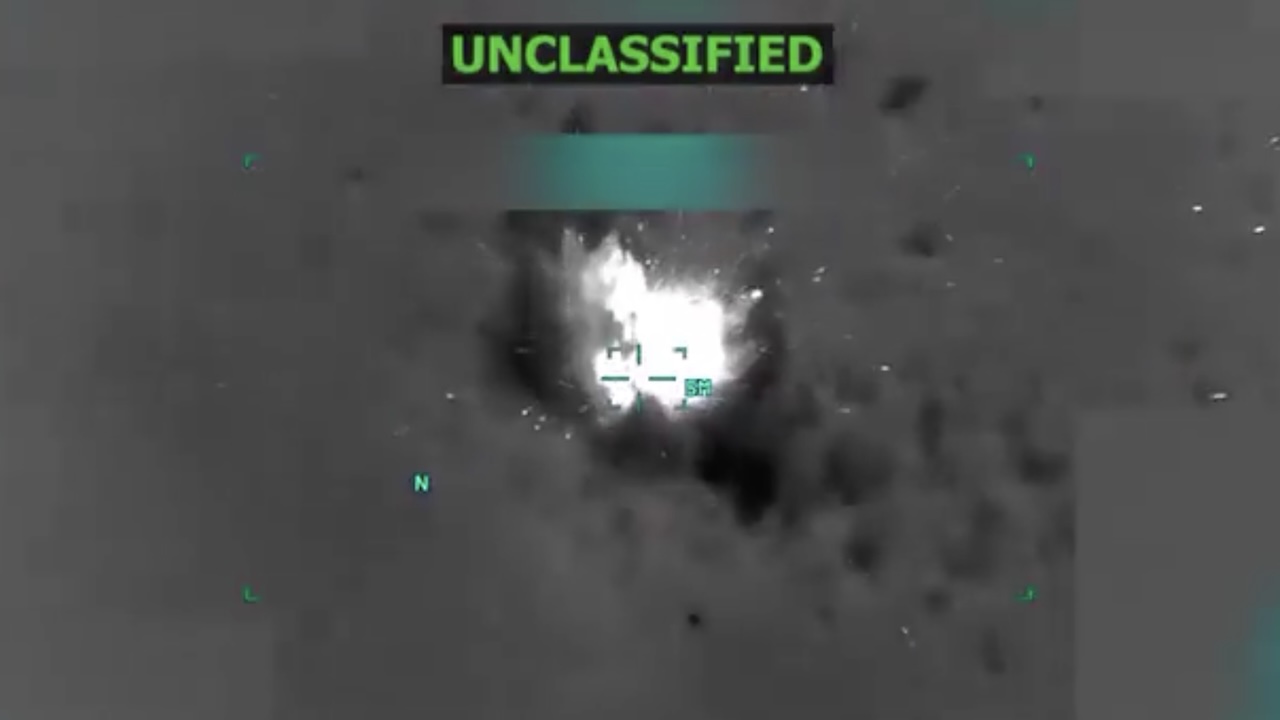
US President Trump carried out yet another lethal strike off the Venezuelan coast on October 14, killing six people. In a social media post, Trump claimed the six men killed above the ship were “narcoterrorists,” without providing any evidence. 

This latest airstrike is the fifth of its kind, with world leaders and international activists condemning the Trump policy as a violation of human rights. The death toll of Trump’s strikes against small boats in the Caribbean Sea now stands at 27. 

The airstrikes represent the latest escalation of a tense relationship between the United States and Venezuela. Last week, Trump ordered the termination of diplomacy with Venezuela. Richard Grenell, special presidential envoy, was directed by Trump to halt all diplomatic outreach and talks with Venezuelan President Nicolás Maduro.

On Tuesday, October 14, Trump once again repeated allegations that the Venezuelan government is responsible for introducing gangs into the US. “What they do very well is they send their criminals into the United States, and they send Tren de Aragua.”

The Trump administration has pushed the narrative that Venezuela is a leader in drug trafficking through the groups “Tren de Aragua”, now designated a Foreign Terrorist Organization (FTO) by the Trump administration, and “Cartel de los Soles” as a way to push escalation in the Caribbean Sea and justify Trump’s draconian immigration policies, including justifying massive ICE raids and the illegal deportation of 250 Venezuelans to El Salvador earlier this year.

declassified assessment from the US National Intelligence Council, released in early May 2025, that the Venezuela’s government “probably does not have a policy of cooperating with TDA and is not directing TDA movement to and operations in the United States.”

Original article republished from peoples dispatch under a Creative Commons Attribution-ShareAlike 4.0 (CC BY-SA) license.
Donald Fuhrump says that Amerikkka doesn't bother with crimes or charges anymore, not being 100% Amerikkkan and opposing his real estate intentions is enough.
Donald Fuhrump says that Amerikkka doesn’t bother with crimes or charges anymore, not being 100% Amerikkkan and opposing his real estate intentions is enough.
Orcas discuss how Trump was re-elected and him being an obviously insane, xenophobic Fascist.
Continue ReadingSix killed in fifth US airstrike in the Caribbean as Trump doubles down on “narcoterrorist” narrative

Madagascar’s military seizes power after parliament impeaches fleeing parliament impeaches fleeing President Rajoelina

Spread the love

Original article by Nicholas Mwangi republished from peoples dispatch under a Creative Commons Attribution-ShareAlike 4.0 (CC BY-SA) license.
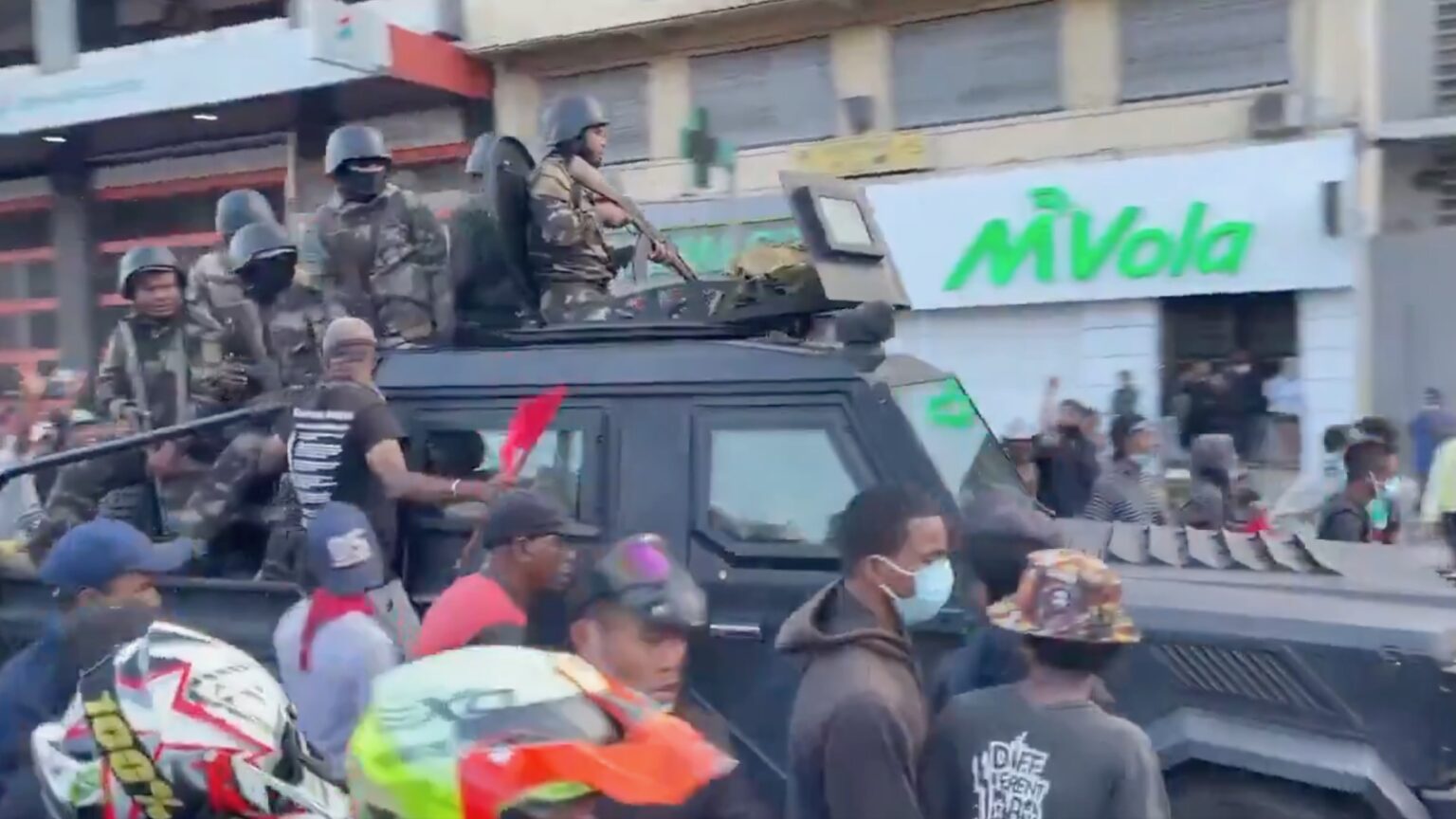
An elite army unit has announced it has taken control of the military as soldiers join anti-government protests. Photo: screenshot

According to reports, President Andry Rajoelina of Madagascar fled to France following an agreement with President Emmanuel Macron. While he insists that he remains the leader, the military has taken over and the National Assembly has impeached him.

Weeks of youth-led demonstrations against water and power shortages in Madagascar have escalated into a full-blown political crisis, with an elite military unit announcing that it now commands the armed forces in what President Andry Rajoelina has described as a coup d’état. 

On Tuesday October 14, Colonel Michael Randrianirina, acting commander of the elite CAPSAT military unit, announced on national radio that the military had taken control of state institutions and would form a transitional government. Randrianirina later told reporters that a committee led by the military would oversee the country for a transitional period of up to two years, working alongside a civilian government before organizing new elections.

This is after the National Assembly voted overwhelmingly to impeach President Andry Rajoelina (130 in favor, one blank), just hours after he attempted to dissolve parliament by decree on Monday.

The mass protests, described as the largest in the country in years, initially forced Rajoelina to dissolve his government in late September. But the move did little to quell public anger. Instead, demands intensified, with protesters calling for the president’s resignation after years of economic hardship and deteriorating public services.

Rajoelina, who was scheduled to address the nation on Monday evening, was reportedly evacuated from the capital following an arrangement brokered with French President Emmanuel Macron, according to Radio France Internationale (RFI). French authorities later stated that they were not intervening in Madagascar’s internal crisis, which has continued to escalate since September 25.

Elite military unit declares control

The escalation reached a new level this week when members of CAPSAT, an elite army unit, declared they had taken control of the armed forces. The declaration followed reports that some military soldiers had joined the protesters in the streets of Antananarivo and other cities last week. CAPSAT had a major role in the 2009 political upheaval that first brought Rajoelina to power.

Political shake-up fails to quell anger

The president had previously attempted to restore order by appointing Army General Ruphin Fortunat Zafisambo as prime minister, following the dissolution of his civilian government. However, the appointment appears to have failed to stabilize the situation.

Many had condemned the government’s heavy-handed response to the demonstrations in recent weeks. Security forces used tear gas, arbitrary arrests, and live ammunition against largely peaceful protesters, leaving at least 22 people dead and over 100 injured, according to UN human rights officials.

Deep-rooted discontent

Rajoelina’s 15-year grip on power, including his return to the presidency in 2018 and contested re-election in 2023, has done little to address Madagascar’s deep social and economic problems. The island nation remains one of the poorest in the world, with millions lacking reliable access to water, electricity, and essential services.

Popular anger, fueled by unemployment, corruption, and inequality, has been building for years and exploded into the current wave of protests, largely driven by young people.

Now as the situation rapidly unfolds, Madagascar faces deep uncertainty. If the military solidifies its hold, it could mark the second successful coup in the country’s modern history. 

With what is unfolding, whether this crisis ushers in a political transition and stability will depend on the coming days, but the anger driving Madagascar’s youth-led movement has already reshaped the nation’s political reality.

Original article by Nicholas Mwangi republished from peoples dispatch under a Creative Commons Attribution-ShareAlike 4.0 (CC BY-SA) license.
Continue ReadingMadagascar’s military seizes power after parliament impeaches fleeing parliament impeaches fleeing President Rajoelina

Trump Knesset speech displays complete US backing of Israel

Spread the love

Original article by Natalia Marques republished from peoples dispatch under a Creative Commons Attribution-ShareAlike 4.0 (CC BY-SA) license.

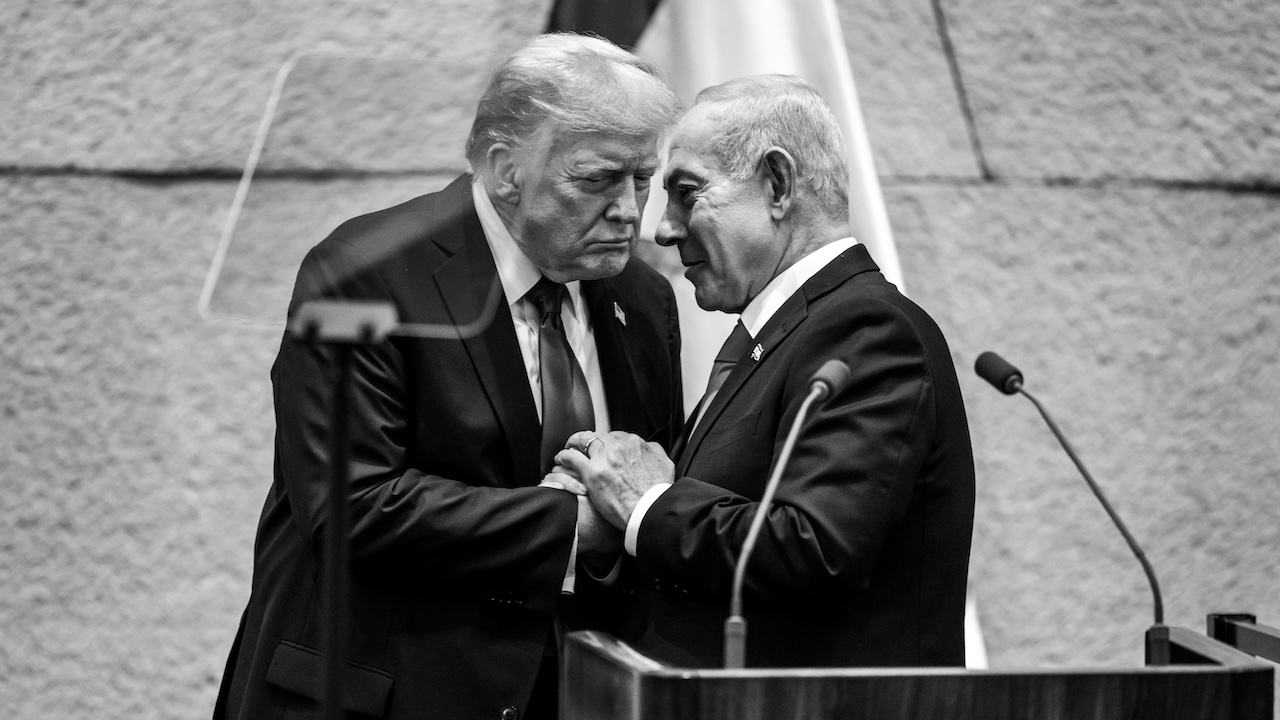
Trump embraces Netanyahu in the Knesset (Photo via the White House)

Trump stirred controversy in several off-script moments in his address to the Israeli Knesset, including spotlighting a top pro-Israel donor

US President Donald Trump spoke in the Israeli parliament on October 13 amid the implementation of the Israeli-Hamas ceasefire deal he helped broker – labeling the deal as a “historic dawn for the Middle East.” 

Trump attempted to position himself not only as a behind-the-scenes mediator, but as a central actor in shaping post-war Gaza and the region as a whole. “Israel, with our help, has won all that they can by force of arms,” Trump proclaimed. “Now it’s time to translate these victories against terrorists on the battlefield into the ultimate prize of peace and prosperity for the entire Middle East.”

Several unscripted moments of US President Donald Trump’s speech at the Israeli Knesset have become the subject of controversy, highlighting the unconventional diplomatic relationship between Israel and the US. 

In an extraordinary intrusion into Israeli domestic politics, Trump went off script and urged Israeli President Isaac Herzog to pardon Prime Minister Benjamin Netanyahu, who is facing corruption charges. 

“Cigars and champagne, who the hell cares about this?” Trump proclaimed, referring to Netanyahu’s charges of fraud and breach of trust. 

Trump claimed that Netanyahu is “a very popular man” because he knows “how to win.” A Maariv poll from last month revealed that a majority – 52% – of Israelis do not trust Netanyahu as Prime Minister. However, polling by the Israeli Democracy Institute reveals that a majority of Israelis also support a hostage deal with Hamas that leads to a full withdrawal of forces, indicating that the recent ceasefire deal may boost support for Netanyahu.

Trump’s speech at the Knesset comes the same day that Israel freed nearly 2,000 Palestinian prisoners as part of the Israeli-Hamas hostage exchange. Before the ceasefire deal, there were about 10,400 Palestinians in Israeli prisons, according to Palestinian prisoners’ rights group Addameer.

Trump shines spotlight on pro-Israel lobby

In a separate controversial moment, Trump singled out one of his major donors, Israeli-American Miriam Adelson, who was in the audience at the Knesset. Adelson donated USD 106 million to Trump’s super PAC, which helped fundraise for his reelection last year. 

“Look at her, sitting there so innocently,” Trump said, pointing Adelson out. “She’s got 60 billion in the bank.”

Trump continued: “I’m gonna get her in trouble with this, but I actually asked her once, I said, ‘So, Miriam, I know you love Israel. What do you love more, the United States or Israel?’ She refused to answer.”

“That might mean Israel,” Trump said, before laughing.

Trump’s commentary on Adelson, who was awarded a Presidential of Medal of Honor by Trump during his first term, has inadvertently shined a spotlight on the ultra-powerful pro-Israel lobby in US politics. 

Some have noted the pattern of Trump saying “the quiet part out loud” throughout his political career. US law professor and public commentator Jody David Armour wrote on X that Trump “regularly just spills the beans on how US policy actually works,” in response to the president’s Adelson comments. 

“He might have been a bit too frank for her tastes. She looked uncomfortable,” remarked Electronic Intifada journalist Asa Winstanley on X. 

Independent journalist Sam Husseini summarized Trump’s comments as “she bribed me and she loves Israel more than the US.”

A major part of the recent resurgence of the Palestine solidarity movement in the past two years has been shining a light on the pro-Israeli influence in US politics. 

“By his own admission, the president of the United States is acting on the wishes of his top donors” like Adelson, wrote the account “AIPAC Out of US Politics” on social media. AIPAC Out of US Politics is a grassroots campaign recently launched by pro-Palestine activists in the United States, aiming to spotlight the influence of the American Israel Public Affairs Committee, the largest pro-Israel lobbying group in the US. 

Quinnipiac University polling from September revealed that the share of registered US voters who believe that backing Israel aligns with their country’s national interests has dropped sharply over the 21 months of Israel’s military offensive in Gaza. Less than half of voters say they believe support for Israel aligns with US national interests, a sharp drop from 67% in December.

Original article by Natalia Marques republished from peoples dispatch under a Creative Commons Attribution-ShareAlike 4.0 (CC BY-SA) license.

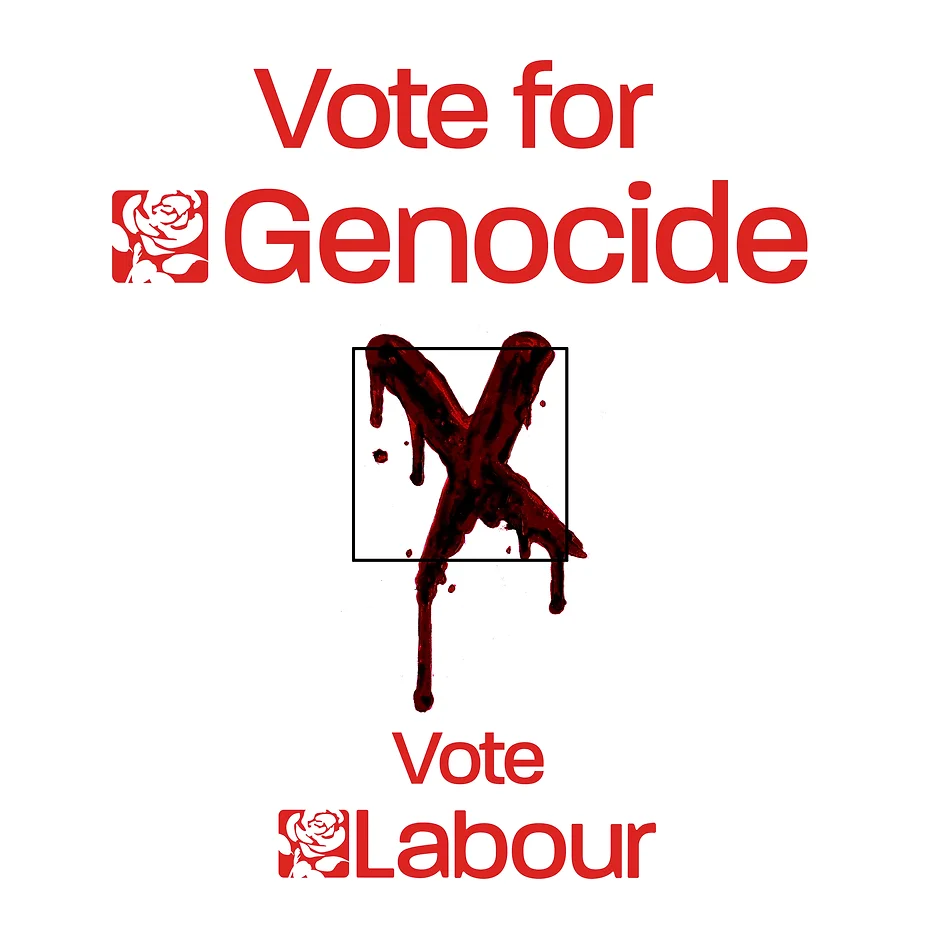
Keir Starmer objects to criticism of the IDF. He asks how could anyone object to them starving people to death, forced marches like the Nazis did, bombing Gaza's hospitals and universities, mass-murdering journalists, healthworkers and starving people queuing for food, killing and raping prisoners and murdering children. He calls for people to stop obstructing his genocide for Israel.
Keir Starmer objects to criticism of the IDF. He asks how could anyone object to them starving people to death, forced marches like the Nazis did, bombing Gaza’s hospitals and universities, mass-murdering journalists, healthworkers and starving people queuing for food, killing and raping prisoners and murdering children. He calls for people to stop obstructing his genocide for Israel.
Experiencing issues with this image not appearing. I suspect because it's so critical of Zionist Keir Starmer's support of and complicity in Israel's genocides.
Genocide denier and Current UK Prime Minister Keir Starmer is quoted that he supports Zionism without qualification. He also confirms that UK air force support has been essential in Israel’s mass-murdering genocide. Includes URLs https://www.declassifieduk.org/keir-starmers-100-spy-flights-over-gaza-in-support-of-israel/ and https://youtu.be/O74hZCKKdpA
Vote Labour for Genocide.
Continue ReadingTrump Knesset speech displays complete US backing of Israel

140,000 march in Brussels against austerity

Spread the love

Original article by Ana Vračar republished from peoples dispatch under a Creative Commons Attribution-ShareAlike 4.0 (CC BY-SA) license.
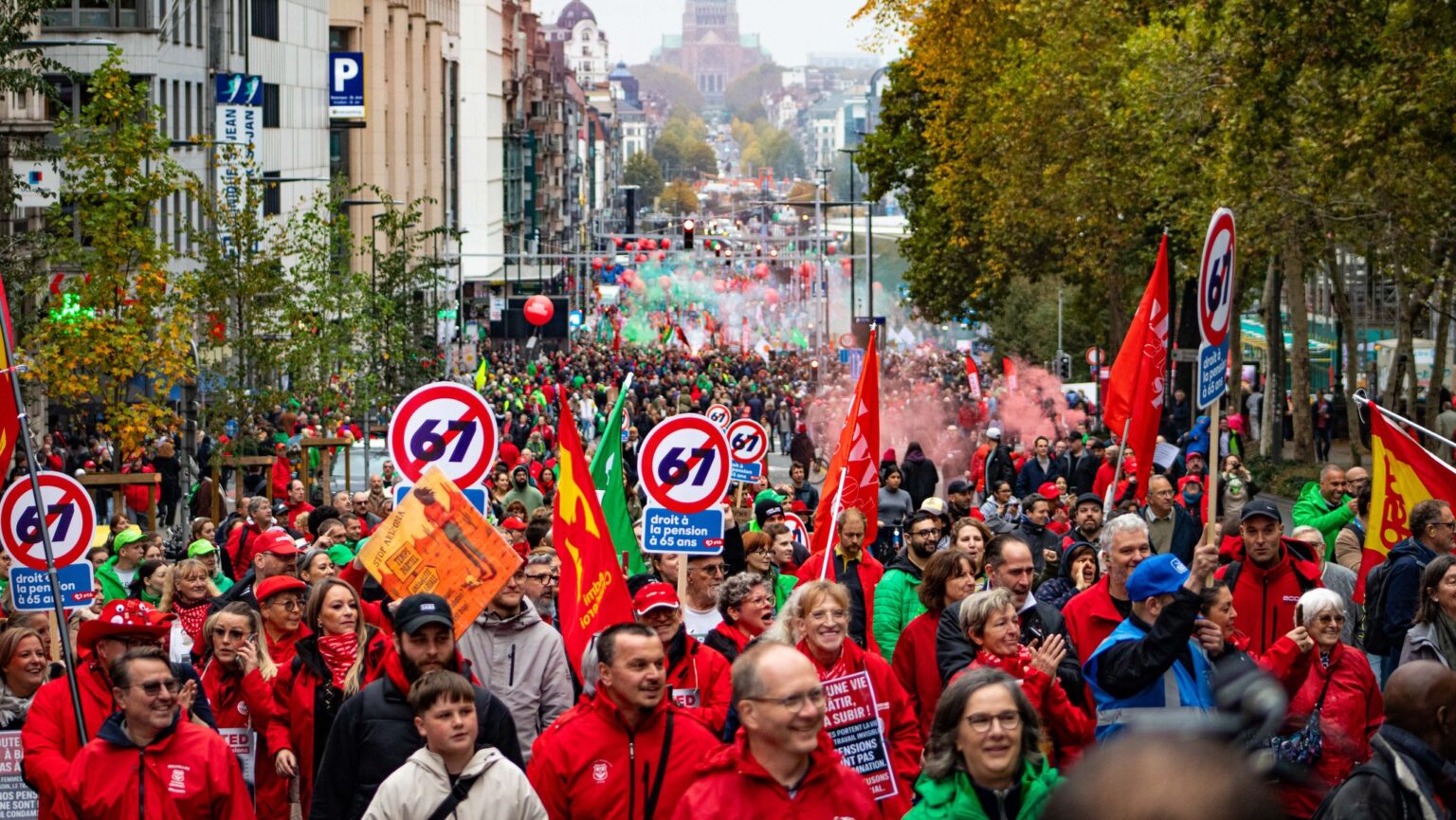
Source: Workers’ Party of Belgium (PTB-PVDA)

Around 140,000 people joined trade union protests in Brussels, opposing austerity measures planned by Bart De Wever’s administration.

Approximately 140,000 people took to the streets of Brussels on October 14, 2025, answering the call of Belgium’s trade unions to oppose the austerity plans of Bart De Wever’s government. Demonstrators arrived from across the country, making this one of the largest labor mobilizations in years.

“People came from all over Belgium, from all walks of life: workers, employees from both the public and private sectors, from all the professions that keep society running,” said Peter Mertens, General Secretary of the Workers’ Party of Belgium (PTB-PVDA). “A total of 140,000 people who are fed up with this government’s social destruction.”

Prime Minister De Wever’s administration has pressed ahead with plans to cut workplace protections and freeze income while increasing military spending, including the purchase of new F-35 fighter jets. “With its summer agreement, the government is further reducing social security, social rights, and purchasing power, and therefore the future prospects of the population,” said the trade union FGTB-ABVV. “On the other hand, it has found money to buy more drones and warplanes.”

Read more: Belgians to government: “We won’t sacrifice pensions for warplanes”

Trade unions and the PTB-PVDA have warned that certain groups of workers will be hit hardest by the reforms – particularly women, who risk being penalized for taking maternity leave if they cannot produce the required documentation. “The government intends to deliberately steal from thousands of women who took maternity leave before 2003,” FGTB-ABVV activists wrote in Syndicats Magazine. “These women will bear the ‘burden of proof’ for this leave. Otherwise, what? Their maternity leave will simply not be counted in their pension calculations. This is a discriminatory choice, and a deliberate one. It shows a total lack of respect.”

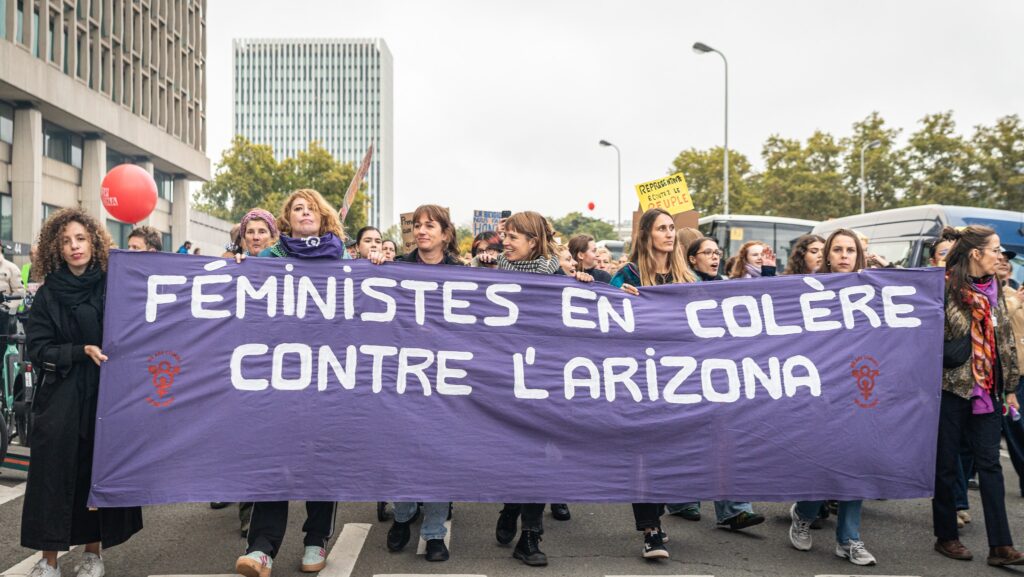
Feminists against Arizona coalition. Source: Workers’ Party of Belgium (PTB-PVDA)

But all workers are expected to suffer under the new wave of austerity: younger employees will face weaker protections on night work, while those retired or nearing retirement could see their pensions slashed. “Figures from the Federal Pension Service show that 30% of people – 70% of whom are women – will lose an average of 318 euros per month. That’s a third of their pension,” said Thierry Bodson, head of the FGTB-ABVV, in a recent interview. “For many, that automatically means falling below the poverty line.”

“Investing in weapons and cutting back on pensions is a political choice,” Mertens explained ahead of the protest. “By 2070, pension spending would rise by 2% of GDP, which the Reformist Movement (Mouvement réformateur) claims is impossible [to fund]. Yet increasing defense budgets by 2% over ten years is entirely possible for them.”

Read more: World Bank acknowledges poverty increase in Nigeria, but doubles down on the reforms causing it

The government has attempted to dismiss the unions’ and the left’s analyses but largely failed to do so, only managing to offer vague assurances that pensions would not be cut and protections would be preserved. “All these distortions, half-truths, and blatant lies prove one thing: the government is under pressure,” Mertens said.

“What we feel today is incredible energy, collective pride, and great determination,” he added on the day of the demonstration. “More and more people are realizing: together, we can make the government back down. Together, we can win.”

Original article by Ana Vračar republished from peoples dispatch under a Creative Commons Attribution-ShareAlike 4.0 (CC BY-SA) license.
Continue Reading140,000 march in Brussels against austerity