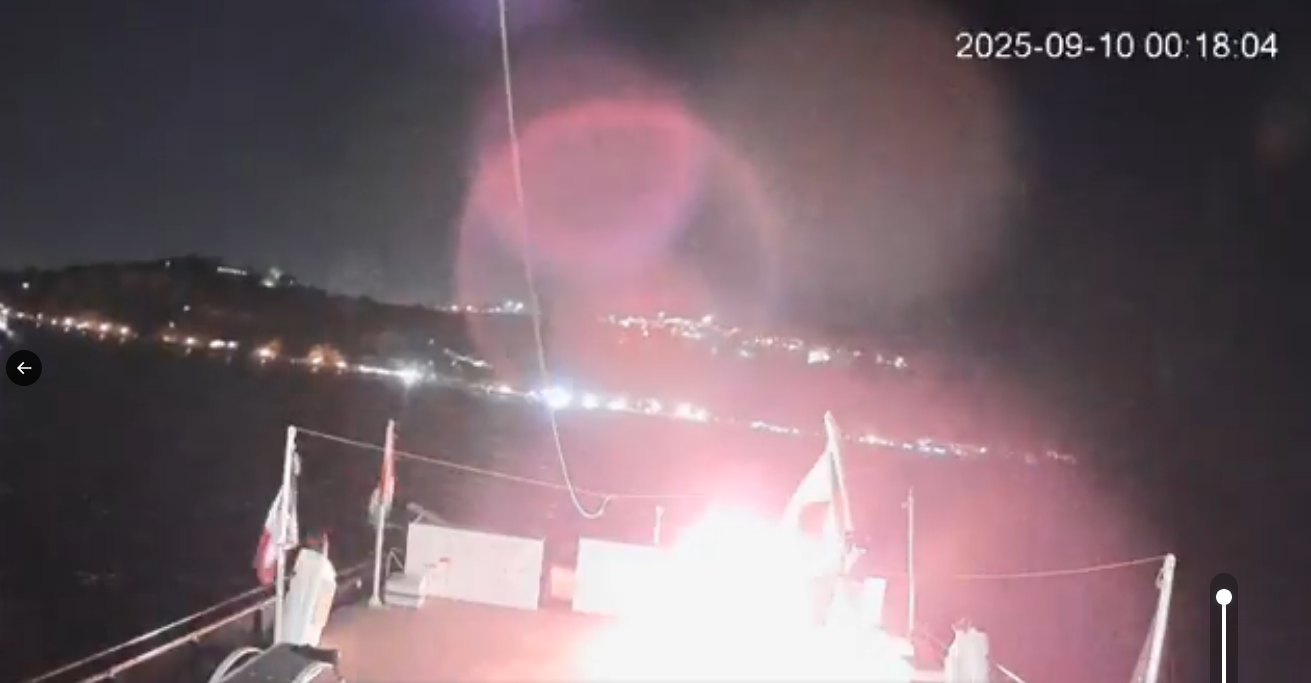
Attack on Global Sumud Flotilla’s “Alma”. Source: screenshot
The Global Sumud Flotilla’s vessel “Alma” was hit in a new suspected drone strike, marking the second attack on the initiative within days.
The Global Sumud Flotilla has come under attack for a second time in days while preparing to break the Israeli blockade of Gaza by sea. The vessel Alma, sailing under a British flag, was struck in another suspected drone assault and sustained fire damage to its upper deck.
“These repeat attacks come during intensified Israeli aggression on Palestinians in Gaza, and are an orchestrated attempt to distract and derail our mission,” the coalition stated. “The Global Sumud Flotilla continues undeterred.”
While investigations are ongoing, UN Special Rapporteur Francesca Albanese wrote on social media that early expert opinions suspected a drone strike carried out with “an incendiary grenade wrapped in plastic materials dipped in fuel.” The incident followed the attack a day earlier on the flotilla’s FamilyBoat, which carried steering committee members and supplies for Gaza on previous legs of the voyage. The strike drew widespread condemnation from grassroots groups and led to immediate popular mobilizations in the Tunisian port of Sidi Bou Said, where the flotilla is currently docked.
After the first assault, the coalition reaffirmed its determination to proceed. “We are leaving on this mission. No acts of aggression will stop us,” Global Sumud Flotilla’s Saif Abukeshek said. “In the coming days, the flotilla will be united at sea in our mission to break the siege, to end the genocide and to stand with the Palestinian people in their just struggle for freedom.”
“Our mission is clear: to expose Israel’s unfolding ethnic cleansing and stand in solidarity with the Palestinian people,” the flotilla added.
The Global Sumud Flotilla is made up of trade unionists, health workers, actors, activists, and ordinary people seeking to reach Gaza with essential supplies while spotlighting Israeli war crimes and Western governments’ complicity. It marks the largest attempt to break the sea blockade since the genocide began in October 2023, supported by dozens of civilian vessels and thousands of volunteers on land.
Genocide denier and Current UK Prime Minister Keir Starmer is quoted that he supports Zionism without qualification. He also confirms that UK air force support has been essential in Israel’s mass-murdering genocide. Includes URLs https://www.declassifieduk.org/keir-starmers-100-spy-flights-over-gaza-in-support-of-israel/ and https://youtu.be/O74hZCKKdpAKeir Starmer objects to criticism of the IDF. He asks how could anyone object to them starving people to death, forced marches like the Nazis did, bombing Gaza’s hospitals and universities, mass-murdering journalists, healthworkers and starving people queuing for food, killing and raping prisoners and murdering children. He calls for people to stop obstructing his genocide for Israel.Vote Labour for Genocide.
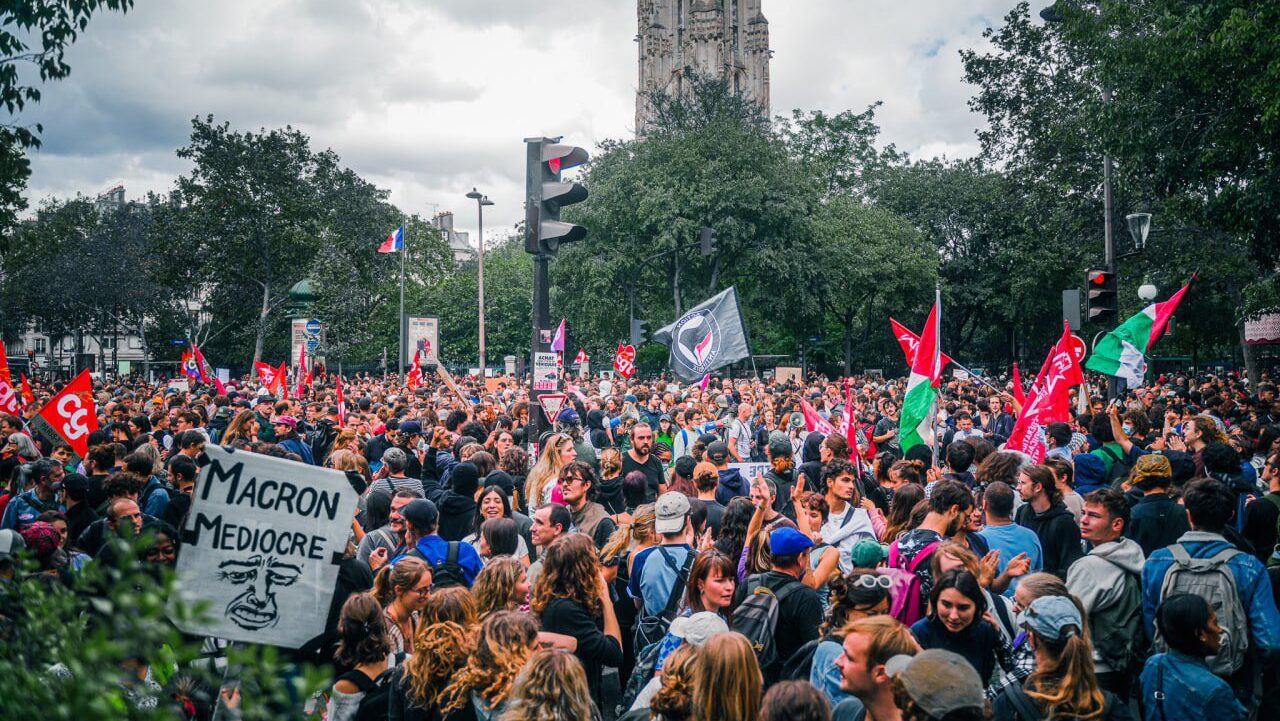
September 10 mobilization in Paris. Source: Mathilde Panot/X
Hundreds of mobilizations across France signaled public rejection of President Emmanuel Macron’s austerity path.
Hundreds of mobilizations, including picket lines and strikes, took place across France on September 10, signaling general rejection of a new wave of austerity policies advanced by the neoliberal camp. Trade unions reported significant participation in multiple sectors, including railways, education, culture, and health – where at least 100 work stoppages occurred during the day.
Grassroots networks estimate that approximately 500,000 people joined the demonstrations, held under the slogan “Let’s Block Everything” (Bloquons tout). Student collectives and Palestine solidarity groups were among those contributing to the day, among many others. Actions took place not only in major cities like Paris and Marseille but also in smaller towns such as Albi and Pau. The day was also marked by a heavy police presence and reports of violence against protesters, including the use of tear gas.
The mobilization came just days after another prime minister appointed by President Emmanuel Macron, François Bayrou, lost a confidence vote in the National Assembly. Macron quickly replaced him with former defense minister Sébastien Lecornu, a representative of the center’s right-wing faction. The appointment irked the public further. Maurizio Coppola of the Italian left party Potere al Popolo, who took part in the actions, told Peoples Dispatch: “Many saw this hasty appointment of a new prime minister as a provocation on the eve of the mobilization.”
Demonstrators also saw Lecornu’s appointment as a sign that Macron continues to pursue policies repeatedly rejected by the public. In a recent speech, France Unbowed (La France Insoumise) leader Jean-Luc Mélenchon highlighted the devastating social impact of neoliberal economic policies, pointing out that thousands of children and hundreds of thousands of people in France are homeless. Poverty and inequality, he described, plague the country. The trade union group Solidaires offered similar reflections on the day of action: “After the fall of the Bayrou government, the head of state’s desire to pursue the same policy in the service of special interests can only exacerbate fiscal and social inequalities and the ecological crisis.”
“He must go”
“Macron is to blame for this situation,” Mélenchon wrote on September 10. “He and his decisions are responsible for the chaos. He makes no effort whatsoever to show that he is receiving or listening to the messages coming from the National Assembly or the country. On the contrary, he brazenly pushes ahead to show that he remains in control of his strange and absurd plans. He must go.”
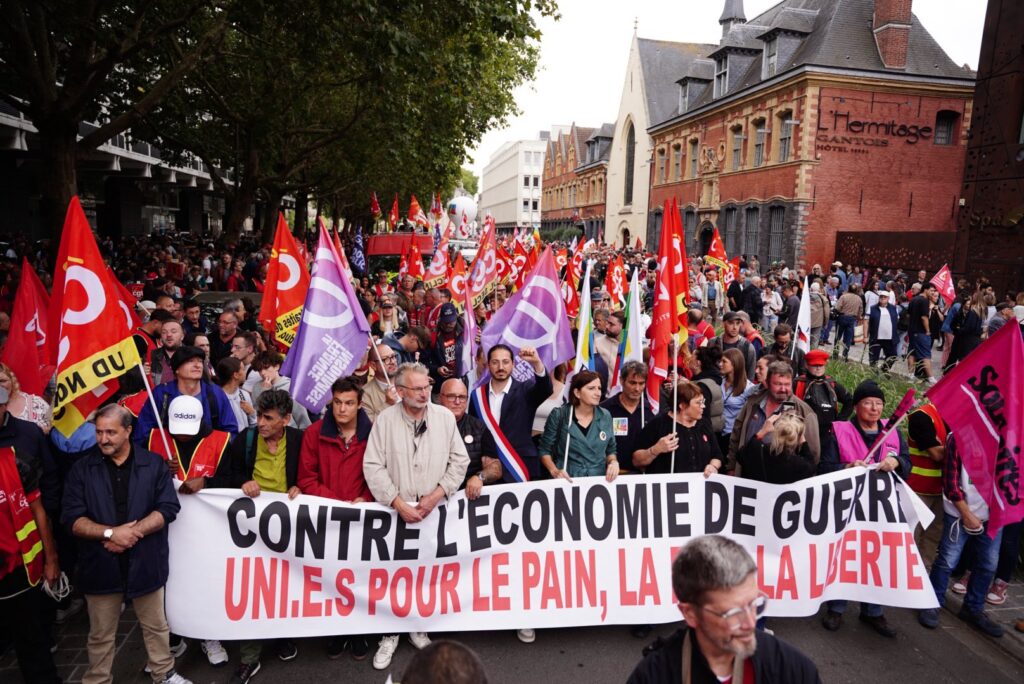
Protesters marching with banner: “Against the war economy. United for bread, peace, and liberty.” Lille, September 10, 2025. Source: Aurélien Le Coq/X
France Unbowed has campaigned for Macron’s removal since the 2024 national election, when he blocked the progressive New Popular Front (Nouveau Front Populaire) from forming a cabinet despite its electoral result, instead entrusting government formation to a succession of neoliberals. The party renewed its call after Bayrou’s collapse but also threw its weight behind the ongoing grassroots struggles. Coppola noted that activists from France Unbowed were active in preparing demonstrations across communities, helping amplify and link popular demands. “Their elected representatives marched with the protesters, defending them from police violence through their institutional status,” he added.
The role of organized labor
Despite the success of the day of action, questions remain. One concerns the role of labor unions, Coppola suggests. While certain unions and confederations, notably Solidaires, joined the call for September 10, others kept more distance. Branches of the General Confederation of Labor (Confédération générale du travail, CGT) and Workers’ Force (Force Ouvrière) participated in the actions, but their leadership chose to emphasize a strike call for September 18. By doing so, these organizations echoed popular demands against austerity but did not fully align themselves with the grassroots initiative.
The ability of grassroots groups and labor unions to connect over and channel the anger that fueled the “Let’s Block Everything” protests may have an important impact on the mobilization’s long-term success. As Coppola points out, “where strikes and blockades were successful, this was only possible thanks to the presence of organized labor.” However, he also adds that some unions joined the day of action only because rank-and-file members pushed for it, highlighting how bottom-up participation remains vital across the struggle.
Another unresolved question is the feasibility of France Unbowed’s proposal to remove Macron. While such an outcome would potentially be a significant victory against austerity, it would trigger new presidential elections with uncertain results. In 2024, the far-right National Rally (Rassemblement National) secured more votes than the left-progressive alliance, making the prospect of an extreme right president a genuine risk.
Nevertheless, the message of September 10 was unmistakable and is unlikely to fade soon. “The message was clear everywhere: no to the [austerity] financial maneuver, [yes to the] strengthening of public services and workers’ rights, taxing the rich, and above all, the resignation of President Macron,” Coppola concluded.
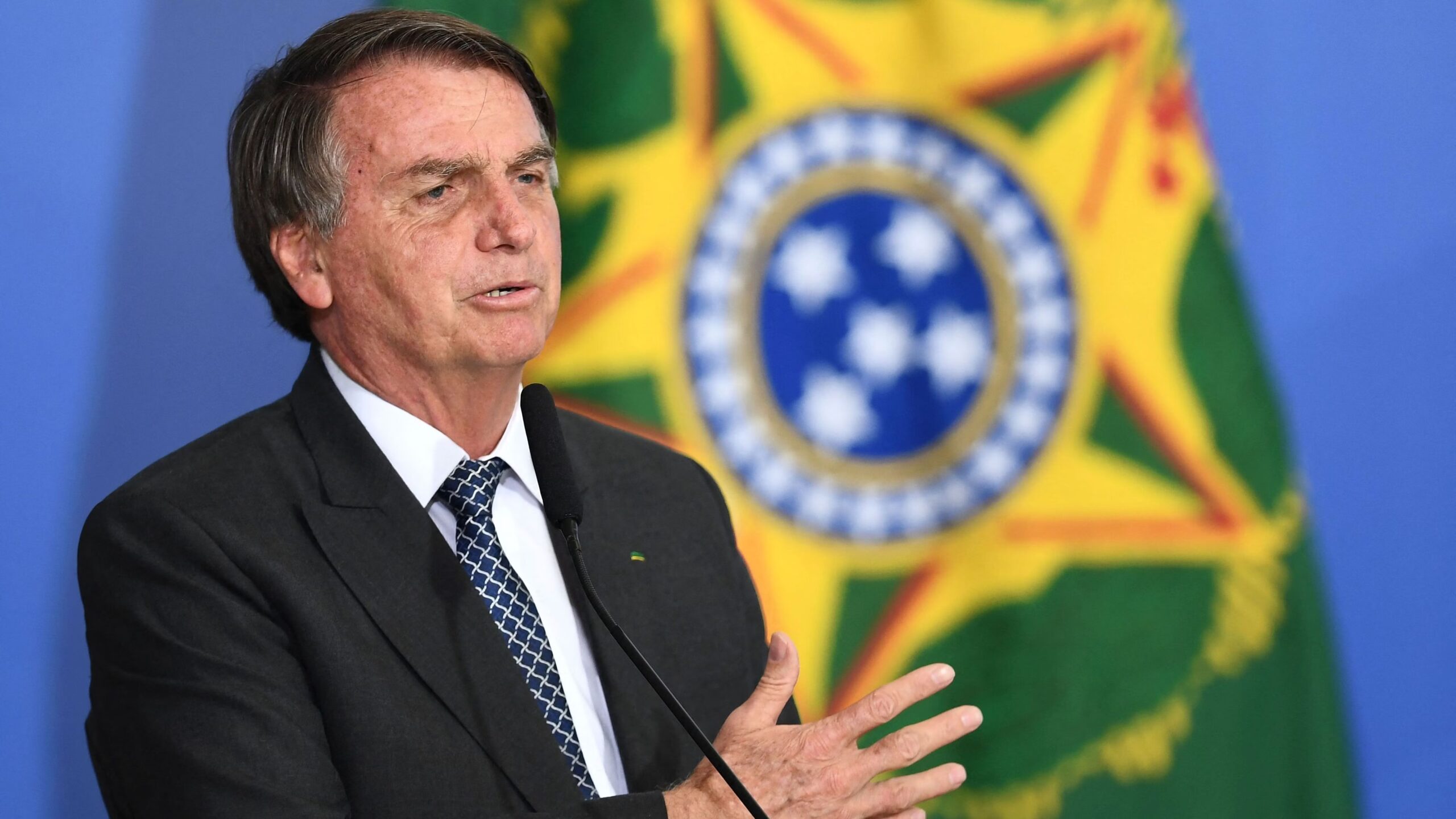
Former Brazilian President Jair Bolsonaro. Photo: Huete
He is already under house arrest, but if convicted, he would be taken to a cell only after the sentence becomes final.
The answer to the question is yes. In fact, former Brazilian President Jair Bolsonaro is already under house arrest after failing to comply with precautionary measures imposed by the reporting judge in the criminal case investigating the attempted coup in Brazil, Alexandre de Moraes, such as the prohibition on using social media.
Lawyer Ney Strozake states that preventive detention could be imposed if there is a risk of flight. “If he [Bolsonaro] flees or takes actions that clearly demonstrate that he is going to flee, what could happen is that the Attorney General’s Office could request preventive detention and Alexandre Moraes could order preventive detention. But [only] because he is preparing to flee or because he has fled, which is the case with [Carla] Zambelli. She is already abroad and has announced that she has fled. Then her preventive detention was ordered. In Bolsonaro’s case, this could also happen,” explained the lawyer.
However, these are preventive measures, which are primarily aimed at ensuring the smooth running of the proceedings and are unlikely to be taken on the eve of a sentence. The final arrest, in compliance with a possible sentence established by the First Panel of the Supreme Federal Court (STF), will still take a little more time, and this depends on how the five ministers will vote.
Possibilities for appeals
If there are at least two disagreements among the justices regarding the merits of the case, that is, regarding the conviction or acquittal of the defendants, the defense may file appeals to bring the case to the full court, known as infringements. The deadline for the defense to file these appeals is ten days, and there is no deadline for the court to decide whether to accept them.
If there is not this minimum number of disagreements on the merits, the defense will be limited to only one possibility of appeal: the so-called motions for clarification. In this case, there is no possibility of changing the majority decision, but lawyers may contest or even request clarification regarding any measure imposed in the sentence, or request, for example, immediate progression to house arrest for health reasons. For this type of appeal, the deadline for filing defenses is five days after the sentence, and the judge in the case has the same amount of time to rule on them.
Jail only after the final judgment
According to the understanding established by the STF, those convicted will only begin serving their sentences after the so-called final judgment, that is, when there are no more possibilities for appeals.
Former President Jair Bolsonaro and seven other defendants are identified by the Attorney General’s Office (PGR) as the “crucial nucleus” of the coup plot. They are accused of the crimes of armed criminal organization, attempted violent abolition of the Democratic Rule of Law, coup d’état, damage qualified by violence and serious threat, and deterioration of listed heritage.
Together, the penalties related to the crimes identified by the Attorney General’s Office could total 43 years in prison, considering the maximum penalties for each crime and the possibility of aggravating circumstances.
In addition to the former president, seven other men, all close allies during his administration, are being tried this week. They are: Alexandre Ramagem (former head of the Brazilian Intelligence Agency, Abin, and now a federal deputy for the Liberal Party in Rio de Janeiro); Almir Garnier Santos (former Navy commander); Anderson Torres (former Minister of Justice); Augusto Heleno (Army general and former Minister of Institutional Security); Mauro Cid (Bolsonaro’s former aide-de-camp); Paulo Sérgio Nogueira (who, like Braga Netto, was also Minister of Defense); and Walter Braga Netto (Army general and former Minister of Defense and Chief of Staff).
Among the eight defendants, Ramagem is the only one charged with three crimes, rather than five, as the charges of aggravated damage and deterioration of listed property (relating to January 8) were suspended, since he was already a certified congressman at the time and therefore had parliamentary immunity.
With the exception of whistleblower Mauro Cid, who has confessed to the charges, the others claim innocence.
This article was first published in Brasil de Fato in Portuguese.
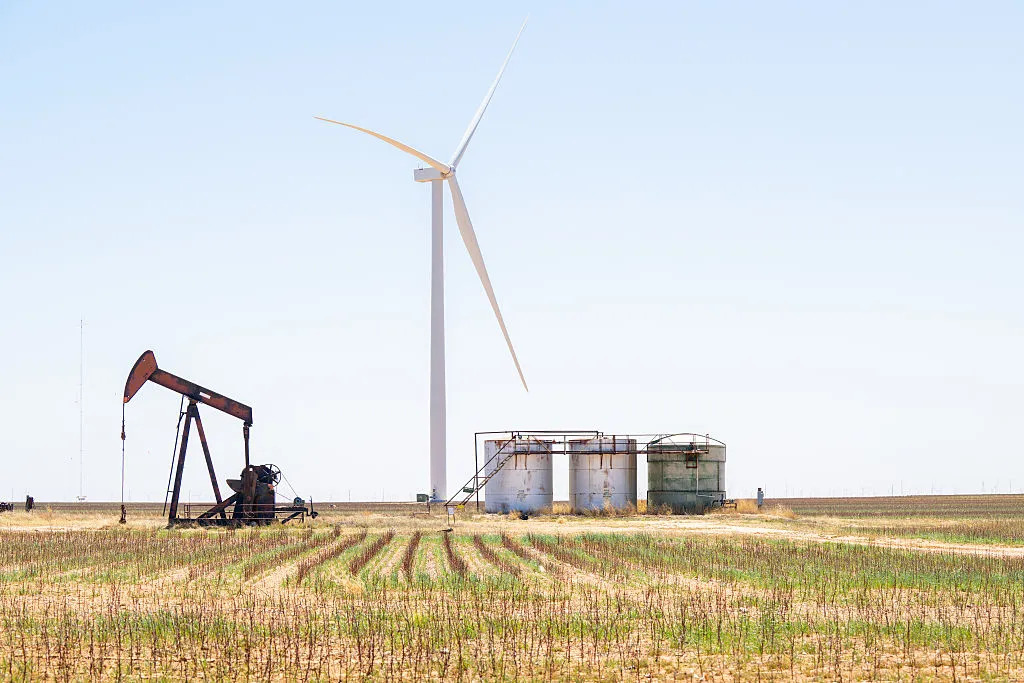
The price of eggs has more than doubled in the past eight years, which isn’t great, but at least you can eat eggs. The price of US government subsidies for the fossil-fuel industry has also more than doubled in that time, which is far, far less great. Welfare for an industry that makes billions of dollars in profits and pollutes the climate is worse than useless. It’s self-destructive.
The federal government gives oil, gas and coal producers at least $34.8 billion in subsidies each year, according to a new study by the research and advocacy nonprofit Oil Change International. In 2017, OCI estimated these gifts at $14.7 billion annually. This doubling in federal largesse has taken place under both Democratic and Republican political administrations, highlighting the difficulty of stopping its growth, much less reversing it.
In fact, some of the most recent extensions of federal aid have made it possible for these subsidies to explode in the future, threatening to reach trillions of dollars. When the world needs exponential growth in clean-energy investments to avoid the most catastrophic effects of global heating, the US government will be bankrolling fossil-fuel expansion and stoking the emergency.
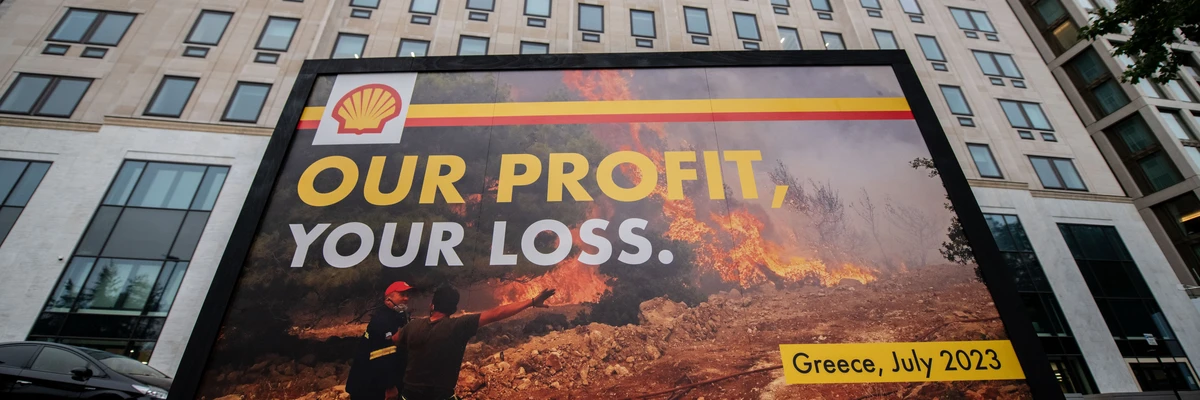
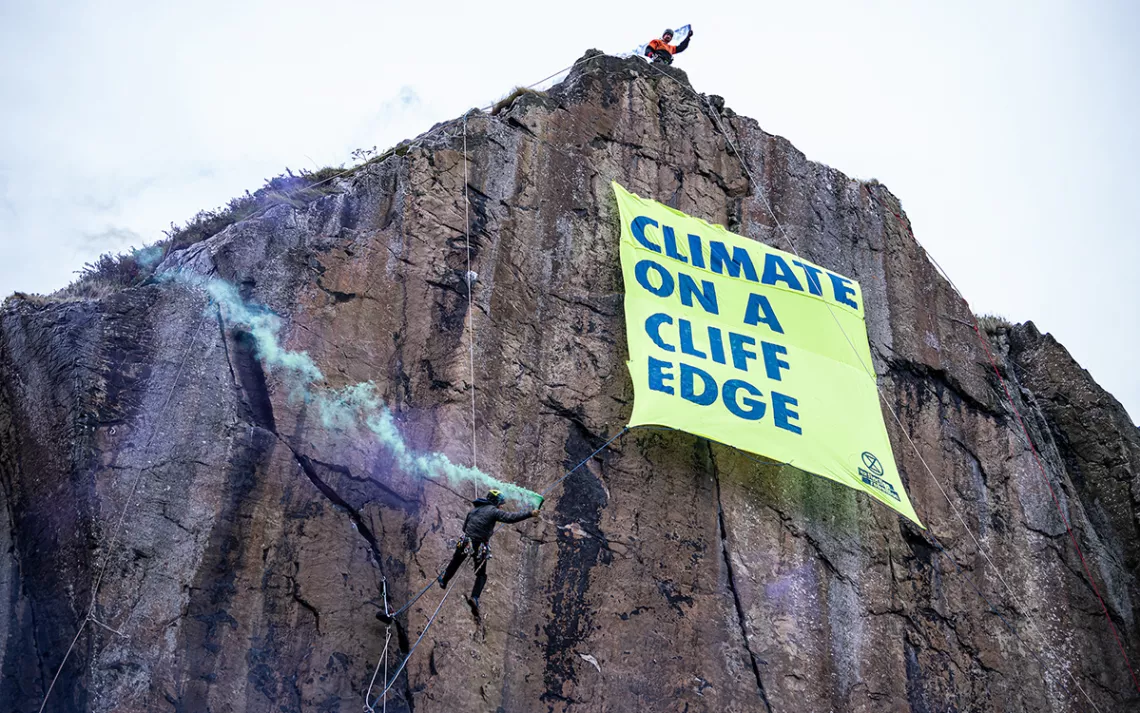
Donald Trump urges you to be a Climate Science denier like him. He says that he makes millions and millions for destroying the planet, Burn, Baby, Burn and Flood, Baby, Flood.Greenpeace activists display a billboard during a protest outside Shell headquarters on July 27, 2023 in London. (Photo: Handout/Chris J. Ratcliffe for Greenpeace via Getty Images)Experienced climbers scale a rock face near the historic Dumbarton castle in Glasgow, releasing a banner that reads “Climate on a Cliff Edge.” One activist, dressed as a globe, symbolically looms near the edge, while another plays the bagpipes on the shores below. | Photo courtesy of Extinction Rebellion and Mark Richards
Global warming linked to the world’s biggest oil and gas companies made all “major” 21st century heatwaves more intense and frequent.
This is according to new research, published in Nature, which uses “extreme event attribution” to assess the impact of climate change on all 21st-century heatwaves that were classified as “major disasters”.
The authors find one-quarter of the 213 heatwaves would have been “virtually impossible” without human-caused global warming.
They add that the effect of climate change on heatwave frequency and intensity is becoming more pronounced as the planet warms.
The study estimates the emissions stemming from the operations and production of more than 100 “carbon majors”, such as ExxonMobil, BP, Saudi Aramco and Shell.
The fossil fuels produced by these companies account for 60% of all human-caused CO2 emissions over 1850-2023, the study says.
The authors find that heatwaves recorded over 2000-23 were made, on average, 1.7C hotter due to climate change, with half of this increase due to the emissions originating from carbon majors.
This study “could be used to support future climate lawsuits and aid diplomatic negotiation”, according to a scientist not involved in the research.
The EM-DAT database catalogues all “major disasters” that have been reported since the year 1900 – defined as events that cause at least 10 fatalities, affect at least 100 people, or result in the declaration of state of emergency or a call for international assistance.
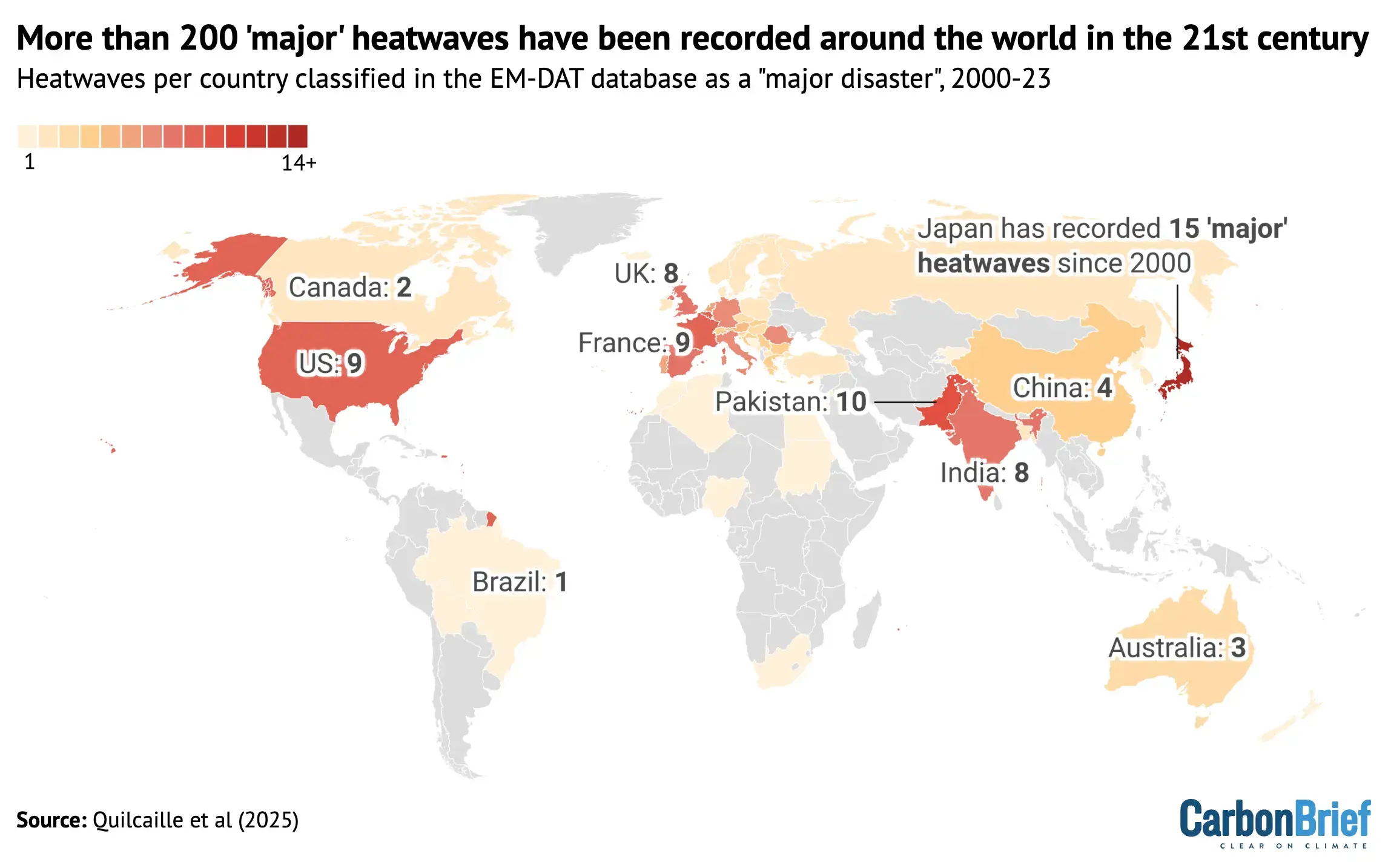
Between 2000 and 2023, the database lists more than 200 heatwaves. These are shown on the map below, where darker pink indicates a greater number of heatwaves. Countries with no reported heatwaves are shown in grey.
The map below shows the number of heatwaves per country recorded over 2000-23 on the EM-DAT database. Data: Quilcaille et al (2025).
The study authors acknowledge that heatwave reporting is “highly uneven”, with only nine of the heatwaves reported in the database since the year 2000 in Africa, Latin America or the Caribbean. (This is largely because extreme heat events in these regions are not routinely monitored.)
They then carried an attribution analysis on each heatwave to identify whether it was made more likely or intense due to human-caused climate change.
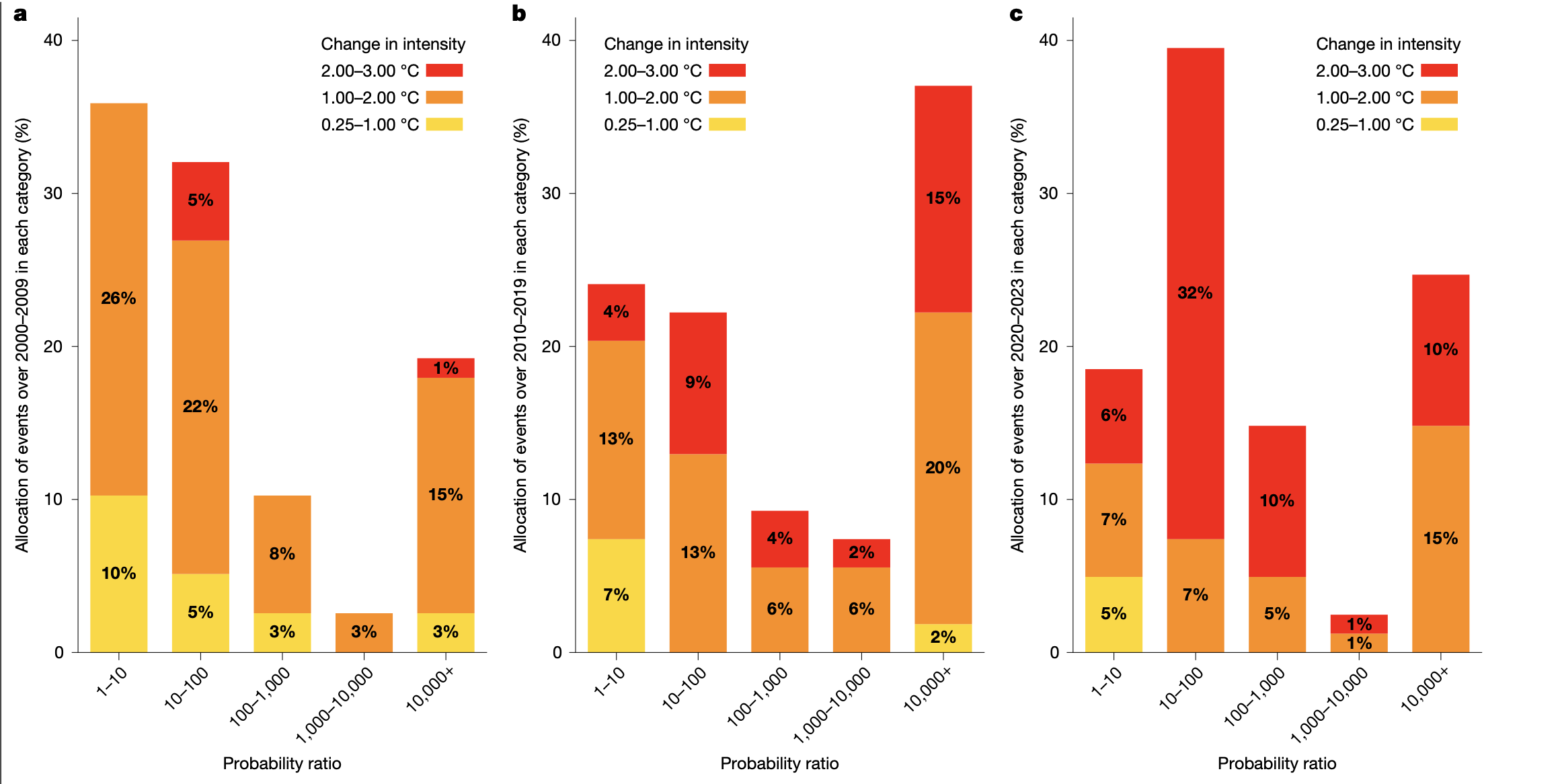
The chart below shows how climate changes increased the intensity and frequency of the 78 heatwaves assessed over 2000-09 (left), 54 heatwaves assessed over 2010-19 (middle) and 81 heatwaves assessed over 2020-23 (right).
The authors find that climate change increased the intensity and probability of all 213 heatwaves in the study. They add that the influence of climate change on heatwaves is strengthening over time.
In each panel, the bars show the percentage of heatwaves in that time period that were made 0.25-1.0C (yellow), 1.0-2.0C (orange) or 2.0-3.0C (red) hotter due to climate change.
The position of bars indicate the change in likelihood of the heatwaves. This ranges from those made 1-10 times more likely due to climate change (left-most bar in each panel) to those made more than 11,000 times more likely (right-most bar in each panel).
The extent to which climate changes increased the intensity and frequency of the 78 heatwaves assessed over 2000-09 (left), 54 heatwaves assessed over 2010-19 (middle) and 81 heatwaves assessed over 2020-23 (right). These are shown by colours and bar heights respectively. Source: Quilcaille et al (2025).
Heatwaves recorded over 2000-09 were, on average, 20 times more likely due to climate change, according to the authors. Meanwhile, those recorded over 2010-19 were about 200 times more likely.
Similarly, 2000-09 heatwaves were 1.4C hotter due to human-caused climate change on average, according to the study, while 2010-19 heatwaves were made 1.7C hotter.
The study finds that human-caused climate change made 55 heatwaves at least 10,000 times more likely. According to the authors, this is “equivalent to saying that they would have been virtually impossible” without the influence of human activity.
Carbon majors
To assess the contribution to heatwaves by oil and gas companies’ products, the authors use a database of carbon dioxide and methane emissions from 180 carbon majors over 1854-2023. This includes direct emissions from the companies, as well as the emissions released when the oil and gas they produced is used by others.
The 180 carbon majors in the database represent 60% of all human-caused CO2 emissions, including land use, over 1850-2023, according to the study. The paper adds that 14 companies, including ExxonMobil, BP, Saudi Aramco and Shell, are responsible for almost half of these emissions.
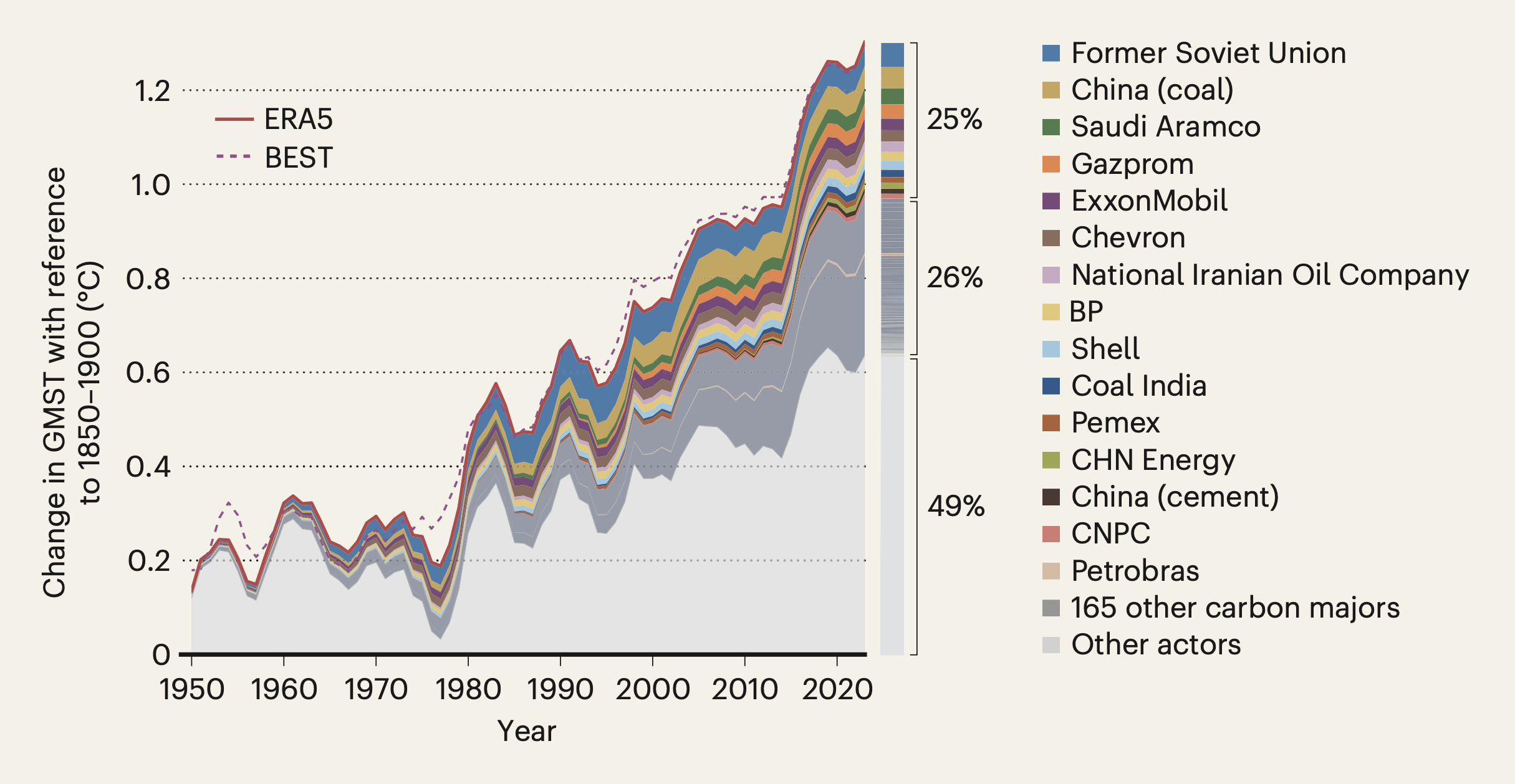
Using the Earth system model OSCAR, the authors estimate that global average surface temperatures increased by 1.3C between the 1850-1900 average and the year 2023.
They find that 0.7C of this increase was linked to the carbon majors, with 0.3C due to the emissions of the 14 largest.
The chart below, taken from an accompanying Nature “news and views” article, shows the contribution of oil and gas companies’ products to increasing global average surface temperatures over 1950-2023, compared to the 1850-1900 average.
Each colour indicates a carbon major, while grey indicates other sources of temperature increase, such as land-use change.
The contribution of oil and gas companies to increasing global average surface temperatures over 1950-2023, compared to the 1850-1900 average. Each colour indicates a company, while grey indicates other sources of temperature increase. Source: Haustein (2025).
Heatwaves recorded over 2000-23 were, on average, 1.7C hotter due to climate change, according to the study. The authors find that emissions originating from carbon majors and their products contributed about half of the increase in intensity of heatwaves seen since pre-industrial times.
The authors then break down the contribution of emissions from each carbon major on each heatwave in their analysis.
For example, they find that the emissions linked to Saudi Aramco made 51 heatwaves at least 10,000 times more likely. They add that on average, emissions tied to the company made the 213 heatwaves 0.04C hotter.
Legal action
Attribution studies already play an important role in courts by providing evidence that helps judges to determine liability.
Dr Rupert Stuart-Smith is a research associate in climate science and the law at the University of Oxford’s Sustainable Law Programme. He was not involved in the study, but has published separate work showing that the emissions linked to each of the six largest corporate emitters cause one heat-related death in Zurich alone, every summer.
Stuart-Smith tells Carbon Brief that the new paper is a “high-quality analysis and a meaningful step forward for the field of climate change attribution”. He adds:
“With more and more lawsuits aiming to hold high-emitting companies responsible for their contributions to climate change impacts or compel state and corporate actors to reduce their emissions and prevent rising climate harms, work like this provides the basis for well-informed judicial decision-making.”
Dr Yann Quilcaille is a researcher at ETH Zürich and lead author of the study. He stresses the importance of attribution research for court cases, telling Carbon Brief that he hopes his work “can be used by legal practitioners”.
However, he also says that his role as a scientist is not to assign “responsibility” for climate change, but to “provide information to governments for decision making and to courts for litigation”.
Mankin tells Carbon Brief that the new paper is “very closely” linked to his research.
Callahan says the new paper is “an important contribution to an emerging literature that illustrates how individual emitters can be linked to the change risk of extreme climate conditions and human impacts”.
He explains that “this kind of evidence will be important in courtrooms – holding emitters legally accountable requires demonstrating a causal nexus between that emitter and a particularised harm suffered by a plaintiff”.
Attribution
The cutting-edge field of extreme weather attribution seeks to establish the role that human-caused warming played in these events. Attribution studies have been carried out on hundreds of heatwaves all around the world, as shown in Carbon Brief’s interactive map.
The new paper uses one of the earliest and most commonly used methods of attribution, called “probabilistic attribution”.
The authors first chose a temperature “threshold” to define their heatwave.
They then used a global climate model to simulate two worlds – one mirroring the world as it was during the heatwave and the other using the climate of 1850-1900. This second scenario is used to represent the climate in a world without human-caused climate change.
The authors run their models thousands of times in each scenario. As the world’s climate is inherently chaotic, each model “run” – individual simulations of how the climate progresses over many years – produces a slightly different progression of temperatures. This means that some runs simulate the heatwave, while others do not.
The authors count how many times the threshold temperature was in each model run. They then compared the likelihood of crossing the threshold temperature in the world with – and a world without – climate change.
For example, they find that the 2021 Pacific north-west heatwave was made 3.1C hotter due to human caused climate change and more than 10,000 times more likely.
(A study by the WWA at the time of the heatwave found that the heatwave was made 150 times more likely. The discrepancy is due to differences in the definition of the event, as well as its “very unlikely nature” according to the study authors.)
Dr Frederieke Otto is a professor at Imperial College London and founder of the WWA initiative. She tells Carbon Brief that the new study is “very similar to some other recent studies on impacts, based on the hazard attribution method used by WWA”, but says that “this is the most high profile and wide-reaching one”.
Otto adds:
“I do hope that many more impact attribution studies will follow, based on our or other extreme event attribution studies. We need more research on this.”
Donald Trump urges you to be a Climate Science denier like him. He says that he makes millions and millions for destroying the planet, Burn, Baby, Burn and Flood, Baby, Flood.Nigel Farage urges you to ignore facts and reality and be a climate science denier like him. He says that Reform UK has received millions and millions from the fossil fuel industry to promote climate denial and destroy the planet.Greenpeace activists display a billboard during a protest outside Shell headquarters on July 27, 2023 in London. (Photo: Handout/Chris J. Ratcliffe for Greenpeace via Getty Images)Experienced climbers scale a rock face near the historic Dumbarton castle in Glasgow, releasing a banner that reads “Climate on a Cliff Edge.” One activist, dressed as a globe, symbolically looms near the edge, while another plays the bagpipes on the shores below. | Photo courtesy of Extinction Rebellion and Mark Richards