Journalists decry escalating state attacks on press freedom in India

Spread the love

Original article by Abdul Rahman republished from peoples dispatch under a Creative Commons Attribution-ShareAlike 4.0 (CC BY-SA) license.
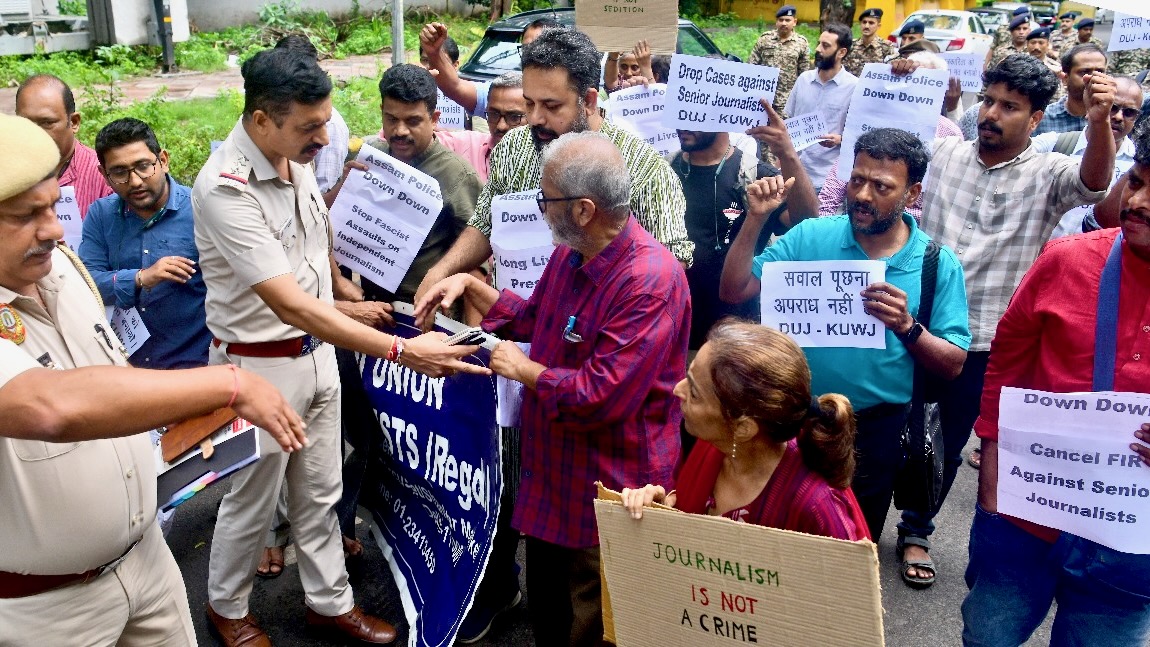
Journalists and activists protest in Delhi against the state’s attacks on press freedom. Photo: DUJ

The ultra-right-wing Bharatiya Janata Party (BJP) governments in various provinces in India have used sedition charges against journalists for their critical reporting on policies and actions.

Members of the Delhi Union of Journalists (DUJ) and the Kerala Union of Working Journalists (KUWJ) held a protest in India’s capital, New Delhi, on Wednesday, August 27, denouncing the rising cases of state-sponsored attacks on journalists in the country.

The protesters also demanded the immediate withdrawal of all the false charges against senior journalists Siddharth Varadarajan, Karan Thapar, and Abhisar Sharma, calling them blatant attacks on media and press freedom in the country.

The DUJ and KUWJ warned that if their cases are not withdrawn and such attacks on press freedom continue in the future, journalists in the country will take larger public action and flood the streets in protest.

Siddharth Varadarajan, founding editor-in-chief of the independent newsportal The Wire, Karan Thapar, senior editor with The Wire, and another senior journalist, Abhisar Sharma, were booked by the police in India’s north-eastern state of Assam and charged with sedition and other criminal activities.

The case against Abhisar is related to his reporting on his YouTube channel on the charges of corruption against the chief minister of Assam, Himanta Biswa Sarma. Abhisar also talks about the chief minister’s openly sectarian policies and provocative language against Muslim minorities in his video.

Varadarajan and Thapar were booked first in July and then again in August by the Assam police for their critical reporting on Operation Sindoor, India’s military operation against Pakistan in May which created a war-like situation between the two nuclear-powered neighbors.

Varadarajan and Thapar went to the court demanding the dismissal of the cases against them. While the matter was still under consideration by the court, the Assam police filed fresh charges against them. The Supreme Court of India (SCI) provided the journalists temporary protection from any action.

Abhisar Sharma also received interim relief from the SCI on Thursday. However, in both cases the SCI failed to quash the First Information Reports (FIRs), the official document in India that initiates criminal proceedings.

BJP’s attempts to silence critical voices

What the DUJ calls “attempts to browbeat and harass the media into submission”, has been a policy of the BJP government to silence critical voices in the country.

Assam is ruled by the same BJP which runs the union government in Delhi.

Several other journalists have faced false charges in the state in the last few years. In March of this year, Assam witnessed large-scale protests against the arrest of senior journalist Dilwar Hussain Mazumdar, who was arrested after he tried to expose corruption in a cooperative bank.

The union government has also used its agencies to raid and shut down independent newsportals, such as Newsclick, and has threatened others, including the Wire, to try to silence them.

Reflecting on the state of media in India earlier this year, Reporters without Borders (RSF) demanded that the state must “end media raids and arrests of journalists, often carried out under the guise of anti-terrorism laws or tax regulations.”

RSF had noted that “this judicial harassment has reached a critical level for independent news media”, with authorities repeatedly misusing the legal provisions.

Misuse of sedition

Apart from anti-terrorism laws and allegations of financial irregularities, the BJP government has also used sedition, a colonial era offense which remained a part of India’s legal codes even decades after independence. It has been frequently invoked against journalists questioning government policies.

Following massive public outcry and court interventions, the BJP government promised to scrap it in 2023, underlining its “colonial origin”. However, within months, the same government brought it back with a new name under the new set of legal codes called Bharatiya Nyaya Sanhita (BNS), promulgated in 2024.

The Wire has filed a fresh petition in the court to remove the sedition charges from the new code (section 156 of the BNS).

The DUJ hopes that the section “will be struck down so it can no longer be used to arrest, imprison, browbeat and harass those who dare to speak truth to power.”
Continue ReadingJournalists decry escalating state attacks on press freedom in India

Entire UN Security Council Except US Says Gaza Famine ‘Man-Made’ as 10 More People Starve to Death

Spread the love

Original article by Brett Wilkins republished from Common Dreams under Creative Commons (CC BY-NC-ND 3.0). 

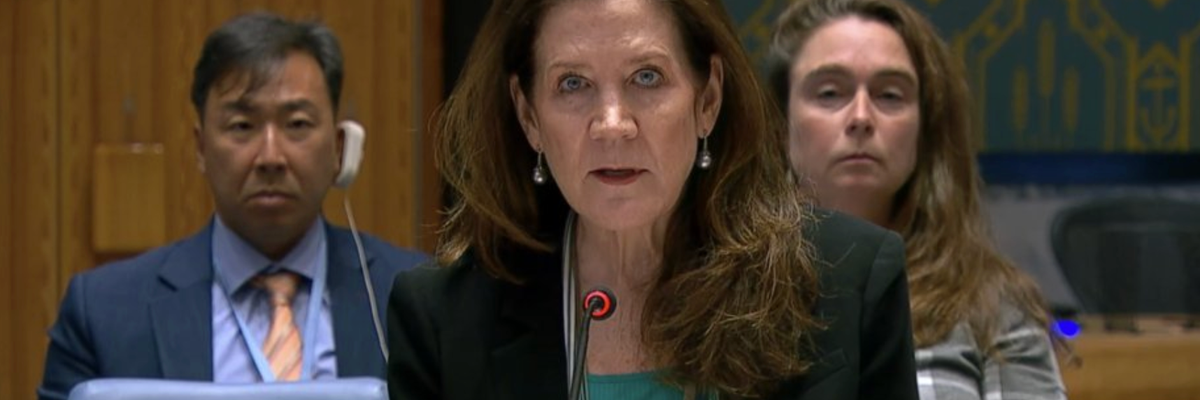
US Ambassador to the United Nations Dorothy Shea speaks on August 27, 2025. (Photo: US Mission to the United Nations/X)

While acknowledging that “hunger is a real issue in Gaza,” the US ambassador to the UN repeated a debunked claim that the world’s leading authority on starvation lowered its standards to declare a famine.


Every member nation of the United Nations Security Council except the United States on Wednesday affirmed that Israel’s engineered famine in Gaza is “man-made” as 10 more Palestinians died of starvation amid what UN experts warned is a worsening crisis.

Fourteen of the 15 Security Council members issued a joint statement calling for an immediate Gaza ceasefire, release of all remaining hostages held by Hamas, and lifting of all Israeli restrictions on aid delivery into the embattled strip, where hundreds of Palestinians have died from starvation and hundreds of thousands more are starving.

“Famine in Gaza must be stopped immediately,” they said. “Time is of the essence. The humanitarian emergency must be addressed without delay and Israel must reverse course.”

“We express our profound alarm and distress at the IPC data on Gaza, published last Friday. It clearly and unequivocally confirms famine,” the statement said, referring to the Integrated Food Security Phase Classification’s declaration of Phase 5, or a famine “catastrophe,” in the strip.

“We trust the IPC’s work and methodology,” the 14 countries declared. “This is the first time famine has been officially confirmed in the Middle East region. Every day, more persons are dying as a result of malnutrition, many of them children.”

“This is a man-made crisis,” the statement stresses. “The use of starvation as a weapon of war is clearly prohibited under international humanitarian law.”

Israel, which is facing a genocide case at the UN’s International Court of Justice, denies the existence of famine in Gaza. Israeli Prime Minister Benjamin Netanyahu and former Defense Minister Yoav Gallant are wanted by the International Court of Justice for alleged war crimes and crimes against humanity, including murder and forced starvation.

The 14 countries issuing the joint statement are: Algeria, China, Denmark, France, Greece, Guyana, Pakistan, Panama, the Republic of Korea, the Russian Federation, Sierra Leone, Slovenia, Somalia, and the United Kingdom.

While acknowledging that “hunger is a real issue in Gaza and that there are significant humanitarian needs which must be met,” US Ambassador to the UN Dorothy Shea rejected the resolution and the IPC’s findings.

“We can only solve problems with credibility and integrity,” Shea told the Security Council. “Unfortunately, the recent report from the IPC doesn’t pass the test on either.”

Shea also repeated the debunked claim that the IPC’s “normal standards were changed for [the IPC famine] declaration.”

The Security Council’s affirmation that the Gaza famine is man-made mirrors the findings of food experts who have accused Israel of orchestrating a carefully planned campaign of mass starvation in the strip.

The UN Palestinian Rights Bureau and UN humanitarian officials also warned Wednesday that the famine in Gaza is “only getting worse.”

“Over half a million people currently face starvation, destitution, and death,” the humanitarian experts said. “By the end of September, that number could exceed 640,000.”

“Failure to act now will have irreversible consequences,” they added.

Wednesday’s UN actions came as Israel intensified Operation Gideon’s Chariots 2, the campaign to conquer, occupy, and ethnically cleanse around 1 million Palestinians from Gaza, possibly into a reportedly proposed concentration camp that would be built over the ruins of the southern city of Rafah.

The Gaza Health Ministry (GHM) on Wednesday reported 10 more Palestinian deaths “due to famine and malnutrition” over the past 24 hours, including two children, bringing the number of famine victims to at least 313, 119 of them children.

All told, Israel’s 691-day assault and siege on Gaza has left at least 230,000 Palestinians dead, maimed, or missing, according to the GHM.

Original article by Brett Wilkins republished from Common Dreams under Creative Commons (CC BY-NC-ND 3.0). 

Continue ReadingEntire UN Security Council Except US Says Gaza Famine ‘Man-Made’ as 10 More People Starve to Death

Israeli Government Social Media Urges Europe to ‘Remove’ Muslims

Spread the love

Original article by Brett Wilkins republished from Common Dreams under Creative Commons (CC BY-NC-ND 3.0). 

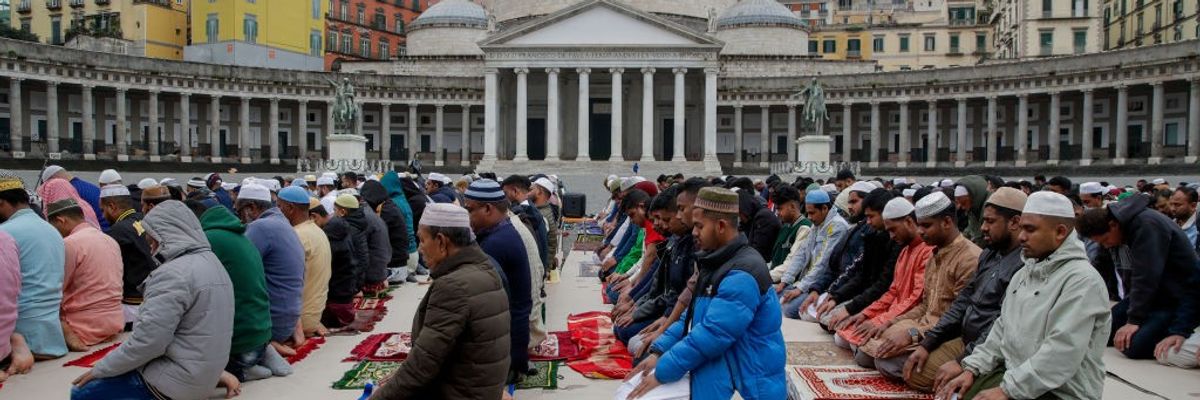
Muslims pray in Plebiscito Square in Naples on April 10, 2024. (Photo by Salvatore Laporta/KONTROLAB/LightRocket via Getty Images)

“What would the reaction would be if an Arab state wrote this about synagogues and Jews?” asked one critic.

Israel faced backlash this week after its Arabic-language account on the social media site X published a message warning Europeans to take action against the proliferation of mosques and “remove” Muslims from their countries.

“In the year 1980, there were only fewer than a hundred mosques in Europe. As for today, there are more than 20,000 mosques. This is the true face of colonization,” posted Israel, a settler-colonial state whose nearly 2 million Muslim citizens face widespread discrimination, and where Palestinians in the illegally occupied territories live under an apartheid regime.

“This is what is happening while Europe is oblivious and does not care about the danger,” the post continues. “And the danger does not lie in the existence of mosques in and of themselves, for freedom of worship is one of the basic human rights, and every person has the right to believe and worship his Lord.”

“The problem lies in the contents that are taught in some of these mosques, and they are not limited to piety and good deeds, but rather focus on encouraging escalating violence in the streets of Europe, and spreading hatred for the other and even for those who host them in their countries, and inciting against them instead of teaching love, harmony, and peace,” Israel added. “Europe must wake up and remove this fifth column.”

Referring to the far-right Alternative for Germany party, Berlin-based journalist James Jackson replied on X that “even the AfD don’t tweet, ‘Europe must wake up and remove this fifth column’ over a map of mosques.”

Other social media users called Israel’s post “racist” and “Islamophobic,” while some highlighted the stark contrast between the way Palestinians and Israelis treat Christian people and institutions.

Others noted that some of the map’s fearmongering figures misleadingly showing a large number of mosques indicate countries whose populations are predominantly or significantly Muslim.

“Russia has 8,000 mosques? Who would’ve known a country with millions of Muslim Central Asians and Caucasians would need so many!” said one X user.

Israel’s post came amid growing international outrage over its 691-day assault and siege on Gaza, which has left more than 230,000 Palestinians dead, maimed, or missing and hundreds of thousands more starving and facing ethnic cleansing as Operation Gideon’s Chariots 2—a campaign to conquer, occupy, and “cleanse” the strip—ramps up amid a growing engineered famine that has already killed hundreds of people.

Israel is facing an ongoing genocide case at the International Court of Justice, while Israeli Prime Minister Benjamin Netanyahu and Yoav Gallant, his former defense minister, are fugitives form the International Criminal Court, where they are wanted for alleged war crimes and crimes against humanity including murder and forced starvation.

European nations including Belgium, Ireland, and Spain are supporting the South Africa-led ICJ genocide case against Israel. Since October 2023, European countries including Belgium, France, Malta, Portugal, Slovenia, the United KingdomIreland, Norway, and Spain have either formally recognized Palestinian statehood or announced their intention to do so.

Original article by Brett Wilkins republished from Common Dreams under Creative Commons (CC BY-NC-ND 3.0). 

Continue ReadingIsraeli Government Social Media Urges Europe to ‘Remove’ Muslims

Trump’s Venezuela Drug War Gambit and the Militarization Playbook at Home

Spread the love

This article by Michelle Ellner republished from Common Dreams under Creative Commons (CC BY-NC-ND 3.0).

National Guard troops are deployed to the Washington Monument as part of US President Donald Trump’s mobilization of law enforcement on August 12, 2025 in Washington, DC. (Photo by Andrew Leyden/Getty Images)

Whether it’s a wall in the desert or barricades in front of the White House, the message is the same: Perceived threats, real or manufactured, are met with troops, not talks.

US President Donald Trump has quietly authorized the Pentagon to carry out military operations against what his administration calls “narco-terrorist” networks in Latin America. On paper, it’s a counter-narcotics policy. In practice, it serves as a green light for open-ended US military action abroad, bypassing congressional approval, sidestepping international law, and stretching the definition of “national security” until it becomes a catchall justification for the use of force.

The directive allows the US to target groups unilaterally labeled as both criminal and terrorist. Once that designation is made, the military can operate without the consent of the targeted country, a move that violates international law. In a region with a long history of US-backed coups, covert wars, and destabilization campaigns, the risk of abuse isn’t hypothetical; it’s inevitable.

While the order applies across Latin America, Venezuela stands at the top of the list. The Trump administration has accused President Nicolás Maduro’s government of working with transnational cartels, and has doubled the bounty on him to $50 million (double the bounty for Osama bin Laden). It’s a lawfare tactic designed to criminalize a head of state and invite mercenaries and covert operatives to participate in regime change. The accusations fueling this escalation have grown increasingly far-fetched casting Maduro in turn as a partner of Colombia’s FARC, the head of the “Cartel de los Soles,” a patron of Venezuela’s Tren de Aragua, and now, as an ally of Mexico’s Sinaloa Cartel. a charge even Mexico’s own president says has no evidence, revealing how politicized and unfounded this allegation is.

The core premise of the accusation is that Maduro is involved in a cocaine trafficking network of Venezuelan military and political figures called Cartel de los Soles. The Venezuelan government denies the cartel’s existence, calling it a fabrication to justify sanctions and regime change efforts. Multiple independent investigations have shown no hard evidence exists and that this narrative thrives in a media-intelligence echo chamber. Reports from outlets like Insight Crime cite anonymous US sources; those media stories are then cited by policymakers and think tanks, and the cycle repeats until speculation becomes policy.

The communities in Caracas and Los Angeles, in the Venezuelan plains, and in the US-Mexico border may seem worlds apart, but they are facing the same war machine.

Fulton Armstrong, a professor at American University and a former longtime US intelligence officer, has stated that he knows no one in the intelligence community, apart from those currently in government, who believes in the existence of the Cartel de los Soles.

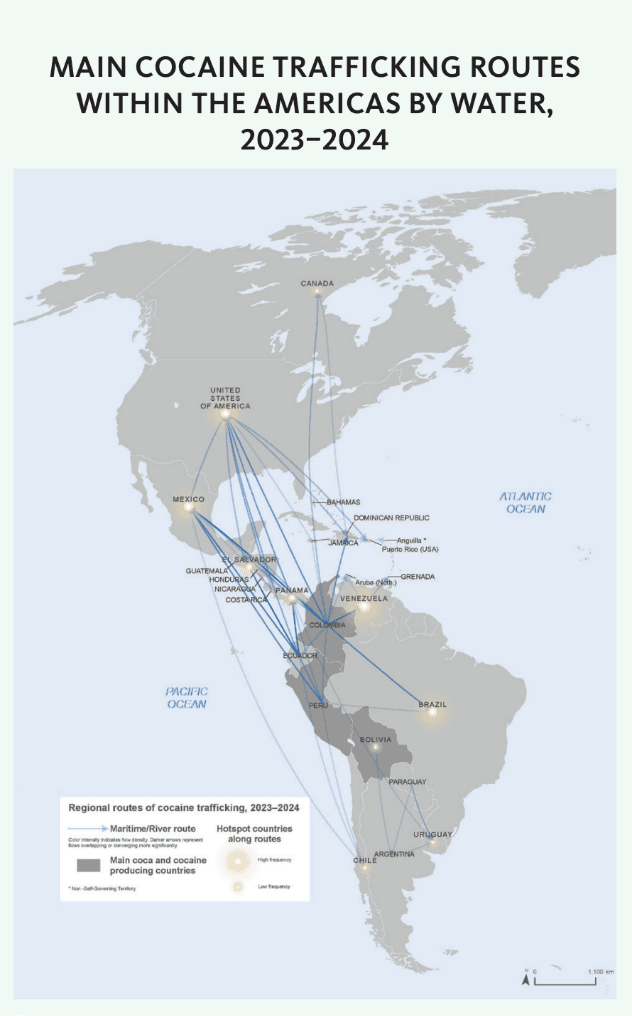
Drug monitoring data also contradict this narrative. The Washington Office on Latin America (WOLA) reports that only about 7% of US-bound cocaine transits through the Eastern Caribbean via Venezuela, while approximately 90% takes Western Caribbean and Eastern Pacific routes. The United Nations Office on Drugs and Crime’s 2025 World Drug Report likewise confirms that trafficking remains concentrated in major Andean corridors, not through Venezuela. Yet Venezuela is targeted anyway, not for its actual role in the drug trade, but because neutralizing its government has become a pillar of US foreign policy, seen in Washington as a step toward reshaping the country’s political system and prying open its economy to foreign control.

The “narco-terror” label put on Venezuela also attempts to rope Venezuela into the US fentanyl crisis, despite the absence of evidence that the country plays any role in fentanyl trafficking. Even US drug enforcement assessments make no mention of Venezuela as a source or transit point.

This link exists only in political rhetoric, a way to fold Venezuela into a domestic public health crisis and recycle the same logic used to brand it a “national security threat.” That accusation dates back to 2015 when then-President Barack Obama created the legal and political scaffolding for an open-ended campaign of coercion. Once the “narco-terror” framework is in place, Washington can sustain and escalate military measures over time, regardless of the immediate pretext.

This framing turns a political standoff into a declared security imperative. It broadens the range of permissible military tools, from ISR (intelligence, surveillance, reconnaissance) to direct action.

The pattern is familiar. In Panama (1989), Colombia (2000s), and Honduras (2010s), US militarized antidrug campaigns failed to dismantle supply chains or reduce trafficking volumes. What they did accomplish was shifting routes, militarizing criminal actors, and destabilizing governments, and left societies more fragile—costing lives and destroying communities in the process.

The Mirror at Home: Militarization and Communities of Color

The same militarized logic driving US policy in Venezuela is being applied inside the United States. In August 2025, President Trump signed an executive order placing the DC Metropolitan Police Department under federal control and deployed the National Guard, citing a public safety “emergency,” despite official data showing violent crime at multiyear lows. Even US law enforcement statistics contradict the White House narrative, but the administration dismissed them, casting the city as overrun by “roving mobs,” “wild youth,” and “drugged-out maniacs.”

DC is only one example. The same militarized logic has sent thousands of troops to the US-Mexico border, converted military bases into detention centers from Texas to New Jersey, and stationed soldiers inside Immigration and Customs Enforcement detention facilities in over 20 states. In Los Angeles, Marines and National Guard units patrolled immigrant neighborhoods in a show of force, a deployment beaten back only by mass community resistance and the threat of labor action.

Whether it’s a wall in the desert or barricades in front of the White House, the message is the same: Perceived threats, real or manufactured, are met with troops, not talks. The playbook never changes: In Venezuela, the “threat” is cast as narco-terrorism; in the US, it’s a “border surge” or a manufactured public safety emergency built on racially coded depictions of Black and brown communities. In both cases, the logic is identical: Treat political disputes and social crises as security emergencies, sideline diplomacy and community solutions, usurp greater executive powers, and make military force a routine tool of governance.

The Real Threat

Trump’s “narco-terror” authorization uses the language of fighting drugs and crime to mask a deeper project: expanding the military’s role in governance and normalizing its use as a tool of political control both at home and abroad.

In Latin America, that means more interventions against governments the US wants to topple. At home, it means embedding the military deeper into civilian life, particularly in Black and brown neighborhoods.

The communities in Caracas and Los Angeles, in the Venezuelan plains, and in the US-Mexico border may seem worlds apart, but they are facing the same war machine. Until we reject militarization in all its forms, the targets will keep shifting, but the people under the gun will look the same.

This article by Michelle Ellner republished from Common Dreams under Creative Commons (CC BY-NC-ND 3.0).

Continue ReadingTrump’s Venezuela Drug War Gambit and the Militarization Playbook at Home