This work by Middle East Monitor is licensed under a Creative Commons Attribution-NonCommercial-ShareAlike 4.0 International License.
Press vests lie on a table outside Nasser Medical Complex in Khan Younis, southern Gaza Strip. [Abdallah F.s. Alattar – Anadolu Agency]
Another Palestinian journalist was killed by Israeli army fire in Gaza, taking the death toll since October 2023 to 239, local authorities said on Tuesday, Anadolu reports.
Islam Al-Koumi, a journalist working with several media outlets, lost his life late Monday when Israeli fighter jets bombed his house in the Sabra neighborhood of Gaza City, local media said.
Gaza’s Government Media Office said the new fatality brought the number of Palestinian journalists killed in the Israeli war in Gaza since October 2023 to 239.
The office condemned “Israel’s systematic assassination of Palestinian reporters in Gaza” and called on human rights and media institutions to “condemn these systematic crimes against Gaza journalists.”
Israel has killed more than 62,000 Palestinians in Gaza since October 2023. The military campaign has devastated the enclave, which is facing famine.
Last November, the International Criminal Court issued arrest warrants for Israeli Prime Minister Benjamin Netanyahu and his former Defense Minister Yoav Gallant for war crimes and crimes against humanity in Gaza.
Israel also faces a genocide case at the International Court of Justice for its war on the enclave.
This work by Middle East Monitor is licensed under a Creative Commons Attribution-NonCommercial-ShareAlike 4.0 International License.
Keir Starmer objects to criticism of the IDF. He asks how could anyone object to them starving people to death, forced marches like the Nazis did, bombing Gaza’s hospitals and universities,mass-murdering journalists, healthworkers and starving people queuing for food, killing and raping prisoners and murdering children. He calls for people to stop obstructing his genocide for Israel.Genocide denier and Current UK Prime Minister Keir Starmer is quoted that he supports Zionism without qualification. He also confirms that UK air force support has been essential in Israel’s mass-murdering genocide. Includes URLs https://www.declassifieduk.org/keir-starmers-100-spy-flights-over-gaza-in-support-of-israel/ and https://youtu.be/O74hZCKKdpAUK Labour Party government ministers Keir Starmer, Angela Rayner and Rachel Reeves explain that they are partners complicit in Israel’s Gaza genocide. The UK has provided Israel with arms, military and air force support. They explain that they don’t do gas chambers but do do forced marches, starvation, destroy hospitals, mass-murders of journalists and healthcare workers.
Robert Jenrick pictured with Eddy Butler, former member of Nazi terror group Combat 18
Shadow justice secretary Robert Jenrick has attended a demonstration organised by a neo-Nazi party and posted a picture of himself with the founder of a terror organisation.
On Sunday evening, Jenrick attended a rally organised by members of the Homeland Party in Epping. The event was addressed by Callum Barker, a member neo-Nazi group Homeland who have a history of endorsing racism and terrorism.
Jenrick later posted pictures of himself with demonstrators, which included Eddy Butler, one of the founders of neo-Nazi terror gang Combat 18. The numerals in Combat 18 refer to the first and eighth letters of the alphabet, referencing the name of Adolf Hitler.
After the demonstration, Butler posted a picture of himself standing directly behind Jenrick with the text, “At the Bell Hotel riding shotgun for Robert Jenrick.”
…
Legitimising fascist violence
Jenrick’s attendance at the demonstration legitimises a growing fascist movement that is targeting refugees across the South East and around the country.
Many participants in Sunday’s Epping demonstration had been at a protest earlier in the day in Canary Wharf, where men in balaclavas clashed with police outside asylum-seeker accommodation at the Britannia Hotel.
Original article by Carmen Navas Reyes republished from peoples dispatch under a Creative Commons Attribution-ShareAlike 4.0 (CC BY-SA) license.
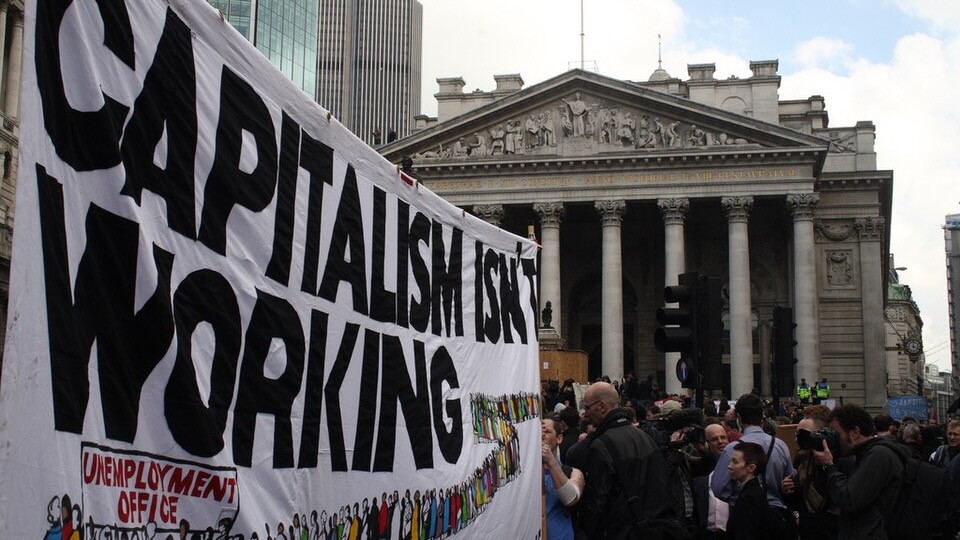
Protesta por la crisis del G20 en Londres en abril de 2009. Foto: Wiki commons
Between capitalism in decline, expressed in wars and neo-fascism, and the left calling for reconstruction, people resist.
The famous quote by Italian Marxist philosopher Antonio Gramsci seems to have been written for the moment humanity is currently experiencing: “The old is dying, and the new cannot be born. In this interregnum, monsters arise.”
The world is going through a civilizational crisis in which the neoliberal capitalist order, although mortally wounded, continues to impose its predatory logic, that of the use of force and the resurgence of fascism, while emancipatory alternatives fail to consolidate. In this vacuum, monsters proliferate: wars and attempts at recolonization, climate crisis, structural hunger, collapse of multilateralism and international law placed at the service of the world’s powers that be.
Capitalism and its “terminal crisis”
According to Brazilian theologian Leonardo Boff, the globalized capitalist system has been showing terminal signs for more than a decade: the obscene concentration of wealth, parasitic financialization, planetary catastrophes, and the precariousness of life have led to this crisis, but it has not been strong enough to finally bury this system. Western imperialism – today embodied in NATO and its imposition of increased war budgets on member countries, in the US economic war, especially against China, and in the European Union’s sanctions against Russia – can no longer flaunt itself as before, but it refuses to die. Its decline is evident in global inflation, the return of Cold War geopolitics, and the rise of neo-fascisms as fictitious “solutions” to inequality.
Is the left also in crisis?
While capitalism seems to be moving towards its decomposition, the left is unable to articulate a hegemonic project. Progressive experiences in Latin America face economic siege, blockades, unilateral coercive measures and judicialization, divisions and popular demobilization; European social democracy is surrendering to neoliberalism and anti-capitalist alternatives still lack global strength. Fragmentation and what appears to be a lack of strategies in the face of new forms of domination (such as the digital divide, corporatist government, and the rule ofBig Tech) weaken the possibility of the emergence of a new order.
Wars and neocolonialism: Ukraine, Palestine, Sudan, the Sahel, conflicts where resources are plundered under the rhetoric of “defending democracy” or simply betting on chaos and the disappearance of states.
Environmental catastrophe: Capitalism has turned nature into a “commodity,” and now the planet is suffering countless fires, floods, and desertification.
The failure of international law:The International Criminal Court prosecutes Africans but ignores the crimes of Israel and the US, while the Security Council has become a veto club. Furthermore, reform of the United Nations has become a key issue for the Global South, as seen at the last BRICS meeting in Rio de Janeiro, Brazil.
Criminalization of migrants: In the first six months of his second term, President Donald Trump has launched a strong public campaign against the presence of migrants, especially Latin Americans, in the United States. This campaign has also been the basis for an aggressive anti-immigration policy that ranges from the revocation of programs such as Humanitarian Parole, the cancellation of Temporary Protected Status (TPS), mass deportations, family separation, and the removal of infants from their parents, to the establishment of a highly sophisticated international prison system that violates human rights.
However, this policy is not exclusive, nor was it initiated by the Trump administration, as noted in the testimony of Gladys Caricote, one of the Venezuelan women deported from the United States to Venezuela. In her testimony, she details the discriminatory policy of US governments after being held in an immigration detention center (ICE) for more than 10 months, which means that it was under the administration of Joe Biden, the 46th President of the United States (Democratic Party, 2021-2025), when this restrictive policy towards migrants from Venezuela was tightened.
Is there a way out?
What is needed to build alternatives? How can the Global South help? Is there any point in creating new forms of democracy, popular organization, and class internationalism?
The BRICS summit held in Rio de Janeiro, Brazil, on July 6 and 7 was a key event, as it represented a counterweight to the Western-dominated economic and political order, Similarly, its progressive expansion (in 2023-2024, the BRICS accepted new members such as Egypt, Ethiopia, Iran, Saudi Arabia, and the United Arab Emirates), despite differing criteria among member countries on this issue, has meant greater representation for the Global South, even if it is not without tensions, such as Brazil’s opposition to Venezuela’s entry.
This summit, which issued a 126-point declaration, was quickly responded to by President Donald Trump, who described the proposal to de-dollarize the group’s economic transactions, promoting payments in local currencies and mechanisms such as the New Development Bank (NDB), as a threat to the United States and threatened to increase tariffs on countries that support this action.
Another important event, highlighted in the final declaration of this meeting, was the session of the Civil Council, which the movements present in Brazil have called the “BRICS People’s Council,” promoted at last year’s meeting in Kazan, Russia, as a Civil Forum, even though it is not institutionalized in any instance of the political bloc. However, the potential of this Council, not only for the BRICS countries themselves, but also for our countries in the South, is summed up in the reading of the Council’s consensus statement by João Pedro Stedile, of the National Coordination of the Landless Rural Workers’ Movement (MST) and the Political Coordination of ALBA Movements, who summarized that “the formal participation of the People’s Council is historic because it consolidates a method. Everyone agrees that the problems facing the peoples will not be solved by government initiatives alone.” However, everyone seems to be clear that it will not be an easy process, given that the rotating presidencies of the group determine the approaches.
Next year, the presidency will go to India, which may have a different view of the role of popular organizations in BRICS, but the important thing is that it is already a decision of the popular organizations to accompany this geopolitical instance as an alternative to the crises already raised, this being another way in which popular movements and organizations are standing up to the monsters that have emerged at this stage, as they have also done with mass actions against the attacks on Iran, Israel’s extreme violence in Gaza and throughout Palestine, the kidnapping of migrants, in defense of the sovereignty of the Sahel countries, etc.
Palestinians gather in the ruins of Gaza City in the hopes of obtaining humanitarian aid packages dropped from planes | Mahmoud Abu Hamda/Anadolu via Getty Images
It’s clear that Netanyahu’s ‘messianic fantasy’ is full control of the territory. Staying silent is complicity
As its appalling onslaught in Gaza and treatment of Palestinians in the West Bank are broadcast around the world, Israel is increasingly encountering international opprobrium. Yet Binyamin Netanyahu’s position is still not under threat from the country’s domestic opposition, whose criticism of his government scarcely stretches to the war.
While that may be starting to change, the Israeli prime minister’s rule will likely persist as long as he can rely on the support of Donald Trump, which shows no sign of abating. In any case, he could probably rectify any significant shift in domestic attitudes by engineering another crisis with Iran.
Why support for the war persists in Israel needs to be understood, and it is worth recalling that before the Hamas attack nearly two years ago, Israeli Jews thought that they were at last achieving a measure of lasting security.
At the time, the occupied West Bank has seen a steady increase in the number and size of Jewish settlements, along with all the strategic roads, checkpoints and patrols that went with them. That helped to ensure Israel could more effectively control the whole area, which was already enclosed by the heavily guarded border with Jordan and the separation barrier with Israel.
More widely, Israel had overwhelming air superiority in the region, which enabled it to project power in Lebanon, Syria, Iraq and elsewhere. It was far from complete, given the presence of Hezbollah in Lebanon and the theocratic regime in Iran, but Israel’s ever-present connection with the United States offered further protection.
Perhaps the most reassuring element was how Gaza had been subdued after the shock of the 2006 Hamas election victory over Fatah, a secular nationalist party that had previously had a majority on the Palestinian Legislative Council.
That election had been held across all the Palestinian territories and was followed by violent Israeli and international opposition to the onset of Hamas rule, as well as conflict between Fatah and Hamas. Within months, Fatah had regained control of the West Bank, while Hamas ran Gaza, which almost immediately became subject to a near siege by Israel.
The first of the four, in 2008, was a 22-day Israeli military offensive that killed around 1,400 Palestinians and 13 Israelis. This was followed by the Israeli Defence Forces (IDF) assassinating Hamas’s military chief of staff, Ahmed Jabari, and conducting eight days of air raids in 2012.
Then, mid-2014 saw a seven-week IDF offensive after Hamas kidnapped and killed three Israeli teenagers. That bitter air and ground offensive led to the deaths of more than 2,100 Palestinians and 73 Israelis. Israeli losses were mostly IDF ground troops, which is one reason why many senior Israeli soldiers are now reluctant to put troops into Gaza City.
More recently, in May 2021, the IDF killed 260 Palestinians in Gaza, and 13 Israelis died in rocket fire from Gaza. Thirty more Palestinians were killed in further attacks in 2022.
Amid these short but intense wars, many Israelis became used to brief bursts of warfare, which were often seen as a necessary means to control Palestinians. Israeli military personnel even referred to such violence as “mowing the grass”, according to foreign correspondent and author Phoebe Greenwood, whose vivid insights into reporting on the years of war do much to explain the lack of balance in the mainstream media when it comes to Israel and Palestine.
In total, in the 15 years leading up to 2023, in the wake of the first and second Intifadas (Palestinian uprisings) and the control of Gaza, Israeli military operations killed close to 5,000 Palestinians and wounded thousands more. That this was well over three times the Israeli death toll on 7 October counted for little among the great majority of Israeli Jews, enabling the Netanyahu coalition to go to war with those Palestinian “human animals” to destroy Hamas once and for all.
Within weeks, it became clear that Hamas would not easily be defeated. From very early on in the war, the IDF was pursuing the Dahiya Doctrine of punishing the civilian population to undermine support for Hamas. That is failing to the extent that while Hamas has lost thousands of its paramilitaries, there are many thousands more ready to take their place.
As a result, Israel is using increasingly extreme measures, including killing medics and paramedics, destroying hospitals and medical centres, and starving people by cutting off food supplies.
At the same time, the Netanyahu government is conducting an international propaganda exercise, especially in the UK and Germany – two of the states where support is most urgently needed.
In an interview with LBC journalist Iain Dale last year, Hotovely suggested that “every school, every mosque, every second house” in Gaza had access to underground tunnels and that this justified Israel’s bombardment.
“But that’s an argument for destroying the whole of Gaza, every single building there,” said LBC presenter Iain Dale. “Do you have another solution?” she responded.
That response starkly supports Nimer Sultany’s assessment of the situation in an article in The Guardian this week. Sultany, a Palestinian citizen of Israel who is a reader in public law at SOAS University of London, wrote: “Israel is pursuing the messianic fantasy and the criminal enterprise of a ‘Greater Israel’, with the goal of ‘maximum land, and minimum Arabs.’”
Ambassador Hotovely’s views certainly support Sultany’s argument, as does the announcement this week that Israel’s security cabinet has approved a plan to take full control of Gaza City. From there, it seems likely that the rest of the Gaza Strip would be next, followed by the West Bank.
Sultany is right to call this aim a “messianic fantasy”. Western political leaders must recognise it as such and radically change their policies on selling arms and sharing intelligence with the IDF, as well as introducing sanctions on trade with Israel. Given the UK’s long-term relationship with Israel, and its close military and security links with the IDF (which exceed those of any other nation bar the US), Keir Starmer should take the lead in this.
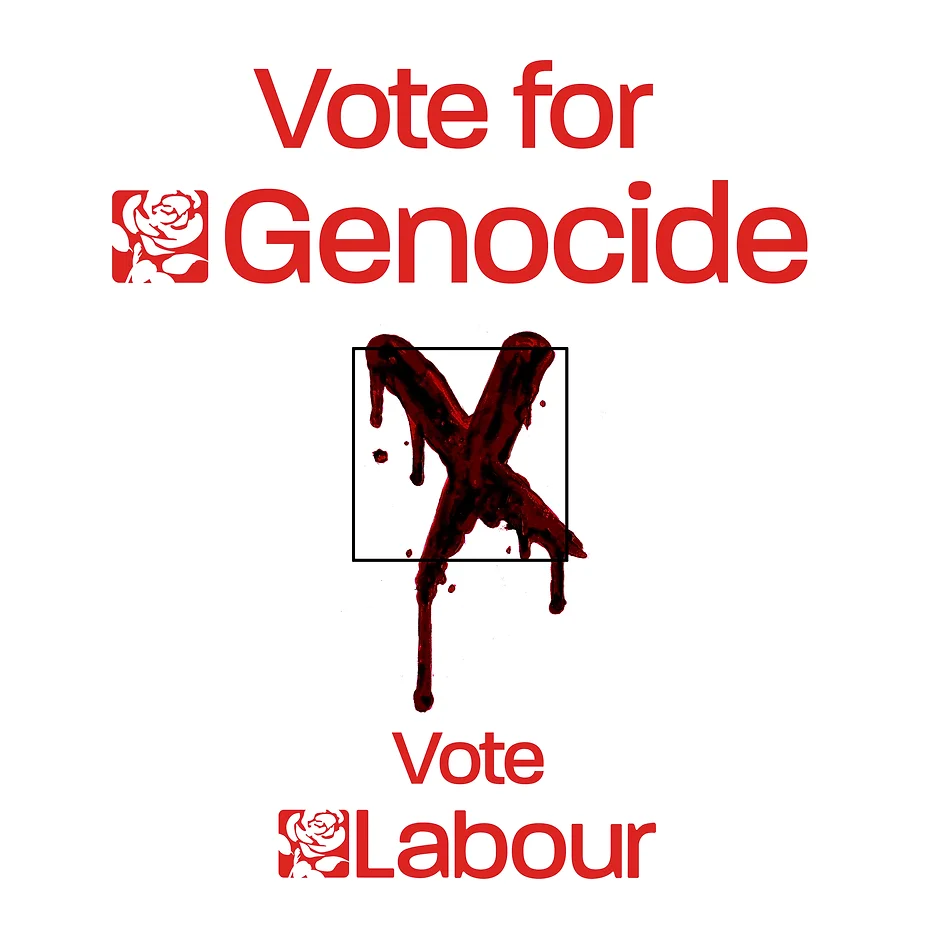
Keir Starmer objects to criticism of the IDF. He asks how could anyone object to them starving people to death, forced marches like the Nazis did, bombing Gaza’s hospitals and universities,mass-murdering journalists, healthworkers and starving people queuing for food, killing and raping prisoners and murdering children. He calls for people to stop obstructing his genocide for Israel.UK Labour Party government ministers Keir Starmer, Angela Rayner and Rachel Reeves explain that they are partners complicit in Israel’s Gaza genocide. The UK has provided Israel with arms, military and air force support. They explain that they don’t do gas chambers but do do forced marches, starvation, destroy hospitals, mass-murders of journalists and healthcare workers.Vote Labour for Genocide.