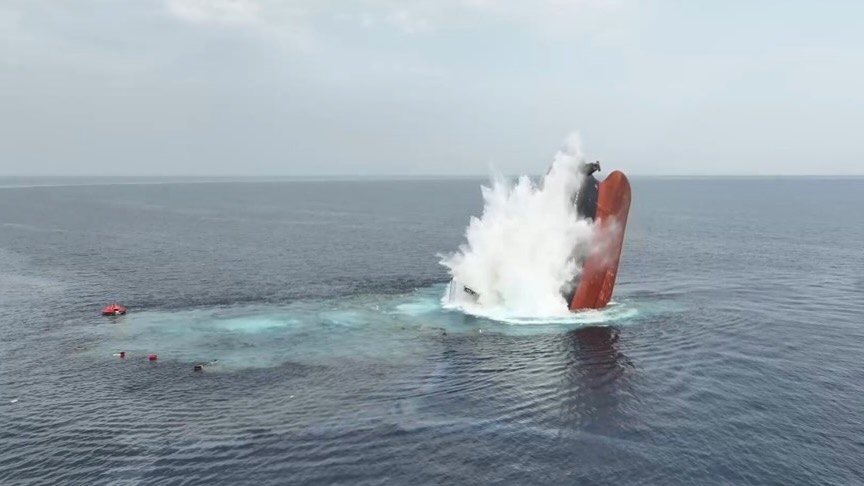
Liberia-flagged bulk carrier Eternity C sinking after it was attacked by Ansar Allah at sea. Photo: Ansar Allah Media Center
The two strategic operations are part of an escalation by the Yemeni resistance group against the Israeli occupation, in response to its continued genocide in Gaza.
The Ansar Allah-led Yemeni armed forces escalated their operations in the Red Sea last week against merchant vessels that violated the movement’s previously declared naval blockade by docking in the ports of occupied Palestine.
“Magic Seas”
The Yemeni Armed Forces’ spokesperson, Brigadier General Yahya Saree, announced in a televised speech on Monday, July 7, that Liberian-flagged Greek-operated cargo ship “Magic Seas” was struck, one day earlier, by two unmanned boats, five ballistic and cruise missiles, and three drones.
Saree added that the attack sank the ship, but the Yemeni Forces allowed its crew to safely evacuate.
“Eternity C”
On Wednesday, July 9, Ansar Allah released a video of an attack launched Monday on Liberian-flagged bulk carrier “Eternity C”, as it made its way to the occupied Palestinian city of Umm al-Rashrash (also known as Eilat).
Repeated warnings and calls by Ansar Allah’s naval forces for the crew to evacuate the vessel prior to the attack were heard at the beginning of the video. However, the ship continued sailing towards the port, ignoring the instructions.
Saree confirmed that “Eternity C” completely sank after it was targeted with an unmanned surface vehicle, and six cruise and ballistic missiles. He also pointed out that a special unit from the Yemeni naval forces moved to rescue several members of the vessel crew, who were provided with medical care and transported to a safe location.
According to media reports, the crew consisted of 25 members, four of whom were killed in the attack, 10 were saved after a 48-hour rescue operation, while 11 are still missing, including six who are believed to be taken by Ansar Allah to an unknown location.
Ansar Allah hits Ben Gurion Airport and vows to continue maritime blockade until Israel ends Gaza genocide
The recent escalation of Ansar Allah’s attacks has not been limited to the ban on Israel’s maritime navigation. Yemeni missiles have continued to target strategic sites in the depth of the territories occupied by Israel.
On Thursday, July 10, the Yemeni Armed Forces carried out a strike on the Israeli occupation’s Lod Airport (known as Ben Gurion) using a Zolfiqa precision ballistic missile.
Ansar Allah confirmed the success of the operation in a statement, noting that it resulted in halting air traffic, and driving millions of panicked Israeli settlers into shelters after air raid sirens sounded in over 300 towns and cities occupied by Israel.
The Yemeni resistance movement vowed to expand their operations by targeting more military and strategic Israeli sites inside occupied Palestine, while persisting with a maritime blockade on Israeli ports, until “the crimes of the Zionist entity in Gaza are brought to an end.”
Last week, hundreds of scientists, policymakers and journalists flocked to the University of Exeter to attend an international conference on “tipping points”.
Attendees also explored “positive tipping points” – large-scale, self-propelling social changes that would reduce the impact of humans on the climate.
(For more on the key talking points, new research and ideas that emerged from the four-day event, see Carbon Brief’s full write-up of the event.)
On the sidelines of the conference, Carbon Brief asked a wide range of delegates which tipping point concerns them the most.
These are their responses, first as sample quotes, then, below, in full:
Prof Gabi Hegerl: “I am particularly worried about tipping points that involve the biosphere and humans due to breaching thresholds for heat or drought that then ripple into food availability, livelihood and ecosystems.”
Prof Carlos Nobre: “The Amazon is a very serious tipping point, because [dieback] could release around 250bn tonnes of CO2 by 2100 – which will make it impossible to [limit global warming] at 1.5C.”
Gaia Vince: “I would say that we have already passed the tipping point for coral reef ecosystems…As a scuba diver, I find it a tragedy because I love coral reef ecosystems, but it’s also a tragedy for human systems.”
Dr Andrew Hartley: “The tipping point I’m most concerned about is Amazon forest dieback…because of the significance of the carbon cycle and the feedback to the global climate. Also [due to] the effects that Amazon tipping has on food security, both locally and globally.”
Prof Tim Lenton: “The Atlantic Meridional Overturning Circulation, or AMOC, for sure. The consequences of crashing that would be devastating globally – and also for where I live in the UK.”
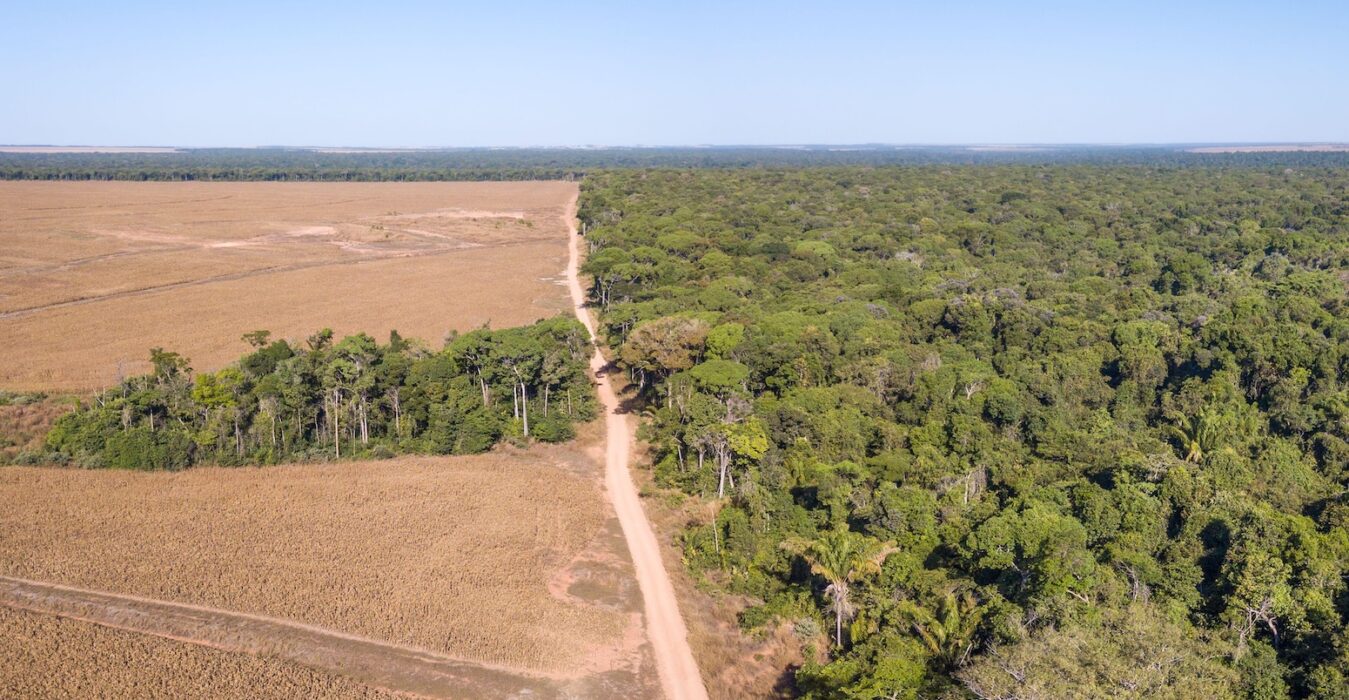
Prof Peter Cox: “The one that I’ve worked on most and worries me most at the moment is Amazon dieback. And that’s because we’ve got two things, two stressors, going on at once that push it in the wrong direction. Climate change is one, deforestation is another.”
Prof Johan Rockström: “The tipping element that worries me most is coral reef systems, for the simple reason that the scientific uncertainty range is very limited.”
Dr Patricia Pinho: “For me, it is the Amazon…I think it’s going to be a really profound, irreversible change that will affect the global population in the most dramatic way.”
Prof Ricarda Winkelmann: “I’m mostly concerned about the Greenland and West Antarctic ice sheets. This is because we know that, even at lower warming levels, they are already at risk of transgressing tipping points in certain regions.”
Dr Nico Wunderling: “The tipping element that worries me most is the Amazon rainforest. This is because the Amazon rainforest is not only threatened by climate change, but also by deforestation at the same time.”
Dr Rebecca Shaw: “The coral reef tipping point…It signals the end of the most colourful and biodiverse ecosystem which supports the nutrition and livelihoods of over one billion people.”
Dr David Obura: “The ice [tipping elements] – because they are the first ones to go that have cascading impacts on other tipping elements.”
Dr David Armstrong McKay: “The Amazon is actually probably closer to a deforestation-induced tipping point than to a climate change-induced tipping point. So, I actually think that could be potentially in the offing sooner than we would like.”
Kate Raworth: “The tipping point that I fear we will fail to cross is [the social tipping point] around transforming our mindsets.”
Prof Gabi Hegerl Chair in climate system science in the school of geosciences at the University of Edinburgh
I am worried about all of them, but for the immediate future, I am particularly worried about tipping points that involve the biosphere and humans due to breaching thresholds for heat or drought that then ripple into food availability, livelihood and ecosystems. The Earth system tipping points will do that too, but maybe a little bit later. Examples [of this] are the coral diebacks triggered by marine heatwaves, forest change and fires, and droughts threatening livelihoods and putting people on the move.
I did a research project on the US Dust Bowl and the trigger [for that event] was drought causing vegetation and crop dieback, [which led to] extreme heat and dust storms in response – and migration, as memorialised in [the 1939 John Steinbeck novel] The Grapes of Wrath. And, now with warming, all droughts get supercharged.
Prof Carlos Nobre Scientist and meteorologist who spearheaded the multi-disciplinary, multinational large-scale biosphere-atmosphere experiment in Amazonia
The Amazon is a very serious tipping point, because [dieback] could release around 250bn tonnes of CO2 by 2100 – which will make it impossible to [limit global warming] at 1.5C. We could also lose the largest [host to] biodiversity on the planet, which would induce a tremendous, large number of epidemics and several pandemics. Also, of course, the Amazon forest controls aspects of the global climate. In South America, the climate is entirely controlled by the Amazon forest.
I’m most worried about Amazon [dieback] because I have worked on it for 40 years. But the other tipping points deeply concern me. The melting of the permafrost will release more than 200bn tonnes [of greenhouse gases], mostly methane. Ice sheet melt in Greenland is a very serious tipping point because it could raise sea level rise by three metres in 200 years. The melting of Greenland has already started. Species extinction is also very serious.
One thing that was not much talked about [at this conference] is that when the ocean heats up, particularly the Arctic Ocean, then a tremendous amount of methane is released. And if that happens – if the Arctic Ocean warms up by 3-4C – the amount of methane that would be released could see [air] temperatures reach 8-10C [above pre-industrial levels]. At 8-10C, the only inhabitable places for us humans will be the top of the Alps, the Andes and the north and south poles. The rest of the planet would be uninhabitable.
I would say that we have already passed the tipping point for coral reef ecosystems, for example. That really is a tragedy. As a scuba diver, I find it a tragedy because I love coral reef ecosystems, but it’s also a tragedy for human systems. They are the nursery for our fisheries. And, of course, they’re not just fisheries – they are a valid ecosystem and a biodiversity hotspot. This will have untold consequences and cascading impacts for other parts of the ecosystem, for example, the cycling of nutrients and coral reefs are really important to stop coastal erosion. And they actually provide sand, the lovely white sand that people go on holiday for.
Dr Andrew Hartley Climate impacts scientist at the Met Office Hadley Centre
The tipping point I’m most concerned about is Amazon forest dieback and reduction in the function of the Amazon forest, because of the significance of the carbon cycle and the feedback to the global climate. Also [due to] the effects that Amazon tipping has on food security, both locally and globally, because of [the Amazon’s] contribution to major commodity markets, such as soybean and maize.
This might interact with climate change in the future to lead to more severe events, particularly in populated areas of Brazil. If an Amazon tipping point were to occur, it might lead to more severe events on the coast of Brazil which would affect a much larger population. There are negative impacts across the forest from the drying of the forest, for example for the Indigenous communities, but also globally.
Prof Tim Lenton Founding director of the Global Systems Institute and chair in climate change and Earth system science at the University of Exeter
The Atlantic Meridional Overtoning Circulation, or AMOC, for sure. The consequences of crashing that would be devastating globally – and also for where I live in the UK. By our own calculation, we could have less than half the viable area for growing a couple of major staple crops, wheat and maize worldwide. We would have a widespread water crisis. We could have collapses of the monsoons in West Africa and India that would displace hundreds of millions of people. It is hard to see that as anything other than a catastrophe.
Prof Peter Cox Professor of climate system dynamics in mathematics and director of the Global Systems Institute at the University of Exeter
The one that I have worked on most and worries me most at the moment is Amazon dieback. And that’s because we’ve got two things, two stressors going on at once that push it in the wrong direction. Climate change is one, deforestation is another. You can imagine crossing the boundary in various ways – but, if you push diagonally, you get there quicker.
If I had spoken to you 25 years ago, I would have said I’m really worried about [Amazon dieback]. Then I went through a phase of thinking that the models have overdone it. And now I’m thinking the models that don’t include land-use change are underdoing it. So, I’m more concerned about that one.
There are others as well, but that is the one that is also quite fast. The other [tipping points] we worry about, we’re worried about a long-term commitment. It takes a while for the AMOC to shut down, it really does. It takes a while for the Greenland ice sheet to melt. We’ve done work that suggests you can overshoot even a little bit for these slow systems. The Amazon forest is a decadal dieback, especially if it is fire driven.
Prof Johan Rockström Director of the Potsdam Institute for Climate Impact Research (PIK) and professor in Earth system science at the University of Potsdam
There is not a simple answer to this – there is a two-part answer.
The tipping element that worries me most is coral reef systems, for the simple reason that the scientific uncertainty range is very limited. We have, unfortunately, ample evidence that at 1.5C we’re very likely to knock over, potentially, the entire tropical coral reef system on Earth. [This threatens] the livelihoods of 400 million people and a fundamental nursing ground for the whole ocean food web. So that is one deep concern. It is the canary in the coal mine – the first kid on the block to fall over. We’re so close.
The second one is AMOC – the whole overturning of heat in the Atlantic, which connects the entire ocean system. Not only is the latest science showing that we are going from low likelihood to uncomfortably high likelihood, but we also know – with very little uncertainty – that this would cause a catastrophic impact across the entire world, and it would go fast. So the AMOC, I would argue, is today the most important scientific message to the world. If you want a really hard-hitting reason to act at a level of planetary emergency, it is the AMOC. That is the second one.
From a planetary boundary perspective, it is important to recognise that – on climate science grounds – the Amazon basin is not at risk of tipping until 3-5C of warming. But as soon as you factor in loss of biodiversity, deforestation and changes in hydrology – then the temperature risk goes down to between 1.5-2C. So suddenly – when taking a more integrated [assessment] approach – the conclusion is that it is also very close to a tipping point.
Dr Patricia Pinho Deputy science director at the Amazon Environmental Research Institute (IPAM)
For me, it is the Amazon. When we think of the planetary crisis, we think about the Amazon and all the regulating climate services it provides. This is not only regionally, but we know it’s a global “climate good”, if you will. But it is highly sensitive to land-use change and increasing temperature. So, if we transition to a point of no return – Amazon dieback – and transforming or transitioning to another ecosystem, the function of the forest will not be doing what it has been doing for the past millennium and so on. And then we cannot revert this loss. I think it is going to be a really profound, irreversible change that will affect the global population in the most dramatic way.
Of course, we have the people on the front line that I’m working with – Indigenous people, traditional population – that are safeguarding this resource, but they are also at the front line of climate risks and the impacts that we already observe. If we miss this opportunity of really reverting from increasing greenhouse emissions and increasing temperature, we’re going to miss the window of opportunity to really protect the region, protect the ecosystem and the forest for the global society.
Prof Ricarda Winkelmann Founding director of the Max Planck Institute of Geoanthropology and professor of climate system analysis at PIK and the University of Potsdam
So I am thinking about this from a risk perspective – so both the likelihood as well as the impacts – and I think the answer depends on that. Because when it comes to the likelihood and the particular threshold – and we know about those – I’m mostly concerned about the Greenland and the West Antarctic ice sheets. This is because we know that, even at lower warming levels, they’re already at risk of transgressing tipping points in certain regions.
But when it comes to the impacts and also the timescales over which those play out, there are other tipping elements that worry me most. In particular, regional tipping elements. So if we think of the mountain glaciers, for instance, these impacts are already experienced right now and several mountain glaciers are undergoing these accelerated changes. And so thinking about the timescales when it comes to the impacts is also incredibly important.
Dr Nico Wunderling Junior professor at the Center for Critical Computational Studies at Goethe University Frankfurt and researcher at the Potsdam Institute for Climate Impact Research.
The tipping element that worries me most is the Amazon rainforest. This is because the Amazon rainforest is not only threatened by climate change, but also by deforestation at the same time. So that means that the critical threshold from climate change alone, at around 3-4C of global warming, can come down to 1.5-2C. Climate change and deforestation basically go hand-in-hand to lower the [Amazon’s tipping] threshold because of this double threat.
Dr Rebecca Shaw Chief scientist and senior vice-president at WWF
The coral reef tipping point – it comes first because of warming surface waters, and then the outcome is sealed by ocean acidification. It signals the end of the most colourful and biodiverse ecosystem which supports the nutrition and livelihoods of over one billion people and has captured the imagination of more people than any other through the characters like Nemo the clownfish, SpongeBob SquarePants, and, of course, Frank the coral [a character from an educational YouTube video].
If humanity is not motivated to act in the face of the loss of coral reefs, is there hope that we will act in time to prevent the Amazon and glacier tipping points?
Dr David Obura Chair of the Intergovernmental Science-Policy Platform on Biodiversity and Ecosystem Services and founding director of CORDIO East Africa
The ice [tipping elements] – because they are the first ones to go that have cascading impacts on other tipping elements. When [ice masses] reduce, we lose their albedo, waters heat up more [and] the AMOC can collapse. That has the biggest impact across the planetary system, including the Amazon.
My own [research], of course, is coral reefs. So, in a way, the coral reef tipping point does concern me the most. [But] it doesn’t have cascading impacts on other tipping elements. It does on people, in socioeconomic terms – but not on other system elements. So, in a sense, it is the least worrying one.
Dr David Armstrong McKay Lecturer in geography, climate change and society in the school of global studies at the University of Sussex and lead author on an influential tipping points assessment, published in Science in 2022
One of the tipping systems that concerns me the most is Amazon rainforest dieback. Because even though we assessed it a few years ago as having a warming threshold that’s a bit higher than what we might be seeing – we’ve thought it is maybe at a best estimate of 3.5C – there’s also deforestation as well. The Amazon is actually probably closer to a deforestation-induced tipping point than to a climate change-induced tipping point. So I actually think that could be potentially in the offing sooner than we would like. That would have huge impacts for biodiversity, for South America as a whole, by shifting rainfall patterns, which would really affect a lot of people for agriculture or ecosystems. Also, the Amazon as an ecosystem is so incredibly biodiverse and amazing in itself, it would be a tragedy to lose it.
Kate Raworth Senior visiting research associate and lecturer at the University of Oxford’s Environmental Change Institute and co-founder and conceptual lead of Doughnut Economics Action Lab
The tipping point that I fear we will fail to cross is [the social tipping point] around transforming our mindsets. We need to move from the extractive, degenerative economy towards a regenerative one. This all starts within our head and it underlies everything.
[A failure to do this] is what is driving us towards all these [Earth system tipping points].
Donald Trump urges you to be a Climate Science denier like him. He says that he makes millions and millions for destroying the planet, Burn, Baby, Burn and Flood, Baby, Flood.Orcas discuss how Trump was re-elected and him being an insane, xenophobic Fascist.Nigel Farage urges you to ignore facts and reality and be a climate science denier like him. He says that Reform UK has received millions and millions from the fossil fuel industry to promote climate denial and destroy the planet.
Health Secretary Wes Streeting speaking at the launch of the Government’s 10-year health plan during a visit to the Sir Ludwig Guttman Health & Wellbeing Centre in east London, July 3, 2025
US General Stanley McChrystal has been invited to advise on creating a ‘team of teams’ for healthcare transformation. His credentials? He previously ran interrogation bases where Iraqis were stripped naked and beaten, reports SOLOMON HUGHES
HEALTH SECRETARY Wes Streeting adopted Labour’s “warfare over welfare” approach by inviting US General Stan McChrystal, a key player in the disastrous Iraq and Afghanistan wars, to give advice on NHS “reform.”
Papers I recently obtained under Freedom of Information show Streeting sought out McChrystal for the meeting, which took place last November. Streeting’s office wrote to the Ministry of Defence saying he “would like a contact for General Stanley McChrystal as he’d be interested in hearing more about his experience in mobilising change” to “inform” his “10 Year Plan for Health.” With Ministry of Defence help, Streeting invited McChrystal to London.
…
McChrystal led JSOC from 2003–8, battling the al-Qaida insurgency in Iraq, which followed the British-US invasion. McChrystal is credited with success through the 2006 killing of al-Qaida’s Iraqi leader, Abu Musab al-Zarqawi. However, defeating al-Qaida only led to the rise of the more vicious group Isis.
Human Rights Watch and the Washington Post detailed abuses by troops under McChrystal’s command in Iraq in this conflict. JSOC ran an interrogation base, Camp Nama, where Human Rights Watch says detainees were “beaten” and “regularly stripped naked, subjected to sleep deprivation and extreme cold, placed in painful stress positions.” Maybe Streeting thinks McChrystal being in charge of physical abuses gives him some kind of medical knowledge.
It’s certainly hard to see how Streeting can believe McChrystal is somehow a model for good and lasting change. McChrystal’s Afghanistan success was also short-lived: the Taliban is back in charge of Kabul.
Deputy Labour Party Leader Angela Rayner calls for police to kill and harass innocent people.
These comments by Angela Rayner identify an individual by his location. They mirror the murder of Jean Charles de Menezes who was killed because of his name to identify an individual by his location. To be clear I am saying that Jean Charles de Menezes name identifies identified a person by his location and that is why JCd was murdered. These comments by Angela Rayner use a traditional reference while the murder of Jean Charles de Menezes and the 7/7 fake-manufactured terrorism exercise used an alternative reference.
Rayner’s comments are clearly designed to be compared to the murder of Jean Charles de Menezes and by making them for the same purpose she is implicitly supporting his murder.
The BBC and OBR claim that failing to cut disability benefits could ‘destabilise the economy’ while ignoring the spendthrift approach to tens of billions on military spending that really spirals out of control, argues DIANE ABBOTT MP
THE Labour leadership is adopting a scorched-earth policy to social programmes and public spending, with no section of society safe from their cuts. The consequences will be very grave for some of the poorest in society, for society as a whole and for the Labour Party.
In the first year of a Labour government, we have had cuts to the winter fuel allowance, a refusal to budge on the two-child benefit cap, cuts to sickness and disability benefits, and a tightening of departmental spending overall, which means cuts for some and a squeeze for the NHS.
This list is growing longer all the time. The latest target is the provision of special educational needs (SEN) spending in our schools, which ministers claim is spiralling out of control. There is also the beginning of a concerted PR campaign to abolish the “triple-lock” on the state pension, even though the meagre amount provided is one of the lowest in western Europe and insufficient for a decent retirement.
The main exception to this all-round austerity drive is military spending, which is really spiralling out of control. In fact, the pace of spending cuts elsewhere is designed to fill the real hole in government finances caused by the commitment to raise military spending to 5 per cent of GDP, a promise given to placate Donald Trump by Keir Starmer at the Nato summit.
Keir Starmer confirms that he’s proud to be a red Tory continuing austerity and targeting poor and disabled scum.Keir Starmer says that the Labour Party under his leadership all feel a small part of Scunthorpe.














 Health Secretary Wes Streeting speaking at the launch of the Government’s 10-year health plan during a visit to the Sir Ludwig Guttman Health & Wellbeing Centre in east London, July 3, 2025


