Lula demands respect for Brazil’s sovereignty after Trump’s statements

Spread the love

Original article by Pablo Meriguet republished from peoples dispatch under a Creative Commons Attribution-ShareAlike 4.0 (CC BY-SA) license.
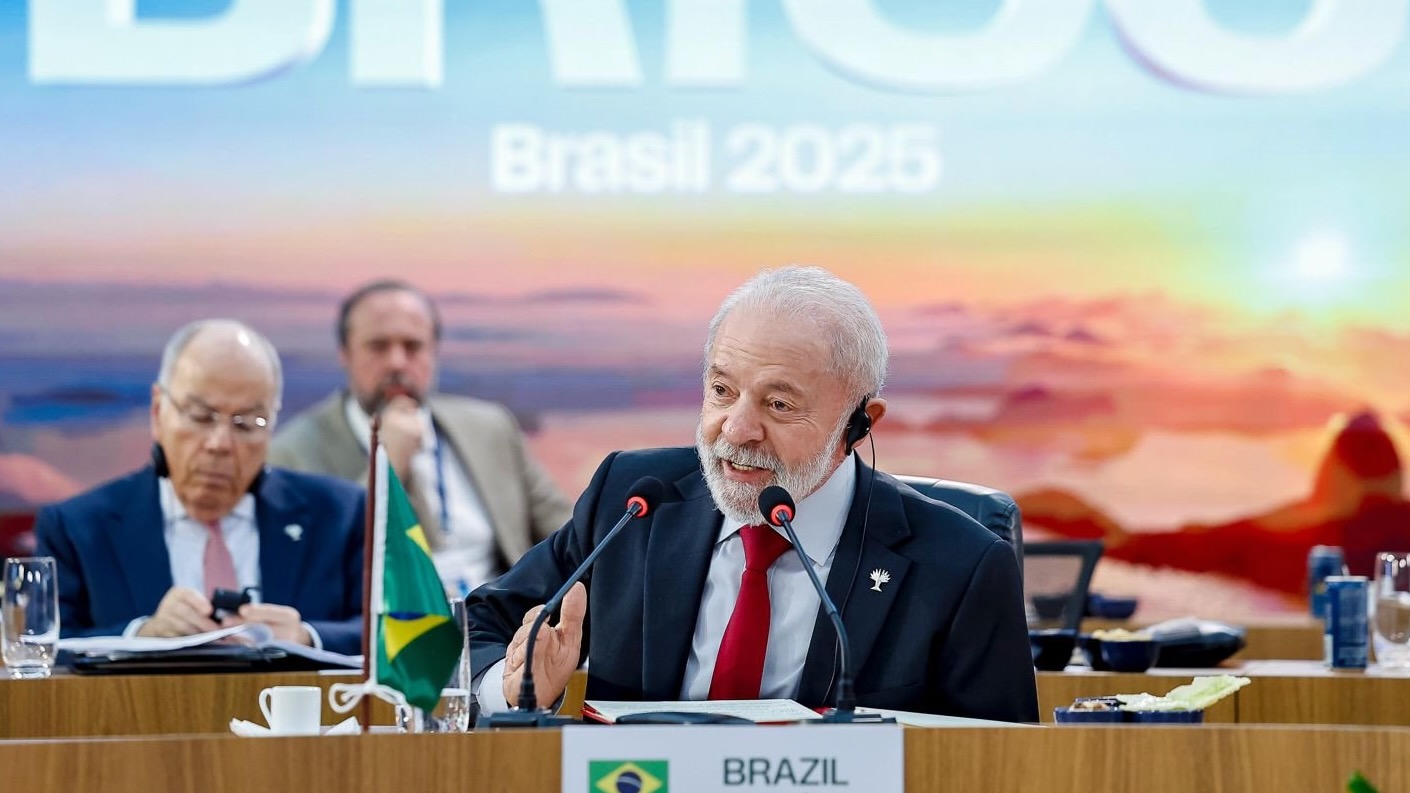
Brazilian President Lula da Silva leads the 17th BRICS Summit in Rio de Janeiro, Brazil, July 6, 2025. Photo: X

New tensions have arisen between the United States and Brazil after Trump claims that former Brazilian President Jair Bolsonaro, an ultra-right-wing leader, is innocent

On July 7, the president of the United States, Donald Trump, published a message on Truth Social defending former Brazilian President Jair Bolsonaro and claiming he has been mistreated and is innocent. Bolsonaro was los reelection in the 2022 elections and later the Supreme Court declared that he was ineligible to serve in public office due to his numerous violations.

Trump wrote: “Brazil is doing a terrible thing on their treatment of former President Jair Bolsonaro. I have watched, as has the World, as they have done nothing but come after him, day after day, night after night, month after month, year after year! He is not guilty of anything, except having fought for THE PEOPLE… This is nothing more, or less, than an attack on a Political Opponent — Something I know much about! It happened to me, times 10, and now our Country is the “HOTTEST” in the World! The Great People of Brazil will not stand for what they are doing to their former President.”

He also claimed that the alleged persecution of Bolsonaro is a “witch hunt”: “I’ll be watching the WITCH HUNT of Jair Bolsonaro, his family, and thousands of his supporters, very closely. The only Trial that should be happening is a Trial by the Voters of Brazil — It’s called an Election. LEAVE BOLSONARO ALONE!”

In response to these statements, Brazilian President Luiz Inácio Lula da Silva asserted that the US president’s declaration is interference and that Brazilian sovereignty must be respected. “The defense of democracy in Brazil is a matter for Brazilians. We are a sovereign country,” Lula reminded Trump. “We do not accept interference or tutelage from anyone. We have solid and independent institutions. No one is above the law. Especially those who attack freedom and the rule of law.”

For her part, Brazil’s secretary of state, Gleisi Hoffmann, was more confrontational: 

“Donald Trump is very mistaken if he thinks he can interfere in the Brazilian judicial process. The period when Brazil was subservient to the US was during Bolsonaro’s presidency, when he saluted his flag and failed to defend national interests. Today, he is answering for the crimes he committed against democracy and the electoral process in Brazil. You can’t talk about persecution when a sovereign country complies with due process in the democratic rule of law, which Bolsonaro and his coup plotters have tried to destroy. The US president should take care of his problems, of which there are many, and respect the sovereignty of Brazil and our judiciary.”

Trump’s comments were made while Lula leads the 17th BRICS Summit in Rio de Janeiro, where the economic bloc denounced “unilateral, punitive, and discriminatory protectionist measures” and called for the strengthening of multilateralism to create a more equitable global order.

What is Bolsonaro accused of?

Former President Jair Bolsonaro (2019-2023), a longtime friend of Donald Trump, thanked the US president for his support: “I was delighted to receive the note from President Donald Trump. This lawsuit to which I am responding is a legal aberration (Lawfare), clear political persecution, already perceived by everyone with common sense … I thank the illustrious President and friend. You went through something similar … Your struggle for peace, justice, and freedom echoes across the planet. Thank you for existing and for giving us an example of faith and resilience.”

According to the Brazilian justice system, Bolsonaro led, together with several high-ranking military officers and other far-right politicians, an attempt to delegitimize and reverse the electoral results that marked his defeat in October 2022 by the current President Lula da Silva, who obtained 50.9% of the valid votes, to the far-right’s 49.1%. On January 8, 2023, hundreds of Bolsonaro supporters stormed the headquarters of the legislative and judicial branches in Brasilia.

The protesters entered the Three Powers Square a week after Lula assumed his mandate as president of the country. Following the declaration of a state of emergency, security forces took several hours to expel Bolsonaro’s supporters, while most governments around the world condemned the incursion.

Read more: Jair Bolsonaro will stand trial for coup attempt

For his part, Bolsonaro has denied his participation in the events, in which, according to the Brazilian justice system, generals Augusto Heleno and Walter Braga (former Secretary of Defense), as well as former Secretaries, Anderson Torres, Augusto Heleno, and the 2022 electoral campaign aide, Mauro Cid, are also involved.

The charges are attempted coup d’état, participation in an armed criminal organization, attempted abolition of the democratic rule of law, aggravated damages, and deterioration of historical heritage. The final decision of justice will be known in the coming months and will surely affect the political future of the Amazonian nation.

Original article by Pablo Meriguet republished from peoples dispatch under a Creative Commons Attribution-ShareAlike 4.0 (CC BY-SA) license.

Continue ReadingLula demands respect for Brazil’s sovereignty after Trump’s statements

Israeli PM Netanyahu back in the US capital, defying ICC arrest warrant

Spread the love

Original article by Peoples Dispatch republished from peoples dispatch under a Creative Commons Attribution-ShareAlike 4.0 (CC BY-SA) license.

Netanyahu visits Trump in the White House (Photo via @WhiteHouse/X)

Israeli Prime Minister supports Trump’s plan for mass displacement of Palestinians and nominates US leader for Nobel Peace Prize

Israeli Prime Minister and wanted war criminal Benjamin Netanyahu is once again visiting the United States capitol, discussing the “relocation” of the entire Palestinian population from Gaza, Trump’s push for a renewed ceasefire, and the renewal of US-Iran talks.

The controversial visit has been met with protests from pro-Palestine and anti-imperialist organizations in Washington DC.

Earlier this year, Trump floated a controversial plan to colonize the region – emptying Gaza of Palestinians and developing its coastline into what he called a “Riviera of the Middle East.” Although this proposal was denounced by everyone from human rights organizations to most countries in the West Asia region, Netanyahu appears to have issued renewed support for the idea of the mass displacement of Palestinians.

“It’s called free choice,” the Israeli Prime Minister told reporters on Monday. “If people want to stay, they can stay. But if they want to leave, they should be able to leave.”

The same day, during a dinner at the White House, Netanyahu handed Trump a letter nominating him for a Nobel Peace Prize, citing Trump’s role in the Abraham Accords.

Palestinian diaspora and solidarity organizations have denounced Netanyahu’s visit. Activists with the Palestinian Youth Movement and the ANSWER Coalition, took to the streets of the US capital on July 7, chanting “Bibi out of DC now!”

The United States is one of the few countries that Netanyahu has visited since the International Criminal Court issued an arrest warrant for him over his responsibility for war crimes in Gaza. The US is not a party to the Rome Statute, the treaty that created the ICC, and the Biden administration stated that it fundamentally rejected the arrest warrant when it was issued. However, the socialist candidate for mayor of New York City, Zohran Mamdani, a likely winner of the mayoralty in November, has stated that he would indeed arrest Netanyahu if the Israeli leader steps foot in the city.

Netanyahu has taken detours to avoid arrest in other countries that are parties to the Rome Statute, including Ireland, Iceland, and the Netherlands. 

“Wanted war criminal, Benjamin Netanyahu, is in Washington DC, yet again continuing to be received by the highest offices in the US while carrying out a mass slaughter campaign against the entire population of Gaza,” a member of the Palestinian Youth Movement told Peoples Dispatch. “We condemn Netanyahu’s presence here which will only siphon resources from the American people in service of the genocide on Gaza. The Trump administration could end the slaughter today, but they choose to continue fueling this holocaust against Palestinians despite the wishes of the American people.”

Original article by Peoples Dispatch republished from peoples dispatch under a Creative Commons Attribution-ShareAlike 4.0 (CC BY-SA) license.

Keir Starmer objects to criticism of the IDF. He asks how could anyone obect to them starving people to death, forced marches like the Nazis did, bombing Gaza's hospitals and universities,mass-murdering journalists, healthworkers and starving people queuing for food, killing and raping prisoners and murdering children. He calls for people to stop obstructing his genocide for Israel.
Keir Starmer objects to criticism of the IDF. He asks how could anyone obect to them starving people to death, forced marches like the Nazis did, bombing Gaza’s hospitals and universities,mass-murdering journalists, healthworkers and starving people queuing for food, killing and raping prisoners and murdering children. He calls for people to stop obstructing his genocide for Israel.
Experiencing issues with this image not appearing. I suspect because it's so critical of Zionist Keir Starmer's support of and complicity in Israel's genocides.
Genocide denier and Current UK Prime Minister Keir Starmer is quoted that he supports Zionism without qualification. He also confirms that UK air force support has been essential in Israel’s mass-murdering genocide. Includes URLs https://www.declassifieduk.org/keir-starmers-100-spy-flights-over-gaza-in-support-of-israel/ and https://youtu.be/O74hZCKKdpA
UK Labour Party government Keir Starmer, Angela Rayner and Rachel Reeves explain that they are participants and complicit in Israel's Gaza genocide providing Israel with army and air force support. They explain that they don't do gas chambers but do do forced marches, starvation, destroy hospitals, mass-murders of journalists and healthcare workers.
UK Labour Party government Keir Starmer, Angela Rayner and Rachel Reeves explain that they are participants and complicit in Israel’s Gaza genocide providing Israel with army and air force support. They explain that they don’t do gas chambers but do do forced marches, starvation, destroy hospitals, mass-murders of journalists and healthcare workers.
Continue ReadingIsraeli PM Netanyahu back in the US capital, defying ICC arrest warrant

Benefit cuts will hit severely disabled people despite ministers’ claims, say charities

Spread the love

https://www.theguardian.com/society/2025/jul/08/universal-credit-cuts-will-hit-people-with-fluctuating-disabilities-charities-say

A protest in London last month against changes to benefits. The government says the severe conditions criteria will provide ‘peace of mind’. Photograph: Wiktor Szymanowicz/Future Publishing/Getty Images

Exclusive: Charities say planned universal credit changes fail to account for progressive or fluctuating conditions

“Huge swathes” of severely disabled people will be hit by the planned universal credit cuts, contrary to government claims that they will be protected, charities say.

Organisations including Scope, Z2K and the MS Society say the legislation, which is due to be voted on again by MPs on Wednesday, fails to account for disabilities if they are progressive or fluctuating.

The clause in the bill said to shield the most severely disabled and ill people from reassessment and the new lower benefit rate – known as the severe conditions criteria (SCC) – will only do so if a claimant meets a number of strict requirements, including that a health condition must be constant.

It means people with severe illnesses that vary with symptoms day to day, such as Parkinson’s, bipolar and multiple sclerosis, could be put on to the reduced universal credit rate despite being too ill to seek employment.

“Contrary to government claims, we have real fears that many disabled people with lifelong conditions that severely impact their daily lives will not in fact be protected from the cuts,” said Ayla Ozmen, the director of policy and campaigns at the anti-poverty charity Z2K.

“The protections have a very narrow definition – as drafted, they will only apply where someone is seriously affected by their condition at all times. Based on our experience, this will likely exclude huge swathes of disabled people, including those who have fluctuating conditions but who everyone would agree have high support needs. We’re calling on the government to drop these damaging cuts and go back to the drawing board.”

Article continues at https://www.theguardian.com/society/2025/jul/08/universal-credit-cuts-will-hit-people-with-fluctuating-disabilities-charities-say

Keir Starmer says that the Labour Party under his leadership all feel a small part of Scunthorpe.
Keir Starmer confirms that he's proud to be a red Tory continuing austerity and targeting poor and disabled scum.
Keir Starmer confirms that he’s proud to be a red Tory continuing austerity and targeting poor and disabled scum.
Continue ReadingBenefit cuts will hit severely disabled people despite ministers’ claims, say charities

Nearly two-thirds of voters think Starmer doesn’t respect them – new poll

Spread the love
Simon Dawson/Number 10/Flickr, CC BY-NC-ND

Marc Stears, UCL

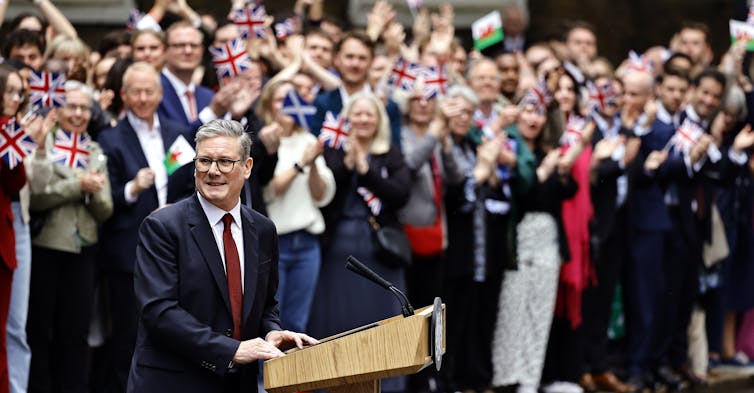
Exhausted from a long campaign but buoyed by an extraordinary victory, Keir Starmer stood on the steps of Downing Street just over one year ago to deliver his victory speech. “Your government,” the new prime minister said, “should treat every single person in this country with respect.”

This message of respect resonated strongly in the year leading up to the campaign, coming as close as anything to providing a central argument to Labour’s case for government. And, according to polling and focus groups that my team at UCL Policy Lab designed along with polling company More in Common, it seemed to work.

As our research at the time showed, voters felt that “respecting ordinary people” was the most important attribute that any politician could have, more important than having ideas for the future, managing effectively or having real experience. And they thought Starmer was the leader who displayed that respect most.

A year later, the picture looks quite different. In new polling, we asked a representative sample of over 7,000 people to evaluate the government one year on. On respect, the judgement has not been good.


Want more politics coverage from academic experts? Every week, we bring you informed analysis of developments in government and fact check the claims being made.

Sign up for our weekly politics newsletter, delivered every Friday.


During the general election campaign, 41% of the electorate said that they believed that Starmer “respected people like them”. One year on, that stands at only 24%. At the same time, the number who say that he does not respect them has risen from 32% to 63%. Starmer is now outstripped on that question by Nigel Farage – 33% say the Reform UK leader respects people like them.

Losing support

This view has had crucial political consequences. Of those who voted for Labour in the general election, only 60% of our respondents say they would vote for the party in an election held tomorrow.

And that is not because some other political party is suddenly swooping in for their supporters. Labour’s voters are defecting in a host of different directions: 11% say they would vote Reform; 8% would vote Liberal Democrat; 4% would vote Green and 4% would vote Conservative. A further one in ten say they simply don’t know how they would vote.

Labour’s losses have been most dramatic among their first-time voters. Of those who voted for Labour in 2024 but not in any other general election since 2010, barely a third still support the party, while a fifth would vote for Reform UK.

These political failures, our report contends, are directly related to the declining sense of respect. The top reason voters gave for turning away from Labour are the broken promises and U-turns made by Labour in government, followed by the party’s failure to reduce the cost of living and changes to the winter fuel payment.

The idea of “respect” being key to the public’s sense of whether a government is on their side or not has been growing for many years now, both in academia and in politics itself. Since at least the 2007/8 financial crisis there has been a sense that large swathes of the public feel neglected, overlooked and even disdained by those who govern them.

When people talk about wanting to see “change” in Britain, this is often what they mean. It was a theme I touched on recently in two books, Out of the Ordinary and, with my co-author Tom Baldwin, England.

A smiling Keir Starmer delivers his victory speech, with a crowd of supporters behind him
Just over a year ago, a happier Starmer delivers his victory speech. Shutterstock

But respect is not just an abstract idea. People appear to judge whether they are respected by those who govern them or not primarily on the basis of whether the government stands up for them against powerful vested interests.

Our earlier research demonstrated that there is a widespread sense among the British public that certain groups have had it too easy for too long. This is either because they have been able to intimidate the government, or because government ministers and advisers have themselves been recruited from among these groups.

In our new report, therefore, we see that the new government’s most popular act was their willingness to raise the minimum wage by £1,400 in April, against the objections of some in business who suggested that such a move was too burdensome on them.

Changes to the winter fuel allowance and proposed changes to the disability benefits system, on the other hand, registered poorly. They suggest that the interests of ordinary and vulnerable people count for too little in decision-making.

These judgements currently shape the mood of the country and probably top the list of issues that the government now needs to address. There is still time for the government to rebuild its appeal, of course. Indeed, our respondents who said they would vote for Labour said they would do so because the party needs more time to fix the problems they inherited.

But as it seeks to do so, voters will want to know who this government stands for. Whose interests does it put first? What kind of people does it respect?

Much of the electorate thought they knew the answer to these questions one year ago. Now they’re not so sure.

Marc Stears, Director of UCL Policy Lab and Professor of Political Science, UCL

This article is republished from The Conversation under a Creative Commons license. Read the original article.

Keir Starmer says that the Labour Party under his leadership all feel a small part of Scunthorpe.
Keir Starmer objects to criticism of the IDF. He asks how could anyone obect to them starving people to death, forced marches like the Nazis did, bombing Gaza's hospitals and universities,mass-murdering journalists, healthworkers and starving people queuing for food, killing and raping prisoners and murdering children. He calls for people to stop obstructing his genocide for Israel.
Keir Starmer objects to criticism of the IDF. He asks how could anyone obect to them starving people to death, forced marches like the Nazis did, bombing Gaza’s hospitals and universities,mass-murdering journalists, healthworkers and starving people queuing for food, killing and raping prisoners and murdering children. He calls for people to stop obstructing his genocide for Israel.
Keir Starmer chases Nigel Farage's racist bigot vote.
Keir Starmer chases Nigel Farage’s racist bigot vote.

Continue ReadingNearly two-thirds of voters think Starmer doesn’t respect them – new poll

Survey shows support for electoral reform now at 60% – so could it happen?

Spread the love

Alan Renwick, UCL

Public support for reforming the UK’s first past the post electoral system has risen markedly of late. So is there any serious chance that such reform could actually happen?

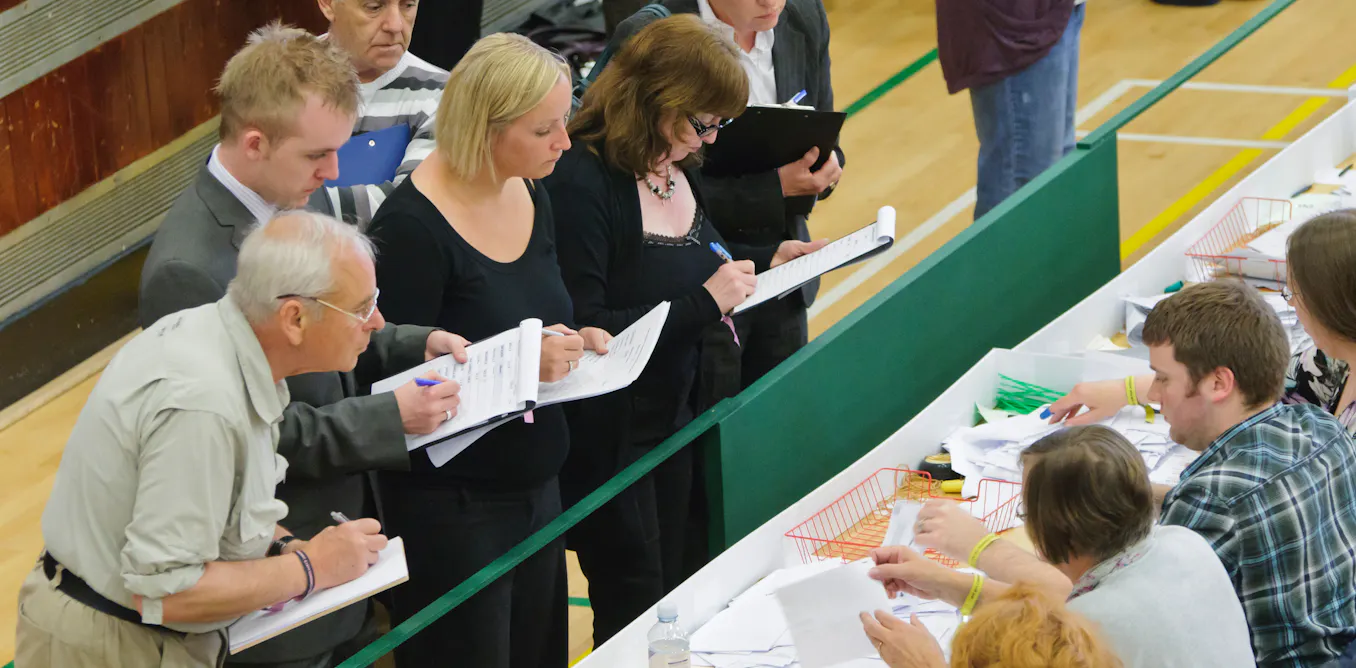
The annual British Social Attitudes survey (BSA) has been tracking public attitudes to electoral reform (and other issues) since 1983. It found consistent majorities for the status quo up to 2017, but charts a dramatic shift since then. In the latest BSA, support for reform has risen to 60%, with just 36% backing the current arrangements.

It’s true that these views are unlikely to be deeply held: most people rarely think about electoral systems. But they do reflect a profound disillusionment with the way the political system is working.

Significant electoral reforms are very rare outside times of regime change. When I wrote a book on the subject in 2010, there had been just six major reforms (from one system type to another) in national parliaments in established democracies since the second world war. That number has increased a little since then, but only because Italy has got into a pattern of endless tinkering. The basic pattern is one of stability.

The main reason for that is obvious: those who gain power through the existing system rarely want to change it.

Yet the cases where reform has happened reveal two basic routes through which such change can take place.

First, those in power can conclude that a different system would better serve their interests. In 1985, for example, France’s president François Mitterrand replaced the system for electing the National Assembly because he feared heavy losses for his Socialist party in the looming elections.

Second, leaders can cave into public demands for reform because they fear that failing to do so will add to their unpopularity. This requires a scandal that affects people in their daily lives, and campaigners who successfully pin blame for that scandal on the voting system. It typically also needs at least a few reform advocates within government.


Want more politics coverage from academic experts? Every week, we bring you informed analysis of developments in government and fact check the claims being made.

Sign up for our weekly politics newsletter, delivered every Friday.


These conditions characterised three major reforms in the 1990s, in Italy, Japan, and New Zealand. In the first two cases, rampant corruption fed economic woes and was attributed to the voting system. In New Zealand, first past the post enabled extreme concentration of power, which allowed successive governments to unleash radical, and widely disliked, economic restructuring.

Prospects for reform in the UK

If Labour continues to lag in the polls and votes remain fragmented across multiple parties, we might imagine reform by the first route in the UK. Ministers could calculate that a more proportional system would cut Labour’s losses, clip Nigel Farage’s wings, and reduce uncertainty.

Yet majority parties facing heavy defeat almost never change the system in this way. Mitterrand’s reform of 1985 was a rare exception. Such parties always hope things will turn around. They don’t want to look like they have given up. And they are used to playing a game of alternation in power: they want to hold all the levers some of the time, and will tolerate years in the wilderness to get that.

Reform by the second route is equally improbable. Notwithstanding great public dissatisfaction with the state of politics in the UK, there is little narrative that the electoral system is the source of the problem.

But, depending on the results, the chances of reform could grow after the next general election.

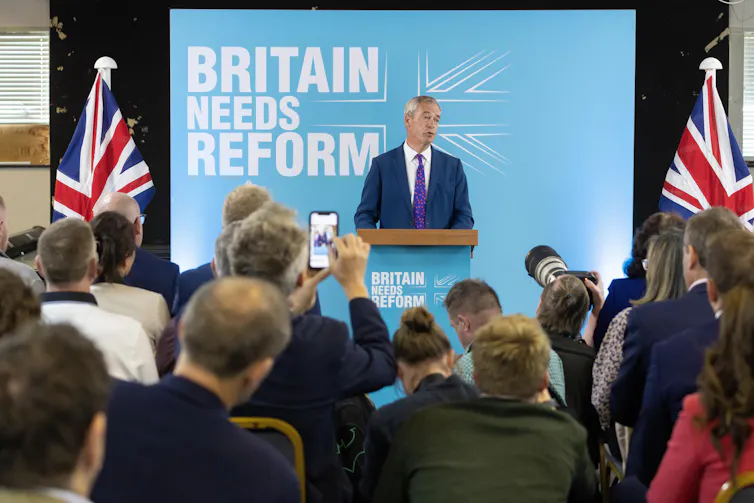
A Reform win could spark change. EPA

Change by the first route is most likely if no party comes close to a majority and a coalition is formed from multiple fragments. Those parties might all see reform as in their interests. Perhaps more likely, the smaller parties in such a coalition might push their larger partner into conceding a referendum – much as the Liberal Democrats did with the Conservatives in 2010. If support for the two big parties is disintegrating, referendum voters might opt for change – though that is not guaranteed.

As for the second route, a majority victory for Reform UK that was generated by first past the post from a small vote share could – given the party’s marmite quality – trigger widespread public rejection of the voting system. A clear path to change might open up if Reform then lost a subsequent election, particularly if it lost to a coalition of parties, some of which backed reform already.

In short, the shifting sands of politics are making electoral reform more likely. But almost certainly not before the 2030s. And much will depend on how the party system evolves in the years to come.

This article includes links to bookshop.org. If you click on one of the links and go on to buy something from bookshop.org The Conversation UK may earn a commission.

Alan Renwick, Professor of Democratic Politics, UCL

This article is republished from The Conversation under a Creative Commons license. Read the original article.

Continue ReadingSurvey shows support for electoral reform now at 60% – so could it happen?