Mourners cry during a funeral service of a person killed a day earlier while attempting to get aid at a distribution point near the Israeli-controlled Zikim border crossing, at Al-Shifa hospital in Gaza City, on June 24, 2025. (Photo: Omar Al-Qattaa/AFP via Getty Images)
“People have been killed almost daily while trying to get food,” said one top U.N. official.
The anti-poverty group Oxfam America has issued a forceful response to reporting that the Trump administration plans to give tens of millions dollars to the Gaza Humanitarian Foundation, an Israeli-backed aid organization which uses private U.S. military firms and whose rollout the United Nations and international aid groups have strongly objected to.
Reuters was first to report on Tuesday that the Trump administration plans to give $30 million to the Gaza Humanitarian Foundation (GHF). A document reviewed by the outlet shows that the amount was authorized last week under a “priority directive” from the White House and the U.S. Department of State. Per Reuters, $7 million has already been dispersed. Sources told the outlet that the administration may approve separate monthly grants for the entity.
Oxfam America president and CEO Abby Maxman said in a statement on Tuesday that the Trump administration is poised to shell out for an aid organization “formed to distribute food parcels without any grounding in the reality of the crisis in Gaza.”
Maxman accused GHF of delivering only a fraction of the number of meals that the population needs and alleged the group is distributing food that families can’t prepare without fuel and clean water. She also said the organization has pushed aid further out of reach for the vulnerable populations who can’t walk long distances to its distribution sites.
“We urge the Trump administration and Congress to instead put its full support behind funding and ensuring safe access for established humanitarian organizations to do the work that is proven to save lives,” added Maxman.
She also highlighted that the distribution sites have been marred by violence.
The U.N.’s human rights office said on Tuesday that at least 410 Palestinians have been killed by Israeli forces “while trying to fetch from controversial new aid hubs in Gaza—a likely war crime,” according to a U.N. News article posted that same day.
Jonathan Whittall, the head of U.N. Office for the Coordination of Humanitarian Affairs in the Occupied Palestinian Territory, told journalists on Monday that since Israel’s total blockade was partially lifted in late May, “people have been killed almost daily while trying to get food.”
In a statement shared with CBS on Tuesday, GHF pushed back on what it called “false allegations of attacks near aid distributions sites.” The group also said that the “Hamas-affiliated Gaza Health Ministry is not a credible source of information, as it fails to report any U.N. convoys or distribution sites that are linked to violent incidents,” according to CBS, whose story focused on comments from the U.N. Relief and Works Agency for Palestine Refugees in the Near East commissioner general decrying GHF.
In that same story, CBSreported that the Gaza Ministry of Health said 79 people had been killed in Gaza over the last day. Fifty-one of those people had died near GHF sites, per CBS, citing the Gaza Ministry of Health.
And on Monday, over a dozen human rights organizations sent a letter to GHF calling for an end to the “privatized, militarized” GHF aid model and urging any parties involved with GHF and the international community in general to press for aid to be distributed through established international relief operations.
“Individuals and corporate entities involved in the planning, financing, or execution of the GHF scheme may incur criminal liability—including under universal jurisdiction statutes—for aiding and abetting war crimes such as the forcible displacement of civilians, starvation as a method of warfare, and denial of humanitarian access,” the letter warned.
The groups behind the letter include the Palestinian Center for Human Rights, the Center for Constitutional Rights, the Center for Applied Legal Studies, and others.
Neo-Fascist Climate Science Denier Donald Trump says Burn, Baby, Burn.Elon Musk urges you to be a Fascist like him, says that you can ignore facts and reality then.
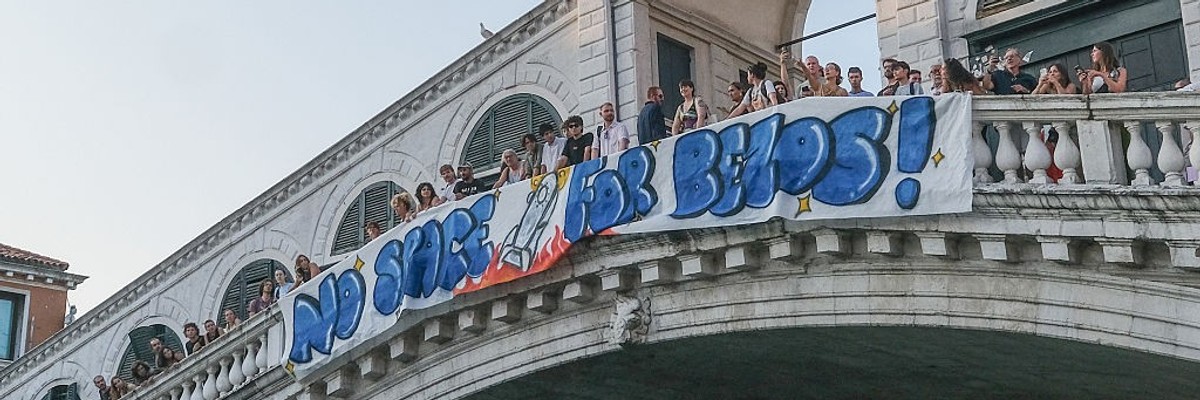
Activists drape a “No Space For Bezos” banner from Venice’s iconic Rialto Bridge on June 13, 2025 to protest a party celebrating the wedding of multicentibillionaire Amazon.com founder Jeff Bezos and journalist Lauren Sánchez. (Photo: Stefano Mazzola/Getty Images)
“We’re just citizens who started organizing and we managed to move one of the most powerful people in the world,” said one protest organizer.
Amazon.com founder Jeff Bezos and Lauren Sánchez on Tuesday relocated their upcoming lavish Venice wedding celebration, a move cheered as an “enormous victory” by protesters whose recent demonstrations in the northeastern Italian city have highlighted the socioeconomic and climate damage caused by billionaires.
Bezos—who is currently the world’s fourth-richest person, according to lists published by Bloomberg and Forbes—is set to marry Sánchez, a journalist, later this week, and the couple is planning to celebrate the occasion with a three-day extravaganza costing an estimated $46-56 million, according to Reuters.
Around 90 private jets are scheduled to land in area airports and local yacht harbors are fully booked, underscoring the climate and environmental impact on a city struggling to survive on one of myriad frontlines of the planetary emergency.
“We are very proud of this! We are nobodies, we have no money, nothing!”
The nuptial celebration has been relocated from the Scuola Grande della Misericordia to the Arsenale di Venezia, a historic fortified palace about 3 kilometers (1.8 miles) away from the original location. Officials cited concerns for the security of guests including several members of U.S. President Donald Trump’s family.
Members of groups including No Space for Bezos, Greenpeace Italy, and Everyone Hates Elon—which targets Elon Musk, the world’s richest person—have staged a series of demonstrations, including one on Monday at which protesters laid out a massive banner with Bezos’ face and the message “If You Can Rent Venice for Your Wedding You Can Pay More Tax” in Piazza San Marco.
Responding to the celebration’s relocation, Tommaso Cacciari of No Space for Bezos told the BBC Wednesday: “We are very proud of this! We are nobodies, we have no money, nothing!”
“We’re just citizens who started organizing and we managed to move one of the most powerful people in the world,” Cacciari added.
Wedding-related festivities are set to kick off Thursday evening, and city officials have blocked off parts of central Venice. While some residents have welcomed the money and fanfare the event will bring to a city with a long and storied history of oligarchs and opulence, others bristle at what they see as the transformation of their home into a playground for the superrich.
“There’s only one thing that rules now: money, money, money, so we are the losers,” Venice resident Nadia Rigo told Reuters. “We who were born here have to either move to the mainland or we have to ask them for permission to board a ferry. They’ve become the masters.”
In the United States, critics contrasted the stratospheric cost of Bezos’ celebration with the multicentibillionaire’s history of personal and corporate tax dodging—and the hyper-capitalist system that enables it.
“Jeff Bezos is worth $230 billion and is reportedly spending $20 million on a three-day wedding in Venice while sailing around on his $500 million yacht,” former U.S. Labor Secretary Robert Reich said Wednesday on the social media site X. “If he can afford to do that, he can afford a wealth tax and to pay Amazon workers a living wage. Hello?”
This is oligarchy. This is obscene.While 60% live paycheck to paycheck & kids go hungry, Jeff Bezos, worth $230 billion, goes to Venice on his $500 million yacht for a $20 million wedding & spends $5 million on a ring while his real tax rate is just 1.1%.End this oligarchy.
While No Space for Bezos organizers are celebrating their victory and have canceled plans to fill Venice’s canals with inflatable crocodiles in a bid to block celebrity guests from accessing the Scuola Grande della Misericordia, they said they still plan on protesting the festivities by holding a “No Bezos, No War” rally and march.
“It will be a strong, decisive protest, but peaceful,” Federica Toninello of the Social Housing Assembly network toldEuronews Wednesday. “We want it to be like a party, with music, to make clear what we want our Venice to look like.”
The UK government has quietly dropped its legal battle to uphold a law that allowed police to arrest peaceful protesters | Seiya Tanase/NurPhoto via Getty Images
Labour has quietly dropped legal fight over unlawful crackdown on protest. But what about those already arrested?
Two years ago, Suella Braverman made a law she had no power to make.
Her new law fundamentally changed the threshold at which police could impose conditions on a protest in England and Wales. It went from anything that caused ‘serious disruption’ – itself a vague phrase that Braverman was asked to define but didn’t – to anything that caused ‘more than minor’ disruption.
Now, finally, those laws have been quashed. We at Liberty launched legal action against the government in June 2023, and five judges over two hearings have since agreed with us that the measures were unlawful and should never have been introduced in the first place.
This week, the Labour government quietly dropped its appeal over those court rulings. The law now reverts back to what it originally was. Police can no longer intervene in protests on trivial grounds, such as a person blocking the entrance to a hotel where a fossil fuel conference is taking place for a matter of minutes – an act for which Greta Thunberg was arrested and later acquitted.
At Liberty, we took action against these laws not just because they were undemocratic and unlawful, but because of the real human impact they had on protesters and non-protesters across the country.
Take Susan* for example, who was wrongly arrested in January. Susan had gone to a vigil for Palestine in the morning, but left to go for lunch. As she was on her way to the shops with friends, she asked the police which way to go, and they directed her back into the protest area. A few minutes later, Susan was caught up in a kettle as the area had conditions imposed on it under these laws.
Susan was arrested, held in custody first on a coach for three hours, and then in a cell for the rest of the 24-hour period that a person can be detained for without charge. She was unable to even call home to tell her son she wouldn’t be allowed home that evening until 10pm.
Eventually, Susan was told that no further action would be taken against her, as was the case for dozens of others who got caught up in this injustice. Despite this, there have been long-lasting effects. In her own words, this has had a huge impact on her mental health. She feels scared for her family’s safety. She has lost all optimism, when she did nothing wrong in the first place.
What makes Susan’s case even worse is that the legislation had already been ruled unlawful at the point she was arrested. Just a few months earlier, the Labour government had chosen to appeal the court’s original decision that the Conservatives acted unlawfully. This is despite Labour’s home secretary, Yvette Cooper, having vocally opposed these same laws when she was in opposition.
Now, the government has finally accepted defeat and has decided to drop its appeal. This is a huge victory for democracy and our right to protest.
Conservative ministers loudly championed free speech – right up until they outlawed it. Now, we’re all at risk
Through successive government acts and rhetoric, the ways in which we can protest have been narrowed. Restrictions have been placed on how we protest, and even how noisy a protest can be. And as we’ve seen recently, the sentences given out to protesters have only got longer and harsher.
This cannot go on. We need a reset on the way protest is treated, because it is leading to situations like Susan’s, where vague laws are causing very real damage.
If we’ve learnt anything from our legal action, it is that justice is possible. But, as Susan’s experience shows, there is still further justice that needs to be gained.
These laws should never have been made, and so, quite clearly, every incident under them must be looked at. There has to be an urgent review of every arrest and conviction made under these regulations.
A private jet making its final approach into Edinburgh airport
Private flights at the Scottish government-owned Glasgow Prestwick Airport increased by more than a third last year, according to figures from Oxfam Scotland.
The charity says there were more than 12,000 private flights in and out of Scottish airports in 2024, with the busiest being Edinburgh, Glasgow Prestwick and Inverness.
Oxfam says that if an Air Departure Tax had been in place, and applied at the highest possible rate, that would have generated an extra £29m in tax revenue.
The Scottish government says it is reviewing rates and bands and is open to introducing a higher tax on private jets.
The rise reflects a global trend in private jets being used increasingly by the super-rich, with climate scientists warning that they can be up to 30 times more damaging for the planet than scheduled flights.
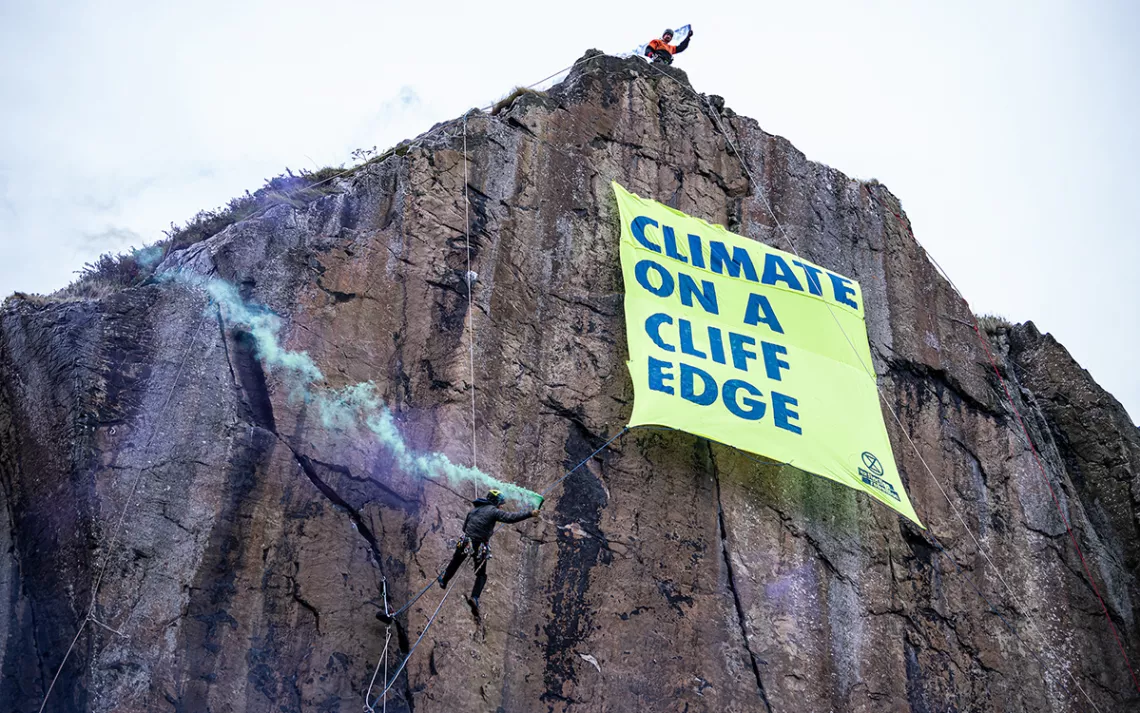
Experienced climbers scale a rock face near the historic Dumbarton castle in Glasgow, releasing a banner that reads “Climate on a Cliff Edge.” One activist, dressed as a globe, symbolically looms near the edge, while another plays the bagpipes on the shores below. | Photo courtesy of Extinction Rebellion and Mark Richards
While campaigners take to the streets, fossil fuel interests lobby governments directly, and often without scrutiny, a new report has found | Vuk Valcic/SOPA Images/LightRocket via Getty Images)
Oil and gas firms were able to water down or change Conservative policies without scrutiny, new report finds
The British government weakened key climate policies after fossil fuel giants lobbied ministers and used legal loopholes to avoid public scrutiny, a new report has found.
Climate-focused think tank InfluenceMap has uncovered that industry influence appears to have led to the delay and dilution of UK policies on the roll-out of heat pumps, the development of ‘sustainable’ aviation fuel and the granting of new oil and gas licenses.
In each case, it found that lobbyists representing fossil fuel actors that stood to lose billions from progressive climate regulations were able to influence the Conservative government’s policy without scrutiny.
While InfluenceMap’s report looks at policies relating to the UK’s net-zero ambitions, its findings on the way the UK’s lax laws allow lobbying to be conducted in secret can be applied across sectors. The think tank is calling for reforms to address this and close the “major transparency gap”.
The secrecy around lobbying, which has been at the heart of many government scandals in recent years, is a major driver of the disillusionment in British politics.
InfluenceMap’s findings illustrate “how inadequate and opaque lobbying rules undermine effective policymaking”, said Alastair McCapra, the CEO of the UK lobbying industry body.
He added: “Business engagement should help to build sounder policy with better outcomes for the public, but unaccountable lobbying breeds public mistrust. This important report removes the guesswork needed to piece together what kind of lobbying is taking place.”
Weak lobbying laws
openDemocracy has previously reported extensively on the ways that the UK’s weak lobbying laws allow corporate influence to secretly shape policy.
Our investigations have now been backed up by InfluenceMap, which has found a huge gap exists between the lobbying that takes place and that which is disclosed. This means the British public often has no way of knowing who is swaying policy.
Comparing transparency rules in the UK, the European Parliament, the US, Canada and France, InfluenceMap found that the UK has by far the worst system.
Of the five, only the UK exempts lobbyists who work in-house for a company, rather than for an agency or consultancy, from registering with a statutory lobbying watchdog. Less than 15% of lobbyists working in the UK need to register because of this rule.
The firms on the register must publish a list of clients on whose behalf they have lobbied each quarter. But they do not have to publish any details about the lobbying, including whether it involved written correspondence or a meeting and what legislation or policy was discussed.
Registered lobbyists also only need to declare clients for whom they lobbied government ministers and senior officials. There is no requirement to name clients when they approached other MPs and peers, including those on select committees, or influential government advisers.
The Committee for Standards in Public Life, an independent public body that advises the prime minister on lobbying and other aspects of public office, has consistently recommended the government publish a single, searchable database of all meetings with lobbyists.
Its recommendations would expand the scope of the current register considerably, requiring lobbyists to disclose the specific policies or legislation they discussed at meetings with government ministers and special advisers.
InfluenceMap has also called on the government to take up this recommendation and address the fundamental flaws in the lobbying act by including in-house lobbyists and publishing all responses to government policy consultants as standard.
Susan Hawley, executive director of Spotlight on Corruption, said the report “starkly demonstrates how major transparency gaps in the UK’s lobbying regime are undermining the development of good climate policy.”
“We fully support their recommendations to make lobbying much more transparent and bring the UK in line with international best practice. These reforms would support more participatory and open decision-making to help rebuild public trust and ensure better decision-making, widening the evidence base for policy making and reducing risks of policy capture by vested interests,” she said.
Oil and gas licensing
In 2022, the UK government quietly dropped two criteria from its ‘Climate Compatibility Checkpoint’ after lobbying from the fossil fuel industry. The checkpoint is used to assess whether proposed oil and gas licenses align with the UK’s climate change goals.
Oil giants BP and Shell and their industry association, Offshore Energies UK (OEUK), responded to a consultation on the checkpoint by objecting to the inclusion of two key metrics for measuring the impact of fossil fuels, according to InfluenceMap’s analysis of consultation responses obtained via Freedom of Information requests.
The measures they opposed would have required the government to consider ‘Scope 3 emissions’ and the ‘global production gap’ when issuing new oil and gas licences.
Scope 3 emissions are produced during end-use and contribute the largest share of all emissions from oil and gas production, while the production gap tracks the discrepancy between planned fossil fuel production and what’s needed to limit global warming to 1.5°C or 2°C.
The government dropped both criteria from the final checkpoint, which instead focuses solely on operational emissions, which represent only a fraction of total emissions from oil and gas projects.
This outcome, InfluenceMap’s report notes, strongly aligns with the positions advocated for by BP, Shell, and OEUK, suggesting their lobbying efforts were successful.
The following year, the government approved 100 new North Sea oil and gas licences, which had a potential emissions footprint equivalent to Denmark’s annual output.
InfluenceMap’s report also highlights the issues around government consultations on proposed policies, pointing out that, as in this case, lobbyists typically use these to suggest amendments in favour of their clients, but their responses are not published as standard.
Similarly, unlike in the other four Parliaments InfluenceMap looked at, corporations in the UK are not required to declare their engagement on policies, how much they spend on lobbying, or which legislation or decisions they are targeting.
It highlights that this can lead to a situation in which companies make voluntary corporate disclosures that fail to capture the true extent of this advocacy. In this case, InfluenceMap found BP published a summary of its response to the checkpoint that omitted key lines of its opposition, which were only revealed later through Freedom of Information requests.
Rachel Davies, advocacy director at Transparency International UK, said: “This report highlights, yet again, the glaring gaps in our lobbying transparency regime and the potential risks of favouring a small group of vested interests at the public’s expense.
“The UK needs to catch up to other comparable democracies and act swiftly to introduce a comprehensive lobbying register with meaningful disclosures.”
Domestic hydrogen
It is broadly agreed that, in the UK, hydrogen is not a viable solution for decarbonising domestic heating and is an especially bad alternative to heat pumps. Much of our hydrogen comes from burning gas or coal and it cannot be transported through our existing pipelines without massive and costly infrastructure changes.
This reality has been set out by different independent bodies advising the UK government.
In 2021, the Climate Change Committee warned that hydrogen had “not yet been proven at scale and should not be a cause to delay other options” such as the roll-out of heat pumps or low-carbon heat networks. Two years later, the National Infrastructure Commission said the government “should not support the roll-out of hydrogen heating” because there is “no public policy case” for its use.
As InfluenceMap’s report notes, this has not prevented the gas industry from waging a successful lobbying campaign in a bid to shore up its market position – with a clear impact on government policy.
The think tank found the industry pursued its cause in a number of ways, including setting up Hello Hydrogen, a campaign fronted by TV star Rachel Riley, to make the case for using hydrogen in homes to the public in 2022. While the campaign did not declare its funders, its director was also a director of Cadent Gas, the UK’s largest gas distribution network.
Cadent is one of the funders of the All-Party Parliamentary Group (APPG) on Hydrogen, which has publicly called for hydrogen to play a part in domestic heating. The APPG’s other funders include Equinor, Shell and the Energy and Utilities Alliance, a lobbying body run by Mike Foster, the former Labour MP for Worcester (home to Worcester Bosch, a major manufacturer of gas boilers).
Other fossil fuel firms and industry lobbying bodies have also consistently pushed for the use of hydrogen in domestic heating in letters to parliamentary select committees and responses to government consultations.
Ahead of last year’s general election, Centrica (formerly British Gas) wrote to the Public Accounts Committee, which examines the value for money of government projects, to call for further public investment in hydrogen for home heating. The firm had written to the Energy Security and Net Zero Committee in support of the technology less than 12 months earlier.
This industry lobbying has led to indecision and disruption on government plans. A February 2023 report by the House of Lords Committee blamed mixed messages on the effectiveness of hydrogen from the government and industry for the poor uptake of a publicly subsidised scheme for heat pumps, which would reduce greenhouse gas emissions and create many jobs.
The lords’ report concluded: “Hydrogen is not a serious option for home heating for the short to medium-term and misleading messages, including from the government, are negatively affecting take-up of established low-carbon home heating technologies like heat pumps.”
The UK’s heat pump roll-outs have lagged behind those of its neighbours. Just 55,000 heat pumps were installed in the UK in 2019, compared to 600,000 in France, according to a study cited in the InfluenceMap report.
In the UK, this reportedly created around 2,000 jobs and reduced emissions of CO₂ by 0.08 million tonnes (MT); in France 30,000 jobs were created and 0.84 MT of CO₂ emissions avoided.
‘Sustainable’ aviation fuel
InfluenceMap also uncovered how industry significantly influenced the government’s so-called ‘Jet Zero’ strategy for cutting emissions in the UK’s aviation industry, which is heavily reliant on fossil fuels.
Biofuels, largely made up of used cooking oils, are often suggested as an option for producing Sustainable Aviation Fuel (SAF), although they are generally accepted to be worse in terms of scalability than other, more advanced fuels, and much worse than just reducing the number of flights.
The government initially proposed limiting the use of used cooking oil for SAF to alleviate competition on the resource – which is increasingly in demand for other uses, such as producing biodiesel for cars – and to encourage investment in new technologies for the aviation industry.
The proposals included two options; either banning the use of used cooking oil for SAF altogether, or rapidly phasing down its use so that it would make up just 8.5% of total sustainable aviation fuel by 2040.
But the government’s final SAF policy was more closely aligned with industry preferences than scientific warnings, InfluenceMap found. It allows used cooking oil to make up 100% of SAF uptake in 2025 and 2026, 71% in 2030, and 35% in 2040.
InfluenceMap’s analysis reveals the weakened SAF mandate came after pressure from Shell, BP, the International Airlines Group (which owns several airlines), Airlines UK (the trade body for UK-registered airlines) and Virgin Atlantic airline.
It also found that business interests were overrepresented in parliamentary meetings on SAF while the policy was being shaped.
This can be seen in the make-up of Parliament’s Jet Zero Council, “a partnership between industry academia and government”, which was run by Heathrow’s chief operating officer, while the International Airlines Group chaired the Sustainable Aviation Fuel Delivery Group.
The council comprised 24 members from industry, three from academia and one from civil society. Ministers were also directly involved with the council, with then-prime minister Boris Johnson attending the group’s first meeting along with four ministers.
Transparency failures again played a key role. Not a single ministerial meeting on SAF referenced the weakening of the cooking oil cap in official records, and industry responses to consultations were only obtained through Freedom of Information.
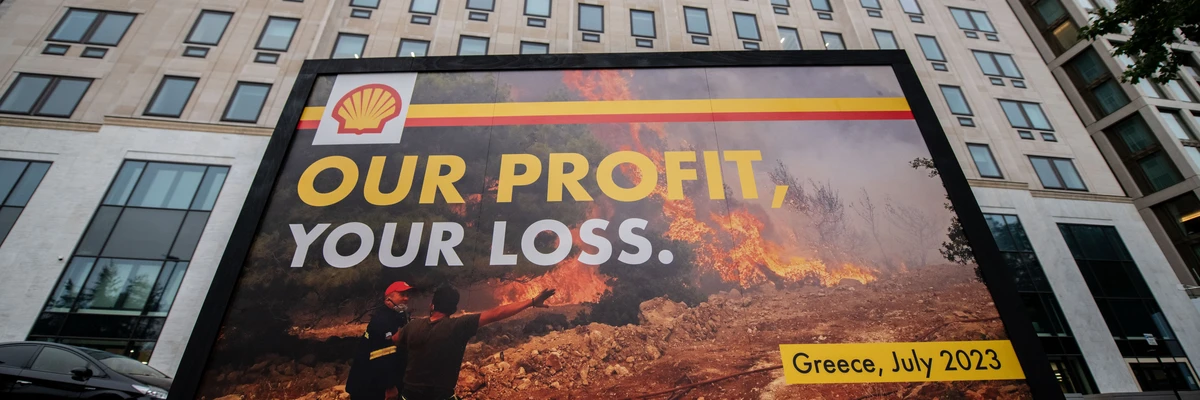
Greenpeace activists display a billboard during a protest outside Shell headquarters on July 27, 2023 in London. (Photo: Handout/Chris J. Ratcliffe for Greenpeace via Getty Images)Experienced climbers scale a rock face near the historic Dumbarton castle in Glasgow, releasing a banner that reads “Climate on a Cliff Edge.” One activist, dressed as a globe, symbolically looms near the edge, while another plays the bagpipes on the shores below. | Photo courtesy of Extinction Rebellion and Mark Richards