- Post author:dizzy
- Post published:11 June 2025
- Post category:Fascism/genocide/human rights violations/Israel/Palestine/Zionism
- Post comments:0 Comments
Rosebank oilfield: why more UK oil means more global emissions

The UK government will soon face a momentous decision over whether to approve production in the Rosebank oilfield off the coast of Shetland.
Rosebank is the UK’s biggest undeveloped field. Its proponents – the largest of which is Norwegian state-owned petroleum company, Equinor – estimate that it will produce the equivalent of up to 500 million barrels of oil between 2026 and 2051. When burned, this oil will generate up to 200 million tonnes of carbon dioxide, which is more than the combined annual emissions of 28 low-income countries.
Thanks to recent court cases, the climate effects of those “combustion emissions” will need to be taken into account by the government when it decides whether to approve production at Rosebank. In a new report, two colleagues and I reviewed the evidence concerning the implications of new oil and gas fields in the UK.
Get your news from actual experts, straight to your inbox. Sign up to our daily newsletter to receive all The Conversation UK’s latest coverage of news and research, from politics and business to the arts and sciences.
There is a rapidly dwindling global carbon budget for holding temperature increases to below 1.5°C of warming (the more conservative end of the Paris agreement’s temperature goal).
Globally, the emissions from burning the fossil fuels in oil and gas fields and coalmines that are already operating or under development far exceed that budget. In this context, Rosebank’s combustion emissions are highly significant, as they add considerably to that excess.
We also found that the projected production from existing fields is sufficient to meet or exceed global oil and gas demand in modelled economic scenarios in which climate warming is restrained to within 1.5°C. This is further evidence that new fields are not consistent with achieving globally agreed temperature goals.
However, it is often asserted by supporters of new fields that keeping UK oil in the ground won’t reduce global emissions, because another producer will supply the demand and reap the benefits. This is a gross and dangerous oversimplification which, according to the United Nations Environment Programme, “defies basic economics of supply and demand”.
Allowing a new field like Rosebank would increase the supply of oil globally, resulting in a fall in its price which, though small, would cause more oil to be consumed. As UK government advisers at the Climate Change Committee have acknowledged, new petroleum projects “support a larger global market overall” for petroleum. Stopping Rosebank would have the opposite effect, and lead to less oil consumed.

The oil industry likes to trumpet the UK’s relatively low upstream emissions – that is, from the process of extracting oil – compared with those of competitors overseas. But this is a distraction from the bigger issue: the additional greenhouse gases emitted from consuming the extra oil that new fields produce.
A recent peer-reviewed study by economists and experts in the emissions-intensity of oil and gas production concluded that limiting oil supply will almost always lead to lower overall emissions, regardless of the intensity of upstream emissions from different fields. It is highly likely that leaving Rosebank’s oil in the ground will result in lower global greenhouse gases than would occur if the field were developed.
However, this focus on Rosebank’s aggregate emissions ignores two further reasons the field’s development consent should be refused on climate grounds.
A litmus test of climate leadership
First, exploiting new sources of oil supply like Rosebank locks in future oil and gas production, ultimately making it economically, politically and legally harder to wind the industry down.
Second, as the Climate Change Committee also stated, decisions by the UK government concerning petroleum production have an important “signalling effect” internationally and at home.
Internationally, the UK government has rightly acknowledged that climate action “must be accelerated drastically” to keep the average global temperature rise “below 1.5°C”.
The UK has a proud reputation for climate leadership. It was the first country to enact a legally binding framework to reduce greenhouse gas emissions, it rapidly phased out coal-fired power generation, and in 2019 it became the first country to adopt a net zero emissions target.
Building on this legacy, the foreign secretary David Lammy has vowed to “push for the ambition needed to keep 1.5 degrees alive”. But approving Rosebank would signal to the world that the UK government is not sincere about keeping the Paris agreement’s 1.5°C goal “alive”, after all.
Some might think that aspirations to climate leadership are futile given the Trump administration’s “drill, baby, drill” approach to fossil fuels. But Trump’s recklessness at a critical time for global climate efforts makes UK climate leadership more important than ever.
The UK already chairs a suite of international energy transition alliances focused on the international phase-out of coal-fired power, the scale-up of renewables, and the financing of these transitions. It could plug a gap in its influence by rejecting Rosebank and joining the Beyond Oil & Gas Alliance, a “club” of (currently) 25 national and sub-national governments that are working to phase-out oil and gas production and persuade other countries to follow suit.
And it could deepen cooperation with the EU to drive down oil and gas demand and scale up clean energy throughout the region, yielding benefits that will outlive the Trump administration.
Domestically, rejecting Rosebank would send a powerful signal to investors about the sincerity of the government’s commitment to achieve economic growth by becoming a “clean energy superpower”, as the governing Labour party pledged to do at the last election.
But the benefits of clean prosperity must extend to the people and communities caught up in the transition, too. The UK’s North Sea oil and gas reserves, along with the jobs their production supports, are in terminal decline.
Oil and gas workers and the communities in which they are based already face a volatile future. New fields like Rosebank would create some additional jobs in this declining industry. But they cannot arrest its long-term decline.
The government recognises that this transition is already taking place and will continue. With targeted regional and industrial investment, support for workers and their families, and careful planning that meaningfully involves affected communities, the UK has an opportunity to demonstrate to the world how to achieve a just transition away from oil and gas.
Don’t have time to read about climate change as much as you’d like?
Get a weekly roundup in your inbox instead. Every Wednesday, The Conversation’s environment editor writes Imagine, a short email that goes a little deeper into just one climate issue. Join the 45,000+ readers who’ve subscribed so far.
Fergus Green, Associate Professor in Political Theory and Public Policy, UCL
This article is republished from The Conversation under a Creative Commons license. Read the original article.
The political opportunism behind Reform UK’s support for abolition of the two-child limit on benefits
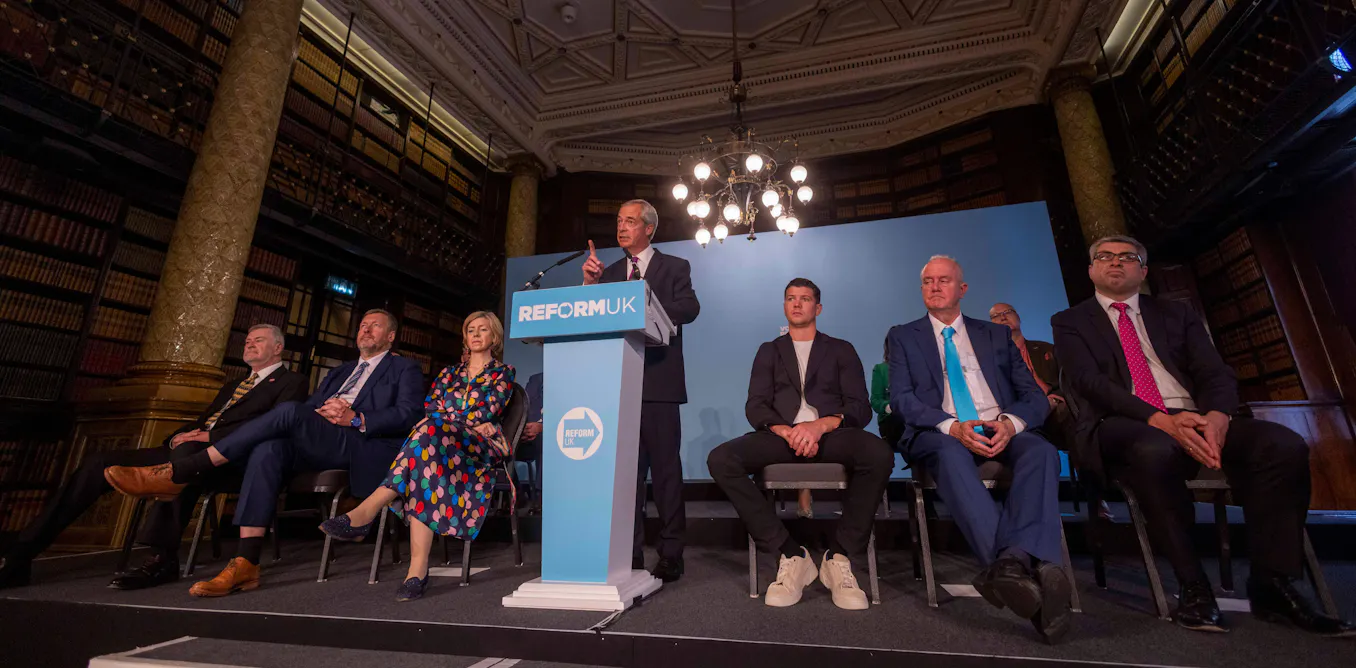
Chris Grover, Lancaster University
The leader of Reform UK, Nigel Farage, recently announced that if in government, his party would abolish the two-child limit on benefits. This social security policy restricts the payment of means-tested benefits to the first two children of a family.
Farage explained the announcement as being pro-natalist – intended to encourage a higher birth rate – as well as being “pro-worker”. Farage said that the abolition of the two-child limit “makes having children just a little bit easier” for “lower paid workers”.
He noted that Reform wanted “to encourage people to have children”. Such arguments are familiar in the European political right, although the UK’s Conservative opposition criticised Reform’s proposal.
To be in government, Reform has two possible routes: to build a coalition of voters for it, or to split left-leaning voters. Its proposal to abolish the two-child limit may be aimed at both.
On the one hand, it might be supported by left-leaning voters who are able to accept Reform’s broader policy agenda. On the other hand, it might be aimed at encouraging left-leaning voters who find Reform’s agenda problematic to move to parties (such as the Greens and Liberal Democrats) who are less equivocal in their commitment to abolishing the two-child limit than the Labour government.
Social security policies winning votes
Social security policies have long been used as part of political strategising. The situation with the two-child limit is complicated, though, because both anti- and pro-natalist views of social security (and it predecessors) have been popular at particular moments.
Political and popular arguments have long been made that supporting the poorest families leads to them having too many children. This, so the argument goes, reproduces, rather than addresses, the poverty they face. Examples can be found, for instance, in the 1834 poor law commission report in relation to “bastardy” and large families, Sir Keith Joseph’s 1970s focus upon the “cycle of deprivation”, as well as “underclass” arguments in the 1980s and 1990s.
The two-child limit was announced in the 2015 budget and introduced in 2017 with the reasoning that “those in receipt of tax credits should face the same financial choices about having children as those supporting themselves solely through work.”

In contrast, the architect of the British welfare state, William Beveridge, noted in 1942 that children’s allowances (now child benefit) would help “housewives as mothers” in their “vital work in ensuring the adequate continuance of the British race and of British ideals in the world.” The 1945 Labour election victory in support of the welfare state suggests pro-natalist policies can contribute to electoral success.
The expansion of tax credits in the 1990s and 2000s were partly explained in pro-natalist terms. Tony Blair, for instance, noted: “The working tax credit enables half a million mothers to choose to stay at home.” That, in other words, tax credits enabled women to choose having and raising children over paid work.
Recent polling, however, suggests that the anti-natalist two-child limit polls well among voters, especially Reform voters. In 2024, for example, YouGov found 60% of Britons thought the two-child limit should be kept. The figure was 84% for Reform voters.
Targeting voters
The abolition of the two-child limit may have been adopted to increase Reform’s appeal to left-leaning voters. Providing additional support for families through social security may be attractive to voters concerned with social injustice. The two-child limit increases child poverty. Affected families are unable to provide even the most basic needs, such as food, clothing and heating.
Nevertheless, Reform’s proposal is also embedded in caveats and would be paid for through means appealing to its existing voters. So, for example, Farage emphasised that the abolition of the two-child limit would be restricted to only British families. It would not be extended to families “who come into the country and suddenly decide to have a lot of children”.
By keeping the two-child limit for migrant families, Reform’s proposals are consistent with existing immigration and asylum policies. It has been observed in an inquiry by All Party Parliamentary Groups on poverty and on migration that policies like this are, at least in part, “designed to push people into poverty in the hope that it will deter others from moving to the UK.” And, therefore, the abolition of the two-child limit can be seen as part of Reform’s pledge to severely curtail immigration.
Farage also argued that the abolition of the two-child limit would be paid for by other policies that are central to Reform’s electoral agenda. These include stopping asylum seekers being housed in hotels and the abolition of net zero policies. It is also consistent with Reform’s view that jobs in Britain should be filled by British people. This, it believes, will help reduce reliance on migrant labour from overseas.
There is little evidence that the introduction of the two-child limit had the desired impact on lowering poorer households’ birth rates. And it is unclear whether the proposed abolition of the two-child limit rooted in a British-only, pro-natalist agenda is enough to attract left-leaning voters.
These voters might, for example, be more concerned with Reform’s position on immigration and asylum seeking, as well as the social injustice of the undoubted poverty in which families subjected to the two child limit on benefits live.
Reform’s strategy then may be to further encourage those voters to turn from its closest rival – the Labour party – to other political parties. Whichever is the case, the situation will undoubtedly shift if the Labour government does take the step of abolishing the two-child limit.
Chris Grover, Professor in Social Policy, Lancaster University
This article is republished from The Conversation under a Creative Commons license. Read the original article.

Why ultra wealthy donors like Elon Musk and Zia Yusuf may just be fundamentally incompatible with the politics of the radical right

Sam Power, University of Bristol
Former chairman Zia Yusuf has rejoined Reform after quitting days previously. Yusuf had said he no longer wanted to work to get the party into government when new MP Sarah Pochin called for a ban on burqas in the UK. However, he seems to have had a change of heart and will return, ostensibly to lead the party’s “department of government efficiency”.
Donald Trump and Elon Musk’s bromance, however, is on much rockier ground. There’s no sign of the world’s richest man reconciling with the US president, his former employer.
These spats, at first glance, might seem like little more than, put politely, teething problems in (relatively) new political operations. Or, a little less politely, the unedifying spectacle of people in or seeking power being completely unable to act like adults.
However, it also points to something more akin to a canary in the coalmine for radical right parties around the world. Their increasing reliance on an ultra-wealthy donor class presents an ideological puzzle that may not be solvable.
Want more politics coverage from academic experts? Every week, we bring you informed analysis of developments in government and fact check the claims being made.
Sign up for our weekly politics newsletter, delivered every Friday.
Reform currently operates on what has been described as vibes alone. That is to say, there’s very little meaningful common ground between the people who vote for Reform and the party elite. The only continuity is their sense of anger at the current political system.
This, as we are seeing in election after election, is an incredibly powerful (and compelling) force. The problem is, of course, that you can’t oppose forever. You often end up having to actually do something. All boxers, Mike Tyson will be glad to tell you, have a plan – until they get punched in the face.
And what makes them such a powerful force at the moment, is precisely that which may cause challenges further down the line. At least for me, given it’s my bread and butter research-wise, I see this when I follow the money.
And I’m increasingly asked a lot of questions about the kind of people who are either giving money to Reform – or who Reform are courting (and at the moment it is decidedly the latter which is the case).
My position is that they very broadly fit into three categories. First are disaffected traditional Conservatives who are increasingly seeing a party – in the words of Farage – “worth investing in”. In the donations figures released on June 10, these are represented by bussinessmen Bassim Haidar and Mohammed Amersi.
Then you have a Silicon Valley-reared tech-bro libertarian. This group already runs on a “move fast and break things” philosophy so the idea of an insurgent party which proclaims, on entering parliament, that “the fox is in the henhouse” naturally appeals.
The final pot of money is filled via small donations, ballooning membership and a whole chunk of votes from a disaffected white working-class population to whom the language of economic and cultural grievances resonates.
There are some places where the interests of these groups align – most notably a distaste for government interference and red tape (though not necessarily a smaller state in terms spending on public services). They also share a sense that progressive politics, broadly defined, ought to be pegged back a bit (but with an emphasis on a bit).
They differ on a great deal else, to the extent that you can only really please two out of the three, but never everybody. And, unfortunately, without all three the project starts collapsing. This is what we have been seeing in the fractious relationships between Trump and Musk and Farage and Yusuf.
Two out of three ain’t bad – but it’s not enough
Yusuf (and Musk) are very much representative of the new tech-bro class. And, when Yusuf called questions about banning the burqa “dumb” he was speaking at both an ideological and organisational level.
At the ideological level it is, frankly, a bit rich for his blood, because “philosophically I am always a bit uneasy about banning things which, for example, would be unconstitutional in the United States”.
Organisationally, it pushes Reform much closer to what journalist Fraser Nelson calls “a tactic more akin to the old BNP”. Indeed, Reform started “just asking questions” about burqas at the same time as it started twisting footage to claim that Anas Sarwar, leader of Scottish Labour, wants to prioritise the needs of Pakistanis.
This kind of dog-whistle politics appeals to some, but puts off a lot more, including, I think, some of the (saner) tech-bro right.
Indeed, Ian Ward at Politico perceptively notes that if we want to explain the current Musk-Trump meltdown we should look back to Christmas 2024, when cracks first started appearing over immigration policy.
The tech-bro right are, generally speaking, much less hardline on the flow of people than the Maga-populist right (think Steve Bannon and Tommy Robinson). In fact, they are pro-high skilled immigration as it tends to benefit them and their business interests.
Tech-bros also like the idea of moving fast and breaking things in theory. But when things start moving fast and actually breaking in practice (or Tesla stocks start to plummet), they tend to get a bit freaked out.
In other words, it’s not just that they don’t like government, they don’t like governing and the inevitable compromise that comes with it. When they say move fast and break things, I get the sense what they really mean is “leave me alone so I can make billions in peace”.
This, of course, is quite appealing to traditional hedge-fund conservatives, but is also the politics that literally built the economic grievances that much of the white-working class support for the populist radical right is, in turn, built on.
Two out of three ain’t bad, but you do need all three. So, don’t be surprised if despite Farage’s seemingly genuine affection for Yusuf, it all falls apart again before long.
Ultimately, Reform will need to decide how they are going to spin these plates. The good news is that it might well be that they can, indeed, get by on vibes alone until the next general election. The bad news, unfortunately, is that winning an election is the easy bit. Just ask Boris Johnson and Keir Starmer. After all, everyone has a plan.
Sam Power, Lecturer in Politics, University of Bristol
This article is republished from The Conversation under a Creative Commons license. Read the original article.