‘Sick’: Trump Marks Earth Day With Layoff Notice for Hundreds of EPA Staff

Spread the love

Original article by Jessica Corbett republished from Common Dreams under Creative Commons (CC BY-NC-ND 3.0).
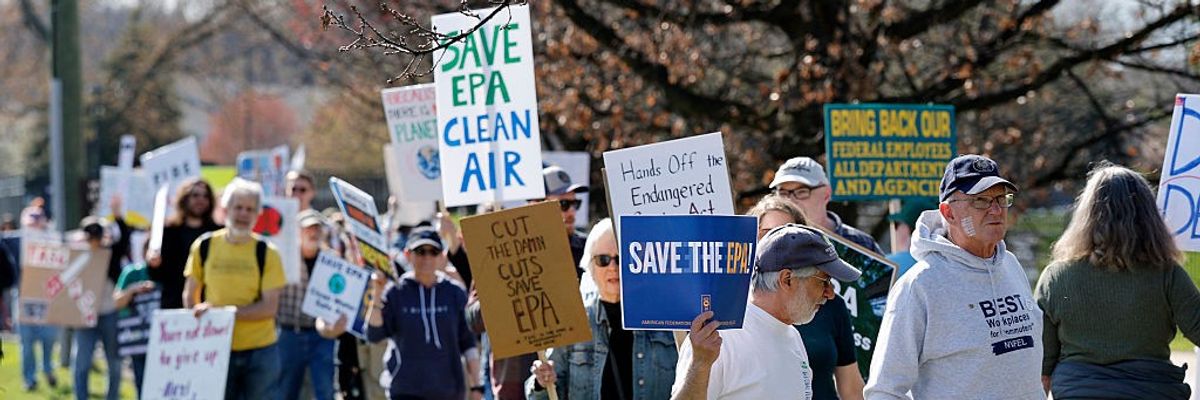
Demonstrators march during a “Hands off the EPA” rally outside the Environmental Protection Agency office in Ann Arbor, Michigan, on Earth Day, April 22, 2025. (Photo: Jeff Kowalsky/AFP via Getty Images)

“The only people who will benefit from their firings are corporate polluters.”

As defenders of the planet marked Earth Day with pledges to fight the destructive agenda of U.S. President Donald Trump, some green groups on Tuesday responded with alarm to the administration’s plans for layoffs at the Environmental Protection Agency.

Several news outlets obtained the notice that EPA Assistant Deputy Administrator Travis Voyles sent on Monday evening to staffers with the Office of Environmental Justice and External Civil Rights as well as regional EJ divisions, warning of a reduction in force (RIF) that will cut 280 employees and reassign about 175 others this summer.

“This action is necessary to align our workforce with the agency’s current and future needs and to ensure the efficient and effective operation of our programs,” Voyles said. “With this action, EPA is delivering organizational improvements to the personnel structure that will directly benefit the American people and better advance the agency’s core mission of protecting human health and the environment.”

The Washington Post noted that “the news comes months after the agency placed 171 of the office’s employees on administrative leave and then reversed course, reinstating dozens of regional employees in offices across the country,” and as decision-makers at the EPA have been weighing how to implement Trump’s executive order targeting diversity, equity, and inclusion (DEI).

“It’s a gut punch but long expected,” said an employee who was put on leave in February and spoke with the Post on the condition of anonymity. “Announcing a RIF of the EJ program on the eve of Earth Day is sick and shows exactly who they are.”

Joyce Howell, executive vice president of the American Federation of Government Employees Council 238 that represents over 8,400 EPA workers nationwide, toldReuters that “decimating our agency and environmental justice workforce goes against our oath to protect human health and to keep our planet healthy and habitable for future generations.”

In a Tuesday statement, Sierra Club executive director Ben Jealous similarly said that “the Trump administration is determined to destroy the stated mission of the Environmental Protection Agency to protect human health and the environment. All of us deserve to have clean air to breathe, safe water to drink, and be protected from toxic pollution.”

“Instead, the Trump administration is selling us out to corporate polluters by actively working to slash clean air and water protections and laying off critical environmental justice staff,” he continued. “The people that Donald Trump is putting out of work are hardworking, dedicated civil servants who have devoted their careers to protecting our clean air and water and securing a livable future for us all. The only people who will benefit from their firings are corporate polluters.”

Chitra Kumar, a former official with the impacted EPA office who’s now managing director at the Union of Concerned Scientists’ Climate and Energy Program, said in a statement that “the layoff notice sent to employees claimed their dismissal would ‘better advance the agency’s core mission of protecting human health and the environment,’ which is the height of hypocrisy given that these staffers are working to reduce pollution and toxins in the communities suffering the most harm.”

“Scientific data shows that, due to historic and ongoing injustices, communities overburdened by polluting industries, smog-forming traffic, and contaminated waterways and soil are predominantly low-income, Black, Brown, and Indigenous. Exposure to consistently higher levels of pollution increases the risk of asthma, heart and lung ailments, cancer, and even death,” said Kumar, who took aim at EPA Administrator Lee Zeldin.

“Zeldin and the Trump administration continue to focus on propping up the profits of coal, oil, and gas companies and other big polluters who take advantage of every loophole available at the expense of public health. This is about all of us, our children, and grandchildren,” she stressed. “If Administrator Zeldin goes forward with this destructive move, he will be responsible for ending decades of work intended to help set right the harmful legacy of pollution in overburdened communities in a handout to big polluters.”

Kumar pointed out that “this is also part of the Trump administration’s larger ongoing strategy to dismantle EPA and its core functions and undermine its very mission, which is to help keep all people in America safe. In the time ahead, Zeldin is expected to launch a repeal, or ‘no enforce’ order, for a host of science-backed environmental regulations and engage in a wholesale ‘reorganization’ of the agency, including gutting the Research and Development Office that produces science undergirding EPA decisions.”

As criticism of Zeldin and Trump’s plans for the EPA mounted, people protested against the administration in communities across the country. Aru Shiney-Ajay, executive director of the youth-led Sunrise Movement, said in a statement that “Donald Trump, backed by fossil fuel billionaires, is waging a full-scale assault on the very lifesaving protections that Earth Day was created to demand.”

While Republicans currently control the White House and both chambers of Congress, some elected Democrats used Earth Day to advocate for policies that would protect the planet. Multiple senators used the day to promote bills that would protect the Pacific and Atlantic oceans from offshore oil and gas drilling.

Original article by Jessica Corbett republished from Common Dreams under Creative Commons (CC BY-NC-ND 3.0).

Orcas comment on killer apes destroying the planet by continuing to burn fossil fuels.
Neo-Fascist Climate Science Denier Donald Trump says Burn, Baby, Burn.
Elon Musk urges you to be a Fascist like him, says that you can ignore facts and reality then.
Continue Reading‘Sick’: Trump Marks Earth Day With Layoff Notice for Hundreds of EPA Staff

Pope Francis Dies at 88 After Final Appeal for Gaza Cease-Fire

Spread the love

Original article by Common Dreams Staff republished from Common Dreams under Creative Commons (CC BY-NC-ND 3.0).

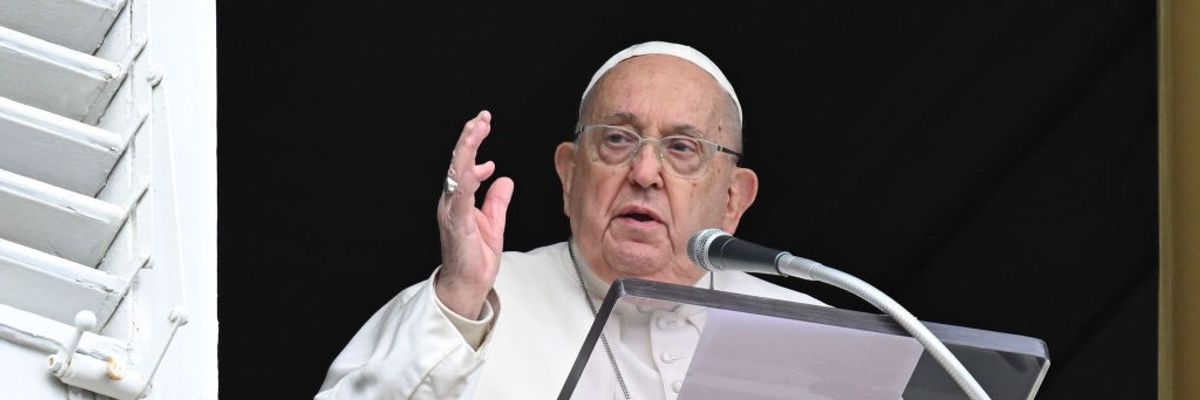
Pope Francis delivered a Sunday Angelus blessing from the window of his studio overlooking St. Peter’s Square on January 12, 2025 in Vatican City.  (Photo: Vatican Media via Vatican Pool/Getty Images)

“Will the millions who will mourn his death these coming days respect this wish of his? Will they care for Gazans and Palestinians the way he did?”

The Vatican announced Monday that Pope Francis has died at the age of 88, hours after he appeared at an Easter mass and appealed for an end to Israel’s war on the Gaza Strip.

The pope’s Easter address, read aloud by Archbishop Diego Ravelli, decried the “terrible conflict” in Gaza that “continues to cause death and destruction and to create a dramatic and deplorable humanitarian situation.”

“I appeal to the warring parties: call a cease-fire, release the hostages, and come to the aid of a starving people that aspires to a future of peace!” said the message from the pope, an outspoken opponent of military conflict and war profiteersclimate destruction, and runaway economic inequality.

“In the face of the cruelty of conflicts that involve defenceless civilians and attack schools, hospitals, and humanitarian workers, we cannot allow ourselves to forget that it is not targets that are struck, but persons, each possessed of a soul and human dignity,” the pope’s address continued.

News of Pope Francis’ death came after a bout with double pneumonia left him hospitalized for more than a month. The Vatican did not specify a cause of death in its announcement.

The Nation‘s John Nichols wrote Sunday that Pope Francis’ calls for peace have made him “arguably the most consistent high-profile defender of the humanity of the Palestinian people during a period when the Israeli assault on Gaza has been pursued with relentless violence.”

Nichols continued:

With a boldness and specificity that has often sparked controversy, this pope has challenged economic injustice, racism, environmental neglect, militarism, and the abuses of new technologies that increase inequality. He has faced his share of criticism, not just from conservatives who disapprove of his views but also from reformers who sincerely wish that he would do more to modernize the church. Yet, in a time of too much indifference and impunity, this pope has remained uniquely engaged with the embattled regions that political and media elites neglect or abandon.

That’s been especially true when it comes to Gaza, where Pope Francis has long argued for cease-fires, arms blockades, aid convoys, and a diplomatic urgency that recognizes that Palestinians and Israelis are “fraternal peoples [who] have the right to live in peace.”

In a tribute to Pope Francis, Palestinian theologian Munther Isaac wrote Monday that “he conveyed true compassion to Palestinians, most notably to those in Gaza during this genocide.”

“The pope left our world today, and the occupation and the wall remained. Even worse, he left our world while a genocide continues to unfold,” Isaac wrote, pointing to the pontiff’s call for a thorough international investigation of Israel’s assault on Gaza.

“Today I wonder: Will the millions who will mourn his death these coming days respect this wish of his?” Isaac asked. “Will they care for Gazans and Palestinians the way he did?”

Original article by Common Dreams Staff republished from Common Dreams under Creative Commons (CC BY-NC-ND 3.0).
Continue ReadingPope Francis Dies at 88 After Final Appeal for Gaza Cease-Fire

Pope Francis: A Humble Advocate for Sharing the World’s Resources

Spread the love

Original article by Adam Parsons republished from Common Dreams under Creative Commons (CC BY-NC-ND 3.0).
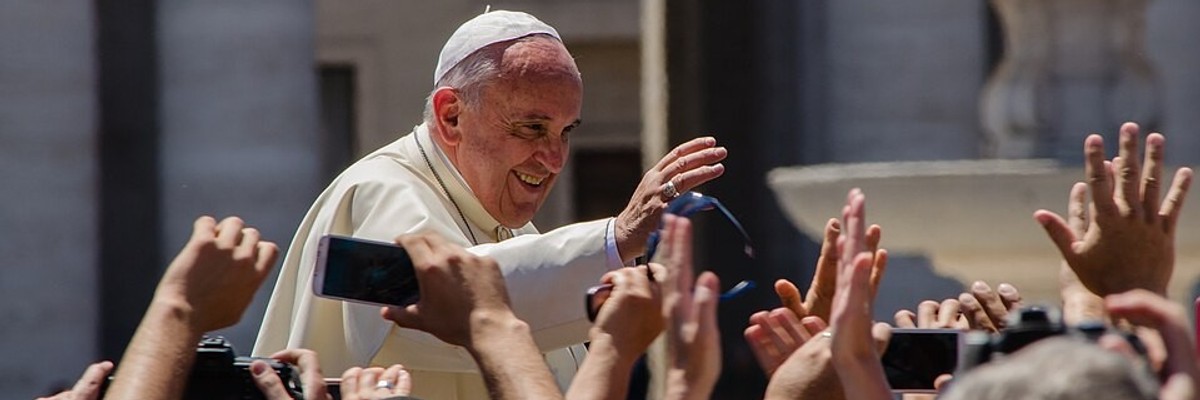
Pope Francis greeting people in St. Peter’s Square in Vatican City in 2014. (Photo: Alfredo Borba/Creative Commons)

Again and again, Pope Francis railed against our collective indifference to widespread suffering and urged humanity, especially world leaders, to do better. It’s not too late to heed his call.

Like millions of other people, I was deeply saddened to hear of the passing of Pope Francis, one of the most vocal and humble advocates for sharing the world’s resources.

Since assuming the throne of St Peter in 2013, the Pope championed many causes that are dear to progressive activists—from agroecology to post-growth economicsfossil fuel divestmentarms trade regulation and global monetary reform.

But at the heart of his advocacy was a focus on ending inequality both globally and on a national basis, repeatedly calling upon governments to redistribute wealth and benefits to the poor in a new spirit of generosity.

I first recall being struck by Pope Francis’ headline-grabbing speech in 2014, when he urged the United Nations to promote a ‘worldwide ethical mobilization’ of solidarity with the poor to help curb an ‘economy of exclusion’ that is taking hold everywhere today.

A year later in 2015, the papal encyclical Laudato Si’—subtitled ‘On care for our common home’—made bigger headlines around the world with its powerful critique of laissez-faire ideology and its destructive effects on the environment. The trenchant letter expounded on the responsibility of rich countries to address their ‘ecological debt’ to less developed countries, with an acknowledgement of ‘differentiated responsibilities’ in addressing climate change. It was a radical entreaty for resource transfers between the Global North and South, and significant reductions in the consumption of non-renewable energy within developed countries.

The eloquent discourse of Laudato Si’ also reflected the core understanding of many environmental activists—that the climate and inequality crises are inextricably interconnected. Again and again, Pope Francis railed against our collective indifference to widespread human suffering. He persistently argued that the welfare of nations is interrelated, so the massive poverty and hunger experienced in the fragile economies of developing nations is, in turn, reflected in the destruction of the natural environment. Hence the urgency of remediating the enormous discrepancies in living standards throughout the world, which calls for a sense of global solidarity and interdependency that is tragically lacking in human affairs.

During the coronavirus pandemic, Francis also set out the challenge for rich nations to cooperate and distribute the vaccine freely to the world, rather than hoarding resources and treating one’s own nation first. The 2020 encyclical titled Fratelli tutti—‘Brother’s all’—made clear that Covid-19 was exposing existing inequalities, and fraternity on a state level requires richer countries to help poorer ones if we are to give meaning to the equality of human rights. Clearly, the world failed to heed Pope Francis’ plea to ensure recovery from the crisis tackled poverty, inequality and the climate emergency by ‘sharing resources in a just and respectable manner’.

Another theme that Francis constantly returned to was the need for cancelling the debts of countries unable to repay them. In his final papal bull for the Jubilee Year 2025, titled Spes non confundit—‘Hope does not disappoint’—he described debt forgiveness as a matter of justice more than generosity, and again decried the true ecological debt that exists between the Global North and South.

Francis was rightly known as the ‘Pope of the peripheries,’ standing up for the most vulnerable and marginalized peoples. He made clear his opposition to Western government policies of battening down the hatches and draconian responses to international migrants. Soon after taking office, Francis visited the Italian island of Lampedusa where he condemned European ‘indifference’ to the drowning of migrants crossing the Mediterranean in small boats. He later visited numerous camps for excluded migrants and refugees living ‘ghost lives in limbo,’ calling upon us to see Christ in the stranger and outsider. This was a sharp rebuke to reactionary politicians like Trump, Meloni, and Orbán, instead emphasizing the need for ‘universal fraternity’ as influenced by St. Francis of Assisi, after whom the Pope took his name.

It was a fitting testament to Francis’ advocacy for the poor and forgotten that he died hours after calling for a ceasefire in Gaza. In his annual Urbi et Orbi —‘To the City and World’—message on Easter Sunday, the day before he died, Francis repeated his appeal to the warring parties to “come to the aid of a starving people that aspires to a future of peace.” Few politicians, it seems, have followed the Pope’s counsel throughout his 12-year-long pontificate. Which now leaves it up to us, the ordinary people of goodwill, to uphold Francis’ tireless advocacy and hope for a better world.

Original article by Adam Parsons republished from Common Dreams under Creative Commons (CC BY-NC-ND 3.0).
Continue ReadingPope Francis: A Humble Advocate for Sharing the World’s Resources

Pope’s climate letter is a radical attack on the logic of the market

Spread the love

Steffen Böhm, University of Esse

What makes Pope Francis and his 183-page encyclical so radical isn’t just his call to urgently tackle climate change. It’s the fact he openly and unashamedly goes against the grain of dominant social, economic and environment policies.

While the Argentina-born pope is a very humble person whose vision is of a “poor church for the poor”, he seems increasingly determined to play a central role on the world stage. Untainted by the realities of government and the greed of big business, he is perhaps the only major figure who can legitimately confront the world’s economic and political elites in the way he has.

However his radical message potentially puts him on a confrontation course with global powerbrokers and leaders of national governments, international institutions and multinational corporations.

The backlash has begun even before the encyclical has been officially published. US presidential candidate Jeb Bush, a Catholic, feels the pope should stay out of the climate debate, joining other Republicans, fossil fuel lobbyists and climate denier think-tanks in seeking to discredit Pope Francis’s intervention.

What makes the pope so radical?

There are several meanings of the word “radical” that can be applied to the Pope and in particular his forthcoming encyclical.

First, radical can be understood as going back to the roots (from Latin radix, root). The majority of Catholics live in the Global South; in Latin America and sub-Saharan Africa. Francis is the first pope from the Global South, and naming himself in honour of Saint Francis of Assisi, “a man of poverty and peace who loved nature and animals”, signalled to the world a commitment to going back to the roots of human existence.

The pope knows the plight of the majority world. Before he became Archbishop of Buenos Aires, he was a priest in the vast, poor neighbourhoods, the villas miserias or slums, of Argentina’s capital.

Improving the lives of slum dwellers and addressing climate change is, for Pope Francis, one and the same thing. Both require tackling the structural, root causes of inequality, injustice, poverty and environmental degradation.

For example, his encyclical says:

Even as the quality of available water is constantly diminishing, in some places there is a growing tendency, despite its scarcity, to privatize this resource, turning it into a commodity subject to the laws of the market. Yet access to safe drink- able water is a basic and universal human right, since it is essential to human survival and, as such, is a condition for the exercise of other human rights. (p. 23)

This stands in stark contrast to, for example, Peter Brabeck-Letmathe, the chairman of Nestlé, the world’s largest food and bottled water company, who thinks water is a normal commodity with a market value, and not a human right. Nestlé is far from unusual. Its stance is backed up by the official water privatisation policies of the World Bank, IMF and other international institutions.

In fact, the encyclical is a radical – for a pope and international leader, unprecedented – attack on the logic of the market and consumerism, which has been expanded into all spheres of life.

The document states:

Since the market tends to promote extreme consumerism in an effort to sell its products, people can easily get caught up in a whirlwind of needless buying and spending. Compulsive consumerism … leads people to believe that they are free as long as they have the supposed freedom to consume. But those really free are the minority who wield economic and financial power. (p. 149-150)

The pope rejects market fundamentalism, instead arguing that “the market alone does not ensure human development and social inclusion.”

In the same way, he warns us of the brave new world of carbon markets such as the EU Emissions Trading System and the UN’s Clean Development Mechanism, which have been created to reduce the world’s carbon emissions.

The encyclical states:

The strategy of buying and selling “carbon credits” can lead to a new form of speculation which would not help reduce the emission of polluting gases worldwide. This system seems to provide a quick and easy solution under the guise of a certain commitment to the environment, but in no way does it allow for the radical change which present circumstances require. Rather, it may simply become a ploy which permits maintaining the excessive consumption of some countries and sectors. (p. 126)

The pope’s right. The same criticisms of carbon markets have been made by myself and others.

Will he make any difference?

Pope Francis has already angered conservative Catholics in the US by clearly stating that:

Climate change is a global problem with grave implications: environmental, social, economic, political and for the distribution of goods. It represents one of the principal challenges facing humanity in our day. (p. 20)

While the pope is not a politician – or maybe precisely because he is not one – he commands high moral and ethical authority that goes beyond traditional partisan lines. His encyclical speaks truth to power, and he might be the only person with both the clout and the desire to meaningfully deliver a message like this:

Many of those who possess more resources and economic or political power seem mostly to be concerned with masking the problems or concealing their symptoms, simply making efforts to reduce some of the negative impacts of climate change. However, many of these symptoms indicate that such effects will continue to worsen if we continue with current models of production and consumption. There is an urgent need to develop policies so that, in the next few years, the emission of carbon dioxide and other highly polluting gases can be drastically reduced, for example, substituting for fossil fuels and developing sources of renewable energy. (p. 21)

The bosses of Shell, ExxonMobil and other fossil fuel companies will not like this message, as it threatens their fundamental business model, and it also stands in contrast to the underwhelming ambitions of the G7 leaders who recently pledged to phase out fossil fuels only by 2100.

The time for bold, radical action on the environment as well as poverty eradication has come. This seems to be Pope Francis’ message: “The same mindset which stands in the way of making radical decisions to reverse the trend of global warming also stands in the way of achieving the goal of eliminating poverty.” (p. 128)

We need to think beyond the current, taken-for-granted logic that believes only markets and consumerism can solve the world’s social and environmental problems. The pope himself believes the situation is so grave that only a new, “true world political authority” will be able to address these problems.


This article was updated on 18 June to include quotes from the final encyclical rather than the earlier draft leaked to L’Espresso magazine.

Steffen Böhm, Professor in Management and Sustainability, and Director, Essex Sustainability Institute, University of Essex

This article is republished from The Conversation under a Creative Commons license. Read the original article.

Continue ReadingPope’s climate letter is a radical attack on the logic of the market

Climate Crisis Deniers Explain Why They Like U.S. Energy Secretary Chris Wright

Spread the love

Original article by Geoff Dembicki republished from DeSmog

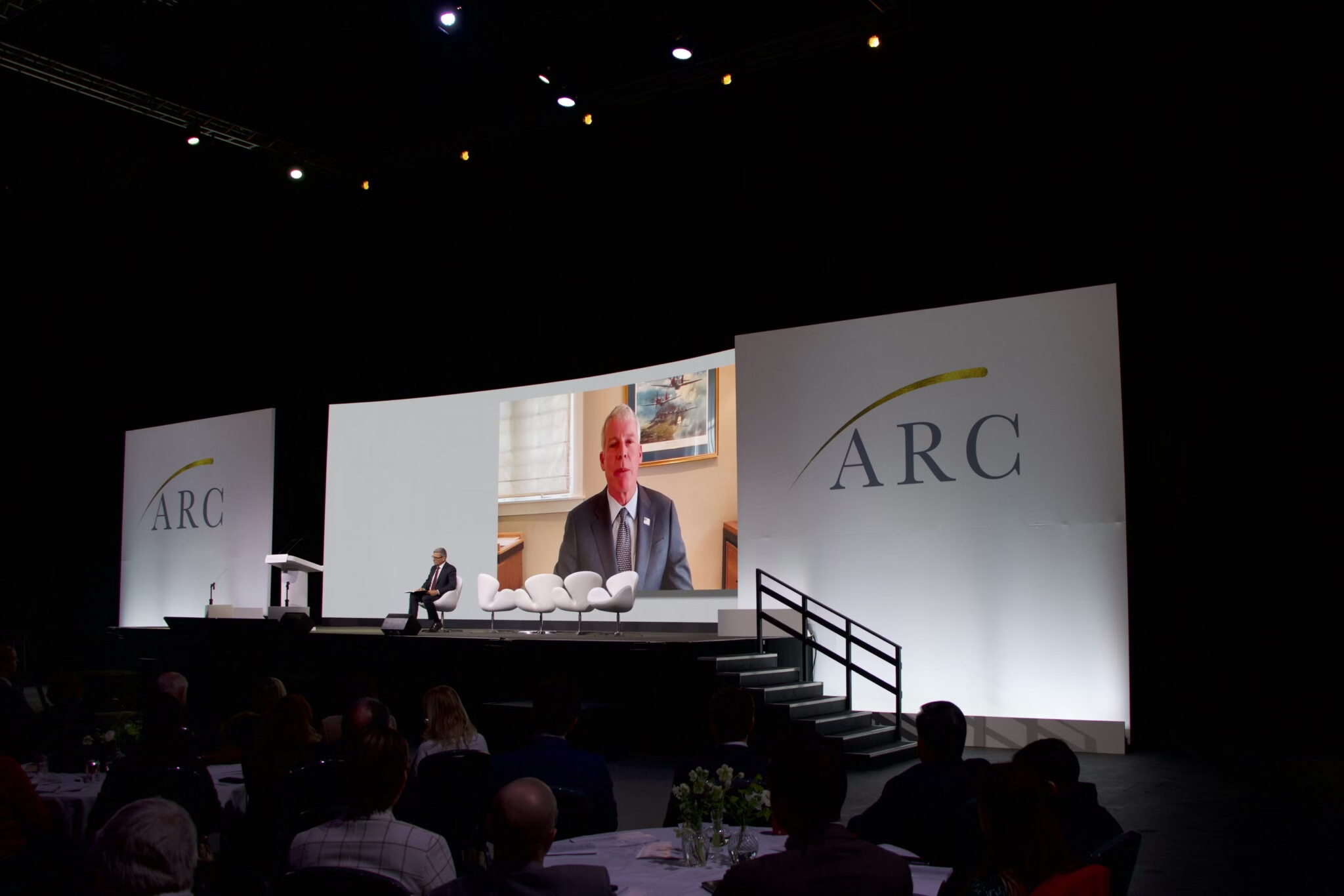
U.S. Energy Secretary Chris Wright speaks to ARC by video. Credit: Marc Fawcett-Atkinson

In exclusive interviews, they called the Trump administration official “terrific,” “very smart,” and someone who “gets it.”

In mid-February, U.S. Energy Secretary Chris Wright described the global effort to stabilize greenhouse gas emissions in dark and conspiratorial terms.

“Net zero 2050 is a sinister goal,” he told the Alliance for Responsible Citizenship (ARC), an international gathering of conservatives convened by Canadian podcaster, author, and anti-climate powerbroker Jordan Peterson. “It’s certainly been a powerful tool used to grow government power [and], top-down control, and shrink human freedom.”

Then in March, Wright did a speech at the 43rd annual CERAWeek where he attacked the Biden administration’s climate policies as a “quasi-religious” agenda “that imposed endless sacrifices on our citizens.”

Those views put Wright, formerly a CEO with the fracking company Liberty Energy, far outside the Paris Agreement consensus among many world leaders and heads of major corporations that climate change is an urgent issue that requires fundamental changes to our global energy system.

But Wright’s reactionary statements are winning him praise from fossil fuel advocates who acknowledge that human-caused climate change is real but deny that it presents existential threats to civilization – what watchdog nonprofits such as the Center for Countering Digital Hate refers to as “the new denial.” 

In exclusive interviews with DeSmog and Canada’s National Observer conducted during the ARC conference, three prominent figures who deny there is a climate emergency explained why they’re excited that Wright holds one of the most consequential cabinet posts in the Trump administration, with one referring to the U.S. energy secretary as “a good friend.”

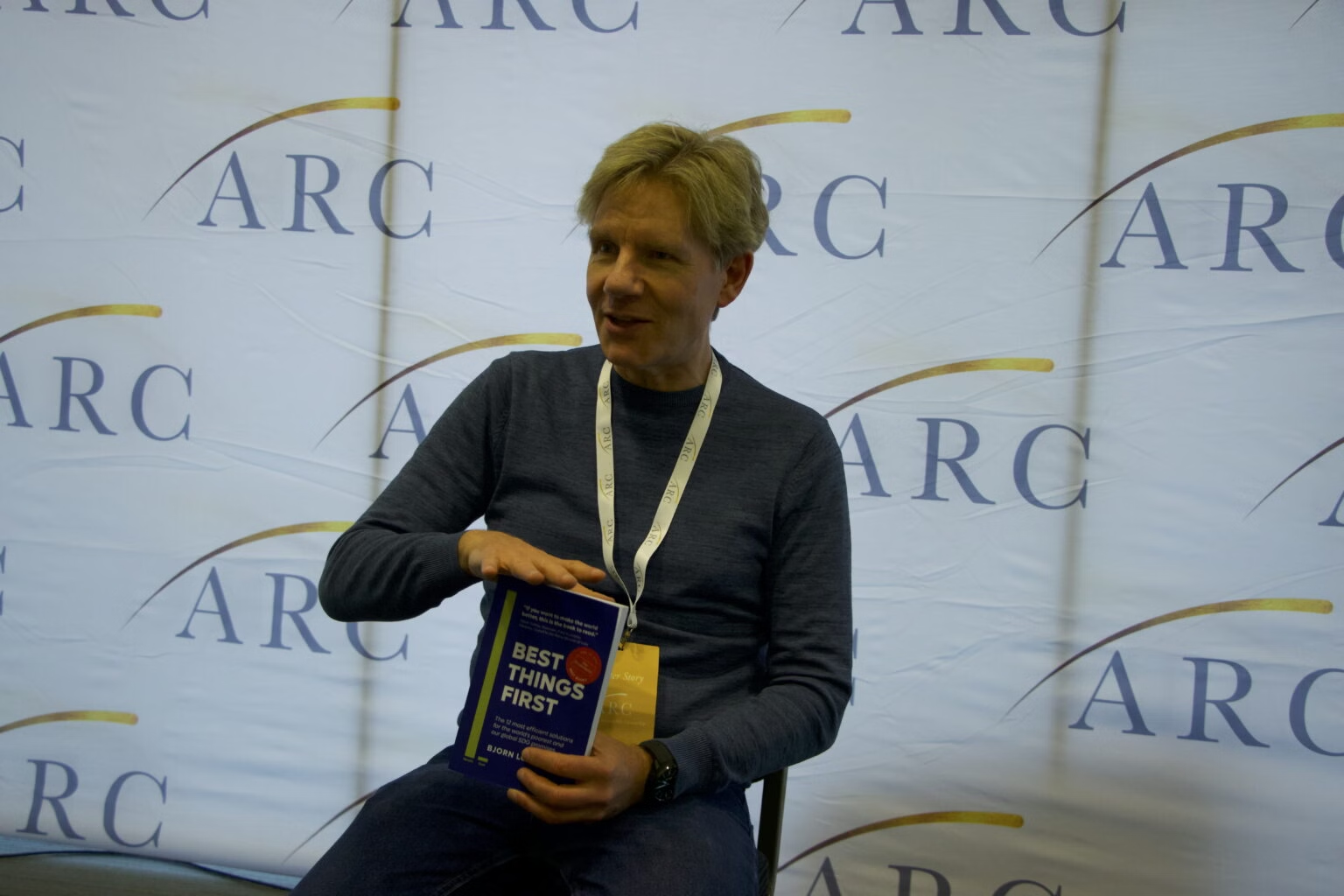
Bjorn Lomborg speaks about his most recent book during a press briefing at ARC. Credit: Marc Fawcett-Atkinson

Bjorn Lomborg

One particularly influential climate crisis denier is Bjorn Lomborg, a Danish political scientist who for decades has been trying to convince policymakers and the public that there are more important global challenges to address than climate change. This is the subject of his most recent book, Best Things First, which Lomborg was promoting at ARC. Last year, Peterson personally presented a copy of the book to Elon Musk.

“We’ll have to wait and see if he actually reads it,” Lomborg said of Musk in an interview with DeSmog and Canada’s National Observer at the conference.

Lomborg, who is an advisor to ARC, said during a keynote speech that efforts to transition off fossil fuels are a “green fantasy.” Lomborg acknowledges that climate change is real but claims, contrary to decades of scientific and economic evidence, that it will be relatively easy and painless for humankind to adapt.

Those arguments have resonated with Wright, who during a 2020 podcast referred to Lomborg’s previous book False Alarm as “fantastic,” and earlier this year described him as a “friend” on LinkedIn.  

Asked what he thinks about Trump’s pick for energy secretary, Lomborg replied: “Look, Chris Wright is a great guy and he’s very smart. And I’m very happy that we can get a more sense-based approach to how we do energy.”

Part of that, according to Lomborg, is acknowledging — despite low-carbon investment surpassing $2 trillion in 2024 — that a transformative global shift to green energy isn’t happening anytime soon. “We’re not there yet,” he said. “And that, I think, is what Chris Wright can help us to do, which is to say, ‘let’s be realistic now and let’s find smarter ways to have greener energy sources in the future.’”

Scott Tinker does a speech at ARC. Credit: Marc Fawcett-Atkinson

Scott Tinker

During his 13-minute presentation at ARC, Scott Tinker outlined his view that energy has to be affordable, reliable, and clean, criteria that in his view disadvantages renewable energy. “If you want 100 percent clean you don’t get much of these other things,” he told the conference. “There are trade-offs in the real world.”

Tinker runs an organization called Switch Energy Alliance that creates videos about energy and climate change for classrooms, museums, and professional training sessions. The organization says that it wants an “energy-educated future that is objective, nonpartisan, and sensible.”

But Tinker tends to promote the benefits of fossil fuels while downplaying the urgency of addressing global temperature rise. During a podcast interview in March, Tinker said it was “a very strange form of economic colonialism” to argue against developing world countries burning fossil fuels “because we’ll wreck the climate.” We shouldn’t fear a bit of atmospheric warming, Tinker added, urging listeners to instead consider “all the positive things” countries gain from oil, gas, and coal.

Wright has used similar language, telling a gathering of African leaders in March that it would be “a paternalistic post-colonial attitude” for the U.S. to stand in the way of their fossil fuel resources.

The similarities between Wright’s and Tinker’s views aren’t a coincidence. Tinker told DeSmog in an interview at ARC that he and the U.S. energy secretary have known each other for years. “Chris is a good friend,” Tinker said. “We’ve bounced a lot back and forth.”

One other area they seem to agree on is rejecting carbon dioxide’s legal status as a pollutant in the U.S., which helps provide the basis for the Environmental Protection Agency to regulate emissions. That’s been a long-time goal of climate denial organizations such as the CO2 Coalition and Heartland Institute.

“We shouldn’t confuse [CO2] with being a pollutant,” Tinker said.

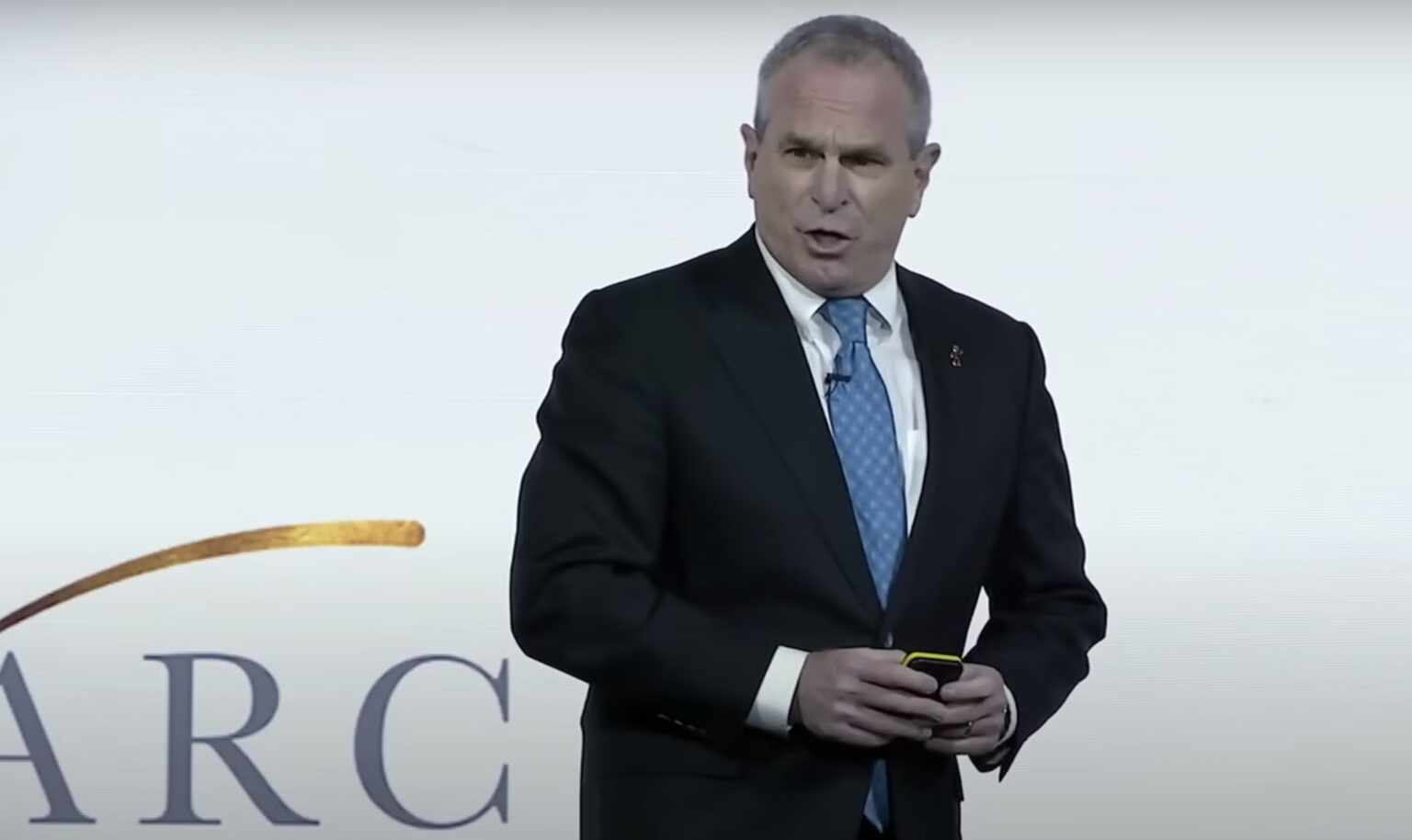
Robert Bryce speaks at ARC. Credit: ARC / YouTube

Robert Bryce

For years Robert Bryce has been on a mission to convince the world that renewable energy can never replace or out-compete coal, gas, and oil. Previously a senior fellow with the Manhattan Institute— a think tank with a long history of accepting fossil fuel money and questioning the scientific consensus on climate change — Bryce now attacks climate solutions as an author, speaker, and filmmaker.

During his speech at ARC, he claimed that “we are inundated with climate catastrophism,” and argued without evidence that the primary motivation for environmentalists to be opposed to fossil fuels is because their organizations have “enormous” budgets, saying “it’s a big business.”

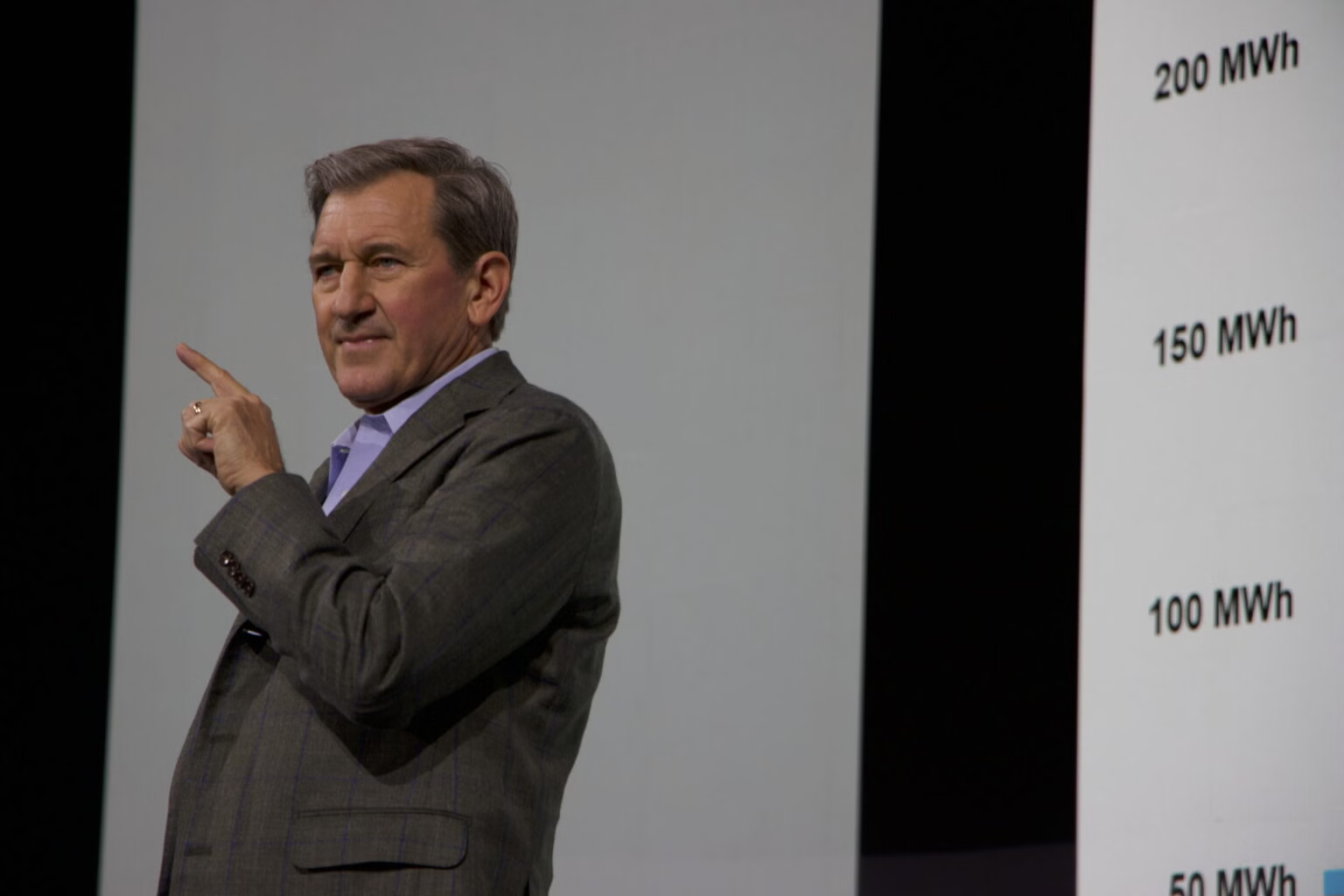
Bryce is a long-time proponent of nuclear energy, something he shares in common with Wright, who stepped down as a member of the board of directors at the nuclear company Oklo after he was confirmed as energy secretary in February.

“Chris gets it,” Bryce said in an interview with DeSmog. “Chris knows what the score is. He’s a natural gas guy, a hydrocarbon guy. He’s promoting nuclear power. Hopefully this administration, now that they’re actually talking about nuclear, can actually move the ball forward, it’s overdue.”

Bryce and Wright also seem to share opposition to carbon capture and storage, a technology widely favored by oil and gas producers, which tout it as key to reducing emissions from their operations despite it being widely used to pull more oil from the ground. Under Wright, the U.S. Department of Energy is considering cutting billions of dollars’ worth of funding for projects utilizing the technology.

“There is only one reason why any of these hydrocarbon companies are doing carbon capture,” Bryce said. “Subsidies, that’s it.”

“It will never work at scale,” he added. “Once you get that CO2 super-compressed and you’re pushing it down underground, there are very few places where you can actually sequester it. So it’s a lot of money wasted.”

This special investigation between Canada’s National Observer and DeSmog was produced in collaboration with the I-SEA and TRACE Foundation.

Original article by Geoff Dembicki republished from DeSmog

Neo-Fascist Climate Science Denier Donald Trump says Burn, Baby, Burn.
Elon Musk urges you to be a Fascist like him, says that you can ignore facts and reality then.
Continue ReadingClimate Crisis Deniers Explain Why They Like U.S. Energy Secretary Chris Wright