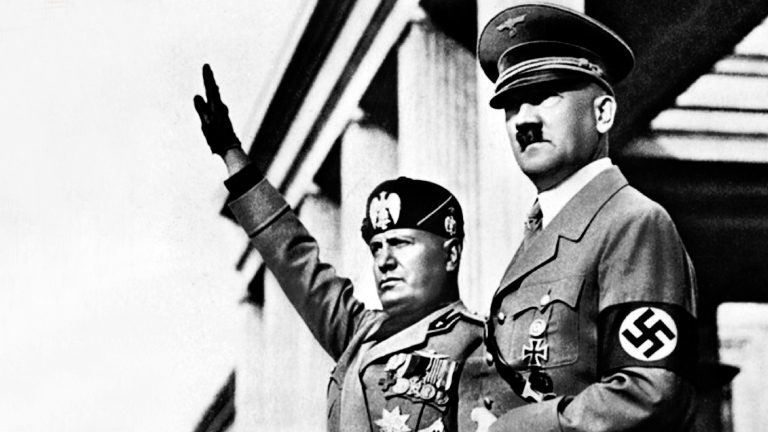
The point is that Zionists are Fascists as much as WW2 Nazi Fascists were Fascist scum
Contemporary Zionists deny human rights. They deserve to be locked up or worse.
Netaniahu, Starmer & Co (isn’t the cabinet to be held totally equally guilty)
Trump, Musk. Let’s fucking lock them up for being mass-murdering genocidal cunts just like the Nazis.
ed: Well come on, that’s exactly what they are. The UK government is supporting Israel’s genocide.
The Fascists of WW2 were different. The contemporary Fascists are Zionists. Yes, it’s difficult to understand in a historical way but current Zionists are very Fascist in the sense that they are racist and intolerant. [ed: They are the same in committing genocide. It is the responsibility of all of us to oppose and resist genocide.] ed: I don’t know about legality. We are all responsible to oppose and resist genocide, to hold those responsible to account. It’s a matter of humanity and common decency never mind anything more than that. Cnuts who are complicit or even less need to be punished.
ed: We have to oppose Fascism. I suggest that includes Netaniahu’s Israeli Neo-Fascism, UK Starmer’s Israel-supporting Fascism and US Trump (and Musk) Fascism. Fascism needs to be confronted and opposed.
03.27am GMT If nothing else, people in UK know that Starmer deserves to be hung, drawn and quartered or worse for complicity in genocide and these Labour Party cunts who support him deserve the same.
03.30a.m. Isn’t that what the law is? That genocide is illegal? yet Keir Starmer, David Lammy and the UK Labour Party, the UK military are complicit, active participants in genocide?
When are you going to oppose this new Fascism?
When are you going to fight back?
ed: If you’re going to oppose Fascism you’de better start now.
Any idea when you might object to genocide?
You could decide that human rights are worth defending. That’s unless you’re a Zionshit of course.
‘Batsh*t Crazy’ Trump Tariffs Should Be Seen as $7,000 Tax Hike on Workers, Says Economist
Original article by Jessica Corbett republished from Common Dreams under Creative Commons (CC BY-NC-ND 3.0).

(Photo: Michael M. Santiago/Getty Images)
Instead of strategically imposing tariffs, Trump has chosen to “give the country the most massive tax increase in its history, possibly exceeding $1 trillion on an annual basis.”
As stocks “nosedived” on Thursday, economists, policymakers, and campaigners around the world continued to warn about the impacts of U.S. President Donald Trump’s trade war, which includes a 10% universal tariff for imports and steeper duties—that he claims are “reciprocal”—for dozens of countries, set to take effect over the next week.
“This is how you sabotage the world’s economic engine while claiming to supercharge it,” wrote Nigel Green, CEO of the international financial consultancy deVere Group. “Trump is blowing up the post-war system that made the U.S. and the world more prosperous, and he’s doing it with reckless confidence.”
As Bloomberg detailed after the president’s “Liberation Day” remarks from the White House Rose Garden:
China’s cumulative tariff rate of 54% includes both the 20% duty already charged earlier this year, added to the 34% levy calculated as part of Trump’s so-called reciprocal plan, according to people familiar with the matter. The European Union’s rate is 20% and Vietnam’s is 46%, White House documents showed. Other nations slapped with larger tariffs include Japan with 24%, South Korea with 25%, India with 26%, Cambodia with 49%, and Taiwan with 32%.
In Europe on Thursday, “the regional Stoxx 600 index provisionally ended down around 2.7%,” while “the U.K.’s FTSE 100 was down 1.6%, with France’s CAC 40 and Germany’s DAX posting deeper losses of 3.3% and 3.1%, respectively,” according to CNBC.
In the United States, CNBC reported, “the broad market index dropped 4%, putting it on track for its worst day since September 2022. The Dow Jones Industrial Average tumbled 1,200 points, or 3%, while the Nasdaq Composite fell 5%. The slide across equities was broad, with decliners at the New York Stock Exchange outnumbering advancers by 6-to-1.”
Sorry, this content could not be embedded.
BlueSky
However, as Economic Policy Institute (EPI) chief economist Josh Bivens noted last week, “because most households depend overwhelmingly on wages from work as their primary source of income and not returns from wealth-holding, the stock market tells us nothing about these households’ economic situations.”
And Trump’s tariffs are expected to hit U.S. households hard, as the cost of his taxes on imports are passed on to consumers.
“Tariffs can be a legitimate and useful tool in industrial policy for well-defined strategic goals, but broad-based tariffs that significantly raise the average effective tariff rate in the United States are unwise,” Bivens and EPI senior economist Adam Hersh stressed in a Thursday statement—which also called out Trump for mischaracterizing one of the think tank’s 2022 analyses.
“Further, the second Trump administration’s rationale, parameters, and timeline for tariffs have been ever-shifting,” Bivens and Hersh continued. “As the original post cited by the administration argues, tariffs should not be a goal unto themselves, but a strategic tool to pair with other efforts to restore American competitiveness in narrowly targeted industrial sectors.”
Instead of strategically imposing tariffs, Trump has chosen to “give the country the most massive tax increase in its history, possibly exceeding $1 trillion on an annual basis, which comes to $7,000 per household,” warned Center for Economic and Policy Research co-founder and senior economist Dean Baker. “And this tax hike will primarily hit moderate and middle-income families. Trump’s taxes go easy on the rich, who spend a smaller share of their income on imported goods.”
Baker—like various other economists and journalists—also took aim at Trump’s claims that the tariffs are reciprocal, explaining:
Trump’s team calculated our trade deficit with each country and divided it by their exports to the United States. Trump decided that this figure was equal to that country’s tariff on goods imported from the U.S.
Trump’s method of calculating tariffs is comparable to the doctor who assesses your proper weight by dividing your height by your birthday. Any doctor who did this is clearly batshit crazy, and unfortunately so is our president. And apparently none of his economic advisers has the courage and integrity to set him straight or to resign.
However, outside Trump’s administration, the intense criticism continued to mount, including from groups focused on combating the fossil fuel-driven climate emergency, which also endangers the global economy.
Andreas Sieber, associate director of policy and Campaigns at 350.org, said Thursday that “Trump’s tariffs won’t slow the global energy transition—they’ll only hurt ordinary people, particularly Americans.”
“Despite his claims he ‘gets’ economic policy, his record tells a different story: Tariffs are tanking U.S. stocks and fueling inflation,” Sieber added. “The transition to renewables is unstoppable, with or without him. His latest move does little to impact the booming clean energy market but will isolate the U.S. and drive up costs for American consumers.”
Allie Rosenbluth, U.S. campaign manager at Oil Change International, similarly emphasized that “Trump’s tariffs will hurt working families first and foremost, raising costs for essentials we depend on and threatening to plunge the U.S. economy into a recession. Though Trump pretends to care about the cost of living for ordinary people, his real loyalties lie with his fossil fuel industry donors.”
“If he actually cared about energy affordability, he would stop bullying other countries into buying more U.S. liquefied natural gas (LNG), which boosts the fossil fuel industry’s profits, but results in increased prices for domestic consumers and pushes us further toward climate catastrophe,” she asserted. “The one step countries can take to hit Trump where it hurts most is wean off their dependency on fossil fuels from the United States.”
The impact of Trump’s new levies won’t be limited to working-class people in the United States. Nick Dearden, director of U.K.-based Global Justice Now, pointed out that “Trump has set light to the global economy and unleashed a world of pain, not least on a group of developing countries that will suffer tremendous impoverishment as a result of his punitive tariffs.”
“All those affected must come together and stand up to this bully by building a very different international economy that promotes the interests of ordinary people rather than the oligarchs standing behind Trump,” he argued. “For all its scraping and crawling, the U.K. got no special treatment here, and the government should learn this lesson fast: They need to stop giving away our rights and protections in a futile effort to appease Donald Trump.”
Leaders in the United States are also encouraging resistance to Trump. U.S. Sen. Chris Murphy (D-Conn.) said Wednesday that “this week you will read many confused economists and political pundits who won’t understand how the tariffs make economic sense. That’s because they don’t. They aren’t designed as economic policy. The tariffs are simply a new, super dangerous political tool.”
Murphy made the case that “the tariffs are DESIGNED to create economic hardship. Why? So that Trump has a straight face rationale for releasing them, business by business or industry by industry. As he adjusts or grants relief, it’s a win-win: the economy improves and dissent disappears.”
“But as long as we see this clearly, we can stop him. Public mobilization is working. Today, a few Republicans joined Democrats to vote against one set of tariffs,” he added, referring to a resolution that would undo levies on Canadian imports. “The people still have the power.”
Original article by Jessica Corbett republished from Common Dreams under Creative Commons (CC BY-NC-ND 3.0).


- ‘Toasts Not Tariffs’: Critics Slam Trump’s Threat of 200% Levy on EU Alcohol Products
- ‘Welp, There Goes the Economy’: Trump Tariffs Trigger Global Alarm
- Trump Follows Through With High Tariffs on Canada, Mexico, and China
- Trump’s Absurd Trade Policies Will Impoverish Americans and Harm the World
- Analysis Finds Trump Tariffs Will Cost Average US Family $1,600 or More Per Year
New Projected Cost of Trump-GOP Tax Cuts for the Rich: ‘Staggering’ $7 Trillion
Original article by Jake Johnson republished from Common Dreams under Creative Commons (CC BY-NC-ND 3.0).
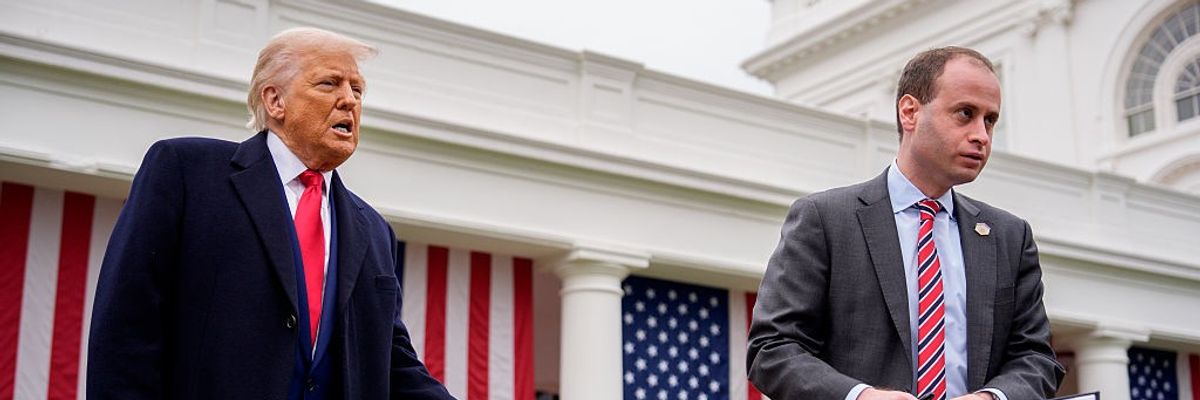
“What Republicans are trying to jam through Congress right now is a level of economic recklessness we’ve never seen before,” said a group of Democratic lawmakers.
A new analysis indicates Republicans’ plan to extend soon-to-expire provisions of their party’s 2017 tax law, as well as their push to tack on additional tax breaks largely benefiting the rich and big corporations, would cost $7 trillion over the next decade, a figure that a group of congressional Democrats called “staggering.”
The analysis from the nonpartisan Joint Committee on Taxation (JCT), published on Thursday, updates previous estimates that suggested the GOP effort to extend expiring provisions of the 2017 law would cost $4.6 trillion over a 10-year period. The new assessment shows that extending the law’s temporary provisions—which disproportionately favored the wealthy—would cost $5.5 trillion over the next decade.
The projected cost of the GOP agenda balloons to $7 trillion after adding Senate Republicans’ call for $1.5 trillion in additional tax cuts in the budget resolution they advanced in a party-line vote on Thursday. The GOP has come under fire for using an accounting trick to claim their proposed tax cuts would have no budgetary impact.
“The Republican handouts to billionaires and corporations will come at a staggering cost, and it’s unconscionable that their plan to pay for those handouts includes kicking millions of Americans off their health insurance, hiking the cost of living with tariffs, and driving up child hunger,” Sen. Ron Wyden (D-Ore.), Sen. Jeff Merkley (D-Ore.), Rep. Richard Neal (D-Mass.), and Rep. Brendan Boyle (D-Pa.) said in a joint statement issued in response to the JCT figures.
“Even after making painful cuts that will inflict hardship on typical American families, Republicans will still risk sending us into a catastrophic debt spiral that does permanent harm to our economy,” the Democrats added. “What Republicans are trying to jam through Congress right now is a level of economic recklessness we’ve never seen before.”
The JCT’s updated cost analysis came as President Donald Trump plowed ahead with what’s been characterized as the biggest tax hike in U.S. history, one that will hit working-class Americans in the form of price increases on household staples and other goods.
Trump administration officials, not known for providing reliable numbers, have claimed the president’s sweeping new tariffs could produce roughly $6 trillion in federal revenue over the next decade. The Trump tariffs have sent financial markets into a tailspin, heightened recession fears, and prompted swift retaliation from targeted nations, including China.
In an appearance on MSNBC on Thursday, Boyle—the top Democrat on the House Budget Committee—said Trump’s tariffs represent “the single largest tax increase in American history.”
“It’s a tax that everyone will pay in this country, based on the goods that they buy,” said Boyle. “However, it’s also a tax that is highly regressive—the poorest amongst us will end up paying a higher percentage of their income.”
A previous version of this story incorrectly stated the analysis was conducted by the Congressional Budget Office. It was conducted by the Joint Committee on Taxation.
Original article by Jake Johnson republished from Common Dreams under Creative Commons (CC BY-NC-ND 3.0).
- The Long Roots of Trump’s Assault on Public Health
- Emails Show Trump Official Targeted Maine Social Security Services as Political Revenge
- Watchdogs Warn Trump Pick for Interior Will Assist Corporate Attack on Public Lands
- War, Doublethink, and the Struggle for Survival: the Geopolitics of the Gaza Genocide