Signal-gate: a national security blunder ‘almost without parallel’

Jonathan Este, The Conversation
Depending on what you think of Donald Trump, his administration could fit either of the following two descriptions. Chaotic, vindictive and accident-prone, marked by mendacity, driven by impulse and bent on securing the will of the leader, rather than – as in the US constitution – the will of the people. Or it could be a government masterminded by a man playing 4D chess while all around him are playing chequers. A president whose deal-making skills and focus on outcomes ensure the security and prosperity of America and its allies.
If you base your assessment on the people Trump has chosen as his key national security advisers then, after the recent Signal chat group intelligence debacle, you’d almost certainly opt for chaotic and accident-prone, at the very least.
Looking around the Signal chatroom, who do we have? National security advisor Mike Waltz, Vice-President J.D. Vance, secretary of state Marco Rubio, defense secretary Pete Hegseth, director of national intelligence Tulsi Gabbard, CIA director John Ratcliffe and a supporting cast of other senior Trump staffers. And, unwittingly, the editor-in-chief of the Atlantic, Jeffrey Goldberg.
Heads must roll, say Trump’s critics. But who from this hydra-headed beast should take the fall? Should it be Waltz, who invited Goldberg to the chat group? Or Hegseth, who posted operational details of a US attack, including the when, where and how, hours before it was due to take place? Should it be Vance, whose swipe at America’s freeloading European allies has caused considerable angst across the Atlantic?
Or perhaps one or another of Gabbard and Ratcliffe, who sat in front of the Senate select committee on intelligence on Tuesday and maintained that no classified material or “war plans” had been revealed to the group – sworn evidence now revealed to be unreliable at best?
Sign up to receive our weekly World Affairs Briefing newsletter from The Conversation UK. Every Thursday we’ll bring you expert analysis of the big stories in international relations.
At present it seems as if none of them are going to pay for their dangerous incompetence. Instead their ire is turned on Goldberg, who has variously been called a “sleazebag” by Trump himself, “loser” and the “bottom scum of journalists” by Waltz and a “deceitful and highly discredited, so-called journalist who’s made a profession of peddling hoaxes time and time again” by Hegseth.
Robert Dover of the University of Hull, whose research centres on intelligence and national security, believes this is a “national security blunder almost without parallel”. He points to the hypocrisy of people like Hegseth who savaged Hillary Clinton for using a private email server to conduct official business when she was secretary of state under Barack Obama.
Dover also notes the damage the episode will have done to America’s already shaky relations with its allies in Europe. Being disparaged by the vice-president as freeloaders and dismissed by the defense secretary as “pathetic”, he believes, will be “difficult to unsee”.
But credit where it’s due, it appears that US diplomacy may at least be bearing some – limited – fruit. At least, that is, if the two partial ceasefires recently negotiated between Russia and Ukraine actually materialise. That’s a fairly big if, of course. Despite a pledge by both sides that they could support a deal to avoid targeting each other’s energy infrastructure, there’s no sign yet of a cessation of attacks.
And there has been a degree of scepticism over the recently announced plan for a maritime ceasefire to allow the free passage of shipping on the Black Sea. Critics say this favours Russia far more than Ukraine. Over the course of the war, Ukraine has successfully driven Russia’s Black Sea fleet away from its base in Crimea, giving it the upper hand in the maritime war. But maritime strategy expert, Basil Germond, says the situation is more nuanced, and the deal represents considerable upside for Ukraine as well.
Setting aside America’s eventful recent forays into foreign relations, there’s a major domestic fix brewing which many US legal scholars believe could plunge the country into a constitutional crisis.
Anne Richardson Oakes, an expert in US constitutional law at Birmingham City University, anticipates a potential clash between between the executive and the judiciary which could threaten the separation of powers that lies at the heart of American democracy.
Oakes observes there are more than 130 legal challenges to Trump administration policies presently before the courts, some of which will end up in front of America’s highest legal authority, the Supreme Court, which is tasked with assessing the constitutionality of those policies. She warns that we’ve already seen evidence that Trump and his senior officials resent what they consider to be interference from the judiciary into the legitimate executive power of the elected president.
Will there be a stand-off where the Trump administration simply ignores the Supreme Court’s ruling? It’s happened before, says Oakes. In the mid-20th century, in Little Rock, Arkansas, when the governor used the state’s national guard to prevent the court-ordered desegregation of public schools. On that occasion the then president, Dwight D. Eisenhower, sent in federal troops to enforce the court’s ruling and a constitutional crisis was averted.
But what if it’s the serving president who chooses to ignore a Supreme Court ruling? This was the case in the 1830s when greedy cotton farmers in Georgia were bent on forcing the Native American peoples off their lands. The Cherokee actually took the state of Georgia to the Supreme Court, which ruled that as a “dependent nation” within the United States they were entitled to the protection of the federal government and that the state of Georgia had no right to order their removal.
As historian Sean Lang of Anglia Ruskin University recounts, Georgia ignored the Supreme Court’s ruling and sent in troops to expel the Cherokee who were then forced to move to new lands in a journey known as the “Train of Tears”. Lang writes that then US president, Andrew Jackson, a populist advocate of states’ rights and former “Indian fighter”, ignored the Supreme Court’s ruling, “sneering that [Chief Justice John] Marshall had no means of enforcing it”.
Lang concludes: “It’s a history lesson Greenlanders, Mexicans and Canadians – and indeed many Americans who may fall foul of this administration and seek recourse to the law – would do well to study.”
Trump’s chilling effect
The Trump administration’s antipathy towards judges who have opposed its policies have extended towards those law firms who have in some way crossed the US president. But the legal system is not the only sector to feel the chilling effect of Trump’s displeasure, writes Dafydd Townley.
The world of higher education in the US is also apprehensive after the administration went after Columbia University, home to some of the most outspoken protest over US policies towards Israel and Gaza. Columbia has recently had to agree to allow the administration to “review” some of its academic programmes, starting with its Middle Eastern studies, after the administration threatened to cancel US$400 million (£310 million) of government contracts with the university.
The news media is also under heavy pressure. The administration has taken control of the White House press pool from the non-partisan White House Correspondents’ Association and has blackballed Associated Press for refusing to call the Gulf of Mexico the Gulf of America. We’ve also seen Trump himself bring lawsuits against media organisations he judges to have crossed him. And now the president has called for the defunding of America’s two biggest public broadcasters, NPR and PBL, for what he perceives as their liberal bias.
Townley, an expert in US politics at the University of Portsmouth is concerned that this all adds up to a deliberate attempt to cripple institutions which underwrite American democracy.
Popularity falls as prices rise
Trump’s leadership continues to be very polarising, writes Paul Whiteley, a political scientist and polling specialist at the University of Essex, who has spent years studying political trends in the US. Looking at the most recent numbers, Whiteley finds that while Trump’s approval ratings are fairly steady at 48% approval and 49% disapproval, when you dig down you find that only 6% of registered Democrats approve of his performance, while 93% disapprove. For registered Republicans it’s almost exactly the opposite.
Whiteley takes his analysis further, looking at measures such as consumer sentiment, which has fallen sharply since January, with talk of tariffs and the return of inflation affecting people’s confidence in the economy. He points out there tends to be a fairly strong historical correlation between confidence in the economy and popular approval of a president’s performance.
Another factor which will surely affect people’s confidence in the government are the job losses flowing from Elon Musk’s work as “efficiency tsar”. Thomas Gift, the director of the Centre on US Politics at University College London, believes that federal job losses as a result of Musk’s cuts are spread indiscriminately among Democrat and Republican states. As a result there may be some Republican voters who are experiencing what he calls “buyer’s remorse”.
At the same time, rising inflation is flowing into the cost of living, something many people voted for Trump to punish the Democrats for. As Gift points out, both parties are experiencing a dip in support at present as people reject politics for having a generally negative effect on their lives. But from now, it’ll be the Republicans who will feel the sting of popular disapproval more keenly.
World Affairs Briefing from The Conversation UK is available as a weekly email newsletter. Click here to get updates directly in your inbox.
Jonathan Este, Senior International Affairs Editor, Associate Editor, The Conversation
This article is republished from The Conversation under a Creative Commons license. Read the original article.

US stands on the brink of a constitutional crisis as Donald Trump takes on America’s legal system

Anne Richardson Oakes, Birmingham City University
As the 19th-century French political philosopher, Alexis de Tocqueville, memorably observed, Americans have a tendency to fight their political battles in court. Barely two months into his presidency, Donald Trump is demonstrating increasing frustration as trade unions, civil rights organisations and states attorneys general challenge the implementation of his policies with lawsuits alleging presidential overreach that undermines the constitutional separation of powers.
More than 130 lawsuits are now pending. As a result, federal courts have put on hold key policies of the Trump administration and Trump lawyers have lodged emergency petitions invoking Supreme Court intervention.
First to face court check was the federal funding freeze order. This was swiftly followed by court rulings against the birthright citizenship order. This controversial measure would withdraw citizenship for children born in the United States to undocumented or non-citizen parents who are in the country legally but temporarily.
Sign up to receive our weekly World Affairs Briefing newsletter from The Conversation UK. Every Thursday we’ll bring you expert analysis of the big stories in international relations.

Another court ruling has overturned the Pentagon’s ban on transgender people enlisting in the US armed forces. Yet another has blocked the Department of Government Efficiency’s (Doge’s) access to treasury department records containing the personal financial details of millions of Americans.
This was blocked for the very fundamental grounds that this has not been authorised by Congress and is not within the scope of the presidential power. Whether Doge can even exist without Congressional authority is also in contention.
The president’s increasing anger with the courts erupted on March 18. The US president launched an astonishing personal attack on a US federal judge who ruled against the summary deportation of alleged members of the Venezuelan Tren de Aragua gang and ordered the administration to turn around the plane carrying them that had already taken off.

Trump’s call for Judge James Boasberg to be impeached prompted a rare intervention from Supreme Court chief justice John Roberts. Roberts condemned the impeachment call in a statement that did not name the president but was clearly intended as a rebuke and a reminder of the constitutional boundaries that guarantee the role of the judiciary as the equal third branch of government.
Unrepentant, Trump doubled down the next day on TruthSocial calling Judge Boasberg a “Radical Left Lunatic Judge” who wanted “to assume the role of president”. His charge was then echoed by White House press secretary Karoline Leavitt who accused the judiciary generally of attempting to paralyse the administration’s programme, usurp the power of the president and undermine the will of the American people.
Despite Judge Boasberg’s order, the plane carrying the Venezuelans did not turn back. The administration has denied wrongdoing and Judge Boasberg has yet to impose any penalty.
This was not the first occasion that the administration has appeared to openly defy court orders. The previous week Dr Raiza Alawieh, a Brown University professor with an American visa was deported despite an order from a federal judge in Boston requiring that the court be given advance notice before the government attempted to remove her.
All eyes on the Supreme Court
All these cases are likely to go to the US Supreme Court. As its name suggests, this is the highest level of the judiciary in the US. It has the final say on what the US constitution means and authorises. At issue will be the scope of the presidential power – and the outcome is uncertain.
It’s important to bear in mind that the court now has a six-to-three majority of conservative justices – three of whom were Trump nominees. We also need to be aware that this court, in a previous ruling, considerably extended the scope of presidential immunity to cover all official “core acts” so that, whatever the outcome, the president himself is unlikely to attract personal liability.
But we do know that the Supreme Court’s ruling on a constitutional issue is final – and that all government officials at federal and state level will be required to respect it. The fear now is that the administration may go ahead regardless in which case we will find ourselves in unknown constitutional territory.
To find parallels we could go back to the desegregation era of the middle of the 20th century and specifically to Little Rock in Arkansas where the then governor, Orval Faubus, called out the national guard to prevent the court-ordered desegregation of the local high school.
The ensuing crisis ended when the then president, Dwight D. Eisenhower, sent in federal troops to enforce the court order. The US Supreme Court unanimously declared that its interpretations of what the constitution required were the supreme law of the land, which bound the governor and the state legislature.
The chief justice of that era, Earl Warren, later regarded this ruling (Cooper v Aaron) as the most important of his time on the Supreme Court – more important even than the actual desegregation decision itself (Brown v Board of Education).
It is clear that the judicial branch depends upon the executive to put its orders into effect and demonstrate respect for the rule of law and the separation of powers. But we now see a president who demonstrates open hostility to judges whom he considers have opposed him. His administration has also begun to vindictively target with punitive blocking orders the big law firms who assisted in the prosecutions brought against him before he took office.
Does a constitutional crisis loom? How all this plays out remains to be seen.
Anne Richardson Oakes, Associate Professor and Director: Centre for American Legal Studies, Birmingham City University
This article is republished from The Conversation under a Creative Commons license. Read the original article.
Vigil for GP jailed over Just Stop Oil protest
https://www.bbc.com/news/articles/cpq7j5z85z1o
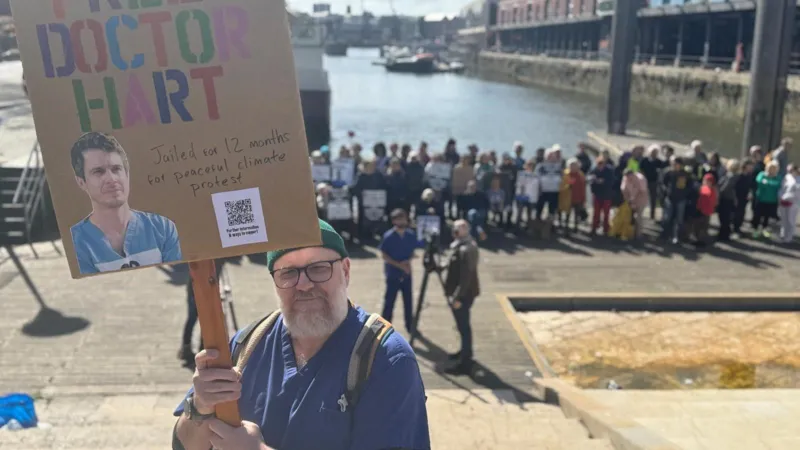
Scores of people took part in a city centre vigil for a GP jailed over his role in a Just Stop Oil protest.
Dr Patrick Hart, 38, was sentenced to 12 months in prison in January after causing thousands of pounds worth of damage to 16 fuel pumps at a service station in Essex in August 2022.
In March, Dr Hart also had his General Medical Council registration suspended for an interim 12-month period, and faces a possible further suspension following his release.
About 150 people, including former colleagues and patients, gathered at Cascade Steps in Bristol on Saturday to raise awareness of his sentence.
Dr Romola Pocock, a GP and former colleague of Dr Hart’s at Bridge View Medical Practice, said he had shown “care, integrity and dedication” to his job and was “greatly missed by patients and colleagues”.
Fellow GP at the practice Dr Emily Pollard said: “Will history remember doctors who stood against the destruction of the health of our planet as criminals?”
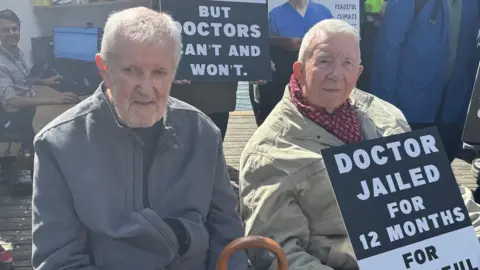
Dr Hart was arrested after hitting petrol pumps with a hammer, spraying them with orange pain and “obstructed or otherwise interfered with the refuelling of vehicles”, and was found guilty of causing criminal damage.
…
Original article continues at https://www.bbc.com/news/articles/cpq7j5z85z1o