Climate change and La Niña made ‘devastating’ southern African floods more intense

Spread the love

Original article by Ayesha Tandon and Yanine Quiroz republished from Carbon Brief under a CC license.
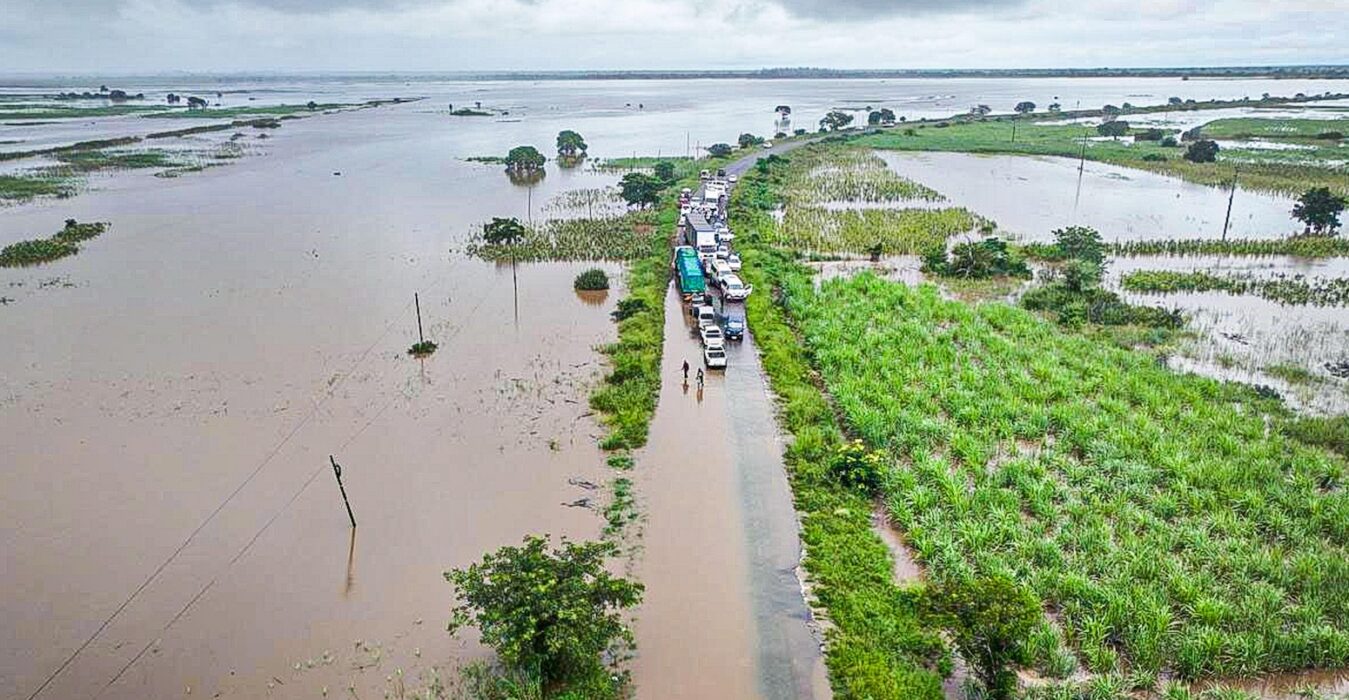
Aerial view of a flooded road and surrounded landscape, Mozambique. Credit: Associated Press / Alamy Stock Photo

“Exceptionally heavy” rainfall that led to deadly flooding across southern Africa in recent weeks was made more intense by a combination of climate change and La Niña.

This is according to a rapid attribution study by the World Weather Attribution service.

From late December 2025 to early January, south-eastern Africa was hit hard by intense downpours that resulted in more than a year’s worth of rain falling in some areas in just a few days, according to the study.

This led to severe flooding that left at least 200 people dead, thousands sheltering in temporary accommodation and tens of thousands of hectares of farmland waterlogged.

The analysis finds that periods of intense rainfall over southern Africa have become 40% more severe since pre-industrial times, according to observations.

The authors say they were unable to calculate how much of this increase was driven specifically by climate change, due to limitations in how climate models simulate African rainfall.

However, the study notes that the researchers “have confidence that climate change has increased both the likelihood and the intensity” of the rainfall.

The authors also note that the El Niño-Southern Oscillation phenomenon played a role in the “devastating” flooding, estimating that a La Niña event made the rainfall around five times more likely.

Major disruption

The heavy rainfall started on 26 December last year and intensified from early January. The most-extreme rainfall took place between 10 and 19 January.

The countries most affected by the floods, and analysed by the study, are Eswatini, Mozambique, South Africa and Zimbabwe, with some areas receiving up to 200mm of rain, according to the study authors.

Study author Bernardino Nhantumbo – a researcher at Mozambique’s National Institute of Meteorology – told a press briefing that in just two or three days, some areas recorded the amount of rainfall that is “expected for the whole rainy season”.

The map below shows the areas most affected by intense rainfall over 10-19 January. Darker blue indicates a greater accumulation of rainfall, while light green indicates less rainfall. The pink box shows the study area.
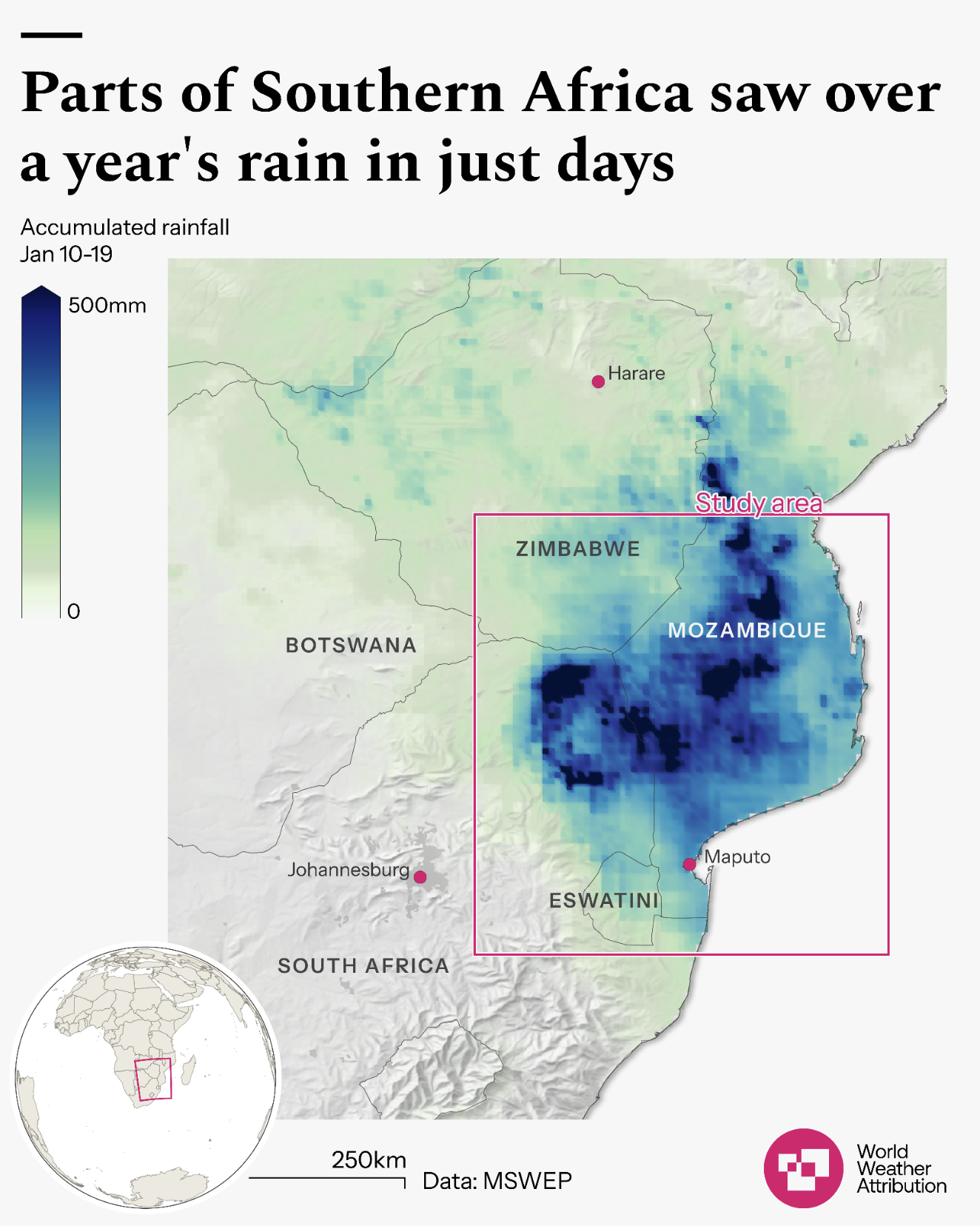
Satellite image of southern Africa showing that some areas saw over a year's rain in just days
Most affected areas by large floods in southern Africa. Darker blue indicates a greater accumulation of rainfall, while light green indicates less rainfall. The pink box shows the study area. Source: WWA (2026).

In Mozambique, the floods damaged nearly 5,000km of roads, which has hindered the transport of goods and affected pharmaceutical supply chains, the study says. In Zimbabwe, bridges, roads and infrastructure were “significantly damaged or destroyed”.

More than 75,000 people have been affected by the floods in Mozambique, according to the study. BBC News reported the floods were the worst seen “in a generation” in the country.

Dr Izidine Pinto, a climate scientist from Mozambique currently working at the Royal Netherlands Meteorological Institute, told a press briefing that the country was particularly affected because it “lies downstream of major river basins”. 

The flooding prompted Mozambique’s education minister to consider rescheduling the start of the academic year, according to Channel Africa.

In South Africa, the country’s weather service said that areas receiving more than 50mm of rain over 11-13 January were “widespread”, with some places seeing up to 200mm.

South Africa’s Kruger National Park – the largest national park in South Africa – was severely damaged by floods and temporarily closed after several rivers burst their banks, reported TimesLIVE

The South African news outlet quoted environment minister Willie Aucamp as saying: “The indication is that it will take as long as five years to repair all the bridges and roads and other infrastructure.” 

Extreme rainfall

The peak of the rainy season in southern Africa falls between December and February.

To put the extreme rainfall into its historical context and determine how unlikely it was, the authors analysed a timeseries of 10-day maximum rainfall data for the December-February season.

They find that in today’s climate, extreme rainfall events of the scale seen this year in southern Africa would be expected only once every 50 years. 

They add that such events have become “significantly more intense”, with observational data showing a 40% increase in rainfall severity since pre-industrial times.

The map below shows accumulated rainfall over Eswatini, Mozambique, South Africa and Zimbabwe over 10-19 January, as a percentage of the average December-February rainfall for the region over 1991-2020.

Green shading indicates that the rainfall in 2026 was higher than in 1991-2020, while brown indicates that it was lower. The red box indicates the study region. 
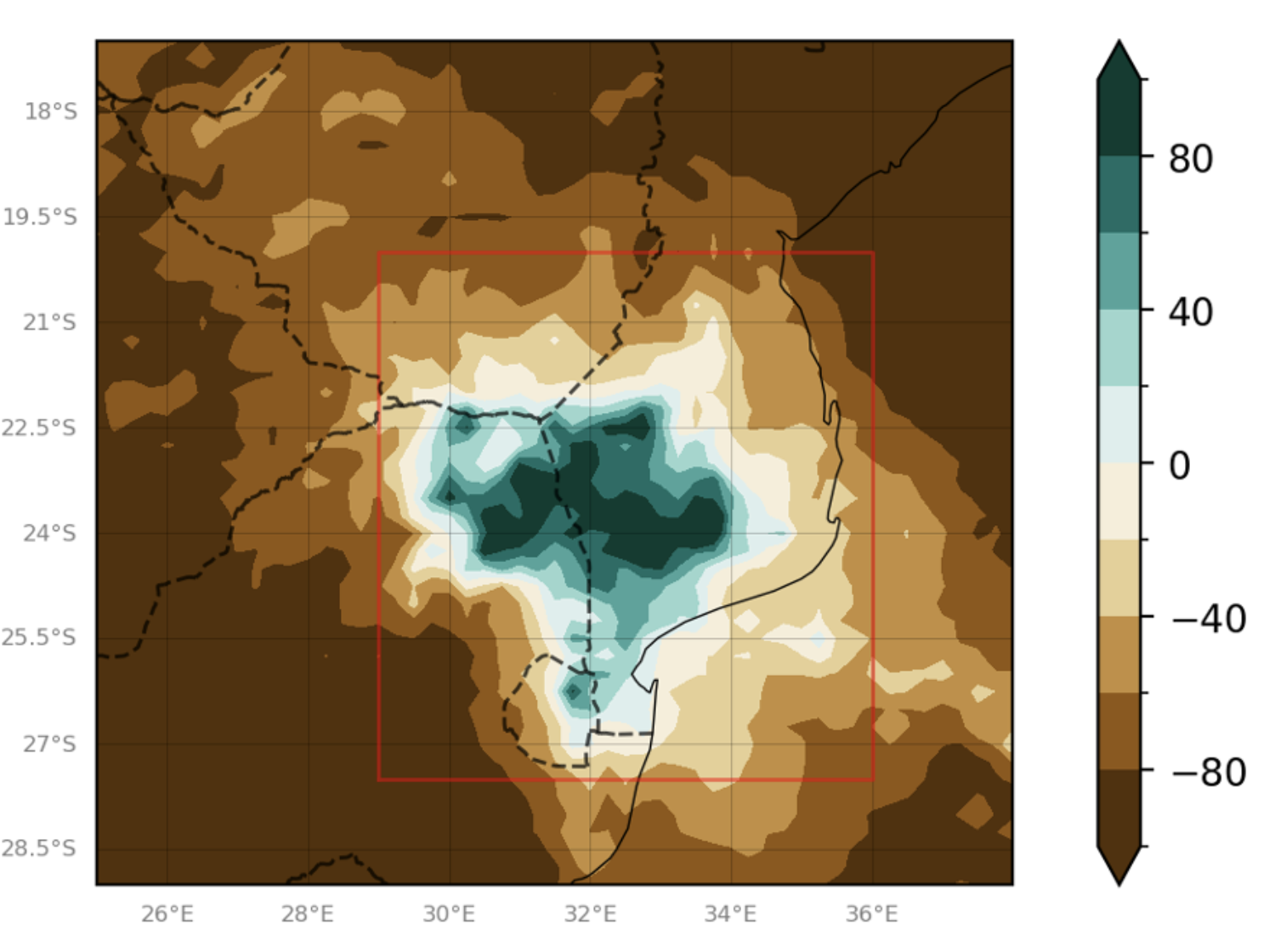
Accumulated rainfall over Eswatini, Mozambique, South Africa and Zimbabwe over 10-19 January 2026, shown as a percentage of the average December-February rainfall for the region over 1991-2020. The study region is outlined in dark red. Source: WWA (2026).

The study explains that in January and February, rainfall patterns in southern Africa are “strongly influenced” by the El Niño-Southern Oscillation (ENSO), a naturally occurring climate phenomenon that affects global temperatures and regional weather patterns. 

La Niña is the “cool” phase of ENSO, which typically brings wetter weather to southern Africa.

Pinto told the press briefing that “most past extreme rainfall events [in the region] have occurred during La Niña years”. 

The authors estimate that the current weak La Niña event made the extreme rainfall five times more likely and increased the intensity of the event by around 22%.

For attribution studies, which identify the “fingerprint” of human-caused climate change on extreme weather events, scientists typically use climate models to simulate and compare worlds with and without global warming.

However, many models have limitations in their simulations of African rainfall. In this study, the authors found that the models available to them cannot “adequately capture” the influence of ENSO on rainfall in the region.  

Study author Prof Fredi Otto, a professor in climate science at the Imperial College London, told a press briefing that these limitations are “well known”. They stem, in part, because the models were “developed outside of Africa” by modellers with different priorities, she explained. 

This means that the authors were unable to calculate how much more intense or likely the rainfall event was specifically as a result of human-caused warming.

However, Otto explained that the authors are “very, very confident that climate change did increase the likelihood and intensity of the rainfall” to some extent. This is because the observations all show an increase in rainfall over time and other existing literature supports this assumption, she added. 

She told the press briefing that the results of this study were “definitely not 100% satisfactory”, adding that this study will “definitely not be the last of its kind in this region”. 

(These findings are yet to be published in a peer-reviewed journal. However, the methods used in the analysis have been published in previous attribution studies.)

Vulnerability

The study warns that the flooding “exposed deep and persistent social vulnerability in the region”.

The authors say that a large proportion of the population – especially in urban areas – live in poor housing with “inadequate planning and insufficient provision of basic services”.

Paola Emerson, head of office at the UN Office for the Coordination of Humanitarian Affairs (OCHA) in Mozambique, told a UN press briefing about the flooding that nearly 90% of people in the country live in traditional adobe houses that “basically melt after a few days’ rains”.

In a WWA press release, study author Nhantumbo explained:

“When 90% of homes are made of sun-dried earth, they simply cannot withstand this much rain. The structural collapse of entire villages is a stark reminder that our communities and infrastructure are now being tested by weather they are just not designed to endure.”

Study author Renate Meyer – an adviser with the conflict and climate team at the Red Cross Red Crescent Centre – said in a WWA press briefing that the “recurring frequency of hazards such as drought and extreme rainfall have had a significant impact on communities experiencing, amongst others, displacement, health challenges, socioeconomic loss and psychological distress”.

For example, the World Health Organization (WHO) said in a press release that the event had disrupted access to health services and increased the risks of water- and mosquito-borne diseases, as well as respiratory infections across southern Africa.

Meyer explained that the countries included in this study have “substantial populations living below or near the poverty line with limited savings, low insurance cover and a high dependence on climate sensitive livelihoods”. 

Original article by Ayesha Tandon and Yanine Quiroz republished from Carbon Brief under a CC license.

Donald Trump urges you to be a Climate Science denier like him. He says that he makes millions and millions for destroying the planet, Burn, Baby, Burn and Flood, Baby, Flood.
Nigel Farage urges you to ignore facts and reality and be a climate science denier like him and his Deputy Richard Tice. He says that Reform UK has received £Millions and £Millions from the fossil fuel industry to promote climate denial and destroy the planet.
Elon Musk urges you to be a Fascist like him, says that you can ignore facts and reality then.

Continue ReadingClimate change and La Niña made ‘devastating’ southern African floods more intense

Revealed: Lobbying firm selling access to ministers for £30,000

Spread the love

Original article by Ethan Shone republished from Open Democracy under a Creative Commons Attribution-NonCommercial 4.0 International licence.

Science, Innovation and Technology Secretary Liz Kendall is due to appear at the summit in July 
| (Photo by Jack Taylor/Getty Images)

Firms can get direct access to tech minister and No 10 advisers in exchange for sponorsing tech event, brochure says

A Labour-linked lobbying firm is selling access to government officials, including tech secretary Liz Kendall and “top advisers to the prime minister”, for tens of thousands of pounds, openDemocracy can reveal.

Businesses looking to sponsor July’s Future of Tech Summit, which is coordinated by Arden Strategies and tech industry lobbying group Startup Coalition, can choose from a tiered range of packages, according to a brochure sent out to prospective sponsors this week.

The most expensive costs £30,000 and entitles the sponsor to make a speech at the reception, be introduced to key policymakers and attend a “private post-conference tech dinner” with senior advisers to Keir Starmer and chancellor Rachel Reeves.

The half-day summit will take place at County Hall in Westminster and involve two panel discussions, private roundtables with MPs, a “fireside chat” with Kendall and a drinks reception. It will “bring together the brightest minds in policy, business and technology to discuss and shape a long-term vision for the UK’s role in the global tech landscape”, the brochure promises.

openDemocracy understands that the document, which we have reviewed, was sent to lobbying agencies and in-house public affairs teams in the tech sector. It has not been made public or reported elsewhere.

Arden Strategies and Startup Coalition hosted a similar event last year, where tech firms, venture capitalists and consultants mingled with then-tech secretary Peter Kyle and a dozen other Labour politicians and aides. One company that attended last year’s event now sits on a government panel shaping data policy.

Founded by former Labour minister Jim Murphy, Arden established itself as arguably the lobbying firm with the best connections to Starmer’s Labour Party in the run-up to the 2024 general election, when it hosted numerous private meetings introducing clients to members of the shadow cabinet.

While this year’s event is unlikely to breach parliamentary rules, ‘cash-for-access’ style arrangements are controversial as they allow companies and interest groups with significant resources opportunities to influence government policy. This is especially concerning on issues like AI and social media, where companies stand to gain significantly from light-touch regulation or government backing.

Campaign group Spotlight on Corruption described the arrangement as “hugely problematic” and has called for the government to review “cash for access schemes”.

‘Guaranteed access?’ ‘Yes’

An FAQ section in this year’s brochure foresees prospective sponsors asking, “Will we be guaranteed a policymaker?” The answer is simply: “Yes”. The level of access afforded to a business, though, appears to depend on which sponsorship package they opt for.

For £7,500, companies can sponsor and co-host a 90-minute roundtable with a “VIP guest”. At last year’s event, the guests were generally MPs with an interest in tech and AI policy, including now-AI minister Kanishka Narayan and the chair of the influential Labour Growth Group of MPs, Chris Curtis, a former aide to Starmer.

For £20,000, a senior representative from a sponsoring business can join or introduce one of two panel discussions taking place on the day. The topics up for discussion are yet to be confirmed, but could include AI regulation and “cybersecurity in a time of geopolitical instability”, the document says.

It adds that while “the vision for the day [is] set in stone… different topics can be approached in different ways and we are happy to work with you to ensure the content is the best it can be”.

For £30,000, businesses can sponsor a drinks reception where attendees will network after the fireside chat with Kendall. This package includes the chance to make a “three-minute” speech during the reception and pose for photos with the minister.

Sponsors who have paid at least £20,000 will also receive “stakeholder introductions” at the reception – likely meaning they will be introduced directly to influential politicians and advisers.

The summit will be followed by an exclusive post-conference dinner for 25 guests, which the brochure describes as “a VIP dinner with top advisors to the prime minister, chancellor and other senior tech policymakers for sponsors and top UK business leaders.”

There are seemingly three seats at this dinner available to sponsors, one each for the businesses that spend £20,000 to sponsor one of the two panels or £30,000 to sponsor the reception.

Another question in the FAQs asks: “Are package pricing set?” To which the response is: “No, we are open to a conversation.”

Brochure Screenshot FAQ1
A screenshot of the brochure showing that sponsors are ‘guaranteed’ access to a policymaker

While transparency rules will require any ministers attending the event declare their attendance, the vast majority of the engagement that will take place will not be captured either by government transparency rules or lobbying regulation.

“When access to politicians is packaged and priced, it shows yet again that it is wealth that determines who gets influence,” Kamila Kingstone, senior campaigner at Spotlight on Corruption, told OpenDemocracy.

“Not only does it fuel public cynicism about who politicians really listen to, it risks distorting major policy decisions in favour of the tech sector rather than the public interest.

“The newly created Ethics and Integrity Commission should conduct a review of cash-for-access schemes to ministers, MPs, and advisers, examining who is selling access, who buys it, and the impact it ultimately has on decision making,” Kingston added.

These concerns were echoed by Jim Killock, the executive director of Open Rights Group, who said: “In recent years, the tech industry has successfully lobbied UK governments to halt AI regulation, weaken data protection rights and undermine competition law. The voice of the public and civil society, meanwhile, is kept out.

“The odds are already stacked in corporates’ favour. Promising paid access to policymakers entrenches that imbalance and is harmful to the public, effective policymaking and the wider economy.”

Arden Strategies

The document describes Arden Strategies as “an advisory and communications firm founded and led by former cabinet minister Jim Murphy”, which works to “ensure exceptional professionals from across the public and private sector get their voices heard by the right people at the right time”.

As openDemocracy reported in September 2024, Arden Strategies organised and sponsored fundraising events for around 40 prospective Labour MPs ahead of that year’s general election, the vast majority of whom were elected successfully.

In all but a handful of cases, these donations were never declared due to a loophole that allows a single donor to give several MPs donations that all fall just under the registrable threshold – even if the total amount donated is significantly above the threshold for individual declaration.

The firm was later criticised for arranging private access to an event at the Treasury to meet with Ian Corfield, a Labour donor employed as a Treasury adviser after the election, but later stepped down.

“If we had a government meeting, we would always choose the cast list ourselves. We wouldn’t ask a lobbying firm to curate it,” said Henry Newman, a former political adviser to Tory ministers including Boris Johnson and Michael Gove, at the time.

Original article by Ethan Shone republished from Open Democracy under a Creative Commons Attribution-NonCommercial 4.0 International licence.

Continue ReadingRevealed: Lobbying firm selling access to ministers for £30,000

Labour Friends of Israel reported to election watchdog

Spread the love

https://www.declassifieduk.org/labour-friends-of-israel-reported-to-election-watchdog/

[Declassified UK] Exclusive: Complaint centres around concerns that the pro-Israel ‘lobby group’ should have declared its donors

Labour Friends of Israel director Michael Rubin in Downing Street, 4 June 2025. (Photo: Ian Davidson / Alamy )

Labour Friends of Genocide Israel has been referred to the Electoral Commission over concerns about its opaque funding.

Activist Andrew Feinstein, who filed the complaint, said he was concerned that the pro-Israel group “may have breached electoral law”.

Labour Friends of Israel (LFI) has previously described itself as “a Westminster based lobby group working within the British Labour Party to promote the State of Israel,” and has funded dozens of British politicians to travel to Israel.

But it has repeatedly refused to disclose where its money comes from, other than to deny that it is funded by the Israeli government. 

Feinstein’s complaint explains that there is “ambiguity over whether LFI is (or ever was) a members association”.

He added: “This question is vital because ‘members associations’ may have to register with the Electoral Commission as a regulated donee. This would also create an obligation for LFI to disclose details about certain donations that it receives.”

LFI has denied being a members association, yet many senior politicians have claimed they are “members”. 

Seven ministers – including Rachel Reeves and David Lammy – have each stated they are a “member” of the group in the List of Ministerial Interests. And the trade secretary, Peter Kyle, also claimed to be an LFI “member” at an event earlier this month.

Article continues at https://www.declassifieduk.org/labour-friends-of-israel-reported-to-election-watchdog/

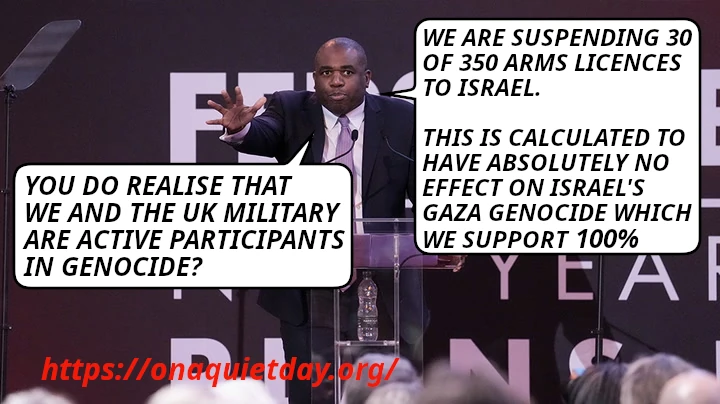
Genocide denying UK Foreign Secretary David Lammy says that UK is suspending 30 of 350 arms licences to Israel. He also confirms the UK government's support for Israel's Gaza genocide and the UK government and military's active participation in genocide.
Genocide denying UK Foreign Secretary David Lammy says that UK is suspending 30 of 350 arms licences to Israel. He also confirms the UK government’s support for Israel’s Gaza genocide and the UK government and military’s active participation in genocide.
Keir Starmer justifies why he has to travel abroad so much
Keir Starmer objects to criticism of the IDF. He asks how could anyone object to them starving people to death, forced marches like the Nazis did, bombing Gaza's hospitals and universities, mass-murdering journalists, healthworkers and starving people queuing for food, killing and raping prisoners and murdering children. He calls for people to stop obstructing his genocide for Israel.
Keir Starmer objects to criticism of the IDF. He asks how could anyone object to them starving people to death, forced marches like the Nazis did, bombing Gaza’s hospitals and universities, mass-murdering journalists, healthworkers and starving people queuing for food, killing and raping prisoners and murdering children. He calls for people to stop obstructing his genocide for Israel.
Continue ReadingLabour Friends of Israel reported to election watchdog

Suella Braverman defects: is Reform becoming a magnet for Tory baggage?

Spread the love
Alamy/Guy Bell

Thomas Lockwood, York St John University

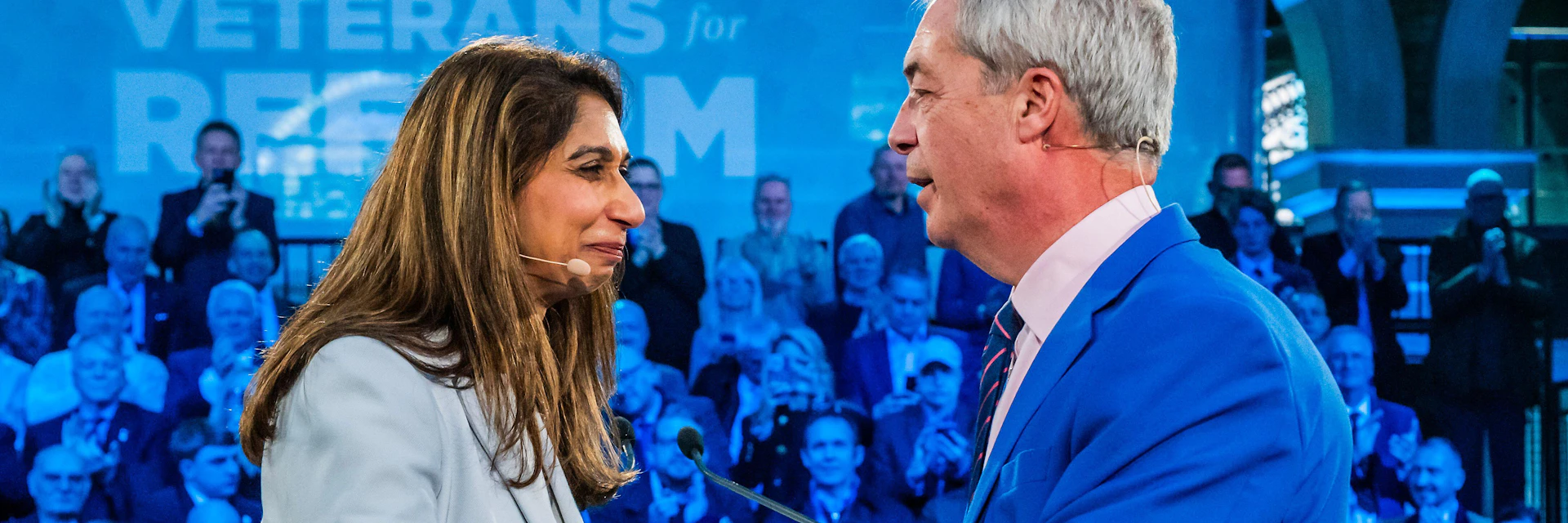
Suella Braverman’s decision to defect to Reform UK is not just another blow to Kemi Badenoch’s attempt to stabilise the Conservatives after their 2024 defeat. It also changes what Reform is being judged on.

Earlier this month, Badenoch sacked Robert Jenrick from the shadow cabinet for plotting to defect to Reform. Hours later, he did just that. Braverman’s move takes Reform’s number of MPs to eight. Party leader Nigel Farage has said Reform had been in talks with her for a year.

At this point, though, Reform is at risk of absorbing so many former Tories that it starts to look like the establishment it denounces. This recruitment spree rewrites the insurgent brand.

Reform’s leadership will understandably celebrate Braverman’s arrival as a serious coup. She is a former home secretary and a national media figure. Her departure is an unmistakable signal that the Conservative right is fragmenting. The Times reports she told supporters it felt like she had “come home”, but there is a basic strategic tension here.

Reform has thrived by arguing that British politics is run by a closed circle of insiders who fail repeatedly and then reshuffle into new jobs. A rapid intake of ex-ministers risks making Reform look less like a clean break and more like a migration route for political careers.

That attack line is already being deployed. After former chancellor Nadhim Zahawi’s switch earlier this month, the Liberal Democrats described Reform as “a retirement home for disgraced former Conservative ministers”. The same basic charge has followed Braverman’s move: critics argue that people who helped shape the recent Conservative record are now trying to rebrand themselves inside Reform rather than account for that record.

For Reform, then, the immediate gain in publicity comes with a reputational cost: the party becomes easier to frame as a collection of defectors rather than a coherent alternative.

The May deadline: Reform knows the danger

If Reform were confident that any defection is good news, it would have no need for a cut-off date. But Farage has set the local elections date of May 7 as the latest date he will take Conservative switchers. After that, he believes his party would start to look like “a rescue charity for every panicky Tory MP”.

That is revealing. It implies Reform is trying to capture the benefits of defections (experience, profile, the aura of inevitability) while limiting the downside (brand dilution, factional chaos, accusations of being “Tories in new colours”). A deadline is, in effect, an admission that there is such a thing as too many ex-Tories… or at least too many arriving too quickly.

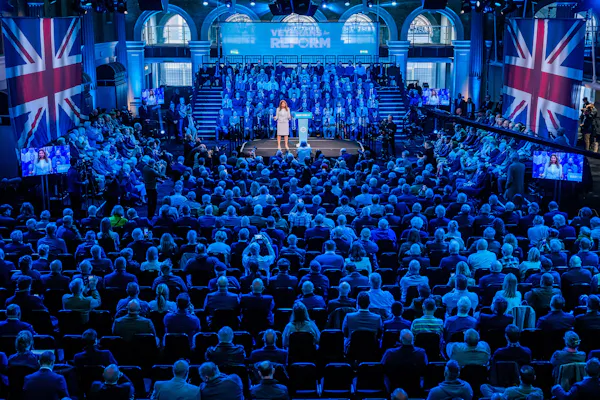
Braverman’s defection was announced at a Veterans for Reform event. Alamy/Guy Bell

The deeper issue is organisational. Recruiting MPs is not the same as building a party machine. Defectors bring personal followings, constituency operations, donor networks and ideological baggage. They can add reach but they can also add volatility, especially if Reform’s appeal relies on projecting discipline and clarity.

And internal tensions are not theoretical. Braverman and Jenrick are not merely Conservatives who happen to have drifted rightwards. They were also senior figures in a government that Reform has attacked as incompetent and deceitful.

That is why a July 2025 post on X by Zia Yusuf (widely circulated as Braverman joined) lands so sharply. In the post, the head of policy at Reform UK referred to the Conservative government’s handling of an Afghan data leak and secret resettlement, asking “who was in government?”, and then named Braverman as home secretary and Jenrick as immigration minister.

The point isn’t whether Yusuf’s earlier argument was fair or unfair. It’s that it feeds an “own goal” narrative. Reform’s senior figures have recently depicted these people as emblematic of the failures of the Conservative state, and now the party is inviting them into the tent.

That forces Reform into a delicate position. If it embraces defectors uncritically, it weakens its anti-establishment brand. If it keeps attacking them, it destabilises its own recruitment strategy.

Braverman’s seat: opportunity and risk

Braverman’s own constituency, Fareham and Waterlooville, illustrates why Reform wants converts of her stature and why the strategy can backfire.

On official local results for the 2024 general election, Braverman won with 35% of the vote; Reform placed fourth on 18%, behind Labour (23%) and the Liberal Democrats (19%).

That is the kind of compressed result Reform dreams about: a sizeable right-populist base already present, plus a Conservative vote that if transferred could turn a marginal into a secure Reform seat. From this perspective, defections are not just PR. They are an attempt to solve Reform’s hardest electoral problem: converting diffuse national support into winnable constituency coalitions.

But the same numbers show the danger. If Braverman fails to bring a large share of Conservative voters with her, the most likely short-term effect is to make the seat more competitive for her opponents through vote fragmentation and tactical voting. Defections can therefore produce a paradox: they make Reform look bigger nationally while making individual contests messier locally.

And at the national level, the risk is huge. Reform’s central claim – that it is the “alternative” to a failed political class – is now colliding with the reality of who it is recruiting from that class.

If Reform wants to remain a pure insurgency, it must keep its distance from establishment figures and prioritise new candidates. If it wants to look like a credible government-in-waiting, it will keep collecting experienced politicians, but it must then accept the costs – intensified scrutiny, more ammunition for opponents, and the constant suspicion that it is simply rebranding Conservatism rather than replacing it.


Want more politics coverage from academic experts? Every week, we bring you informed analysis of developments in government and fact check the claims being made.

Sign up for our weekly politics newsletter, delivered every Friday.


Thomas Lockwood, PhD Researcher in Politics, York St John University

This article is republished from The Conversation under a Creative Commons license. Read the original article.

Keir Starmer confirms that his government is cnutier than Suella Braverman on killing the right to protest.
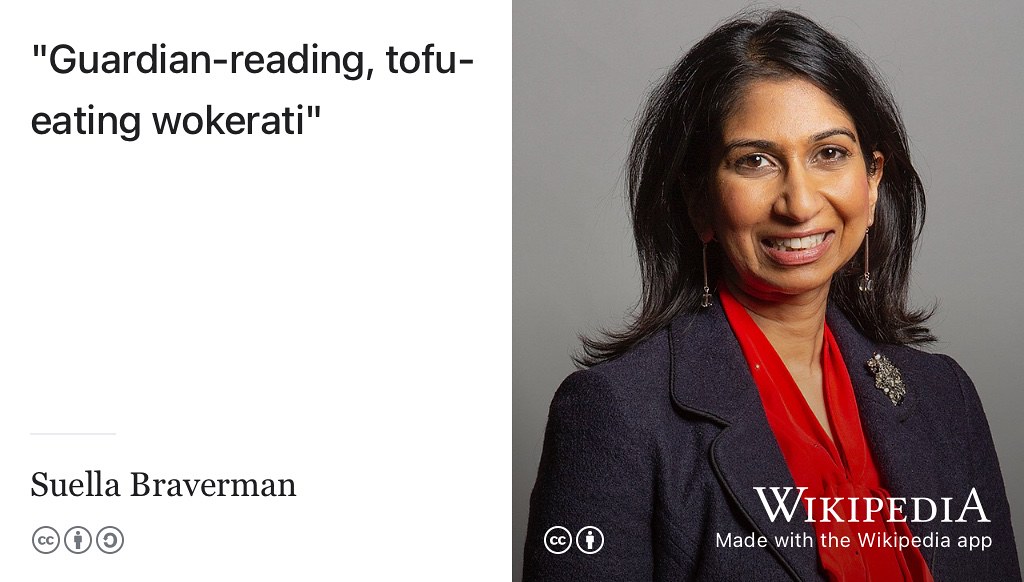
Image quoting Suella 'Sue-Ellen' Braverman reads ‘Guardian-reading, tofu-eating wokerati’.
Image quoting Suella ‘Sue-Ellen’ Braverman reads ‘Guardian-reading, tofu-eating wokerati’.

Continue ReadingSuella Braverman defects: is Reform becoming a magnet for Tory baggage?