Keir Starmer’s reputation will “forever…be associated with the decision to appoint the best friend of the world’s most notorious paedophile” as British ambassador to Washington, the author of a book on the prime minister has said.
Investigative journalist Paul Holden told Declassified that after the resignation of the prime minister’s chief of staff Morgan McSweeney: “Keir Starmer is on borrowed time. He’s done. There’s no coming back from this.
“I mean he was pretty much toast before this because he was so deeply unpopular and there were already moves to remove him.
“The problem is we now have this political vacuum because the success of the McSweeney-Mandelson-Starmer political project has been to totally take utter control of the commanding heights of the Labour party. It’s bureaucracy but also the cabinet.”
Holden, who wrote a book about Starmer’s top aide called The Fraud, said “The eight most senior people in cabinet all have links to McSweeney going back years and decades. This entire political project is implicated and tainted by this scandal.
…
Keir Starmer says that the Labour Party under his leadership is intensely relaxed about assaulting those least able to defend themselves – the very poorest and most vulnerable.Keir Starmer objects to criticism of the IDF. He asks how could anyone object to them starving people to death, forced marches like the Nazis did, bombing Gaza’s hospitals and universities, mass-murdering journalists, healthworkers and starving people queuing for food, killing and raping prisoners and murdering children. He calls for people to stop obstructing his genocide for Israel.Orcas discuss Genocide-supporting and complicit Zionists. Donald Trump, Keith Starmer, David Lammy, Rachel Reeves, Angela Rayner and Wes Streeting are acknowledged as evil genocide-complicit and supporting cnuts.
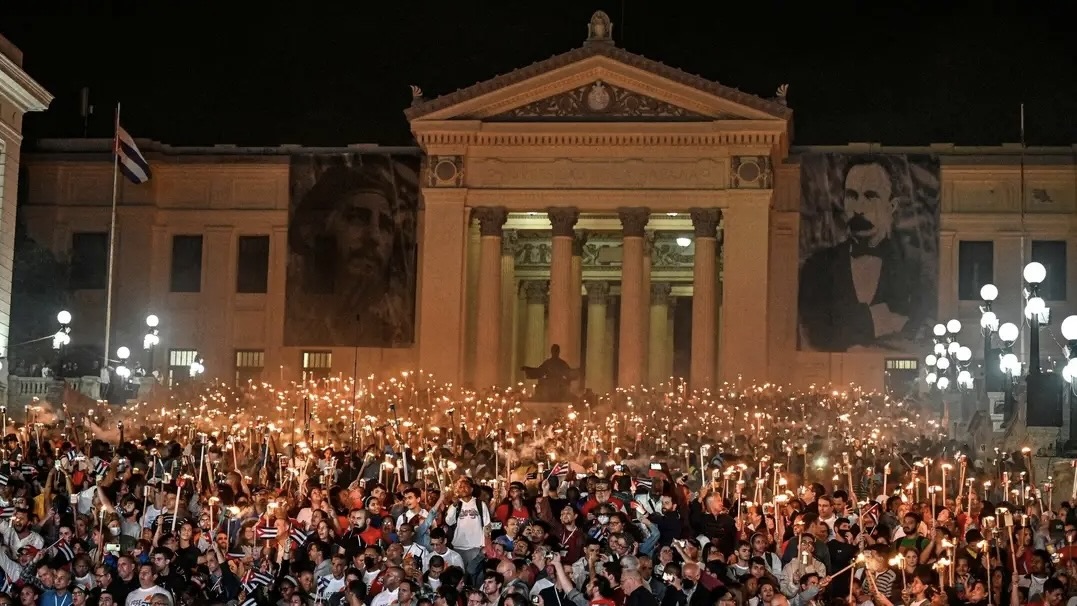
Thousands marched on January 26, 2026 in Havana, Cuba, to honor José Martí’s legacy. Photo: Progressive International
Claims by officials in Washington that “Cuba’s collapse is imminent” usually coincide with a tightening of the blockade. Yet, once again, Cubans have reaffirmed their commitment to the revolution and their creative resistance in the face of the latest US attacks.
The halls of power in Washington are echoing with a familiar, predatory chorus. Once again, the White House, various think-tank experts, and US politicians are predicting the “imminent collapse” of Cuba. This is a tune the world has heard for over sixty years, usually sung at its highest volume whenever the United States decides to tighten the economic noose around the island’s neck. However, in 2026, the rhetoric has shifted from sanctions to an overt campaign of total strangulation. Under a new executive order signed in late January, the second Trump administration has escalated the decades-long blockade into a proactive fuel blockade.
Cuban President Miguel Díaz-Canel laid bare the intended consequences in a press conference on February 5, 2026: “Not allowing a single drop of fuel to enter our country will affect transportation, food production, tourism, children’s education, and the healthcare system.” The objective is clear: to induce systemic failure, sow popular discontent, and create conditions for political destabilization. The White House rhetoric confirms this intent. Press Secretary Karoline Leavitt’s statement on the same day, that “the Cuban government is on its last leg and its country is about to collapse,” is not an analysis but public signaling, a psychological operation meant to reinforce the narrative of inevitable doom and pressure Cuban leadership into unilateral concessions.
This policy is not merely a “sanction” in the traditional sense; it is a calculated attempt to suffocate a nation by blocking every drop of fuel from reaching its shores. The administration has authorized aggressive tariffs and sanctions on any foreign country or company that dares to trade oil with the island, effectively treating Cuban territorial waters as a zone of exclusion. Since December, multiple oil tankers headed to Cuba have been seized by US naval forces in the Caribbean or forced to return to their ports of origin under threat of asset forfeiture. In direct response to this intensifying siege, Cuba has announced sweeping fuel rationing measures designed to protect essential services. The plan prioritizes fuel for healthcare, water, food production, education, public transportation, and defense, while strictly limiting sales to private drivers. To secure vital foreign currency, the tourism sector and key export industries, such as cigar production, will continue operating. Schools will maintain full in-person primary education, with hybrid systems implemented for higher levels. The leadership of the Cuban Revolution has affirmed that Cuba “will not collapse.”
To the planners in the White House, Cuba is a 67-year-old problem to be solved with starvation and darkness. But to the Cuban people, the current crisis is a continuation of a long-standing refusal to trade their sovereignty for Washington’s demands of submission.
The ghost of the “Special Period”
To understand why the Cuban people have not descended into the chaos Washington predicted, one must look to the historical precedent of the “Special Period in Time of Peace.” Following the collapse of the Soviet Union in 1991, Cuba experienced an economic shock that would have toppled almost any other modern state. Overnight, the island lost 85% of its international trade and nearly all of its subsidized fuel imports. The resulting statistics were staggering: the Gross Domestic Product plummeted by 35%, and the daily caloric intake of the average citizen dropped from over 3,000 calories to roughly 1,800. During this era, the lights went out across the island for more than 16 hours a day, and the bicycle became the primary mode of transportation as the public transit system collapsed.
At the same time, Washington escalated its assault through the Torricelli Act (1992) and the Helms-Burton Law (1996), each tightening the noose around Cuba’s economy. However, instead of fracturing under the weight of this tightened blockade, Cubans developed “Option Zero”, a survival plan designed to keep hospitals running and children fed without any fuel, and the Cuban social fabric tightened. The government prioritized the distribution of remaining resources to the most vulnerable, ensuring that infant mortality rates remained lower than those in many parts of the United States despite the scarcity. This period proved that when a population is politically conscious of the external forces causing their suffering, they become extraordinarily resilient. The “Special Period” was not just a time of hunger; it was a period of forced innovation that gave rise to the world’s first national experiment in organic urban farming and mass-scale energy conservation.
The return of the energy crisis
The crisis of 2026 is, in many ways, a sequel to the 1990s, but with higher stakes and more advanced technological targets. The roots of the current energy shortage can be traced back to the first Trump administration’s decision in 2019 to target Cuban oil imports as a means of punishing the island for its solidarity with Venezuela. By designating Cuba as a “State Sponsor of Terrorism” and activating Title III of the Helms-Burton Act, the US successfully scared off international shipping lines and insurance companies. This was followed by a focused campaign against the PDVSA (Venezuela’s state oil company) and the shipping firms involved in the trade agreement between countries in the region known as ALBA-TCP.
By 2025, the impact on Cuba’s energy grid was catastrophic. The island’s thermal power plants, most of which were built with aging Soviet technology, were never designed to burn the heavy, sulfur-rich crude that Cuba produces domestically without constant maintenance and expensive imported additives. The lack of foreign exchange, caused by the tightening of the blockade, meant that spare parts were non-existent. By the time the 2026 fuel blockade began, the national grid was already operating at 25% below its required capacity. President Miguel Díaz-Canel has been transparent with the public, noting that without fuel, everything from the morning school bus to the refrigeration systems for the nation’s advanced biotech medicines is under constant threat, a reality that has now precipitated the stringent new rationing regime.
The threat of intervention: from Caracas to Havana
The current US stance toward Cuba cannot be viewed in isolation from its recent military interventions in the Middle East and Latin America. The “regime change” efforts in Cuba are being modeled after the maximum pressure campaigns used against Iran and the military incursions seen in Venezuela on January 3, 2026. The threat of a US military attack is no longer a rhetorical flourish used by Havana to drum up nationalism; it is a documented strategic option discussed in Washington.
The logic behind such an intervention is twofold. First, there is the ideological drive to eliminate the “contagion” of a country that questions the Monroe Doctrine and US domination in the region. Cuba’s existence serves as a reminder that sovereignty is possible even in the shadow of a superpower. Second, and more pragmatically, the US is motivated by a thirst for strategic minerals. Cuba sits on some of the world’s largest reserves of nickel and cobalt, essential components of lithium-ion batteries that power the global transition to electric vehicles and advanced weaponry. In a world where the US is scrambling to compete with China for control of the mineral and energy supply chain, a sovereign Cuba that controls its own mines is seen as an obstacle to American hegemony. If the US can force a collapse, these minerals would no longer belong to the Cuban people; they would be auctioned off to US corporations as it was before 1959.
The new resistance: extraordinary efforts in renewable energy
However, the Cuban response to this renewed strangulation is not a white flag of surrender. Recognizing that fossil fuel dependence is a vulnerability the US will always exploit, Cuba has, in recent years, launched an extraordinary national effort to transform its energy matrix. Building on this momentum, the country completed 49 new solar parks in 2025 alone. This massive undertaking added approximately 1,000 megawatts of power to the national grid, marking a 7% increase in total grid capacity and accounting for a remarkable 38% of the nation’s energy generation. By the end of March 2026, with support from China, the island is on track to add over 150 MW of renewable power to its grid through the rapid deployment of solar parks.
The strategy is clear: if the empire can shut off the oil, Cuba will harvest the sun. “The way the US energy blockade has been implemented reinforces our commitment to the renewable energy strategy,” President Miguel Díaz-Canel declared. The government has committed to a plan to generate 24% of the country’s electricity from renewable sources by 2030, with a long-term goal of achieving total energy independence. This involves not just large-scale solar farms, but the decentralization of the grid through the installation of thousands of small-scale solar panels on homes and state buildings. This “energy sovereignty” movement is the 21st-century equivalent of the 1990s urban gardens. It is a way of overcoming the US blockade by removing the very commodity, oil, that Washington uses as a leash.
The narrative of Cuba’s “imminent collapse” has been written a thousand times by people who do not understand the depth of the island’s historical memory. The 2026 fuel blockade is a brutal crime against a civilian population, designed to create the very chaos that the US media then reports on as “proof” of government failure. It is the arsonist blaming the house for being flammable. The newly imposed fuel rationing is not a sign of surrender, but a tactical maneuver of national defense, a structured effort to outlast the assault while safeguarding the pillars of Cuban society that precisely make it an alternative to the US model.
Yet, Cuba’s message to the world remains consistent. They are willing to talk and trade, but not to be owned or become a neo-colony of the United States. The story of Cuba is not one of a failed state, but of a people who have decided that the most potent fuel for their future isn’t oil, it’s the will to remain independent. As the sun rises over the new solar arrays in the Cuban countryside, it serves as a silent, glowing testament to a nation that refuses to disappear.
Manolo De Los Santos is Executive Director of The People’s Forum and a researcher at Tricontinental: Institute for Social Research. His writing appears regularly in Monthly Review, Peoples Dispatch, CounterPunch, La Jornada, and other progressive media. He coedited, most recently, Viviremos: Venezuela vs. Hybrid War (LeftWord, 2020), Comrade of the Revolution: Selected Speeches of Fidel Castro (LeftWord, 2021), and Our Own Path to Socialism: Selected Speeches of Hugo Chávez (LeftWord, 2023).
Donald Fuhrump says that Amerikkka doesn’t bother with crimes or charges anymore, not being 100% Amerikkkan and opposing his real estate intentions is enough.Elon Musk urges you to be a Fascist like him, says that you can ignore facts and reality then.
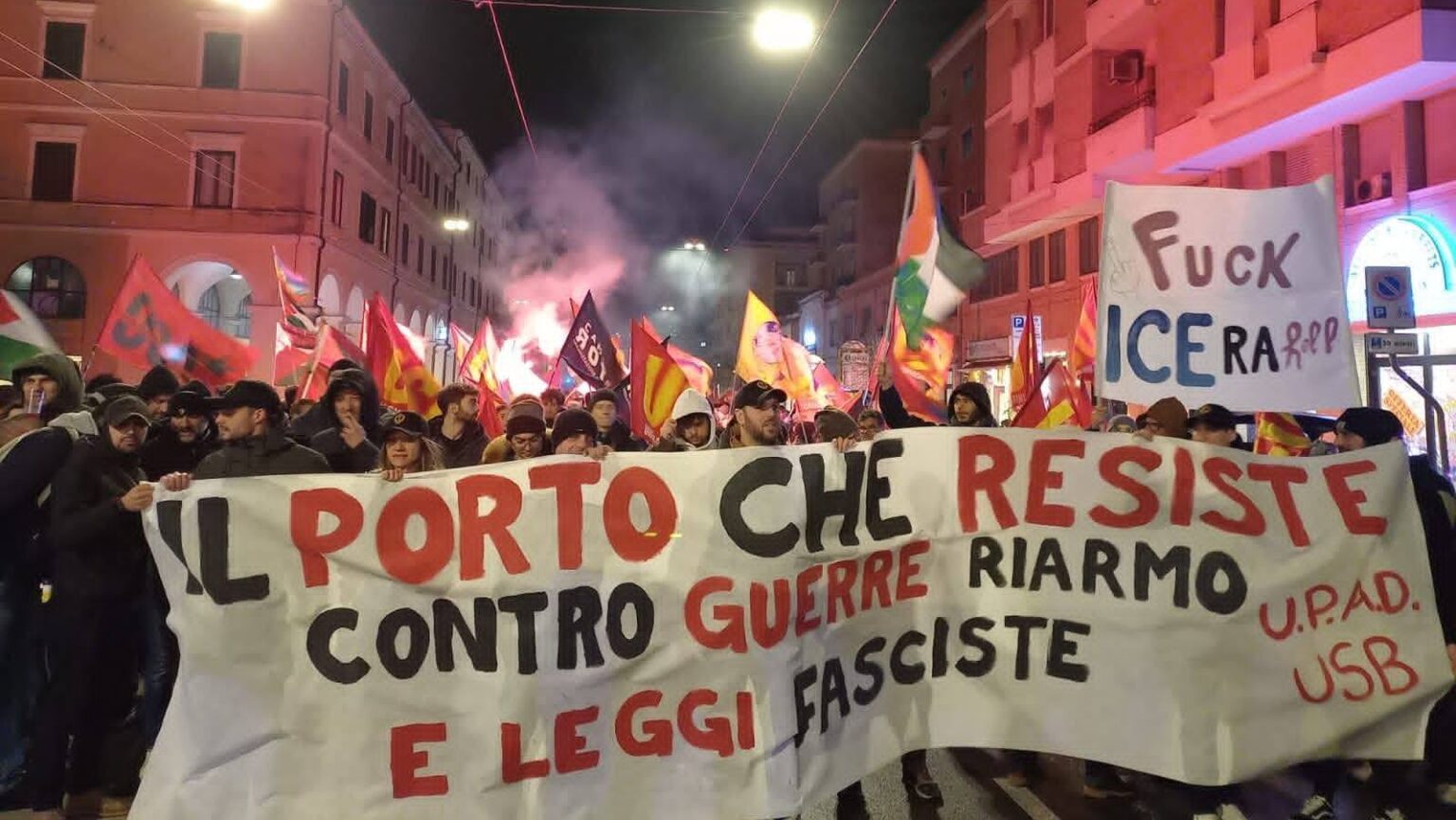
Strike banner in Ancona, reading: “The port that resists wars, rearmament, and fascist laws.” Source: Potere al Popolo Terni/Facebook
On February 6, dockworkers in more than 20 Mediterranean ports went on strike against war, militarization, and port privatization.
Dockworkers in more than 20 ports across the Mediterranean marked a historic moment today as they launched an international day of strike and protest against war and rearmament. Dockers also protested the privatization and militarization of port infrastructure.
Unionists involved in preparing the action described it as the result of a long and complex process, built on dockworkers’ solidarity with Palestine and their struggles for dignified working conditions at home.
The impact of the strike was felt even before it fully unfolded on February 6, as reports emerged of ships – vessels that regularly transport military cargo to Israel – disrupting their itineraries due to the actions.
“Ports are places of sweat, not blood”
Demonstrations began in the morning in the Greek ports of Piraeus and Elefsina, in Türkiye’s Mersin, and in Bilbao and Pasaia in the Basque Country. The trade union Liman-İş Sendikası rallied hundreds of its members to send a message against genocide and in solidarity with Palestine, echoing similar dispatches by their comrades from LAB in the Basque Country.
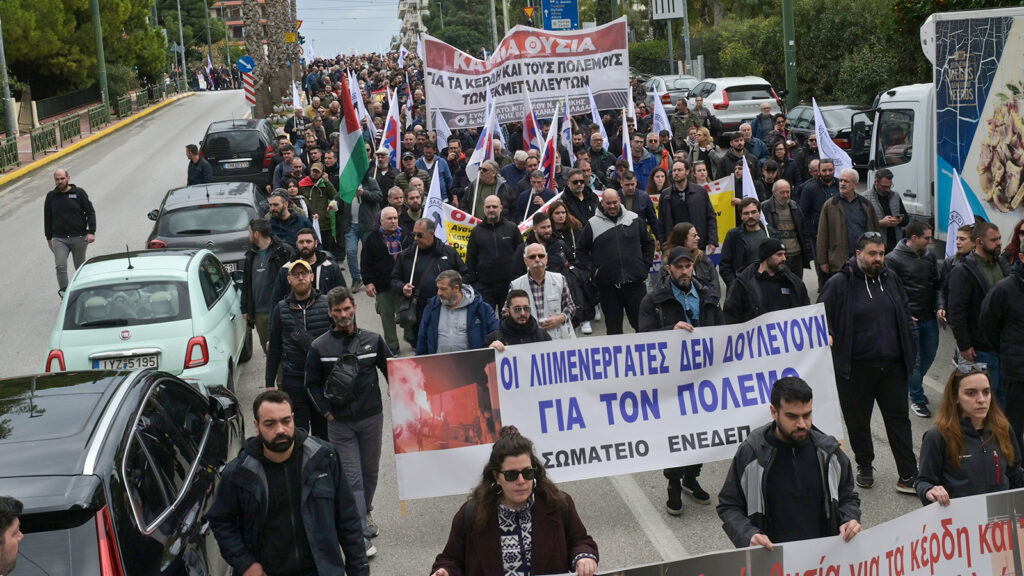
In Greece, dockworkers highlighted the contradiction between massive European investments in rearmament and the imposition of austerity on public services and infrastructure, which is leading to increasingly unsafe working conditions. “We won’t accept work without rights,” said Damianos Voudigaris of the Greek union ENEDEP later in the day. “Development should mean going home alive. Ports are places of work, not war. They are places of sweat, not blood.”
Demonstration during the strike in Piraeus Port. Source: PAME International
Some of the largest mobilizations of the day took place in Italy. Strikes were organized in Ancona, Bari, Cagliari, Civitavecchia, Crotone, Genoa, Livorno, Palermo, Ravenna, Salerno, and Trieste, involving not only dockworkers and port employees but also students and members of the public. The map of the strikes once again underscored the momentum built by Italy’s labor movement over the past year, including three general strikes for Palestine – mobilizations that have drawn inspiration from some of the dockers collectives’ anti-war activism.
The trade union Unione Sindacale di Base (USB) reported from all striking ports, with union representatives addressing assemblies prominently displaying Palestinian and Cuban flags. Workers stressed that Europe’s labor movement must find an internationalist orientation in order to block the anti-worker agenda of the European Union and right-wing governments. Governments including that of Prime Minister Giorgia Meloni, which, as USB activists noted during live broadcasts, was rattled by the determination shown by workers after years of stagnation. According to trade unionists, this panic has translated into a new wave of repression, including measures targeting union members involved in Palestine solidarity actions. USB, however, insisted that resistance to Meloni’s policies would only intensify in the coming weeks.
“Today it’s the ports, tomorrow it will be the entire logistics sector”
While uniting around shared demands – to prevent the militarization of ports, reject rearmament, and stop a war economy from stifling all other priorities – striking workers also raised local concerns. Dockworkers in Trieste warned against port privatization. Elsewhere, including in Bari and Ravenna, workers and students described how port infrastructure was being used, sometimes covertly, to transport military and dual-use materials to Israel. “Everyone here has had enough of that,” one activist in Ravenna said.
Demonstrations held in Civitavecchia, Livorno, and Ancona on Friday evening were notable, with strikers in Ancona describing the day as “monumental.” In Genoa, as has become customary, turnout was massive. Members of the collective CALP – who had previously vowed that “not one nail” would leave the port if Israel attacked the Global Sumud Flotilla en route to Gaza – led the protest. Speaking to media and fellow activists, they stressed that the success of the international strike once again proved that dockworkers keep their promises.
“We promised to block everything – and we blocked everything. We promised a general strike – and we had a general strike. We promised an international strike – and here we are,” they said.
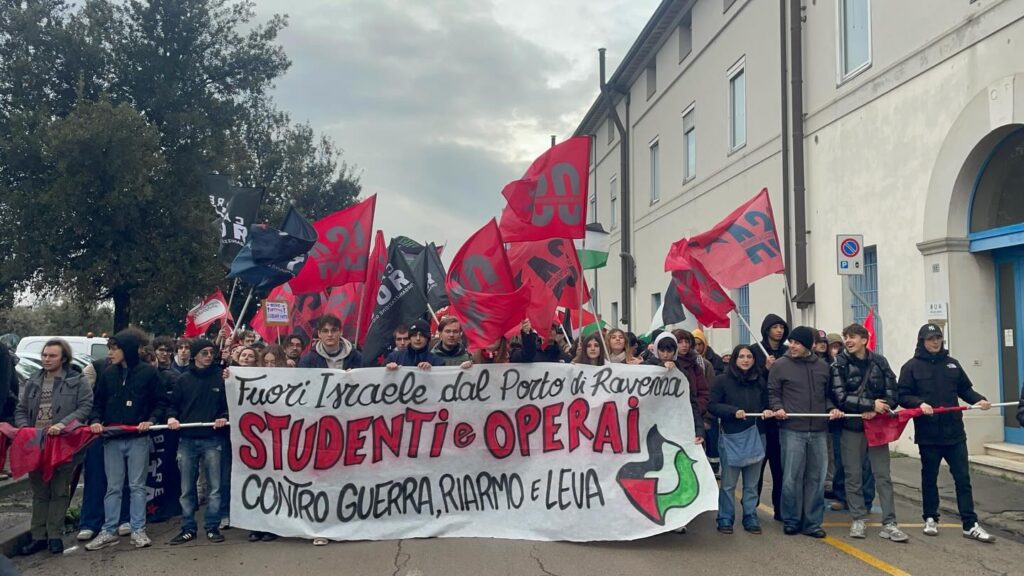
Students in solidarity with dockworkers in Ravenna. Source: Cambiare Rotta Bologna
The international dockworkers’ strike, however, is not the end of the road, workers emphasized. “Today it’s the ports, tomorrow it will be the entire logistics sector, and then it will be all workers,” strikers in Ravenna concluded.
Actions were also reported in the ports of Fos-sur-Mer near Marseille, the German hubs of Bremen and Hamburg, and in Corsica. Dockworkers from Morocco’s Democratic Labor Organization (ODT), who had been involved in preparing the strike throughout the process, were forced to postpone their industrial action due to extreme weather conditions that led to port closures.
Genocide denier and Current UK Prime Minister Keir Starmer is quoted that he supports Zionism without qualification. He also confirms that UK air force support has been essential in Israel’s mass-murdering genocide. Includes URLs https://www.declassifieduk.org/keir-starmers-100-spy-flights-over-gaza-in-support-of-israel/ and https://youtu.be/O74hZCKKdpAKeir Starmer objects to criticism of the IDF. He asks how could anyone object to them starving people to death, forced marches like the Nazis did, bombing Gaza’s hospitals and universities, mass-murdering journalists, healthworkers and starving people queuing for food, killing and raping prisoners and murdering children. He calls for people to stop obstructing his genocide for Israel.Orcas discuss Genocide-supporting and complicit Zionists. Donald Trump, Keith Starmer, David Lammy, Rachel Reeves, Angela Rayner and Wes Streeting are acknowledged as evil genocide-complicit and supporting cnuts.
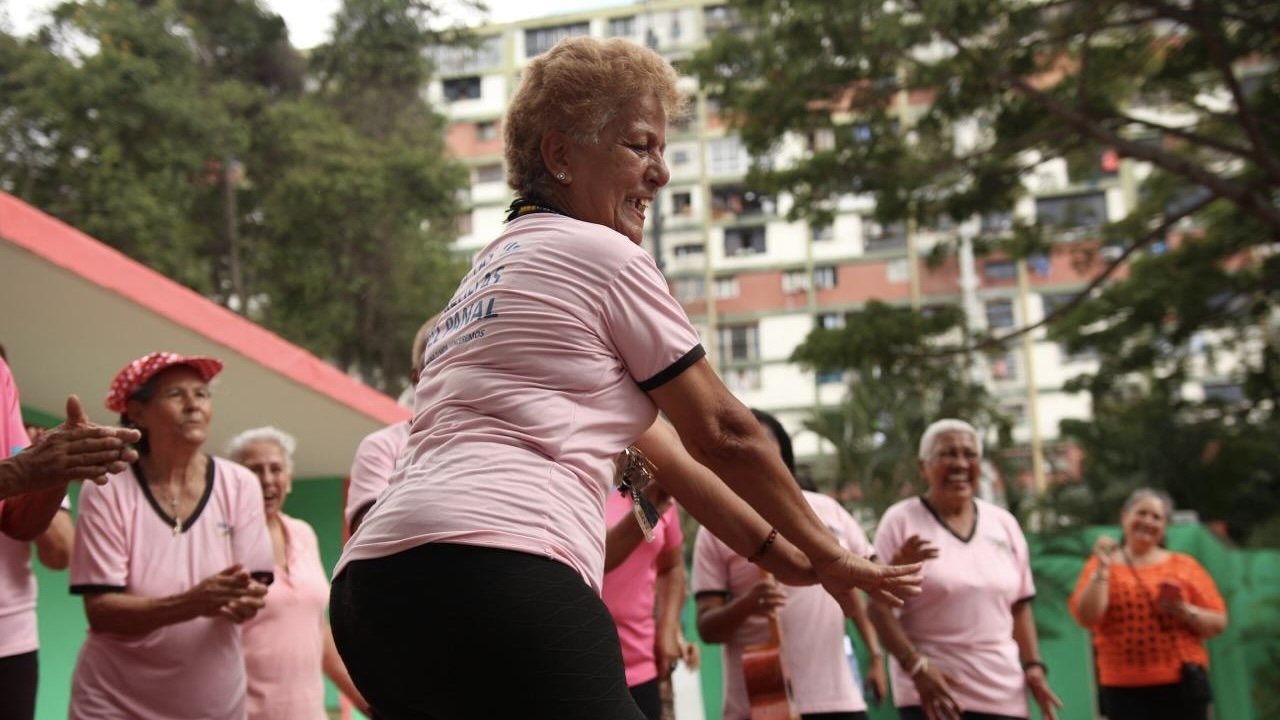
Las abuelas del Panal (The Grandmothers of the Panal, a commune in Caracas) dance as part of their regular exercise class. Photo: Celina della Croce
Unlike social democratic projects in the West, Venezuela’s Bolivarian Revolution has set out to fundamentally transform society and build a socialist project rooted in class struggle and run by its people.
US President Donald Trump has not shied away from admitting his thirst for Venezuelan oil. On December 16, 2025, in the leadup to the January 3 bombing of Caracas and kidnapping of the country’s president and first lady, Nicolás Maduro and Cilia Flores, he claimed ownership over Venezuela resources, stating that “America will not … allow a hostile regime to take our Oil, Land, or any other Assets, all of which must be returned to the United States, IMMEDIATELY”. In his previous administration, he echoed the same obsession with resource-driven regime change, decrying in June 2023 that “When I left [office], Venezuela was ready to collapse. We would have taken it over. We would have gotten all that oil. It would have been right next door.” Yet Venezuela is not only home to the world’s largest known oil reserve, but also the continent’s largest gold reserves and an ample supply of bauxite, diamonds, iron ore, nickel, and coal … And, not least of all, hope.
Trouble at home
Within his own borders, Trump faces heightened civil unrest, with over 100,000 people in Minneapolis alone taking to the streets (roughly a quarter of the city’s population) during a January 23 general strike (an action that has not been seen on this scale for decades) and again during a January 30 nationwide shutdown. Similar uprisings have spread across the country, from Los Angeles to New York, following ICE’s murder of Renée Good and Alex Pretti. This massive outpouring follows a year of discontent and marches decrying Trump’s anti-immigrant, anti-poor policies.
The escalation of ICE’s tactics under the Trump administration has cost US taxpayers, reaching an all-time high of 85 billion USD in allocated funds (compared to annual spending that has hovered around 10 billion USD or less for the past decade). Much of these funds go to benefit private corporations: for instance, 86% of detainees are held in private, for-profit prisons (whose stocks skyrocketed as a result of Trump’s election and subsequent policies), and the cost of deportation flights, also run by private companies, is astronomically higher than commercial flights (the per-person cost of a deportation flight from El Paso to Guatemala, for example, is USD 4,675—five times higher than a commercial first-class ticket for the same route). At the same time, Trump’s administration has slashed social spending, with a 186-billion USD reduction to Supplemental Nutrition Assistance Program (SNAP) benefits alone (a program that, up to that point, helped 1 in 8 people in the US with the basic provision of food).
In the United States, and the West in general, there is a deep-seated narrative that this is just the way things are. Perhaps we can tone back the violence – swap out a Donald Trump for a Joe Biden who is more cautious with his tactics and open to mild concessions but no less interested in protecting capitalist profits at all costs. Even key figures in Trump’s own party, from Senators Josh Hawley (R-MO) and Todd Young (R-IN) to Trump’s former Vice President Mike Pence, have sought to distance themselves from his extreme tactics and distaste for liberal democracy (a general audacity that risks backfiring lest it create sufficient dissent and turmoil to provoke a mass uprising and turn to the left). Yet neither party is willing to allow anything further than a meek liberal democracy beholden to the interest of a small but powerful elite, at most with enough provisions to keep the general population at bay.
Venezuela’s break with the end of history
The US population, like much of the world, has been told, time and time again, that History has ended. We may be able to eke out higher wages, and certainly demand that the heightened assault on liberal democracy through ICE and the openly fascistic declarations by Donald Trump be brought under control, but anything beyond that is painted as impractical at best, and perilous at worst. Just look at the Soviet Union, we are told – it just doesn’t work. Socialism sounds nice, but look at the suffering in Venezuela and Cuba. You don’t want that, do you?
Yet this way of understanding the past, present, and future not only seeks to protect the interests of capital, tricking many working-class people into betraying their own interests, but is wildly inaccurate through both omission and outright lies. And it seeks to cover up another extraordinary resource that Venezuela represents: a living example of hope, of unmovable dignity, of the success of a revolution that has not only brought a population out of extreme poverty but has lifted up its confidence and consciousness. In a country under extreme siege by more than 1,000 US-led unilateral coercive measures, there are nonetheless a fraction of the amount of homeless people in the US (where there are roughly 28 vacant homes to every 1 homeless person).
At the height of the crisis in Venezuela, as Trump ramped up his maximum pressure campaign, 40,000 Venezuelans died in a single year (2017-2018) due to the lack of medicines and healthcare that had previously been provided freely to the population. Even then, the vast majority of Venezuelans have continued to fight to defend not only their right to self-determination, but also to revolution and transformation. What exactly are the Venezuelan people fighting for that the US government tries so hard to cover up? What is the source of resiliency and loyalty to the Bolivarian Revolution, despite the tremendous human cost of US-led efforts to overthrow it? And, what is the “unusual and extraordinary threat” that Venezuela poses to the US – as then President Barack Obama decreed in a 2015 executive order that paved the way for the economic siege?
The Venezuelan “threat”
When President Hugo Chávez came to power in 1999, a revolutionary process began that would set out to repay the “social debt” owed to the Venezuelan people, beginning by dedicating 75% of national spending to social investment – funds, importantly, generated by the country’s historically predominant oil sector. Through missions that began the year Chávez was elected, the country elevated its population out of poverty and illiteracy, reaching a 100% literacy rate, with more than three million people learning how to read and write (Mission Robinson); training 6,000 professionals in universities and graduating one million high school students (Mission Sucre); granting nearly 5 million homes to families across the country (Mission Vivienda); building health clinics in 320 of Venezuela’s 355 municipalities (Mission Barrio Adentro); and restoring the eyesight of some 300,000 Venezuelans while providing eye surgery to 1 million (Mission Milagro).
President Nicolás Maduro has continued this legacy, despite the duress imposed by the US-led unilateral coercive measures imposed in the years following Chávez’s death, ensuring not only that the country’s resources benefit the well-being of the majority, but also that power is given back to the people through a model of direct democracy. Weeks before he was kidnapped, for instance, Maduro convened the Constitutional Congress of the Working Class, the culmination of 22,110 assemblies in workplaces across the country in which delegates debated and made proposals to the president about the future of the country’s labor sector and productive processes, such as strengthening domestic production of machinery components in order to reduce external technological dependency. Aprobada (“approved”), Maduro told delegate María Alejandra Grimán Rondón as she presented him with the conclusions of the congress in front of a packed auditorium; for another proposal, “the method still needs to be refined”, he replied, outlining next steps for further debate. Furthermore, communes (grassroots organizations at the heart of Venezuela’s direct democracy through which communities exercise self-governance) have engaged in quarterly national consults since 2024, with millions voting on the allocation of government funding for thousands of projects that most need attention in their communities, from updating medical equipment in their local health clinics to investing in water filtration supplies to ensure access to potable water.
Both of these processes are part of a model of direct democracy that, in the 27 years of the Bolivarian Revolution, has held 31 elections, carried out constitutional reform, and created structures for everyday people to make direct decisions about the path of the country. In short, while the accomplishments of the revolution are far too numerous to list here, at their core is a people who have reclaimed their dignity, taken control of their future, and made the irreversible decision to stand upright.
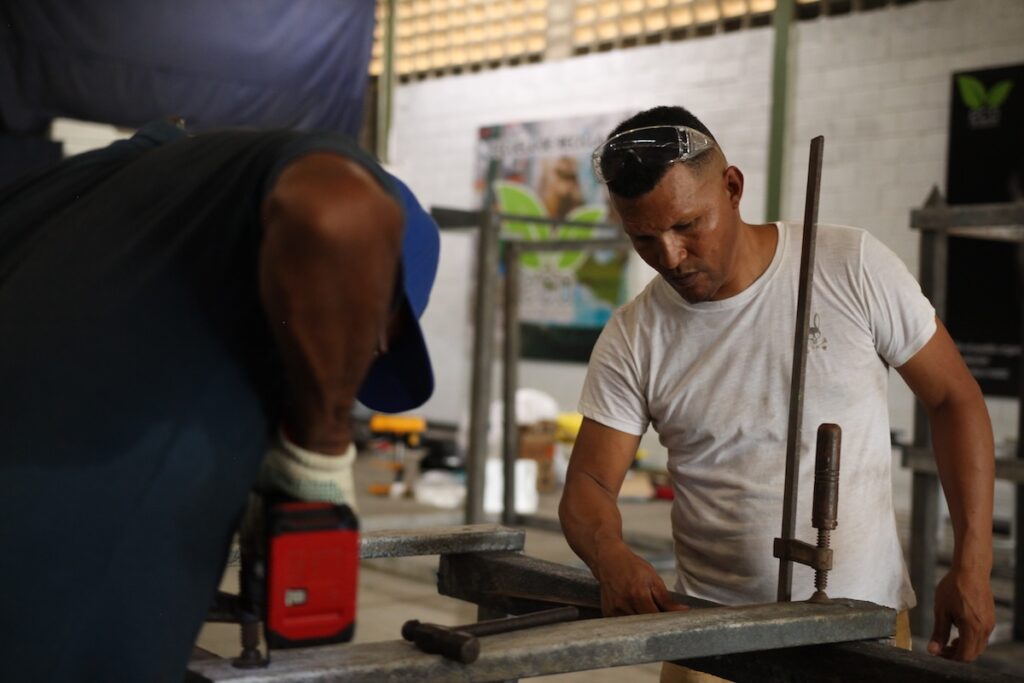
Members of the Fruto Vivas Recycling School (Escuela de Reciclaje Fruto Vivas) in Barcelona, Anzoátegui, assemble a playground with materials they produced from recycled plastic. Members of the school collect the plastic, sort it, melt it, and then mold it into the pieces required to build a given product based on the needs of the community as well as other paid contracts which generate funds to continue the school’s work. Photo: Celina della Croce
Unlike social democratic projects in the West, Venezuela’s Bolivarian Revolution has set out to fundamentally transform society and build a socialist project rooted in class struggle and run by its people. That means that the social advances are also tied to a process of raising consciousness among the population, whereby people become the protagonists of their own struggle in a process that ultimately seeks to give them the power and tools to run the country, replacing the bourgeois state with a communal one. In this system, decisions are made by the population which is organized into communes and various social and political movements across the country. Through these processes, people learn how to run productive processes, from coffee to construction materials, and be effective owners of their own means of production; how to engage in popular decision-making processes across thousands of households; run communications teams; carry out education programs; identify, prioritize, and fix issues in their communities; and other elements that are necessary for a productive society that prioritizes the well-being of its people. All of this is done in line with coreprincipals such as protecting the planet (with some communes collecting recyclable plastics and turning them into playgrounds, benches and chairs for the elderly and schoolchildren, and other needs expressed by the community) and centering the leadership and rights of women and marginalized sectors.
What does the future hold for the nobodies?
This dynamic process is a continuation of the path set out by Chávez, one that called upon the “nobodies” to be the makers of their own destiny. These “nobodies” (today the protagonists of one of the world’s most resilient and equitable democracies) have shown, time and time again, that they will not sacrifice their dignity nor sovereignty at any cost, no matter how severe the threat. This example is no less valuable a resource than the country’s oil, nor any less of a threat to the Trump regime and US agenda at large. The example set by the Bolivarian Revolution and its people creates a fissure in the narrative that the US (and the world) population must make the best of what we have, go to work every day with our heads down and spirits crushed, and forfeit our dreams of a better world. It opens a window for the nobodies of the world (and especially of the US) to see that on the other side of events like the mass uprisings sweeping the country, they, too, could live in a society where the wealth that they themselves generate is reinvested into the common good rather than paying for bombs and lining the pockets of the few.
Celina della Croce is a writer, editor, and the publications director of Tricontinental: Institute for Social Research. She has been an organizer and leader in internationalist, anti-imperialist, and working-class struggles in the United States for over a decade.
Donald Fuhrump says that Amerikkka doesn’t bother with crimes or charges anymore, not being 100% Amerikkkan and opposing his real estate intentions is enough.Elon Musk urges you to be a Fascist like him, says that you can ignore facts and reality then.
[Guardian] Exclusive: António Guterres says world’s accounting systems should place true value on the environment
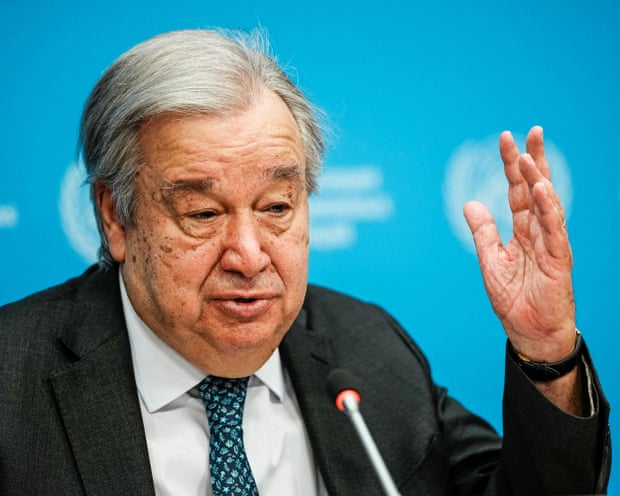
AntónioGuterres called for economies to ‘move beyond GDP’ as a measure of economic and societal success. Photograph: Eduardo Muñoz/Reuters
The global economy must be radically transformed to stop it rewarding pollution and waste, UN secretary general António Guterres has warned.
Speaking to the Guardian after the UN hosted a meeting of leading global economists, Guterres said humanity’s future required the urgent overhaul of the world’s “existing accounting systems” he said were driving the planet to the brink of disaster.
“We must place true value on the environment and go beyond gross domestic product as a measure of human progress and wellbeing. Let us not forget that when we destroy a forest, we are creating GDP. When we overfish, we are creating GDP.”
For decades, politicians and policymakers have prioritised growth – as measured by GDP – as the overarching economic goal.
But critics argue that endless, indiscriminate growth on a planet with finite resources is driving not only the climate and nature crisis but increasing inequality.
Guterres said: “Moving beyond gross domestic product is about measuring the things that really matter to people and their communities. GDP tells us the cost of everything, and the value of nothing. Our world is not a gigantic corporation. Financial decisions should be based on more than a snapshot of profit and loss.”
…
In January, the UN held a conference in Geneva titled Beyond GDP attended by senior economists from around the world – including Nobel laureate Joseph Stiglitz, leading Indian economist Kaushik Basu and equity expert Nora Lustig.
The trio are part of a group set up by Guterres that has been tasked with devising a new dashboard of measures of economic success that takes “human wellbeing, sustainability and equity” into account.
A report published by the group late last year argued that, as the world wrestled with repeated global shocks over the past two decades, the need for an economic transformation had become increasingly urgent – from the financial crash of 2008 to the Covid-19 pandemic.
It said those events were exacerbated by the “triple planetary crisis of climate change, biodiversity loss, and pollution” and, in addition, warned that rapid technological change was upending labour markets and exacerbating growing inequality.
Donald Trump urges you to be a Climate Science denier like him. He says that he makes millions and millions for destroying the planet, Burn, Baby, Burn and Flood, Baby, Flood.Nigel Farage explains the politics of Reform UK: Racism, Fake anti-establishmentism, Deregulation, Corporatism, Climate Change Denial, Mysogyny and Transphobia.Elon Musk urges you to be a Fascist like him, says that you can ignore facts and reality then.