The Israeli professor that the BBC won’t interview


Original article by J.E. Rosenberg republished from People’s World under http://creativecommons.org/licenses/by-nc-nd/3.0/us/.
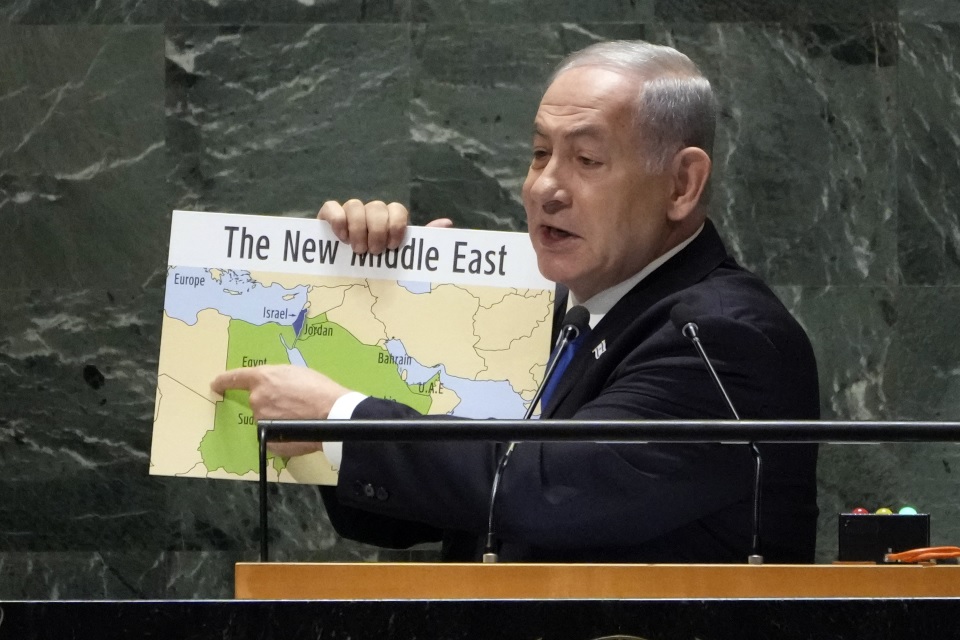
As the U.S.- Israeli wars across West Asia widen, a clearer picture is emerging of Israel’s long-term strategic and ideological objectives, and they go far beyond claims of “security” or “self-defense.”
This week, Israeli Finance Minister Bezalel Smotrich made that reality explicit. Speaking publicly amid Israel’s escalating assault on Lebanon, he declared that Israel’s northern border “must be the Litani River,” calling for the outright conquest and annexation of southern Lebanon.
This is not fringe rhetoric. It is a statement from a senior cabinet minister, and one that aligns with military actions already underway on the ground.
Israeli forces are not merely striking Hezbollah positions. They are systematically reshaping southern Lebanon: Vital [b]ridges over the Litani River have been destroyed, cutting off civilian movement and isolating the south from the rest of Lebanon. Entire villages are being leveled and depopulated, as the Israeli government calls for the demolition of homes and other civilian infrastructure. This has led to over a million Lebanese already being displaced.
Rather than taking temporary battlefield measures, the Israeli army is putting in place the material preconditions for territorial reorganization.
Military planners and political leaders are increasingly aligned around the idea of a permanent “buffer zone” south of the Litani. Such language has historically often preceded de facto annexation, and Smotrich’s statement removes any ambiguity. The goal is a permanently expanded Israel.
What is now unfolding in Lebanon follows the pattern already visible in Gaza. Israeli officials and lawmakers have repeatedly called for the resettlement of Gaza by Israeli settlers and the absorption of large portions of its territory into Israel. Many in Israeli leadership have even called for the depopulation of Gaza to build a Jewish majority in the territory. The destruction of entire cities like Rafah and Beit Hanoun has already emptied former population centers of their residents.
In Lebanon, Israeli leaders are explicitly invoking this precedent. Government figures have urged applying the “Gaza model” to southern Lebanon, meaning the destruction of villages, displacing populations, and then redefining control on the ground.
Gaza and Lebanon are thus not two separate wars; they are two avenues in pursuit of the same strategy. While bombs fall in Gaza and Lebanon, the West Bank is undergoing its own transformation. Israeli settler violence, mass expulsions, and military raids have intensified alongside open political calls to formally annex that territory, as well. Entire Palestinian communities are being pushed off their land, often under direct protection of the Israeli military.
There is no large-scale bombardment as in Gaza and Lebanon, but the goal of removing the population and normalizing such actions remains the same.
At the same time, Israel has expanded its military operations deeper into Syria, targeting Iranian-linked infrastructure and asserting “freedom of action” across the country. Just this week, Israeli forces entered the Syrian city of Qunetra, set up road blocks, and arrested residents, as if Israel already had legal jurisdiction over this Syrian city.
These strikes are being framed as preemptive defense, but taken together with operations in Gaza and Lebanon, they reflect a broader doctrine. Israel is showing it intends to reshape the entire region through force, regardless of sovereignty.
The messianic vision of a Greater Israel
What ties these fronts together is not simply conflict with Hamas, Hezbollah, or Iran. It is a coherent territorial and political project known as The Greater Israel Project. Proponents of this idea have long called for Israel to expand its borders south into Egypt and northward and westward to the Euphrates River. Their claim is based on Biblical passages that say God promised these lands to Abraham’s descendants.
While this idea was once rightfully scene as fringe, religious fanaticism, it has become increasingly mainstream. U.S. Ambassador to Israel and famed Chritisan Zionist Mike Huckabee recently endorsed such a vision during an interview with Tucker Carlson. Even the supposed secular and “liberal” leader of the Israeli opposition, Yair Lapid, said he supported the idea of expanding Israel to match the biblical description.
What’s happening on the ground shows that such talk is not simply empty rhetoric for religious constituents but a plan being put into action. Smotrich’s statement is significant not because it is shocking, but because it is consistent. It articulates openly what Israeli policy has been implementing incrementally: the use of war to redraw borders and reshape demographics across the region.
These wars by Israel are materially enabled and politically shielded by the United States. The current escalation—particularly the joint U.S.-Israeli war against Iran—has created the conditions under which these expansionist, fanatical aims can be pursued under the cover of a broader regional conflict.
The Trump administration continues to frame these actions as part of a defensive alliance, but the outcome on the ground expanding war, mass displacement, and the steady erosion of national sovereignty across multiple countries.
The danger of the current moment lies in its normalization. Greater Israel was once an idea the fascist right wing carefully whispered about only among like-minded people. Today, it has become official policy of the Israeli government, with the backing of the United States.
The question is no longer whether such plans exist. It is whether they will be allowed to proceed unchallenged. If the Litani River becomes Israel’s new northern border, it will not be the end of the process. From there, history suggests, the map will not stop changing.
As with all op-eds and news analytical articles published by People’s World, the views expressed here are those of the author.
J.E. Rosenberg grew up in an extremist, religious Zionist household in the U.S. After moving to Israel as a young adult, he changed his world views. He left Israel and is now a member of the Communist Party.
Original article by J.E. Rosenberg republished from People’s World under http://creativecommons.org/licenses/by-nc-nd/3.0/us/.


https://morningstaronline.co.uk/article/much-united-states-would-wish-otherwise-cuba-not-alone

 Activists wave Cuban and Palestinian flags from the vessel Maguro, arriving from Mexico with humanitarian aid as part of the “Nuestra America,” or Our America convoy, in Havana Bay, Cuba, March 24, 2026
MORE than 100 MPs have voiced “grave concern” over Donald Trump’s Cuba oil blockade, calling on PM Sir Keir Starmer to oppose the US president’s “collective punishment” of its civilian population.
Ministers were urged to reject Washington’s threat to slap tariffs on any other country that ships fuel to the island after it kidnapped Venezuelan leader Nicolas Maduro in January.
The US has blocked Venezuelan oil supplies to Cuba’s socialist government, which said last week that it had not received any fuel in three months.
Your Party leader Jeremy Corbyn, Labour, SNP, Plaid Cymru, Green, SDLP, and Lib Dem MPs have now signed an early day motion by Labour MP for Montgomeryshire and Glyndwr Steve Witherden.
Mr Corbyn told the Morning Star: “The aim of the criminal and inhumane blockade by the US is clear: to starve the Cuban people into submission. They will not succeed.
“As much as the United States would wish otherwise, Cuba is not alone.”
They collectively called on the government to reject the “unjustifiable” sanctions and US claims that Cuba poses an “extraordinary” threat.
…
Socialist MP Richard Burgon, who was in Cuba this weekend delivering humanitarian aid with an international delegation, said: “In Cuba I saw the cruel consequences of Trump’s total ban on fuel entering the country, including its impact on the ability to provide healthcare to those in need.
“Cutting off fuel to an entire country is an inhumane attempt by Trump to strangle the Cuban people into submission. It is illegal and it’s putting lives at risk.
“The UK rightly votes against the US blockade at the UN each year, but that must now be matched with action. It should follow Spain’s example and provide emergency humanitarian aid.”
Green Party parliamentary leader Dr Ellie Chowns said: “Trump has intensified his threats against Cuba following the collapse of the island nation’s energy grid under a US-imposed oil blockade, declaring just yesterday that he believes he will ‘take’ the country and ‘could do anything [he] want[s] with it. This cannot continue.”
Cuba Solidarity Campaign director Rob Miller said his group is delighted with the number of MPs who have signed the motion, saying: “Together they represent over seven million UK constituents.
“We now hope the UK government will move quickly to send humanitarian support to Cuba, a country with which we have had full diplomatic and friendly relations for over 120 years.”
…
Original article at https://morningstaronline.co.uk/article/much-united-states-would-wish-otherwise-cuba-not-alone


Original article by Stephen Prager republished from Common Dreams under Creative Commons (CC BY-NC-ND 3.0).
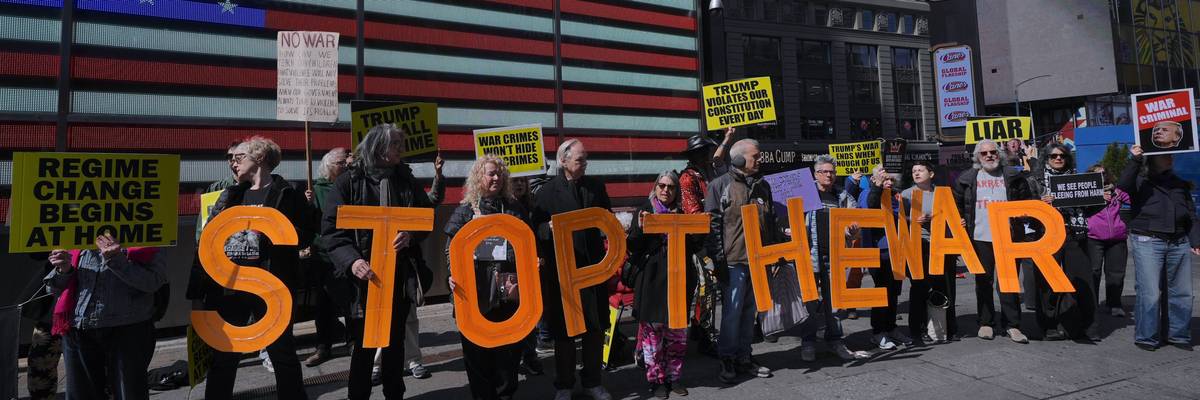
Nearly six in ten Americans say President Donald Trump’s war in Iran has gone too far, according to a poll out Wednesday from the Associated Press-NORC Center for Public Affairs Research.
The war launched late last month by the US and Israel has led to the deaths of more than 1,400 Iranian civilians, according to the Human Rights Activist News Agency (HRANA), and the displacement of more than 3 million. It has spiraled out across the region while creating a global economic crisis that has caused gas prices to spike to nearly $4 per gallon in the US.
RECOMMENDED…
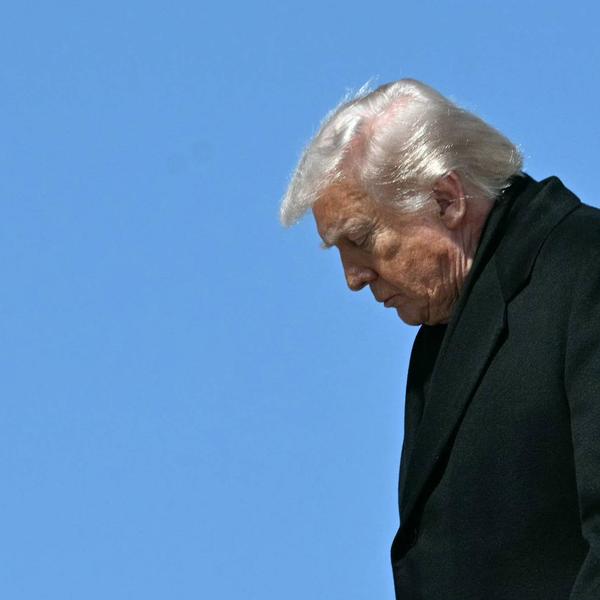
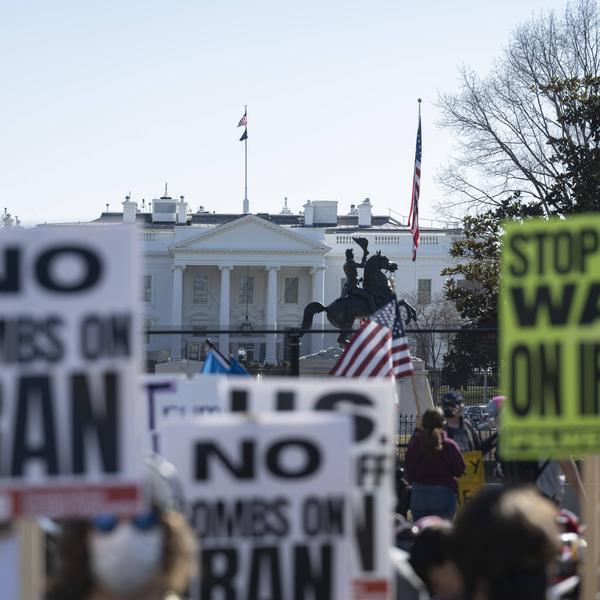
Now, 59% of American adults say it’s “gone too far,” compared to just 26% who say it’s “been about right” and 13% who say it’s “not gone far enough,” according to the survey of 1,150 people.
Those opposed to continuing the president’s war of choice include 90% of Democrats and 63% of independents. Most Republicans, 52%, say the amount of force used by Trump has been “about right.” Just 20% want him to go further, while 26% say he’s gone too far.
In recent days, as Iran’s closure of the Strait of Hormuz has wreaked havoc on global oil prices, Trump has sent thousands more servicemembers to the region and reportedly mulled deploying American ground troops in hopes of reopening the crucial waterway.
Experts have warned that a ground deployment could turn the war into an even greater quagmire. Already, 13 US soldiers have been killed since February 28.
An even larger share of Americans, 62%, said they oppose the idea of deploying US troops on the ground in Iran, while just 12% say they support it and 26% say they have no opinion.
While a minority says it is very important for the US to stop Iran from threatening Israel or to replace its government with one more favorable to the US, Americans are prioritizing issues at home.
Ninety-three percent said it was very or somewhat important for the US to keep oil and gas prices low, which has so far not happened—in less than a month, they have spiked by about a dollar and have not shown signs of coming down, even as Trump has deployed emergency fuel reserves and lifted sanctions on some Iranian oil to juice supply.
A majority of Americans, 65%, also said they felt that preventing Iran from obtaining a nuclear weapon—one of Trump’s stated objectives for the war—was a very important foreign policy goal.
However, as journalist and commentator Adam Johnson pointed out in a piece for The Real News on Tuesday, the US public is “grossly misinformed” about the subject—25% wrongly believe Iran already possesses a nuke while 45% believe they are working towards developing one, which has been refuted by US intelligence assessments and reporting based on the testimony of US officials.
The unpopularity of the war with Iran is in line with previous polls showing that the majority of Americans believe the war benefits Israel more than the US and want the war to end quickly.
With Trump having returned to office on the explicit pledge to avoid war with Iran and the cost of living already at the center of the president’s near-historic unpopularity, Republicans’ outlook for this year’s midterm elections looks as grim as ever.
Polling aggregators predict Democrats will easily flip the House, and the Senate is now a toss-up, though Republicans still hold a slight edge.
According to polls, Republicans’ midterm chances truly began to tank in January amid outrage over federal immigration agents’ killings of two US citizens in Minneapolis. Though surveys haven’t shown GOP numbers getting markedly worse since the war began, recent opinion polling suggests it is not a non-factor.
A poll last week from the Institute of Middle East Understanding found that 43% of voters said they’re less likely to support Republicans in the midterms as a result of the war, compared to 31% who said they’re more likely.
Original article by Stephen Prager republished from Common Dreams under Creative Commons (CC BY-NC-ND 3.0).

