The Green Party has accused Farage of being “focused on personal gain and public division”.
Reform UK leader Nigel Farage has banked more than £2 million in earnings and gifts since becoming an MP, DeSmog can reveal.
Farage has come under fire in recent days for failing to declare a £5 million gift from major Reform donor Christopher Harborne prior to the 2024 general election, potentially in violation of parliamentary rules.
Despite this tax-free handout, Farage has used his time in Parliament to earn millions from second jobs, speaking events, and trips abroad.
DeSmog’s analysis shows that Farage has registered more than £2 million in financial interests since July 2024, when he was elected as the MP for Clacton.
His principal employer has been the right-wing broadcaster GB News, which has now paid Farage £700,000 since July 2024. The Reform leader – who presents a show on GB News – registered another £40,662 from the outlet last week.
This income has been received on top of Farage’s £94,000-a-year public salary.
He also listed a new gift from South African businessman Avi Lasarow, who gave the Reform leader three tickets to a boxing match on 4 April worth £1,749.
“Nigel Farage is a multi-millionaire who is out for himself and working for the interests of his super-rich friends,” a Green Party spokesperson said. “His whole career has been focused on personal gain and public division. He is failing his constituents and has no positive plan to help ordinary people with the cost of living crisis, housing or improving public services.”
Since becoming an MP, Farage has accepted £272,000 in gifts, including several private jet flights to the United States, and F1 tickets provided by the Abu Dhabi government.
“That Farage has amassed £2 million from personal earnings and gifts while a sitting member of Parliament should concern anyone who thinks an MP’s job is to represent their constituents,” said Kamila Kingstone, a senior campaign lead at Spotlight on Corruption.
“It’s a systemic issue and highlights a wider failure of the rules that are supposed to ensure integrity in public life. It risks blurring the lines between public service and private interests, creating the perception – and in some cases a reality – that some politicians are in it for themselves.”
DeSmog revealed in April that over 70 percent of Farage’s patrons are based abroad – including Harborne, the Thailand-based crypto investor who has gifted flights and accommodation to Farage worth £85,453 since July 2024.
Harborne, who owns a jet fuel supplier, has donated £22 million to Reform on top of the £5 million that he gifted to Farage before the 2024 general election.
His contributions to the party are now in jeopardy after Labour introduced new rules that cap political donations from overseas residents to £100,000 a year. In response, Harborne has committed to finding a loophole through which he can donate even larger sums to Reform.
“Where there’s a will, there’s a way,” he told The Telegraph – adding: “I don’t believe the government has a right to stop me, and they won’t.”
Reform UK is the UK’s leading anti-climate party, with several of its senior figures – including Farage – having denied basic climate science. The Reform leader has claimed it’s “absolutely nuts” for CO2 to be considered a pollutant, while his deputy Richard Tice has called it “plant food”.
“The government urgently needs to impose tougher limits on MPs’ second jobs,” Kingstone added, “so that the public can be confident that their representatives are working in the public interest rather than to line their own pockets.”
Reform and Farage were approached for comment.
A version of this article was published by The Guardian.
Climate science denier Nigel Farage explains that it’s simple to blame asylum-seekers or Muslims for everything.Nigel Farage explains the politics of Reform UK: Racism, Fake anti-establishmentism, Deregulation, Corporatism, Climate Change Denial, Mysogyny and Transphobia.Nigel Farage objects to criticism of the IDF. He asks how could anyone object to them starving people to death, forced marches like the Nazis did, bombing Gaza’s hospitals and universities, mass-murdering journalists, healthworkers and starving people queuing for food, killing and raping prisoners and murdering children. He calls for people to stop obstructing his genocide for Israel.Nigel Farage urges you to ignore facts and reality and be a climate science denier like him and his Deputy Richard Tice. He says that Reform UK has received £Millions and £Millions from the fossil fuel industry to promote climate denial and destroy the planet.Nigel Farage reminds you that he’s the man that brought you Brexit and asks what could possibly go wrong.
Wales Green Party Leader Anthony Slaughter. Image: NoBeefKieth, CC0, via Wikimedia Commons.
Wales Green Party will be looking to achieve the key manifesto pledges it promised to voters in any forthcoming arrangement with Plaid Cymru, their leader Anthony Slaughter announced today. At the same time, Slaughter welcomed the defeat of the ‘divisive, Trumpian’ Reform Party.
Anthony Slaughter said: “We welcome the defeat of Reform and congratulate Plaid Cymru on their result – this is a victory for everyone who wanted to keep out Reform’s divisive, Trumpian politics out of Wales. We are a welcoming nation – and Wales needs to stay a place where everyone is treated with respect and dignity and can thrive.
“When it comes to the next government of Wales, we are open to having conversations, but no decisions have been made at this point. In any negotiations we will be looking to deliver on the Green objectives that people voted on in this election – including action to address the cost-of-living crisis, protecting our NHS, fixing the renting crisis, and restoring our natural environment.”
The declaration comes after Wales Green Party celebrated its historic breakthrough onto the Senedd with the election of their first ever two MSs – Leader Anthony Slaughter in Caerdydd Penarth and environmentalist Paul Rock in Caerdydd Ffynnon Taf.
Wales Green Party’s key manifesto pledges include:
Replacing council tax with land value tax paid by landlords not tenants
Freezing rents, building 60,000 social homes and ending no-fault evictions
Ending corridor care, addressing the mental health pandemic and putting the NHS on a sustainable footing
Free bus fares for the under 22s, £1 for adults, more bus routes
Extending free childcare from nine months to four years
Taking back control of water to clean up our rivers and bring down bills
Making sure every government decision supports climate and nature recovery
Paul Rock was the second Green Party candidate to win a seat in the Senedd. He will serve in the Caerdydd Ffynnon Taf constituency where he has lived for 30 years. Paul is committed to the sustainability and resilience of Welsh communities, serving as UCU branch Environmental Officer at Cardiff University, and helping create the Gabalfa Library of Things. He has a long history of activism, with interests in sustainable transport, renewable energy and public access to land.
Zack Polanski, Leader of the Green Party of England and Wales said:
“When myself and my deputies Rachel Milward and Mothin Ali were elected a year ago we were very clear that breaking through and gaining representation in the Senedd was our number one priority. If you asked us six months ago no one expected us to get more than one seat but we have doubled that.”
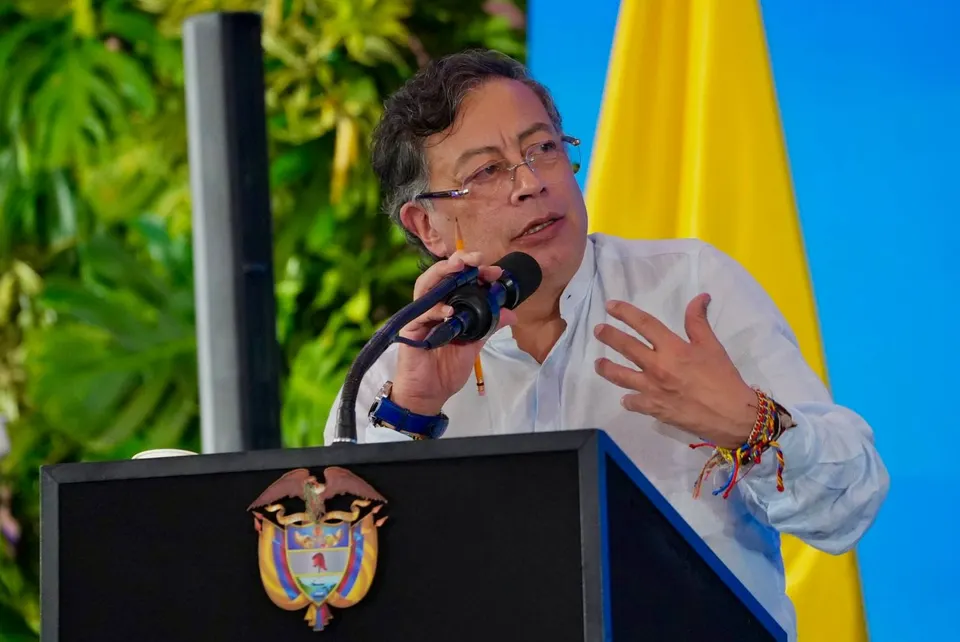
Colombian President Gustavo Petro speaks at the First Conference on the Transition Beyond Fossil Fuels | Colombian Ministry of the Environment
Nearly 60 countries launch coalition to accelerate the energy transition against the backdrop of the blockade of the Strait of Hormuz
SANTA MARTA, COLOMBIA — As the US and Israeli war against Iran puts oil at the centre of global concerns, a new intergovernmental coalition is seeking to accelerate the energy transition outside the UN’s climate change convention (COP) system, which has been trying – and failing – to phase out fossil fuels for three decades.
The coalition’s 57 members, who account for almost half of global GDP, met last week in the Colombian coastal city of Santa Marta for the First Conference on the Just Transition Away from Fossil Fuels, co-hosted by the governments of Colombia and the Netherlands.
Colombian President Gustavo Petro said the initiative was established after COP30 ended in November with no concrete resolution on phasing out the use of fossil fuels, which account for 75% of global greenhouse emissions. Since then, it has only been made more urgent by the oil crisis created by the Iran war.
“The ongoing disruptions due to the hostilities in the Strait of Hormuz have underlined that reducing fossil fuel dependencies is critical. It is essential to keep our planet livable, to safeguard energy security, and to build economic resilience to volatile fossil fuel markets,” states the conference’s final communiqué.
Rather than duplicating COPs’ efforts to establish new greenhouse gas reduction targets, the coalition agreed “to advance and accelerate the implementation of agreed goals” by applying pressure and strengthening international alliances within the multilateral negotiations adopted by consensus, the text says.
The conference was significant for its discussions on what “the consequences of decarbonisation” mean for oil exporters, said Susana Muhamad, Colombia’s ambassador for the initiative to create aFossil Fuel Non-Proliferation Treaty. It was the first time such conversations have been had at “a diplomatic forum on climate issues”.
“The fact that a country like Nigeria [which depends on crude oil exports] is here at a high level is very important, because they are not necessarily saying we are going to stick with oil until the end, whatever the cost,” she told openDemocracy. “They are recognising the vulnerability of being economically dependent on those exports.”
This need for economic freedom from oil was recognised by President Petro. “Can capitalism adapt to an energy system that is not fossil-based?” he asked an auditorium of delegates from participant countries, including Brazil, Mexico, Nigeria, the United Kingdom, France and the European Union as a bloc, as well as small island states in the Caribbean and the South Pacific.
Noticeably absent were representatives of the United States and China – the world’s two biggest carbon emitters – as well as Russia and India, all of whom were deliberately not invited to avoid the kind of deadlocks and obstructionism that led to the blocking of efforts to create a roadmap to phase out fossil fuels at COP30.
“When you make a plan, you first call your closest friends, and then you send the invitation to the rest,” Juan Carlos Monterrey Gómez, Panama’s Ministry of the Environment’s special representative for climate change, told openDemocracy.
Monterrey Gómez said the initial focus was instead on strengthening a group of countries committed to phasing out fossil fuels. “With this first group, we can have an honest conversation, without administrative roadblocks. This conversation has never taken place before, and that is historic.”
Other attendees had mixed feelings about the invite list.
While Claudio Angelo, an international policy coordinator at the Climate Observatory, a network of Brazilian environmental organisations, agreed that inviting Donald Trump’s climate-denying US administration would have been “unnecessary”, he told openDemocracy: “China should be here, as it supplies renewable energy technology to the whole world.”
‘Oil is nobody’s friend’
As well as the official delegates, the conference was attended by representatives of social movements, academia, multilateral institutions, parliaments, trade unions, Indigenous and Afro-descendant peoples, women and diverse communities, the private sector, farmers, NGOs, children and young people.
In the days leading up to the event, Santa Marta hosted scientific and civil society debates, where activists and Indigenous peoples urged governments to accelerate the energy transition.
Their calls came as a new report by 350.org, a global grassroots movement to accelerate the transition away from fossil fuels, found that consumerspay three times for fossil fuels: through public subsidies, on their bills, and through the natural disasters that are a direct consequence of the climate crisis.
“Oil is nobody’s friend,” said Angelo, noting that the international community has viewed the energy transition more favourably as solar and wind technologies have become more accessible over the past decade. Installed capacity of renewable energy was 50% higher last year than in 2023 and almost all new energy demand is being met by renewable sources, according to thefinal communiqué of the meeting.
Samoan activist Brianna Fruean at a demonstration held at the conference venue | Julián Reingold/openDemocracy
For Colombian environment minister Irene Vélez Torres and Stientje van Veldhoven, the Dutch minister for climate and green growth, the event marked the beginning of a new era of global environmental democracy.
“This new method of dialogue between civil society, parliamentarians and governments represents a new multilateral collective force that is not bound by consensus and is led by women,” Torres said at the conference’s close. Veldhoven agreed, saying the meeting was the first step towards a proactive coalition of governments that do not negotiate, as happens at the UN, but rather collaborate with one another.
At the conference, civil society and governments agreed on steps to address the inequalities in the energy transition, which is taking place primarily in the Global North, rather than in countries where it is most needed but that lack the financing for green energy. These included drafting national road maps for the phase-out of fossil fuels, in addition to the global road map that will be discussed at COP31 this year.
“This is a contribution towards resolving common and interdependent problems through dialogue, discussion and cooperation, rather than through military means,” said Muhamad, who was Colombia’s Environment Minister until early 2025.
Harjeet Singh, the founder and director of the India-based Satat Sampada Climate Foundation that advocates for global climate justice, said the war in Iran has opened people’s eyes to the vulnerability inherent in dependence on fossil fuels.
“In a recent statement, India’s road and transport minister said that the era of diesel and petrol vehicles is over. It’s all about clean fuels, biofuels and electric vehicles,” Singh told openDemocracy.
But this realisation is meaningless without “international cooperation in green finance”, he said, noting that India self-funds 80% of its climate initiatives despite being a part of the Global South – and needs trillions more dollars for its transition away from fossil fuels.
Democracy, climate denialism and the future
Carlos Nobre, a researcher at the University of São Paulo and a member of the scientific panel for aGlobal Energy Transition, highlighted the risk that citizens might elect leaders who deny climate change. This is a particularly pressing worry in Amazonian countries such as Brazil, Colombia and Peru, where far-right parties that deny the climate crisis or are committed to expanding fossil fuels stand a chance of winning presidential elections taking place this year.
“It is not just that the far right seeks to maintain dependence on fossil fuels, but that they also intend to push ahead with deforestation and the removal of protections for indigenous peoples. We must not head towards ecocide, that is, ecological suicide,” said Nobre in an interview with openDemocracy.
Colombia remains the world’s deadliest country for environmental activists – an issue that must be addressed at the election on 31 May and can serve as a gateway to discussing wider environmental policies, says Liberal Party congressman Juan Carlos Losada, a member of Colombia’s Parliamentarians for a Fossil-Fuel-Free Future network.
Losada believes the candidate of the ruling left-wing Historic Pact coalition, Iván Cepeda, “will clearly prioritise the defence of human rights at a local level, and other issues will fall under that umbrella”. Polls currently suggest Cepeda will lead the election’s first round, although most analysts believe he is unlikely to reach the 50% threshold needed to win outright.
The other presidential candidates say “that if they come to power, they’ll go all out to extract every last bit of what exists,” Losada said, referring to the right’s proposals to intensify coal mining and introduce fracking.
“The debate on energy security has changed, and fossil fuels are seen as part of the insecurity issue,” said Brazilian Ana Toni, the executive director of COP30, noting: “It’ll be interesting to see how different actors act from now on.”
Speaking to openDemocracy at a press conference, Toni acknowledged the contradictions facing even climate-conscious governments, such as Brazil’s. “I don’t know if this conference is going to change the mind of Petrobras and its exploration plans,” she said, referring to Brazil’s state-owned oil company, whichlast year obtained permission for new exploration 500 kilometres from the mouth of the Amazon, days before world leaders met to debate the climate crisis at COP30.
“But it is changing the mind of many people in many countries,” she argued, noting that a move away from fossil fuels is becoming more popular as wars, supply shocks and extreme weather events expose the risk of oil and gas dependence. “When we talk about the transition, we do it not just because of climate change but also because of energy and economic security, and peace.”
These risks will be on full display at next year’s conference, where delegates will visit one of the countries most threatened by rising sea levels: Tuvalu, a South Pacific island nation that is co-hosting the second conference with Ireland.
“We, the small Pacific Islands, have no choice but to be ambitious,” said Brianna Fruean, a climate activist from Samoa, at a rally during the Colombian conference. “The next summit in Tuvalu will put faces to our countries and bring world leaders to the frontline of the climate crisis.”
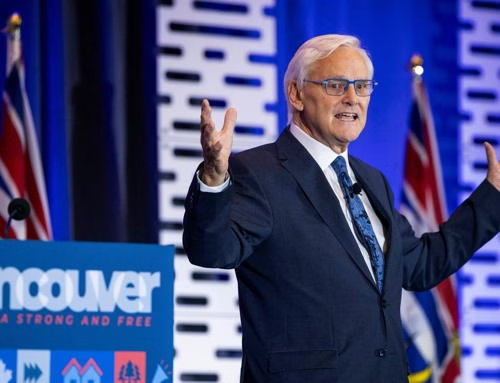
Former British Columbia Premier Gordon Campbell delivers the keynote address at the 2026 Canada Strong and Free Network conference in Vancouver. Credit: Canada Strong and Free Facebook page
Is the mask finally coming off the long-delayed Pathways Alliance CCS Project?
For years, Canadian officials and oil industry backers have pitched carbon capture and storage (CCS) as the solution that would allow Alberta’s oil sands — and the nation’s proposed west coast pipeline — to proceed with a lower climate impact. Now, in a speech at this year’s Canada Strong and Free Network (CSFN) conference in Vancouver, keynote speaker and former British Columbia Premier Gordon Campbell warned the costly, troubled technology has failed to deliver, undercutting a central justification for billions in public subsidies and new oil infrastructure.
This reporter was there in person at the April 24 CSFN gathering. Formerly the Manning Centre for Building Democracy, the CSFN self-describes as supporting “conservative and libertarian activists and ideas in Canada”. Imagine a MAGA-adjacent gabfest featuring speakers mostly cheerleading extractive industries or fear-mongering about First Nations rights. My already low expectations were not exceeded.
However, there was an unexpected utterance of truth from Campbell, who was the first elected leader in North America to bring in a carbon tax. And what does he think about the technology being touted to clean up ballooning emissions from the Alberta oil sands and justifying a new pipeline to the BC coast?
“It’s time to take off the blinders. Carbon capture and storage is something we’ve talked about in Canada for more than a generation, more than 25 years,” he told the conference. “We’ve invested billions of dollars trying to convince ourselves that carbon capture and storage will work. It doesn’t work. It costs money. And that money is money that we take out of other potential productive resources that we could have for Canadians.”
Campbell was certainly not suggesting that fossil fuel extraction be scaled back. His comments instead pointed out that pretending to solve emissions problems with expensive and ineffective carbon capture and storage is an unwise waste of scarce public resources. This unusual truth-bomb from a public figure stands in stark contrast to the theater playing out in Alberta and Ottawa, where CCS is being heavily promoted and backed by billions in public money as a panacea for oil sands climate costs.
Even a Pathways Alliance co-founder is now publicly coming out against the CCS project in a recent Globe and Mail op-ed, equating long-delayed efforts by the oil patch to limit its massive carbon emissions with a cash-strapped household wasting money on a vacation or meal deliveries. Is Big Oil now pivoting away from a marquee carbon capture project it never intended to build?
Meanwhile the government of Prime Minister Mark Carney claims that the $20 billion CCS project being promoted by the Pathways Alliance will make “Alberta oil among the lowest carbon intensity-produced barrels of oil in the world.” This multi-billion-dollar boondoggle has been offered as a “grand bargain” between Ottawa and Alberta to facilitate a new bitumen pipeline outlined in their now-overdue memorandum of understanding.
This confident public posturing was made despite internal briefing notes accessed by DeSmog showing Pathways had “…few front end engineering (FEED) studies done and initial cost estimates based on very limited project information”.
DeSmog previously reviewed 12 large scale CCS projects around the world and found “a litany of cost-overruns and missed targets, with a net increase in emissions.” Only 50MT of CO2 are sequestered each year by CCS, representing a mere 0.1 percent of global greenhouse gases.
A recent study published in the prestigious journal Nature showed that a shortage of suitable geological formations worldwide limit CCS to mitigating only a puny portion of dangerous emissions. And even if injecting all production emissions underground was somehow perfectly effective, it would do nothing to alleviate the other 80-90 percent of downstream tailpipe greenhouse gases.
Such shaky fundamentals have apparently had little impact on government enthusiasm for throwing billions in public money towards dubious CSS schemes. The federal government has committed to covering half of the $20 billion estimated cost of the Pathways CCS project in tax credits, and the Alberta government is pledging to shovel billions more towards the highly profitable members of the Pathways Alliance.
Pathways Alliance companies — recently renamed as the Oil Sands Alliance — include Canada Natural Resources Ltd, Cenovus, ConocoPhillips, Imperial Oil, MEG Energy, and Suncor, representing 95 percent of Alberta’s bitumen production. These giants enjoyed $37 billion in combined profit in 2023 and will reap billions more in windfall profits with oil above $100 per barrel due to Trump’s war on Iran.
A ‘Generous Transfer Provision’
A good yardstick of whether the Pathways project is credible is revealed in action, not words. Despite years of public spin and lobbying by Pathways members, the largest bitumen producers still stubbornly refuse to pony up any of their own money towards beginning construction even as Canadians struggle with historically high prices at the gas pump.
If carbon capture is so safe, why has the oil patch lobbied to wash its hands of long-term CCS liabilities? In a system unique to Alberta, the province assumes the long-term risks associated with CO2 storage once a closure certificate has been issued, a concession to the oil industry described as one of the most “generous transfer provisions” of any CCS scheme in the world.
Documents obtained by the Narwhal also revealed that Pathways Alliance president Kendall Dilling asked Ottawa for “assurance that the Pathways pipeline, hub and capture projects would not require a federal review under the Impact Assessment Act.”
In Alberta, regulators allowed the largest CCS project in the world to be broken into over 120 separate proposals to avoid triggering a provincial environmental assessment. Does this kind of maneuvering inspire confidence?
Not for local residents facing risks of a potentially deadly CO2 leak from a pipeline rupture, as occurred in Sataria, Mississippi where 49 people were hospitalized in 2020. Rural Albertans living close to the proposed 600 kilometre CO2 pipeline from the oil sands to Cold Lake have recently come together in an unlikely alliance of farmers and Indigenous leaders opposed to the Pathways project called “No CO2 Pipelines.”
“Thousands of Albertans like me live directly in this project’s ‘hazard zone’”, said Penny Fox, No CO2 Pipelines co-founder, in a press release. “In an explosion, people in our communities are facing anything from breathing issues to brain damage to instant death. So I have one question for the Prime Minister: if you wouldn’t live next to this pipeline, why should we?”
“We’re talking about hundreds of kilometers of pipeline that pass directly through areas where we live, hunt, fish and exercise our treaty rights”, Chief Allan Adam of the Athabasca Chipewyan First Nation has said. “This project endangers our people, our land, our water and wildlife. And yet there has been no consultation, no information sharing, and no formal environmental assessment.”
Gordon Campbell makes a good point. The Pathways project will cost the taxpayers billions and do nothing to contain the vast majority of ultimate oil sands emissions. Other Canadian industries have managed to cut greenhouse gases by one quarter since 2005, while bitumen producers have seen their emissions explode by 143 percent over the same period.
Why should highly profitable oil industry laggards still expect public handouts before cleaning up their own mess?
Donald Trump urges you to be a Climate Science denier like him. He says that he makes millions and millions for destroying the planet, Burn, Baby, Burn and Flood, Baby, Flood.Elon Musk urges you to be a Fascist like him, says that you can ignore facts and reality then.Orcas comment on killer apes destroying the planet by continuing to burn fossil fuels.
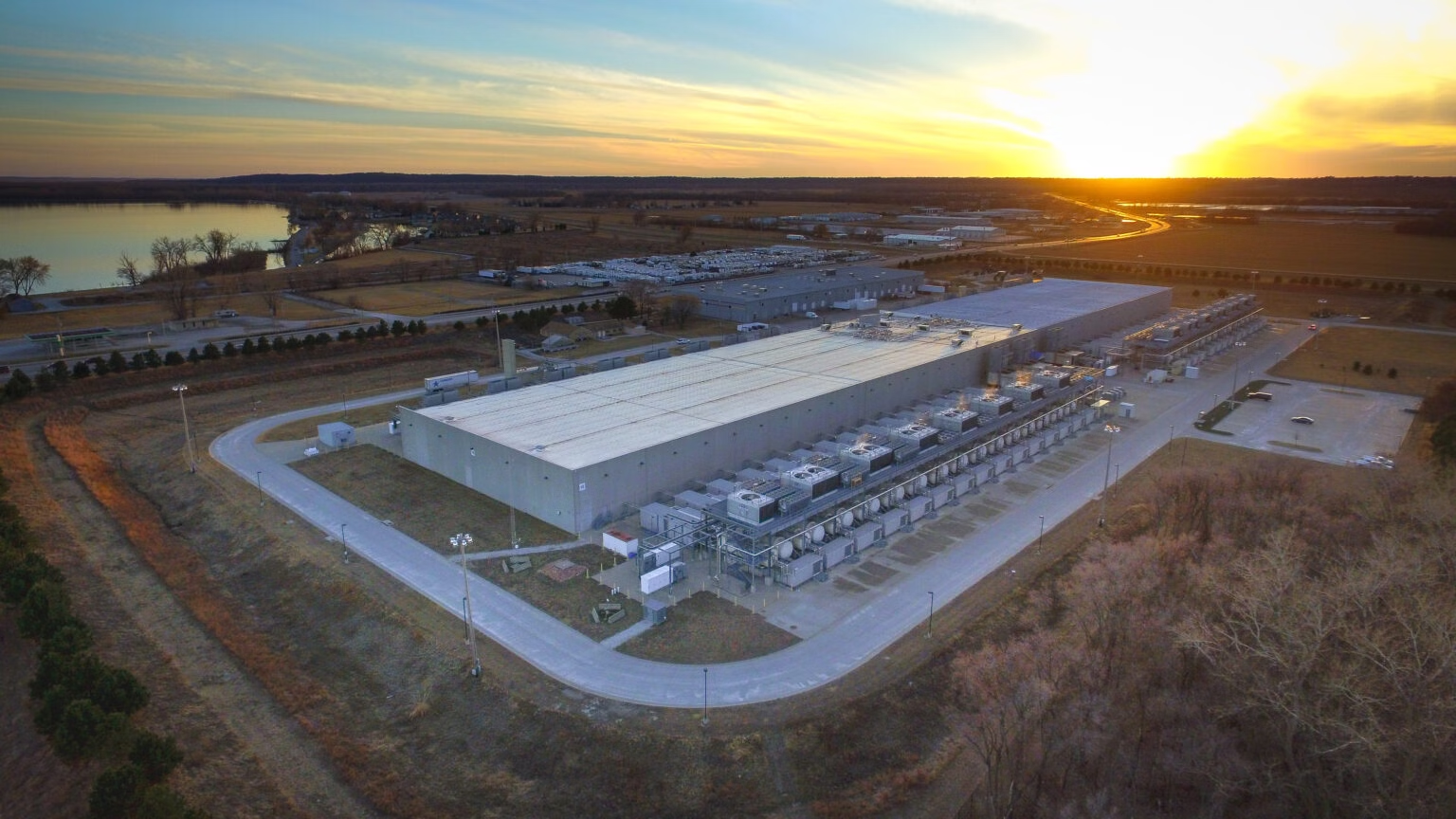
Koch, Inc., said in October that its real estate arm has been getting into the business of building data centers like this one in Council Bluffs, Iowa. Credit: Chad Davis/Wikimedia Commons(CC BY-NC-ND 2.0)
Right-wing political group Americans for Prosperity, backed by oil and gas billionaire Charles Koch, sees data centers as part of a larger pro-fossil fuel agenda.
A political group created by oil and gas billionaire Charles Koch earlier this year wrote to a branch of the U.S. government making requests about artificial intelligence.
“To seize the moment and ensure that AI can meet its true promise and potential,” it argued in March to the National Coordination Office, a federal body tasked by Donald Trump at the time with developing an AI Action Plan, the administration should “clear the red tape” preventing “energy innovators” from supplying the massive amounts of electricity required to power new AI data centers across the country.
The comments were written by analysts with Americans for Prosperity (AFP), a Koch-bankrolled activist organization that supports right-wing causes and political candidates and spent more than $157 million to sway voters during the 2024 elections.
Strategy plans, policy documents, corporate communications and comments to the federal government reviewed by DeSmog show that Koch’s political operation is attempting to shape and help implement a U.S. AI technology agenda, which could ultimately profit Koch’s traditional oil and gas business.
Despite the Koch network’s ongoing disagreements with Trump on issues including tariffs, the vast political operation appears to have found common cause with the administration on ensuring that fossil fuels, and not renewable energy sources, are central to AI development, even as wind and solar remain cheaper and faster to build.
“Practical solutions can be identified that move our nation forward,” Americans for Prosperity wrote to the government’s AI and Energy Working Group in May. “We look forward to working with you and the Congress to assist in the identification of those solutions.”
Neither AFP nor Koch, Inc. responded to a request for comment.
‘Couched in Fear’
Charles Koch became one of America’s richest people through owning and overseeing an industrial empire with his late brother, David, that includes oil refineries, pipelines, petrochemicals and natural gas. Koch, Inc., formerly known as Koch Industries, is now embracing AI across its vast operations, which it has predicted will create “substantial economic value” for the company.
Koch, Inc., in 2020 announced a partnership with the AI software provider C3 AI, with the goal of improving “operating performance” across its products “ranging from refined oil, chemicals, and biofuels to polymers, automotive components, and forest products.”
Also around that time, the company led a $125 million investment in the San Francisco cloud computing startup Mesosphere, alongside the likes of Microsoft and Khosla Ventures. Other backers included Andreessen Horowitz, the venture capital firm whose founders became prominent Trump supporters during the 2024 election.
Koch, Inc., said in October that its real estate arm has been getting into the business of building data centers in cities like Chicago, Kansas City, and Atlanta. The company argued in a news release that it “can provide the expertise and capabilities that major tech companies either don’t have or don’t think would be worth the time or effort to build on their own from the ground up.”
As Koch’s industrial empire invests in AI and partners with Big Tech, AFP is pushing the Trump administration to remove regulatory barriers on the technology.
Last March, AFP analysts Faith Burns and James Czerniawski disapprovingly noted there were over 800 state-level proposals to regulate AI. These efforts “are couched in fear of the technology,” they argued in comments to the National Coordination Office, and said the correct approach for government is “keeping itself out of the way to drive innovation.”
This is part of a larger political project that would also be beneficial to the Koch companies involved with producing, transporting and selling fossil fuels.
AFP argued in its March comments that the administration and Congress could make progress on accelerating AI by deregulating the power sector “to get abundant and affordable energy to Americans and leading AI companies.”
‘Radical Climate Dogma’
The quickest and most economic way to power all the data centers now being built is through renewable sources, industry data shows. That’s in part because nearly 80 percent of planned electricity projects in the U.S. are currently tied to solar and wind farms.
But Americans for Prosperity has thrown its political weight behind legislation that hobbles renewables in favor of oil, gas and coal.
It cited as a major victory the passage this summer of the Trump administration’s Big Beautiful Bill, a massive tax cut bill predominately benefiting America’s wealthiest citizens that included deep cuts to clean energy tax credits brought in under President Joe Biden.
The Koch political group ran a $20 million advertising and political campaign that it claimed “helped make this win possible through over 1,500 meetings with lawmakers, nearly 500,000 doors knocked, more than 475,000 phone calls, 725+ community events [and] over 100,000 letters sent to Congress.”
AFP presented the bill as a victory for fossil fuels. “It provides for a minimum of 30 offshore oil and gas lease sales,” its analyst Burns said in an advertisement posted on the group’s Facebook page. “And it makes available for lease four million acres of recoverable coal resources on federal land.”
As it worked to help pass the Big Beautiful Bill, Americans for Prosperity was supporting the administration’s efforts on AI.
In late July, the Trump administration unveiled an AI Action Plan, which promised “to reject radical climate dogma and bureaucratic red tape” to ensure that the U.S. can “build and maintain vast AI infrastructure and the energy to power it.”
In a statement that was posted on the White House website, Americans for Prosperity’s Brent Gardner said the plan “will ensure America leads the world” on AI. That statement was included along with praise from the likes of Chevron, Palantir, Meta, IBM and the Heritage Foundation.
The plan itself had input from Dean Ball, who was recently an AI advisor at the White House Office of Science and Technology Policy, and earlier a fellow at the Mercatus Center, a conservative think tank that’s received millions of dollars in funding from the Charles G. Koch Charitable Foundation. Ball was “intimately involved in the drafting” of the plan, according to a recent webinar on AI policy hosted by National Journal.
Ball said during the event that the build-out of data centers will likely mean that there’s “more gas, natural gas in particular, used in the United States than there otherwise might have been.”
Ball is now a senior fellow at the Foundation for American Innovation, a national non-profit whose supporters include the Koch-backed Stand Together Trust.
The Next AI Battle
The fallout of Trump’s Big Beautiful Bill is already being felt across the renewables industry. Power “developers have canceled 1,891 power projects this year with a combined capacity of 266 GW, with clean energy accounting for 93% of cancellations,” according to analysis by the climate newsletter Distilled.
That’s not necessarily good news for AI, given that new natural gas and nuclear facilities can take much longer to build than renewables.
And there is now a growing backlash to the technology, with a coalition of over 200 environmental groups this month demanding a halt to new U.S. data centers, arguing they are “rapidly increasing demand for energy, driving more fossil fuel pollution, straining water resources and raising electricity prices across the country.”
But Americans for Prosperity has now made one of its political priorities getting federal “permitting reform” legislation passed, which would streamline or eliminate many environmental and other reviews on new energy projects such as data centers.
In a recent petition form sent out to its members, AFP claimed that permitting reform can help “ensure 24/7 reliable power as demand increases, particularly in regions experiencing surging data center growth and electrification trends.” It envisions such legislation as hastening “new pipelines, export terminals and delivery systems” along with expanding “LNG and crude oil exports.”
The Koch network is joined by a coalition of fossil fuel industry groups including the American Petroleum Institute and the American Gas Association, which in early December released a letter calling for passage of “a broader permitting package” around new energy infrastructure projects.
And the effort is also attracting interest from Big Tech.
Sponsors for a mid-December conference in Washington, D.C., that includes U.S. Energy Secretary Chris Wright and features panels on “permitting reform,” “energy for AI,” and “American energy dominance” include the Koch nonprofit organization Stand Together.
Donald Trump urges you to be a Climate Science denier like him. He says that he makes millions and millions for destroying the planet, Burn, Baby, Burn and Flood, Baby, Flood.Nigel Farage urges you to ignore facts and reality and be a climate science denier like him and his Deputy Richard Tice. He says that Reform UK has received £Millions and £Millions from the fossil fuel industry to promote climate denial and destroy the planet.Elon Musk urges you to be a Fascist like him, says that you can ignore facts and reality then.