Zack Polanski becomes Green party leader – what happens next?

Spread the love
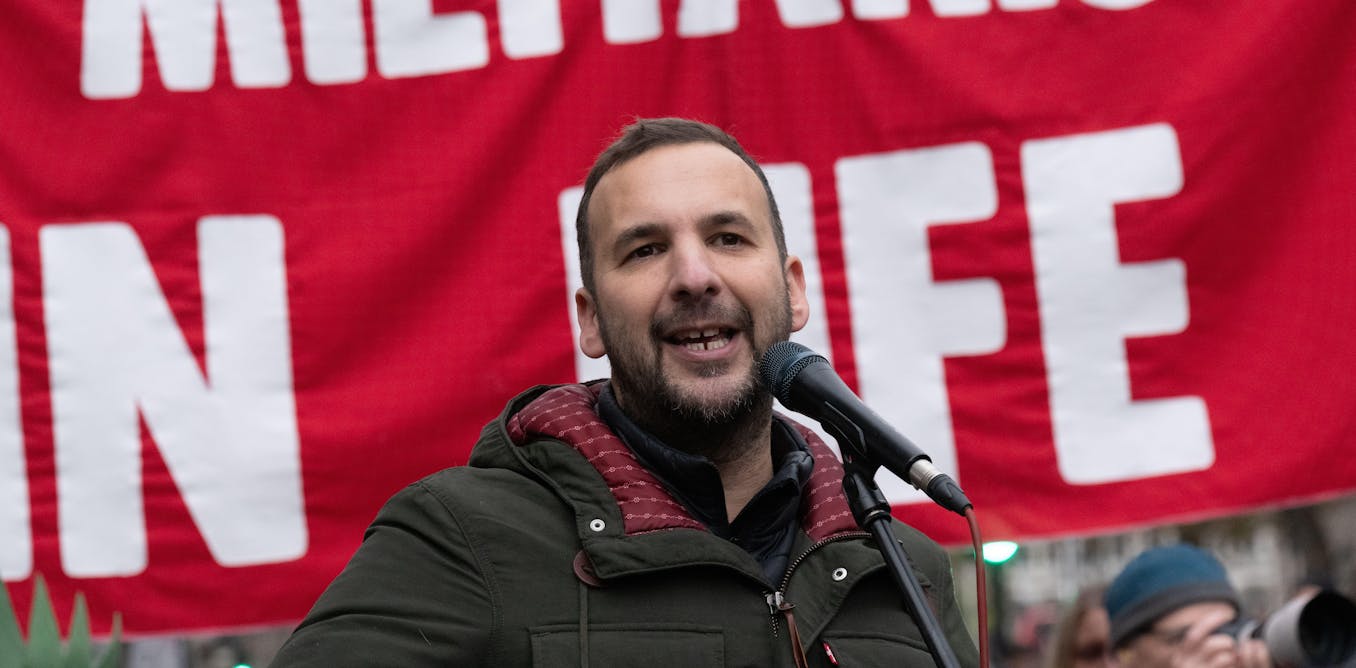
Zack Polanski is the new leader of the Green party. Alamy/Ron Fassbender

Louise Thompson, University of Manchester

Zack Polanski is the new leader of the Green party in England and Wales after winning a leadership election promising a programme of “eco-populism”. Polanski beat incumbent leader Adrian Ramsay and his partner on the ticket, Ellie Chowns.

It’s been just over a year since the party celebrated its best ever results in the most recent general election. In July 2024, it doubled its vote share and quadrupled its representation in the House of Commons to four MPs.

The same election saw terrible results for the Conservatives and even for Labour, despite its win, raising questions about whether two-party politics was well and truly over. Since then, as professor John Curtice has vividly described, things have started to look even shakier.

This year’s local election saw a “record-breaking” fragmentation of the vote in which less than a quarter of local council seats went to the two main parties. The Greens now hold over 800 seats in more than 170 different councils, adding to their electoral portfolio – which also includes two members of the House of Lords and three London Assembly members.

While Polanski will be celebrating today, party members will look to him to raise their electoral fortunes even further. The electoral challenge for the Greens in England and Wales is two-pronged.

First, the party needs to maintain its position in the seats it has already secured. Its four MPs have fairly comfortable majorities, the smallest being Chowns’ 5,800 majority in North Herefordshire. Second, and perhaps most importantly, it needs to maximise its success in the 40 constituencies where it came second. All but one of these constituencies were won by Labour, which makes Labour voters the prime targets.

My research has shown how the Green party has followed a policy of “total engagement” in recent years. It takes its parliamentary work very seriously, using any and every opportunity to get its message across, even in lower-priority policy areas.

The goal here is to build credibility with the electorate. Small parties tend to want voters to think they are bigger than they are, so they can present themselves as realistic contenders for taking on the heavy work and responsibility of government. Caroline Lucas did a fantastic job of this, punching well above her weight as the party’s only MP between 2010 and 2024.

Together, the Green MPs have made over 380 contributions in the House of Commons. Chowns in particular has been a prolific backbencher, making 161 contributions, while the previous co-leaders Carla Denyer and Ramsay have been much quieter.

With Polanski sitting in the London Assembly rather than the House of Commons, this will inevitably change. The four Green MPs will collectively have more time on their hands and, with the right direction from their new leader, will have the space to be more strategic in their parliamentary activities.

Outsiders

But the Greens have always acted as something of an atypical party too, keeping one foot outside Westminster. Lucas was regularly involved in activism, joining protesters campaigning against tuition fee increases and fracking and to support refugees, to name just a few. She was even arrested in 2013 after joining a protest against energy firm Cuadrilla in Sussex (she was later cleared of all charges in court).

The new Green MPs have continued in this vein, with Sian Berry joining a peaceful protest against far-right agitators in Brighton last year and Chowns pressing the government to water down anti-protest laws.

The new leadership will need to decide whether this strategy enhances their electoral appeal. Does it highlight the Greens’ distinctiveness from the establishment parties, or does it imply they aren’t responsible enough to manage being a party of significant size? The answer depends on who you ask. Polanski has participated in several protests in the past, so chances are this activism will continue to be a core feature of Green party politics.

An added complication for the Greens is that two other parties are also chasing left-leaning voters. One of these is Reform UK. Although associated with rightwing views on social issues, the party came second in many Labour seats in 2024 and needs to appeal to both sides of the political spectrum.

This may explain why the Greens have focused their efforts on highlighting Reform’s failures. Berry, for instance, recently challenged Nigel Farage and his colleagues to publish a log of all their meetings since entering the Commons, arguing that it would be in the public interest.

The other outside threat is Jeremy Corbyn and Zarah Sultana’s new and currently nameless party of the left. While we know little about this party’s policy platform right now, it seems to be veering towards a similarly bottom-up democratic model of organisation which has long been favoured by the Greens – possibly even with co-leaders.

The challenge for the Greens will be to better establish their niche on the left, to ensure they capture voters who are disillusioned with Keir Starmer’s wobbly start. Part of the solution could be to focus on a handful of key policy areas which go beyond the Green party’s niche of environmental issues. At the moment, its MPs take something of a scattergun approach in the Commons, contributing on everything from local buses and universal credit to Ukraine and the Middle East.

Some of the most recent questions asked during Prime Minister’s Questions by Greens hint at the options they might pursue. Ramsay has pushed for a wealth tax on the super rich, and an end to the two-child benefit cap. Both Corbyn and Sultana have, of course, been outspoken on these issues in the past.

If the Greens can’t forge a different path to this new left party, they may have no choice but to consider an electoral pact to avoid splitting the anti-Labour vote right down the middle.

Louise Thompson, Senior Lecturer in Politics, University of Manchester

This article is republished from The Conversation under a Creative Commons license. Read the original article.
Continue ReadingZack Polanski becomes Green party leader – what happens next?

ICJ ruling leaves UK with duty to speed up green transition

Spread the love
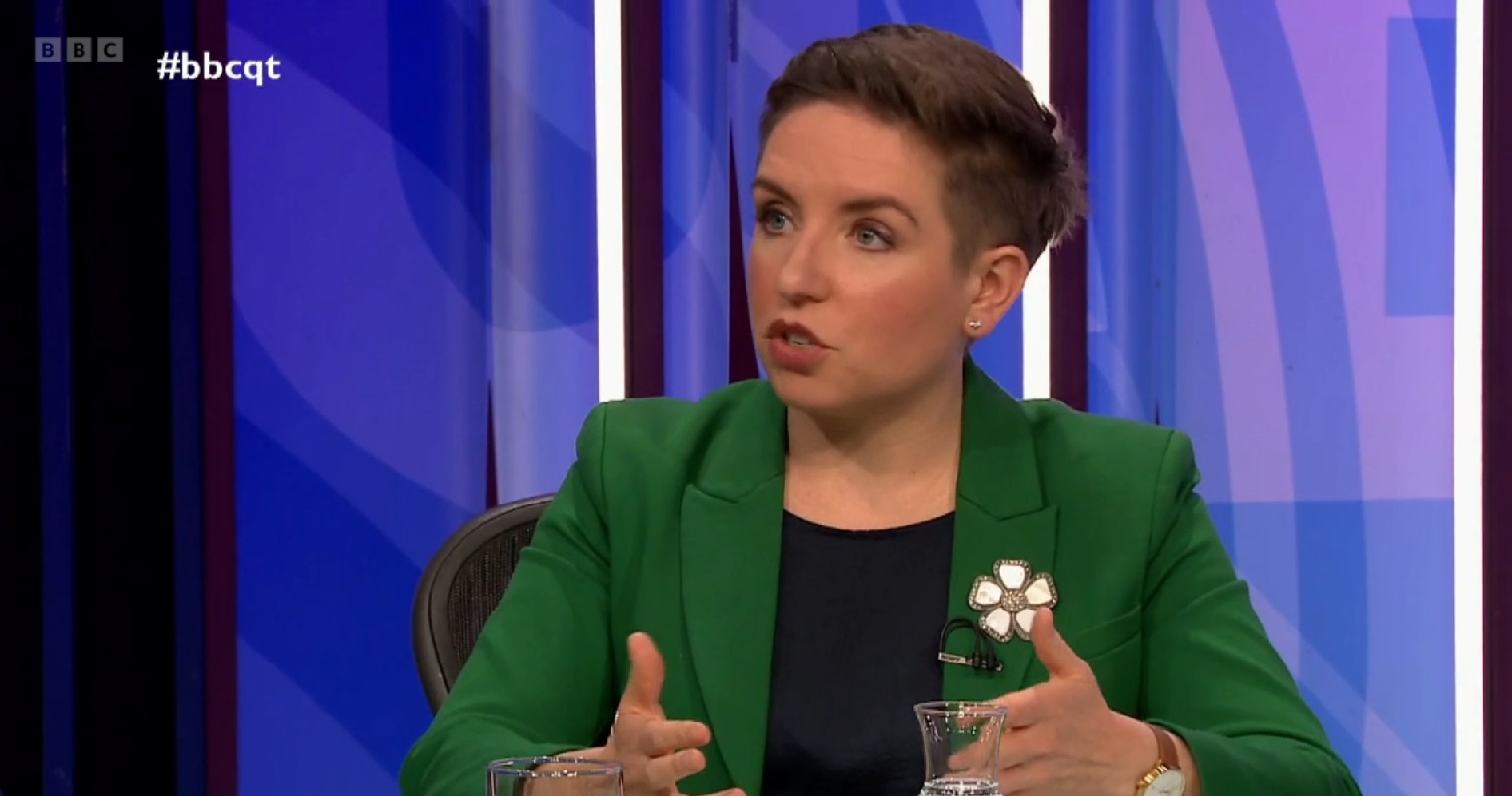
Image of the Green Party's Carla Denyer on BBC Question Time.
Image of the Green Party’s Carla Denyer on BBC Question Time.

Reacting to the International Court of Justice’s first-ever ruling on climate change, co-leader of the Green Party, Carla Denyer MP, said:

“In a landmark ruling today the ICJ has made clear that failure to take decisive action to protect the climate, through continued fossil fuel production and consumption and granting fossil fuel exploration licences, can be considered as acting ‘wrongfully’. This means the UK has a legal duty to speed up the transition towards a cleaner, greener economy and block any new licences for the extraction of fossil fuels. 

“The ruling also made clear that human rights must be at the heart of climate action because climate breakdown affects our rights to health, homes, and livelihoods.

“The court has recognised that rich countries like the UK, responsible for ongoing and historic pollution, have a special responsibility to act, and to offer compensation to countries and communities already suffering from floods, droughts, and rising sea levels.

“Today’s ruling should be the moment we draw a line. Governments that fail to act and polluters that refuse to clean up their act must no longer be allowed to harm communities either at home or across the globe with impunity.”

Continue ReadingICJ ruling leaves UK with duty to speed up green transition

Rachel Reeves Promised Oil Industry ‘Quid Pro Quo’ Over Windfall Tax in Private Meeting

Spread the love

Original article by Sam Bright republished from DeSmog.

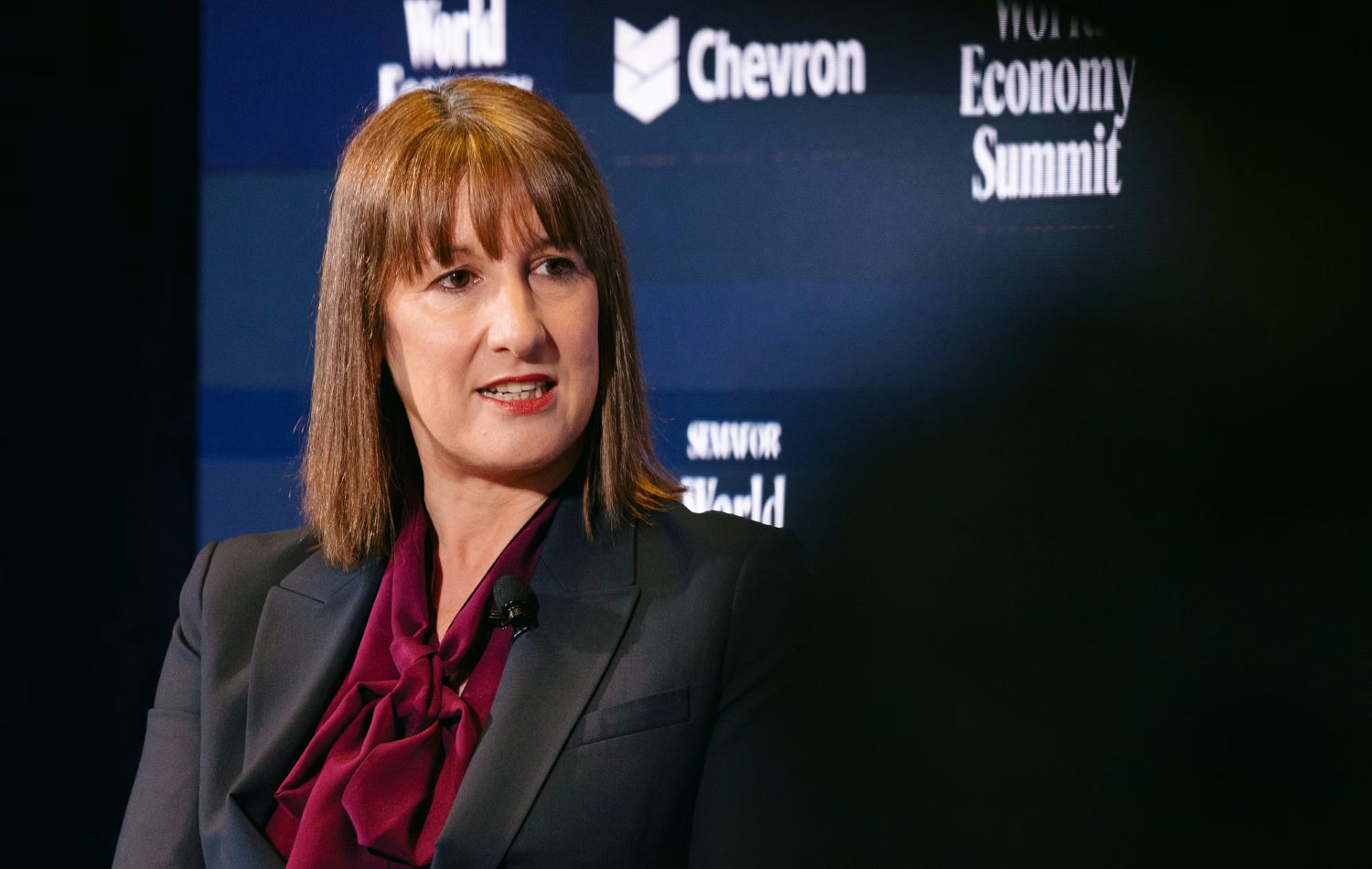
Chancellor Rachel Reeves speaks at the Semafor World Economy Summit in Washington D.C in April 2025. Credit: Credit: Kirsty O’Connor / Treasury (CC BY-NC-ND 2.0)

The government has been accused of making a “secret exchange deal” with fossil fuel firms to compensate for the tax hike.

Chancellor Rachel Reeves told a fossil fuel giant that the industry would receive a “quid pro quo” in return for higher taxes on its windfall profits, DeSmog can reveal.

In a meeting with the Norwegian state energy company Equinor on 27 August last year, Reeves suggested that the government’s carbon capture, utilisation and storage (CCUS) subsidies were a payoff for oil firms being hit with a higher tax rate.

Minutes of the meeting obtained by DeSmog state that Equinor CEO Anders Opedal raised concerns over the Energy Profits Levy – also known as the “windfall tax” – and “its impact on the value” of Equinor’s UK portfolio.

In response, Reeves said that raising the windfall tax from 35 percent to 38 percent was a “manifesto commitment”, but stated that “Equinor should recognise the quid pro quo – the funds raised enable government investment in CCUS etc.”.

This article was co-published with The Guardian.

CCUS is the controversial practice of trapping the emissions produced by fossil fuel plants before they enter the atmosphere.

The technology is accused of being a favourite climate “solution” of the fossil fuel industry since it allows for the continued extraction of oil and gas. Experts have also suggested that the technology is not economically viable at scale.

The Labour government announced in October that it would provide £22 billion in subsidies to CCUS projects over 25 years following a surge in lobbying by the fossil fuel industry, as revealed by DeSmog.

Green Party co-leader Carla Denyer MP claimed that Reeves and the Labour government had been “caught out making promises in a secret exchange deal which goes against the interests of the British people”.

Denyer added: “In public they claim to be taxing fossil fuel giants more fairly by raising the windfall tax, but behind closed doors they are giving back with dodgy deals to allow the fossil fuel corporates to continue with business as usual under the guise of CCUS – an expensive distraction and largely unproven technology.”

An Equinor spokesperson said: “Government regularly meets with companies like Equinor. This is standard and necessary practice. As with any official meeting, minutes were taken of the conversation between the chancellor and Equinor CEO as a public record of what was said and readily available via a Freedom of Information request.”

Equinor is one of the principal firms investing in the UK’s CCUS sector. In December, the government signed deals with Equinor, BP, and TotalEnergies to develop carbon capture facilities in Teesside. This will involve the development of the Net Zero Teesside Power plant, which will be 25 percent owned by Equinor and aims to be the world’s first gas-fired power station featuring CCUS.

Earlier this year, following a DeSmog investigation, Equinor retracted the claim that it stores 1 million tonnes of carbon dioxide annually at its flagship carbon capture project in the North Sea. Equinor has not captured 1 million tonnes of CO2 per year at the site since 2001, and only captured a tenth of that figure in 2023.

The firm made an $28.7 billion (£21.2 billion) post-tax profit in 2022 after Russia’s invasion of Ukraine triggered higher oil and gas prices – a figure that stood at $8.8 billion (£6.6 billion) in 2024.

Tessa Khan, executive director of the campaign group Uplift, said: “Oil companies, like Equinor, have held sway over successive UK governments, for years shaping policies to benefit their bottom line and slowing down climate action. This Labour government must stand up to them and put our needs – for affordable clean energy and a safe climate that we can pass on to our children – ahead of their insatiable need to profit.”

The House of Commons’ Public Accounts Committee (PAC) – which scrutinises government spending decisions – released a report in February describing the UK’s CCUS subsidies as “risky”.

The report noted that the government has downgraded its ambitions for CCUS storage, scrapping its previous commitment of storing 20 to 30 million tonnes annually by 2030. It also highlighted that the UK’s new CCUS projects don’t allow the government to share any potential profits or for local consumers to benefit from lower energy bills.

The committee also reported that producing liquid natural gas, which will be used in the UK’s CCUS projects, leaks more greenhouse gases into the atmosphere than previously thought.

“This could undermine the rationale for pursuing certain schemes,” the report said.

After being sued by environmental consultant Andrew Boswell over the Net Zero Teesside scheme, the previous Conservative government admitted that it had not taken into account the plant’s full potential emissions, which Boswell estimated could reach more than 20.3 million tonnes during its lifetime.

In summer 2024, a judge rejected Boswell’s case, which argued that officials did not fully explore the environmental impacts of the scheme before approving it. The government also won the appeal in May.

Boswell, who leads the Scrap Carbon Capture campaign, called Reeves’ Equinor meeting “an outrageous spectacle”.

“She begs Norway’s oil colossus to tax its huge profits, and then gifts it with far more in return – many billions over decades for climate-wrecking CCUS.”

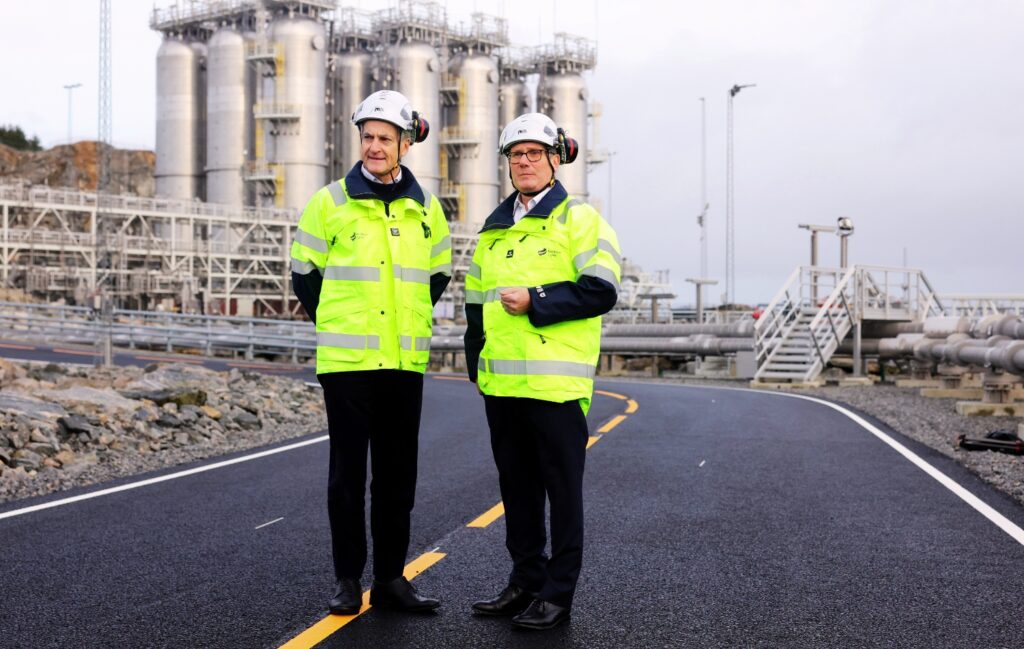
Prime Minister Keir Starmer visits Equinor’s Northern Lights CCUS plant with Norway Prime Minister Jonas Gahr Støre in Bergen in December 2024. Credit: Credit: Simon Dawson / No 10 Downing Street (CC BY-NC-ND 2.0)

Equinor and Shell have formed a joint venture to become the UK’s largest North Sea fossil fuel producer. In November, the government admitted that it had unlawfully approved the development of the country’s largest untapped oilfield, Rosebank, which is operated by Equinor, by not taking into account the climate effects of burning the oil and gas extracted from the field. Equinor intends to re-apply for approval to develop the project.

The Labour government has been steadfast in its support for the UK achieving net zero emissions by 2050, with Prime Minister Keir Starmer stating that “home grown clean energy” is “in the DNA” of his administration.

The Climate Change Committee stated in its 2025 appraisal of the government’s net zero policies that the UK needs to scale up its CCUS capacity to 73 million tonnes a-year by 2050 to help meet its climate commitments.

“Investment in carbon capture and storage is a gamble on unproven technology,” said Lily-Rose Ellis, campaigner at Greenpeace UK. “All it does is give oil and gas giants carte blanche to continue causing planet destroying emissions in the hopes that one day they might be able to capture the carbon and store it for all of eternity. Public money should be spent on renewables which guarantee to lower emissions, bring bills down, and boost the economy with new jobs.”

“Equinor has been a reliable energy partner to the UK for over 40 years,” a company spokesperson said, “providing a stable supply of oil and gas, developing the UK’s offshore wind industry, and pioneering solutions to decarbonise the UK economy, including carbon capture and storage.

“Using our experience of decarbonising energy production in Norway, including safely storing carbon emissions under the North Sea for over 25 years, we are supporting the UK to develop its own home grown energy transition.”

A government spokesperson said: “We are delivering first of a kind carbon capture projects in the UK, supporting thousands of jobs across the country, reigniting industrial heartlands and tackling the climate crisis.

“Money raised from changes to the Energy Profits Levy made at the Autumn Budget last year support the transition to clean energy, enhance energy security and independence, provide sustainable jobs for the future, and help protect electricity bills against future price shocks”.

This article was co-published with The Guardian.

Original article by Sam Bright republished from DeSmog.

Continue ReadingRachel Reeves Promised Oil Industry ‘Quid Pro Quo’ Over Windfall Tax in Private Meeting

Make polluters pay to bring down bills, Greens say 

Spread the love
Image of the Green Party's Carla Denyer on BBC Question Time.
Image of the Green Party’s Carla Denyer on BBC Question Time.

Responding to the Climate Change Committee’s latest report, co-leader Carla Denyer MP said:

“Last year fossil fuel giants Shell and BP made a total of £26 billion in profit – while ordinary people struggle every day to pay their energy bills, and the climate crisis takes its toll on communities across the UK. 

 “The Climate Change Committee’s latest report shows some movement in the right direction towards trying to keep us all safe, but the truth is we’re not moving nearly fast enough. Stalling progress means we all have higher bills in cold and leaky homes, while wildfires, extreme heat and flooding put lives and livelihoods at risk. The best time for action was years ago – the next best time is now. 

“We need urgent action to bring down the cost of electricity more widely, to reduce household bills and keep us all safe from the growing threat from the climate crisis. Instead of handing fossil fuel giants a licence to keep profiting from climate destruction, or wasting money on slow and expensive nuclear projects, now is the time for a national push to roll out energy efficiency, heat pumps, solar panels and battery storage for our homes. 

“Crucially, it’s time for the government to stop throwing money at the fossil fuel industry and instead make big polluters like Shell and BP pay up. Currently the government subsidises the fossil fuel industry to the tune of a staggering £17.5 billion per year – it’s time to pull the plug and put that money into lowering bills instead.”

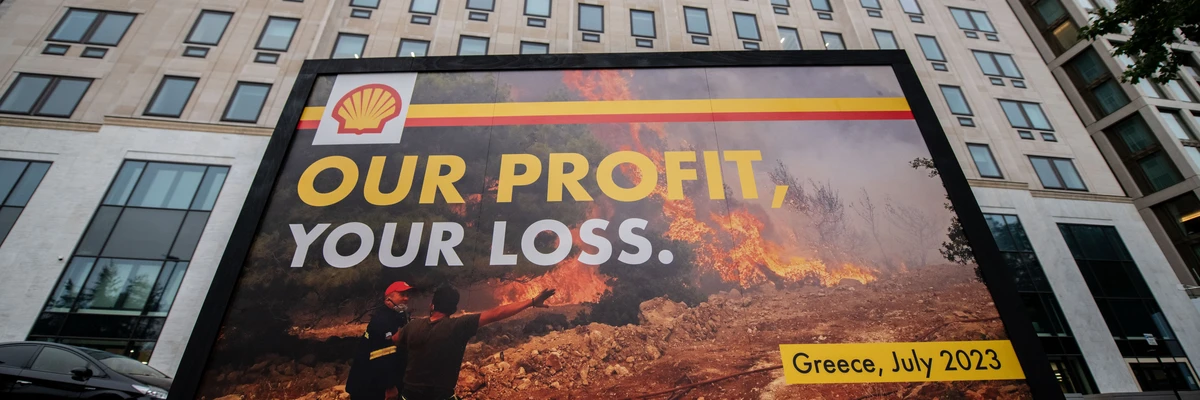
Greenpeace activists display a billboard during a protest outside Shell headquarters on July 27, 2023 in London.
Greenpeace activists display a billboard during a protest outside Shell headquarters on July 27, 2023 in London. (Photo: Handout/Chris J. Ratcliffe for Greenpeace via Getty Images)
Continue ReadingMake polluters pay to bring down bills, Greens say 

Actuaries and Scientists Warn Climate Shocks Risk ‘Planetary Insolvency’

Spread the love

Original article by Jessica Corbett republished from Common Dreams under Creative Commons (CC BY-NC-ND 3.0). Published Jan 16, 2025

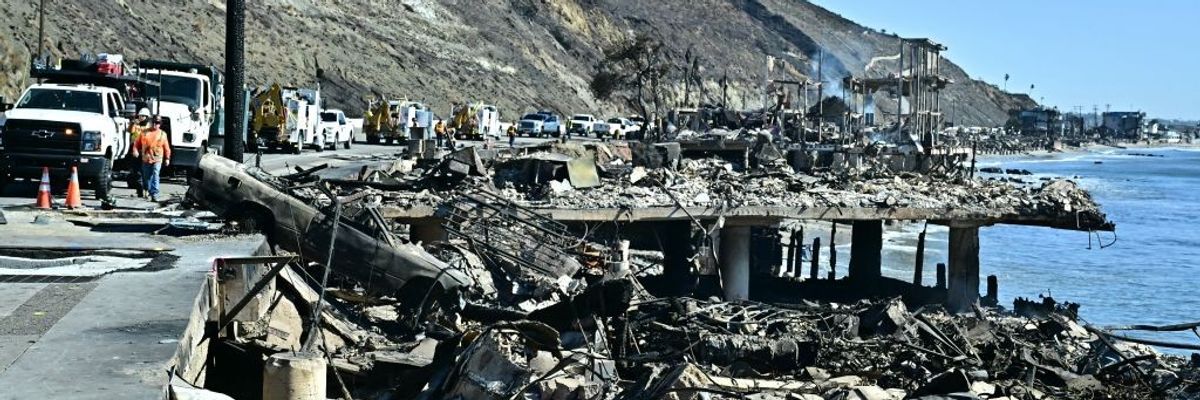
Gas company employees work in Malibu, California, after the Palisades Fire destroyed beach homes on January 12, 2025. (Photo: Frederic J. Brown/AFP via Getty Images)

A new report “shows a 50% GDP contraction between 2070 and 2090 unless an alternative course is chartered,” said the lead author.

U.K. actuaries and University of Exeter climate scientists on Thursday warned that “the risk of planetary insolvency looms unless we act decisively” and urged policymakers to “implement realistic and effective approaches to global risk management.”

Actuaries have developed techniques that “underpin the functioning of the global pension market with $55 trillion of assets, and the global insurance market, collecting $8 trillion of premiums annually, to help us manage risk,” Tim Lenton, University of Exeter’s climate change and Earth system science chair, noted in the foreword of a report released Thursday.

Planetary Solvency—Finding Our Balance With Nature is the fourth report for which the Institute and Faculty of Actuaries (IFoA) has collaborated with climate scientists. In financial terms, solvency is the ability of people or companies to pay their long-term debts. Co-authors of one of the previous publications coined the phrase planetary solvency, “setting out the idea that financial risk management techniques could be adapted to help society manage climate change and other risks.”

Three IFoA leaders—Kalpana Shah, Paul Sweeting, and Kartina Tahir Thomson—explained in their introduction to the latest report how “planetary solvency applies these techniques to the Earth system,” writing:

The essentials that support our society and economy all flow from the Earth system, commodities such as food, water, energy, and raw materials. The Earth system regulates the climate and provides a breathable atmosphere, it is the foundation that underpins our society and economy. Planetary solvency assesses the Earth system’s ability to continue supporting us, informed by planetary boundaries, tipping points in the Earth system, and other scientific discoveries to assess risks to this foundation—and thus to our society and the economy.

Our illustrative assessment of planetary solvency in this report shows a more fundamental, policy-led change of direction is required. Our current market-led approach to mitigating climate and nature risks is not delivering. There is an increasing risk of severe societal disruption (planetary insolvency), as our economic system drives further global warming and nature degradation.

“Impacts are already severe with unprecedented fires, floods, heatwaves, storms, and droughts,” the document points out, emphasizing that human activity—particularly burning fossil fuels—drives climate change and biodiversity loss. “If unchecked they could become catastrophic, including loss of capacity to grow major staple crops, multimeter sea-level rise, altered climate patterns, and a further acceleration of global warming.”

The report was released as wildfires ravage California and shortly after scientific bodies around the world concluded that 2024 was the hottest year on record and the first in which the average global temperature exceeded a key goal of the Paris agreement: 1.5°C above preindustrial levels. In the United States, experts identified 27 disasters with losses exceeding $1 billion.

“We risk triggering tipping points such as Greenland ice sheet melt, coral reef loss, Amazon forest dieback, and major ocean current disruption,” the new publication warns, adding that “tipping points can trigger each other,” and if multiple are triggered, “there may be a point of no return, after which it may be impossible to stabilize the climate.”

Food system shocks and more frequent and devastating disasters increase the risk of mass mortality for humanity—including due to hunger and infectious diseases—along with mass migration and conflict, the report highlights.

“Climate change risk assessment methodologies understate economic impact, as they often exclude many of the most severe risks that are expected and do not recognize there is a risk of ruin,” the document stresses. “They are precisely wrong, rather than being roughly right.”

Specifically, lead author and IFoA council member Sandy Trust said in a statement, “widely used but deeply flawed assessments of the economic impact of climate change show a negligible impact” on gross domestic product (GDP).

However, Trust continued, “the risk-led methodology, set out in the report, shows a 50% GDP contraction between 2070 and 2090 unless an alternative course is chartered.”

To mitigate the risk of planetary insolvency, the co-authors called on policymakers around the world to implement independent, annual assessments; set limits and thresholds that respect the planet’s boundaries; enhance governance structures to support planetary solvency; and “enhance policymaker understanding of ecological interdependencies, tipping points, and systemic risks so they understand why these changes are needed.”

They also underscored the need to limit global warming and avoid triggering tipping points with actions such as accelerating decarbonization, removing greenhouse gases from the atmosphere, restoring damaged ecosystems, and building resilience.

“You can’t have an economy without a society, and a society needs somewhere to live,” said Trust. “Nature is our foundation… Threats to the stability of this foundation are risks to future human prosperity which we must take action to avoid.”

Original article by Jessica Corbett republished from Common Dreams under Creative Commons (CC BY-NC-ND 3.0).

Orcas discuss Donald Trump and the killer apes' concept of democracy. Front Orca warns that Trump is crashing his country's economy and that everything he does he does for the fantastically wealthy.
Orcas discuss Donald Trump and the killer apes’ concept of democracy. Front Orca warns that Trump is crashing his country’s economy and that everything he does he does for the fantastically wealthy.
Neo-Fascist Climate Science Denier Donald Trump says Burn, Baby, Burn.
Elon Musk urges you to be a Fascist like him, says that you can ignore facts and reality then.

Continue ReadingActuaries and Scientists Warn Climate Shocks Risk ‘Planetary Insolvency’