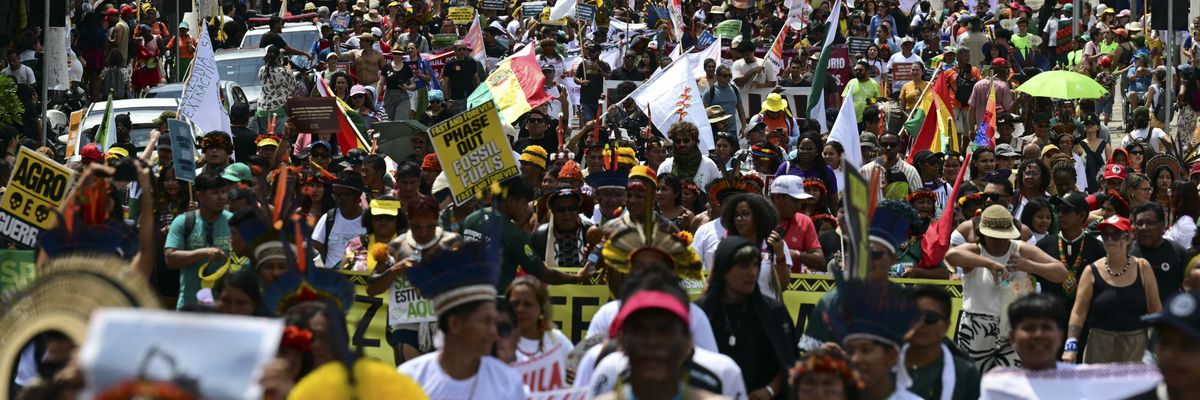
Thousands of people take part in the so-called “Great People’s March” in the sidelines of the COP30 UN Climate Change Conference in Belem, Para State, Brazil on November 15, 2025. Tens of thousands of people attended the march to demand “real solutions” to human-caused global warming , and which comes at the halfway point of contentious COP30 negotiations following two Indigenous-led protests that disrupted proceedings earlier in the week. (Photo by Pablo Porciuncula / AFP via Getty Images)
“It is time to put these old fuels where they belong—in the ground of history.”
An estimated 50,000 people took to the streets of Belém do Pará, Brazil, on Saturday to demonstrate outside the halls of the United Nations annual climate summit, holding a “Great People’s March” and makeshift “Funeral for Fossil Fuels” as they demanded a just transition toward a more renewable energy system and egalitarian economy.
Organized by civil society organizations and Indigenous Peoples groups from Brazil and beyond, the tens of thousands who marched outside the thirtieth Conference of the Parties (COP30) summit called for an end to the rapacious greed of the oil, gas, and coal companies as they advocated for big polluters to pay for the large-scale damage their businesses have caused worldwide over the last century.
“We are tens of thousands here today, on the streets of Belém, to show negotiators at COP30 that this is what people power looks like,” said Carolina Pasquali, executive director of Greenpeace Brazil, said as the march took hold. “Yesterday we found out that one in every 25 COP30 participants is a fossil fuel lobbyist, proportionally a 12% increase from last year’s COP. How can the climate crisis be solved while those creating it are influencing the talks and delaying decisions? The people are getting fed up–enough talking, we need action and we need it now.”
The report by the Kick Big Polluters Out coalition last week showed that at least 1,600 lobbyists from the fossil fuel industry are present at the conference, making it the second-largest delegation overall, second only to Brazil’s, the host nation.
“It’s common sense that you cannot solve a problem by giving power to those who caused it,” said Jax Bongon from the Philippines-based IBON International, a member of the coalition, in a Friday statement. “Yet three decades and 30 COPs later, more than 1,500 fossil fuel lobbyists are roaming the climate talks as if they belong here. It is infuriating to watch their influence deepen year after year, making a mockery of the process and of the communities suffering its consequences.”
While the overwhelming presence of fossil fuel lobbyists has once again diminished hopes that anything worthwhile will emerge from the conference, the tens of thousands in the streets on Saturday represented the ongoing determination of the global climate movement.
João Talocchi, co-founder of Alianza Potência Energética Latin America, one of the key groups behind the “Funeral for Fossil Fuels” portion of the day’s action—which included mock caskets for the oil, gas, and coal companies alongside parades of jungle animals, wind turbines, and solar panels representing what’s at stake and the better path forward—noted the key leadership of Indigenous groups from across the Global South.
“From the Global South to the world, we are showing what a fair and courageous energy transition must look like,” said Talochhi.
Ilan Zugman, director of 350.org in Latin America and the Caribbean, noted the significance of the demonstration, including the symbolism of the funeral procession.
“We march symbolically burying fossil fuels because they are the root of the crisis threatening our lives,” explained Zugman. “Humanity already knows the way forward: clean energy, climate justice, and respect for the peoples who protect life. What is missing is political courage to break once and for all with oil, gas, and coal. It is time to put these old fuels where they belong—in the ground of history.”
With the COP30 at its midway point, climate activists warn that not nearly enough progress is being made, with the outsized influence of the fossil fuel industry one of the key reasons that governments, year after year and decade after decade, continue to drag their feet when it comes to taking the kind of aggressive actions to stem the climate crisis that scientists and experts say is necessary.
“We are taking to the streets because, while governments are not acting fast enough to make polluters pay for their climate damages at COP30, extreme weather events continue to wreak havoc across the globe,” said Abdoulaye Diallo, co-head of Greenpeace International’s “Make Polluters Pay” campaign. “That is why we are here, carrying the climate polluters bill, showing the projected economic damages of more than $5 trillion from the emissions of just five oil and gas companies over the last decade.”
“Fossil fuel companies are destroying our planet, and people are paying the price,” said Diallo. “Negotiators must wake up to the growing public and political pressure to make polluters pay, and agree to new polluter taxes in the final COP30 outcome.”
MST activists held a protest on November 11 in the Agrizone at COP 30, an area dedicated to discussions related to agribusiness. The action aimed to denounce agribusiness as the main driver of the environmental crisis in Brazil. Photo: @alain.grao / COP30 Collaborative Coverage
Embrapa’s event at the Climate Conference is sponsored by giants such as Bayer, Nestlé, and Syngenta, accused of practices that exacerbate socio-environmental damage
The United Nations Climate Conference COP30, is currently underway in Belém, Brazil and will conclude on November 21. It has become increasingly clear that, just as the Landless Rural Workers’ Movement (MST) and several other organizations, movements, collectives, and groups warned, agribusiness is at the forefront of the supposed search for solutions to the environmental crisis. This, in itself, sheds light on the fact that the Conference has become a large business expo, in which the assets will be our territories, communities, and nature.
According to Embrapa itself (the Brazilian Agricultural Research Corporation, a state entity), Agrizone is “a large showcase of technologies, science, and international cooperation focused on sustainable agriculture and the fight against hunger in a context of climate change.” However, in practice, the space will serve as a stage for agribusiness to do business, promote its image, and increase its profits – at the expense of the destruction of nature, the concentration of land, and the expulsion of peasant communities and traditional peoples. Under the discourse of “sustainability,” what we will see is the old logic of exploitation disguised as green.
Starting with its sponsors. It is unthinkable that a space that claims to combat hunger and the environmental crisis would have Bayer, Nestlé, and OCP among its financiers. These are three companies that directly contribute to the deepening of the environmental crisis. In 2024, Bayer had to pay more than USD 2 billion in compensation to a man in the US who was proven to have contracted cancer because of one of its main products: the pesticide Roundup. The product is no longer sold in that country, but in Brazil it circulates freely. It is estimated that the company faces 170,000 similar lawsuits.
One of the panels that Nestlé will lead at Agrizone is called “Remodeling food in Brazil.” This is a very suggestive title, given that the company is already engaged in this “remodeling” – at the expense of the health of the Brazilian people. According to the company’s own criteria, 54% of its sales are products with very low health ratings. In this context, it has already been proven that the Swiss company adds more sugar to its products destined for Africa and Latin America.
Office Chérifien des Phosphates (OCP) is a Moroccan state-owned company focused on the extraction of phosphate, which is mainly used in the production of pesticides. The company holds 70% of global phosphorus reserves. However, most of its production comes from the Bou Craa mine in Western Sahara, a country under colonial occupation by the Moroccan kingdom. In other words, OCP literally maintains its production at the expense of looting and stealing minerals that belong to the people of the Sahara.
Agrizone panels will be dominated by giants that plunder nature
The giants of agribusiness, the ultra-processed food industry, and mining, in addition to sponsoring Agrizone, will also dominate the debate panels at the event.
Syngenta, together with Itaú Bank, will coordinate the panel “Cooperation for long-term financing in the restoration of degraded areas.”
The question to be asked is whether the transnational corporation is willing to restore areas that it itself degrades? After all, the company is responsible for a quarter of the market for profenofos, an insecticide used mainly on corn, soybean, cotton, and other crops. It turns out that this pesticide “is extremely harmful to aquatic organisms, birds, and bees. It is a powerful neurotoxin (similar to sarin gas) that can affect brain development in humans, especially in children,“ said Laurent Gaberell, head of agriculture and biodiversity at the NGO Public Eye, which published a report on the subject. In Brazil, Syngenta’s largest market, ”profenofos residues are found in the drinking water of millions of people,” the report points out.
It is also worth remembering that Syngenta was responsible for the murder of Keno, an MST activist, in 2015, in Paraná. The murder took place in a field of illegal Syngenta transgenic experiments in the city of Santa Tereza do Oeste, western Paraná, near the Iguaçu National Park. The area was occupied by about 150 members of Via Campesina. The activists were shot at by about 40 agents from NF Segurança, a private company hired by Syngenta. In addition to Keno’s murder, Isabel Nascimento was also shot and lost sight in her right eye.
In addition to Syngenta, Natura will also be at Agrizone. The cosmetics company will lead the panel “from circular carbon to sustainable cooperation.” Natura was fined by Ibama in 2010 for biopiracy. The fine, in the amount of 21 million reais, was imposed “for allegedly irregular access to biodiversity.” In addition, the company was the subject of a complaint to the Parliamentary Inquiry Commission in the Federal Senate in 2023 for exploiting traditional communities in Pará. According to testimony from Indigenous leaders at the time, cooperatives linked to Natura paid three reais per day for harvesting andiroba and copaiba seeds, which are typical of the Amazon. However, the cooperatives sold a liter of seeds for 1,000 reais, and the company further increased this profit margin.
Ultra-processed food giant PepsiCo will be the protagonist in the panel “Every drop counts: growing potatoes in a changing climate.” Residues of the pesticide glyphosate have been identified in several of the company’s products, including Doritos chips. Potential health damage can begin at very low levels, from 0.1 parts per billion (ppb) of glyphosate. But in the company’s products, levels between 289.47 ppb and 1,125.3 ppb were found. The consequences of glyphosate on the body include gastrointestinal disorders, obesity, diabetes, heart disease, depression, autism, infertility, cancer, Alzheimer’s disease, Parkinson’s disease, and gluten intolerance.
Agribusiness controls Agrizone
Although Agrizone was officially conceived by Embrapa, control of the space is, in fact, in the hands of agribusiness. It is no surprise that important players in the sector here in Brazil, such as the Brazilian Agribusiness Association (ABAG), the Brazilian Rural Society (SRB), and Amaggi will be in the spotlight.
There is no way to build concrete solutions to the environmental crisis when the main causes of this scenario are sitting at the table, coordinating the “board room.” In Brazil, agribusiness (and the entire industrial complex surrounding it) is the main cause of this crisis. It is responsible for 74% of greenhouse gas emissions in the country.
All the supposed sustainable discourse maintained by those entities and companies in this sector – which will dominate the Agrizone panels – will actually serve two functions. First, to camouflage the real way agribusiness operates, which is based on the appropriation and destruction of nature’s common goods, in addition to the exploitation of traditional peoples. Second, in the face of the environmental crisis that they themselves have caused, to implement false solutions based on the financialization of nature – as is the case with the carbon market.
For an Embrapa that serves the people, not corporations
Embrapa is a strategic public company for the country. It suffered a profound attack during the Bolsonaro administration. However, it was not agribusiness, which was hand in hand with Bolsonaro, that defended it, but the Brazilian people and their public servants.
Therefore, it is essential that it be effectively focused on the interests of the Brazilian people and not under the control of transnational giants linked to agribusiness. The challenges related to food sovereignty and combating the environmental crisis will not come from those who profit from hunger and diseases caused by ultra-processed foods and pesticides. They will come from those who have been resisting the advance of capital for centuries and cultivating emancipated forms of relationship with nature.
This article was first published on the MST website.
Donald Trump urges you to be a Climate Science denier like him. He says that he makes millions and millions for destroying the planet, Burn, Baby, Burn and Flood, Baby, Flood.Nigel Farage urges you to ignore facts and reality and be a climate science denier like him and his Deputy Richard Tice. He says that Reform UK has received £Millions and £Millions from the fossil fuel industry to promote climate denial and destroy the planet.
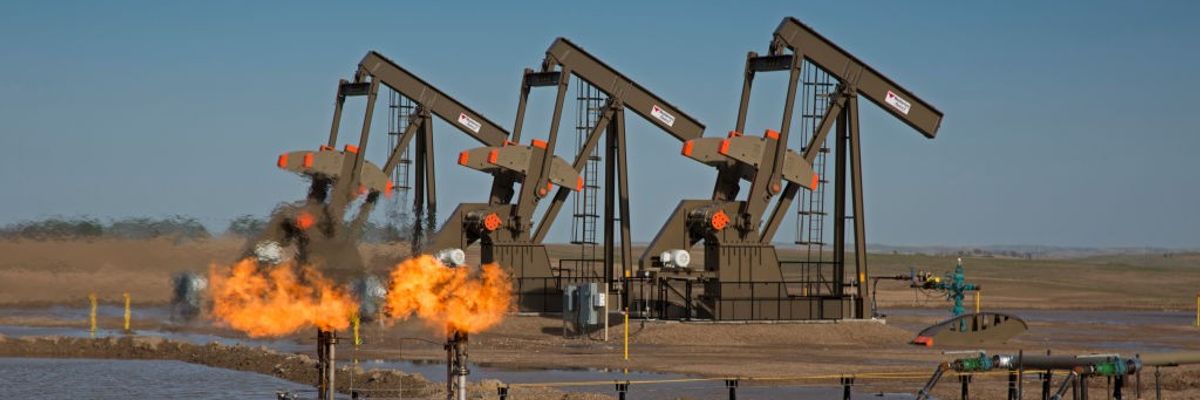
Natural gas is flared off as oil is pumped in the Bakken shale formation in Watford City, North Dakota. (Photo by Jim West/UCG/Universal Images Group via Getty Images)
“Without rapid, deep emissions cuts—over 50% by 2030—overshooting 1.5°C becomes ever more likely, with severe consequences for people and ecosystems,” one expert said.
Despite new national policies submitted ahead of the United Nations COP30 climate conference in Belém, Brazil, the world remains on track for a disastrous 2.6°C of fossil fuel-driven warming, according to an annual analysis released on Thursday.
Climate Action Tracker (CAT) said the 2025 report marked the fourth year in a row in which there had been “little to no measurable progress” in its warming predictions for 2100 based on the current policies and commitments of 40 countries.
“The world is running out of time to avoid a dangerous overshoot of the 1.5°C limit,” Climate Analytics CEO Bill Hare said in a statement. “Delayed action has already led to higher cumulative emissions, and new evidence suggests the climate system may be more sensitive than previously thought. Without rapid, deep emissions cuts—over 50% by 2030—overshooting 1.5°C becomes ever more likely, with severe consequences for people and ecosystems.”
Under the Paris Agreement, countries are required to submit nationally determined contributions (NDCs) every five years outlining their plans to slash greenhouse gas emissions and adapt to the impacts of the climate crisis. However, CAT found that nearly none of the 40 countries it analyzed had updated their 2030 NDCs or announced sufficiently ambitious 2035 NDCs ahead of COP30, which began on Monday. This means that the projected warming based on 2030 and 2035 targets remained at 2.6°C above preindustrial levels.
“We have said it before, and we will keep saying it: We are running out of time.”
“A world at 2.6°C means global disaster,” Hare toldThe Guardian, adding that it would likely trigger key tipping points such as the death of coral reefs, the transformation of the Amazon rainforest into grassland, the destabilizing of ice sheets, and the collapse of the Atlantic Meridional Overturning Circulation.
“That all means the end of agriculture in the UK and across Europe, drought and monsoon failure in Asia and Africa, lethal heat and humidity,” Hare explained. “This is not a good place to be. You want to stay away from that.”
CAT also made temperature projections based on existing policies and actions; pledges and targets, including binding long-term targets; and an optimistic scenario including net-zero targets. In 2025, the temperature projection for existing policies dropped from 2.7°C to 2.6°C, mostly due to a change in methodology, and the “optimistic scenario” remained the same at 1.9°C. However, the “pledges and targets” projection increased from 2.1°C to 2.2°C, predominately due to President Donald Trump’s decision to withdraw the US from the Paris Agreement.
Other major carbon polluters China and the European Union did not update their plans with the ambition required to meet the Paris goals.
— ClimateActionTracker @catclimate.bsky.social (@climateactiontr) November 13, 2025
The analysis comes a week after the UN Environment Programme released its Emissions Gap Report, which found that NDCs put the world on track for 2.3-2.5°C of warming, while current policies put it on track for 2.8°C.
Overall, CAT blamed the lack of progress on the continued growth of fossil fuel production and use. It noted that several major countries had continued to expand fossil fuels, from India, China, and Indonesia building more coal plants to Japan and Saudi Arabia championing gas as a “bridge fuel.”
“Worst of all,” the report authors wrote, “the United States is actively shutting down offshore wind projects, rolling back renewable energy incentives, cutting curbs on carbon pollution, and actively expanding oil and gas production.”
However, despite their grim projections, CAT did see hope in the massive rollout of renewable energy, which generated more power than coal for the first time in 2025.
“While not at the pace needed, our analysis shows that the Paris Agreement works,” said Niklas Höhne, of CAT partner the NewClimate Institute, in a statement.
Höhne continued:
Back in 2015, our current policies scenario led to 3.6°C of warming by 2100. Today, 10 years later, our latest projections show that this has been reduced by roughly 1°C to around 2.6°C. The Paris Agreement has rewritten the rules of global climate action—sparking investment, innovation, and reforms that would simply not have happened without it.
But governments need to speed up the pace now. Although emissions have risen, the exponential pace of the renewable energy expansion allows us to now reduce emissions much faster than previously thought. Governments can strengthen or overachieve 2030 targets, implement robust policies, and ensure transparency and accountability to deliver on the Paris Agreement promise and safeguard a sustainable future.
The faster governments act, the faster they can close the “targets gap” between current emissions and how far they have to fall to keep the 1.5°C goal within reach. This gap is expected to grown by as many as 2 billion metric tons between 2030 and 2035 alone.
The longer we wait, the larger the "targets gap": from 2030 to 2035, the gap between climate targets and the pathways to 1.5°C is projected to grow up to two billion tonnes, up from 26-29 GtCO2e in 2030, to 26-31 GtCO2e by 2035. pic.twitter.com/ityn6p9wOC
— ClimateActionTracker @catclimate.bsky.social (@climateactiontr) November 13, 2025
CAT said that current research indicates that implementing the most ambitious policies could limit peak warming to 1.7°C. This could be achieved by reaching net-zero carbon dioxide emissions before 2050, reaching net-zero greenhouse gas emissions in the 2060s, and removing carbon dioxide from the atmosphere. Under this scenario, global temperatures would return to below 1.5°C by the end of the century.
“We have said it before, and we will keep saying it: We are running out of time,” said report lead author Sofia Gonzales-Zuñiga.
“Every new fossil gas deal the EU makes, every new coal plant built in China, every fossil gas expansion project in Australia, every exported barrel from Norway, every tonne of LNG Japan pushes into neighboring Asian countries, costs billions to people elsewhere in the world as they deal with increasingly extreme weather events,” Gonzales-Zuñiga continued. “These are not abstract policy choices—they are physical realities with human consequences. The atmosphere does not negotiate, and it does not wait.”
Orcas comment on killer apes destroying the planet by continuing to burn fossil fuels.Donald Trump urges you to be a Climate Science denier like him. He says that he makes millions and millions for destroying the planet, Burn, Baby, Burn and Flood, Baby, Flood.Nigel Farage urges you to ignore facts and reality and be a climate science denier like him and his Deputy Richard Tice. He says that Reform UK has received £Millions and £Millions from the fossil fuel industry to promote climate denial and destroy the planet.
The world’s fossil-fuel use is still on track to peak before 2030, despite a surge in political support for coal, oil and gas, according to data from the International Energy Agency (IEA).
The IEA’s latest World Energy Outlook 2025, published during the opening days of the COP30 climate summit in Brazil, shows coal at or close to a peak, with oil set to follow around 2030 and gas by 2035, based on the stated policy intentions of the world’s governments.
Under the same assumptions, the IEA says that clean-energy use will surge, as nuclear power rises 39% by 2035, solar by 344% and wind by 178%.
Still, the outlook has some notable shifts since last year, with coal use revised up by around 6% in the near term, oil seeing a shallower post-peak decline and gas plateauing at higher levels.
This means that the IEA expects global warming to reach 2.5C this century if “stated policies” are implemented as planned, up marginally from 2.4C in last year’s outlook.
In addition, after pressure from the Trump administration in the US, the IEA has resurrected its “current policies scenario”, which – effectively – assumes that governments around the world abandon their stated intentions and only policies already set in legislation are continued.
If this were to happen, the IEA warns, global warming would reach 2.9C by 2100, as oil and gas demand would continue to rise and the decline in coal use would proceed at a slower rate.
This year’s outlook also includes a pathway that limits warming to 1.5C in 2100, but says that this would only be possible after a period of “overshoot”, where temperature rise peaks at 1.65C.
The IEA will publish its “announced pledges scenario” at a later date, to illustrate the impact of new national climate pledges being implemented on time and in full.
The IEA’s annual World Energy Outlook (WEO) is published every autumn. It is regarded as one of the most influential annual contributions to the understanding of energy and emissions trends.
The outlook explores a range of scenarios, representing different possible futures for the global energy system. These are developed using the IEA’s “global energy and climate model”.
The latest report stresses that “none of [these scenarios] should be regarded as a forecast”.
However, this year’s outlook marks a major shift in emphasis between the scenarios – and it reintroduces a pathway where oil and gas demand continues to rise for many decades.
This pathway is named the “current policies scenario” (CPS), which assumes that governments abandon their planned policies, leaving only those that are already set in legislation.
If the world followed this path, then global temperatures would reach 2.9C above pre-industrial levels by 2100 and would be “set to keep rising from there”, the IEA says.
The CPS was part of the annual outlook until 2020, when the IEA said that it was “difficult to imagine” such a pathway “prevailing in today’s circumstances”.
It has been resurrected following heavy pressure from the US, which is a major funder of the IEA that accounts for 14% of the agency’s budget.
For example, in July Politico reported “a ratcheted-up US pressure campaign” and “months of public frustrations with the IEA from top Trump administration officials”. It noted:
“Some Republicans say the IEA has discouraged investment in fossil fuels by publishing analyses that show near-term peaks in global demand for oil and gas.”
The CPS is the first scenario to be discussed in detail in the report, appearing in chapter three. The CPS similarly appears first in Annex A, the data tables for the report.
The second scenario is the “stated policies scenario” (STEPS), featured in chapter four of this year’s outlook. Here, the outlook also includes policies that governments say they intend to bring forward and that the IEA judges as likely to be implemented in practice.
In this world, global warming would reach 2.5C by 2100 – up marginally from the 2.4C expected in the 2024 edition of the outlook.
Beyond the STEPS and the CPS, the outlook includes two further scenarios.
One is the “net-zero emissions by 2050” (NZE) scenario, which illustrates how the world’s energy system would need to change in order to limit warming in 2100 to 1.5C.
The NZE was first floated in the 2020 edition of the report and was then formally featured in 2021.
The report notes that, unlike in previous editions, this scenario would see warming peak at more than 1.6C above pre-industrial temperatures, before returning to 1.5C by the end of the century.
This means it would include a high level of temporary “overshoot” of the 1.5C target. The IEA explains that this results from the “reality of persistently high emissions in recent years”. It adds:
“In addition to very rapid progress with the transformation of the energy sector, bringing the temperature rise back down below 1.5C by 2100 also requires widespread deployment of CO2 removal technologies that are currently unproven at large scale.”
Finally, the outlook includes a new scenario where everyone in the world is able to gain access to electricity by 2035 and to clean cooking by 2040, named “ACCESS”.
While the STEPS appears second in the running order of the report, it is mentioned slightly more frequently than the CPS, as shown in the figure below. The CPS is a close second, however, whereas the IEA’s 1.5C pathway (NZE) receives a declining level of attention.
Number of mentions of each scenario per 100 pages of text. Source: Carbon Brief analysis.
US critics of the IEA have presented its stated policies scenario as “disconnected from reality”, in contrast to what they describe as the “likely scenario” of “business as usual”.
Yet the current policies scenario is far from a “business-as-usual” pathway. The IEA says this explicitly in an article published ahead of the outlook:
“The CPS might seem like a ‘business-as-usual’ scenario, but this terminology can be misleading in an energy system where new technologies are already being deployed at scale, underpinned by robust economics and mature, existing policy frameworks. In these areas, ‘business as usual’ would imply continuing the current process of change and, in some cases, accelerating it.”
In order to create the current policies scenario, where oil and gas use continues to surge into the future, the IEA therefore has to make more pessimistic assumptions about barriers to the uptake of new technologies and about the willingness of governments to row back on their plans. It says:
“The CPS…builds on a narrow reading of today’s policy settings…assuming no change, even where governments have indicated their intention to do so.”
This is not a scenario of “business as usual”. Instead, it is a scenario where countries around the world follow US president Donald Trump in dismantling their plans to shift away from fossil fuels.
More specifically, the current policies scenario assumes that countries around the world renege on their policy commitments and fail to honour their climate pledges.
For example, it assumes that Japan and South Korea fail to implement their latest national electricity plans, that China fails to continue its power-market reforms and abandons its provincial targets for clean power, that EU countries fail to meet their coal phase-out pledges and that US states such as California fail to extend their clean-energy targets.
Similarly, it assumes that Brazil, Turkey and India fail to implement their greenhouse gas emissions trading schemes (ETS) as planned and that China fails to expand its ETS to other industries.
The scenario also assumes that the EU, China, India, Australia, Japan and many others fail to extend or continue strengthening regulations on the energy efficiency of buildings and appliances, as well as those relating to the fuel-economy standards for new vehicles.
In contrast to the portrayal of the stated policies scenario as blindly assuming that all pledges will be met, the IEA notes that it does not give a free pass to aspirational targets. It says:
“[T]argets are not automatically assumed to be met; the prospects and timing for their realisation are subject to an assessment of relevant market, infrastructure and financial constraints…[L]ike the CPS, the STEPS does not assume that aspirational goals, such as those included in the Paris Agreement, are achieved.”
Only in the “announced pledges scenario” (APS) does the IEA assume that countries meet all of their climate pledges on time and full – regardless of how credible they are.
The APS does not appear in this year’s report, presumably because many countries missed the deadlines to publish new climate pledges ahead of COP30.
The IEA says it will publish its APS, assessing the impact of the new pledges, “once there is a more complete picture of these commitments”.
Fossil-fuel peak
In recent years, there has been a significant shift in the IEA’s outlook for fossil fuels under the stated policies scenario, which it has described as “a mirror to the plans of today’s policymakers”.
In 2020, the agency said that prevailing policy conditions pointed towards a “structural” decline in global coal demand, but that it was too soon to declare a peak in oil or gas demand.
By 2021, it said global fossil-fuel use could peak as soon as 2025, but only if all countries got on track to meet their climate goals. Under stated policies, it expected fossil-fuel use to hit a plateau from the late 2020s onwards, declining only marginally by 2050.
There was a dramatic change in 2022, when it said that Russia’s invasion of Ukraine and the resulting global energy crisis had “turbo-charged” the shift away from fossil fuels.
As a result, it said at the time that it expected a peak in demand for each of the fossil fuels. Coal “within a few years”, oil “in the mid-2030s” and gas ”by the end of the decade”.
This outlook sharpened further in 2023 and, by 2024, it was saying that each of the fossil fuels would see a peak in global demand before 2030.
This year’s report notes that “some formal country-level [climate] commitments have waned”, pointing to the withdrawal of the US from the Paris Agreement.
The report says the “new direction” in the US is among “major new policies” in 48 countries. The other changes it lists include Brazil’s “energy transition acceleration programme”, Japan’s new plan for 2040 and the EU’s recently adopted 2040 climate target.
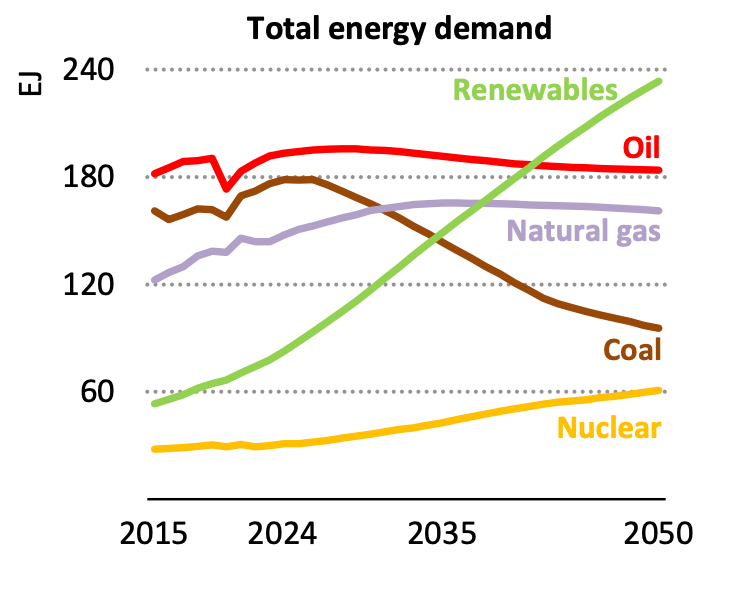
Overall, the IEA data still points to peaks in demand for coal, oil and gas under the stated policies scenario, as shown in the figure below.
Alongside this there is a surge in clean technologies, with renewables overtaking oil to become the world’s largest source of energy – not just electricity – by the early 2040s.
In this year’s outlook under stated policies, the IEA sees global coal demand as already being at – or very close to – a definitive peak, as the chart above shows.
Coal then enters a structural decline, where demand for the fuel is displaced by cheaper alternatives, particularly renewable sources of electricity.
The IEA reiterates that the cost of solar, wind and batteries has respectively fallen by 90%, 70% and 90% since 2010, with further declines of 10-40% expected by 2035.
(The report notes that household energy spending would be lower under the more ambitious NZE scenario than under stated policies, despite the need for greater investment.)
However, this year’s outlook has coal use in 2030 coming in some 6% higher than expected last year, although it ultimately declines to similar levels by 2050.
For oil, the agency’s data still points to a peak in demand this decade, as electric vehicles (EVs) and more efficient combustion engines erode the need for the fuel in road transport.
While this sees oil demand in 2030 reaching similar levels to what the IEA expected last year, the post-peak decline is slightly less marked in the latest outlook, ending some 5% higher in 2050.
The biggest shift compared with last year is for gas, where the IEA suggests that global demand will keep rising until 2035, rather than peaking by 2030.
Still, the outlook has gas demand in 2030 being only 7% higher than expected last year. It notes:
“Long-term natural gas demand growth is kept lower than in recent decades by the expanding deployment of renewables, efficiency gains and electrification of end-uses.”
In terms of clean energy, the outlook sees nuclear power output growing to 39% above 2024 levels by 2035 and doubling by 2050. Solar grows nearly four-fold by 2035 and nearly nine-fold by 2050, while wind power nearly triples and quadruples over the same periods.
Notably, the IEA sees strong growth of clean-energy technologies, even in the current policies scenario. Here, renewables would still become the world’s largest energy source before 2050.
This is despite the severe headwinds assumed in this scenario, including EVs never increasing from their current low share of sales in India or the US.
The CPS would see oil and gas use continuing to rise, with demand for oil reaching 11% above current levels by 2050 and gas climbing 31%, even as renewables nearly triple.
This means that coal use would still decline, falling to a fifth below current levels by 2050.
Finally, while the IEA considers the prospect of global coal demand continuing to rise rather than falling as expected, it gives this idea short shrift. It explains:
“A growth story for coal over the coming decades cannot entirely be ruled out but it would fly in the face of two crucial structural trends witnessed in recent years: the rise of renewable sources of power generation, and the shift in China away from an especially coal-intensive model of growth and infrastructure development. As such, sustained growth for coal demand appears highly unlikely.”
Elon Musk urges you to be a Fascist like him, says that you can ignore facts and reality then.Donald Trump urges you to be a Climate Science denier like him. He says that he makes millions and millions for destroying the planet, Burn, Baby, Burn and Flood, Baby, Flood.Nigel Farage urges you to ignore facts and reality and be a climate science denier like him and his Deputy Richard Tice. He says that Reform UK has received £Millions and £Millions from the fossil fuel industry to promote climate denial and destroy the planet.
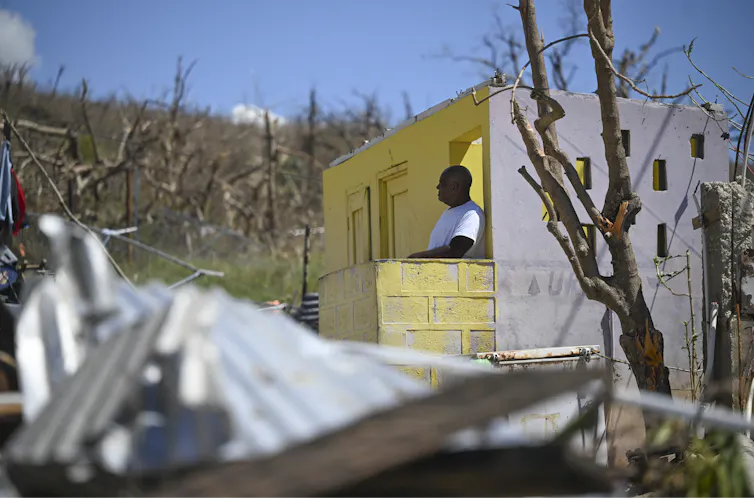
Hurricane Melissa tore off roofs and stripped trees of their leaves, including in many parts of Jamaica hit by Hurricane Beryl a year earlier. Ricardo Makyn/AFP via Getty Images
Headlines have been filled with talk of the catastrophic power of Hurricane Melissa after the Category 5 storm devastated communities across Jamaica, Cuba and Haiti in October 2025. But to see this as a singular disaster misses the bigger picture: Melissa didn’t hit stable, resilient islands. It hit islands still rebuilding from the last hurricane.
St. Elizabeth Parish, Jamaica, suffered intense damage from both Hurricane Melissa in October 2025 and Hurricane Beryl a year earlier. Ivan Shaw/AFP via Getty Images
In Cuba, the power grid collapsed during Hurricane Oscar in October 2024, leaving 10 million people in darkness. When Melissa arrived, it struck the same fragile infrastructure that Cubans had barely begun to rebuild.
This is the new reality of the climate crisis: Disasters hitting the Caribbean are compounding and can trigger infrastructure collapse, social erosion and economic debt spirals.
The compounding disaster trap
I study disasters, with a focus on how Caribbean island systems absorb, adapt to and recover from recurring shocks, like the nations hit by Melissa are now experiencing.
It’s not just that hurricanes are more frequent; it’s that the time between major storms is now shorter than the time required for a full recovery. This pulls islands into a trap that works through three self-reinforcing loops:
Infrastructure collapse: When a major hurricane hits an already weakened system, it causes simultaneous infrastructure collapses. The failure of one system – such as power – cascades, taking down water pumps, communications and hospitals all at once. We saw this in Grenada after Hurricane Beryl and in Dominica after Hurricane Maria. This kind of cascading damage is now the baseline expectation for the Caribbean.
When schools are heavily damaged by storms, like this one in Jamaica that lost its roof during Hurricane Melissa, it’s harder for families to remain. Ricardo Makyn/AFP via Getty Images
The trap is that all three of these loops reinforce each other. A country can’t rebuild infrastructure without money. It can’t generate economic activity without infrastructure. And it can’t retain the skilled workforce needed for either when people are fleeing to safer places.
Rebuilding a system of overlapping recoveries
The Caribbean is not merely recovering from disasters – it is living within a system of overlapping recoveries, meaning that its communities must begin rebuilding again before fully recovering from the last crisis.
Each new attempt at rebuilding happens on the unstable physical, social and institutional foundations left by the last disaster.
The question isn’t whether Jamaica will attempt to rebuild following Melissa. It will, somehow. The question is, what happens when the next major storm arrives before that recovery is complete? And the one after that?
Without fundamentally restructuring how we think about recovery – moving from crisis response to continuous adaptation – island nations will remain trapped in this loop.
The way forward
The compounding disaster trap persists because recovery models are broken. They apply one-size-fits-all solutions to crises unfolding across multiple layers of society.
Breaking free requires adaptive recovery at all levels, from household to global.
Residents formed a human chain among the hurricane debris to pass food supplies from a truck to a distribution center in the Whitehouse community in Westmoreland, an area of Jamaica hit hard by Hurricane Melissa in October 2025. Ricardo Makyn/AFP via Getty Images
Local networks are often the only ones capable of rebuilding trust and participation.
At the infrastructure level: Breaking the cycle
The pattern of rebuilding the same vulnerable roads or power lines only to see them wash away in the next storm fails the community and the nation. There are better, proven solutions that prepare communities to weather the next storm:
Decentralized power grids with renewable energy sources can operate independently when the main grid fails.
Natural infrastructure such as restored mangroves and wetlands provide natural storm barriers.
Hurricanes can damage infrastructure, including water and drainage systems. Hurricane Beryl left Jamaican communities rebuilding not just homes but also streets, power lines and basic infrastructure. Ricardo Makyn/AFP via Getty Images
At the global level: Fixing the debt trap
None of this is possible if recovery remains tied to high-interest loans. There are ways for internal financial institutions and global development lenders to allow for breathing room between disasters:
Hurricane clauses in bond agreements can automatically pause all debt payments when disasters strike. These clauses allow governments to automatically suspend debt service payments to bondholders for up to two years when a qualifying disaster strikes. After Beryl, Grenada became the first government to activate a hurricane clause with private creditors.
Comprehensive debt-for-climate swaps involve reducing existing debt – owed to private banks, institutional investors, countries or multilateral banks – in exchange for the debtor country committing funds to climate adaptation or resilience projects.
The Caribbean needs a system that provides support before disasters strike, with agreed-upon funding commitments and regional risk-pooling mechanisms that can avoid the delays and bureaucratic burden that slow recovery.
What’s happening in Jamaica, Cuba and Haiti today is a glimpse of what’s coming for coastal and island communities worldwide as climate change accelerates. In my view, we can either learn from the Caribbean’s experiences and redesign disaster recovery now or wait until the trap closes around everyone.
Elon Musk urges you to be a Fascist like him, says that you can ignore facts and reality then.Donald Trump urges you to be a Climate Science denier like him. He says that he makes millions and millions for destroying the planet, Burn, Baby, Burn and Flood, Baby, Flood.Nigel Farage urges you to ignore facts and reality and be a climate science denier like him and his Deputy Richard Tice. He says that Reform UK has received £Millions and £Millions from the fossil fuel industry to promote climate denial and destroy the planet.