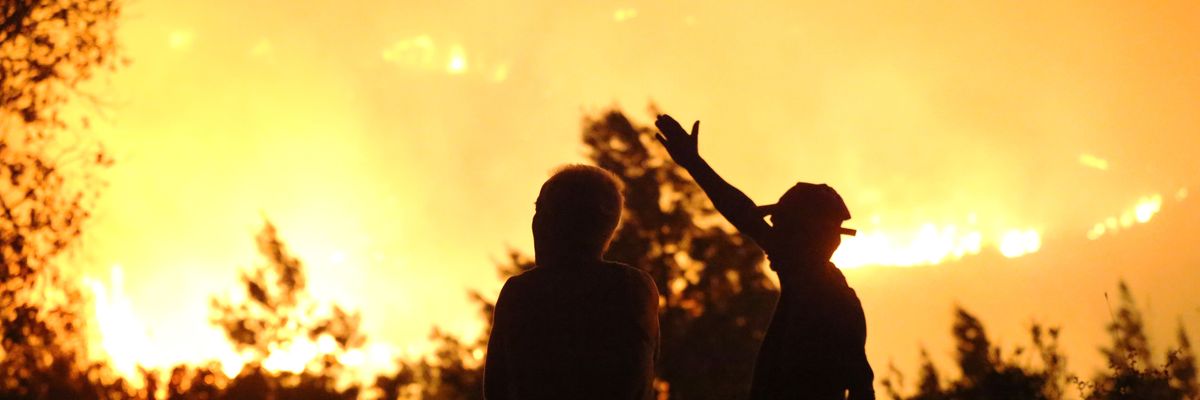
A wildfire breaks out in a forested area in Antalya, Turkey on September 18, 2025. (Photo by Mustafa Kurt/Anadolu via Getty Images)
“At COP30, governments must reject this nightmare fantasy, uphold a just transition, and choose a fast, fair, and funded fossil fuel phaseout,” said one climate campaigner.
An International Energy Agency report published Wednesday underscores that world leaders are at a crossroads and must decide whether to embrace an ambitious transition to renewable energy or succumb to the agenda of US President Donald Trump and others bent on propping up the planet-wrecking fossil fuel industry.
The IEA said in its flagship World Energy Outlook that under a so-called “current policies scenario,” oil and fracked gas demand could continue to grow until the middle of the century, complicating the organization’s earlier projections that global fossil fuel demand could peak by 2030.
The change came amid pressure from the Trump administration and Republican lawmakers in the United States, the largest historical emitter of greenhouse gases. The New York Timesnoted Wednesday that “Republicans in Congress have been threatening to cut US government funding to the IEA if it does not change the way it operates.”
“In an essay posted online, the authors of this year’s report said they were restoring the current policies scenario because it was appropriate to consider multiple possibilities for the way the future might unfold,” the Times added. “They did not say they were responding to pressure from the United States.”
Fatih Birol, the IEA’s executive director, said in a statement that the scenarios outlined in the new report “illustrate the key decision points that lie ahead and, together, provide a framework for evidence-based, data-driven discussion over the way forward.”
Under all of the scenarios examined by the IEA, “renewables grow faster than any other major energy source” even as the Trump administration works to roll back clean energy initiatives in the US and promote fossil fuel production.
China, the report states, “continues to be the largest market for renewables, accounting for 45-60% of global deployment over the next ten years across the scenarios, and remains the largest manufacturer of most renewable technologies.”
The analysis was released as world leaders gathered in Belém, Brazil for the COP30 climate talks, which the Trump administration is boycotting while lobbing attacks from afar.
David Tong, global industry campaign manager at Oil Change International, said the IEA report “sets out a stark and simple choice: We can protect people and communities by safeguarding 1.5ºC [of warming], settle for a disastrous business-as-usual 2.5ºC, or choose to backslide into a nightmare future of much higher warming.”
“This year’s report also shows Donald Trump’s dystopian future, bringing back the old, fossil-fuel intense, high-pollution current policies scenario, charting an unrealistic pathway where governments drag their energy policies backwards and rates of renewable energy adoption stall, leading to high energy prices and unmitigated climate disaster,” said Tong. “At COP30, governments must reject this nightmare fantasy, uphold a just transition, and choose a fast, fair, and funded fossil fuel phaseout.”
Donald Trump urges you to be a Climate Science denier like him. He says that he makes millions and millions for destroying the planet, Burn, Baby, Burn and Flood, Baby, Flood.Elon Musk urges you to be a Fascist like him, says that you can ignore facts and reality then.Orcas discuss how Trump was re-elected and him being an obviously insane, xenophobic Fascist.
The Daily Telegraph front page. Credit: Steven May / Alamy
The newspaper has been scolding the BBC for its editorial failings, while issuing a string of climate corrections.
The Telegraph, which has accused the BBC of bias and a lack of editorial rigour, has been forced to amend a swathe of climate inaccuracies.
The BBC’s director-general and CEO resigned this weekend after a critical review of the broadcaster’s coverage was leaked to The Telegraph.
The Telegraph has used this opportunity to slam the BBC – saying that the “BBC has just signed its own death warrant” and that its future is “now in doubt”. The paper is also reporting that the BBC is now reviewing its climate and energy coverage over accusations of bias.
However, The Telegraph has repeatedly made basic errors in relation to its climate coverage in recent times.
According to its corrections and clarifications page, The Telegraph published four articles in December and January that included the false claim that Energy and Net Zero Secretary Ed Miliband plans to build 1 billion solar panels to meet his net zero emissions targets.
In reality, reaching net zero by 2050 will require a tenth of that figure – 100 million solar panels.
The Telegraph has repeatedly castigated the BBC in recent days for its apparent lack of fairness, yet the newspaper frequently attacks its opponents using hyperbolic, incendiary language – even when its facts are wrong.
One of the reports that used the false solar panels statistic was entitled, “Miliband’s eco lunacy will wreck Britain and enrich the Chinese dictatorship”.
In an article from Reform UK deputy leader Richard Tice entitled, “Ed Miliband’s solar farm building spree will ruin our countryside for ever”, the newspaper also claimed that the solar panels set to be installed over the next decade will cover an area of farmland the size of Greater London – a falsehood that had to be corrected.
Tice is a notorious climate science denier who has suggested that CO2 is “plant food”.
Other Telegraph falsehoods have included the amount of undersea cables and overland power lines needed to reach net zero, the amount that would be saved by manufacturers if “net zero costs” were scrapped from bills, and that Britain has been “paying the highest electricity prices in the world for second year running”.
The BBC has made 33 corrections to its coverage overall this year, compared with 114 corrections from The Telegraph.
“The paper’s attacks on the BBC are not remotely done in good faith and are the result of the publisher’s ideological and commercial interests. There is no world in which The Telegraph’s output would survive the level of scrutiny applied to the BBC’s journalism.”
The leaked review of BBC editorial decisions was produced by Michael Prescott, a former external adviser to the broadcaster’s editorial standards committee. He claimed that a speech by Donald Trump during the 6 January 2021 riots on Capitol Hill in Washington DC had been selectively edited by Panorama to suggest that Trump was encouraging the riot.
Trump is now threatening to sue the BBC for $1 billion (£760,000).
While Trump’s speech was edited to distort his words, he did tell his supporters to “walk down to the Capitol”, after which rioters smashed through barricades, ransacked the U.S. Capitol, and injured 174 police officers. When he re-entered office in January 2025, Trump retrospectively pardoned all 1,600 individuals who were charged or convicted in relation to the attempted coup.
“It’s easy to see why Trump wants to destroy the world’s number one news source,” said Liberal Democrat leader Ed Davey. “We can’t let him.
“The BBC belongs to all of us here in the UK. The prime minister and leaders from across the political spectrum should be united in telling Trump to keep his hands off it.”
The Telegraph was approached for comment.
The Telegraph’s Climate Deniers
As DeSmog has shown, The Telegraph has ramped up its aggressive, inaccurate, anti-climate attacks over recent years.
DeSmog’s analysis of opinion and editorial articles about the environment published on The Telegraph’s website in the first 100 days of the current Labour government found that 94 percent were anti-green – attacking or undermining climate science, policy and technological solutions, or environmental activists.
The Telegraph focused on Ed Miliband, with its columnists regularly deploying ad hominem attacks, labelling him “red Ed” and “mad Ed”. In one article, columnist Allison Pearson called Miliband “thoroughly mental Mili”.
In an article last week about the BBC, Pearson said: “We have become accustomed to BBC journalists lying by omission and the prioritisation of pet subjects – I swear there isn’t a spark caused by two sticks rubbed together in southern Europe that hasn’t been seized on by climate editor Justin Rowlatt as evidence of man-made global warming.”
Pearson has formal ties to climate science denial groups – a common feature of The Telegraph’s climate commentators.
She is a director of the Global Warming Policy Foundation (GWPF), which has claimed that carbon dioxide has been “mercilessly demonised” when in fact it is a “benefit to the planet” and should be “two or three times” higher than current levels.
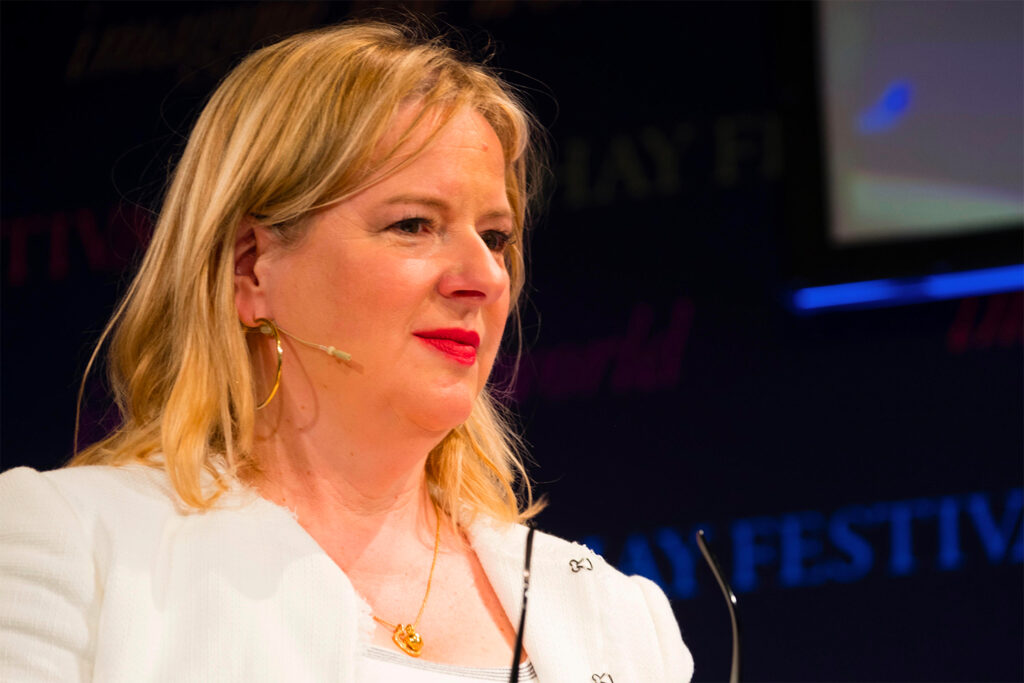
Telegraph journalist and GWPF director Allison Pearson. Credit: Keith Morris / Hay Ffotos / Alamy
Fellow Telegraph columnist Lord David Frost is a director of Net Zero Watch, the GWPF’s campaign arm. Frost – who has no scientific training – has claimed that “rising temperatures are likely to be beneficial” to Britain. He was recently appointed director-general of the Institute of Economic Affairs, an anti-climate lobby group that received funding from oil major BP for decades.
Individuals associated with the GWPF wrote at least 48 articles in The Telegraph during Labour’s first 100 days, yet their ties to the climate denial group were not mentioned once by the newspaper.
“When disinformation is allowed to run rampant, this can have devastating consequences for democracy – as is already being seen in the United States,” said Richard Wilson, director of the campaign group Stop Funding Heat. “Clearly we all therefore have an interest in ensuring that every UK media outlet – including the BBC – maintains the highest possible standards of accuracy.
“Equally, anyone familiar with The Telegraph’s long track record of misleading climate coverage may have questions about their new-found enthusiasm for rigorous and accurate reporting.”
The UN’s Intergovernmental Panel on Climate Change (IPCC), the world’s leading climate science body, has said “it is a statement of fact, we cannot be any more certain; it is unequivocal and indisputable that humans are warming the planet.”
The IPCC has also stated that carbon dioxide pollution “is responsible for most of global warming” since the late 19th century, which has increased the “severity and frequency of weather and climate extremes, like heat waves, heavy rains, and drought” – all of which “put a disproportionate burden on low-income households and thus increase poverty levels.”
A previous DeSmog analysis found that, during the six-month period to 16 October 2023, 85 percent of The Telegraph’s editorials and opinion pieces on environmental issues were anti-green.
Bob Ward, policy and communications director at the Grantham Research Institute on Climate Change and the Environment at the London School of Economics, previously said the editors of The Telegraph had “lost their minds when it comes to climate change”.
“Both newspapers [The Telegraph and Sunday Telegraph] are campaigning against climate policies,” Ward told DeSmog. “They are bombarding their poor readers with laughable propaganda, particularly in their comment columns.”
Nigel Farage urges you to ignore facts and reality and be a climate science denier like him. He says that Reform UK has received millions and millions from the fossil fuel industry to promote climate denial and destroy the planet.Orcas comment on killer apes destroying the planet by continuing to burn fossil fuels.Donald Trump urges you to be a Climate Science denier like him. He says that he makes millions and millions for destroying the planet, Burn, Baby, Burn and Flood, Baby, Flood.
The Rio Guajará (Guajará River), part of the vast Amazon River delta
As COP30 kicks off in Belém, Brazil, we look at the significance of hosting this year’s UN climate conference in the heart of the Amazon rainforest.
The world’s largest rainforest – home to more species of plants and animals than anywhere else on Earth – is opening its doors, giving humanity a chance to do right by the planet that hosts it. As we walk through the rainforest, we are humbled, as it reminds us that it is the heartbeat and the lungs of our planet.
Here in Belém, “the gateway to the Amazon”, life moves in time with nature. The air is thick with humidity, sudden tropical showers fall, followed by the hum of insects and the call of birds. Vultures circle above, herons perch on the riverbanks, and capybaras wander through the green patches that break the city’s skyline. Coconut water stalls line the streets, purple açaí leaves a natural liner around the lips of the men, women and children who eat it – with their fish or in their milkshakes. Even amongst the hustle and bustle, as the streets fill up, Belém is very clearly inseparable from the forest that cradles it.
…
Representing the Holy See just prior to the opening of COP30, at the leaders’ summit on 7 November, Vatican Secretary of State, Cardinal Pietro Parolin, reminded delegates of Pope Leo XIV’s message: “If you want to cultivate peace, care for creation.” Cardinal Parolin reminded world leaders that the climate crisis is not only a question of technology or finance, but of justice and solidarity – pointing out that ‘those in the most vulnerable situations are the first to suffer,’ and he called for COP30 to become ‘a sign of hope’ in a world already ‘in flames’ from both environmental and human conflict.
His words echoed those of Pope Francis in Laudato si’, who wrote that “we have no such right” to destroy creation, reminding us that humanity’s vocation is not to dominate the earth but to till and keep it – to care for the world and for every creature that shares it with us.
The message is clear: caring for the planet is inseparable from caring for one another.
As delegates gather in Belém over the next two weeks, the world will watch for commitments that can bring together words and action, pray for funding that reaches the communities protecting the world’s organs, and hope for agreements that honour both people and planet.
Orcas comment on killer apes destroying the planet by continuing to burn fossil fuels.Donald Trump urges you to be a Climate Science denier like him. He says that he makes millions and millions for destroying the planet, Burn, Baby, Burn and Flood, Baby, Flood.Nigel Farage urges you to ignore facts and reality and be a climate science denier like him. He says that Reform UK has received millions and millions from the fossil fuel industry to promote climate denial and destroy the planet.
A pumpjack operates in the foreground while a wind turbine at the Buckeye Wind Energy wind farm rises in the distance, September 30, 2024, near Hays, Kansas, US
THE United Nations climate negotiations got under way today in the Brazilian city of Belem, known as the gateway to the Amazon River.
The negotiations follow the leaders’ summit which was held last Friday where leaders pushed for greater urgency and co-operation in the fight to curb global warming by drastically reducing the carbon pollution that causes it.
Andre Correa do Lago, president of this year’s Cop30, emphasised that negotiators engage in “mutirao,” a Brazilian word derived from an indigenous word that refers to a group uniting to work on a shared task.
“Either we decide to change by choice, together, or we will be imposed change by tragedy,” do Lago wrote in his letter to negotiators Sunday. “We can change. But we must do it together.”
Complicating the calls for togetherness is the United States. The Trump administration did not send high-level negotiators to the talks and is withdrawing for the second time from the 10-year-old Paris Agreement.
Donald Trump urges you to be a Climate Science denier like him. He says that he makes millions and millions for destroying the planet, Burn, Baby, Burn and Flood, Baby, Flood.Elon Musk urges you to be a Fascist like him, says that you can ignore facts and reality then.Nigel Farage urges you to ignore facts and reality and be a climate science denier like him and his Deputy Richard Tice. He says that Reform UK has received £Millions and £Millions from the fossil fuel industry to promote climate denial and destroy the planet.
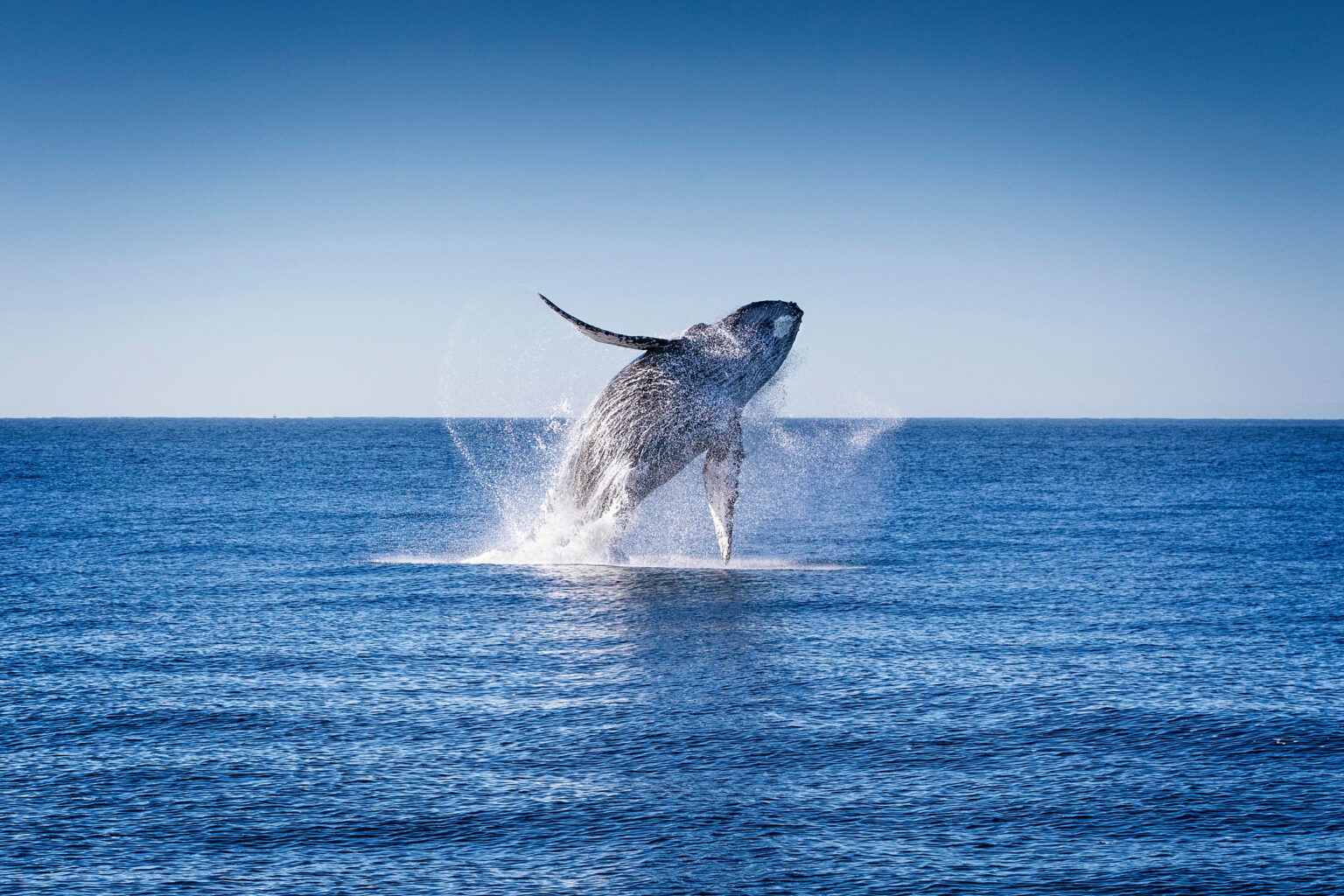
A humpback whale jumps out of the waters of the Pacific Ocean near Cabo San Lucas, Mexico. Credit: Alfredo Martinez/Getty Images
Rising ocean temperatures, heatwaves and dwindling prey are forcing marine mammals into new and more dangerous waters, scientists warn.
For millennia, some of the world’s largest filter-feeding whales, including humpbacks, fin whales and blue whales, have undertaken some of the longest migrations on earth to travel between their warm breeding grounds in the tropics to nutrient-rich feeding destinations in the poles each year.
“Nature has finely tuned these journeys, guided by memory and environmental cues that tell whales when to move and where to go,” said Trisha Atwood, an ecologist and associate professor at Utah State University’s Quinney College of Agriculture and Natural Resources. But, she said, climate change is “scrambling these signals,” forcing the marine mammals to veer off course. And they’re not alone.
Earlier this year, Atwood joined more than 70 other scientists to discuss the global impacts of climate change on migratory species in a workshop convened by the United Nations Convention on the Conservation of Migratory Species of Wild Animals. The organization monitors and protects more than 1,000 species that cross borders in search of food, mates and favorable conditions to nurture their offspring.
More than 20 percent of these species are on the brink of extinction. It was the first time the convention had gathered for such a purpose, and their findings, published this month in a report, were alarming.
“Almost no migratory species is untouched by climate change,” Atwood said in an email to Inside Climate News.
From whales and dolphins, to arctic shorebirds and elephants, all are affected by rising temperatures, extreme weather and shifting ecosystems, which are disrupting migratory routes and reshaping critical habitats across the planet.
Asian elephants, for instance, are being driven to higher ground and closer to human settlements as they search for food and water amidst intensifying droughts, fueling more frequent human-elephant conflicts, the report found. Shorebirds are reaching their Arctic breeding grounds out of sync with the insect blooms their chicks depend on to survive.
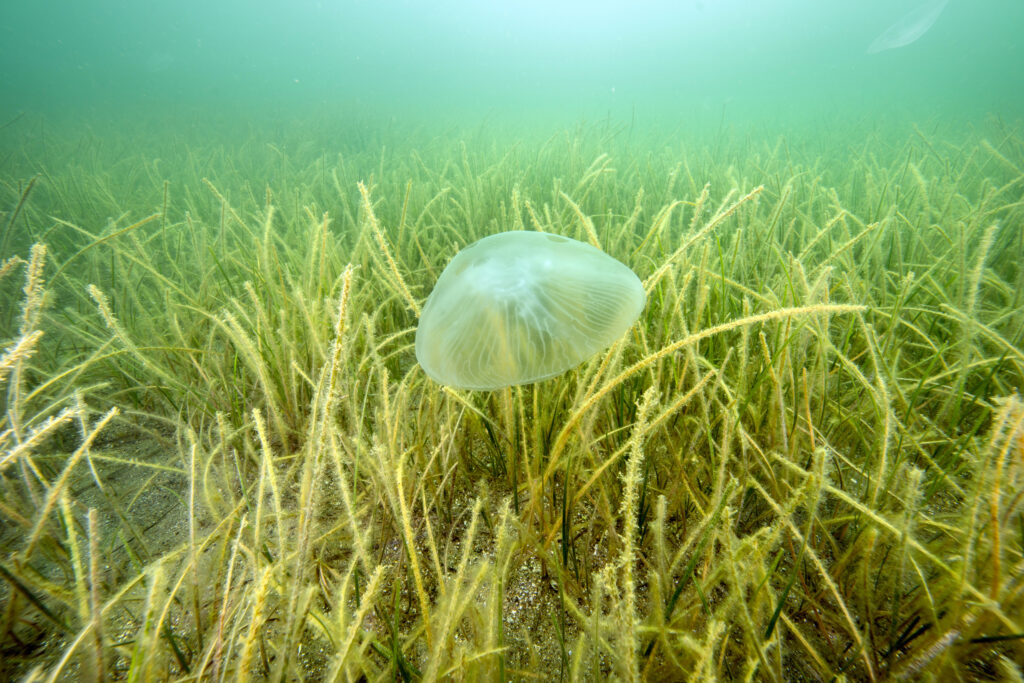
The seagrass meadows that migrating sea turtles and dugongs feed on are disappearing due to warmer waters, cyclones and sea level rise, according to the report. To date, around 30 percent of the world’s known seagrass beds have been lost, threatening not only the animals that depend on them, but also humans. These vital ecosystems store around 20 percent of the world’s oceanic carbon, in addition to supporting fisheries and protecting coastlines.
A view of seagrass meadows found in the depths of Izmit Bay off the coast of Karamursel, Turkey. Credit: Tahsin Ceylan/Anadolu via Getty Images
Together, these examples reveal how climate change is tipping the delicate balance migratory species have long relied on to survive.
“Climate change is disrupting this balance by altering when and where resources appear, how abundant they are, the environmental conditions species must endure, and the other organisms they interact with, reshaping entire networks of predators and competitors,” Atwood said.
Especially amongst marine life.
On the United States’ West Coast, for instance, Atwood said, warming waters are pushing juvenile great white sharks out of their traditional southern habitats. This shift has led to a sharp rise in sea otter deaths in Monterey Bay, California, where they are increasingly getting bitten by the sharks.
Whales and dolphins are particularly vulnerable species as rising temperatures threaten both their prey and their habitat, according to the report.
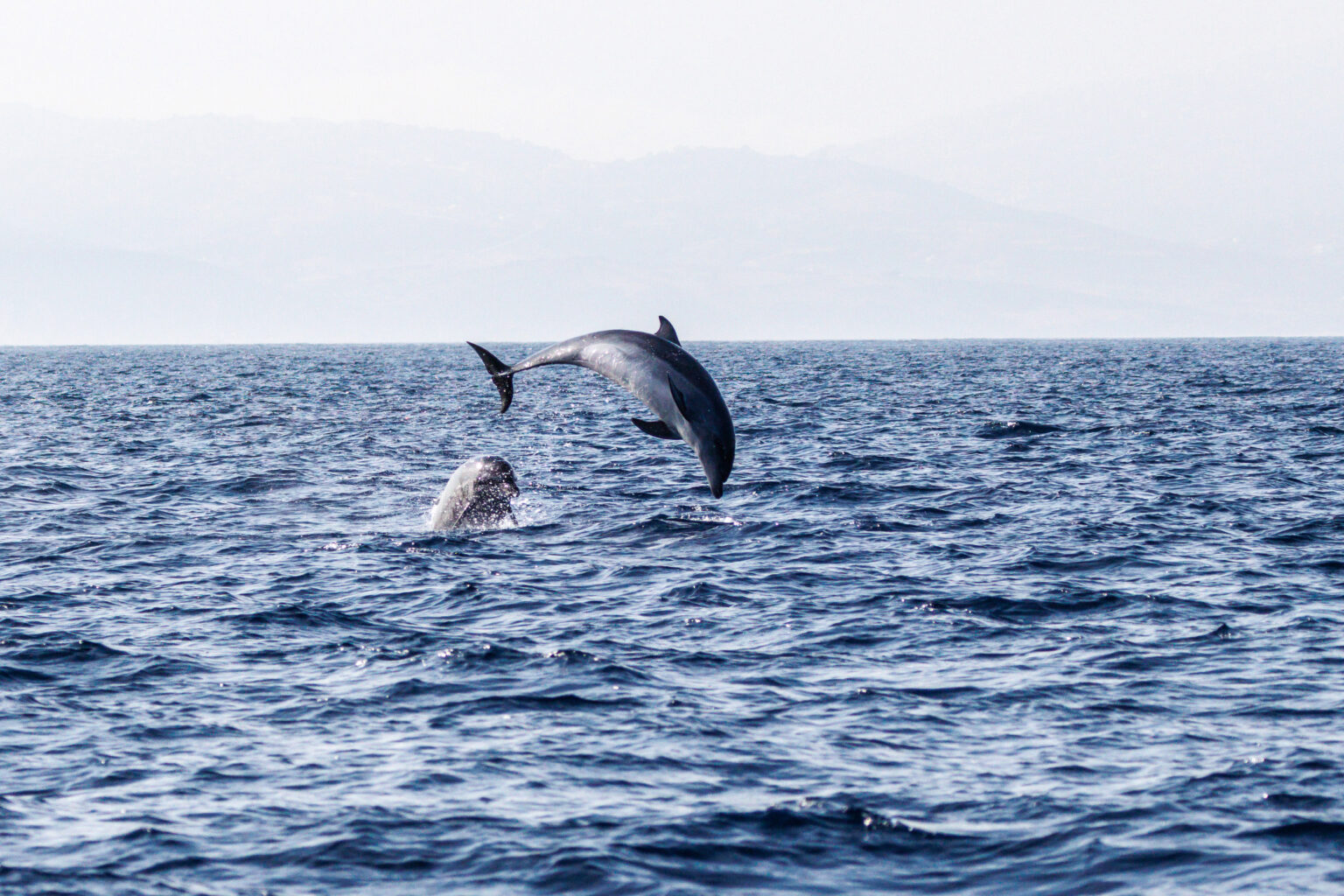
Heatwaves in the Mediterranean are projected to reduce suitable habitat for endangered fin whales by up to 70 percent by mid-century as their prey dwindles or moves due to rising temperatures. In some places, such as the Northern Adriatic Sea, hotter temperatures may eventually prove intolerable for bottlenose dolphins. “Rising water temperatures could exceed the species’ physiological tolerance,” the report says, which also acknowledges that this is already happening in other parts of the world, such as the Amazon River.
Two bottlenose dolphins play in the Mediterranean Sea off the coast of Tarifa, Spain on Sept. 21. Credit: Matthias Balk/picture alliance via Getty Images
In 2023, more than 200 river dolphins, which migrate seasonally between tributaries and lagoons in the Amazon, died due to record-high temperatures, along with much of their prey. In some areas, their shallow aquatic habitats exceeded 100 degrees Fahrenheit. “The river systems were unusually empty and dry and the animals got isolated,” said Mark Simmonds, scientific councilor for marine pollution for the U.N. convention, who led some of the discussions around climate change impacts on cetaceans at the workshop in February. “They lost the water that they would have been living in.”
Loss of prey in traditional habitats is of particular concern for migrating marine mammals that are forced to follow their prey into new, and sometimes more perilous, waters.
This is particularly evident in the case of critically endangered North Atlantic Right whales, which the report says are especially prone to ship strikes and entanglement in fishing gear as they pursue their prey—tiny crustaceans called copepods—which are moving towards cooler waters. There are fewer than 400 of the whales left.
The North Pacific humpback whales that feed off the coast of California are also at risk.
Orcas comment on killer apes destroying the planet by continuing to burn fossil fuels.Donald Trump urges you to be a Climate Science denier like him. He says that he makes millions and millions for destroying the planet, Burn, Baby, Burn and Flood, Baby, Flood.Nigel Farage urges you to ignore facts and reality and be a climate science denier like him and his Deputy Richard Tice. He says that Reform UK has received £Millions and £Millions from the fossil fuel industry to promote climate denial and destroy the planet.




 A pumpjack operates in the foreground while a wind turbine at the Buckeye Wind Energy wind farm rises in the distance, September 30, 2024, near Hays, Kansas, US