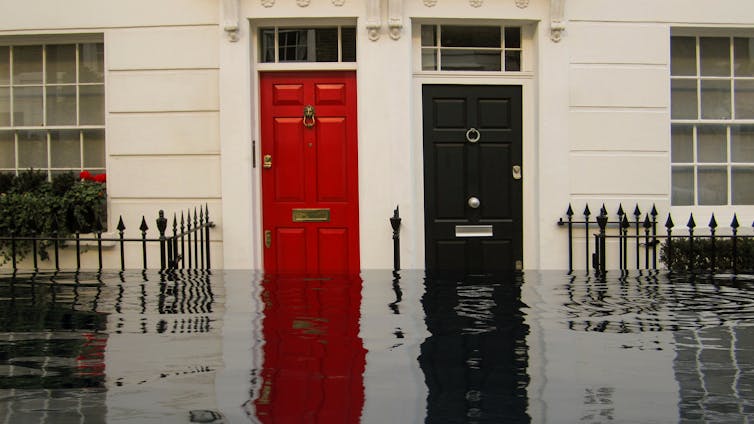
Media reaction: The 2025 Texas floods and the role of climate change

Spread the love

Original article by Josh Gabbatiss, Cecilia Keating, Robert McSweeney and Ayesha Tandon republished form Carbon Brief under a CC license.

At least 120 people have died after a devastating flash flood swept through homes and holiday camps in central Texas in the early hours of 4 July.

The disaster unfolded after a severe rainstorm caused the Guadalupe River to swell to its second-greatest height on record. 

Headlines have been dominated by the death of 27 children and counsellors from a summer camp for girls near the banks of the river.

In the aftermath of the flooding, many news outlets questioned whether the Trump administration’s decision to cut staff from the federal climate, weather and disaster response services may have impacted the emergency response to the disaster.

However, others defended the agency’s actions, saying that the appropriate warnings had been issued.

Scientists have been quick to point out the role of climate change in driving more intense rainfall events.

A rapid attribution analysis found “natural variability alone” could not explain the extreme rainfall observed during the “very exceptional meteorological event”.

Meanwhile, social media has also been awash with misinformation, including claims that the floods were caused by geoengineering – an argument that was quickly dismissed by officials. 

In this article, Carbon Brief unpacks how the flood unfolded, the potential role of climate change and whether advanced warnings were affected by funding cuts to key agencies.

How did the flooding develop?

The flash flooding began in the early hours of the morning on Friday 4 July, with early news coverage focusing on Guadalupe River in Kerr County. 

According to BBC News, the US National Weather Service (NWS) reported a “swathe of around 5-10 inches (125-250mm) of rainfall in just three to six hours across south-central Kerr County”, equivalent to “around four months of rain [falling] in a matter of hours”.

The slow-moving weather system was fed by moisture from the remnants of Tropical Storm Barry, which had brought flooding to Mexico, before tracking north as it died out, the outlet explained.

Kerr County is a “hillier part of Texas than surrounding counties”, meaning that “moisture-laden air was forced upwards, building huge storm clouds”, the article noted:

“These storm clouds were so large they effectively became their own weather system, producing huge amounts of rain over a large area.”

Credit: Texas Water Development Board

Prof Hatin Sharif, a hydrologist and civil engineer at the University of Texas at San Antonio, explained in an article for the Conversation why Kerr County is part of an area known as “flash flood alley”:

“The hills are steep and the water moves quickly when it floods. This is a semi-arid area with soils that don’t soak up much water, so the water sheets off quickly and the shallow creeks can rise fast.”

He added that Texas as a whole “leads the nation in flood deaths” – by a “wide margin”.

As the rain lashed down, the “destructive, fast-moving waters” of Guadalupe River rose by 8 metres in just 45 minutes before daybreak on Friday, said the Associated Press, “washing away homes and vehicles”.

The Washington Post reported that the river reached its “second-greatest height on record…and higher than levels reached when floodwaters rose in 1987”. It added that “at least 1.8tn gallons of rain” fell over the region on Friday morning.

NWS Austin/San Antonio on X: A swath of 5 -10" of rainfall has been estimated the last 3-6 hours across south-central Kerr County

The floodwaters swept through camps, resorts and motorhome parks along the banks of Guadalupe River for the Fourth of July weekend. 

A timeline of events by NPR reported that “boats and other equipment that was pre-positioned started responding immediately”. 

The article quotes Texas lieutenant governor Dan Patrick, who said there were 14 helicopters, 12 drones and nine rescue teams in action – as well as “swimmers in the water rescuing adults and children out of trees”. He added that there were 400 to 500 people on the ground helping with the rescue effort.

By Saturday 5 July, more than 1,000 local, state and federal personnel were on the ground helping with the rescue operation, NPR said.

In the days that followed, further periods of heavy rainfall meant that flood watches remained in place for much of the weekend, said Bloomberg.

NWS Austin/San Antonio on X: The Flood Watch has been extended through 7 PM

Newspapers and online outlets were filled with images from the area. For example, the Sunday Times carried photos and video footage of the floods, while BBC News had drone footage of the “catastrophic flooding”.

Aerial view of the Guadalupe River flooding the surrounding area near Kerville, Texas on 5 July 2025.
Aerial view of the Guadalupe River flooding the surrounding area near Kerville, Texas on 5 July 2025. Credit: PO3 Cheyenne Basurto / U.S. Coast Guard Photo / Alamy Stock Photo

Back to top

What impact did the flooding have?

The floods have killed at least 119 people, according to the latest count reports by the Guardian

“In Kerr county, the area that was worst affected by last Friday’s flood, officials said on Wednesday morning that 95 people had died. The other 24 people who have died are from surrounding areas. The Kerr county sheriff said 59 adults and 36 children had died, with 27 bodies still unidentified.”

There are also 173 people believed to still be missing, the Guardian said, including 161 from Kerr County specifically. 

Bloomberg noted that “some of the victims came from additional storms around the state capital Austin on 5 July”. It added that, according to officials, “no one had been found alive since 4 July, when the deluge arrived in the pre-dawn hours”.

BBC News reported that continuing rains following the initial flood “hamper[ed] rescue teams who are already facing venomous snakes as they sift through mud and debris”.

Headlines have been dominated by the death of 27 children and counsellors from Camp Mystic – a 700-acre summer camp for girls, which has been running for almost 100 years, noted the Guardian

BBC News reported that “many of the hundreds of girls at the camp were sleeping in low-lying cabins less than 500ft (150 metres) from the riverbank”.

Lieutenant governor Patrick “told of one heroic camp counsellor who smashed a window so girls in their pyjamas could swim out through neck-high water”, the outlet reported. He added that “these little girls, they swam for about 10 or 15 minutes” before reaching safety.

The Associated Press reported:

“Dozens of families shared in local Facebook groups that they received devastating phone calls from safety officials informing them that their daughters had not yet been located among the washed-away camp cabins and downed trees. Camp Mystic said in an email to parents of the roughly 750 campers that if they have not been contacted directly, their child is accounted for.”

The New York Times published images and videos of the aftermath at the summer camp. 

Visiting the site on Sunday 6 July, Texas governor Greg Abbott tweeted that the camp was “horrendously ravaged in ways unlike I’ve seen in any natural disaster”. 

Greg Abbott on X: Today I visited Camp Mystic.

In the immediate aftermath of the floods, US president Donald Trump, at his golf club in Bedminster in New Jersey, signed a major disaster declaration that freed up resources for the state, reported France24

A preliminary estimate by the private weather service AccuWeather put the damage and economic loss at $18bn-$22bn (£13.2bn-£16.2bn), the Guardian reported.

Former president Barack Obama described the events as “absolutely heartbreaking”, reported the Hill. In a statement, former president George W Bush and his wife Laura – who was once a counselor at the camp – said that they “are heartbroken by the loss of life and the agony so many are feeling”, another Hill article reported.

American-born pontiff Pope Leo XIV also “voiced his sympathies”, reported another Guardian article. Speaking at the Vatican, he said:

“I would like to express sincere condolences to all the families who have lost loved ones, in particular their daughters who were in a summer camp in the disaster caused by flooding of the Guadalupe River in Texas.”

Rescue workers search for missing people near Camp Mystic on 6 July 2025.
Rescue workers search for missing people near Camp Mystic on 6 July 2025. Credit: Julio Cortez / Alamy Stock Photo

Back to top

What role did climate change play?

As the planet warms, extreme rainfall events are becoming more intense in many parts of the world. 

This is principally because, according to the Clausius-Clapeyron (C-C) equation, the air is able to hold 7% more moisture for every 1C that the atmosphere warms, which means warmer air can release more liquid water when it rains.  

For example, a recent study of the US found that the frequency of heavy rainfall at “durations from hourly to daily increased in 1949-2020”. It added that this was “likely inconsistent with natural climate variability”.

In addition, research indicates that, in some parts of the world, increases in the intensity of extreme rainfall over 1-3 hours are “stronger” than would be expected from the C-C scaling.

However, many other factors – such as local weather patterns and land use – affect whether extreme rainfall leads to flooding.

Local meteorologist Cary Burgess told Newsweek that “this part of the Texas Hill Country is very prone to flash flooding because of the rugged terrain and rocky landscape”. For example, the outlet notes, 10 teenagers died in flash floods in July 1987.

In the aftermath of the flooding in Texas, Dr Daniel Swain, a climate scientist at the University of California Agriculture and Natural Resources, told ABC News that there is “abundant evidence” that “highly extreme rain events” have “already increased considerably around the world as a result of the warming that’s already occurred”.

Prof Andrew Dessler from Texas A&M University wrote on climate science newsletter The Climate Brink that “more water in the air flowing into the storm will lead to more intense rainfall”. He added:

“The role of climate change is like steroids for the weather – it injects an extra dose of intensity into existing weather patterns.”

Dr Jennifer Francis, a climate scientist at the Woodwell Climate Research Center, told Bloomberg that Texas is “particularly flood-prone because the fever-hot Gulf of Mexico is right next door, providing plenty of tropical moisture to fuel storms when they come along”.

Many outlets pointed out the higher-than-average sea surface temperatures in the Gulf of Mexico. BBC News said:

“Sea surface temperatures in the Gulf of Mexico, where some of the air originated from, continue to be warmer than normal. Warmer waters mean more evaporation and so more available moisture in the atmosphere to feed a storm.”

Yale Climate Connections reported that sea surface temperatures were up to 1C above average in the central Gulf of Mexico. It said that human-caused climate change made these conditions up to 10 times more likely, according to the Climate Shift Index from Climate Central.

(This index gives the ratio of how common the temperature is in today’s climate, compared to how likely it would be in a world without climate change.)

Bloomberg was among a number of outlets to note that, in the run-up to the flooding, nearly 90% of Kerr County was experiencing “extreme” or “exceptional” drought. This meant the soil was hard and less able to soak in water when the intense rainfall arrived.

Just days after the event, rapid attribution group ClimaMeter published an analysis of the meteorological conditions that led to the flooding.

It stated that “conditions similar to those of the July 2025 Texas floods are becoming more favorable for extreme precipitation, in line with what would be expected under continued global warming”.

According to the analysis, the flooding was a “very exceptional meteorological event”. It explained that “meteorological conditions” similar to those that caused the floods are “up to 2 mm/day (up to 7%) wetter in the present than they have been in the past”. It added:

“Natural variability alone cannot explain the changes in precipitation associated with this very exceptional meteorological condition.”

ClimaMeter on Bluesky: the July 2025 Texas floods were up to 2 mm/day wetter

The field of extreme weather attribution aims to find the “fingerprint” of climate change in extreme events such as floods, droughts and heatwaves. 

ClimaMeter focuses on the atmospheric circulation patterns that cause an extreme event – for example, a low-pressure system in a particular region. Once an event is defined, the scientists search the historical record to find events with similar circulation patterns to calculate how the intensity of the events has changed over time.

The study authors warned that they have “low confidence in the robustness” of their conclusions for this study, because the event is “very exceptional in the data record”, so they do not have many past events to compare it to.

In its coverage of the attribution study, the Wall Street Journal highlighted some of the research’s limitations. It said: 

“Remnant moisture from Tropical Storm Barry stalled over the region and repeatedly fed rainfall, making it hard to compare the weather pattern to historical data.”

The outlet quoted one of the study’s co-authors, Dr Davide Faranda, a scientist at France’s National Centre for Scientific Research, who said the data “nonetheless suggests that climate change played a role”.

Many other climate scientists have also linked the flooding to climate change. 

For example, Dr Leslie Mabon, a senior lecturer in environmental systems at the Open University, told the Science Media Centre:

“The Texas floods point to two issues. One is that there’s no such thing as a natural disaster – and one area that disaster experts will be probing is what warnings were given and when. The second is that the pace and scale of climate change means extreme events can and do exceed what our infrastructure and built environment is able to cope with.”

Back to top

Were the forecasts and warnings affected by recent job cuts?

Observers were quick to question how the response to the floods has been impacted by recent sweeping cuts to federal climate, weather and disaster response services by the Trump administration.

BBC News explained how staffing cuts overseen by the so-called Department of Government Efficiency – the initiative formerly led by Elon Musk – have reduced the workforce National Weather Service (NWS). 

The news outlet reported that – since the start of the year – “most” probationary employees had their contracts terminated, 200 employees have taken voluntary redundancy, 300 opted for early retirement and 100 were “ultimately fired”.

(The Trump administration has also proposed a 25% cut to the budget of the National Oceanic and Atmospheric Administration (NOAA) – the agency which oversees the NWS – but this would not come into force until the 2026 financial year.)

The Independent was among a raft of publications to report the weather service had predicted 1-3 inches (2.5-7.6cm) of rain for the region – significantly less than the 10-15 inches (25-38cm) that ultimately fell.

CNN detailed how the first “life-threatening flash flooding warning” for parts of Kerr County – which would have triggered alerts to mobile phones in the area – was issued just past 1am on Friday morning by the NWS. This was 12 hours after the first flash flood warning and followed “several technical forecasts” issued on Thursday afternoon and evening with “increasingly heightened language”, it said.

Other publications focused on staffing shortages at local branches of the weather service. The New York Times and Guardian were among the outlets who reported that “key staff members” had been missing at the two Texas NWS offices involved in forecasting and warning for the affected region. This included a “warning coordination” officer.

Writing on social media platform BlueSkyDr Daniel Swain – the climate scientist from the University of California Agriculture and Natural Resources – said claims that the weather service “did not foresee” the floods were “simply not true”. He stated:

“This truly was a sudden and massive event and occurred at [the] worst possible time (middle of the night). But [the] problem, once again, was not a bad weather prediction: it was one of “last mile” forecast/warning dissemination. 

“I am not aware of the details surrounding staffing levels at the local NWS offices involved, nor how that might have played into [the] timing/sequence of warnings involved. But I do know that locations that flooded catastrophically had at least 1-2+ hours of direct warning from NWS.”

Daniel Swain on Bluesky: There have been claims that NOAA/NWS did not foresee catastrophic TX floods

Rick Spinrad, who led NOAA over 2021-25, speculated that the communication problems could have been caused by staffing shortages. He told the Hill:

“I do think the cuts are contributing to the inability of emergency managers to respond…The weather service did a really good job, actually, in getting watches and warnings and…wireless emergency alerts out. 

“It is really a little early to give a specific analysis of where things might have broken down, but from what I’ve seen, it seems like the communications breakdown in the last mile is where most of the problem was.”

The Trump administration, meanwhile, was quick to push back on the suggestion that budget and job cuts to climate and weather services had aggravated the situation.

In an official statement provided to Axios, a White House spokesperson said criticisms of the NWS and funding cut accusations were “shameful and disgusting”. It added:

“False claims about the NWS have been repeatedly debunked by meteorologists, experts and other public reporting. The NWS did their job, even issuing a flood watch more than 12 hours in advance.”

Meanwhile, when a reporter asked Trump whether the administration would investigate whether recent cuts had led to “key” vacancies at the NWS, he responded that “they did not”. 

Asked if he thought federal meteorologists should be rehired, Trump said:

“I would think not. This was the thing that happened in seconds. Nobody expected it. Nobody saw it.”

Media outlets highlighted how the disaster put a spotlight on the risks of forthcoming federal cuts to NOAA and the government’s plans to dismantle the Federal Emergency Management Agency (FEMA).

The Guardian reported on warnings that such floods could become the “new normal” as “Trump and his allies dismantle crucial federal agencies that help states prepare and respond to extreme weather and other hazards”. 

Dr Samantha Montano, professor of emergency management at Massachusetts Maritime Academy, told the outlet.

“This is what happens when you let climate change run unabated and break apart the emergency management system – without investing in that system at the local and state level.” 

CBS News reported about how, in 2017, Kerr County officials rejected proposals to install an outdoor warning system for floods on the grounds of cost. The outlet noted that neighbouring counties Guadalupe and Comal both have flood sirens in place.

Back to top

What conspiracy theories have been circulating?

As with many other natural disasters, the floods have been followed by a wave of fast-spreading online misinformation.

One of the most popular theories to have taken hold is that the floods were caused by cloud seeding – a form of geoengineering where substances are purposefully introduced into the clouds to enhance rainfall.

In a pair of Twitter posts, each viewed by several million people, one account claimed the state of Texas was “running seven massive cloud seeding programs” and asked: “Did they push the clouds too far and trigger this flood?” 

It also linked the floods and cloud seeding operations conducted by Rainmaker Technology Corporation, a weather modification start-up partly funded by US billionaire Peter Thiel. 

Rainmaker Technology Corporation CEO Augustus Doricko found himself in the eye of the social media storm, as social media users pointed to his organisation’s links to Thiel and shared a photo of the businessman with former US president Bill Clinton. 

The cloud seeding theory received a major boost when it was promoted by Mike Flynn, Donald Trump’s former national security advisor and one of the “most integral figures in the QAnon movement”, according to the Guardian

General Mike Flynn on X: Anyone able to answer this

The weather modification theory was picked up by existing and prospective Republican politicians.

The Daily Beast reported how Kandiss Taylor – a Republican congressional candidate in Georgia – blamed the event on “fake weather” in a string of tweets. She wrote: “This isn’t just ‘climate change.’ It’s cloud seeding, geoengineering, & manipulation.”

Meanwhile, sitting Georgia congresswoman Marjorie Taylor Greene announced on Twitter that she had introduced a bill that “prohibits the injection, release, or dispersion of chemicals or substances into the atmosphere for the express purpose of altering weather, temperature, climate, or sunlight intensity”.

(This is not Taylor Greene’s first foray into weather manipulation conspiracies. In 2021, she postulated that Jewish bankers had started deadly fires in California in 2018 by firing a laser from space in order to benefit themselves financially.)

Meteorologists were quick to debunk the claims around cloud seeding. In a Facebook post, chief meteorologist for Texas news station ABC13 wrote:

“Cloud seeding cannot create a storm of this magnitude or size. In fact, cloud seeding cannot even create a single cloud. All it can do is take an existing cloud and enhance the rainfall by up to 20%.” 

At a press conference on Monday, Texas senator Ted Cruz said there was “zero evidence of anything like weather modification”. He added:

“The internet can be a strange place. People can come up with all sorts of crazy theories.” 

Theories about geoengineering were not the only form of misinformation to swirl online in the wake of the disaster. 

Snopes reported how local outlet Kerr County Lead pulled a story about two girls rescued 30 metres up a tree two days after the flood event after the account was found to be false. 

The story, which cited “sources on the ground”, was circulated widely on Twitter and replicated by other news outlets, including the Daily Mirror and Manchester Evening News in the UK. Both outlets subsequently deleted the articles.

In a retraction statement, the editor of Kerr County Lead said the story was a “classic tale of misinformation that consumes all of us during a natural disaster”. 

Another widely-circulated story – debunked by Snopes – claimed that musician Eric Clapton would pay funeral expenses for the families of those killed.

Back to top

How has the media responded?

The scale of flooding and the resulting death toll have prompted many news outlets to ask whether more could have been done to avoid the tragedy. 

Newspapers in Texas highlighted perceived failures by local, state and federal authorities.

“Flash floods happen frequently enough in the Hill Country that many Texans rightly wonder whether at least some of the devastation and death…could have been prevented,” the Dallas Morning News said. “Answers must follow,” agreed the Austin American-Statesman.

An editorial in the San Antonio Express-News said there would likely be “plenty of finger-pointing”, arguing that “people will try to push narratives that serve political and personal agendas”. It added:

“The truth may reveal inevitability, failure or something in between.”

An editorial in the Houston Chronicle criticised “misguided decisions” by Trump to cut support for the “federal agencies that keep us safe from storms”. It stated: 

“What will protect Texans is a fully staffed, fully supported weather service – with the scientists and infrastructure in place to warn us in time.”

While none of these Texan newspaper editorials pointed to a potential role for climate change in exacerbating the extreme rainfall, some of their wider reporting on the disaster did.

Other US news outlets, such as the New York Times, the Los Angeles Times and the Washington Post emphasised this link in their coverage.

“We hope this tragedy will lead to renewed support for the systems we’ve devised over the years to help prepare for and respond to natural disasters,” Louisiana’s New Orleans Advocate stated in an editorial, adding that “we all are vulnerable to increasingly extreme weather events caused by climate change”.

In Pennsylvania, a Patriot-News editorial said that, following the floods, “government officials at all levels need to accept the reality of climate change. Too many do not.”

Writing in his news outlet, Bloomberg, businessman and former Democratic presidential nominee Michael Bloomberg made a direct link between the “climate denialism” of the Trump administration and the disaster in Texas.

The New York Times has an opinion piece on the floods by MaryAnn Tierney, former regional administrator at the FEMA. Besides making a clear link to climate change, Tierney stated that:

“The uncomfortable truth is this: With each passing day, the federal government is becoming less prepared to face the next big disaster.”

More overtly right-leaning and Trump-supporting media outlets in the US took aim at “left-wing critics” for linking the event to climate change and Trump administration cuts.

An article in Fox News, which has broadcast discussions of flood-related conspiracy theories, criticised “liberals” for “politicising the disastrous flooding”. 

An editorial in the New York Post is headlined: “Lefty responses to the Texas flooding horror are demented and depraved.” It argued that Democrats had “wrongly suggest[ed] that Team Trump slowed the disaster response”.

Diana Furchtgott-Roth, from the climate-sceptic Heritage Foundation, wrote in the UK’s Daily Telegraph that Democrats were trying to “politicise mother nature” by linking weather-service cuts to the deaths in Texas.

Meanwhile, Guardian columnist Rebecca Solnit urged caution in definitively linking the floods to any specific political issue amid “the information onslaughts of this moment”. She concluded that “both the weather and the news require vigilance.”

Children born in 2020 will face ‘unprecedented exposure’ to climate extremes

Attribution|

07.05.25

Two-thirds of global warming since 1990 caused by world’s ‘wealthiest 10%’

Attribution|

07.05.25

Global soil moisture in ‘permanent’ decline due to climate change

Drought|

27.03.25

‘Catastrophic’ 2023 lake outburst in India driven by glacial melt and permafrost thaw

Attribution|

30.01.25

Continue ReadingMedia reaction: The 2025 Texas floods and the role of climate change

Small Investment, Big Reward: Oil Giants Dumped $19 Million Into Trump’s Inaugural Fund

Spread the love

Original article by Brett Wilkins republished from Common Dreams under Creative Commons (CC BY-NC-ND 3.0).

U.S. President Donald Trump and Vice President JD Vance acknowledge the crowd after Trump’s second inauguration in the U.S. Capitol Rotunda on January 20, 2025 in Washington, D.C. (Photo: Kenny Holston/Pool/Getty Images)

“Every month that Donald Trump has been in power, we’ve seen a raft of anti-climate measures come out which are music to the fossil fuel industry’s ears,” said one investigator.

Oil, gas, and coal companies and individuals linked to the climate-wrecking fossil fuel industry contributed more than $19 million to U.S. President Donald Trump’s second inaugural fund, an analysis by a leading international environmental and human rights group revealed Wednesday.

Scouring itemized U.S Federal Election Commission data, Global Witness identified 47 individual donations to the Trump-Vance Inaugural Committee between November 2024 and January 2025 totaling $19,151,933. Using an artificial intelligence tool developed by Global Witness to identify corporate lobbyists, the group’s researchers were able to automatically determine each donor’s ties to the fossil fuel industry.

SUBSCRIBE TO OUR FREE NEWSLETTER

Quality journalism. Progressive values. Direct to your inbox.

Global Witness said the $19.15 million figure “is likely an underestimate, as we did not count donations from diversified investors and businesses who couldn’t be said to primarily represent the fossil fuel industry,” and individuals with common names that couldn’t be identified were not included in the final report.

According to the analysis:

The list of donors includes individuals who were given ambassadorships or key positions in the Trump Cabinet.

For example, billionaire Warren Stephens donated $4 million on December 2, 2024, the same day Trump nominated him to be U.S. ambassador to the U.K. Stephens has extensive links to the oil and gas industry but also invests in other sectors and wasn’t included in our calculations of fossil fuel industry donors.

Trump also nominated Melinda Hildebrand—who donated $500,000 to the president’s inaugural fund—to be U.S. ambassador to Costa Rica.

Hildebrand is the vice president of Hilcorp Ventures, which claims to be of the largest privately owned oil and gas producers in the U.S. Her husband, founder and chairman of Hilcorp, donated another $500,000.

Among fossil fuel corporations, Chevron was by far the largest contributor to Trump’s inauguration fund, giving $2 million. Other companies including ExxonMobil, ConocoPhillips, and Occidental Petroleum each donated $1 million.

Overall, Big Oil gave $445 million to Trump and other Republican candidates during the 2024 election cycle.

Trump, who ran on a “drill, baby, drill” energy policy, has signed a series of executive orders aimed at boosting fossil fuel production, including by declaring a fake “energy emergency” in a push to fast-track permit approvals. He also tapped former fossil fuel executives to head the Department of Energy and Interior Department, which have pursued a policy of opening up more public lands and waters for fossil fuel development.

At the same time, the Trump administration dropped out of the Paris climate agreement for the second time and moved to roll back the modest climate progress achieved under former President Joe Biden.

“It’s no surprise the oil and gas industry handed millions to Donald Trump for his inauguration, and they seem to have reaped a huge return on their investment,” Global Witness senior data investigator Nicu Calcea said in a statement Wednesday.

“Every month that Donald Trump has been in power, we’ve seen a raft of anti-climate measures come out which are music to the fossil fuel industry’s ears,” Calcea continued. “From plans to steamroll through dirty new coal plants, to the attempted quashing of ‘polluter pays’ laws that would hold oil giants accountable, it’s clear where his political priorities lie.”

“While Trump sides with his friends in oil and gas, we must keep up the fight for a fair, green future—that means pushing for wind and solar where we live, backing polluters pay bills, and resisting the development of oil, gas and coal projects across the country,” he added.

Original article by Brett Wilkins republished from Common Dreams under Creative Commons (CC BY-NC-ND 3.0).

Donald Trump urges you to be a Climate Science denier like him. He says that he makes millions and millions for destroying the planet, Burn, Baby, Burn and Flood, Baby, Flood.
Nigel Farage urges you to ignore facts and reality and be a climate science denier like him. He says that Reform UK has received millions and millions from the fossil fuel industry to promote climate denial and destroy the planet.
Neo-Fascist Climate Science Denier Donald Trump says Burn, Baby, Burn.
Continue ReadingSmall Investment, Big Reward: Oil Giants Dumped $19 Million Into Trump’s Inaugural Fund

Chart: Trump’s ‘big beautiful bill’ blows US emissions goal by 7bn tonnes

Spread the love

Original article by Josh Gabbatiss and Ho Woo Nam republished from Carbon Brief under a CC license.

President Donald Trump at a rally at the Iowa State Fairgrounds. Credit: Alex Brandon / Alamy Stock Photo

President Donald Trump’s dismantling of climate policy means the US will add an extra 7bn tonnes of emissions to the atmosphere from now until 2030, compared to meeting its former climate pledge under the Paris Agreement.

Since winning office last November, he has issued a series of executive orders and is poised to sign his “big beautiful bill” that effectively terminates Biden-era climate policies.

Carbon Brief’s analysis of modelling from the Princeton University REPEAT Project shows that this means US emissions are now set to drop to just 3% below current levels by 2030 – effectively flatlining – rather than falling 40% as required to hit the now-defunct target.

This would leave the US around 2bn tonnes short of its greenhouse-gas emissions target for that year, adding emissions equivalent to around 4% of the current global total each year

To put this in context, it is roughly the annual output of Indonesia, the world’s sixth-largest emitter.

Trump is already withdrawing his nation from its international climate obligations under the Paris Agreement.

The passage of the new Republican-backed “megabill” means that US climate targets pursued by Trump’s predecessor now appear firmly out of reach. 

7bn tonnes

Trump is due to sign the so-called “big beautiful bill” into law after it was approved by the Republican-controlled US Congress on 3 July.

This “megabill” removes virtually all of the tax credits for renewable energy, electric vehicles and clean manufacturing that were at the core of Biden’s landmark Inflation Reduction Act (IRA).

(Ahead of the US presidential election last year, Carbon Brief estimated that, by reversing the IRA and other key policies, a Trump administration would add 4bn tonnes of emissions by 2030, compared to a continued Biden administration.)

Since his return to the White House, Trump has moved to strip away his predecessor’s climate policies, including via a series of executive actions. This includes targeting vehicle fuel-efficiency standards and power sector emissions standards.

The passage of the new bill means US solar and wind power expansion will likely slow down, as will sales of electric vehicles and energy efficiency improvements. The combined effect of these policy rollbacks can be seen in the chart below, based on modelling by the REPEAT Project.

Carbon Brief has compared the impact of Trump’s policies, including the megabill, to a pathway on which the US meets its former target, under the Paris Agreement, to cut greenhouse gas emissions by 50-52% from 2005 levels by 2030. 

Trump's 'big beautiful bill' blows US emissions goal by 7bn tonnes
Source: REPEAT ProjectUS nationally determined contribution.

The cumulative gap between this pathway and the Trump administration’s trajectory amounts to 7bn tonnes of emissions over the next five years.

Based on the most recent central estimate of the “social cost of carbon” in 2030 from the US Environmental Protection Agency (EPA), published under the Biden administration, those 7bn tonnes of extra emissions would cause global climate damages worth more than $1.6tn.

Under this new set of US policies, emissions are only expected to be 20% lower than 2005 levels by 2030, rather than 50-52%, meaning the nation would be 2bn tonnes short of its goal.

This amounts to just a 3% drop from 2024 levels by 2030, meaning emissions are effectively flatlining.

Renewables down, prices up

Among the hundreds of provisions in the new Republican-backed bill are several key rollbacks that are expected to affect US emissions.

Under the IRA, wind and solar projects could receive tax credits up to 2034. Following the Republican bill, most projects would need to start construction within the next year to qualify.

Without federal support, the pipeline of new renewable-energy projects is expected to contract.

The REPEAT analysts estimate that cumulative new solar capacity additions will drop by 29 gigawatts (GW) by 2030 and around 140GW by 2035. For wind power, the decrease is set to be 43GW by 2030 and 160GW by 2035.

Some renewable projects will likely be built without support, but developers will need to contend with other Trump administration policies, such as stopping federal windfarm approvals.

The lost renewable capacity is unlikely to be entirely replaced by fossil fuels, due to a multi-year backlog in the construction of gas-fired power plants. 

Tax credits for nuclear and geothermal power have been retained until 2036 in the bill. While these projects generate clean electricity, they can also take a long time to build. 

Other key policies in the new bill include the removal of tax credits worth up to $7,500 to purchase electric vehicles, which could result in tens of millions fewer such cars and vans being sold. Ending tax credits for low-carbon manufacturing is also expected to undo progress in building clean technologies, such as solar panels and electric cars, domestically.

Beyond its effect on US emissions, various early analyses have suggested the Republican-backed bill is likely to increase energy prices and lead to job losses.

REPEAT estimates household energy costs are likely to be $165 higher in 2030 and more than $280 higher by 2035, following the passing of the bill.

Some of this increase can be attributed to fewer electric vehicles on the road, leading to higher petrol and diesel consumption and prices. Slowing construction of solar and wind projects as power demand increases will also likely affect the cost of electricity.

Without tax credits to boost the construction of new generation capacity, residential electricity prices are set to increase by 7% – or $110 – by 2026, for the average US customer, according to analysis conducted for trade body the Clean Energy Buyers Association.

In the state of Wyoming, the same analysis found that electricity prices may rise by as much as 30% over the next year. Other firmly Republican states, such as North Carolina and Tennessee, are also expected to see near-term price rises in the double digits.

Methodology

Modelling of the impact of the Trump administration’s “big beautiful bill” is from the REPEAT Project, a joint initiative of the Princeton University ZERO Lab and Evolved Energy Research

The project has assessed the emissions impact of the executive actions that the Trump administration has already taken to unwind Biden-era policies, as well as the bill itself. 

Carbon Brief compared this trajectory out to 2030 with a straight-line pathway towards the official US climate target for 2030. This is set out in the US’ nationally determined contribution (NDC) under the Paris Agreement. It is worth noting that the Trump administration is withdrawing the US from the Paris Agreement.

Original article by Josh Gabbatiss and Ho Woo Nam republished from Carbon Brief under a CC license.

Donald Trump urges you to be a Climate Science denier like him. He says that he makes millions and millions for destroying the planet, Burn, Baby, Burn and Flood, Baby, Flood.
Nigel Farage urges you to ignore facts and reality and be a climate science denier like him. He says that Reform UK has received millions and millions from the fossil fuel industry to promote climate denial and destroy the planet.
Orcas discuss Donald Trump and the killer apes' concept of democracy. Front Orca warns that Trump is crashing his country's economy and that everything he does he does for the fantastically wealthy.
Orcas discuss Donald Trump and the killer apes’ concept of democracy. Front Orca warns that Trump is crashing his country’s economy and that everything he does he does for the fantastically wealthy.
Continue ReadingChart: Trump’s ‘big beautiful bill’ blows US emissions goal by 7bn tonnes

OBR: Net-zero is much cheaper than thought for UK – and unchecked global warming far more costly

Spread the love

Original article by Simon Evans republished from Carbon Brief under a CC license.

Aerial view of a solar farm, north west England, UK. Credit: Paul White – UK Industries / Alamy Stock Photo

Reaching net-zero will be much cheaper for the UK government than previously expected – and the economic damages of unmitigated climate change far more severe.

These are two key conclusions from the latest report on risks to the government finances from the independent Office for Budget Responsibility (OBR), which includes a chapter on climate change.

The new OBR report shows very clearly that the cost of cutting emissions to net-zero is significantly smaller than the economic damages of failing to act.

Here are four key charts from the OBR report.

Climate damages could reach 8% of GDP by 2070s

The UK could take an 8% hit to its economy by the early 2070s, if the world warms by 3C this century, according to the new OBR report.

(This aspect of the OBR report has been picked up in a Reuters headline: “Global 3C warming would hurt UK economy much more than previously predicted, OBR says.”)

Its latest estimate (blue line) of the impact of “climate-related damages” by the 2070s is three percentage points (60%) higher than thought just last year (yellow), as shown in the figure below.

Chart 1.9: Impact on GDP and government borrowing of climate change damage
Left: Impact of climate damages on UK GDP, if global warming reaches 3C by the end of the century. Right: Impact on government borrowing. Blue lines show the latest estimates whereas yellow lines are from last year’s report. Credit: OBR

The OBR says that the increase in its estimate of climate damages is due to using a “more comprehensive and up-to-date analysis”.

(The world is currently on track to warm by only slightly less than 3C this century.)

Unchecked damages could double hit to borrowing

The impact of climate damages on government borrowing would be nearly twice as high by the 2070s, if global warming goes unchecked and reaches 3C, according to the OBR report.

This is shown in the figure below, which compares additional government borrowing each year, as a share of GDP, if warming is limited to less than 2C this century (left) or if it climbs to 3C (right).

Chart 4.6: Additional public sector net borrowing from climate damage costs
Additional government borrowing each year due to climate damages, as a share of GDP, %, if warming is limited to less than 2C this century (left) or 3C (right). Credit: OBR.

The OBR explains that the largest impact of climate damages on government borrowing is “lower productivity and employment and, therefore, lower tax receipts”.

Cost of net-zero halved

When it comes to cutting UK emissions, the OBR says the government will only need to invest just over half as much on reaching net-zero, compared with what it expected four years earlier.

This is shown in the figure below, with the latest 2025 estimate (right) showing a cumulative government investment of 6% of GDP across the 25 years to 2050, down from 11% (left).

(Note that the large majority of “lost government receipts”, shown in yellow in the figure below, are due to fuel duty evaporating as drivers shift to electric vehicles. As the OBR notes, the government could choose to recoup these losses via other types of motoring taxes.)

Chart 4.12: Change in cumulative real spending and receipts impacts by 2050-51
Cumulative change in government lost receipts (yellow) and extra investment (green), as a share of GDP, %. Left: OBR’s 2021 report. Right: Latest 2025 report. Credit: OBR.

The OBR takes its estimates of the costs and benefits of cutting emissions to net-zero from the government’s Climate Change Committee (CCC). The CCC recently issued significantly lower estimates for net-zero investment costs, due to more rapidly falling clean-technology costs.

Acknowledging this shift, the OBR says the latest CCC estimates on the cost of reaching net-zero are “significantly lower” than earlier figures.

It notes that the net cost to the economy of reaching net-zero emissions by 2050 is now put at £116bn over 25 years, some £204bn lower than previously expected.

In very rough terms, this figure – which excludes health co-benefits due to cutting emissions and avoided climate damages – is equivalent to less than £70 per person per year.

Cost of action far lower than cost of inaction

Taken together, the OBR findings show more clearly than ever before that the cost of taking action to tackle climate change would be far lower than the cost of unchecked warming.

For the first time, its latest report combines the estimated cost of cutting emissions with the expected damages due to rising temperatures in a single figure, shown below.

The comparison illustrates that climate damages (blue bars in the chart) are set to impose severe costs on the UK public finances, even if warming is limited to less than 2C this century (left).

The OBR also shows how the cost of government investment in cutting emissions (yellow) is both temporary and relatively small in comparison to climate damages.

Moreover, it highlights how unchecked warming of 3C this century (right) would impose far higher climate damages on the UK government’s finances than if global temperatures are kept in check.

Specifically, global action to limit warming to 2C instead of 3C could prevent more than 1 percentage point of climate damages being added to annual government borrowing by the 2070s.

In contrast, the combined estimated cost to government of action to cut emissions never exceeds 0.6 percentage points – even if lost receipts due to fuel duty are not replaced (green).

CHart 4.13: Annual additional primary borrowing from the combined costs of damage and transition, relative to the 2024 FRS central long-term projection
Annual additional government borrowing as a result of action to cut emissions (yellow, green) and from climate damages (blue, purple). Left: 2C of warming this century. Right: 3C. Credit: OBR.

Beyond these new numbers, the OBR acknowledges that it still does not include the cost of adapting to climate change, or the impact this could have on reducing damages.

Nor does it consider the potential for accelerated transitions towards clean energy, technological advances that make this shift cheaper or the risk of tipping points, which could cause “large and irreversible changes” to the global climate.

Original article by Simon Evans republished from Carbon Brief under a CC license.

Donald Trump urges you to be a Climate Science denier like him. He says that he makes millions and millions for destroying the planet, Burn, Baby, Burn and Flood, Baby, Flood.
Nigel Farage urges you to ignore facts and reality and be a climate science denier like him. He says that Reform UK has received millions and millions from the fossil fuel industry to promote climate denial and destroy the planet.
Neo-Fascist Climate Science Denier Donald Trump says Burn, Baby, Burn.
Continue ReadingOBR: Net-zero is much cheaper than thought for UK – and unchecked global warming far more costly

‘Indefensible’: Trump Budget Law Subsidizes Private Jet Owners While Taking Healthcare From Millions

Spread the love

Original article by Jake Johnson republished from Common Dreams under Creative Commons (CC BY-NC-ND 3.0). 

Private jets were seen on the tarmac at Friedman Memorial Airport ahead of a business conference on July 5, 2022 in Sun Valley, Idaho. (Photo: Kevin Dietsch/Getty Images)

A provision of the budget law that President Donald Trump signed last week will leave taxpayers to “pick up the tab for the private jet industry and billionaire high flyers.”

The Republican budget measure that U.S. President Donald Trump signed into law late last week contains a provision that analysts say will allow private jet owners to write off the full cost of their aircraft in the first year of purchase, a boon to the ultra-rich that comes as millions of people are set to lose healthcare under the same legislation.

FlyUSA, a private aviation provider, gushed in a blog post that with final passage of the unpopular budget reconciliation package, “business jet ownership has never looked more fiscally attractive or more fun to explain to your accountant.”

The law, crafted by congressional Republicans and approved with only GOP support, permanently restores a major corporate tax break known as 100% bonus depreciation, which allows businesses to deduct the costs of certain assets in the first year of purchase rather than writing them off over time.

Forbes noted that the bonus depreciation policy “applies to a slew of qualified, physical business expenses which depreciate over time, such as machinery and company cars, but the policy is often associated with big-ticket luxury items, such as private aircraft, and its institution last decade led to a boom in jet sales.”

“Trump and congressional Republicans have certainly delivered for the billionaire class.”

Chuck Collins, director of the Program on Inequality at the Institute for Policy Studies, called bonus depreciation “a massive tax break for billionaires and centi-millionaires that use the most polluting form of transportation on the planet.”

“A corporation purchasing a $50 million private jet could potentially deduct the entire $50 million from their taxes in the year of the purchase, rather than spreading the deduction over many years,” Collins wrote. “This amounts to a massive taxpayer subsidy, as ordinary taxpayers pick up the tab for the private jet industry and billionaire high flyers.”

“Subsidizing more private jets on a warming planet is reckless and indefensible,” he added.

The National Business Aviation Association, a lobbying group for the private aviation industry, celebrated passage of the Republican legislation, specifically welcoming the bonus depreciation policy as “effective for incentivizing aircraft purchase.” (The Institute for Taxation and Economic Policy argues that “depreciation tax breaks have never been shown to encourage more capital investment.”)

Meanwhile, communities across the United States are bracing for the law’s deep cuts to Medicaid and federal nutrition assistance, which are expected to impose damaging strains on state budgets and strip food benefits and health coverage from millions of low-income Americans.

“Trump and congressional Republicans have certainly delivered for the billionaire class,” said Robert Weissman, co-president of Public Citizen. “This is certainly one of the cruelest bills in American history, backtracking on the country’s painfully slow history of expanding healthcare coverage and, equally remarkably, taking food away from the hungry.”

“That’s a lot of needless suffering just to make the richest Americans richer,” he added.

Original article by Jake Johnson republished from Common Dreams under Creative Commons (CC BY-NC-ND 3.0). 

Donald Trump urges you to be a Climate Science denier like him. He says that he makes millions and millions for destroying the planet, Burn, Baby, Burn and Flood, Baby, Flood.
Nigel Farage urges you to ignore facts and reality and be a climate science denier like him. He says that Reform UK has received millions and millions from the fossil fuel industry to promote climate denial and destroy the planet.
Orcas discuss Donald Trump and the killer apes' concept of democracy. Front Orca warns that Trump is crashing his country's economy and that everything he does he does for the fantastically wealthy.
Orcas discuss Donald Trump and the killer apes’ concept of democracy. Front Orca warns that Trump is crashing his country’s economy and that everything he does he does for the fantastically wealthy.
Continue Reading‘Indefensible’: Trump Budget Law Subsidizes Private Jet Owners While Taking Healthcare From Millions