Green party leader Zack Polanski (Green Party of England and Wales). Image: Bristol Green Party Creative Commons CC0 1.0 Universal Public Domain Dedication.
The Green Party of England and Wales’ membership has surged past the Conservative Party, making the Greens the third largest party in the UK. From this position, and with Labour’s clear shift to the right, it’s clear that the Greens are now the Party of choice to counter Reform and their brand of divisive politics.
In just over two hours, the Green Party saw 1,000 new members join on Sunday morning after Zack Polanski announced the news on BBC One’s Laura Kuenssberg show. The Green Party membership now stands at over 126,000. This latest milestone marks an 80% increase since Zack Polanski was elected Leader of the party last month. The Greens now have more than double the reported members of the Liberal Democrats.
Green Party Leader Zack Polanski said:
“More than 126,000 people have now joined the Green movement, showing that British politics is changing and support for old-style parties built on privilege and power is shrinking. Increasing numbers of people are walking away from the politics of austerity, inequality and division and choosing a new kind of politics that offers a bold, hopeful vision of prosperity, equality and unity”.
“Our membership boom reflects growing public frustration with the political status quo and a hunger for genuine alternatives”.
Since Polanski was elected leader, the Greens have become a clear voice on the cost-of-living crisis, climate breakdown, and the collapse in political trust.
Polanski added, “This milestone shows that people are ready for something new. The old two-party system is broken. The Green Party is growing because we speak to the real challenges of this moment, and it’s clear that with our message, people can see that politics can be a force for good”.
The Green Party is now preparing to launch a series of autumn campaigns on fair taxation and tackling the cost-of-living crisis, as the Labour Party prepares what is likely to be another austerity-driven budget.
Orcas comment on killer apes destroying the planet by continuing to burn fossil fuels.Nigel Farage urges you to ignore facts and reality and be a climate science denier like him and his Deputy Richard Tice. He says that Reform UK has received £Millions and £Millions from the fossil fuel industry to promote climate denial and destroy the planet.UK Conservative Party leader Kemi ‘not a genocide’ Badenoch explains her reality that the Earth is flat, the Moon is made of cheese and that she was born from
Unicorn horn dust
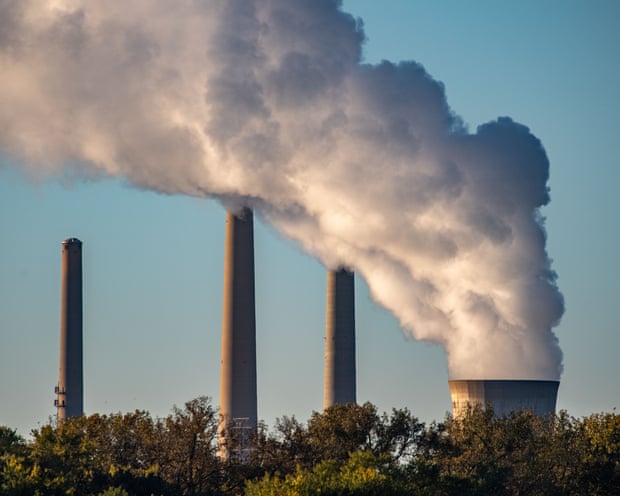
A coal power station in Ohio, US. Donald Trump has declared his support for coal and other fossil fuels. Photograph: Jason Whitman/NurPhoto/Shutterstock
Bleak report finds greenhouse gas emissions are still rising despite ‘exponential’ growth of renewables
Coal use hit a record high around the world last year despite efforts to switch to clean energy, imperilling the world’s attempts to rein in global heating.
The share of coal in electricity generation dropped as renewable energy surged ahead. But the general increase in power demand meant that more coal was used overall, according to the annual State of Climate Action report, published on Wednesday.
The report painted a grim picture of the world’s chances of avoiding increasingly severe impacts from the climate crisis. Countries are falling behind the targets they have set for reducing greenhouse gas emissions, which have continued to rise, albeit at a lower rate than before.
Clea Schumer, a research associate at the World Resources Institute thinktank, which led the report, said: “There’s no doubt that we are largely doing the right things. We are just not moving fast enough. One of the most concerning findings from our assessment is that for the fifth report in our series in a row, efforts to phase out coal are well off track.”
Orcas comment on killer apes destroying the planet by continuing to burn fossil fuels.Donald Trump urges you to be a Climate Science denier like him. He says that he makes millions and millions for destroying the planet, Burn, Baby, Burn and Flood, Baby, Flood.Nigel Farage urges you to ignore facts and reality and be a climate science denier like him and his Deputy Richard Tice. He says that Reform UK has received £Millions and £Millions from the fossil fuel industry to promote climate denial and destroy the planet.
“If you’re a woman, you’ve just been shown how Reform will treat your dignity and rights.”
Nigel Farage has been labelled misogynistic and disrespectful for the way he spoke to Mishal Husain during an interview with the journalist.
The Reform UK leader was speaking to Husain as part of an interview for Bloomberg when she challenged him over his recent comments saying he would ‘shoot down’ Russian planes that enter NATO airspace.
…
When Husain pushed the politician over the potential consequences of shooting down Russian planes, Farage condescendingly butted in: “Listen love, you’re trying ever so hard.”
As Husain asked him if he was suggesting Russia “needs to be taught a lesson,” Farage again said: “Listen love, you’re trying ever so hard.
Nigel Farage urges you to ignore facts and reality and be a climate science denier like him and his Deputy Richard Tice. He says that Reform UK has received £Millions and £Millions from the fossil fuel industry to promote climate denial and destroy the planet.Elon Musk urges you to be a Fascist like him, says that you can ignore facts and reality then.Donald Trump urges you to be a Climate Science denier like him. He says that he makes millions and millions for destroying the planet, Burn, Baby, Burn and Flood, Baby, Flood.
“Extreme” wildfires emitted more than 8bn tonnes of carbon dioxide during the 2024-25 “global fire season”, according to a new report.
The annual “state of wildfires” report from an international team of scientists finds that fires burned at least 3.7m square kilometres of land – an area larger than India – between March 2024 and February 2025.
This is almost 10% below the average annual area burned over the past two decades.
But, due to an increase in wildfires in carbon-rich forests, the CO2 emissions resulting from these fires were almost 10% above average.
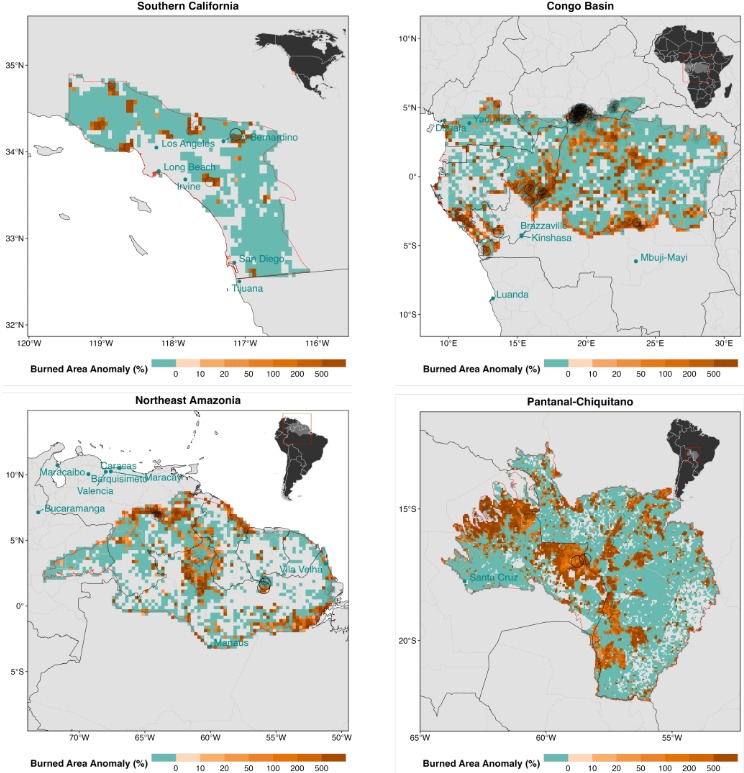
The report also zooms in on four of the most prominent extreme wildfire events during this time: southern California; north-east Amazonia; South America’s Pantanal-Chiquitano region; and the Congo Basin.
All of these events were found to have been more likely to occur as a result of human-caused climate change.
The researchers identify that, in some cases, the area burned by these fires was 25-35 times larger than it would have been without global warming.
The report also estimates that more than 100 million people around the world were exposed to wildfires in 2024 and 2025.
These fires are “reshaping lives, economies and ecosystems on a global scale”, one of the report authors, Dr Carmen Steinmann from ETH Zürich, said in a statement.
‘Increasing extent and severity’
Scientists from dozens of institutions analyse “extreme wildfires” globally between March 2024 and February 2025 in the second annual edition of the report.
The report explains that the “March-February definition of the global fire season latest global fire season is chosen so as to align with an annual lull in the global fire calendar in the boreal spring months”.
According to the report, the authors “harness and adopt new methodologies brought forward by the scientific community”. They add that in future reports, they hope to “enhance the tools presented in this report to predict extremes with increasing lead times, monitor emerging situations in near-real time and explain their causes rapidly”.
“[The report] focuses on the global extreme wildfire events of the global fire season, explains why they happened and fingerprints the role of climate change as one of the key drivers of changing wildfire risk globally.”
The authors aim to “deliver actionable information” to policy experts and wider society about wildfires, the report says.
Using satellite data, the authors find that 3.7m square kilometres (km2) of land burned globally between March 2024 and February 2025. This means that the 2024-25 fire season ranks 16th out of all fire seasons since 2002, indicating below-average burned area compared to the rest of the 21st century.
However, the global fire emissions database shows that the 2024-25 wildfire season drove more than 8bn tonnes of CO2 emissions, according to the report. This is 10% above the average of wildfire seasons since 2002.
Jones explains that this is indicative of a trend towards “increasing extent and severity of fire in global forests, which are carbon-rich”, as opposed to less carbon-rich grassland biomes.
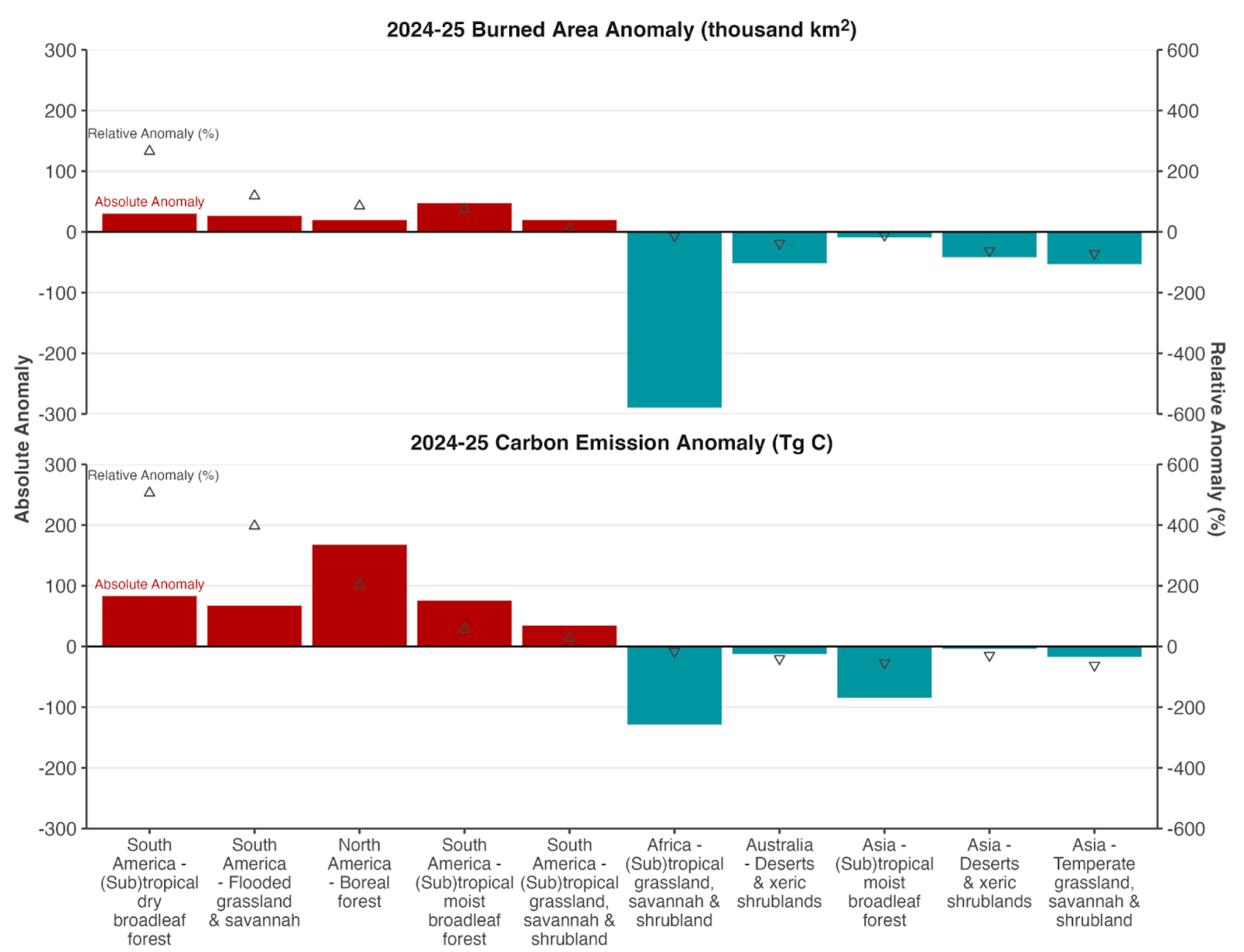
The chart below shows global burned area (top) and carbon emissions (bottom) during the 2024-25 wildfire season, compared to the average over 2002-24, for different world regions. Red bars indicate that the 2024-25 wildfire season had higher-than-average burned area or emissions for the given region, while blue indicates lower-than-average numbers.
Burned area, in thousands of km2 (top) and carbon emissions in teragrams (equivalent to millions of tonnes) of carbon (bottom) during the 2024-25 wildfire season, compared to the 2002-24 average, for different world regions and biomes. The triangles (right y-axis) indicate the percentage of the relative anomaly compared to the average. Source: Kelley et al. (2025)
Savannas, grasslands and shrublands account for more than 80% of the burned area in a typical year, with forests and croplands making up the rest.
According to the report, burned area in tropical and subtropical grasslands, savannah and shrublands was 10% below the 2002-24 average over 2024-25, but still contributed 70% towards the total global burned area.
The 2024-25 wildfire season was the second consecutive year that African savannahs “experienced a low fire season”, the report notes, with below average burned area and carbon emissions.
Meanwhile, the report finds that the greatest increases in burned area and carbon emissions during the 2024-25 wildfire season were seen in the Canada’s boreal forests, the moist tropical forests in the Amazon region, the Chiquitano dry forests of Bolivia and the Cerrado – a tropical savannah in central Brazil.
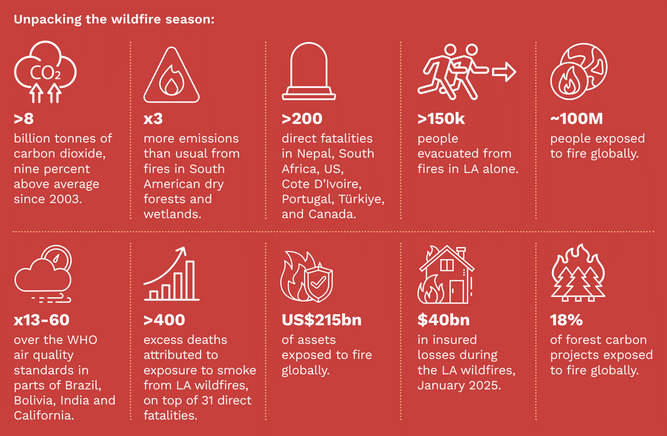
The graphic below shows some key figures from the 2024-25 wildfire season.
Key figures from the 2024-25 wildfire season. Source: State of wildfires project, summary for policymakers (2025).
The team identified four “focal events” – extreme wildfire events that were chosen both for the severity of the fire and the impacts on people and the environment.
For each focal point, the study authors assessed the drivers of the wildfire. They also used attribution – a field of climate science that aims to identify the “fingerprint” of climate change on an extreme event – to determine the contribution of human-caused climate change.
Finally, the authors estimated the likelihood of similar events occurring in the future as the climate continues to warm over the coming century.
Kelley told the press briefing that “capturing fires themselves can be quite tricky”, because they are affected by a range of different factors.
The report notes that wildfires are affected by changes in weather, with hot and dry weather providing the best conditions for wildfires. It adds that changes in land use are also important, as they can affect ignition.
Kelley explained that the report authors used “multiple types of attribution” to capture these different factors, using a range of fire models, weather forecasting models and land use data.
North America
In North America, 2024-25 was an “extreme” fire year, the report says.
Both burned area and carbon emissions reached their second-highest levels since records began in 2002 and 2003, respectively. Across the continent, the burned area was 35% higher than the average since 2002 and the carbon emissions were more than double the average emissions since 2003.
In Canada, 46,000km2 of land burned during the 2024-25 fire season, releasing 282m tonnes of carbon (Mt). The burned area was 85% higher than average, but the associated emissions were more than 200% higher than average, according to the report.
The report also notes that the wildfire season started early in Canada in 2024, due to earlier-than-normal snowmelt, as well as persistent, multiyear drought and “holdover fires” that reignited in the spring after smouldering through the winter months.
In the US, more than 64,000 individual wildfires contributed to a total burned area larger than 36,000km2. More than 8,000 wildfires in Mexico led to a record 16,500km2 of burned area.
The regions experiencing record or near-record burned area and carbon emissions were varied: from the Canadian tundra and the north-western US mountain ranges to California’s grasslands and Mexico’s tropical forests. In the far-northern boreal forest – which contains around 20% of the world’s forest carbon – the season trailed only the record-breaking 2023-24 fire season in burned area and associated emissions.
The researchers select the January 2025 southern California wildfires as one of the four “focal events” of the report.
The maps below show the locations of the four focal events: southern California, the Congo Basin, north-east Amazonia and the Pantanal-Chiquitano. The colours show the percentage difference from the average burned area, with blue indicating less burned area than average and darker browns showing more burned area.
The burned area anomaly, expressed as a percentage difference from the 2002-24 average, for each of four focal events (clockwise from top left): southern California, Congo Basin, Pantanal-Chiquitano and north-east Amazonia. The inset on each chart shows the location of the event. Blue colours indicate negative anomalies (less burned area than usual) and browns indicate positive anomalies. Source: Kelley et al. (2025)
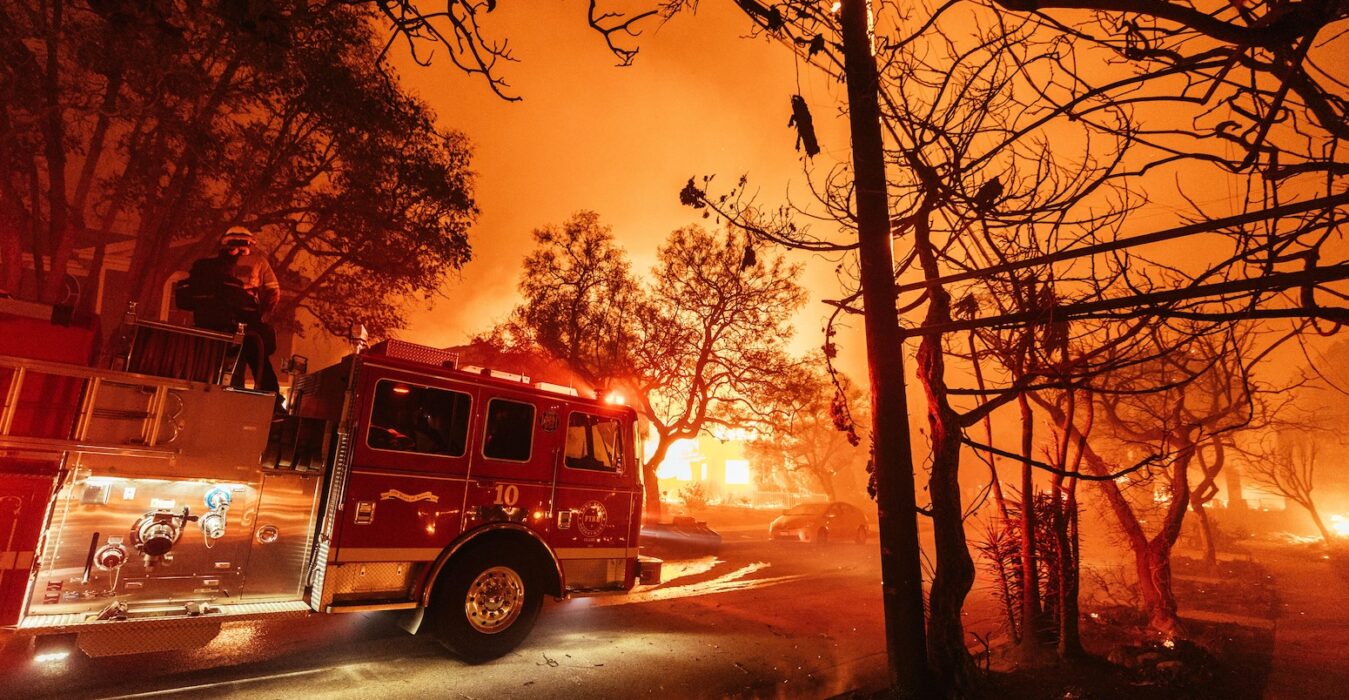
In early January 2025, more than a dozen fires broke out in and around Los Angeles. Although January is “well outside the typical fire period”, the fires “became the most expensive wildfires ever recorded in just a few short days”, Prof Crystal Kolden – a study author and the director of the University of California, Merced’sFire Resilience Center – wrote in the report.
The two largest fires, named the Palisades fire and the Eaton fire, resulted in at least 30 deaths, more than 11,500 homes destroyed and more than 153,000 people being evacuated from their homes.
The fires resulted in estimated economic losses of $140bn, placing “substantial pressure on the already volatile home insurance market in California”, according to the report. It notes that the fires also contributed to the “housing and affordability crisis” in southern California.
The report says that the severity of the January fires was largely due to intensifying extremes in the water cycle – an unusually wet period that allowed vegetation to flourish, followed by an unusually arid winter that dried out that vegetation, turning it into fuel. It notes:
“Between 5 and 25 January, favourable weather, fuel availability and ignition sources aligned, leading to create ideal conditions for ignition and rapid fire spread.
“The substantial suppression efforts deployed is unaccounted for in our modelling framework and could be one of the possible reasons the fires did not escalate even further.”
Previous attribution analysis found that the January 2025 fires were “likely influenced” by human-driven climate change. The report authors also find that the burned area in the southern California event was 25 times greater due to climate change.
However, whether extreme fire activity in southern California continues to intensify depends largely on how the region’s plants and trees respond to increased atmospheric CO2, the report says. It also notes that climate models disagree as to whether wintertime rainfall will increase or decrease in future climates.
South America
The report finds that South America had a total area burned by wildfires of 120,000km2 during the 2024-25 fire season – 35% higher than average.
That translated into the release of 263Mt of carbon – the “highest carbon emissions on record for the continent” and 84% above average, the report says.
Jones, a study author, said in a press briefing that South America “hasn’t seen carbon emissions like this on record before”.
The report underlines that South America’s fire season was “unprecedented” in many ways, such as fire extent, emission levels, intensity and their impacts on society and the environment, although not in the number of fires.
For example, fires in the north-east Amazon impacted air quality, crops, houses and native vegetation, affecting people living in the region, including Indigenous peoples such as the Yanomami, the report says.
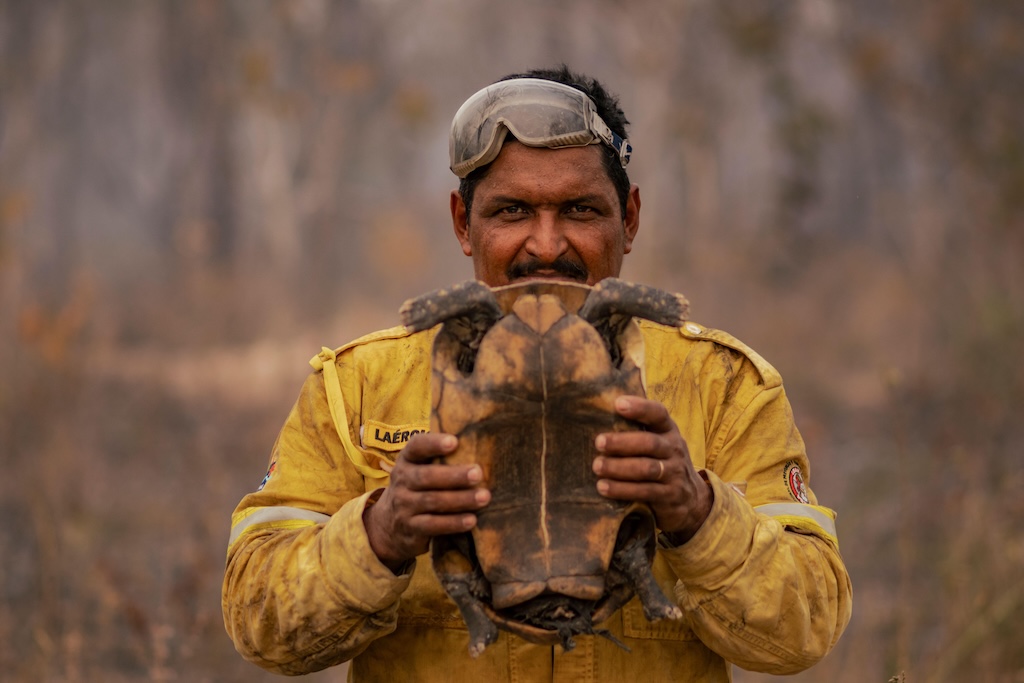
Laercio Fernandes, a volunteer firefighter and Indigenous man, holds a shell of a turtle found dead after a forest fire hit the Kadiwéu Indigenous land, in Mato Grosso do Sul, Brazil, in 2024. Credit: Diego Cardoso / Alamy Stock Photo
The country with the largest area burned by wildfires during the 2024-25 fire season was Brazil, with a total burned area of 243,000km2, followed by Bolivia, with a total of 107,000km2 of burned area, and Venezuela, with a total of 43,000km2 of burned area.
The most-affected biomes in the region were the Amazon rainforest, with 47,000km2 of wildfires above the average since 2002.
Second was the Chiquitano and Chaco dry forests – encompassing parts of Bolivia, Brazil, Paraguay and Argentina. These biomes experienced a “record-breaking” fire season with more than 46,000km2 of burned area. These fires resulted in 100Mt of carbon emissions – six times higher than the average since 2003.
More than 46,000km2 of the Pantanal – the largest tropical wetland located in Brazil, Bolivia and Paraguay – burned in 2024-25, with associated carbon emissions of 67Mt above the average.
According to the report, fire activity in the region was primarily driven by “anomalous dry weather”.
In the north-eastern Amazon, the severity of the fire season between January and April 2024 was compounded by natural sources of climate variability, such as El Niño and the Atlantic Meridional Mode, which contributed to very high temperatures and absence of rainfall. There, deep soil moisture dropped to 1%.
Meanwhile, in Pantanal and Chiquitano, “extreme dry weather” since 2023 and “multiple years of below-average rainfall” contributed to the severe fires, the report says. Study author Dr Francesca Di Giuseppe said in a briefing that the “wet season that usually happens between February and May failed completely to recharge the soil that kept completely dry and this drove most of the fire season” in the region.
The authors conduct an attribution analysis and find that the fire weather conditions in the north-eastern Amazon that season were “significantly more likely” due to climate change. In the Pantanal and Chiquitano, the conditions were 4.2-5.5 times more likely due to climate change.
Africa
Overall, the scale of fires across Africa was “well-below average” in 2024 and 2025, the report finds, except in certain areas, including the Congo Basin, northern Angola and South Africa.
In 2024, a record-high amount of land was burned in the Congo Basin – a biodiverse region in central Africa spanning six countries that holds the world’s second-largest tropical forest. This burned area was 28% higher than the annual average and there were 4,000 fires in total, 20% more than usual, in 2024.
Fires also caused “hazardous” air pollution and contributed to the Congo Basin’s highest loss of primary forest in a decade.
The analysis in the report finds that it is “virtually certain” that human-caused climate change contributed to the extreme fire weather in this region in July and August 2024.
The hot, dry and windy conditions were 3-8 times more likely to occur as a result of climate change and the area scorched by fires was three times greater than it would have been otherwise, the findings show.
Climate change has also driven an increase of more than 50% in the average annual burned area in the Congo Basin, which the researchers say is “one of the most robust signals of climate influence” in the fire trends they analysed.
Drought was a major factor behind the fires, the report finds, and water stress is expected to be the main driver shaping future fires in the Congo Basin.
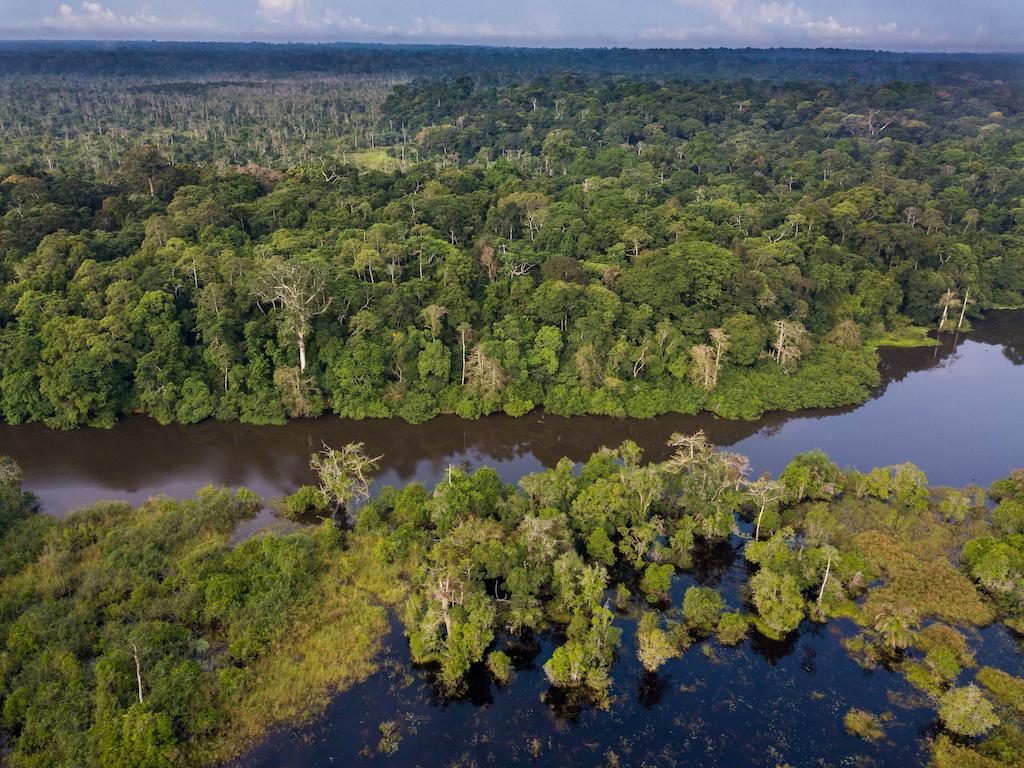
Congo rainforest along Rembo Ngowe river in Akaka, Loango National Park, Gabon. Credit: Lee Dalton / Alamy Stock Photo.
These fires are “part of a long-term trend of increasing fire encroachment into African moist forests, driven by climate change and human pressure”, says Prof Michael Wimberly, a professor at the University of Oklahoma who was not involved in the report, but has researched wildfires in Africa. He tells Carbon Brief:
“The increased fire activity in the Congo Basin is troubling because of the vast expanses of unfragmented forests and peatlands that store massive amounts of carbon, provide habitat for threatened species and supply vital resources to local populations.”
The report notes that there is “sparse reporting and poor media coverage” on the impacts of fires in the Congo Basin in 2024, despite millions of people being impacted.
In South Africa, 34 people were killed and thousands of livestock and homes were destroyed in fires last year. In Ivory Coast, 23 people were killed and 50km2 of land was burned.
Dr Glynis Humphrey, a postdoctoral research fellow at the University of Cape Town, who was not involved in the study, adds that a below-average burned area across Africa “does not necessarily indicate a decline in fire risk or impact”. She tells Carbon Brief:
“In some ecosystems, fewer but more intense fires are being observed, which can still have severe ecological and atmospheric consequences.”
Using climate models, the researchers project that fires to the extent of those in the Congo Basin last year could occur up to 50% more often by 2100, under a medium-emissions pathway.
The region is also projected to see more increases in extreme wildfire risk by the end of this century. Gabon, Equatorial Guinea and the central part of the Democratic Republic of the Congo could see some of the largest increases in burned area, which, the report estimates, could double or quadruple in some cases.
Humphrey notes that fire patterns are “shifting” in response to climate change, which is “leading to significant consequences for ecosystems that don’t typically burn – like the forests in the Congo Basin”. She tells Carbon Brief:
“This is of concern, as primary forests harbour critical biodiversity that supports ecosystem functioning and provide services to people…These forests are also sanctuaries for endangered species.”
Nigel Farage urges you to ignore facts and reality and be a climate science denier like him and his Deputy Richard Tice. He says that Reform UK has received £Millions and £Millions from the fossil fuel industry to promote climate denial and destroy the planet.Donald Trump urges you to be a Climate Science denier like him. He says that he makes millions and millions for destroying the planet, Burn, Baby, Burn and Flood, Baby, Flood.Elon Musk urges you to be a Fascist like him, says that you can ignore facts and reality then.
Last week, around 180 scientists, researchers and legal experts gathered in Luxenburg, Austria to attend the first-ever international conference focused on the controversial topic of climate “overshoot”.
This hypothesised scenario would see global temperatures initially “overshoot” the Paris Agreement’s aspirational limit of 1.5C, before they are brought back down through techniques that would remove carbon dioxide from the atmosphere.
(For more on the key talking points, new research and discussions that emerged from the three-day conference, see Carbon Brief’s full write-up of the event.)
On the sidelines of the conference, Carbon Brief asked a range of delegates what they consider to be the key “unknowns” around overshoot.
Below are their responses, first as sample quotes, then, in full:
Dr James Fletcher: “Yes, there will be overshoot, but at what point will that overshoot peak? Are we peaking at 1.6C, 1.7C, 2.1C?”
Prof Shobha Maharaj: “There are lots of places in the world where adaptation plans have been made to a 1.5C ceiling. The fact is that these plans are going to need to be modified or probably redeveloped.”
Sir Prof Jim Skea: “There are huge knowledge gaps around overshoot and carbon dioxide removal.”
Prof Kristie Ebi: “If there is going to be a peak – and, of course, we don’t know what that peak is – then how do you start planning?”
Prof Lavanya Rajamani: “To me, a key governance unknown is the extent to which our current legal and regulatory architecture…will actually be responsive to the needs of an overshoot world.”
Prof Nebojsa Nakicenovic: “One of my major concerns has been for a long time…is whether, even after reaching net-zero, negative emissions can actually produce a temperature decline.”
Prof Debra Roberts: “For me, the big unknown is how all of these areas of increased impact and risk actually intersect with one another and what that means in the real world.”
Dr Oliver Geden: “[A key unknown] is whether countries are really willing to commit to net-negative trajectories.”
Dr Carl-Friedrich Schleussner: “This is a bigger concern that I have – that we are pushing the habitability in our societies on this planet above that limit and towards maybe existential limits.”
Dr Anna Pirani: “I think that tracking global mean surface temperature on an overshoot pathway will be an important unknown.”
Prof Richard Betts: “One of the key unknowns is are we going to continue to get the land carbon sink that the models produce.”
Prof Hannah Daly: “The biggest unknown is whether countries can translate these global [overshoot] pathways into sustained domestic action…that is politically and socially feasible.”
Dr Andrew King: “[W]e still have a lot of uncertainty around other elements in the climate system that relate more to what people actually live through.”
Dr James Fletcher Former minister for public service, sustainable development, energy, science and technology for Saint Lucia and negotiator at COP21 in Paris.
The key unknown is where we’re going to land. At what point will we peak [temperatures] before we start going down, and how long will we stay in that overshoot period? That is a scary thing. Yes, there will be overshoot, but at what point will that overshoot peak? Are we peaking at 1.6C, 1.7C, 2.1C? All of these are scary scenarios for small island developing states – anything above 1.5C is scary. Every fraction of a degree matters to us. Where we peak is very important and how long we stay in this overshoot period is equally important. That’s when you start getting into very serious, irreversible impacts and tipping points.
Prof Shobha Maharaj Adjunct professor at the University of Fiji and a coordinating lead author for Working Group II of the IPCC’s seventh assessment
First of all, there is an assumption that we’re going to go back down from overshoot. Back down is not a given. And secondly, we are still in the phase where we are talking about uncertainty. Climate scientists don’t like uncertainty. We are not acknowledging that uncertainty is the new normal… But because we’re so bogged down in terms of uncertainties, we are not moving towards [the issue of] what we do about it. We know it’s coming. We know the temperatures are going to be high. But there is little talk about the action.
The focus seems to be more on how we can understand this or how we can model this, but not what we do on the ground. Especially when it comes to adaptation planning – [and around] how does this modify whatever the plans are? There are lots of places in the world where adaptation plans have been made to a 1.5C ceiling. The fact is that these plans are going to need to be modified or probably redeveloped. And no one is talking about this, especially in the areas that are least resourced in the world – which sets up a big, big problem.
There are huge knowledge gaps around overshoot and carbon dioxide removal. As it’s very clear from the themes of this conference, we don’t altogether understand how the Earth would react in taking carbon dioxide out of the atmosphere. We don’t understand the nature of the irreversibilities and we don’t understand the effectiveness of CDR techniques, which might themselves be influenced by the level of global warming, plus all the equity and sustainability issues surrounding using CDR techniques.
There are all kinds of questions about adaptation and how to approach effective adaptation. At the moment, adaptation is primarily assuming a continual increase in global mean surface temperature. If there is going to be a peak – and of course, we don’t know what that peak is – then how do you start planning? Do you change your planning? There are places, for instance when thinking about hard infrastructure, [where overshoot] may result in a change in your plan – because as you come down the backside, maybe the need would be less. For example, when building a bridge taller. And when implementing early warning systems, how do you take into account that there will be a peak and ultimately a decline? There is almost no work in that. I would say that’s one of the critical unknowns.
I think there are several scientific unknowns, but I would like to focus on the governance unknowns with respect to overshoot. To me, a key governance unknown is the extent to which our current legal and regulatory architecture – across levels of governance, so domestic, regional and international – will actually be responsive to the needs of an overshoot world and the consequences of actually not having regulatory and governance architectures in place to address overshoot.
One of my major concerns has been for a long time – as it was clear that we are heading for an overshoot, as we are not reducing the emissions in time – is whether, even after reaching net-zero, negative emissions can actually produce a temperature decline…In other words, there might be asymmetry on the way down [in the global-temperature response to carbon removal] – it might not be symmetrical to the way up [as temperature rise in response to carbon emissions]. And this is really my major concern, that we are planning measures that are so uncertain that we don’t know whether they will reach the goal.
The last point I want to make is that I think that the scientific community should, under all conditions, make sure that the highest priority is on mitigation.
Well, I think coming from the policy and practitioner community, what I’m hearing a lot about are the potential impacts that come from the exceedance component of overshoot. What I’m not hearing a lot about is the responses to overshoot and their impacts – and how those impacts might interact with the impacts from temperature exceedance. So there’s quite a complex risk landscape emerging. It’s three dimensional in many ways, but we’re only talking about one dimension and, for policymakers, we need to understand that three dimensional element in order to understand what options remain on the table. For me, the big unknown is how all of these areas of increased impact and risk actually intersect with one another and what that means in the real world.
[A key unknown] is whether countries are really willing to commit to net-negative trajectories. We are assuming, in science, global pathways going net negative, with hardly any country saying they want to go there. So maybe it is just an academic thought experiment. So we don’t know yet if [overshoot] is even relevant. It is relevant in the sense that if we do, [the] 1.5C [target] stays on the table. But I think the next phase needs to be that countries – or the UNFCCC as a whole – needs to decide what they want to do.
I’m convinced that there’s an upper limit of overshoot that we can afford – and it might be not far outside the Paris range [1.5C-2C] – before human societies will be overwhelmed with the task of bringing temperatures back down again. This [societal limit] is lower than the geophysical limits or the CDR limit.
The impacts of climate change and the challenges that will come with it will undermine society’s abilities to cooperatively engage in what is required to achieve long-term temperature reversal. This is a bigger concern that I have – that we are pushing the habitability in our societies on this planet above that limit and towards maybe existential limits. We may not be able to walk back from it, even if we wanted to. That is a big unknown to me.
I’m convinced that there is an upper limit to how much overshoot we can afford, and it might be just about 2C or a bit above – it might not be much more than that. But we do not have good evidence for this. But I think these scenarios of going to 3C and then assuming we can go back down – I have doubts that future societies grappling with the impacts of climate change will be in the position to embark on such an endeavour.
I think that tracking global mean surface temperature on an overshoot pathway will be an important unknown – how to take account of natural variability in that context, to inform where we are on an overshoot pathway and how well we’re doing on it. I think, methodologically, that would prove to be a challenge. The fact that it occurs over many, many years – many decades – and, yet, we sort of think about it as a nice curve. We see these graphs that say “by the 2050s, we will be here and we’ll start declining and so on”. I think that what that actually translates to in the evolution of global surface temperatures is going to be very difficult to measure and track. Even how we report on that, internationally, in the UNFCCC [UN Framework Convention on Climate Change] context and what the WMO [World Meteorological Organization] does in terms of reporting an overshoot trajectory, that would be quite a challenge.
One of the key unknowns is are we going to continue to get the land carbon sink that the models produce. We have got model simulations of returning from an overshoot.
If you are lowering temperatures, you have got to reduce emissions. The amount you reduce emissions depends on how much carbon is taken up naturally by the system – by forests, oceans and so on. The models will do this; they give you an answer. But we don’t know whether they are doing the right thing. They have never been tested in this kind of situation.
In my field of expertise, one of the key [unknowns] is how these carbon sinks are going to behave in the future. That is why we are trying to get real-world data into the models – including through the Amazon FACE project – so we can really try and narrow the uncertainties in future carbon sinks. If the carbon sinks are weaker than the models think, it is going to be even harder to reduce emissions and we will need to remove even more by carbon capture and removal.
We know ever more about the profound – and often irreversible – damages that will be felt as we overshoot 1.5C. Yet we seem no closer to understanding what will unlock the urgent decarbonisation that remains our only way to avoid the worst impacts of climate change.
Global models can show, on paper, what returning temperatures to safer levels after overshoot might look like. The biggest unknown is whether countries can translate these global pathways into sustained domestic action – over decades and without precedent in history – that is politically and socially feasible.
I think, firstly, can we actually achieve net-negative emissions to bring temperatures down past a peak? It’s a completely different world and, unfortunately, it’s likely to be challenging and we’re setting ourselves up to need to do it more. So I think that’s a huge unknown.
But then, beyond that, I think also, whilst we’ve built some understanding of how global temperature would respond to net-zero or net-negative emissions, we still have a lot of uncertainty around other elements in the climate system that relate more to what people actually live through. In our warming world, we’ve seen that global warming relates to local warming being experienced by everyone at different amounts. But, in an overshoot climate, we would see quite diverse changes for different people, different areas of the world, experiencing very different changes in our local climates. And also definitely worsening of some climate hazards and possibly reversibility in others, so a very different risk landscape as well, emerging post net-zero – and I think we still don’t know very much about that as well.
Nigel Farage urges you to ignore facts and reality and be a climate science denier like him and his Deputy Richard Tice. He says that Reform UK has received £Millions and £Millions from the fossil fuel industry to promote climate denial and destroy the planet.Donald Trump urges you to be a Climate Science denier like him. He says that he makes millions and millions for destroying the planet, Burn, Baby, Burn and Flood, Baby, Flood.Elon Musk urges you to be a Fascist like him, says that you can ignore facts and reality then.