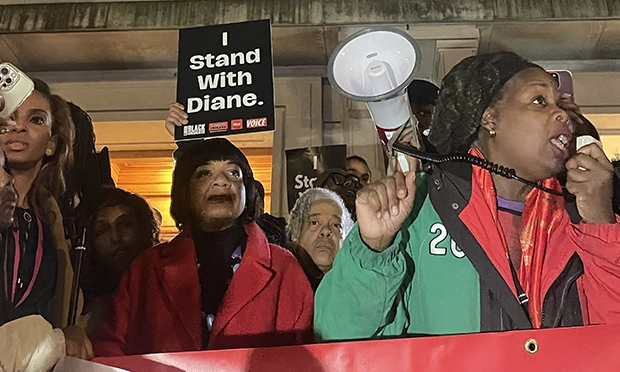
Diane Abbott surrounded by supporters at last night’s rally. Photograph: Maya Sall
Hundreds of people gathered outside Hackney Town Hall last night for a rally in support of Diane Abbott, MP for Hackney North and Stoke Newington.
On Monday, the Guardian revealed that the Conversative party’s largest donor, businessman Frank Hester, told colleagues that looking at Abbott makes you “want to hate all Black women” and that the MP “should be shot”.
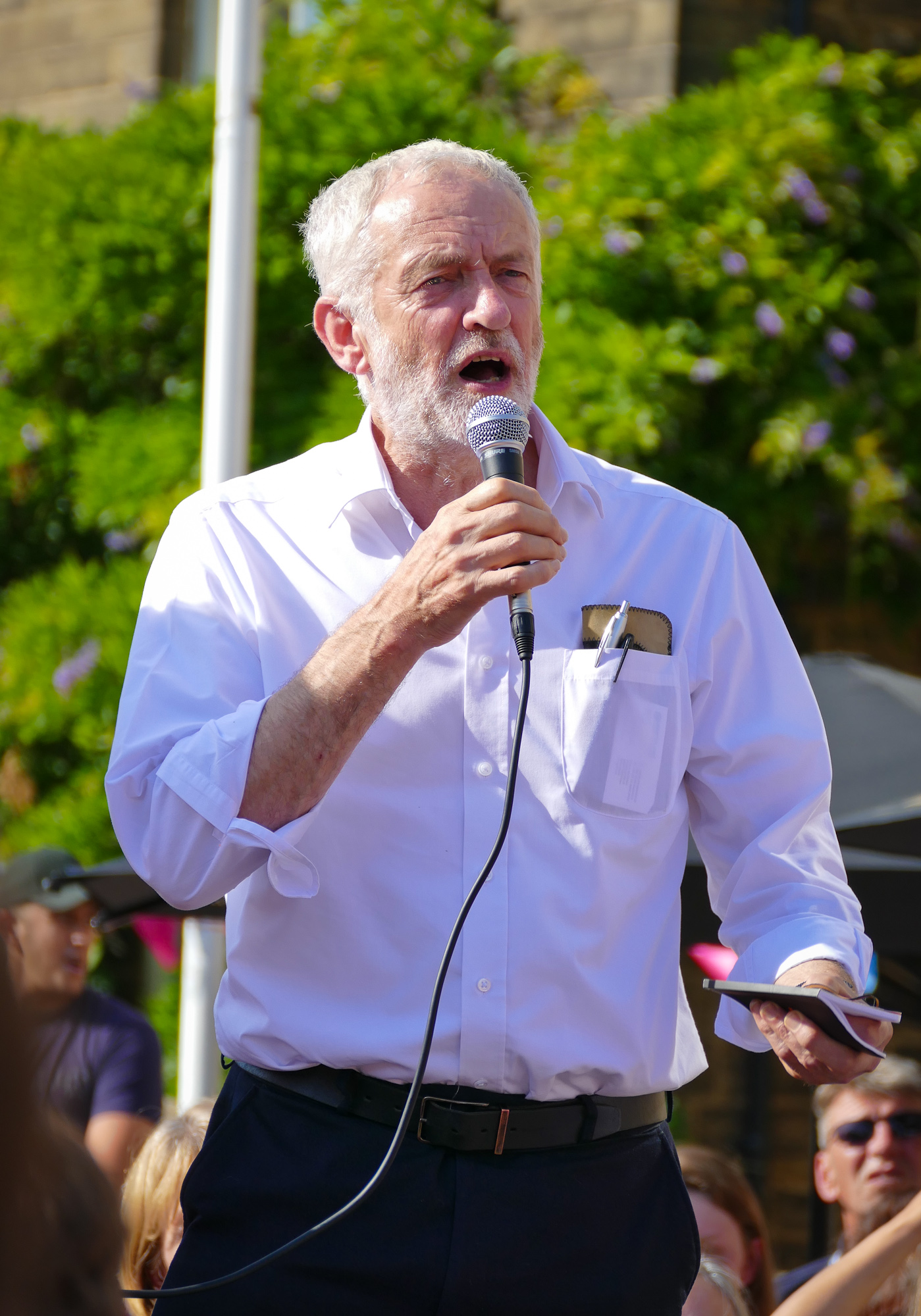
At the demonstration, crowds chanted ‘We stand with Diane’ and heard speeches from people including independent Islington MP Jeremy Corbyn and a representative of Sistah Space, a domestic violence charity for Black women.
The speakers called for Labour to restore the whip to Abbott after it was removed in May last year.
Abbott has been MP for Hackney North and Stoke Newington since 1987, making her the first Black female MP and the longest-serving Black MP.
Addressing the crowd, she thanked local residents: “It is Hackney that work to get me elected in the ’80s, and it is Hackney people who have stood by me year after year, decade after decade.”
“What I want to say is this: this is not about me,” the MP continued. “This is about the level of racism that there is still in Britain. This is about the way that Black women are disrespected.”
Abbott talked about the institutional racism faced by her mother after she emigrated to Britain in the 1950s, and said that racism is still embedded in our society today.
…
Jeremy Corbyn MP, former leader of the Labour Party
Corbyn praised Abbott for her “steadfastness in coping with the personal stress that goes with the abuse”, and criticised the fact that she was unable to defend herself in parliament this week.
During Wednesday’s Prime Minister’s Question Time, Abbott stood up 46 times in 35 minutes to ask for an opportunity to address the Commons.
It is tradition that if an MP is embroiled in a particular issue, or is in the news, the Speaker will call on them to address parliament. However, Abbott was never called.
In a post on X, Abbott wrote: “I don’t know whose interests the Speaker thinks he is serving. But it is not the interests of the Commons or democracy.”
…
Cllr Adejare spoke passionately about Abbott’s legacy. “She paved the way for so many of us. Without her, it’s more likely than not that people like me would not be in politics.”
…
Commenting on how quickly the rally was organised, she added: “It’s about making sure that when we look back in history, we know as a community that we stood up in solidarity against the oppression that’s Diane Abbott has experienced.”
Labour leader’s reluctance to differ from Tories on policy or Gaza sets stage for progressive independent candidates
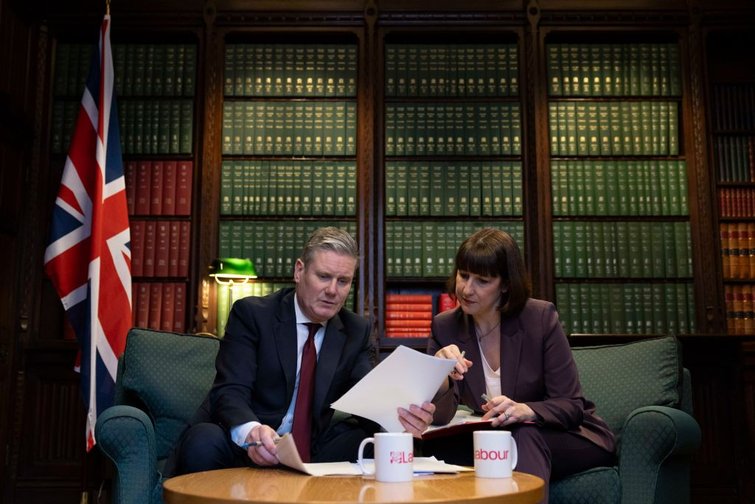
Keir Starmer has moved Labour to the right – leaving left-wing voters without a political home | Belinda Jiao/Getty Images
Almost all of Britain’s pollsters agree: the Labour Party is heading for a massive victory in this year’s general election, while Rishi Sunak’s Tories are set for a historic defeat. But there is another, far less talked about shift underway, which could see a wave of independent left-wing MPs elected.
Most polling firms expect Labour to win a majority of more than a hundred seats. A ‘poll of polls’ by political forecasting website Electoral Calculus suggests the party is on course for a 200+ majority.
These polls could all be wrong, but little seems to shake them. There is some evidence, though, of another trend that is yet to be reflected in the polls: Keir Starmer’s unwillingness to set out any clear policy differences from the Conservatives may be backfiring.
Severalpolls in recent months have indicated that around 70% of people in the UK want an immediate ceasefire, and there are weekly demonstrations in towns and cities across the country in support of Palestinians. Organisers of a march in London last week estimated that up to 400,000 people had gathered to demand an end to the violence.
This leaves a huge gap in political representation, at least from the biggest two parties, for swathes of people nationwide.
It was in this opening that former Labour MP George Galloway – who was kicked out of the party in the 2000s after objecting to the UK entering the Iraq war – was elected as an independent MP for Rochdale last month, following a campaign that centred the need for a ceasefire in Gaza.
Another gap in political representation has been created by Starmer’s remodelling of the Labour Party, which has been sanitised to ensure it poses little or no threat to the political establishment. The majority of his policies so far appear to be a continuation of the status quo, suggesting little will change if the party wins the forthcoming election.
In contrast, so bold and progressive were the policies of his predecessor, Jeremy Corbyn, that the higher echelons of the Labour Party and the wider political and media establishment were determined to get rid of him from the offset.
A leadership challenge was mounted against him in the summer of 2016, little over a year after he was elected the party’s leader. Corbyn won comfortably – a fact I found unsurprising, having seen first-hand how he could pull a crowd of more than a thousand people to a hurriedly arranged event half a mile from a city centre.
Internal party opposition to Corbyn surged following his re-election, again backed by the mainstream media. When then Tory prime minister Theresa May called an election in 2017, many anticipated she would win a landslide victory that would consign ‘Corbynism’ to the outer margins.
Instead, Corbyn and his Labour manifesto struck a chord with many voters. Labour gains resulted in a hung parliament, to the horror of the political establishment, which worked to eliminate this threat from the left over the following two years.
After Labour lost the 2019 general election, Corbyn resigned and Starmer moved the party rightwards – prompting tens of thousands of its members to desert it as a result. Their votes are now up for grabs, and left-wing independents are hoping to win them.
Take a meeting in London just last weekend, scarcely reported on except by socialist paper The Morning Star. Two hundred of Labour’s former parliamentary candidates, councillors and supporters gathered to develop an alternative to its current stance on Gaza and other issues.
In a video message played at the meeting, Driscoll said: “In the next election, both parties will have the same manifesto and the same rich donors pulling the strings.”
A similar event is planned in Blackburn next month – just one part of a much wider movement that will likely see independent left-wing candidates standing against Labour candidates in many seats in the general election.
This is already being seen in England’s upcoming local council elections, where clusters of non-party, progressive candidates are working together in many parts of the country. In Blackburn, for example, every ward will have an independent left-wing candidate standing, as will all six wards in Dewsbury, West Yorkshire. Early indications suggest similar trends in Merseyside and parts of London.
The accepted political wisdom in the UK is that once a general election is called, voters tend to revert to the usual pattern of voting. But if independent candidates were to pick up substantial numbers of votes in the local elections, even taking some council seats, it could indicate a political shift that means this wisdom will not apply this year.
This may seem unlikely but there is undeniably a political vacuum waiting to be filled – and a sense that something is afoot in British politics that is simply not being recognised.
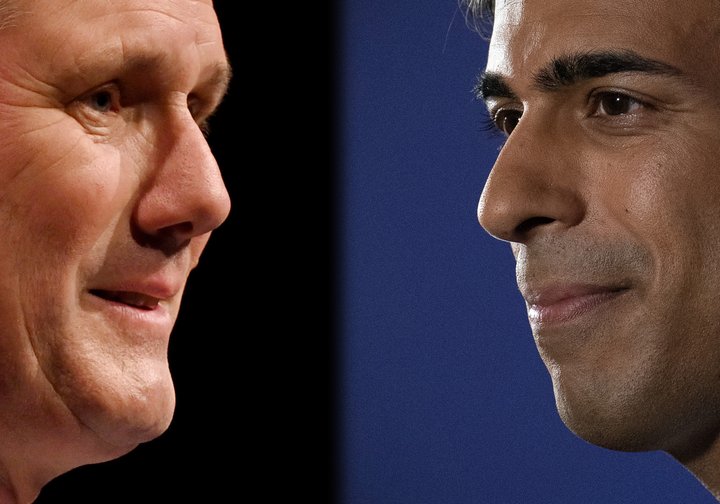
Keir Starmer and Rishi Sunak saw donations to their respective parties increase significantly last year | Leon Neal & Carl Court/Getty Images
Labour’s cash from private donors now dwarfs donations from unions, while the Tories got their biggest bung ever
Britain suffered a bleak economic landscape in 2023, with wages stagnant and costs rising across the board, but political donors and the parties they give to seem to have been unimpacted. All parties declared more than £93m in total compared with £52m in the previous year. And the cash looks set to keep pouring in ahead of the general election, which could take place as soon as May – although our money is on a November poll.
The Conservatives received the most donations by far, raking in £44.5m in cash, compared with Labour’s total of £21.6m, £6m for the Liberal Democrats, £610,000 for the Green Party and £255,000 for Reform – who now have their first MP in the form of ‘Red Wall Rottweiler’ Lee Anderson. The SNP registered only £76,000 cash donations in 2023, with £50,000 from the estate of a donor who passed away some years prior.
In addition to this, parties received non-cash donations – for things like premises, staff costs, sponsorship, consultancy services and more – worth £4.2m in total. Other regulated recipients like Labour Together, The New Conservatives, Labour First, and the Carlton Club Political Committee, took in £2.5m – these are campaigning organisations affiliated to political parties but legally separate from them, and often provide financial support to a particular faction within a party.
We’ve had a closer look at some of the underlying trends behind the numbers and picked out a few key points to look out for in the months ahead, based on what these donations tell us about the state of play in the two main parties.
Labour’s reliance on companies and individuals over trade unions
Much has been made of Labour’s increasingly close relationship with big business and the wealthy under Keir Starmer. Supporters of the party leadership argue that Labour has to be able to compete with the spending power of the Conservatives in the general election, and so has to look beyond the traditional funding source of the trade union movement toward people and businesses with deep pockets. Critics, however, might suggest that the interests of the trade union movement and the interests of those with the deepest pockets may not accord.
The concern among those of the latter view is that, as donations from the wealthy come to represent a larger proportion of the party’s war chest, there could be a shift in policy in that direction. Dark Arts has already reported on the access and influence enjoyed by corporate lobbying firms who employ Labour candidates to connect their clients with senior party figures. I’ve also written for openDemocracy about the millions that have poured into the party from bankers and financiers under Starmer. And our analysis of donations data for 2023 shows another potentially concerning trend for those worried about a corporate takeover of the party.
Of the £21.5m in cash received by the party in 2023, just £5.9m came from the trade union movement, compared with £14.5m from companies and individuals – a huge increase on the previous year, and indeed more than in the three previous years of Keir Starmer’s leadership combined. As trade union contributions have dipped slightly, from around £6.9m in 2020 and 2021 to £5.3m in 2022, donations from businesses and individuals have soared: they totalled £2.3m in 2020 and rose to £3m in 2021 and £7.6m in 2022 before nearly doubling last year.
Around £10m of this total comes from just four sources: Gary Lubner (£4.6m), David Sainsbury (£3.1m), Fran Perrin (£1m) and Ecotricity (£1m), the green energy firm owned by prominent eco-activist Dale Vince. This means that just two individuals gave the Labour Party more money last year than all the trade unions combined.
Lubner is the former CEO of Belron, a global firm specialising in vehicle glass repair. He has been donating to the party since meeting shadow chancellor Rachel Reeves at a dinner hosted by the big-four consultancy firm PwC in 2021. Sainsbury – of supermarket fame – has been an on-off Labour donor for decades, forging a close relationship with the party during the New Labour years when he got a seat in the Lords and served as a science minister. His daughter, Fran Perrin, was an adviser in Tony Blair’s Downing Street.
Including trade unions, there were 114 donors who gave £25,000 or more last year, while the overall average sum donated over the year was £111,499.
Tories in need of new funding sources ahead of GE
It is perhaps an indictment of the British political system that two of the largest individual donors to political parties last year were both men with the last name Sainsbury. David Sainsbury’s contribution to Labour was dwarfed by the £10m left by his cousin, Tory peer John Sainsbury, to the Conservatives in his will – the largest single donation ever received by the party.
Of the £44.5m in cash received by the Conservatives last year, more than £20m came from two sources: John Sainsbury and Frank Hester, an IT entrepreneur from Leeds who has given £5m personally and another £5m through his firm, The Phoenix Partnership. Hester’s firm has profited from public sector contracts and his ties with the party are under heightened scrutiny following the publication of an investigation by the Guardian that revealed he had said former Labour MP Diane Abbott made him “want to hate all black women” and should be shot.
A further £11.3m came from five individuals:
Mohamed Mansour, Egyptian-born billionaire who controls the behemoth conglomerate Mansour Group, which has interests in real estate, finance, retail and tech: £5m
Graham Edwards, co-founder of one of the largest private companies in the UK, Telereal Trillium, which owns thousands of properties and approximately 60 million square feet of land: £2m
Amit Lohia, son of billionaire petrochemical and fertiliser tycoon Sri Prakash Lohia, chair of Indorama: £2m
Christopher Barry Wood, founder of biotech firm Medannex: £1.3m
Alan Howard, hedge fund manager who co-founded Jersey-based Brevan Howard and has significant interests in crypto-currency: £1m
Even without the mega-donation from John Sainsbury, the party comfortably brought in more than Labour last year, and plans pushed through recently by the government raising the amount that political parties can spend at a general election have been widely seen as a sign the party still believes it can leverage its financial pull to good effect against Starmer’s Labour.
However, when the one-off £10m donation is discounted, the party’s fundraising efforts slowed down significantly in the latter half of last year. In the first six months of 2023 the party received £20.6m, compared with just £12m in the second half of the year. Without the £10m from Lord Sainsbury, the party would have taken in just £3m in the third quarter, a huge drop from Q2 (£9.2m) and Q1 (£11.4m).
This might suggest that, at least into the latter portion of last year, the Conservatives were not planning on holding an election in the early portion of 2024, as we would expect to see an uptick in fundraising in anticipation of that.
Overall, there were 286 donors who gave the Conservative Party £25,000 or more last year. The average Tory donor gave £90,811 over the course of the year.
If you’re concerned about the influence of money in politics and want to support our reporting in this area, sign up to our newly-launched newsletter, The Dark Arts, on Substack.
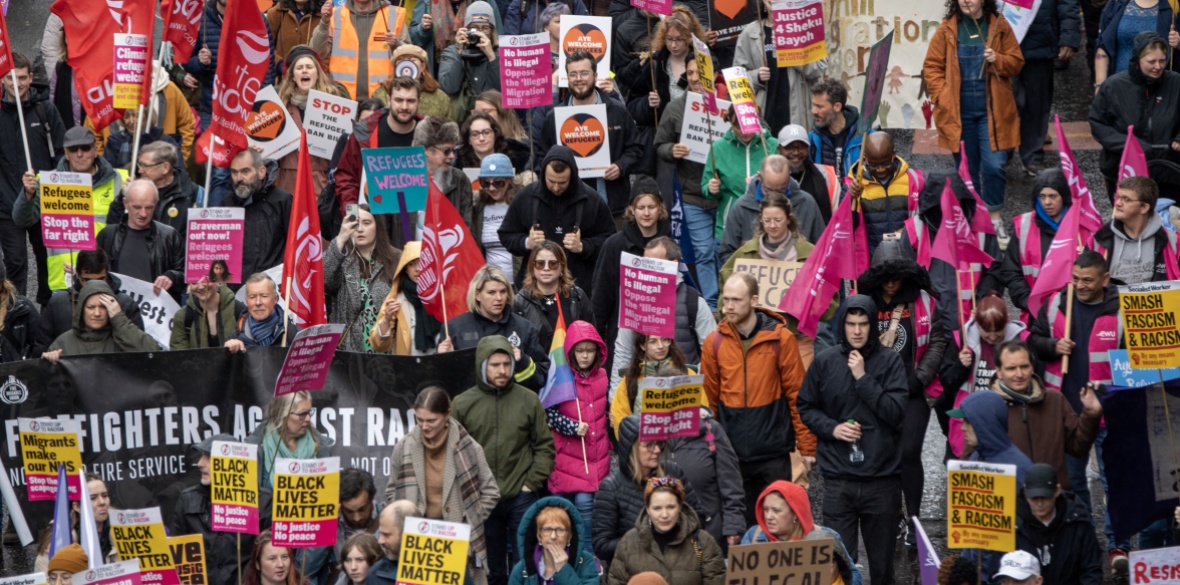
People take part in the Resist Racism Scotland rally in George Square, Glasgow, organised by Stand Up To Racism and the STUC, March 18, 2023
…
You will not find Gove, or Sunak, or for that matter Keir Starmer, on this weekend’s anti-racist marches. For them racism is an accusation to be deployed cynically for factional advantage, not an evil to be confronted through standing in solidarity with its victims.
So Starmer can condemn the Tories for permitting racist abuse of Diane Abbott, while ignoring a leaked report into Labour officials’ racism including multiple instances directed at her, and blandly brief that “disciplinary processes take time” when challenged over her ongoing suspension as a Labour MP — though 10 months in, we know the party hasn’t even spoken to her. Some investigation.
So Sunak can retort with another attack on the left — repeating the lie that Jeremy Corbyn’s Labour leadership tolerated anti-semitism — a jibe eagerly accepted by Starmer.
These people cannot be trusted to oppose racism. Even their performative anti-racism is often racist (as in the insinuation that Muslims are a threat to Jews, or Labour’s disproportionate crackdown on Jewish anti-zionists).
They are the “forces at home trying to tear us apart.” They do so because nothing scares them more than people power: than a mass movement for peace that challenges British imperialism, today, as for centuries, one of the main drivers of racism.