

Original article by Brad Reed republished from Common Dreams under Creative Commons (CC BY-NC-ND 3.0).
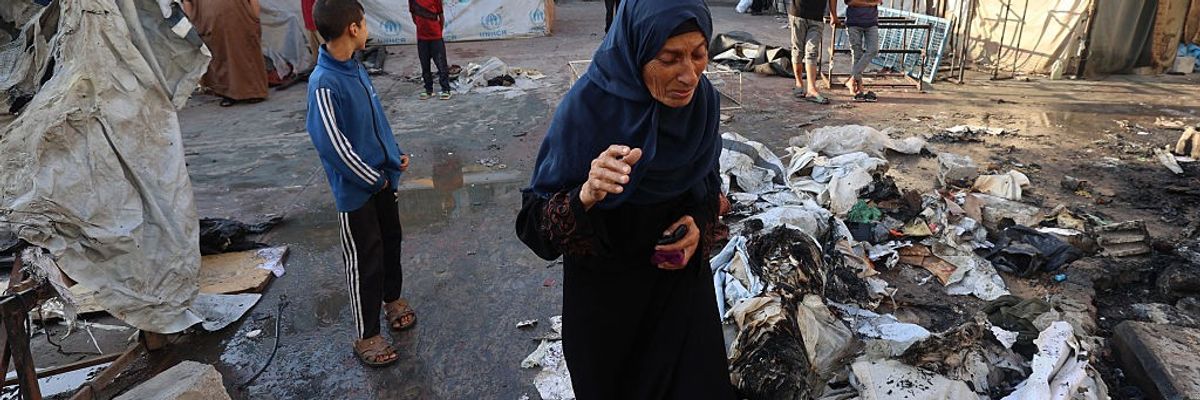
The Israeli government’s new plan to push all residents in Gaza to live in a camp built atop the ruins of the city of Rafah is drawing heavy criticism from experts who see it as a precursor for ethnic cleansing.
In an interview with The Guardian, Israeli human rights attorney Michael Sfard accused Israeli Defense Minister Israel Katz of laying out “an operational plan for a crime against humanity” with his announcement this week of an initiative to build a massive refugee camp at Rafah from which Palestinians would not be allowed to leave. Katz characterized the proposed camp as a “humanitarian city.”
Sfard said that the entire camp was being built as a pretext for the mass deportation of Palestinians from Gaza.
“It is all about population transfer to the southern tip of the Gaza Strip in preparation for deportation outside the strip,” he told The Guardian. “While the government still calls the deportation ‘voluntary,’ people in Gaza are under so many coercive measures that no departure from the strip can be seen in legal terms as consensual. When you drive someone out of their homeland that would be a war crime, in the context of a war. If it’s done on a massive scale like he plans, it becomes a crime against humanity.”
Dr. Amos Goldberg, a historian of the Holocaust at the Hebrew University of Jerusalem, picked apart the Israeli government’s claims that the camp in Rafah would be a “humanitarian city” where Palestinian civilians could live safely away from Israeli military operations being conducted against Hamas fighters.
“It is neither humanitarian nor a city,” Goldberg explained. “A city is a place where you have possibilities of work, of earning money, of making connections and freedom of movement. There are hospitals, schools, universities and offices. This is not what they have in mind. It will not be a livable place, just as the ‘safe areas’ are unlivable now.”
Ihab Hassan, a Palestinian human rights activist and director of the Agora Initiative, expressed a similar sentiment in an interview with The National.
“Israel’s Defense Minister Katz isn’t even hiding it any more—he’s openly calling for a concentration camp for Palestinians in Gaza,” he said.
Jeremy Konyndyk, the president of the Refugees International advocacy group, told Reuters that he wasn’t at all buying the Israeli government’s stated humanitarian intentions regarding the construction of the camp.
“There is no such thing as voluntary displacement amongst a population that has been under constant bombardment for nearly two years and has been cut off from essential aid,” he said.
Reuters reported Monday that a $2 billion plan for so-called “humanitarian transit areas” inside Gaza was recently discussed in the Trump White House.
President Donald Trump earlier this year called for the mass removal of Palestinians from Gaza so that the area could be rebuilt as an international beach resort that he described as the “Riviera of the Middle East.”
Original article by Brad Reed republished from Common Dreams under Creative Commons (CC BY-NC-ND 3.0).

https://www.morningstaronline.co.uk/article/pm-faces-protests-his-own-constituency

 Protesters in Camden
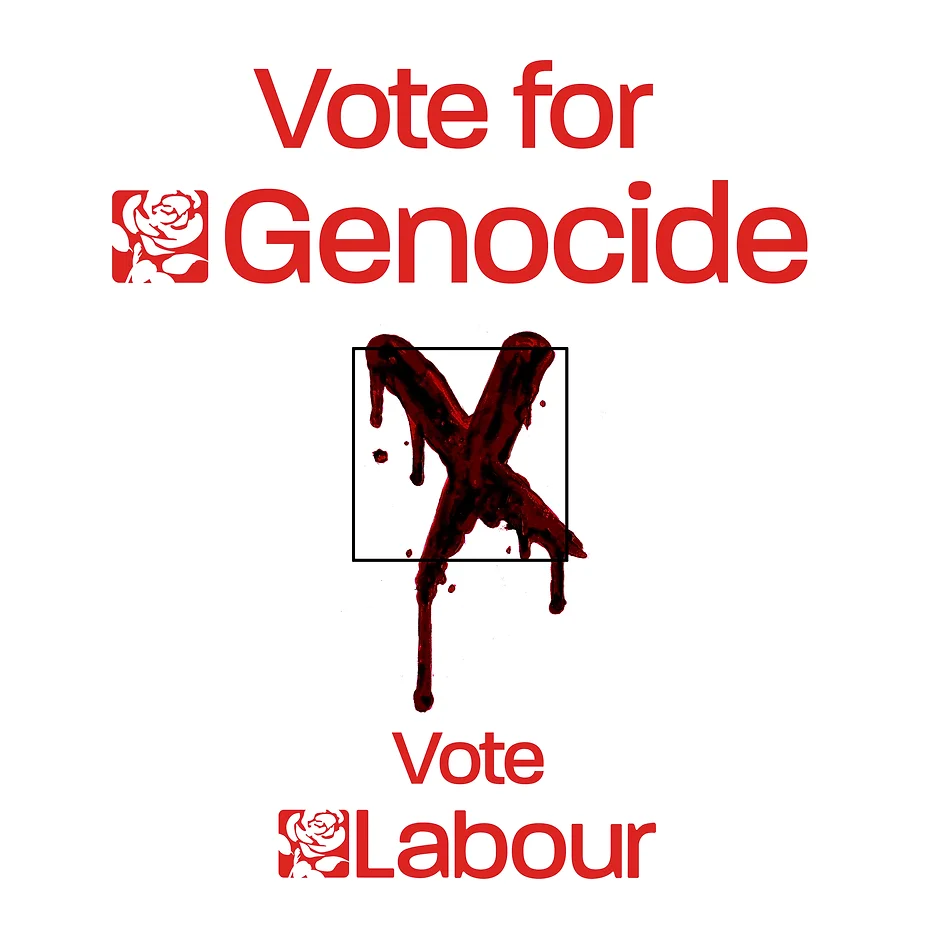
… KEIR STARMER is facing mass rejection within his own constituency as a large demonstration of Palestine supporters took to the streets to demand he quits.
Two thousand joined a noisy and vibrant protest through the PM’s Holborn and St Pancras seat on Saturday, marking the first anniversary of his re-election as local MP by telling him that the community had turned against him.
In a message to the concluding rally, local campaigner Andrew Feinstein, who secured 7,000 votes standing against Sir Keir as a pro-Palestine independent last year warned: “If he dares stand again we as a community will decide the best candidate to stand against him and we as a community will end his political career.”
…
Article continues at https://www.morningstaronline.co.uk/article/pm-faces-protests-his-own-constituency
Original article by Stephen Prager republished from Common Dreams under Creative Commons (CC BY-NC-ND 3.0).
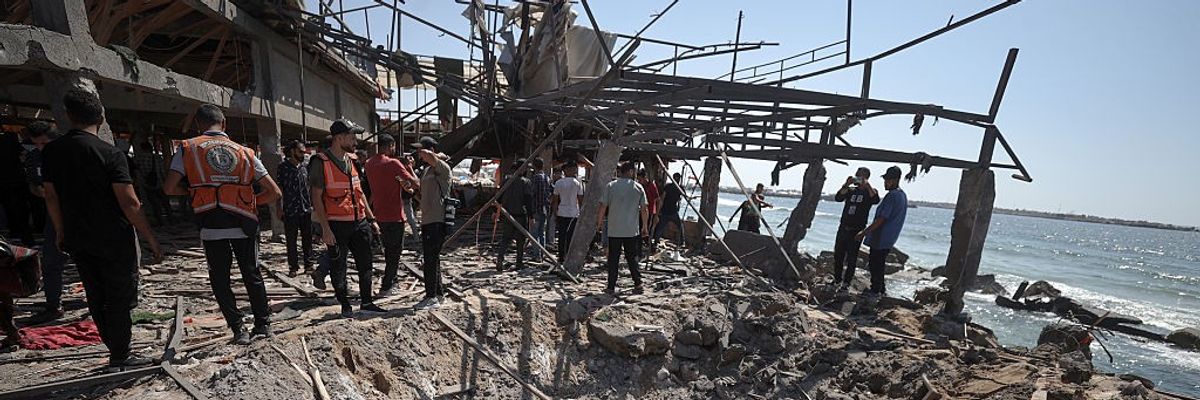
International law experts are describing Israel’s Monday attack on a Gaza café as a potential war crime after an investigation in The Guardian revealed that the attack was carried out using a 500-lb bomb supplied by the U.S. government.
Reporters photographed fragments of the bomb left behind in the wreckage of the al-Baqa Café. Weapons experts identified them as parts of an MK-82 general purpose bomb, which it called “a US-made staple of many bombing campaigns in recent decades.”
The attack killed anywhere from 24 to 36 Palestinians and injured dozens more. Casualties included women, children, and the elderly. A prominent photojournalist and artist were also killed.
Experts have called the use of such a weapon on an area full of civilians wildly disproportionate and a likely violation of the Geneva Convention, which outlaws military operations that cause “incidental loss of civilian life” that is “excessive or disproportionate” to the military advantage to be gained.
“It is almost impossible to see how this use of that kind of munition can be justified,” said Marc Schack, an associate professor of international law at the University of Copenhagen in comments to The Guardian. “If you are talking about 20, 30, 40 or more civilian casualties, usually that would have to be a target of very great importance.”
After the attack drew heavy criticism, an army spokesperson for the Israel Defense Forces (IDF) said the strike had killed “several Hamas terrorists” and that “prior to the strike, steps were taken to mitigate the risk of harming civilians using aerial surveillance.”
Gerry Simpson of Human Rights Watch criticized that defense.
“The Israeli military hasn’t said exactly whom it was targeting, but it said it used aerial surveillance to minimize civilian casualties, which means it knew the café was teeming with customers at the time,” Simpson told The Guardian. “The military would also have known that using a large guided air-dropped bomb would kill and maim many of the civilians there. The use of such a large weapon in an obviously crowded café risks that this was an unlawful disproportionate or indiscriminate attack and should be investigated as a war crime.”
Since Monday’s bombing, the attacks against civilians in Gaza have only intensified. According to a Thursday report from the Gaza Government Media Office, more than 300 Palestinians have been killed within the last 48 hours in “26 bloody massacres.”
According to reporting Thursday from Al Jazeera, these have included attacks on “shelters and displacement centers overcrowded with tens of thousands of displaced people, public rest areas, Palestinian families inside their homes, popular markets and vital civilian facilities, and starving civilians searching for food.”
At least 33 people were killed Thursday at a Gaza Humanitarian Fund (GHF) aid distribution site, adding to the hundreds of aid seekers who have been killed in recent weeks. In a Haaretz investigation last week, soldiers described these aid sites, administered by the U.S. and Israel, as a “killing field,” where they have routinely been ordered to fire on unarmed civilians who posed no threat.
Two American contractors at a GHF site told The Associated Press on condition of anonymity that their colleagues fired their guns wildly, including in the direction of Palestinians. They provided a video which shows hundreds of aid-seekers crowded between metal gates, being assaulted with stun grenades and pepper spray, while gunshots echo in the background.
On Tuesday, Amnesty International and hundreds of other humanitarian NGOs called for an end to the Israeli government’s blockade of food and other necessities entering the Gaza Strip. They also called for an end to the “deadly Israeli distribution scheme” and for a return of aid distribution to the United Nations and other international organizations.
“This devastating daily loss of life as desperate Palestinians try to collect aid is the consequence of their deliberate targeting by Israeli forces and the foreseeable consequence of irresponsible and lethal methods of distribution,” said Agnès Callamard, the secretary general of Amnesty International, on Thursday.
Original article by Stephen Prager republished from Common Dreams under Creative Commons (CC BY-NC-ND 3.0).
This work by Middle East Monitor is licensed under a Creative Commons Attribution-NonCommercial-ShareAlike 4.0 International License.

At least 64 people were killed and dozens injured in Israeli strikes in the Gaza Strip on Saturday, according to medical sources.
Eight Palestinians, including five children, were killed and 18 others injured in a strike on the Nuseirat refugee camp in central Gaza, Al-Awda Hospital said in a statement.
Three more people were killed and several others injured in another strike targeting the Al-Sultan water desalination plant in the Al-Rimal neighborhood of Gaza City.
Israeli fighter jets also hit a café in Al-Zawaida town in central Gaza, leaving six people dead, medics said.
Seven people were killed and many injured in an Israeli strike on a school-turned-shelter in the Zeitoun neighborhood of Gaza City, a medical source told Anadolu.
The Israeli army targeted the home of a Palestinian family in the same neighborhood, killing four more people.
READ: Gaza death toll passes 57,300 as Israel continues brutal war on Palestinians
Eight people, including a woman, lost their lives in various Israeli attacks in Gaza City and Jabalia al-Balad in northern Gaza.
Israeli strikes killed three others, including two children, and injured many people in another school sheltering displaced Palestinians in the Sheikh Ridwan neighborhood of Gaza City.
Two people lost their lives after the Israeli army struck the vicinity of a mosque in the Shejaiya neighborhood of Gaza City.
A medical source said that two siblings were killed and several others injured in an Israeli drone attack on a residential building in the al-Bureij refugee camp in central Gaza.
Israeli strikes hit a home in the Maghazi refugee camp, central Gaza Strip, killing two Palestinians, a medical source said.
A Palestinian doctor and four of his sons were killed in an Israeli drone attack on a tent sheltering displaced people in Al-Mawasi in western Khan Younis in southern Gaza, according to medical sources.
In the same area, a Palestinian man and his only son were also killed in an Israeli strike on a tent.
A woman was killed when the Israeli army opened fire on the tents of displaced civilians in western Khan Younis.
Eleven more people, including three children, were killed and others injured by Israeli army fire on a group of civilians waiting for aid near an aid distribution point in Rafah, southern Gaza Strip.
Despite international calls for a ceasefire, the Israeli army has pursued a genocidal war on Gaza, killing more than 57,300 Palestinians, most of them women and children, since October 2023.
Last November, the International Criminal Court issued arrest warrants for Israeli Prime Minister Benjamin Netanyahu and his former Defense Minister Yoav Gallant for war crimes and crimes against humanity in Gaza.
Israel also faces a genocide case at the International Court of Justice for its war on the enclave.
READ: UNRWA calls for immediate fuel delivery to Israel-blockaded Gaza before shutdown of basic services
This work by Middle East Monitor is licensed under a Creative Commons Attribution-NonCommercial-ShareAlike 4.0 International License.