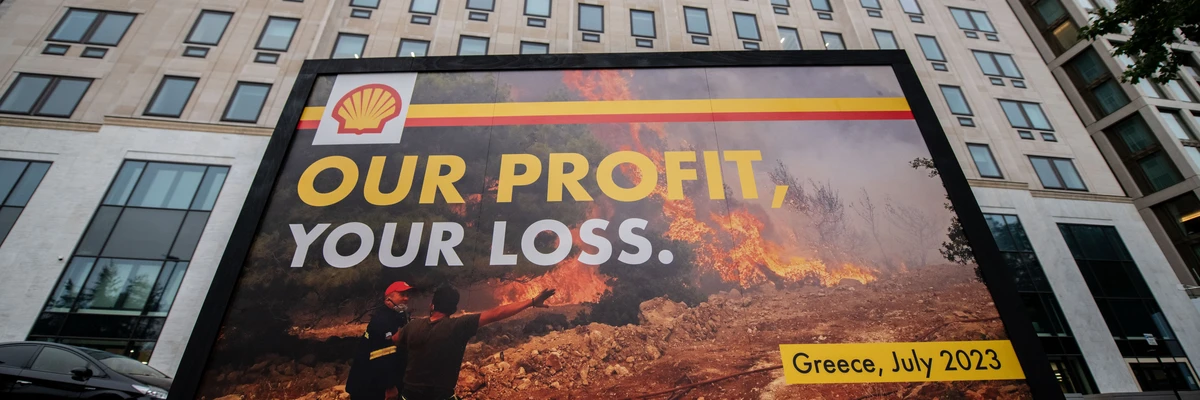
Greenpeace activists display a billboard during a protest outside Shell headquarters on July 27, 2023 in London. (Photo: Handout/Chris J. Ratcliffe for Greenpeace via Getty Images)
Storm Bert caused serious flooding in UK, particularly in the South Wales town of Pontypridd. Gross Capitalists scum and governments scum refuse to accept responsibility for their actions in destroying the climate at COP29. Yet more false solutions pushed by the fossil fuel industry pursued by governments …
It seems like nothing changes. Our climate is fekked. The fossil fuel industry and politicians are responsible for it since they have known since the 1960s. Governments and politicians are supposed to protect their populations. Instead they are controlled and quite willingly work for the rich and powerful. Despite the UK government committing to radical action to address climate, they still pursue false solutions i.e. carbon capture and nuclear power.
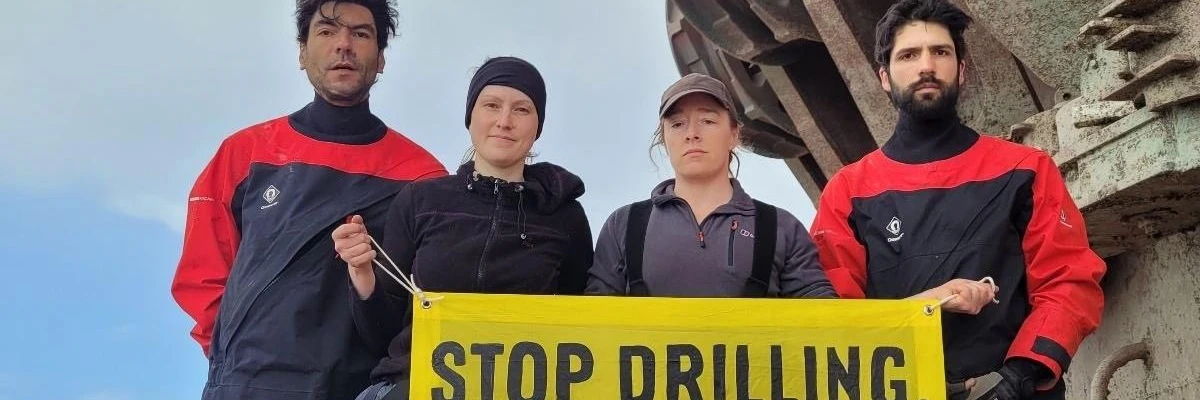
Four Greenpeace activists are pictured on a Shell vessel in the Atlantic Ocean on January 31, 2023.
ed: We are at 1.5C increase now, the limit proposed by the Paris Agreement. We’re flying past it because gross Capitalists and Capitalist politicians are refusing to address the climate crisis. We are on course to far more and far more severe extreme weather events because of these cnuts.
Prime Minister Keir Starmer during a bilateral meeting with Kristalina Georgieva, Managing Director of the International Monetary Fund, at the Cop29 climate summit in Baku, Azerbaijan, November 12, 2024
IF KEIR STARMER were serious about treating people who receive social security payments with “dignity and respect,” he would not have announced his crackdown in the Mail on Sunday, or used it to rail against “criminals” who “game the system.”
…
The presumption of guilt is built into the successive wars on “benefit cheats.” It grossly exaggerates the scale of benefit fraud, feeding hostility to the social security system itself. It encourages suspicion of anyone claiming, and was certainly linked to the steady rise in hate crimes against disabled people recorded over 14 years of Tory government.
The assault on disabled and chronically ill people was among the cruellest policies of those governments.
The DWP admitted in 2015 that thousands of people passed as “fit for work” died within months; there were even cases where people starved to death after their benefits were cut, like Errol Graham, whose body was only discovered by the bailiffs sent to evict him.
Labour should be rejecting a Tory inheritance that persecutes some of Britain’s most vulnerable.
But it shows little sign of doing so, with Rachel Reeves pledging to continue Tory amendments to the work capability assessment that narrow eligibility criteria and are likely to cost disabled people hundreds of pounds a month.
ARCHITECTS OF SLAUGHTER : Jonathan Powell (right)and Alastair Campbell attend a Gala dinner to mark the 25th anniversary of the Good Friday Agreement at Hillsborough Castle in Northern Ireland on April 16 2023 [dizzy: War criminal Alastair Campbell often complains about being called a war criminal.]
The British press has welcomed Keir Starmer’s new National Security Adviser without any mention of his deep, central involvement in the criminal invasions of Iraq and Afghanistan — but history remembers, writes IAN SINCLAIR
“THE US media’s gravest shortcoming is much more their errors of omission than their errors of commission,” William Blum, historian and fierce critic of US foreign policy, once astutely observed. “It’s what they leave out that distorts the news more than any factual errors or out-and-out lies.”
Blum’s evergreen maxim very much applies to the British media, too.
Take the press response to Prime Minister Keir Starmer recently appointing Jonathan Powell to be his new National Security Adviser.
…
Given the job description for his new position, amazingly, none of the five newspapers thought it pertinent to mention Powell’s central role in the illegal and aggressive invasion of Iraq in March 2003 and Britain’s subsequent military occupation. Or, for that matter, Powell’s role in Britain’s (also illegal) 2001 invasion of Afghanistan and subsequent occupation.
If we judge Powell’s political career in the 2000s using the limited, liberal framing endemic to these newspapers, his record is a disaster.
The British military interventions in both Iraq and Afghanistan are now widely understood to have been catastrophes, leading to the deaths of hundreds of British soldiers. The presence of British troops in both countries energised the armed resistance.
The Taliban are now back in control of Afghanistan, and Iraq’s social fabric was torn asunder to such an extent that Isis was able to take control of around 40 per cent of the country in the mid-2010s.
…
If we judge Powell’s career using a moral lens, then he arguably becomes a blood-soaked, criminal political figure. He was, after all, one of the key individuals in Blair’s inner circle in the run-up to the invasion when this cabal repeatedly misled the cabinet, parliament, media and British public.
He attended the infamous July 23 2002 meeting recorded in the leaked minutes which have become known as the Downing Street Memo.
Summarising recent talks Richard Dearlove, then head of MI6, had had in Washington, the minute’s note: “Military action was now seen as inevitable” but “the intelligence and facts were being fixed around the policy.”
The minutes also note foreign secretary Jack Straw said the “case [for war] was thin” as “Saddam was not threatening his neighbours, and his [weapons of mass destruction] capability was less than that of Libya, North Korea or Iran.”
Powell was at Blair’s side when the September 2002 dossier was compiled, with little regard for the actual evidence, to strengthen the case for war. In fact, Powell “instructed intelligence chiefs to change the … dossier to make it appear that the threat posed by Saddam Hussein was much greater than they believed,” the Guardian reported in September 2003.
…
[T]he ramifications of the historical record are clear. Rather than returning to Downing Street, Powell — like Blair, Campbell and Brown — should be heading to The Hague.
Original article republished from MEMO under a Creative Commons Attribution-NonCommercial-ShareAlike 4.0 International License.
Simon Walters, UK Ambassador to Israel, speaks at the “International Rally – United We Bring Them Home” rally in Hostage Square on May 18th, 2024 in Tel Aviv, Israel. [ Alexi J. Rosenfeld/Getty Images]
British military personnel will be put in “harm’s way” to defend Israel against Iran, the UK’s Ambassador to Israel has declared in a stark admission that could see British forces ordered to risk their lives defending the apartheid state.
Speaking to Israeli journalists at his Ramat Gan residence, Ambassador Simon Walters made the extraordinary commitment that “the United Kingdom will be a close ally and is prepared to put its own aircraft and its own personnel in harm’s way to defend Israel.”
Walters revealed that British forces have already been actively involved in military operations supporting Israel, noting that the Royal Air Force flew alongside Israeli and US pilots during Iran’s missile and drone attack in April. “Without going into detail, on October 1, the British armed forces again played a role in trying to disrupt the Iranian attack on Israel,” Walters disclosed.
These revelations come as an Al Jazeera investigation has exposed the extent of British military support for Israel’s genocide in Gaza. The investigation found that the UK and the US have established an air bridge crucial for sustaining Israel’s military campaign. In revelations that are highly controversial, British forces have conducted nearly half of all reconnaissance missions over Gaza since Israel’s assault on Gaza began. Reconnaissance carried out by the UK is said to have surpassed Israel’s own surveillance operations by more than double.
With Israel facing genocide charges at the International Court of Justice (ICJ) and Prime Minister Benjamin Netanyahu and former Defence Minister Gallant having been served arrest warrants by the International Criminal Court (ICC) for war crimes and crimes against humanity, Britain’s direct military support could expose London to allegations of complicity in international crimes. Under international law, states providing material assistance to forces committing serious violations can be held responsible as accomplices
Addressing the ongoing controversy over British arms sales to Israel, Walters acknowledged that the risk of violations of international law “is evidently present here”. He noted that UK NGOs are currently pursuing legal action against the government to force additional restrictions on arms exports to Israel, battles which the government is actively contesting in court.
The Ambassador also expressed concerns about Israel’s treatment of Palestinian prisoners, pointing out that Israel has denied Red Cross access to detainees from Gaza. “Had the Red Cross visited regularly, it would provide reassurance of the conditions, it would not only protect the prisoners,” he stated, adding that such visits would also protect guards from accusations.
Israel is accused of torture and sexual abuse of Palestinians, including rape of detainees in prisons. Famous Gaza surgeon, Dr Adnan Al-Bursh, is the latest high-profile figure who was killed by Israel while in detention. Al Bursh is said to have been severely tortured. His body was left naked from waist down suggesting that he was also raped by the Israeli army.
On the situation in Gaza, Walters challenged the notion that military pressure alone could achieve Israel’s objectives. “I hear people calling for the continuation of the war until Hamas is destroyed and I think they are kidding themselves,” he said. “They are imagining an outcome that will never come.”
Walters also highlighted concerns about Palestinian rights in the illegally Occupied West Bank, particularly regarding restrictions around olive harvesting and attacks by Israeli extremists. “At the end of the day, this is an aspect of the Occupation, which many Israelis do not see and are not aware of,” he concluded.
Original article republished from MEMO under a Creative Commons Attribution-NonCommercial-ShareAlike 4.0 International License.
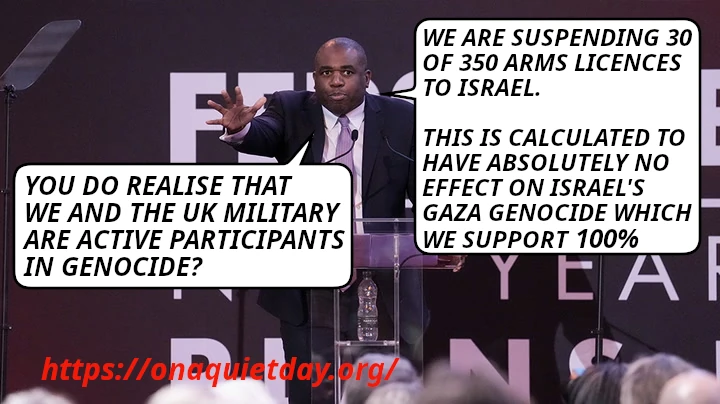
Genocide denier and Current UK Prime Minister Keir Starmer is quoted that he supports Zionism without qualification. He also confirms that UK air force support has been essential in Israel’s mass-murdering genocide. Includes URLs https://www.declassifieduk.org/keir-starmers-100-spy-flights-over-gaza-in-support-of-israel/ and https://youtu.be/O74hZCKKdpAGenocide denying UK Foreign Secretary David Lammy says that UK is suspending 30 of 350 arms licences to Israel. He also confirms the UK government’s support for Israel’s Gaza genocide and the UK government and military’s active participation in genocide.
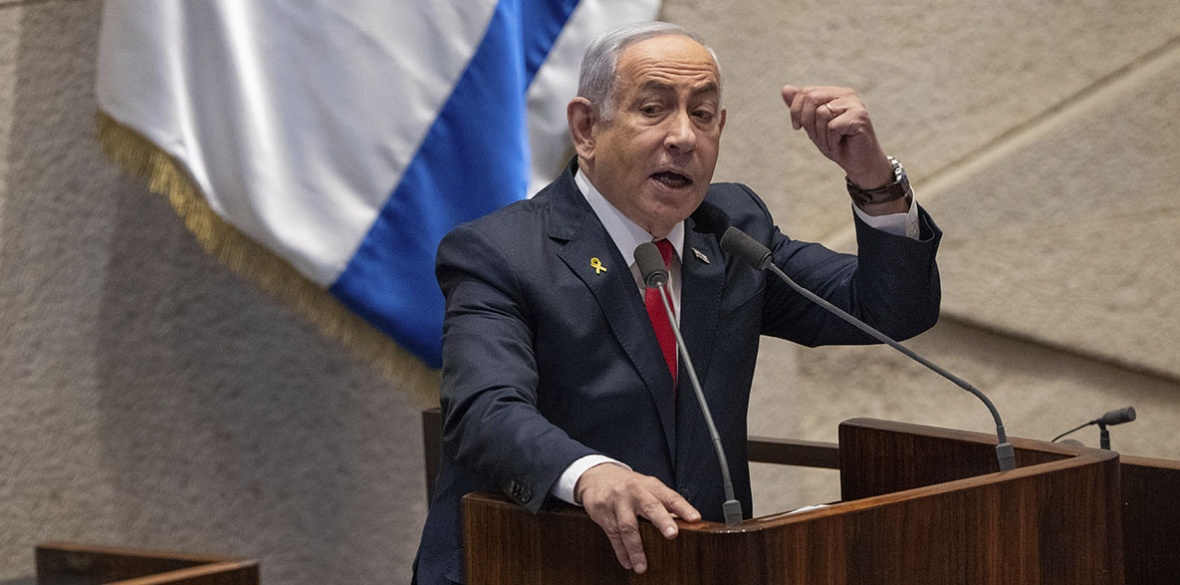
EVASIVENESS on whether Britain will comply with the International Criminal Court (ICC’s) arrest warrant for Israeli Prime Minister Benjamin Netanyahu exposes government hypocrisy.
It underlines the crisis engulfing the Western-defined and policed “rules-based international order” and the dilemmas this poses for liberal imperialists like Keir Starmer.
Neither he nor Home Secretary Yvette Cooper can risk slamming the arrest warrant as “outrageous,” as US President Joe Biden does.
Washington has never signed up to the ICC. Its political leaders are open about being rule-makers not rule-takers, insisting other countries comply with the court’s rulings — as when Secretary of State Antony Blinken demanded that every ICC member honour the arrest warrant for Russia’s Vladimir Putin — while rejecting its jurisdiction over anything the United States or its citizens do.
Britain’s role is subordinate. It belongs to the ICC and claims respect for the court’s neutrality.
Hence Cooper’s mealy-mouthed talk of “proper processes that need to be followed.” In fact, as the chair of the foreign affairs select committee Emily Thornberry acknowledges, the proper process is straightforward: “If Netanyahu comes to Britain, our obligation under the Rome Convention would be to arrest him under the warrant from the ICC… we are required to, because we are members.”
But to admit that would raise questions the Starmer government is determined to ignore. If the prime minister of Israel is a wanted war criminal, systematically starving the civilian population of northern Gaza among other crimes, how can Britain justify continued support for his war — which it continues to provide, for all the empty talk about immediate ceasefires, through arms sales, shared surveillance flight data and allowing the use of RAF bases on Cyprus to supply its military?
Genocide denier and Current UK Prime Minister Keir Starmer is quoted that he supports Zionism without qualification. He also confirms that UK air force support has been essential in Israel’s mass-murdering genocide. Includes URLs https://www.declassifieduk.org/keir-starmers-100-spy-flights-over-gaza-in-support-of-israel/ and https://youtu.be/O74hZCKKdpAGenocide denying UK Foreign Secretary David Lammy says that UK is suspending 30 of 350 arms licences to Israel. He also confirms the UK government’s support for Israel’s Gaza genocide and the UK government and military’s active participation in genocide.