An extra 260,000 children are on the breadline since before the Covid pandemic. Photograph: Orlando Britain/Alamy
Exclusive: Study finds almost quarter of UK population living in poverty, reaching the highest level this century
More than one in three children and a quarter of adults are living in poverty in the UK as deprivation levels rise to the highest in the 21st century, according to a landmark report.
The study by the Social Metrics Commission (SMC), which uses measures recently adopted by the UK government, found the cost of living crisis had plunged 2 million more people into severe hardship since 2019.
In total, more than 16 million people are defined as living in poverty, or 24% of the UK population – the highest since comparable records began in 2000.
Children accounted for the biggest rise of any social group falling into poverty, the report found, with an extra 260,000 on the breadline since before the Covid pandemic, meaning a record 36%, or 5.2 million children, were in deprivation.
It is likely to reignite calls for Labour to scrap the two-child benefit cap as, of those 5.2 million children, more than half (55%) lived in families with three or more children. About one in four of the children in poverty lived in a single-child household, with the same proportion in a two-child family.
Keir Starmer says pensioners can freeze to death and poor children can starve and be condemned to failure and misery all their lives.Zionist Keir ‘Kid Starver’ Starmer. Image thanks to The Skwawkbox.
Original article republished from MEMO under a Creative Commons Attribution-NonCommercial-ShareAlike 4.0 International License.
Former Labour Party leader Jeremy Corbyn makes a speech attending a protest against the Israeli army’s attack on displaced civilians in Al-Mawasi, on September 12, 2024 in London, United Kingdom. [Raşid Necati Aslım – Anadolu Agency]
Former Labour leader, Jeremy Corbyn, and the Independent Alliance of MPs have issued two letters challenging Prime Minister, Keir Starmer, and Attorney-General, Lord Hermer, KC, over their position on Israel’s genocide in Gaza.
The letters follow Starmer’s recent denial in Prime Minister’s Questions that Israel is committing genocide in Gaza, a stance echoed by Foreign Secretary, David Lammy, who claimed such descriptions “undermine the seriousness of that term”.
In their letter to Starmer, the MPs directly challenge his “flippant denial of genocide”, stating it “egregiously downplays the suffering of Palestinians and shows blatant disregard for international law.” They remind the Prime Minister that genocide’s legal definition focuses on intent rather than numbers killed, citing Article 2 of the Genocide Convention.
“It is difficult to avoid the conclusion that your denial of the genocide in Gaza is rooted in the knowledge that, if you accepted the true scale of what is happening, you would be admitting your government’s ongoing complicity in crimes against humanity,” the letter states.
In their letter to Starmer, the MPs specifically ask whether the Prime Minister “sought or received any legal advice from the Attorney-General over the definition of genocide and its applicability to the situation in Gaza.” The letter demands to know if he has “received any other legal advice on this matter” and when such advice will be made public.
The group’s letter to Attorney-General, Lord Hermer, KC, specifically questions whether he has provided legal advice to the Prime Minister regarding the definition of genocide and its applicability to Gaza. They ask whether “the Prime Minister and the Foreign Secretary have publicly contradicted the findings of UN reports and pre-empted decisions of international courts on this issue.” Isreal is currently under investigation by the International Court of Justice (ICJ) for genocide.
The intervention comes as multiple international bodies have called Israel’s aggression in Gaza genocide. A UN Special Committee recently concluded that “the policies and practices of Israel during the reporting period are consistent with the characteristics of genocide,” including “the targeting of Palestinians as a group” and using “starvation as a weapon of war.” The MPs note that the ICJ ruled in January that Palestinians face a “real and imminent risk of irreparable prejudice” to their right to be protected from genocide.
Both letters demand transparency about any legal advice received regarding the definition of genocide and its application to Gaza. The Independent Alliance, which includes MPs Adnan Hussain, Ayoub Khan, Iqbal Mohamed, Jeremy Corbyn, and Shockat Adam, also calls for an end to UK arms sales to Israel.
The parliamentary challenge coincides with Pope Francis’s call for an investigation into whether Israel is committing genocide in Gaza, adding to growing international pressure for accountability over Israel’s military onslaught which has claimed the lives of 44 thousand Palestinians, the overwhelming majority of whom are women and children.
Original article republished from MEMO under a Creative Commons Attribution-NonCommercial-ShareAlike 4.0 International License.
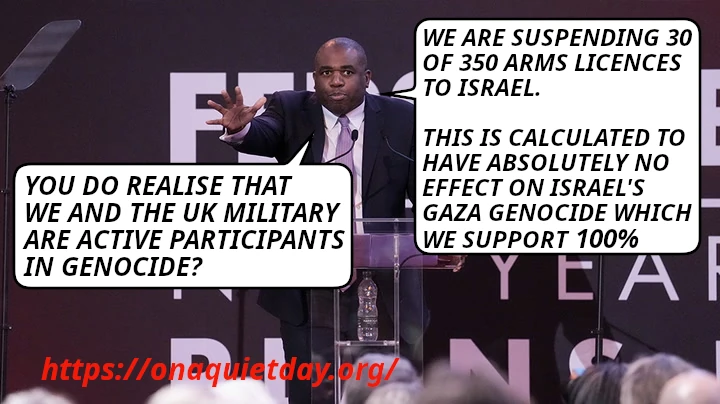
Genocide denier and Current UK Prime Minister Keir Starmer is quoted that he supports Zionism without qualification. He also confirms that UK air force support has been essential in Israel’s mass-murdering genocide. Includes URLs https://www.declassifieduk.org/keir-starmers-100-spy-flights-over-gaza-in-support-of-israel/ and https://youtu.be/O74hZCKKdpAGenocide denying UK Foreign Secretary David Lammy says that UK is suspending 30 of 350 arms licences to Israel. He also confirms the UK government’s support for Israel’s Gaza genocide and the UK government and military’s active participation in genocide.
Downing Street accepts ‘clear risk’ that fighter jet parts sold to Israel could be used to violate international humanitarian law, High Court hears
THE British government accepts there is a “clear risk” that parts for lethal fighter jets might be used by Israel to violate international humanitarian law but continues to export them anyway, the High Court heard today.
Global Legal Action Network (Glan) and human rights group Al-Haq have brought legal action against the Department for Business and Trade, accusing it of breaking its own rules by continuing exports if there is such a risk.
Between October and May, former business secretary Kemi Badenoch approved over 100 licences to Israel throughout its brutal onslaught on Gaza.
In September, the new Labour government eventually moved to ban just 30 out of 361 licences, excluding components for F-35 jets.
Described by its manufacturer Lockheed Martin as the “most lethal” fighter jet in the world, F-35s have been used extensively in Israel’s bloodshed.
Capable of dropping 2,000lb bombs, they are linked to the murder of 90 people in the al-Mawasi “safe zone” in July.
There are 79 companies registered in Britain that hold licences to export parts for the jet.
Genocide denier and Current UK Prime Minister Keir Starmer is quoted that he supports Zionism without qualification. He also confirms that UK air force support has been essential in Israel’s mass-murdering genocide. Includes URLs https://www.declassifieduk.org/keir-starmers-100-spy-flights-over-gaza-in-support-of-israel/ and https://youtu.be/O74hZCKKdpAGenocide denying UK Foreign Secretary David Lammy says that UK is suspending 30 of 350 arms licences to Israel. He also confirms the UK government’s support for Israel’s Gaza genocide and the UK government and military’s active participation in genocide.Vote For Genocide Vote Labour.
Health workers and activists ramp up their campaign to oppose surveillance company Palantir’s role in managing NHS data
Health workers and activists in Britain are intensifying their campaign against US-based surveillance and data company Palantir, as Keir Starmer’s government accelerates its push to involve the notorious firm in managing National Health Service (NHS) data.
Palantir first gained a foothold in the NHS during the COVID-19 pandemic, securing contracts outside standard procurement processes and enjoying popularity among high-ranking health officials. The company, infamous for its involvement in operations such as the US-led invasions of Afghanistan and Iraq and migrant persecution under the US Immigration and Customs Enforcement (ICE), soon expanded its role in Britain. By last year, it had won a £330 million (USD 417 million) contract to implement the Federated Data Platform (FDP), intended to modernize medical data management across England.
Not all NHS institutions are currently able to share data because of differing systems. Both Conservative and Labour governments have identified this as the main reason for bottlenecks in the health system and claimed that resolving the problem would lead to improvements to care. However, organizations like Medact, Just Treatment, and Corporate Watch warn that entrusting this task to Palantir could deepen issues rather than solve them.
Similarly, many health experts have highlighted how the FDP would effectively lock the NHS into dependency on Palantir. The company’s systems are designed in a way to make data extraction difficult and integration with industry-standard analytics costly and complicated, so users are compelled to keep using them. “Palantir’s system pushes people to its own proprietary systems; and switching costs [for the NHS] will be very high,” Doctors’ Association and Foxglove warned in a 2023 report.
The current government is pushing forward with this form of private sector expansion in the NHS despite warnings from trusts and experts that the results will fall far short of expectations. In fact, some NHS organizations being forced to adopt the FDP under Labour’s administration have said that the new platform could result in a loss of functionality compared to the systems they currently rely on.
While there is general agreement among analysts that data sharing and usage within the NHS could be significantly improved, they argue that these improvements can and should be achieved through local and regional initiatives. In contrast to the top-down model ushered in by the FDP, these initiatives would build on existing systems and expertise, avoiding handing over control to a private company with a track record of human rights abuses.
Concerns that the FDP could make the NHS entirely dependent on Palantir are sharpened by fears over how patient data might be used. As one of the world’s largest public healthcare systems, the NHS holds an unique health dataset. While such data has immense potential to strengthen public services, entrusting it to corporate partners poses great risks. For instance, it could be exploited for purposes such as tracking and criminalizing migrants—a practice that has been systematically pursued under Britain’s hostile environment policies.
Palantir takes pride in finding new applications for data, specifically to reinforce Western dominance. Given that the full scope of the FDP remains unclear, there is significant concern that NHS data could also be exploited to boost Palantir’s surveillance tools. These tools are already being deployed in Israel’s ongoing genocide against Palestinians in the Gaza Strip.
Palantir’s leadership has been outspoken in its support for Israel, openly aligning with Benjamin Netanyahu’s government even as it proceeded to kill tens of thousands of Palestinians. The company is actively testing—or rather, showcasing—its artificial intelligence (AI) models through Israel’s attacks in Palestine and Lebanon. This indicates a clear intent to monetize these tools further by marketing them to other states preparing to go on killing sprees.
Handing over NHS medical data to Palantir would deepen the Starmer administration’s complicity in Israel’s war crimes, health justice organizations warn. Such a move risks staining the NHS’s reputation, turning its dataset into a tool for oppression internationally while undermining public trust in the healthcare system at home.
Many had hoped that a change in government in July would mean an end to the FDP. However, “instead of hitting reset, Labour hit accelerate,” Just Treatment remarked during a No Palantir in the NHS meeting in November. This response reflects Labour’s priorities when it comes to the public healthcare provider. “If the government were setting out to implement reforms in the way that our data is held to improve health outcomes and improve the NHS, they would be going about it in a way that maximizes public trust, maximizes public and health service and health worker support for those initiatives,” the organization remarked during the meeting.
Instead, the government appears more interested in using national health data for economic gain. This approach aligns closely with recommendations from neoliberal policy advisors, such as those at the Tony Blair Institute for Global Change, who have recently called for the use of NHS data as a means to boost Britain’s economic standing.
Although the implementation of the FDP is progressing, activists argue that it is not too late to stop it—especially if local groups escalate their efforts. They emphasize that by increasing pressure, health workers and activists could not only push for the cancellation of Palantir’s FDP contract but also demand the termination of all agreements with companies complicit in Israel’s occupation. While Palantir is currently a key focus, the organizations highlighted that this campaign is just the beginning, serving as a starting point for broader action.
Peace campaigners protest against the Gaza genocide at the Welsh Labour conference, November 17, 2024
HUNDREDS of peace campaigners marched on the Welsh Labour conference venue at the weekend, calling for an immediate ceasefire in Gaza.
Stop the War Cymru (STW) and Palestine Solidarity Campaign Cymru (PSC) organised the Llandudno rally to pressure the Welsh government to join calls to end the genocide in Gaza and stop arms sales to Israel.
Campaigner Sara Roberts said it was beyond comprehension “that we have had to stand outside the Welsh Labour conference and challenge our elected representatives to support calls for peace in Gaza and the Middle East.
“Shame on Starmer who as a human rights lawyer knows the legal definition of genocide.”
Genocide denier and Current UK Prime Minister Keir Starmer is quoted that he supports Zionism without qualification. He also confirms that UK air force support has been essential in Israel’s mass-murdering genocide. Includes URLs https://www.declassifieduk.org/keir-starmers-100-spy-flights-over-gaza-in-support-of-israel/ and https://youtu.be/O74hZCKKdpAGenocide denying UK Foreign Secretary David Lammy says that UK is suspending 30 of 350 arms licences to Israel. He also confirms the UK government’s support for Israel’s Gaza genocide and the UK government and military’s active participation in genocide.Vote For Genocide Vote Labour.