Of course, straight after 7/10, mainstream journalists were quick to promote the deployment of planes and personnel to support “our ally” in the region.
While the Sun splashed photos of British jets and frigates heading to the eastern Mediterranean with the headline “United We Stand”, the BBC basically reproduced a Ministry of Defence press release in its story, “UK to deploy Royal Navy ships to Middle East to ‘bolster security’.”
On 2 December, the Ministry of Defence released a short statement on UK military activity in the region, ostensibly to secure the release of (only) Israeli hostages.
The BBC, along with other news outlets, immediately ran a story repeating the MoD’s words verbatim (with a sprinkling of additional text from the Pentagon) as if these were to be innocent “surveillance flights” despite the fact that over 15,000 Palestinians had already been killed in brutal air strikes since 7/10.
This was followed by a flurry of highly bullish coverage of two further military interventions directly related to bolstering UK support for Israel – evidence of the “extensive defence and security cooperation” between the two countries that was embedded in the ‘Roadmap’ agreement signed in 2023 (and ignored by the media).
…
Censorship by omission
This lack of interest in the British government’s military links to Israel shouldn’t suggest, however, that there is nothing to investigate.
Indeed, Declassified UK has published multiple stories on the more opaque actions of the UK government that have been largely ignored by mainstream news including the deployment of a British spy team in Israel since 7/10, the dozens of flights by UK military aircraft to Israel in this period, the surveillance activities in support of Israel and the training of Israeli military personnel in the UK. Almost none of these have been followed up in broadcast bulletins and articles.
There is one area, however, in which the media do appear to have engaged with this topic: British arms sales to Israel that, according to the Campaign against Arms Trade, amount to £576 million since 2008.
That there were 2,648 stories mentioning “arms sales to Israel” and “UK” between 7 October and 19 June 2024 might suggest this is a major area of concern for journalists.
Not so fast. 85% of all stories appeared after 1 April when three UK citizens were among seven aid workers killed when Israeli jets attacked the food convoy they were managing.
For the 177 days between 7/10 and 1 April, the media (with the exception of the Scottish National, Guardian and BBC Parliament) showed little inclination to open up discussion on the issue.
Despite serious concerns that, through its exports of weapons to the Israeli military, the UK is complicit in ongoing war crimes, major news outlets only started to show an interest in the topic once British people, not Palestinians, were the story.
…
Response to Rishi Sunak’s extremism speech at Downing Street 1 March 2024. Second version of this image with text slightly altered.Zionist Keir Starmes is quoted “I support Zionism without qualification.” He’s asked whether that means that he supports Zionism under all circumstances, whatever Zionists do.
CONFRONTING SIR KEIR: Andrew Feinstein is standing to unseat the Labour leaderPhoto: Marija Carter
THE latest opinion polls are showing that it is possible Rishi Sunak will lose his own parliamentary seat come July 4. The voters in Richmond, Yorkshire, may be as tired of the Tory Premier as the rest of the country.
…
The voters in Holborn and St Pancras also have the chance to speak for the nation by rejecting a bankrupt and duplicitous leader.
Did Starmer represent the people of Camden, the borough his seat sits within, when he endorsed Israel’s genocidal actions in Gaza, refused to call for a ceasefire until given permission to do so by Washington, and backs continued arms sales to the aggressor? Not likely.
Do they endorse his Islamophobic political positioning, his authoritarian indifference to civil liberties, his culling of any remotely progressive Labour candidate? We doubt it.
Now they have a unique opportunity to clip Starmer’s wings. The country may want, as much through weary resignation and anti-Tory sentiment as anything else, a Labour government. There is absolutely no indication that it wants a specifically Starmer-led one.
And Holborn and St Pancras has an outstanding alternative. It is Andrew Feinstein, an independent left candidate who has parliamentary experience from his service as an African National Congress MP in his native South Africa.
Feinstein, the son of a Holocaust survivor, is well-placed to call out Starmer’s cynical abuse of anti-semitism as a political weapon against the left. He is one of many progressive Jewish men and women sanctioned by the Starmer apparatus.
Zionist Keir Starmes is quoted “I support Zionism without qualification.” He’s asked whether that means that he supports Zionism under all circumstances, whatever Zionists do.
Zionist Keir Starmes is quoted “I support Zionism without qualification.” He’s asked whether that means that he supports Zionism under all circumstances, whatever Zionists do.
SHIFTY Sir Keir Starmer was left squirming today as he dodged election questions about his past conduct and present and future plans.
The lacklustre Labour leader failed to come clean on Gaza, Jeremy Corbyn or his volte-face on public ownership.
Speaking in a radio phone-in, Sir Keir also repeated shadow health secretary Wes Streeting’s controversial call for junior doctors to call off their strike action.
“Don’t strike during the election campaign because we’re very close now to the opportunity for a different approach with a Labour government if we get over the line,” he said.
“So don’t strike because that causes all sorts of issues.”
On the Gaza crisis Sir Keir waffled when asked whether a Labour government would stop arms sales to Israel.
The lawyer said that he would have to “look at the legal advice” and hold “a review.”
He also refused to agree that what is happening in Gaza is a genocide.
“You need the evidence in front of you to make a decision,” he slithered, as if the whole world has not seen an amplitude of such evidence over the last nine months.
The Labour leader was also uncomfortable when he was put on the spot as to whether he would have served in a Corbyn-led cabinet had Labour won the 2017 or 2019 general elections.
He repeated his argument that he “did not think Labour would win” and insisted that the question was “hypothetical,” a silly answer because it was evident to everyone at the time that he would have done.
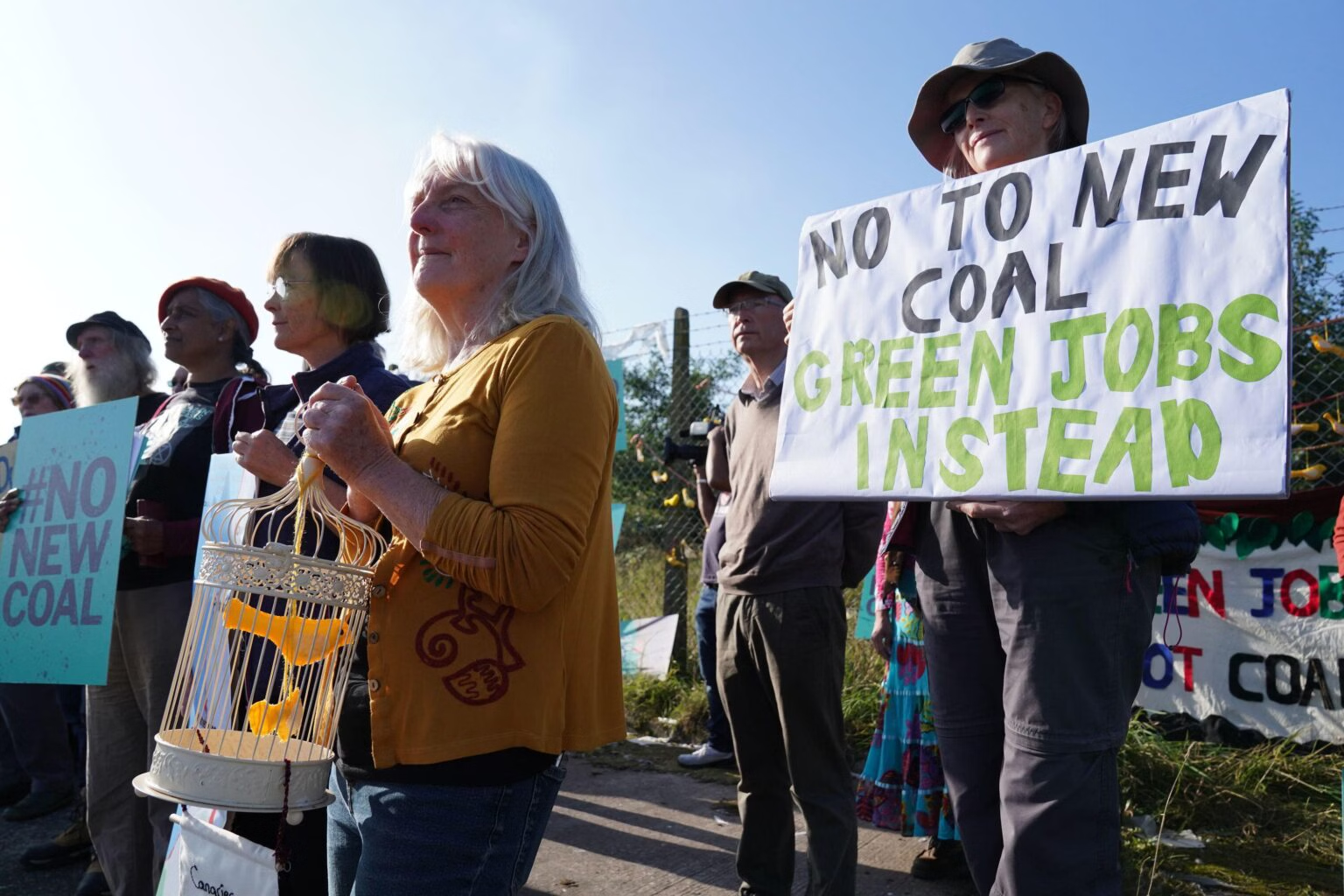
Demonstrators outside the proposed Woodhouse Colliery, south of Whitehaven, September 2021. Credit: PA Images / Alamy Stock Photo
Questions over compensation and employment could make it politically difficult for Labour to scrap the Whitehaven project, experts told DeSmog.
Labour has been urged to clarify its stance on the UK’s first deep coal mine in more than 30 years – as it fights an election campaign that has put clean energy at the fore.
The proposed mine in Whitehaven, Cumbria, would extract 2.8 million tonnes of coking coal a year from under the Irish sea to produce steel, emitting an estimated 220 millions tonnes of greenhouse gases over its lifetime.
The mine has become a political flashpoint in discussions over the UK’s commitment to reach net zero by 2050. In 2021, the International Energy Agency concluded that any new fossil fuel extraction was incompatible with global decarbonisation targets.
Ahead of a widely predicted victory at the 4 July election, Labour’s lack of clarity on the polluting mine poses awkward questions for a party that has based its manifesto on making Britain “a clean energy superpower”.
In the new manifesto, launched last week, Labour says it will not revoke existing oil and gas licences, but will also not grant any new licences. The party has explicitly ruled out issuing licences for new coal mines and says it will ban fracking for good.
The Woodhouse Colliery was granted planning permission by then Conservative levelling up secretary Michael Gove in December 2022, but has been plagued by controversy over its environmental impact and beset by legal delays.
So far, Labour has failed to address whether it would seek to overturn planning permission for the project, and has not responded to DeSmog’s requests for clarification.
In contrast, the party’s parliamentary candidate for the new Workington and Whitehaven constituency, where the mine would be built, has been vocal in his opposition.
Speaking to his local newspaper the News & Star last week, prospective MP Josh MacAlister said the mine was “a risky bet for new jobs”. “The easiest thing in the world would be to tell you the mine will solve our problems – but it won’t,” he said.
DeSmog understands that MacAlister has also addressed the issue at a number of local meetings, including to a mining heritage group in Whitehaven.
According to a source, he told dozens of residents in November that the area was better off without the mine. However, he reportedly stopped short of clarifying whether he would oppose the national party if it backed the scheme’s development.
When approached by DeSmog for comment, MacAlister’s team referred DeSmog to his views expressed in the News & Star, adding that they were “consistent with what he has said since being selected”.
A projection released by YouGov on 5 June shows that MacAlister is expected to win the seat in a landslide, with a predicted 53 percent of the vote to the Conservatives’ 25 percent.
Rebecca Willis, professor in energy and climate governance at the University of Lancaster, told DeSmog that “the mine has huge symbolic importance” both domestically and in terms of climate diplomacy.
“You can’t be a leading climate nation and provide consent for new coal mines,” she said. “Those two things are fundamentally incompatible.”
‘Non-Committal’
Despite Labour’s silence, MacAlister’s position appears to align with that of Ed Miliband, the party’s shadow climate change secretary.
Shortly after the mine was approved, Miliband co-authored an opinion piece for the News & Star with Cumberland’s council leader Mark Fryer. In the article, they argued that the mine would be “obsolete by the 2030s and 2040s at the latest, because of changes to the global steel industry which is rapidly moving towards clean steel production”.
Miliband reiterated this message at a March 2023 Cumberland Economic Summit event in west Cumbria.
Since then, the national Labour party has revealed little on its position.
Karl Conor, a former Labour councillor for Copeland, told DeSmog that given the controversies surrounding the scheme and the interest of the local community, MacAlister and Labour will be unable “to get through the campaign without having to nail their colours to the mast”.
In contrast to MacAlister, prospective Conservative MP Andrew Johnson has strongly backed the mine, telling the News & Star: “It offers the best prospect in years to create new jobs, attract significant investment into West Cumbria and help to deliver the upgrade to the coastal railway.
“If elected I will work tireless[ly] to fight for the mine to open and those jobs delivered”.
Claims by West Cumbria Mining that the project will create around 500 jobs have been strongly disputed.
Campaign group South Lakes Action on Climate Change (SLACC) group, which is bringing a legal challenge against the decision to greenlight the scheme, said that “no methodology” had been provided by the mining firm to support these claims.
A source in the new joint Cumberland authority told DeSmog they thought the local Conservative party would “try to make it [the local election campaign] about the mine”.
“In the same way they made the Uxbridge by-election all about ULEZ [London’s Ultra Low Emission Zone], Sadiq Khan’s flagship policy, the Tories’ electoral strategy will be to make it about the mine,” they said. “… If I was in their position, it’s what I’d be doing.”
Compensation Conundrum
Any new administration looking to block the Cumbria coal mine may be hit with a compensation claim that runs into the tens of millions, according to a well-placed legal expert.
Matthew McFeeley, a lawyer with Richard Buxton Solicitors, has been advising SLACC on its legal challenge. He told DeSmog that much will depend on the judicial review, which is scheduled to be heard on 16 July, less than a fortnight after the general election.
“If the court were to find that the planning permission had been unlawfully granted, then it would all have to go back to the secretary of state for a new decision,” McFeeley said.
In this scenario, he explained, a Labour administration could argue that the climate and environmental impacts of the project are too great, and refuse to grant permission.
If campaigners can successfully argue the mine’s planning permission is unlawful, the company behind the coaling scheme – West Cumbria Mining (WCM) – would not be able to issue any kind of compensation claim.
However, if the next government decided to revoke planning permission without a legal ruling, the taxpayer would be legally obliged to pay compensation, McFeeley said. The amount would depend on an assessment of how much WCM stood to lose from the permission being revoked.
The legal challenge is one of a number of hurdles WCM has to jump over before it can begin work at the site. McFeeley also indicated that the compensation claim could run into the tens of millions, or higher. “They’re investing their money at risk at this point,” he said.
WCM vacated its offices in west Cumbria on the eve of the 2021 public inquiry after the Singapore-based EMR Capital, one of the mine’s major financial backers, oversaw a “cost-saving” programme. The company has until the end of 2025 to get shovels in the ground.
Other hurdles also stand in the way of the mine’s construction – including approval of marine licences, habitat monitoring and a risk assessment.
Despite the many issues associated with the mine, Professor Willis, of the University of Lancaster, said that scrapping the plans may still prove awkward for an incoming government.
“There’s a timing issue for Labour here,” she said. “They’ve promised a lot in terms of green industrial policy through Great British Energy [Labour’s proposed state-owned energy company] and publicly-backed investment in green industries. But that will take a while to get going.
“So, at least over the next year, you’ll have the situation where they’ll be saying no to the mine but they’re not saying yes to anything else in the area. That’s quite difficult politically.
“Until the community actually sees a physical project with attached jobs being offered to them, they’re going to be pretty cynical about it.”
West Cumbria Mining did not respond to DeSmog’s request for comment.
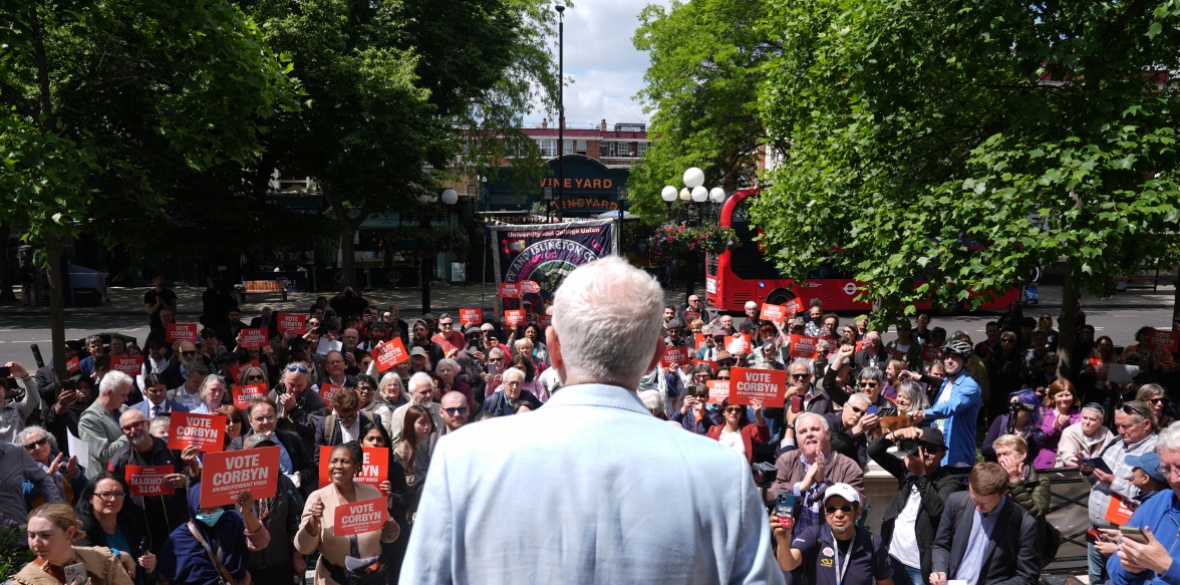
Jeremy Corbyn addresses supporters outside Islington Town Hall, north London, after handing in his nomination papers for the General Election on July 4, June 5, 2024
Praful Nargund, who is bidding to unseat Mr Corbyn, is a private health entrepreneur and has said privatisation is needed in the NHS
LABOUR’S imposed candidate in Islington North, Praful Nargund, has refused to attend hustings organised by Keep our NHS Public, forcing their cancellation.
The move is no surprise since Mr Nargund, bidding to unseat Jeremy Corbyn, is a private health entrepreneur who has said privatisation is needed in the NHS.
The no-hope Tory candidate for the seat also decided to duck the debate, forcing its cancellation.
Mr Corbyn, by way of contrast, spoke to hundreds at a rally in support of the NHS held in the constituency at the weekend.
Canvassing reports indicate massive support for the former Labour leader, particularly in the working-class areas of the constituency.
And in neighbouring Holborn and St Pancras, held by Mr Corbyn’s successor as Labour leader, independent challenger Andrew Feinstein is outgunning Sir Keir Starmer on the streets.