Inflaming Tensions, Trump Threatens Political Left With Retribution Over Killing of Charlie Kirk

Spread the love

Original article by Julia Conley republished from Common Dreams under Creative Commons (CC BY-NC-ND 3.0).
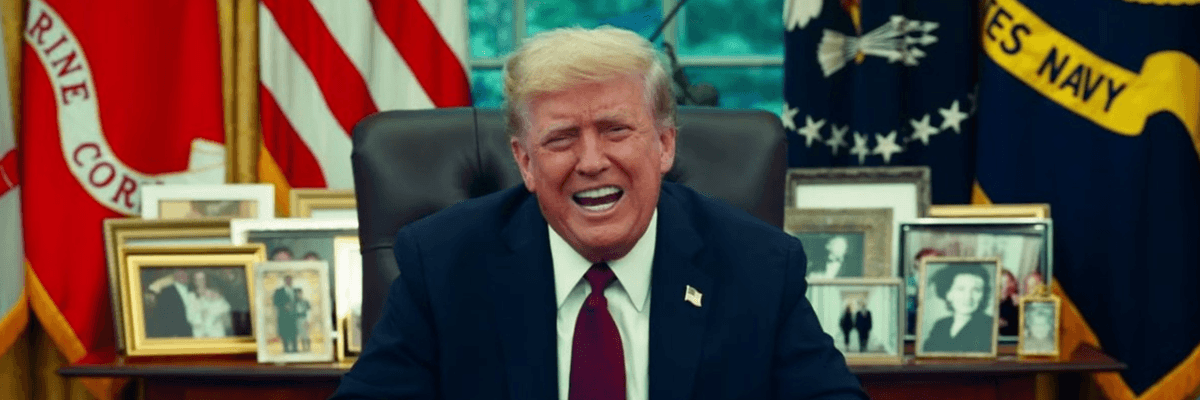
US President Donald Trump speaks about the assassination of right-wing activist Charlie Kirk on September 10, 2025.  (Photo: WhiteHouse.gov)

With the suspect still at large and the motive unknown, the president “seized the moment of widespread mourning to spread more hatred and division.”

Despite the fact that the murderer of right-wing activist Charlie Kirk remained unidentified and still at large, President Donald Trump declared the “radical left” as “directly responsible” for the assassination in remarks from the White House on Wednesday night—comments that critics say shows Trump is more than willing to exploit the killing for his own purposes while sowing more, not less, political violence in the future.

In a video address from the Oval Office, Trump said that criticism of Kirk from the left was “directly responsible for the terrorism that we’re seeing in our country today, and it must stop right now.”

The president didn’t specify which opponents of Kirk he believed contributed to his killing; over the years the influencer, who frequently visited college campuses to debate students, clashed with and was criticized by supporters of abortion rightsgun control, and immigrants’ rights. But Trump said his administration would “find each and every one of those who contributed to this atrocity and to other political violence, including the organizations that fund it and support it.”

Trump did not detail how the White House would determine what groups “contributed” to Kirk’s killing.

“Radical left political violence has hurt too many innocent people and taken too many lives,” he asserted, though he did not mention any of the political violence—which is statistically more pervasive—on the political right.

The president was echoing sentiments expressed by far-right influencer Laura Loomer who has played a key role in shaping the Trump administration, lobbying for the hiring and removal of certain aides.

“It’s time for the Trump administration to shut down, defund, and prosecute every single leftist organization,” Loomer said Wednesday, even before Kirk was publicly pronounced dead. “We must shut these lunatic leftists down. Once and for all. The left is a national security threat.”

In a Thursday op-ed for Common Dreams, author and journalist Christopher D. Cook laments how “Kirk had barely been declared dead when President Trump hideously used his killing to falsely blame and attack the left.”

The president, writes Cook, “seized the moment of widespread mourning to spread more hatred and division, in a reckless, angry televised speech that hurled blame at the left despite not a scintilla of evidence about Kirk’s assassin or their politics.”

Trump named a number of victims of political violence in recent years, including US Rep. Steve Scalise (R-La.), who was shot in 2017 by a man who opposed the president; and Trump himself, who survived two assassination attempts last year.

The president did not mention the killing earlier this year of Minnesota House Speaker Melissa Hortman, a Democrat. The suspect in Hortman’s killing was an evangelical Christian who strongly opposed abortion and LGBTQ+ rights.

Rep. Nancy Mace (R-SC) also asserted without any evidence that critics of the far-right agenda that Kirk embraced were to blame for his killing, specifically suggesting that her Democratic colleagues were implicated in the assassination.

“Democrats own what happened today,” she told reporters. “Some raging leftist lunatic put a bullet through his neck.”

Mace added that it was “ridiculous” to suggest that by her logic, Republican lawmakers “own” Hortman’s assassination.

The comments from Trump and Mace, wrote Cook, only show that these are “not the people who are going to lead us out of this ugly toxic pit” of political violence now pervasive in the United States.

At Zeteo, journalist Mehdi Hasan listed several other recent acts of political violence in which the suspected or confirmed perpetrators held right-wing ideologies, including the attempted assassination of Pennsylvania Gov. Josh Shapiro earlier this year; the assault of then-House Speaker Nancy Pelosi’s husband in 2022; and the attempted kidnapping of Michigan Gov. Gretchen Whitmer in 2020.

“There is no equivalent or even similar list of Obama or Biden supporters who have carried out murders, attempted murders, or violent attacks against Republicans or conservatives in recent years,” wrote Hasan. “In fact, according to statistics compiled by the ADL’s Center on Extremism, 2024 was the third year in a row in which all of the extremist-related killings in the United States were carried out by… right-wingers.”

On the social media platform X, Texas Monthly senior writer Robert Downen pointed out that some far-right white supremacists had also “reviled” Kirk.

“I’m not speculating about the shooter,” said Downen. “I just have been stunned how quickly people have jumped with certainty to partisan conclusions. Because in extremism spaces, the Charlie Kirk Hater-to-Nazi pipeline is canon. It’s how we got a generation of antisemitic extremists.”

Sen. Elizabeth Warren (D-Mass.) was quick to rebuke the suggestion that Democrats or left-wing groups are to blame for the rise in politically motivated attacks or the emergence of violence as a commonplace, acceptable occurrence in American culture.

“Oh, please,” she said when a reporter asked her whether Democrats should tone down their rhetoric. “Why don’t you start with the president of the United States, and every ugly meme he has posted, and every ugly word.”

In a podcast put together Wednesday evening in the wake of Kirk’s assassination, journalist David Sirota said that “what we desperately need right now in this country are leaders who lower the temperature, leaders who will try to pull us back from the brink.”

Instead, Sirota warned, “we have a president right now who seems mostly interested in using the bully pulpit to actually bully people. Inflaming every cultural conflict he can stick his nose into—all for the cause of grabbing more power and money for himself and his family.”

In place of more anger, hatred, and calls for political retribution, Sirota told his audience he wanted to offer a different message.

“It’s a simple message whether you are a leftist, a liberal, a centrist, a conservative, or a MAGA fan,” said Sirota. “Your life has value and your political opponents’ lives have value too. You can hate your adversaries’ ideas, and you can fight hard for your cause, but the moment we stop seeing each other as human beings and we start concluding that violence is the answer, that’s the moment we let the soulless corporations, the ruthless authoritarians, and the sociopathic demagogues win.”

The “nihilism” and “greed” of too many, he added, “are creating the conditions for a civil war—one that we must all do our part to stop. Before it becomes unstoppable.”

Original article by Julia Conley republished from Common Dreams under Creative Commons (CC BY-NC-ND 3.0).

Continue ReadingInflaming Tensions, Trump Threatens Political Left With Retribution Over Killing of Charlie Kirk

The US Is Giving Away $35 Billion a Year to Cook the Planet

Spread the love

https://www.bloomberg.com/opinion/articles/2025-09-10/the-us-is-giving-oil-and-gas-producers-35-billion-a-year-to-cook-the-planet

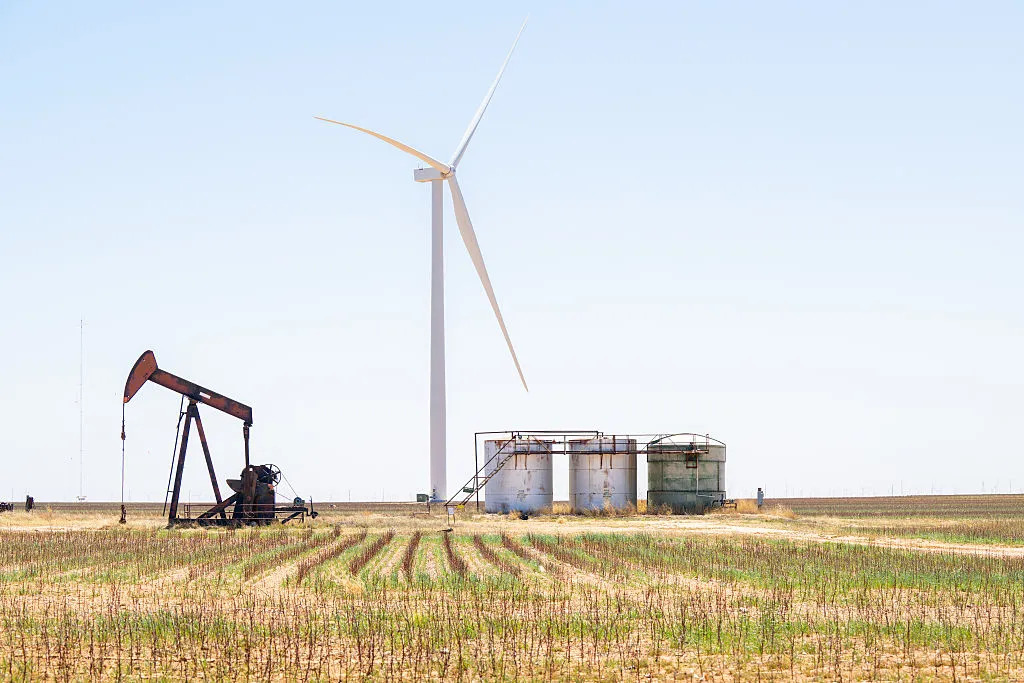
Guess who gets subsidies?Photographer: Brandon Bell/Getty Images

Fossil-fuel producers should be taxed to defray the cost of climate change, not be given even larger subsidies.

By Mark Gongloff

The price of eggs has more than doubled in the past eight years, which isn’t great, but at least you can eat eggs. The price of US government subsidies for the fossil-fuel industry has also more than doubled in that time, which is far, far less great. Welfare for an industry that makes billions of dollars in profits and pollutes the climate is worse than useless. It’s self-destructive.

The federal government gives oil, gas and coal producers at least $34.8 billion in subsidies each year, according to a new study by the research and advocacy nonprofit Oil Change International. In 2017, OCI estimated these gifts at $14.7 billion annually. This doubling in federal largesse has taken place under both Democratic and Republican political administrations, highlighting the difficulty of stopping its growth, much less reversing it.

Bloomberg Opinion

In fact, some of the most recent extensions of federal aid have made it possible for these subsidies to explode in the future, threatening to reach trillions of dollars. When the world needs exponential growth in clean-energy investments to avoid the most catastrophic effects of global heating, the US government will be bankrolling fossil-fuel expansion and stoking the emergency.

Article continues at https://www.bloomberg.com/opinion/articles/2025-09-10/the-us-is-giving-oil-and-gas-producers-35-billion-a-year-to-cook-the-planet

Donald Trump urges you to be a Climate Science denier like him. He says that he makes millions and millions for destroying the planet, Burn, Baby, Burn and Flood, Baby, Flood.
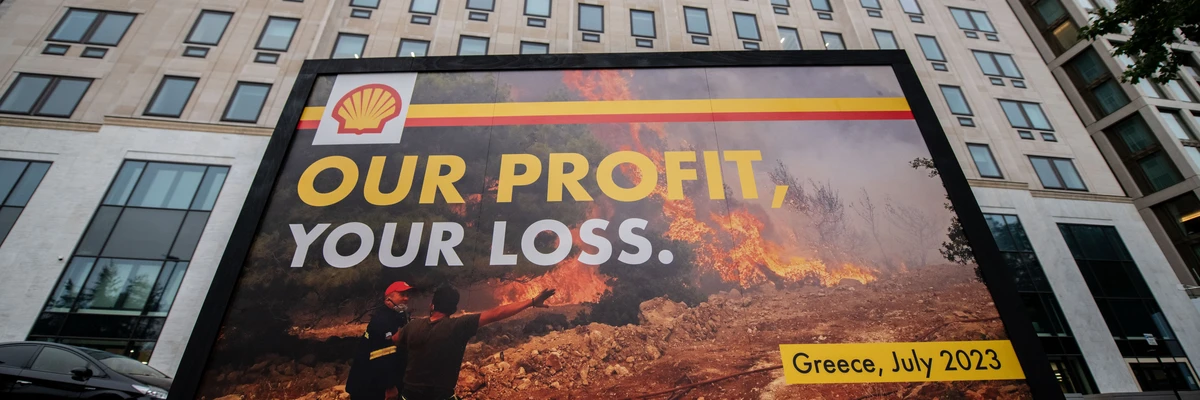
Greenpeace activists display a billboard during a protest outside Shell headquarters on July 27, 2023 in London.
Greenpeace activists display a billboard during a protest outside Shell headquarters on July 27, 2023 in London. (Photo: Handout/Chris J. Ratcliffe for Greenpeace via Getty Images)
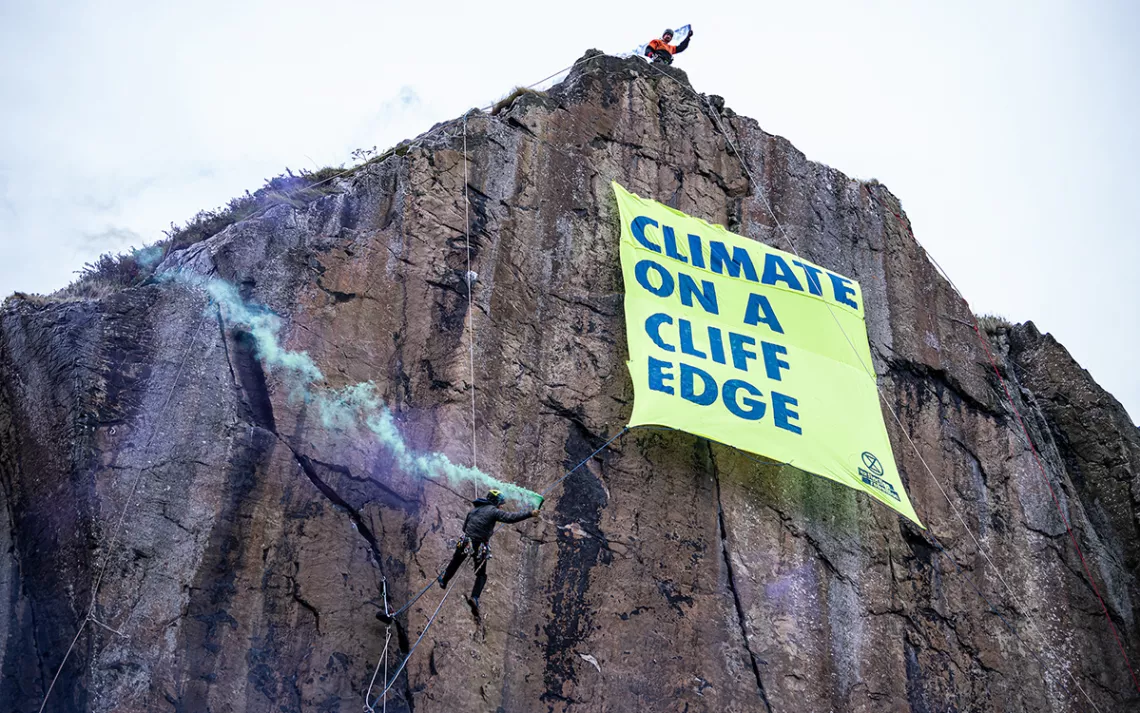
Experienced climbers scale a rock face near the historic Dumbarton castle in Glasgow, releasing a banner that reads “Climate on a Cliff Edge.” One activist, dressed as a globe, symbolically looms near the edge, while another plays the bagpipes on the shores below. | Photo courtesy of Extinction Rebellion and Mark Richards
Continue ReadingThe US Is Giving Away $35 Billion a Year to Cook the Planet

Study links world’s top oil and gas firms to 200 ‘more intense’ heatwaves

Spread the love

Original article by Ayesha Tandon republished from Carbon Brief under a CC license.

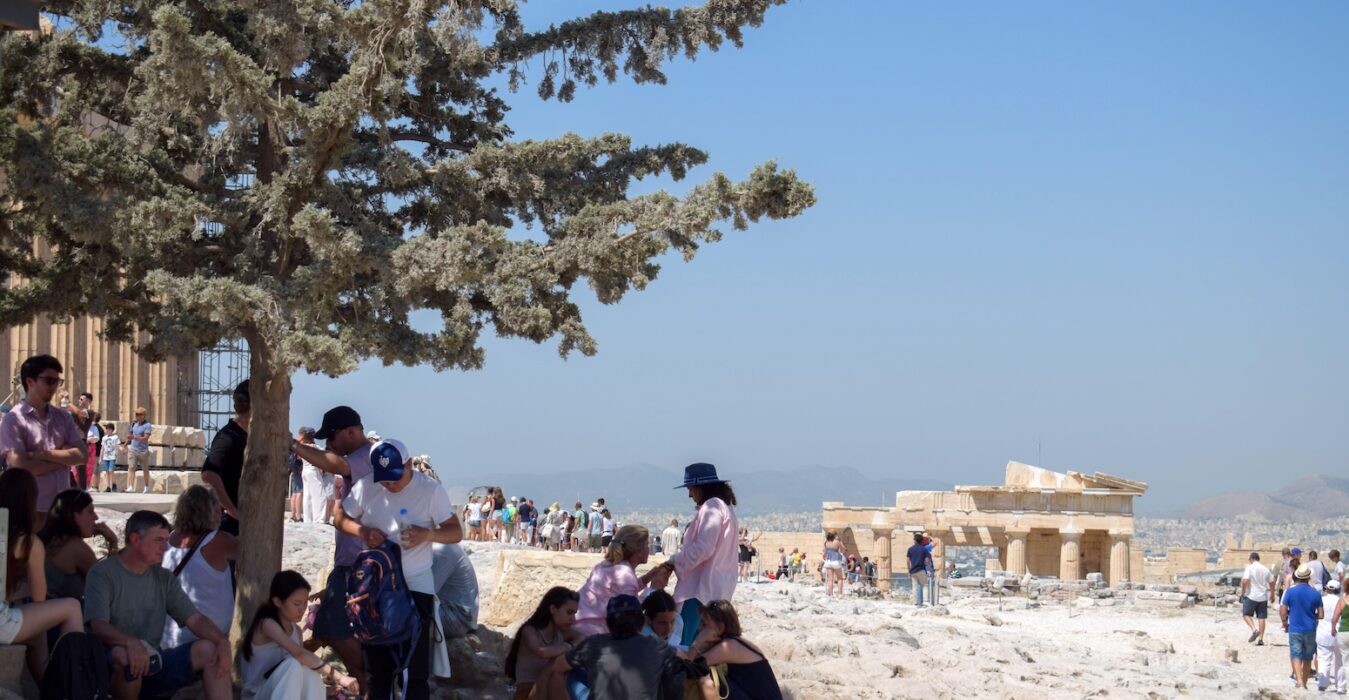
A group of tourists huddled under a tree whilst visiting the Acropolis, Athens, Greece. Credit: Dimitris Aspiotis / Alamy Stock Photo

Global warming linked to the world’s biggest oil and gas companies made all “major” 21st century heatwaves more intense and frequent.

This is according to new research, published in Nature, which uses “extreme event attribution” to assess the impact of climate change on all 21st-century heatwaves that were classified as “major disasters”.

The authors find one-quarter of the 213 heatwaves would have been “virtually impossible” without human-caused global warming.

They add that the effect of climate change on heatwave frequency and intensity is becoming more pronounced as the planet warms.

The study estimates the emissions stemming from the operations and production of more than 100 “carbon majors”, such as ExxonMobil, BP, Saudi Aramco and Shell.

The fossil fuels produced by these companies account for 60% of all human-caused CO2 emissions over 1850-2023, the study says.

The authors find that heatwaves recorded over 2000-23 were made, on average, 1.7C hotter due to climate change, with half of this increase due to the emissions originating from carbon majors. 

This study “could be used to support future climate lawsuits and aid diplomatic negotiation”, according to a scientist not involved in the research.

Worsening heatwaves 

As the planet warms, heatwaves are becoming more intense and frequent, driving economic lossesecosystem damage and a rise in heath-related deaths

The EM-DAT database catalogues all “major disasters” that have been reported since the year 1900 – defined as events that cause at least 10 fatalities, affect at least 100 people, or result in the declaration of state of emergency or a call for international assistance.

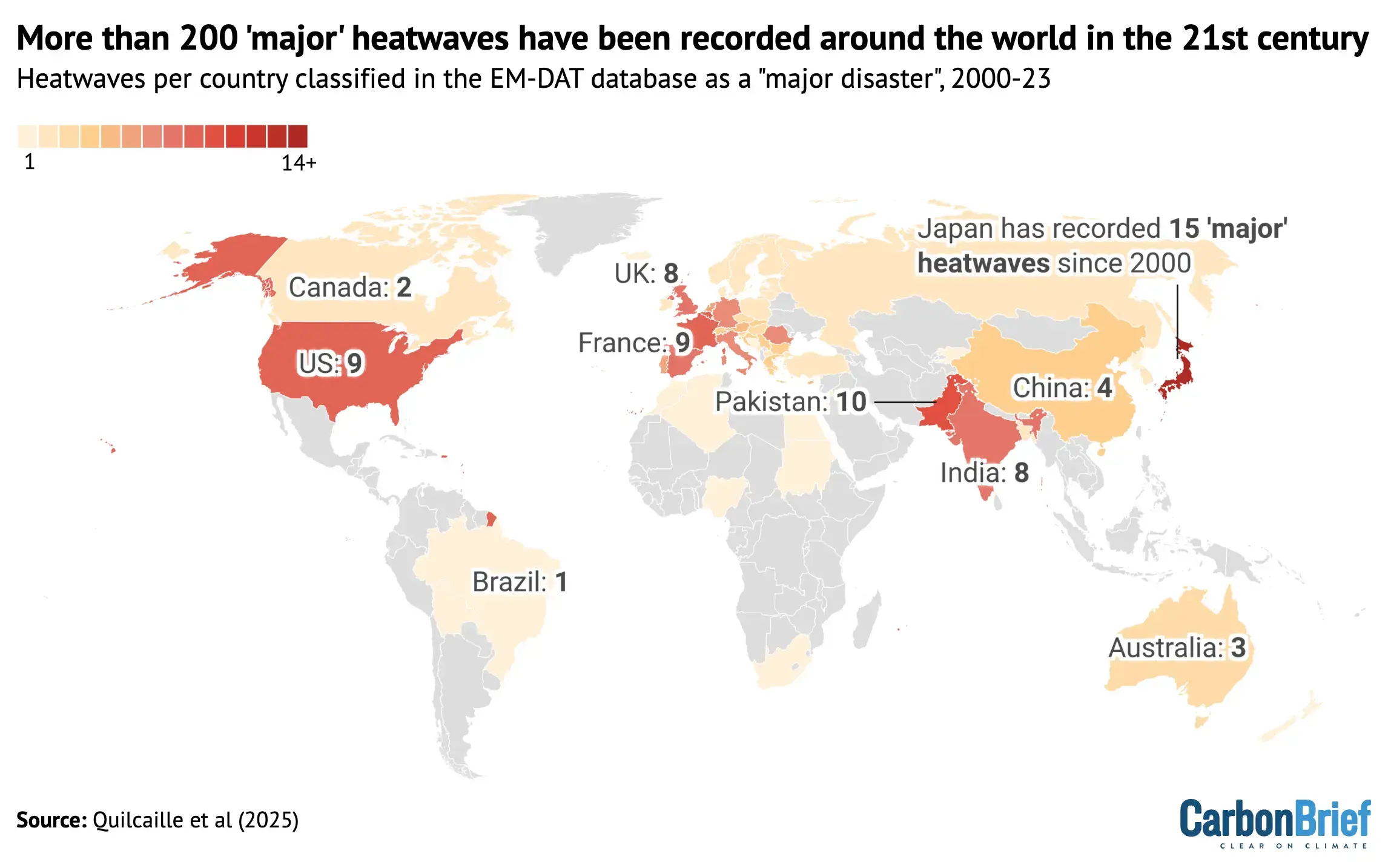
Between 2000 and 2023, the database lists more than 200 heatwaves. These are shown on the map below, where darker pink indicates a greater number of heatwaves. Countries with no reported heatwaves are shown in grey.

Global map showing that more than 200 'major' heatwaves have been recorded around the world in the 21st century
The map below shows the number of heatwaves per country recorded over 2000-23 on the EM-DAT database. Data: Quilcaille et al (2025).

The study authors acknowledge that heatwave reporting is “highly uneven”, with only nine of the heatwaves reported in the database since the year 2000 in Africa, Latin America or the Caribbean. (This is largely because extreme heat events in these regions are not routinely monitored.)

They then carried an attribution analysis on each heatwave to identify whether it was made more likely or intense due to human-caused climate change.

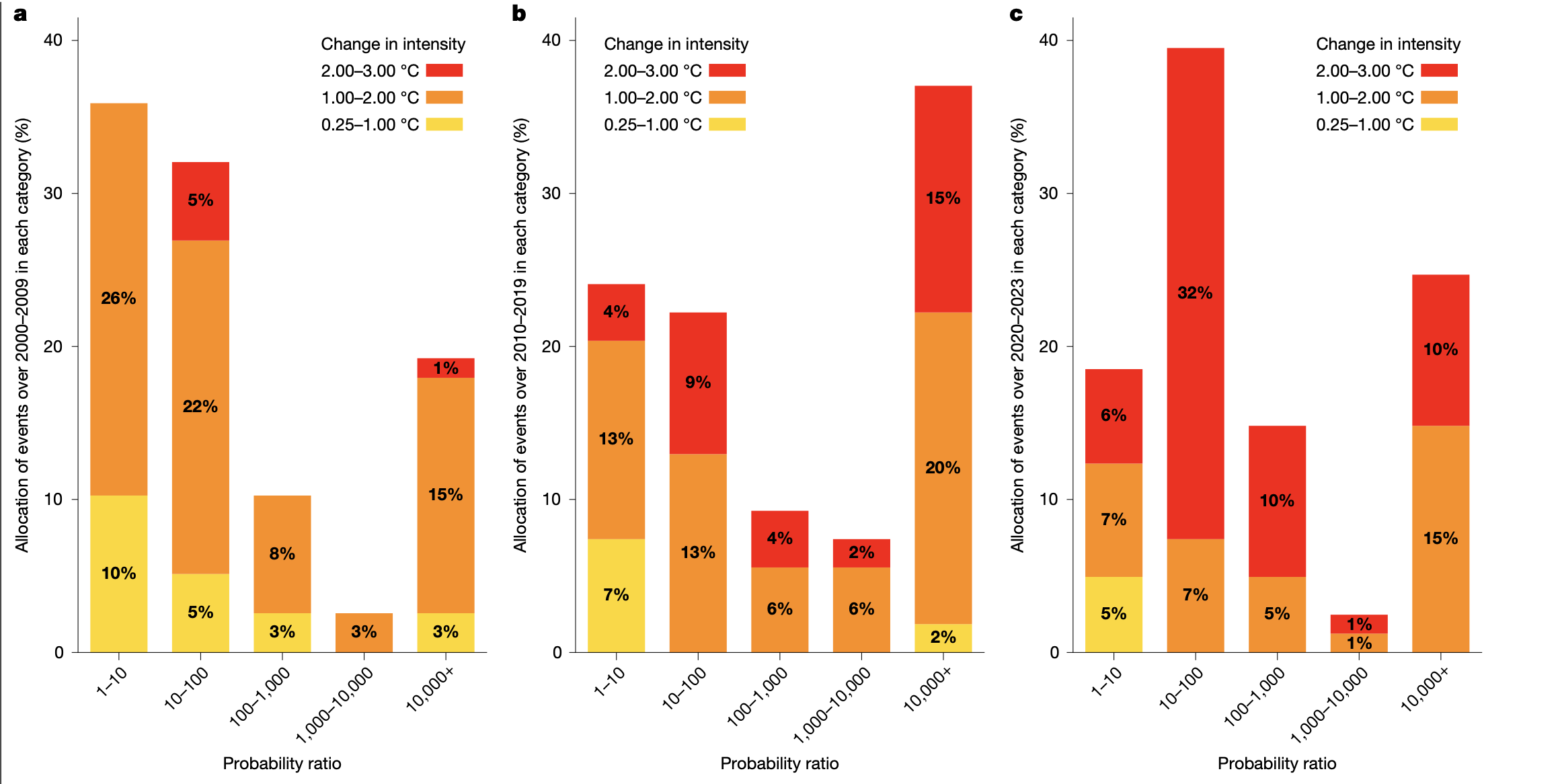
The chart below shows how climate changes increased the intensity and frequency of the 78 heatwaves assessed over 2000-09 (left), 54 heatwaves assessed over 2010-19 (middle) and 81 heatwaves assessed over 2020-23 (right).

The authors find that climate change increased the intensity and probability of all 213 heatwaves in the study. They add that the influence of climate change on heatwaves is strengthening over time.

In each panel, the bars show the percentage of heatwaves in that time period that were made 0.25-1.0C (yellow), 1.0-2.0C (orange) or 2.0-3.0C (red) hotter due to climate change. 

The position of bars indicate the change in likelihood of the heatwaves. This ranges from those made 1-10 times more likely due to climate change (left-most bar in each panel) to those made more than 11,000 times more likely (right-most bar in each panel). 

Bar chart showing change in heat intensity
The extent to which climate changes increased the intensity and frequency of the 78 heatwaves assessed over 2000-09 (left), 54 heatwaves assessed over 2010-19 (middle) and 81 heatwaves assessed over 2020-23 (right). These are shown by colours and bar heights respectively. Source: Quilcaille et al (2025).

Heatwaves recorded over 2000-09 were, on average, 20 times more likely due to climate change, according to the authors. Meanwhile, those recorded over 2010-19 were about 200 times more likely. 

Similarly, 2000-09 heatwaves were 1.4C hotter due to human-caused climate change on average, according to the study, while 2010-19 heatwaves were made 1.7C hotter.

The study finds that human-caused climate change made 55 heatwaves at least 10,000 times more likely. According to the authors, this is “equivalent to saying that they would have been virtually impossible” without the influence of human activity.

Carbon majors

To assess the contribution to heatwaves by oil and gas companies’ products, the authors use a database of carbon dioxide and methane emissions from 180 carbon majors over 1854-2023. This includes direct emissions from the companies, as well as the emissions released when the oil and gas they produced is used by others. 

The 180 carbon majors in the database represent 60% of all human-caused CO2 emissions, including land use, over 1850-2023, according to the study. The paper adds that 14 companies, including ExxonMobil, BP, Saudi Aramco and Shell, are responsible for almost half of these emissions.

Using the Earth system model OSCAR, the authors estimate that global average surface temperatures increased by 1.3C between the 1850-1900 average and the year 2023.

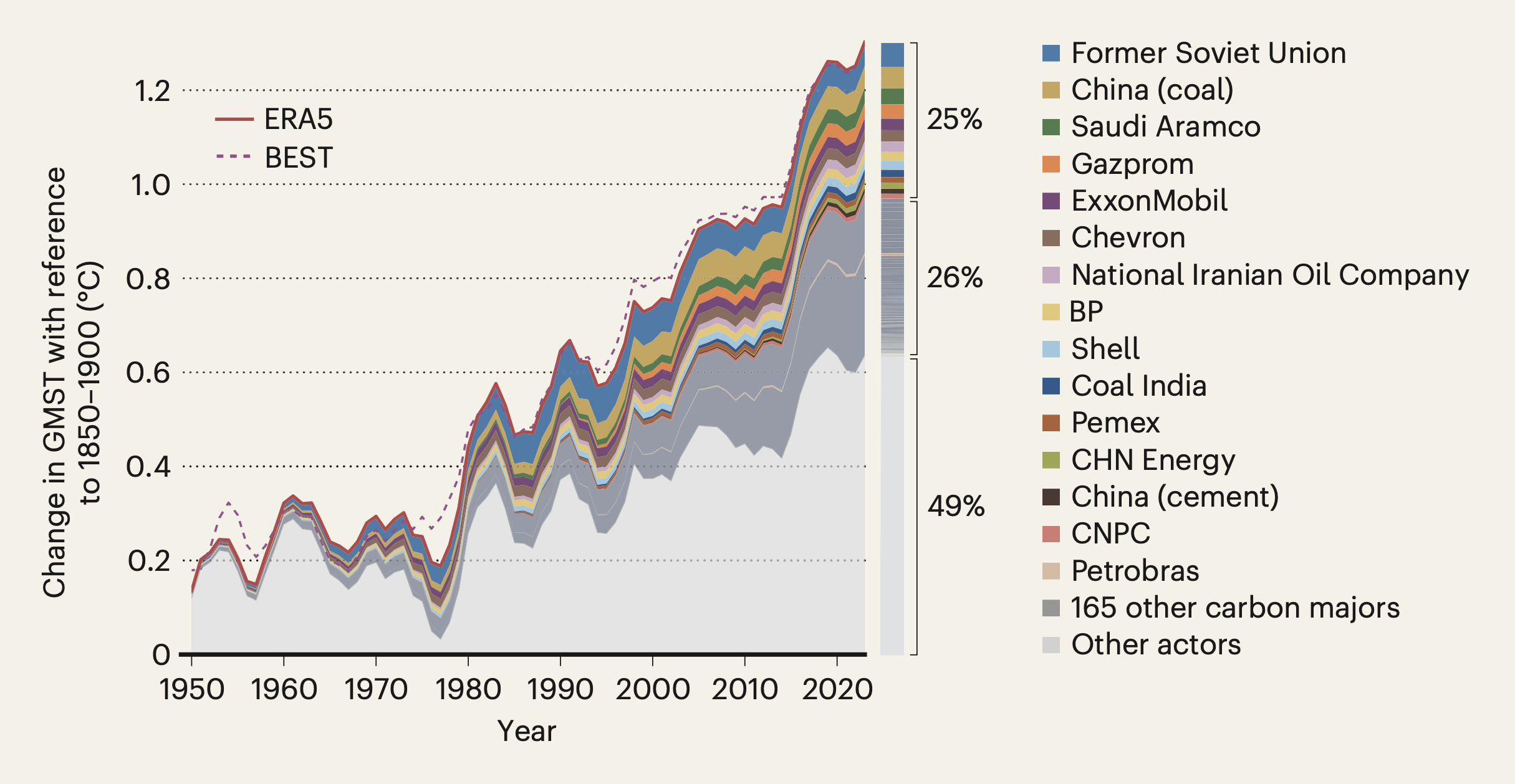
They find that 0.7C of this increase was linked to the carbon majors, with 0.3C due to the emissions of the 14 largest.

The chart below, taken from an accompanying Nature “news and views” article, shows the contribution of oil and gas companies’ products to increasing global average surface temperatures over 1950-2023, compared to the 1850-1900 average. 

Each colour indicates a carbon major, while grey indicates other sources of temperature increase, such as land-use change. 

The contribution of oil and gas companies to increasing global average surface temperatures over 1950-2023, compared to the 1850-1900 average. Each colour indicates a company, while grey indicates other sources of temperature increase. Source: Haustein (2025).

Heatwaves recorded over 2000-23 were, on average, 1.7C hotter due to climate change, according to the study. The authors find that emissions originating from carbon majors and their products contributed about half of the increase in intensity of heatwaves seen since pre-industrial times.

The authors then break down the contribution of emissions from each carbon major on each heatwave in their analysis.

For example, they find that the emissions linked to Saudi Aramco made 51 heatwaves at least 10,000 times more likely. They add that on average, emissions tied to the company made the 213 heatwaves 0.04C hotter.

Legal action

Attribution studies already play an important role in courts by providing evidence that helps judges to determine liability. 

Dr Rupert Stuart-Smith is a research associate in climate science and the law at the University of Oxford’s Sustainable Law Programme. He was not involved in the study, but has published separate work showing that the emissions linked to each of the six largest corporate emitters cause one heat-related death in Zurich alone, every summer.

Stuart-Smith tells Carbon Brief that the new paper is a “high-quality analysis and a meaningful step forward for the field of climate change attribution”. He adds:

“With more and more lawsuits aiming to hold high-emitting companies responsible for their contributions to climate change impacts or compel state and corporate actors to reduce their emissions and prevent rising climate harms, work like this provides the basis for well-informed judicial decision-making.”

Dr Yann Quilcaille is a researcher at ETH Zürich and lead author of the study. He stresses the importance of attribution research for court cases, telling Carbon Brief that he hopes his work “can be used by legal practitioners”.

However, he also says that his role as a scientist is not to assign “responsibility” for climate change, but to “provide information to governments for decision making and to courts for litigation”.

Earlier this year, Dr Christopher Callahan, the principal investigator of the IU Climate & Society Lab, published a study with Prof Justin Makin, an associate professor in the department of geography at the University of Dartmouth, which links trillions of dollars in economic losses to the extreme heat caused by emissions tied to oil and gas companies. 

Mankin tells Carbon Brief that the new paper is “very closely” linked to his research.

Callahan says the new paper is “an important contribution to an emerging literature that illustrates how individual emitters can be linked to the change risk of extreme climate conditions and human impacts”.

He explains that “this kind of evidence will be important in courtrooms – holding emitters legally accountable requires demonstrating a causal nexus between that emitter and a particularised harm suffered by a plaintiff”. 

Attribution

The cutting-edge field of extreme weather attribution seeks to establish the role that human-caused warming played in these events. Attribution studies have been carried out on hundreds of heatwaves all around the world, as shown in Carbon Brief’s interactive map.

The new paper uses one of the earliest and most commonly used methods of attribution, called “probabilistic attribution”.

Specifically, it uses the method set out by the World Weather Attribution initiative for its “rapid attribution” analyses.

The authors first chose a temperature “threshold” to define their heatwave. 

They then used a global climate model to simulate two worlds – one mirroring the world as it was during the heatwave and the other using the climate of 1850-1900. This second scenario is used to represent the climate in a world without human-caused climate change.

The authors run their models thousands of times in each scenario. As the world’s climate is inherently chaotic, each model “run” – individual simulations of how the climate progresses over many years – produces a slightly different progression of temperatures. This means that some runs simulate the heatwave, while others do not.

The authors count how many times the threshold temperature was in each model run. They then compared the likelihood of crossing the threshold temperature in the world with – and a world without – climate change.

For example, they find that the 2021 Pacific north-west heatwave was made 3.1C hotter due to human caused climate change and more than 10,000 times more likely. 

(A study by the WWA at the time of the heatwave found that the heatwave was made 150 times more likely. The discrepancy is due to differences in the definition of the event, as well as its “very unlikely nature” according to the study authors.)

Dr Frederieke Otto is a professor at Imperial College London and founder of the WWA initiative. She tells Carbon Brief that the new study is “very similar to some other recent studies on impacts, based on the hazard attribution method used by WWA”, but says that “this is the most high profile and wide-reaching one”.

Otto adds:

“I do hope that many more impact attribution studies will follow, based on our or other extreme event attribution studies. We need more research on this.”

Q&A: How China is adapting to ‘more frequent and intense’ heat extremes China Policy 04.09.25

Analysis: England’s most ethnically diverse areas are 15 times more likely to face extreme heat Heatwaves 12.08.25

Mapped: How climate change affects extreme weather around the world Attribution 18.11.24

Explainer: Why is climate change causing ‘record-shattering’ extreme heat? Heatwaves 27.08.24

Quilcaille, Y. et al. (2025), Systematic attribution of heatwaves to the emissions of carbon majors, Nature, doi:10.1038/s41586-025-09450-9

Original article by Ayesha Tandon republished from Carbon Brief under a CC license.

Donald Trump urges you to be a Climate Science denier like him. He says that he makes millions and millions for destroying the planet, Burn, Baby, Burn and Flood, Baby, Flood.
Nigel Farage urges you to ignore facts and reality and be a climate science denier like him. He says that Reform UK has received millions and millions from the fossil fuel industry to promote climate denial and destroy the planet.
Greenpeace activists display a billboard during a protest outside Shell headquarters on July 27, 2023 in London.
Greenpeace activists display a billboard during a protest outside Shell headquarters on July 27, 2023 in London. (Photo: Handout/Chris J. Ratcliffe for Greenpeace via Getty Images)
Experienced climbers scale a rock face near the historic Dumbarton castle in Glasgow, releasing a banner that reads “Climate on a Cliff Edge.” One activist, dressed as a globe, symbolically looms near the edge, while another plays the bagpipes on the shores below. | Photo courtesy of Extinction Rebellion and Mark Richards
Continue ReadingStudy links world’s top oil and gas firms to 200 ‘more intense’ heatwaves

Charlie KKKirk’s chickens come home to roost

Spread the love

https://socialistworker.co.uk/comment/charlie-kkkirks-chickens-come-home-to-roost/?mc_cid=31670dbb32

Charlie Kirk

Charlie Kirk was a founder of far right group Turning Point USA and a key Trump backer

On 5 April 2023, Kirk told a rally, “I think it’s worth it to have the cost of, unfortunately, some gun deaths every single year so that we can have the Second Amendment to protect our other god given rights.”

His podcast, The Charlie Kirk Show, was a cesspit of far right lies, vile racism, transphobia and anti-abortion bigotry that he built his career on. 

He has 1.8 million followers on Twitter/X. But even Twitter once blocked Kirk for “violating rules against posting misleading information about voting” when he tweeted lies about supposed election fraud in Pennsylvania. 

Nine months ago Luigi Mangione became a folk hero when he shot Brian Thompson, CEO of UnitedHealthcare. The sector was notorious for declining to pay out policies for dying people.  

The US establishment will wring their hands about political violence. But the US ruling class is responsible for far more violence, death and destruction than any political terrorist. They are complicit in the genocide in Gaza and in enabling the continuing horror of mass shootings in the US. 

Original article at https://socialistworker.co.uk/comment/charlie-kkkirks-chickens-come-home-to-roost/?mc_cid=31670dbb32

Continue ReadingCharlie KKKirk’s chickens come home to roost

The Caribbean on a knife’s edge: Trump’s military buildup threatens Venezuela

Spread the love

Original article by Manolo De Los Santos republished from peoples dispatch under  a Creative Commons Attribution-ShareAlike 4.0 (CC BY-SA) license.

US President Donald Trump, Venezuelan President Nicolás Maduro. Photos via Presidential Press

The war drums beating in Washington are not just a threat to a distant nation; they are a symptom of a political system that thrives on the distraction of war abroad to cover its internal crises.

The sun glints off the gray hull of the USS Iwo Jima, a massive amphibious assault ship cutting through the Caribbean Sea. Secretary of War Pete Hegseth, a key architect of the Trump administration’s “maximum pressure” policies, stands on deck before a group of sailors and marines. His voice, amplified by the ship’s public address system, is a low, serious rumble that carries across the choppy waters. “What you’re doing right now is NOT training,” he says, in a scene reminiscent of George W. Bush’s staged landing to declare victory in Iraq. “This is a REAL-WORLD EXERCISE on behalf of the vital national interests of the United States of America, to end the POISONING of the American people.” His words hang heavy in the air, a dramatic prelude to what some suspect is an impending invasion of Venezuela.

The history of the Caribbean is a bloody one, stained by the imperial ambitions of European powers and the United States. The region now sits on the verge of another bloody chapter. As the great writer and historian Juan Bosch once observed, this region of Latin America is a battleground where empires have fought to seize the rich lands of its peoples and to claim what other empires had already conquered.

Today, the Caribbean is again being transformed into a stage for imperial aggression.

In a dangerous and dramatic escalation, the government of the United States, through its aptly renamed Department of War, has amassed a formidable naval force and deployed advanced fighter jets to the waters off Venezuela. This military buildup, consisting of at least eight warships, 4,000 sailors and marines along with P-8 spy planes and at least one nuclear submarine, is a clear threat to Venezuelan sovereignty and a blatant crime against international law. Washington is hiding behind a well-worn, cynical pretext: the “war on drugs”.

A sordid history of manufactured pretexts

The latest act of lawlessness came on September 2, when US forces in the Caribbean allegedly interdicted a “drug trafficking” vessel. Instead of following international protocols, the US Coast Guard and DEA agents opened fire, destroying the boat and killing all 11 people on board. This extrajudicial execution at sea is a clear violation of international law, which mandates that law enforcement actions must prioritize arrest and the preservation of life. The use of lethal force is only permitted as a last resort in cases of immediate self-defense. Though the US is not a signatory to the United Nations Convention on the Law of the Sea, the US military’s legal advisors have previously said that the US should “act in a manner consistent with its provisions”. To destroy a vessel and summarily execute its occupants without due process is not law enforcement; it is a state-sanctioned massacre, a crime that echoes other massacres in American military missions abroad. Recently, Professor Michael Becker of Trinity College in Dublin told the BBC that the US action “stretches the meaning of the term beyond its breaking point”.

This act of violence is not an anomaly but part of a deliberate pattern of provocation. The US Southern Command (SOUTHCOM) has significantly bolstered its presence with additional destroyers and littoral combat ships. Meanwhile, the US Air Force has sent F-35 fighter jets, aircraft designed for air dominance and striking high-value targets – not for intercepting drug runners – to its base in Puerto Rico, an island under US colonial domination. This military posture has nothing to do with curbing narcotics flow and everything to do with encircling and intimidating a nation that has defiantly resisted Washington’s hegemony for over two decades.

The historical context is inescapable. The United States has a long and sordid history of fabricating justifications for military action to achieve its political ends. The sinking of the USS Maine, the Gulf of Tonkin incident, and the non-existent “Weapons of Mass Destruction” used to justify the invasion of Iraq are all well-worn chapters in the same playbook. The current administration, with its bellicose rhetoric, is drafting a new one. Key architect of Trump-era maximum pressure policies, Secretary of State Marco Rubio, has consistently agitated for regime change, framing the Venezuelan government as a “narco-state”.

Exposing the “narco-state” smokescreen

The “narco-state” narrative collapses under the weight of its own fiction. According to the United Nations Office on Drugs and Crime (UNODC) and the US State Department’s own annual reports, the vast majority of cocaine leaving South America originates from and passes through US-allied nations like Colombia, Ecuador, and Peru. Venezuela is not a significant producer of cocaine. The narrative is a convenient smokescreen, a lie sold to the public to manufacture consent for aggression. The hypocrisy is further exposed by Rubio’s recent tour of Ecuador, a nation with extremely high levels of collaboration with US anti-drug agencies. Despite this collaboration, Ecuador has been plunged into a devastating crisis of drug trafficking and gang violence, proving that US intervention solves nothing and only fuels instability.

Read more: Noboa opens door to US military bases, backs Rubio’s FTO designation for Ecuadorian gangs

The true goal of this military buildup is clearly the overthrow of Venezuela’s government and the seizure of its vast oil reserves. The threats emanating from Washington are not veiled. They range from scenarios of massive bombing campaigns to the outright kidnapping or assassination of President Maduro. Donald Trump’s past musings about a “military option” for Venezuela are now being operationalized.

The Venezuelan people prepare for resistance

In the face of this existential threat, the Venezuelan people are preparing to defend their homeland. President Maduro has called for a “people in arms”, and an estimated 8 million Venezuelans have joined citizen militias. Across the country, young people, students, workers, and retirees are training in basic combat, emergency response, and civil defense. Their resolve is a powerful testament to the spirit of resistance.

Read more: Venezuela mobilizes 4.5 million militia members as US deploys troops to the Caribbean

“We are not an army for aggression, but an army for peace, for the defense of our sacred land,” said Maria Delgado*, a 20-year-old university student and new militia member in Caracas. “They think that because we are young or because we are not professional soldiers, we will be afraid. They are wrong. We know what is at stake: our sovereignty, our future, and the project of justice that our parents built.”

President Maduro has framed this mobilization in stark terms: “Venezuela is facing its greatest threat in 100 years. Having defeated all forms of hybrid warfare, they [United States] have opted for the worst mistake.”

The war drums beating in Washington are not just a threat to a distant nation; they are a symptom of a political system that thrives on the distraction of war abroad to cover its internal crises. The billions spent on deploying F-35s and destroyers to the Caribbean are billions stolen from the right to healthcare, education, and housing of ordinary Americans at home.

*Name changed

Manolo De Los Santos is Executive Director of The People’s Forum and a researcher at Tricontinental: Institute for Social Research. His writing appears regularly in Monthly Review, Peoples Dispatch, CounterPunch, La Jornada, and other progressive media. He coedited, most recently, Viviremos: Venezuela vs. Hybrid War (LeftWord, 2020), Comrade of the Revolution: Selected Speeches of Fidel Castro (LeftWord, 2021), and Our Own Path to Socialism: Selected Speeches of Hugo Chávez (LeftWord, 2023).

Original article by Manolo De Los Santos republished from peoples dispatch under  a Creative Commons Attribution-ShareAlike 4.0 (CC BY-SA) license.

Orcas discuss how Trump was re-elected and him being an insane, xenophobic Fascist.
Continue ReadingThe Caribbean on a knife’s edge: Trump’s military buildup threatens Venezuela