Experts: Which climate tipping point is the most concerning?

Spread the love

Original article by Cecilia Keating, Robert McSweeney and Ayesha Tandon republished from Carbon Brief under a CC license

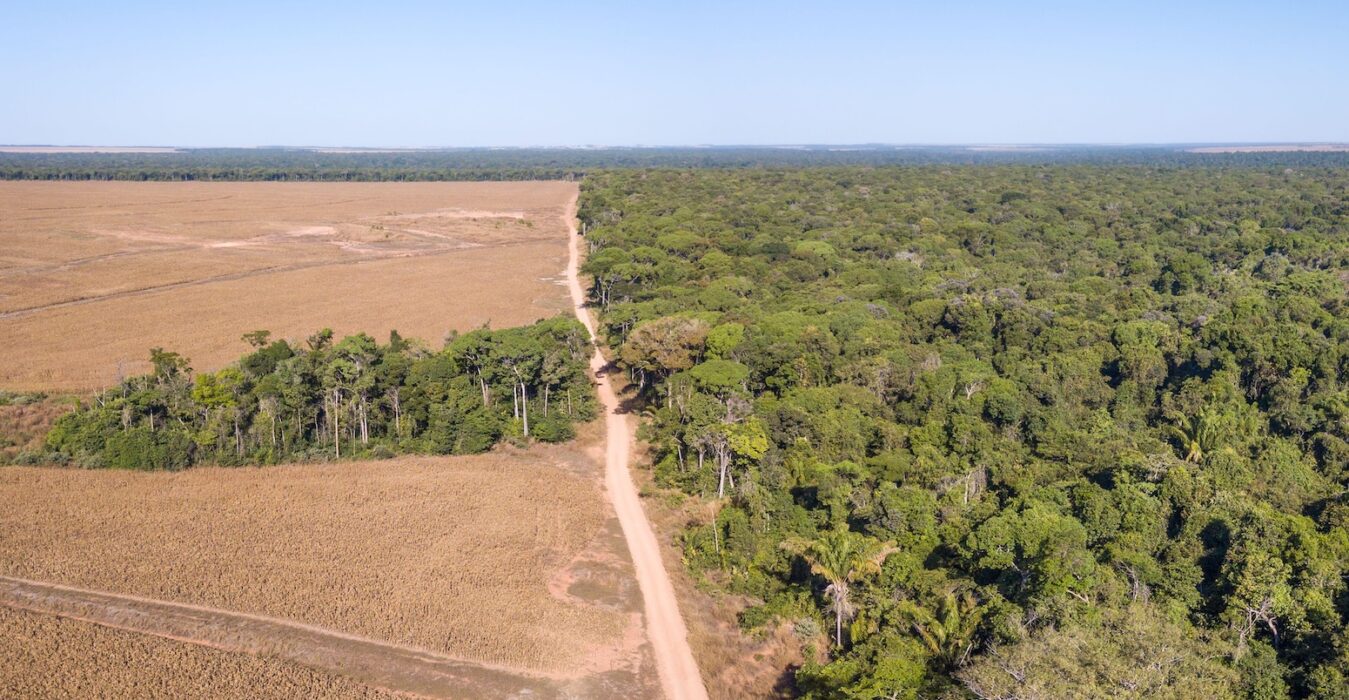
Aerial view of illegal Amazon deforestation. Credit: Paralaxis / Alamy Stock Photo

Last week, hundreds of scientists, policymakers and journalists flocked to the University of Exeter to attend an international conference on “tipping points”.

The conference saw experts discussing the dangers of a range of Earth system tipping points, including the dieback of the Amazon, the melting of the Greenland ice sheet and the shutdown of the Atlantic Meridional Overturning Circulation (AMOC).

Attendees also explored “positive tipping points” – large-scale, self-propelling social changes that would reduce the impact of humans on the climate.

(For more on the key talking points, new research and ideas that emerged from the four-day event, see Carbon Brief’s full write-up of the event.)

On the sidelines of the conference, Carbon Brief asked a wide range of delegates which tipping point concerns them the most. 

These are their responses, first as sample quotes, then, below, in full:

  • Prof Gabi Hegerl: “I am particularly worried about tipping points that involve the biosphere and humans due to breaching thresholds for heat or drought that then ripple into food availability, livelihood and ecosystems.”
  • Prof Carlos Nobre: “The Amazon is a very serious tipping point, because [dieback] could release around 250bn tonnes of CO2 by 2100 – which will make it impossible to [limit global warming] at 1.5C.”
  • Gaia Vince: “I would say that we have already passed the tipping point for coral reef ecosystems…As a scuba diver, I find it a tragedy because I love coral reef ecosystems, but it’s also a tragedy for human systems.”
  • Dr Andrew Hartley: “The tipping point I’m most concerned about is Amazon forest dieback…because of the significance of the carbon cycle and the feedback to the global climate. Also [due to] the effects that Amazon tipping has on food security, both locally and globally.”
  • Prof Tim Lenton: “The Atlantic Meridional Overturning Circulation, or AMOC, for sure. The consequences of crashing that would be devastating globally – and also for where I live in the UK.”
  • Prof Peter Cox: “The one that I’ve worked on most and worries me most at the moment is Amazon dieback. And that’s because we’ve got two things, two stressors, going on at once that push it in the wrong direction. Climate change is one, deforestation is another.”
  • Prof Johan Rockström: “The tipping element that worries me most is coral reef systems, for the simple reason that the scientific uncertainty range is very limited.”
  • Dr Patricia Pinho: “For me, it is the Amazon…I think it’s going to be a really profound, irreversible change that will affect the global population in the most dramatic way.”
  • Prof Ricarda Winkelmann: “I’m mostly concerned about the Greenland and West Antarctic ice sheets. This is because we know that, even at lower warming levels, they are already at risk of transgressing tipping points in certain regions.”
  • Dr Nico Wunderling: “The tipping element that worries me most is the Amazon rainforest. This is because the Amazon rainforest is not only threatened by climate change, but also by deforestation at the same time.”
  • Dr Rebecca Shaw: “The coral reef tipping point…It signals the end of the most colourful and biodiverse ecosystem which supports the nutrition and livelihoods of over one billion people.”
  • Dr David Obura: “The ice [tipping elements] – because they are the first ones to go that have cascading impacts on other tipping elements.”
  • Dr David Armstrong McKay: “The Amazon is actually probably closer to a deforestation-induced tipping point than to a climate change-induced tipping point. So, I actually think that could be potentially in the offing sooner than we would like.”
  • Kate Raworth: “The tipping point that I fear we will fail to cross is [the social tipping point] around transforming our mindsets.”

Prof Gabi Hegerl

Prof Gabi Hegerl
Chair in climate system science in the school of geosciences at the University of Edinburgh

I am worried about all of them, but for the immediate future, I am particularly worried about tipping points that involve the biosphere and humans due to breaching thresholds for heat or drought that then ripple into food availability, livelihood and ecosystems. The Earth system tipping points will do that too, but maybe a little bit later. Examples [of this] are the coral diebacks triggered by marine heatwaves, forest change and fires, and droughts threatening livelihoods and putting people on the move.

I did a research project on the US Dust Bowl and the trigger [for that event] was drought causing vegetation and crop dieback, [which led to] extreme heat and dust storms in response – and migration, as memorialised in [the 1939 John Steinbeck novel] The Grapes of Wrath. And, now with warming, all droughts get supercharged. 

Prof Carlos Nobre

Prof Carlos Nobre
Scientist and meteorologist who spearheaded the multi-disciplinary, multinational large-scale biosphere-atmosphere experiment in Amazonia

The Amazon is a very serious tipping point, because [dieback] could release around 250bn tonnes of CO2 by 2100 – which will make it impossible to [limit global warming] at 1.5C. We could also lose the largest [host to] biodiversity on the planet, which would induce a tremendous, large number of epidemics and several pandemics. Also, of course, the Amazon forest controls aspects of the global climate. In South America, the climate is entirely controlled by the Amazon forest. 

I’m most worried about Amazon [dieback] because I have worked on it for 40 years. But the other tipping points deeply concern me. The melting of the permafrost will release more than 200bn tonnes [of greenhouse gases], mostly methane. Ice sheet melt in Greenland is a very serious tipping point because it could raise sea level rise by three metres in 200 years. The melting of Greenland has already started. Species extinction is also very serious. 

One thing that was not much talked about [at this conference] is that when the ocean heats up, particularly the Arctic Ocean, then a tremendous amount of methane is released. And if that happens – if the Arctic Ocean warms up by 3-4C – the amount of methane that would be released could see [air] temperatures reach 8-10C [above pre-industrial levels]. At 8-10C, the only inhabitable places for us humans will be the top of the Alps, the Andes and the north and south poles. The rest of the planet would be uninhabitable. 
Gaia Vince

Gaia Vince
Science writer and broadcaster

I would say that we have already passed the tipping point for coral reef ecosystems, for example. That really is a tragedy. As a scuba diver, I find it a tragedy because I love coral reef ecosystems, but it’s also a tragedy for human systems. They are the nursery for our fisheries. And, of course, they’re not just fisheries – they are a valid ecosystem and a biodiversity hotspot. This will have untold consequences and cascading impacts for other parts of the ecosystem, for example, the cycling of nutrients and coral reefs are really important to stop coastal erosion. And they actually provide sand, the lovely white sand that people go on holiday for.

Dr Andrew Hartley

Dr Andrew Hartley
Climate impacts scientist at the Met Office Hadley Centre

The tipping point I’m most concerned about is Amazon forest dieback and reduction in the function of the Amazon forest, because of the significance of the carbon cycle and the feedback to the global climate. Also [due to] the effects that Amazon tipping has on food security, both locally and globally, because of [the Amazon’s] contribution to major commodity markets, such as soybean and maize. 

This might interact with climate change in the future to lead to more severe events, particularly in populated areas of Brazil. If an Amazon tipping point were to occur, it might lead to more severe events on the coast of Brazil which would affect a much larger population. There are negative impacts across the forest from the drying of the forest, for example for the Indigenous communities, but also globally.

Prof Tim Lenton

Prof Tim Lenton
Founding director of the Global Systems Institute and chair in climate change and Earth system science at the University of Exeter

The Atlantic Meridional Overtoning Circulation, or AMOC, for sure. The consequences of crashing that would be devastating globally – and also for where I live in the UK. By our own calculation, we could have less than half the viable area for growing a couple of major staple crops, wheat and maize worldwide. We would have a widespread water crisis. We could have collapses of the monsoons in West Africa and India that would displace hundreds of millions of people. It is hard to see that as anything other than a catastrophe.

Prof Peter Cox

Prof Peter Cox
Professor of climate system dynamics in mathematics and director of the Global Systems Institute at the University of Exeter

The one that I have worked on most and worries me most at the moment is Amazon dieback. And that’s because we’ve got two things, two stressors going on at once that push it in the wrong direction. Climate change is one, deforestation is another. You can imagine crossing the boundary in various ways – but, if you push diagonally, you get there quicker. 

If I had spoken to you 25 years ago, I would have said I’m really worried about [Amazon dieback]. Then I went through a phase of thinking that the models have overdone it. And now I’m thinking the models that don’t include land-use change are underdoing it. So, I’m more concerned about that one. 

There are others as well, but that is the one that is also quite fast. The other [tipping points] we worry about, we’re worried about a long-term commitment. It takes a while for the AMOC to shut down, it really does. It takes a while for the Greenland ice sheet to melt. We’ve done work that suggests you can overshoot even a little bit for these slow systems. The Amazon forest is a decadal dieback, especially if it is fire driven.

Prof Johan Rockström

Prof Johan Rockström
Director of the Potsdam Institute for Climate Impact Research (PIK) and professor in Earth system science at the University of Potsdam

There is not a simple answer to this – there is a two-part answer.

The tipping element that worries me most is coral reef systems, for the simple reason that the scientific uncertainty range is very limited. We have, unfortunately, ample evidence that at 1.5C we’re very likely to knock over, potentially, the entire tropical coral reef system on Earth. [This threatens] the livelihoods of 400 million people and a fundamental nursing ground for the whole ocean food web. So that is one deep concern. It is the canary in the coal mine – the first kid on the block to fall over. We’re so close.

The second one is AMOC – the whole overturning of heat in the Atlantic, which connects the entire ocean system. Not only is the latest science showing that we are going from low likelihood to uncomfortably high likelihood, but we also know – with very little uncertainty – that this would cause a catastrophic impact across the entire world, and it would go fast. So the AMOC, I would argue, is today the most important scientific message to the world. If you want a really hard-hitting reason to act at a level of planetary emergency, it is the AMOC. That is the second one. 

From a planetary boundary perspective, it is important to recognise that – on climate science grounds – the Amazon basin is not at risk of tipping until 3-5C of warming. But as soon as you factor in loss of biodiversity, deforestation and changes in hydrology – then the temperature risk goes down to between 1.5-2C. So suddenly – when taking a more integrated [assessment] approach – the conclusion is that it is also very close to a tipping point.
Dr Patricia Pinho

Dr Patricia Pinho
Deputy science director at the Amazon Environmental Research Institute (IPAM)

For me, it is the Amazon. When we think of the planetary crisis, we think about the Amazon and all the regulating climate services it provides. This is not only regionally, but we know it’s a global “climate good”, if you will. But it is highly sensitive to land-use change and increasing temperature. So, if we transition to a point of no return – Amazon dieback – and transforming or transitioning to another ecosystem, the function of the forest will not be doing what it has been doing for the past millennium and so on. And then we cannot revert this loss. I think it is going to be a really profound, irreversible change that will affect the global population in the most dramatic way. 

Of course, we have the people on the front line that I’m working with – Indigenous people, traditional population – that are safeguarding this resource, but they are also at the front line of climate risks and the impacts that we already observe. If we miss this opportunity of really reverting from increasing greenhouse emissions and increasing temperature, we’re going to miss the window of opportunity to really protect the region, protect the ecosystem and the forest for the global society. 

Prof Ricarda Winkelmann

Prof Ricarda Winkelmann
Founding director of the Max Planck Institute of Geoanthropology and professor of climate system analysis at PIK and the University of Potsdam

So I am thinking about this from a risk perspective – so both the likelihood as well as the impacts – and I think the answer depends on that. Because when it comes to the likelihood and the particular threshold – and we know about those – I’m mostly concerned about the Greenland and the West Antarctic ice sheets. This is because we know that, even at lower warming levels, they’re already at risk of transgressing tipping points in certain regions. 

But when it comes to the impacts and also the timescales over which those play out, there are other tipping elements that worry me most. In particular, regional tipping elements. So if we think of the mountain glaciers, for instance, these impacts are already experienced right now and several mountain glaciers are undergoing these accelerated changes. And so thinking about the timescales when it comes to the impacts is also incredibly important. 

Dr Nico Wunderling

Dr Nico Wunderling
Junior professor at the Center for Critical Computational Studies at Goethe University Frankfurt and researcher at the Potsdam Institute for Climate Impact Research.

The tipping element that worries me most is the Amazon rainforest. This is because the Amazon rainforest is not only threatened by climate change, but also by deforestation at the same time. So that means that the critical threshold from climate change alone, at around 3-4C of global warming, can come down to 1.5-2C. Climate change and deforestation basically go hand-in-hand to lower the [Amazon’s tipping] threshold because of this double threat. 
Dr Rebecca Shaw

Dr Rebecca Shaw
Chief scientist and senior vice-president at WWF

The coral reef tipping point – it comes first because of warming surface waters, and then the outcome is sealed by ocean acidification. It signals the end of the most colourful and biodiverse ecosystem which supports the nutrition and livelihoods of over one billion people and has captured the imagination of more people than any other through the characters like Nemo the clownfish, SpongeBob SquarePants, and, of course, Frank the coral [a character from an educational YouTube video]. 

If humanity is not motivated to act in the face of the loss of coral reefs, is there hope that we will act in time to prevent the Amazon and glacier tipping points?

Dr David Obura

Dr David Obura
Chair of the Intergovernmental Science-Policy Platform on Biodiversity and Ecosystem Services and founding director of CORDIO East Africa

The ice [tipping elements] – because they are the first ones to go that have cascading impacts on other tipping elements. When [ice masses] reduce, we lose their albedo, waters heat up more [and] the AMOC can collapse. That has the biggest impact across the planetary system, including the Amazon. 

My own [research], of course, is coral reefs. So, in a way, the coral reef tipping point does concern me the most. [But] it doesn’t have cascading impacts on other tipping elements. It does on people, in socioeconomic terms – but not on other system elements. So, in a sense, it is the least worrying one.
Dr David Armstrong McKay

Dr David Armstrong McKay
Lecturer in geography, climate change and society in the school of global studies at the University of Sussex and lead author on an influential ​​tipping points assessment, published in Science in 2022

One of the tipping systems that concerns me the most is Amazon rainforest dieback. Because even though we assessed it a few years ago as having a warming threshold that’s a bit higher than what we might be seeing – we’ve thought it is maybe at a best estimate of 3.5C – there’s also deforestation as well. The Amazon is actually probably closer to a deforestation-induced tipping point than to a climate change-induced tipping point. So I actually think that could be potentially in the offing sooner than we would like. That would have huge impacts for biodiversity, for South America as a whole, by shifting rainfall patterns, which would really affect a lot of people for agriculture or ecosystems. Also, the Amazon as an ecosystem is so incredibly biodiverse and amazing in itself, it would be a tragedy to lose it.
Kate Raworth

Kate Raworth
Senior visiting research associate and lecturer at the University of Oxford’s Environmental Change Institute and co-founder and conceptual lead of Doughnut Economics Action Lab

The tipping point that I fear we will fail to cross is [the social tipping point] around transforming our mindsets. We need to move from the extractive, degenerative economy towards a regenerative one. This all starts within our head and it underlies everything.

[A failure to do this] is what is driving us towards all these [Earth system tipping points].

Media reaction: The 2025 Texas floods and the role of climate change

Extreme weather|

10.07.25

Tipping points: Window to avoid irreversible climate impacts is ‘rapidly closing’

Science|

08.07.25

Fast-growing, global-south cities are ‘strikingly underrepresented’ in climate research

IPCC|

30.06.25

Guest post: Investigating how volcanic eruptions can affect climate projections

Climate modelling|

23.06.25

Donald Trump urges you to be a Climate Science denier like him. He says that he makes millions and millions for destroying the planet, Burn, Baby, Burn and Flood, Baby, Flood.
Orcas discuss how Trump was re-elected and him being an insane, xenophobic Fascist.
Nigel Farage urges you to ignore facts and reality and be a climate science denier like him. He says that Reform UK has received millions and millions from the fossil fuel industry to promote climate denial and destroy the planet.

Continue ReadingExperts: Which climate tipping point is the most concerning?

Starmer’s Labour: cuts to everything except the war machine

Spread the love

https://www.morningstaronline.co.uk/article/starmers-labour-cuts-everything-except-war-machine

The BBC and OBR claim that failing to cut disability benefits could ‘destabilise the economy’ while ignoring the spendthrift approach to tens of billions on military spending that really spirals out of control, argues DIANE ABBOTT MP

THE Labour leadership is adopting a scorched-earth policy to social programmes and public spending, with no section of society safe from their cuts. The consequences will be very grave for some of the poorest in society, for society as a whole and for the Labour Party.

In the first year of a Labour government, we have had cuts to the winter fuel allowance, a refusal to budge on the two-child benefit cap, cuts to sickness and disability benefits, and a tightening of departmental spending overall, which means cuts for some and a squeeze for the NHS.

This list is growing longer all the time. The latest target is the provision of special educational needs (SEN) spending in our schools, which ministers claim is spiralling out of control. There is also the beginning of a concerted PR campaign to abolish the “triple-lock” on the state pension, even though the meagre amount provided is one of the lowest in western Europe and insufficient for a decent retirement.

The main exception to this all-round austerity drive is military spending, which is really spiralling out of control. In fact, the pace of spending cuts elsewhere is designed to fill the real hole in government finances caused by the commitment to raise military spending to 5 per cent of GDP, a promise given to placate Donald Trump by Keir Starmer at the Nato summit.

Dianne Abbott’s article continues at https://www.morningstaronline.co.uk/article/starmers-labour-cuts-everything-except-war-machine

Keir Starmer confirms that he's proud to be a red Tory continuing austerity and targeting poor and disabled scum.
Keir Starmer confirms that he’s proud to be a red Tory continuing austerity and targeting poor and disabled scum.
Keir Starmer says that the Labour Party under his leadership all feel a small part of Scunthorpe.


Continue ReadingStarmer’s Labour: cuts to everything except the war machine

Fossil fuel donors contributed $19 million to Donald Trump’s inaugural fund

Spread the love
Donald Trump urges you to be a Climate Science denier like him. He says that he makes millions and millions for destroying the planet, Burn, Baby, Burn and Flood, Baby, Flood.

Original article

Companies and individuals linked to the fossil fuel industry donated more than $19 million to Donald Trump’s inaugural fund, new Global Witness analysis reveals. The analysis, based on itemised data published by the US Federal Election Commission, identified 47 individual donations from November 2024 to January 2025, accounting for around 7.8% of the total $245 million raised by the fund. Presidential inaugural funds are used to cover the costs of inauguration events, such as parades, galas and receptions.

Donald Trump used funds from his first inaugural fund in 2017 to organise a party at his own hotel, for which he was sued by the D.C. Attorney General. Of fossil fuel-linked donors, US oil giant Chevron made the largest contribution – $2 million – and was the joint fourth-largest donor overall. A string of other fossil fuel companies made donations of $1 million, including ExxonMobil, ConocoPhillips and Occidental Petroleum. A Chevron spokesperson said that “Chevron has a long tradition of celebrating democracy by supporting the inaugural committees of both parties” and that they were “proud to have done so again this year.” None of the other companies mentioned above responded to our inquiries.

In his inaugural address, Donald Trump promised to “drill, baby, drill” and said that the US “will be a rich nation again, and it is that liquid gold under our feet that will help to do it”. In the following months, the President signed a blitz of Executive Orders aimed at boosting the fossil fuel industry and kneecapping federal climate action. These include:

  • Opening up federal lands and waters to fossil fuel exploration as official US policy and revoking several climate action policies;
  • Establishing a new group to advise his office on how to accelerate the ‘permitting, production, generation, distribution, regulation, and transportation’ of oil and gas;
  • Removing regulations on coal production to revive the flagging industry; and,
  • Ordering the US Attorney General to quash state-level “polluters pay” laws that would push fossil fuel companies to pay their fair share of climate damages.
Neo-Fascist Climate Science Denier Donald Trump says Burn, Baby, Burn.

 Global Witness Senior Data Investigator Nicu Calcea said: “It’s no surprise the oil and gas industry handed millions to Donald Trump for his inauguration, and they seem to have reaped a huge return on their investment.

Every month that Donald Trump has been in power, we’ve seen a raft of anti-climate measures come out which are music to the fossil fuel industry’s ears. From plans to steamroll through dirty new coal plants, to the attempted quashing of ‘polluter pays’ laws that would hold oil giants accountable, it’s clear where his political priorities lie.

“While Trump sides with his friends in oil and gas, we must keep up the fight for a fair, green future – that means pushing for wind and solar where we live, backing polluters pay bills, and resisting the development of oil, gas and coal projects across the country.”

Many of the world’s worst environmental and human rights abuses are driven by the exploitation of natural resources and corruption in the global political and economic system. Global Witness is campaigning to end this. We carry out hard-hitting investigations, expose these abuses, and campaign for change. We are independent, not-for-profit, and work with partners around the world in our fight for justice.

Orcas discuss how Trump was re-elected and him being an insane, xenophobic Fascist.
Nigel Farage urges you to ignore facts and reality and be a climate science denier like him. He says that Reform UK has received millions and millions from the fossil fuel industry to promote climate denial and destroy the planet.

Continue ReadingFossil fuel donors contributed $19 million to Donald Trump’s inaugural fund

Trump’s budget cuts are adding to risk in life-threatening floods and emergencies

Spread the love
AP Photo/Julio Cortez/Alamy

Clodagh Harrington, University College Cork

Acclaimed author Michael Lewis wrote a book about the first Trump administration entitled The Fifth Risk, outlining the consequences when people who don’t understand how the government of a vast, complex and multifaceted nation works are put in charge of said government.

The bestseller was more gripping and fascinating than any work of fiction. It outlined the realities that followed Donald Trump’s 2016 campaign promises to shrink the federal bureaucracy. In it, Lewis quotes lawyer Max Stier, who he describes as the American with the greatest understanding of how his nation’s government worked. Stier offers the truism that “the basic role of governments is to keep us safe.”

You might deduce that this means those in charge during, and ahead of, emergencies should know what to do and how to do it. And, they have to want to do it. In the case of Trump term one, there was often evidence that some or all of these three elements were lacking. Evidently, planning for distant risk was not something that Trump and his team were interested in prioritising.

Fast forward to July 2025, and US headlines are filled with images of devastating flash floods in which more than 100 Texans, many of them children, lost their lives. In Kerr County, outside of San Antonio, water levels of the Guadalupe River rose to what was considered a once in a “100-year catastrophe”. Nobody saw it coming, or at least not to the extent that it did. Despite official warnings, the result was one of the worst natural disasters ever faced by the state.


Get your news from actual experts, straight to your inbox. Sign up to our daily newsletter to receive all The Conversation UK’s latest coverage of news and research, from politics and business to the arts and sciences.


Days earlier, Trump’s “big beautiful bill” was passed in the Senate with a tight 51:50 majority. Republican Texas senator Ted Cruz was among the supporters of a bill which will cut funding for the National Weather Service (NWS) by 6.7% in 2026. These come on the back of earlier resource reductions to the NWS and the National Oceanic and Atmospheric Association (NOAA).

Within days of the Texas floods, Democrats were calling for an investigation into whether previous budget cuts might have affected capacity for flood preparedness in Kerr County.

For the bereaved, talk of culpability will hardly bring solace. And any immediate political blame game presents as unseemly in the middle of so much personal tragedy. But a New York Times article reported that “some experts say that staff shortages might have complicated forecasters’ ability to coordinate response”. Such speculative language does not offer clarity or reassurance, and even the often brash president has thus far refrained from finger pointing.

Nonetheless, uncomfortable conversations are necessary, as it is clear that slashing federal funding does not serve the nation well. Trump already had budget cutting form, as his first-term efforts to slash NOAA and related programme funding demonstrated.

In 2017, the Environmental Protection Agency (EPA) was also targeted for staff and funding reductions. This came along with the appointment of EPA chiefs who appeared uninterested in prioritising the climate crisis. More recently, the controversial spending cuts agency the Department of Government Efficiency (Doge), headed by Elon Musk, included NOAA in its sights.

Yale University’s Center for Environmental Communication said that while there was no clear evidence that budget cuts had affected weather forecasting in the Texas case, Trump’s planned additional cuts would affect some of NOAA’s key flash flood forecast tools. This includes the Flash project, which improves accuracy, timing and specificity of warnings, such as those that occurred in Texas on July 4. It also said that the weather service had lost many of its most senior staff, which would increase the risks associated with weather-related tragedies.

Flood water in Texas rose spectacularly fast causing dozens of deaths.

Cuts and the climate

Across the board, Doge has targeted other agencies that the public rely on in a crisis, including the Federal Emergency Management Agency (Fema), where plans to reduce staffing by about 20% are currently coming into effect. With responsibility for managing natural and climate-fuelled disasters from hurricanes to floods, the agency has become busier in recent years as disasters have evolved from seasonal to perennial.

Rob Moore, the director of flooding solutions at the Natural Resources Defense Council, an influential environmental body, argued that “America’s disaster safety net is unraveling.”

There are likely to be more floods, and other nature-based catastrophes with multiple probable causes and features. While outright prevention may not always be possible, governmental risk and disaster management can help to preclude the devastation seen on July 4 in Texas.

The problem with responding to long-term risk with short-term or inadequate solutions is that one day, an existential threat could arrive for which the US will not be ready. The danger may not even be as overwhelming as a global pandemic or nuclear threat. It could be as mundane as a local river overflowing. For those who lost their loved ones in Texas, there is nothing distant about their anguish.

A country with the world’s largest economy does not have to cut federal bureaucracy corners. Wasting tax dollars is never a vote winner, but funding vital emergency services like Fema and the National Weather Service is a fundamental feature of an advanced democracy. As is investing in the technology and personnel to do all possible to predict flash floods. Trump would do well to remember this as he meets the bereaved in Kerr County.

Clodagh Harrington, Lecturer in American Politics, University College Cork

This article is republished from The Conversation under a Creative Commons license. Read the original article.

Donald Trump urges you to be a Climate Science denier like him. He says that he makes millions and millions for destroying the planet, Burn, Baby, Burn and Flood, Baby, Flood.
Nigel Farage urges you to ignore facts and reality and be a climate science denier like him. He says that Reform UK has received millions and millions from the fossil fuel industry to promote climate denial and destroy the planet.
Neo-Fascist Climate Science Denier Donald Trump says Burn, Baby, Burn.
Continue ReadingTrump’s budget cuts are adding to risk in life-threatening floods and emergencies

Media reaction: The 2025 Texas floods and the role of climate change

Spread the love

Original article by Josh Gabbatiss, Cecilia Keating, Robert McSweeney and Ayesha Tandon republished form Carbon Brief under a CC license.

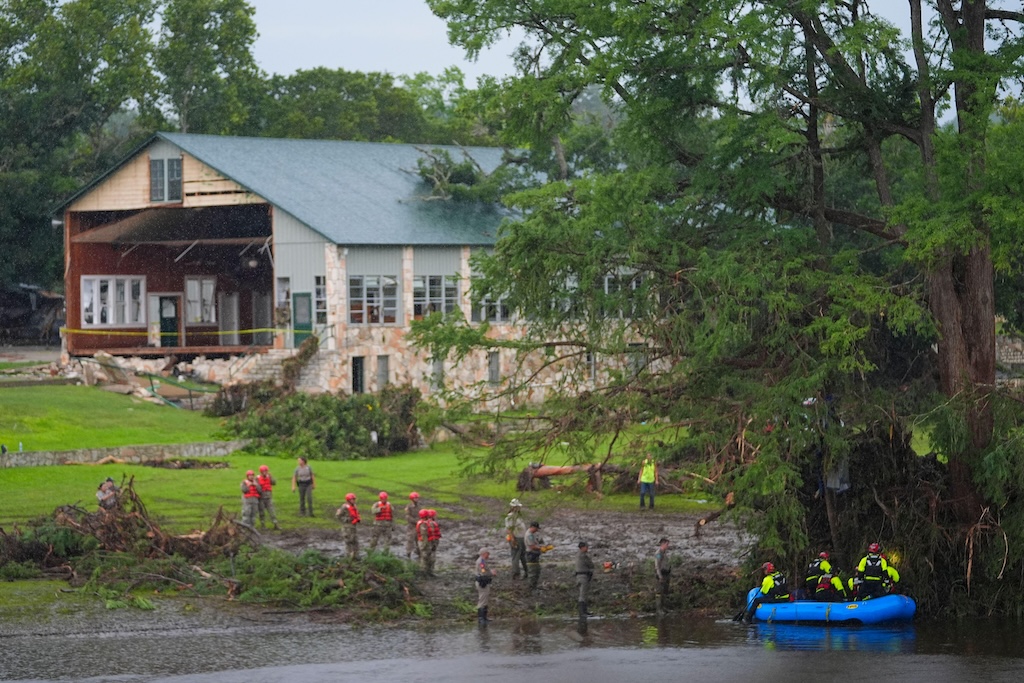
At least 120 people have died after a devastating flash flood swept through homes and holiday camps in central Texas in the early hours of 4 July.

The disaster unfolded after a severe rainstorm caused the Guadalupe River to swell to its second-greatest height on record. 

Headlines have been dominated by the death of 27 children and counsellors from a summer camp for girls near the banks of the river.

In the aftermath of the flooding, many news outlets questioned whether the Trump administration’s decision to cut staff from the federal climate, weather and disaster response services may have impacted the emergency response to the disaster.

However, others defended the agency’s actions, saying that the appropriate warnings had been issued.

Scientists have been quick to point out the role of climate change in driving more intense rainfall events.

A rapid attribution analysis found “natural variability alone” could not explain the extreme rainfall observed during the “very exceptional meteorological event”.

Meanwhile, social media has also been awash with misinformation, including claims that the floods were caused by geoengineering – an argument that was quickly dismissed by officials. 

In this article, Carbon Brief unpacks how the flood unfolded, the potential role of climate change and whether advanced warnings were affected by funding cuts to key agencies.

How did the flooding develop?

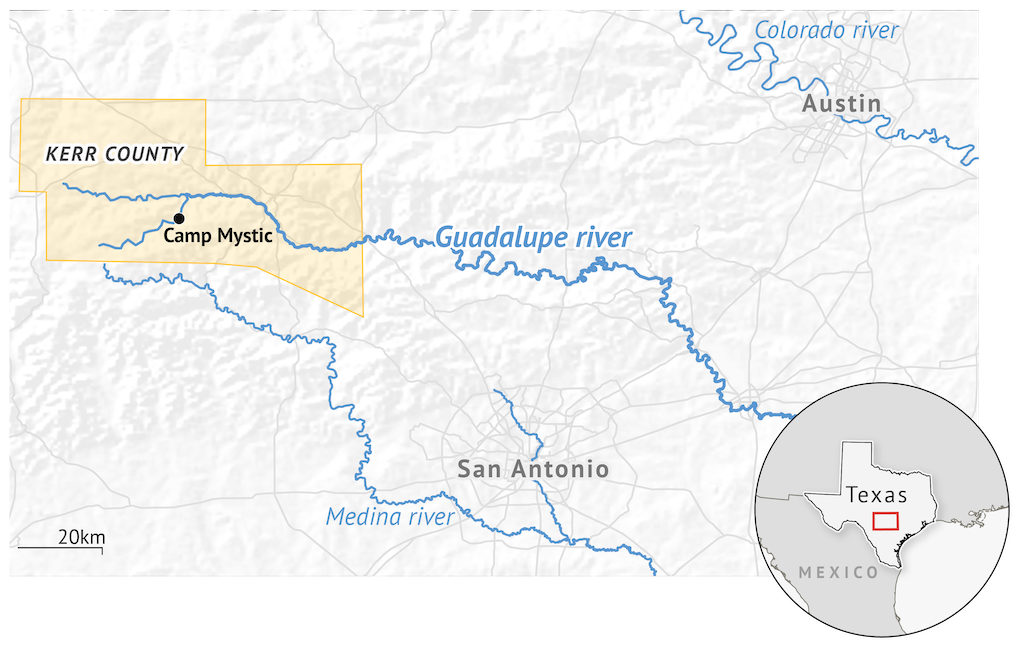
The flash flooding began in the early hours of the morning on Friday 4 July, with early news coverage focusing on Guadalupe River in Kerr County. 

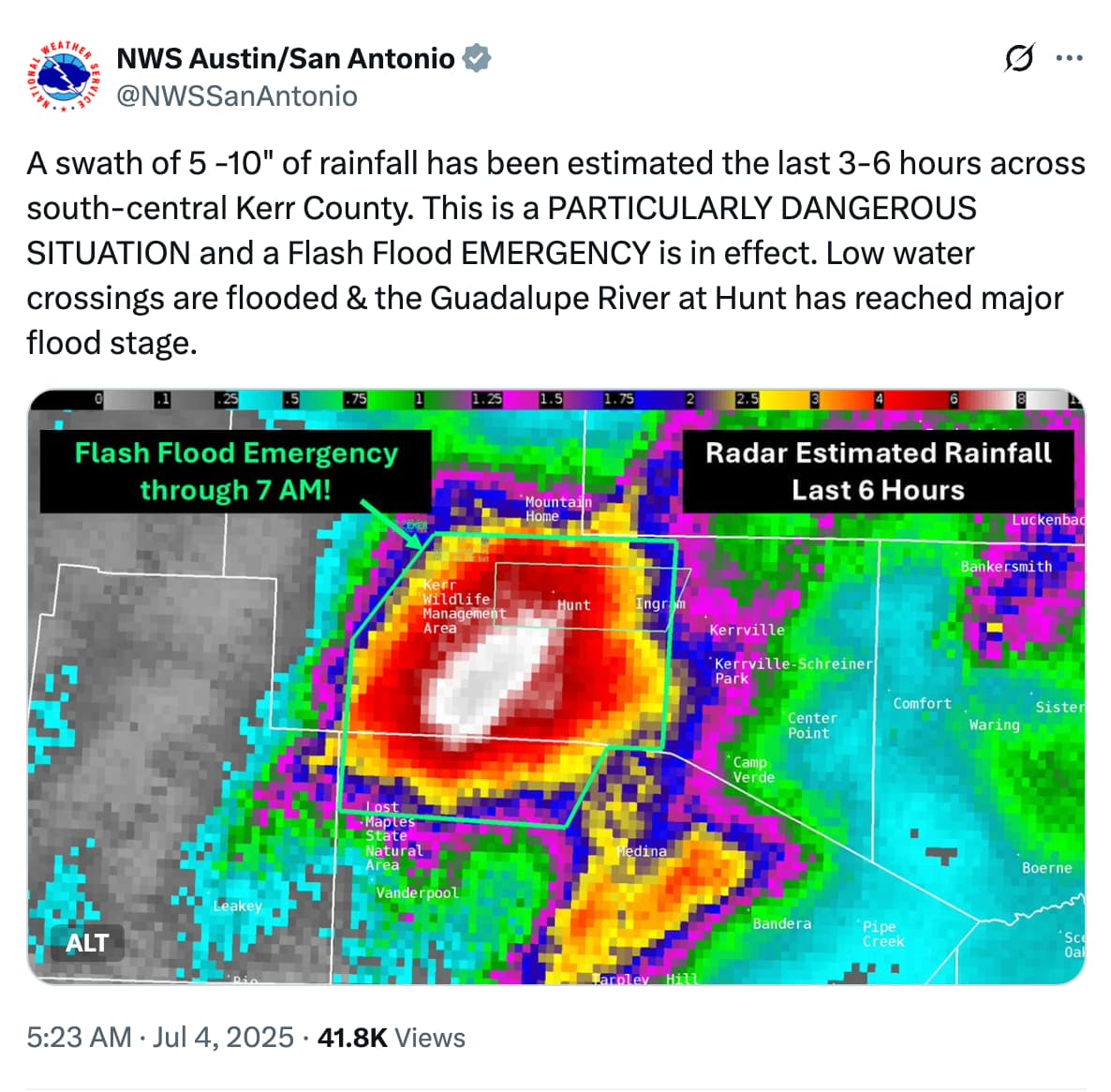
According to BBC News, the US National Weather Service (NWS) reported a “swathe of around 5-10 inches (125-250mm) of rainfall in just three to six hours across south-central Kerr County”, equivalent to “around four months of rain [falling] in a matter of hours”.

The slow-moving weather system was fed by moisture from the remnants of Tropical Storm Barry, which had brought flooding to Mexico, before tracking north as it died out, the outlet explained.

Kerr County is a “hillier part of Texas than surrounding counties”, meaning that “moisture-laden air was forced upwards, building huge storm clouds”, the article noted:

“These storm clouds were so large they effectively became their own weather system, producing huge amounts of rain over a large area.”

Credit: Texas Water Development Board

Prof Hatin Sharif, a hydrologist and civil engineer at the University of Texas at San Antonio, explained in an article for the Conversation why Kerr County is part of an area known as “flash flood alley”:

“The hills are steep and the water moves quickly when it floods. This is a semi-arid area with soils that don’t soak up much water, so the water sheets off quickly and the shallow creeks can rise fast.”

He added that Texas as a whole “leads the nation in flood deaths” – by a “wide margin”.

As the rain lashed down, the “destructive, fast-moving waters” of Guadalupe River rose by 8 metres in just 45 minutes before daybreak on Friday, said the Associated Press, “washing away homes and vehicles”.

The Washington Post reported that the river reached its “second-greatest height on record…and higher than levels reached when floodwaters rose in 1987”. It added that “at least 1.8tn gallons of rain” fell over the region on Friday morning.

NWS Austin/San Antonio on X: A swath of 5 -10" of rainfall has been estimated the last 3-6 hours across south-central Kerr County

The floodwaters swept through camps, resorts and motorhome parks along the banks of Guadalupe River for the Fourth of July weekend. 

A timeline of events by NPR reported that “boats and other equipment that was pre-positioned started responding immediately”. 

The article quotes Texas lieutenant governor Dan Patrick, who said there were 14 helicopters, 12 drones and nine rescue teams in action – as well as “swimmers in the water rescuing adults and children out of trees”. He added that there were 400 to 500 people on the ground helping with the rescue effort.

By Saturday 5 July, more than 1,000 local, state and federal personnel were on the ground helping with the rescue operation, NPR said.

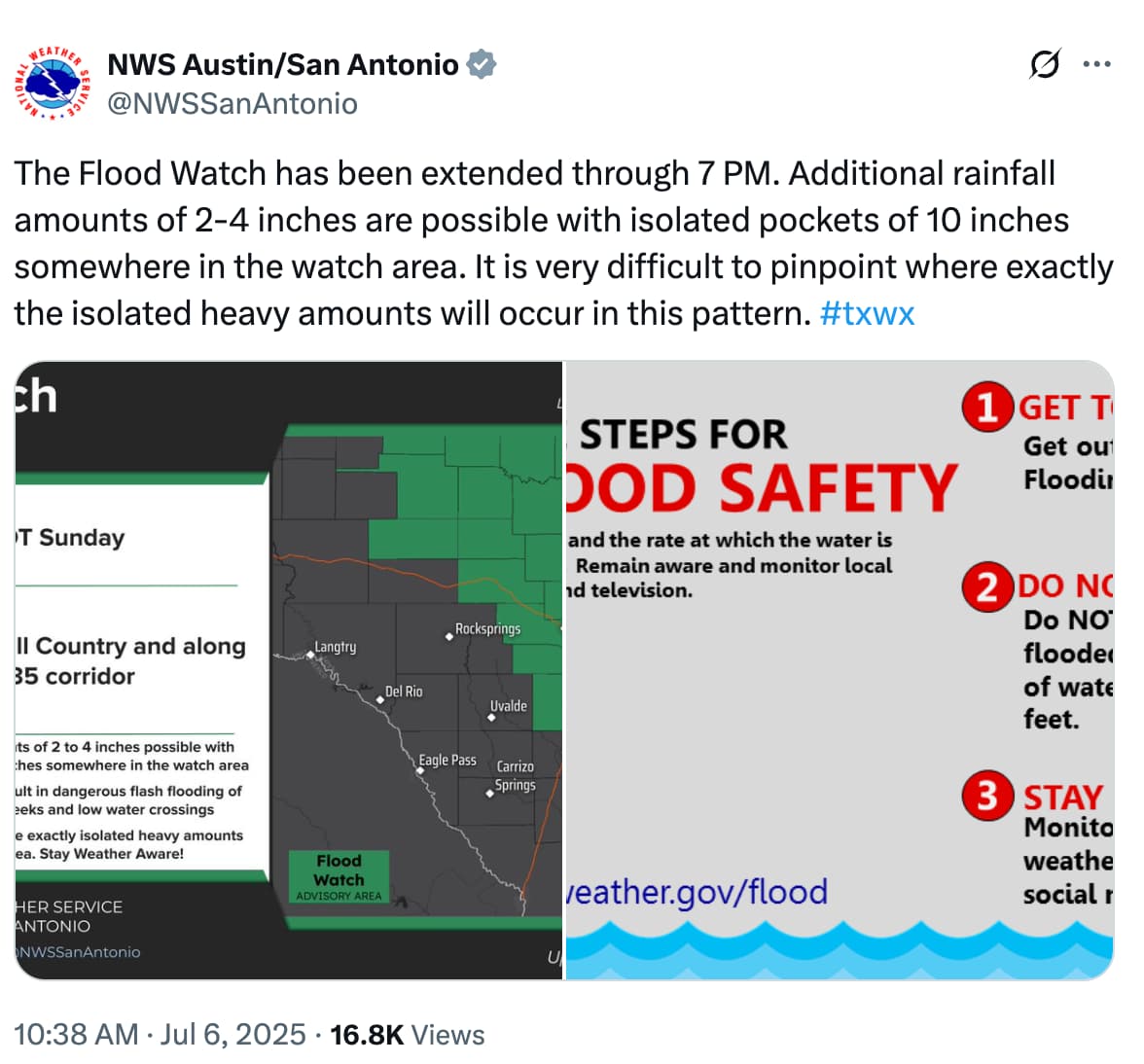
In the days that followed, further periods of heavy rainfall meant that flood watches remained in place for much of the weekend, said Bloomberg.

NWS Austin/San Antonio on X: The Flood Watch has been extended through 7 PM

Newspapers and online outlets were filled with images from the area. For example, the Sunday Times carried photos and video footage of the floods, while BBC News had drone footage of the “catastrophic flooding”.

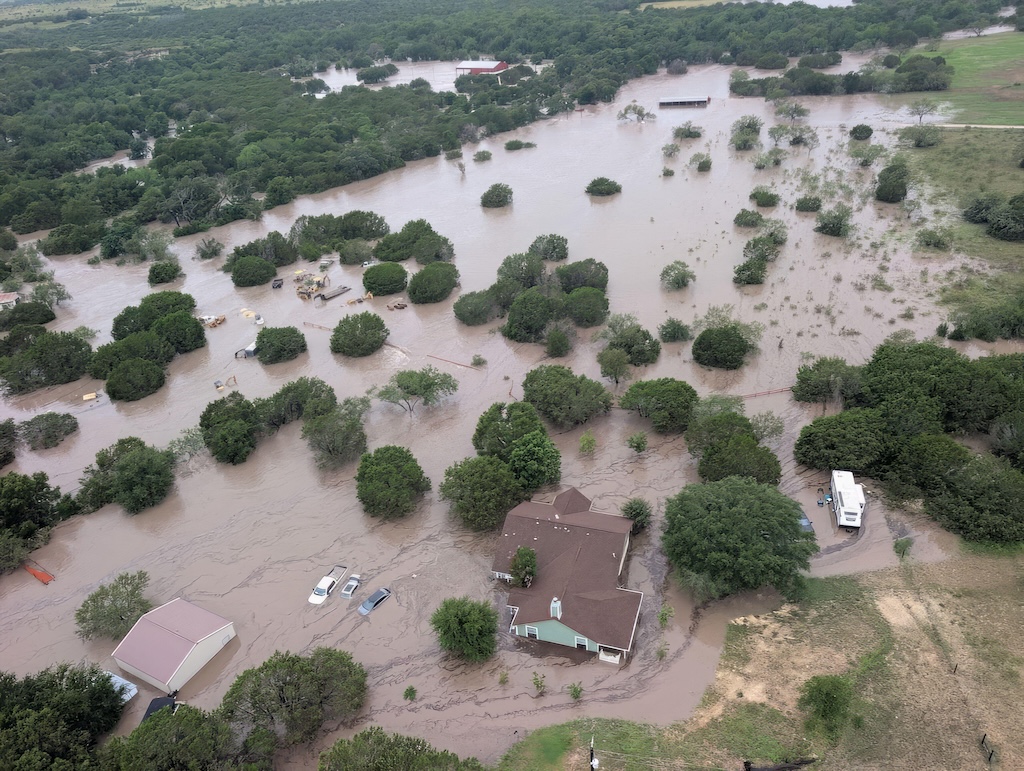
Aerial view of the Guadalupe River flooding the surrounding area near Kerville, Texas on 5 July 2025.
Aerial view of the Guadalupe River flooding the surrounding area near Kerville, Texas on 5 July 2025. Credit: PO3 Cheyenne Basurto / U.S. Coast Guard Photo / Alamy Stock Photo

Back to top

What impact did the flooding have?

The floods have killed at least 119 people, according to the latest count reports by the Guardian

“In Kerr county, the area that was worst affected by last Friday’s flood, officials said on Wednesday morning that 95 people had died. The other 24 people who have died are from surrounding areas. The Kerr county sheriff said 59 adults and 36 children had died, with 27 bodies still unidentified.”

There are also 173 people believed to still be missing, the Guardian said, including 161 from Kerr County specifically. 

Bloomberg noted that “some of the victims came from additional storms around the state capital Austin on 5 July”. It added that, according to officials, “no one had been found alive since 4 July, when the deluge arrived in the pre-dawn hours”.

BBC News reported that continuing rains following the initial flood “hamper[ed] rescue teams who are already facing venomous snakes as they sift through mud and debris”.

Headlines have been dominated by the death of 27 children and counsellors from Camp Mystic – a 700-acre summer camp for girls, which has been running for almost 100 years, noted the Guardian

BBC News reported that “many of the hundreds of girls at the camp were sleeping in low-lying cabins less than 500ft (150 metres) from the riverbank”.

Lieutenant governor Patrick “told of one heroic camp counsellor who smashed a window so girls in their pyjamas could swim out through neck-high water”, the outlet reported. He added that “these little girls, they swam for about 10 or 15 minutes” before reaching safety.

The Associated Press reported:

“Dozens of families shared in local Facebook groups that they received devastating phone calls from safety officials informing them that their daughters had not yet been located among the washed-away camp cabins and downed trees. Camp Mystic said in an email to parents of the roughly 750 campers that if they have not been contacted directly, their child is accounted for.”

The New York Times published images and videos of the aftermath at the summer camp. 

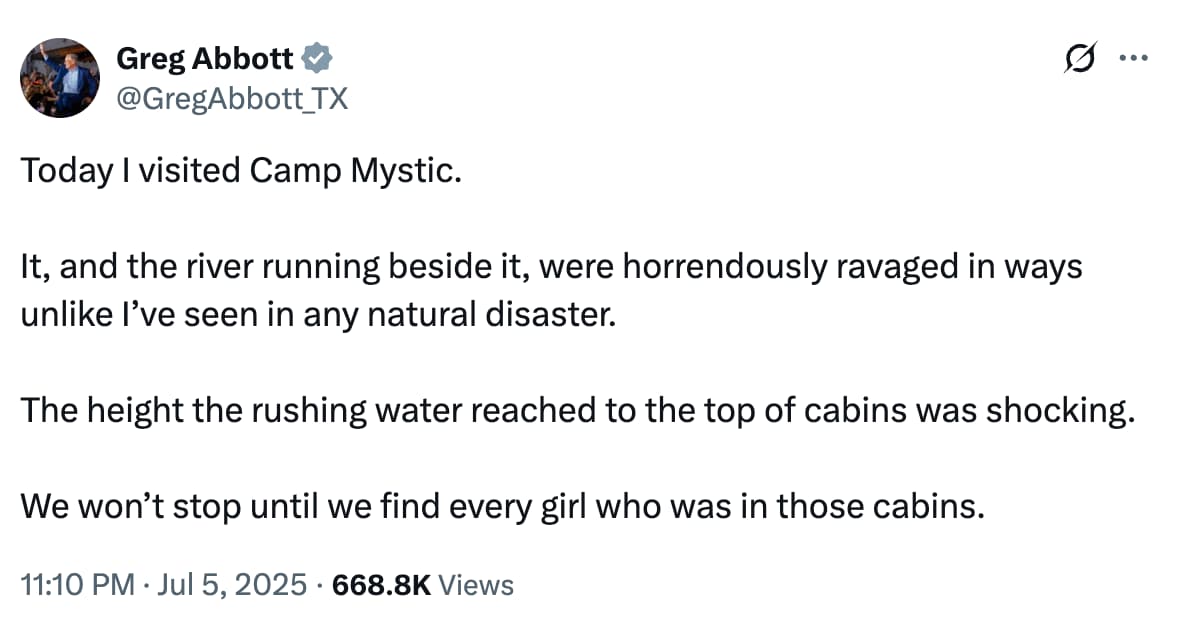
Visiting the site on Sunday 6 July, Texas governor Greg Abbott tweeted that the camp was “horrendously ravaged in ways unlike I’ve seen in any natural disaster”. 

Greg Abbott on X: Today I visited Camp Mystic.

In the immediate aftermath of the floods, US president Donald Trump, at his golf club in Bedminster in New Jersey, signed a major disaster declaration that freed up resources for the state, reported France24

A preliminary estimate by the private weather service AccuWeather put the damage and economic loss at $18bn-$22bn (£13.2bn-£16.2bn), the Guardian reported.

Former president Barack Obama described the events as “absolutely heartbreaking”, reported the Hill. In a statement, former president George W Bush and his wife Laura – who was once a counselor at the camp – said that they “are heartbroken by the loss of life and the agony so many are feeling”, another Hill article reported.

American-born pontiff Pope Leo XIV also “voiced his sympathies”, reported another Guardian article. Speaking at the Vatican, he said:

“I would like to express sincere condolences to all the families who have lost loved ones, in particular their daughters who were in a summer camp in the disaster caused by flooding of the Guadalupe River in Texas.”

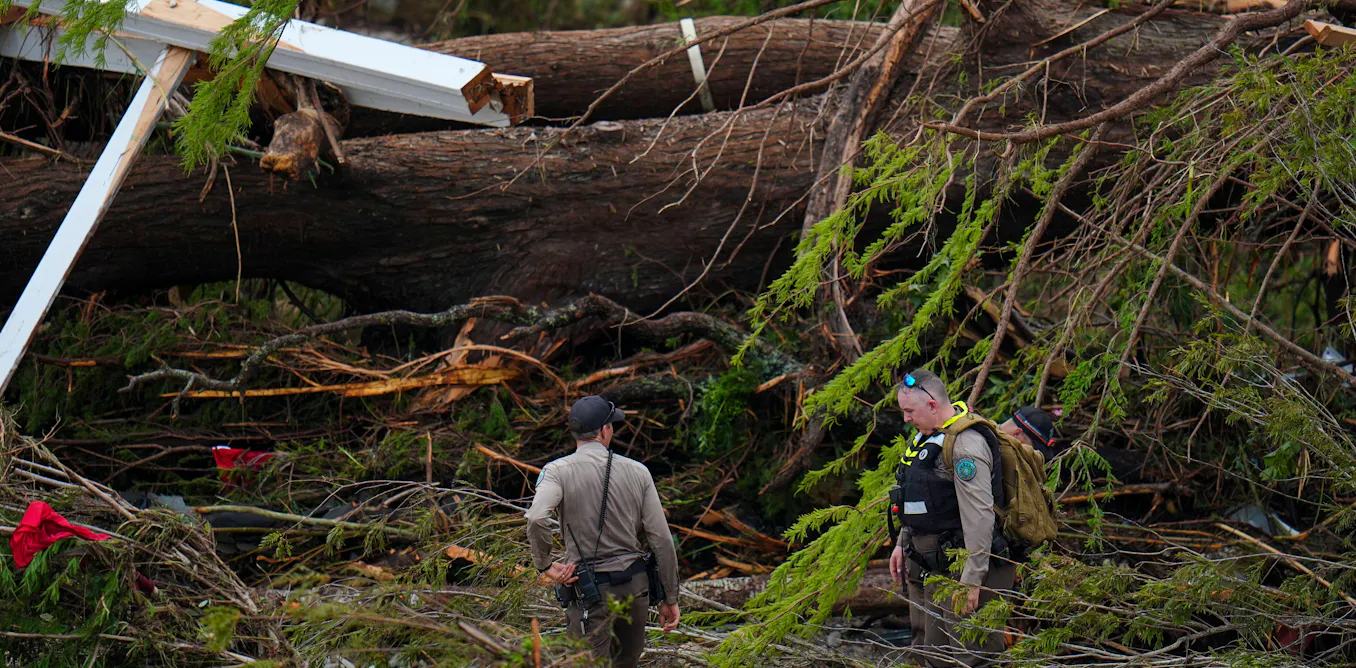
Rescue workers search for missing people near Camp Mystic on 6 July 2025.
Rescue workers search for missing people near Camp Mystic on 6 July 2025. Credit: Julio Cortez / Alamy Stock Photo

Back to top

What role did climate change play?

As the planet warms, extreme rainfall events are becoming more intense in many parts of the world. 

This is principally because, according to the Clausius-Clapeyron (C-C) equation, the air is able to hold 7% more moisture for every 1C that the atmosphere warms, which means warmer air can release more liquid water when it rains.  

For example, a recent study of the US found that the frequency of heavy rainfall at “durations from hourly to daily increased in 1949-2020”. It added that this was “likely inconsistent with natural climate variability”.

In addition, research indicates that, in some parts of the world, increases in the intensity of extreme rainfall over 1-3 hours are “stronger” than would be expected from the C-C scaling.

However, many other factors – such as local weather patterns and land use – affect whether extreme rainfall leads to flooding.

Local meteorologist Cary Burgess told Newsweek that “this part of the Texas Hill Country is very prone to flash flooding because of the rugged terrain and rocky landscape”. For example, the outlet notes, 10 teenagers died in flash floods in July 1987.

In the aftermath of the flooding in Texas, Dr Daniel Swain, a climate scientist at the University of California Agriculture and Natural Resources, told ABC News that there is “abundant evidence” that “highly extreme rain events” have “already increased considerably around the world as a result of the warming that’s already occurred”.

Prof Andrew Dessler from Texas A&M University wrote on climate science newsletter The Climate Brink that “more water in the air flowing into the storm will lead to more intense rainfall”. He added:

“The role of climate change is like steroids for the weather – it injects an extra dose of intensity into existing weather patterns.”

Dr Jennifer Francis, a climate scientist at the Woodwell Climate Research Center, told Bloomberg that Texas is “particularly flood-prone because the fever-hot Gulf of Mexico is right next door, providing plenty of tropical moisture to fuel storms when they come along”.

Many outlets pointed out the higher-than-average sea surface temperatures in the Gulf of Mexico. BBC News said:

“Sea surface temperatures in the Gulf of Mexico, where some of the air originated from, continue to be warmer than normal. Warmer waters mean more evaporation and so more available moisture in the atmosphere to feed a storm.”

Yale Climate Connections reported that sea surface temperatures were up to 1C above average in the central Gulf of Mexico. It said that human-caused climate change made these conditions up to 10 times more likely, according to the Climate Shift Index from Climate Central.

(This index gives the ratio of how common the temperature is in today’s climate, compared to how likely it would be in a world without climate change.)

Bloomberg was among a number of outlets to note that, in the run-up to the flooding, nearly 90% of Kerr County was experiencing “extreme” or “exceptional” drought. This meant the soil was hard and less able to soak in water when the intense rainfall arrived.

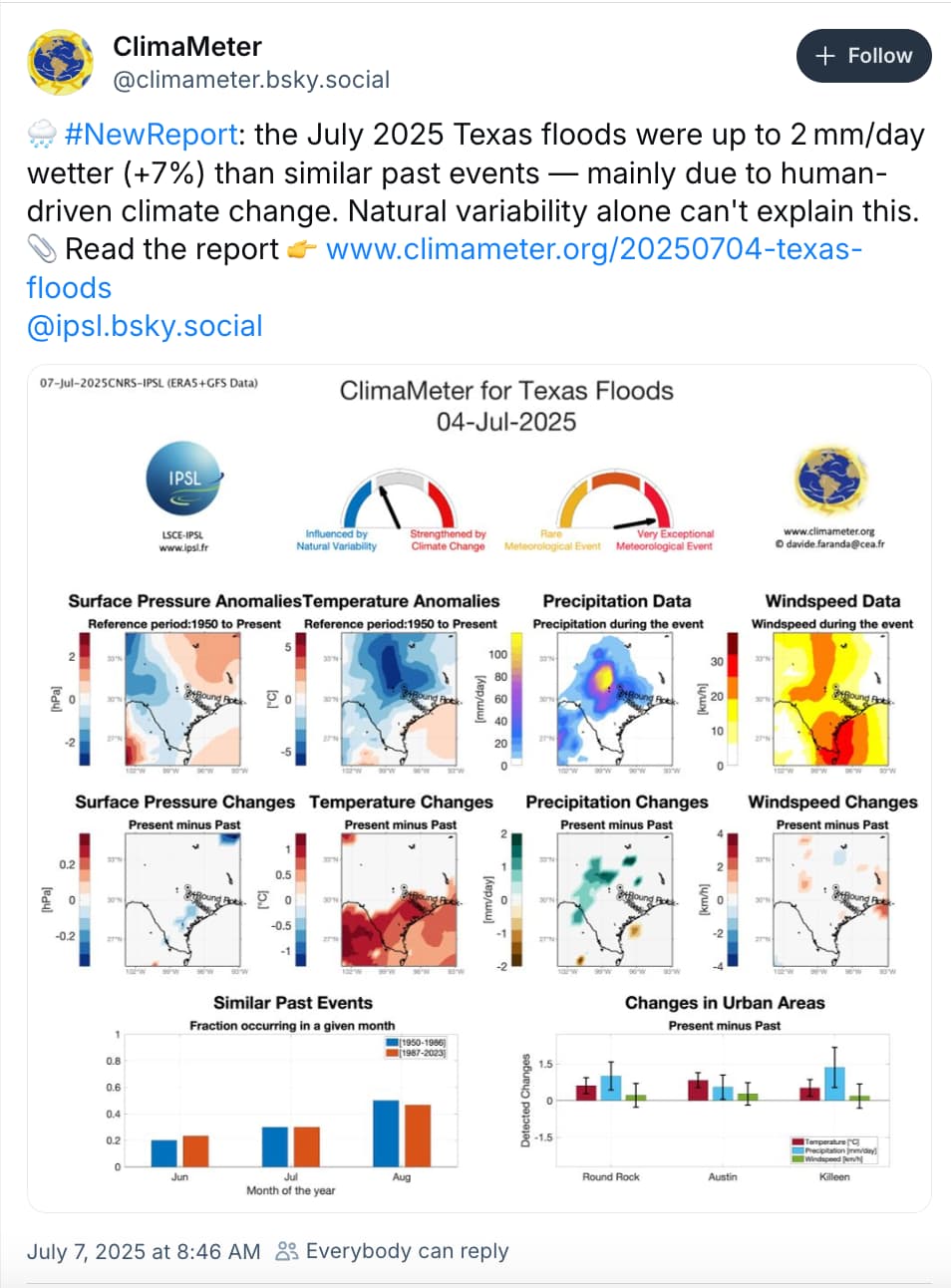
Just days after the event, rapid attribution group ClimaMeter published an analysis of the meteorological conditions that led to the flooding.

It stated that “conditions similar to those of the July 2025 Texas floods are becoming more favorable for extreme precipitation, in line with what would be expected under continued global warming”.

According to the analysis, the flooding was a “very exceptional meteorological event”. It explained that “meteorological conditions” similar to those that caused the floods are “up to 2 mm/day (up to 7%) wetter in the present than they have been in the past”. It added:

“Natural variability alone cannot explain the changes in precipitation associated with this very exceptional meteorological condition.”

ClimaMeter on Bluesky: the July 2025 Texas floods were up to 2 mm/day wetter

The field of extreme weather attribution aims to find the “fingerprint” of climate change in extreme events such as floods, droughts and heatwaves. 

ClimaMeter focuses on the atmospheric circulation patterns that cause an extreme event – for example, a low-pressure system in a particular region. Once an event is defined, the scientists search the historical record to find events with similar circulation patterns to calculate how the intensity of the events has changed over time.

The study authors warned that they have “low confidence in the robustness” of their conclusions for this study, because the event is “very exceptional in the data record”, so they do not have many past events to compare it to.

In its coverage of the attribution study, the Wall Street Journal highlighted some of the research’s limitations. It said: 

“Remnant moisture from Tropical Storm Barry stalled over the region and repeatedly fed rainfall, making it hard to compare the weather pattern to historical data.”

The outlet quoted one of the study’s co-authors, Dr Davide Faranda, a scientist at France’s National Centre for Scientific Research, who said the data “nonetheless suggests that climate change played a role”.

Many other climate scientists have also linked the flooding to climate change. 

For example, Dr Leslie Mabon, a senior lecturer in environmental systems at the Open University, told the Science Media Centre:

“The Texas floods point to two issues. One is that there’s no such thing as a natural disaster – and one area that disaster experts will be probing is what warnings were given and when. The second is that the pace and scale of climate change means extreme events can and do exceed what our infrastructure and built environment is able to cope with.”

Back to top

Were the forecasts and warnings affected by recent job cuts?

Observers were quick to question how the response to the floods has been impacted by recent sweeping cuts to federal climate, weather and disaster response services by the Trump administration.

BBC News explained how staffing cuts overseen by the so-called Department of Government Efficiency – the initiative formerly led by Elon Musk – have reduced the workforce National Weather Service (NWS). 

The news outlet reported that – since the start of the year – “most” probationary employees had their contracts terminated, 200 employees have taken voluntary redundancy, 300 opted for early retirement and 100 were “ultimately fired”.

(The Trump administration has also proposed a 25% cut to the budget of the National Oceanic and Atmospheric Administration (NOAA) – the agency which oversees the NWS – but this would not come into force until the 2026 financial year.)

The Independent was among a raft of publications to report the weather service had predicted 1-3 inches (2.5-7.6cm) of rain for the region – significantly less than the 10-15 inches (25-38cm) that ultimately fell.

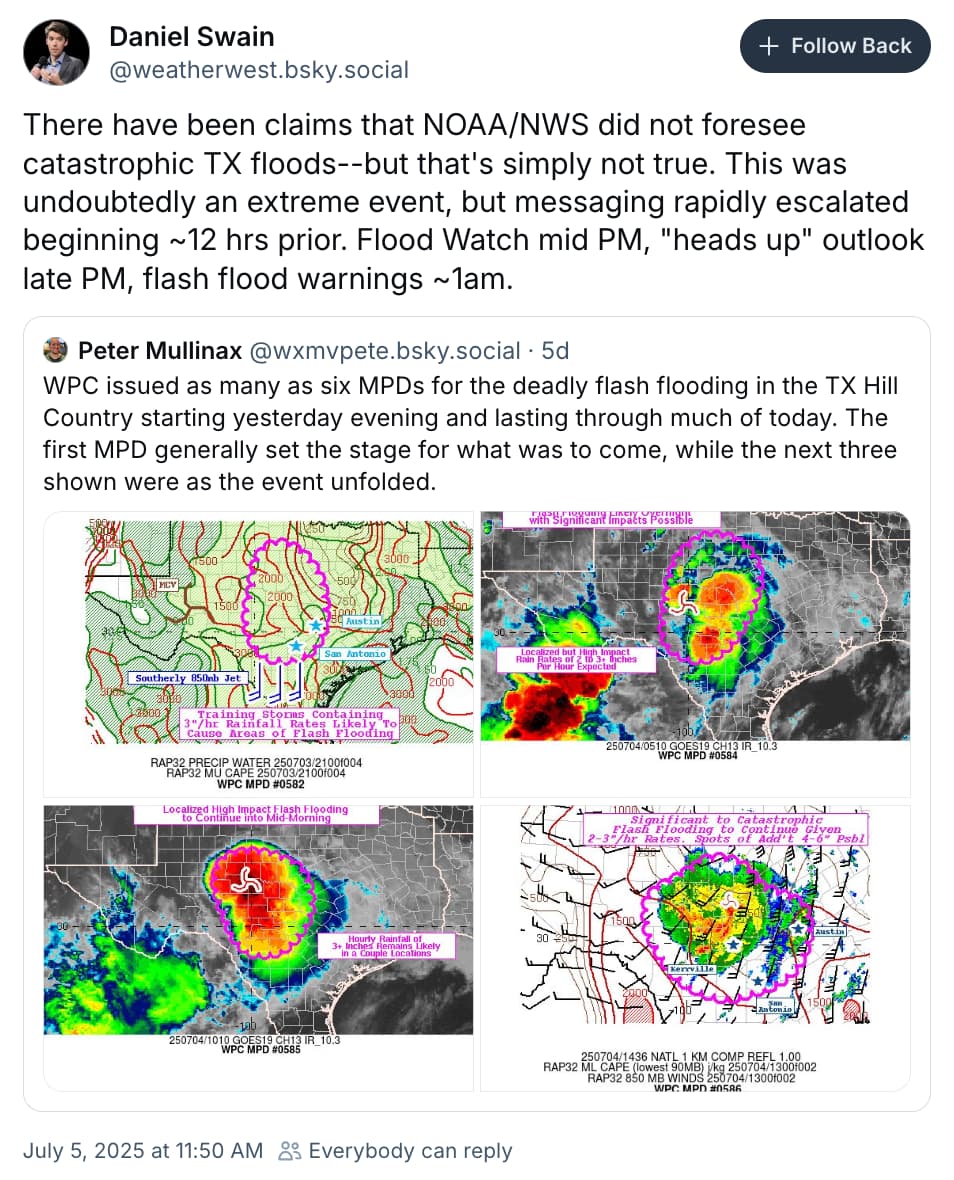
CNN detailed how the first “life-threatening flash flooding warning” for parts of Kerr County – which would have triggered alerts to mobile phones in the area – was issued just past 1am on Friday morning by the NWS. This was 12 hours after the first flash flood warning and followed “several technical forecasts” issued on Thursday afternoon and evening with “increasingly heightened language”, it said.

Other publications focused on staffing shortages at local branches of the weather service. The New York Times and Guardian were among the outlets who reported that “key staff members” had been missing at the two Texas NWS offices involved in forecasting and warning for the affected region. This included a “warning coordination” officer.

Writing on social media platform BlueSkyDr Daniel Swain – the climate scientist from the University of California Agriculture and Natural Resources – said claims that the weather service “did not foresee” the floods were “simply not true”. He stated:

“This truly was a sudden and massive event and occurred at [the] worst possible time (middle of the night). But [the] problem, once again, was not a bad weather prediction: it was one of “last mile” forecast/warning dissemination. 

“I am not aware of the details surrounding staffing levels at the local NWS offices involved, nor how that might have played into [the] timing/sequence of warnings involved. But I do know that locations that flooded catastrophically had at least 1-2+ hours of direct warning from NWS.”

Daniel Swain on Bluesky: There have been claims that NOAA/NWS did not foresee catastrophic TX floods

Rick Spinrad, who led NOAA over 2021-25, speculated that the communication problems could have been caused by staffing shortages. He told the Hill:

“I do think the cuts are contributing to the inability of emergency managers to respond…The weather service did a really good job, actually, in getting watches and warnings and…wireless emergency alerts out. 

“It is really a little early to give a specific analysis of where things might have broken down, but from what I’ve seen, it seems like the communications breakdown in the last mile is where most of the problem was.”

The Trump administration, meanwhile, was quick to push back on the suggestion that budget and job cuts to climate and weather services had aggravated the situation.

In an official statement provided to Axios, a White House spokesperson said criticisms of the NWS and funding cut accusations were “shameful and disgusting”. It added:

“False claims about the NWS have been repeatedly debunked by meteorologists, experts and other public reporting. The NWS did their job, even issuing a flood watch more than 12 hours in advance.”

Meanwhile, when a reporter asked Trump whether the administration would investigate whether recent cuts had led to “key” vacancies at the NWS, he responded that “they did not”. 

Asked if he thought federal meteorologists should be rehired, Trump said:

“I would think not. This was the thing that happened in seconds. Nobody expected it. Nobody saw it.”

Media outlets highlighted how the disaster put a spotlight on the risks of forthcoming federal cuts to NOAA and the government’s plans to dismantle the Federal Emergency Management Agency (FEMA).

The Guardian reported on warnings that such floods could become the “new normal” as “Trump and his allies dismantle crucial federal agencies that help states prepare and respond to extreme weather and other hazards”. 

Dr Samantha Montano, professor of emergency management at Massachusetts Maritime Academy, told the outlet.

“This is what happens when you let climate change run unabated and break apart the emergency management system – without investing in that system at the local and state level.” 

CBS News reported about how, in 2017, Kerr County officials rejected proposals to install an outdoor warning system for floods on the grounds of cost. The outlet noted that neighbouring counties Guadalupe and Comal both have flood sirens in place.

Back to top

What conspiracy theories have been circulating?

As with many other natural disasters, the floods have been followed by a wave of fast-spreading online misinformation.

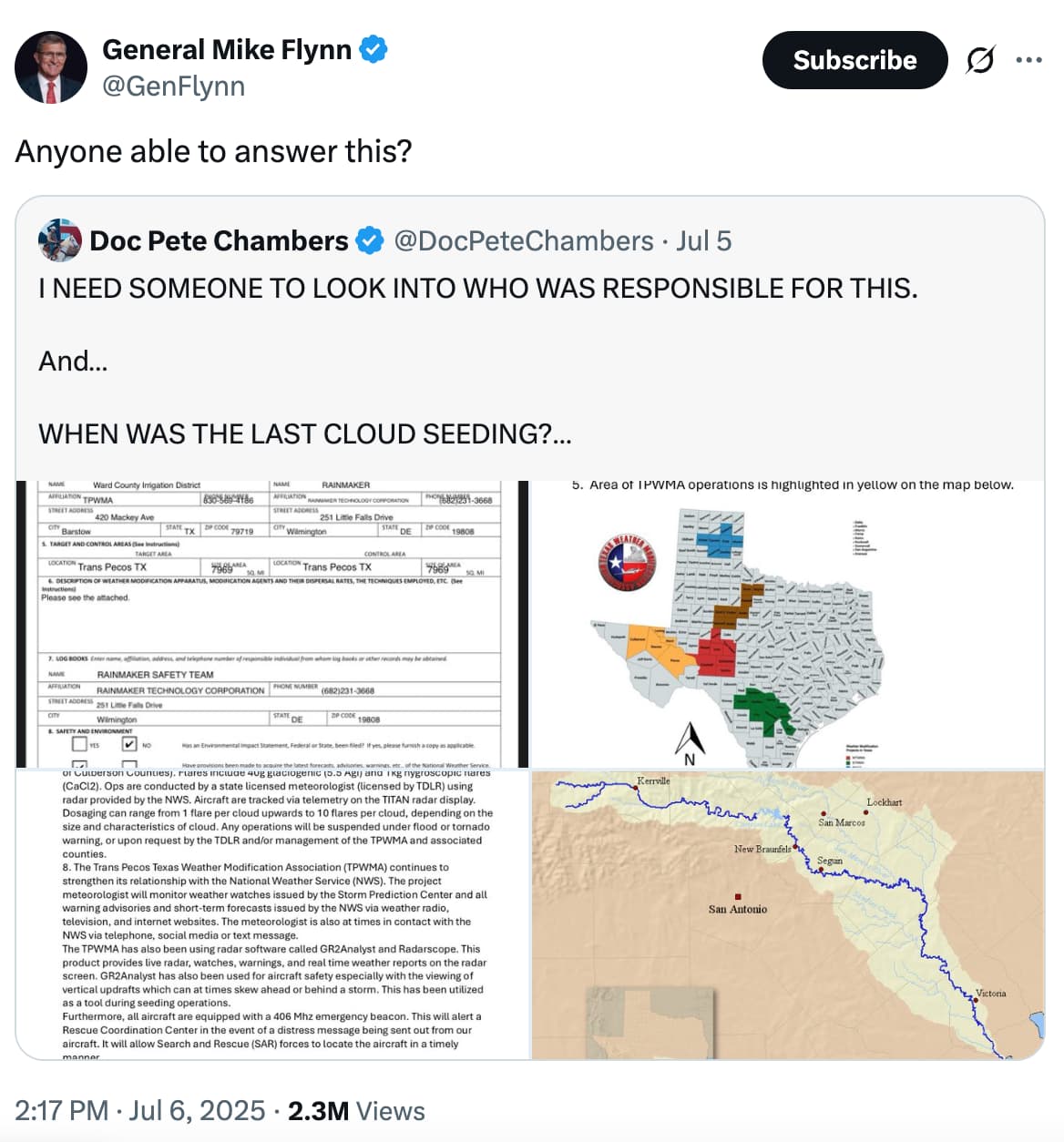
One of the most popular theories to have taken hold is that the floods were caused by cloud seeding – a form of geoengineering where substances are purposefully introduced into the clouds to enhance rainfall.

In a pair of Twitter posts, each viewed by several million people, one account claimed the state of Texas was “running seven massive cloud seeding programs” and asked: “Did they push the clouds too far and trigger this flood?” 

It also linked the floods and cloud seeding operations conducted by Rainmaker Technology Corporation, a weather modification start-up partly funded by US billionaire Peter Thiel. 

Rainmaker Technology Corporation CEO Augustus Doricko found himself in the eye of the social media storm, as social media users pointed to his organisation’s links to Thiel and shared a photo of the businessman with former US president Bill Clinton. 

The cloud seeding theory received a major boost when it was promoted by Mike Flynn, Donald Trump’s former national security advisor and one of the “most integral figures in the QAnon movement”, according to the Guardian

General Mike Flynn on X: Anyone able to answer this

The weather modification theory was picked up by existing and prospective Republican politicians.

The Daily Beast reported how Kandiss Taylor – a Republican congressional candidate in Georgia – blamed the event on “fake weather” in a string of tweets. She wrote: “This isn’t just ‘climate change.’ It’s cloud seeding, geoengineering, & manipulation.”

Meanwhile, sitting Georgia congresswoman Marjorie Taylor Greene announced on Twitter that she had introduced a bill that “prohibits the injection, release, or dispersion of chemicals or substances into the atmosphere for the express purpose of altering weather, temperature, climate, or sunlight intensity”.

(This is not Taylor Greene’s first foray into weather manipulation conspiracies. In 2021, she postulated that Jewish bankers had started deadly fires in California in 2018 by firing a laser from space in order to benefit themselves financially.)

Meteorologists were quick to debunk the claims around cloud seeding. In a Facebook post, chief meteorologist for Texas news station ABC13 wrote:

“Cloud seeding cannot create a storm of this magnitude or size. In fact, cloud seeding cannot even create a single cloud. All it can do is take an existing cloud and enhance the rainfall by up to 20%.” 

At a press conference on Monday, Texas senator Ted Cruz said there was “zero evidence of anything like weather modification”. He added:

“The internet can be a strange place. People can come up with all sorts of crazy theories.” 

Theories about geoengineering were not the only form of misinformation to swirl online in the wake of the disaster. 

Snopes reported how local outlet Kerr County Lead pulled a story about two girls rescued 30 metres up a tree two days after the flood event after the account was found to be false. 

The story, which cited “sources on the ground”, was circulated widely on Twitter and replicated by other news outlets, including the Daily Mirror and Manchester Evening News in the UK. Both outlets subsequently deleted the articles.

In a retraction statement, the editor of Kerr County Lead said the story was a “classic tale of misinformation that consumes all of us during a natural disaster”. 

Another widely-circulated story – debunked by Snopes – claimed that musician Eric Clapton would pay funeral expenses for the families of those killed.

Back to top

How has the media responded?

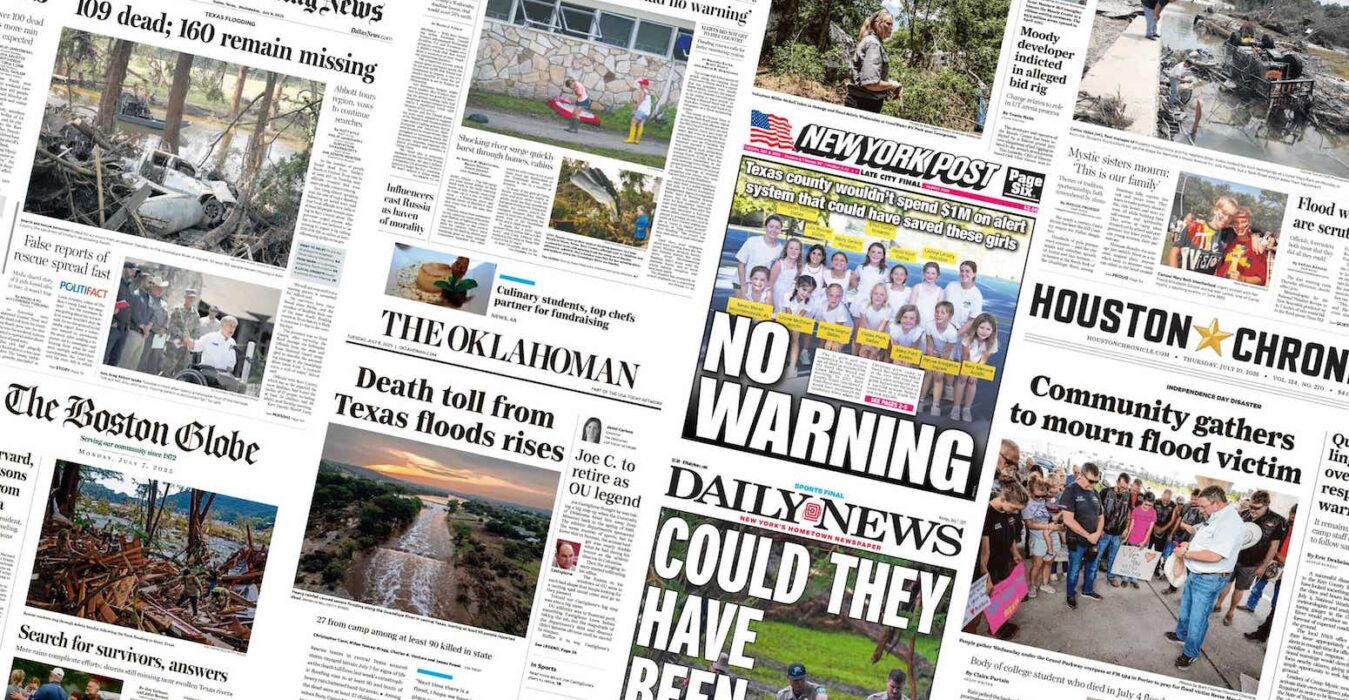
The scale of flooding and the resulting death toll have prompted many news outlets to ask whether more could have been done to avoid the tragedy. 

Newspapers in Texas highlighted perceived failures by local, state and federal authorities.

“Flash floods happen frequently enough in the Hill Country that many Texans rightly wonder whether at least some of the devastation and death…could have been prevented,” the Dallas Morning News said. “Answers must follow,” agreed the Austin American-Statesman.

An editorial in the San Antonio Express-News said there would likely be “plenty of finger-pointing”, arguing that “people will try to push narratives that serve political and personal agendas”. It added:

“The truth may reveal inevitability, failure or something in between.”

An editorial in the Houston Chronicle criticised “misguided decisions” by Trump to cut support for the “federal agencies that keep us safe from storms”. It stated: 

“What will protect Texans is a fully staffed, fully supported weather service – with the scientists and infrastructure in place to warn us in time.”

While none of these Texan newspaper editorials pointed to a potential role for climate change in exacerbating the extreme rainfall, some of their wider reporting on the disaster did.

Other US news outlets, such as the New York Times, the Los Angeles Times and the Washington Post emphasised this link in their coverage.

“We hope this tragedy will lead to renewed support for the systems we’ve devised over the years to help prepare for and respond to natural disasters,” Louisiana’s New Orleans Advocate stated in an editorial, adding that “we all are vulnerable to increasingly extreme weather events caused by climate change”.

In Pennsylvania, a Patriot-News editorial said that, following the floods, “government officials at all levels need to accept the reality of climate change. Too many do not.”

Writing in his news outlet, Bloomberg, businessman and former Democratic presidential nominee Michael Bloomberg made a direct link between the “climate denialism” of the Trump administration and the disaster in Texas.

The New York Times has an opinion piece on the floods by MaryAnn Tierney, former regional administrator at the FEMA. Besides making a clear link to climate change, Tierney stated that:

“The uncomfortable truth is this: With each passing day, the federal government is becoming less prepared to face the next big disaster.”

More overtly right-leaning and Trump-supporting media outlets in the US took aim at “left-wing critics” for linking the event to climate change and Trump administration cuts.

An article in Fox News, which has broadcast discussions of flood-related conspiracy theories, criticised “liberals” for “politicising the disastrous flooding”. 

An editorial in the New York Post is headlined: “Lefty responses to the Texas flooding horror are demented and depraved.” It argued that Democrats had “wrongly suggest[ed] that Team Trump slowed the disaster response”.

Diana Furchtgott-Roth, from the climate-sceptic Heritage Foundation, wrote in the UK’s Daily Telegraph that Democrats were trying to “politicise mother nature” by linking weather-service cuts to the deaths in Texas.

Meanwhile, Guardian columnist Rebecca Solnit urged caution in definitively linking the floods to any specific political issue amid “the information onslaughts of this moment”. She concluded that “both the weather and the news require vigilance.”

Children born in 2020 will face ‘unprecedented exposure’ to climate extremes

Attribution|

07.05.25

Two-thirds of global warming since 1990 caused by world’s ‘wealthiest 10%’

Attribution|

07.05.25

Global soil moisture in ‘permanent’ decline due to climate change

Drought|

27.03.25

‘Catastrophic’ 2023 lake outburst in India driven by glacial melt and permafrost thaw

Attribution|

30.01.25

Continue ReadingMedia reaction: The 2025 Texas floods and the role of climate change