‘Make Polio Great Again’: Alarm Over RFK Jr. Lawyer Who Targeted Vaccine

Spread the love

Original article by Jessica Corbett republished from Common Dreams under Creative Commons (CC BY-NC-ND 3.0). 
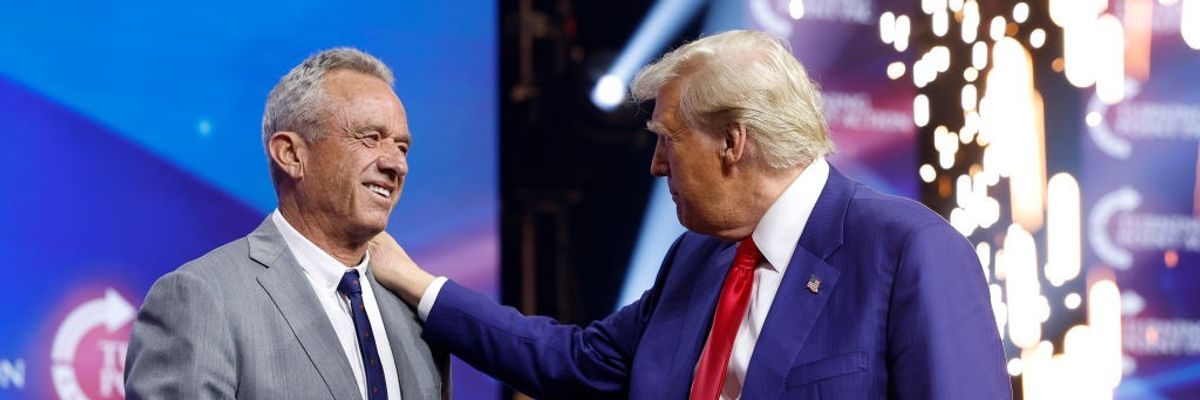
Former U.S. President Donald Trump welcomes Robert F. Kennedy Jr. to the stage at a campaign rally at the Gas South Arena on October 23, 2024 in Duluth, Georgia. (Photo: Anna Moneymaker/Getty Images)

“So if you’re wondering if Donald Trump is trying to kill your kids, yes, yes he is,” said one critic.

Public health advocates, federal lawmakers, and other critics responded with alarm to The New York Times reporting on Friday that an attorney helping Robert F. Kennedy Jr. select officials for the next Trump administration tried to get the U.S. regulators to revoke approval of the polio vaccine in 2022.

“The United States has been a leader in the global fight to eradicate polio, which is poised to become only the second disease in history to be eliminated from the face of the earth after smallpox,” said Liza Barrie, Public Citizen’s campaign director for global vaccines access. “Undermining polio vaccination efforts now risks reversing decades of progress and unraveling one of the greatest public health achievements of all time.”

Public Citizen is among various organizations that have criticized President-elect Donald Trump’s choice of Kennedy to lead the Department of Health and Human Services, with the watchdog’s co-president, Robert Weissman, saying that “he shouldn’t be allowed in the building… let alone be placed in charge of the nation’s public health agency.”

Although Kennedy’s nomination requires Senate confirmation, he is already speaking with candidates for top health positions, with help from Aaron Siri, an attorney who represented RFK Jr. during his own presidential campaign, the Times reported. Siri also represents the Informed Consent Action Network (ICAN) in petitions asking the Food and Drug Administration (FDA) “to withdraw or suspend approval of vaccines not only for polio, but also for hepatitis B.”

According to the newspaper:

Mr. Siri is also representing ICAN in petitioning the FDA to “pause distribution” of 13 other vaccines, including combination products that cover tetanus, diphtheria, polio, and hepatitis A, until their makers disclose details about aluminum, an ingredient researchers have associated with a small increase in asthma cases.

Mr. Siri declined to be interviewed, but said all of his petitions were filed on behalf of clients. Katie Miller, a spokeswoman for Mr. Kennedy, said Mr. Siri has been advising Mr. Kennedy but has not discussed his petitions with any of the health nominees. She added, “Mr. Kennedy has long said that he wants transparency in vaccines and to give people choice.”

After the article was published, Siri called it a “typical NYT hit piece plainly written by those lacking basic reading and thinking skills,” and posted a series of responses on social media. He wrote in part that “ICAN’s petition to the FDA seeks to revoke a particular polio vaccine, IPOL, and only for infants and children and only until a proper trial is conducted, because IPOL was licensed in 1990 by Sanofi based on pediatric trials that, according to FDA, reviewed safety for only three days after injection.”

The Times pointed out that experts consider placebo-controlled trials that would deny some children polio shots unethical, because “you’re substituting a theoretical risk for a real risk,” as Dr. Paul A. Offit, a vaccine expert at the Children’s Hospital of Philadelphia, explained. “The real risks are the diseases.”

Ayman Chit, head of vaccines for North America at Sanofi, told the newspaper that development of the vaccine began in 1977, over 280 million people worldwide have received it, and there have been more than 300 studies, some with up to six months of follow-up.

https://twitter.com/greenhousemd/status/1867639259567731149?ref_src=twsrc%5Etfw%7Ctwcamp%5Etweetembed%7Ctwterm%5E1867639259567731149%7Ctwgr%5E7e48f49e770c41569c1cc4056fd12b7ed80473b6%7Ctwcon%5Es1_c10

Sorry, this content could not be embedded.
X

Trump, who is less than six weeks out from returning to office, has sent mixed messages on vaccines in recent interviews.

Asked about RFK Jr.’s anti-vaccine record during a Time “Person of the Year” interview published Thursday, the president-elect said that “we’re going to be able to do very serious testing” and certain vaccines could be made unavailable “if I think it’s dangerous.”

Trump told NBC News last weekend: “Hey, look, I’m not against vaccines. The polio vaccine is the greatest thing. If somebody told me to get rid of the polio vaccine, they’re going to have to work real hard to convince me. I think vaccines are—certain vaccines—are incredible. But maybe some aren’t. And if they aren’t, we have to find out.”

Both comments generated concern—like the Friday reporting in the Times, which University of Alabama law professor and MSNBC columnist Joyce White Vance called “absolutely terrifying.”

She was far from alone. HuffPost senior front page editor Philip Lewis said that “this is just so dangerous and ridiculous” while Zeteo founder Mehdi Hasan declared, “We are so—and I use this word advisedly—fucked.”

Ryan Cooper, managing editor at The American Prospectwarned that “they want your kids dead.”

Author and musician Mikel Jollett similarly said, “So if you’re wondering if Donald Trump is trying to kill your kids, yes, yes he is.”

Multiple critics altered Trump’s campaign slogan to “Make Polio Great Again.”

U.S. Sen. Elizabeth Warren (D-Mass.) responded with a video on social media:

https://twitter.com/SenWarren/status/1867576860571287653?ref_src=twsrc%5Etfw%7Ctwcamp%5Etweetembed%7Ctwterm%5E1867576860571287653%7Ctwgr%5E7e48f49e770c41569c1cc4056fd12b7ed80473b6%7Ctwcon%5Es1_c10&ref_url=https%3A%2F%2Fwww.commondreams.org%2Fnews%2Frfk-jr-polio-vaccine

Sorry, this content could not be embedded.

X

Without naming anyone, Senate Minority Leader Mitch McConnell (R-Ky.), a polio survivor, put out a lengthy statement on Friday.

“The polio vaccine has saved millions of lives and held out the promise of eradicating a terrible disease. Efforts to undermine public confidence in proven cures are not just uninformed—they’re dangerous,” he said in part. “Anyone seeking the Senate’s consent to serve in the incoming administration would do well to steer clear of even the appearance of association with such efforts.”

Original article by Jessica Corbett republished from Common Dreams under Creative Commons (CC BY-NC-ND 3.0). 

Alarm Over Trump Choosing ‘Extreme, Conspiratorial’ RFK Jr. to Lead HHS
Continue Reading‘Make Polio Great Again’: Alarm Over RFK Jr. Lawyer Who Targeted Vaccine

Tech Billionaires Get in Line to Support Trump Inauguration Fund

Spread the love

Original article by Eloise Goldsmith republished from Common Dreams under Creative Commons (CC BY-NC-ND 3.0). 

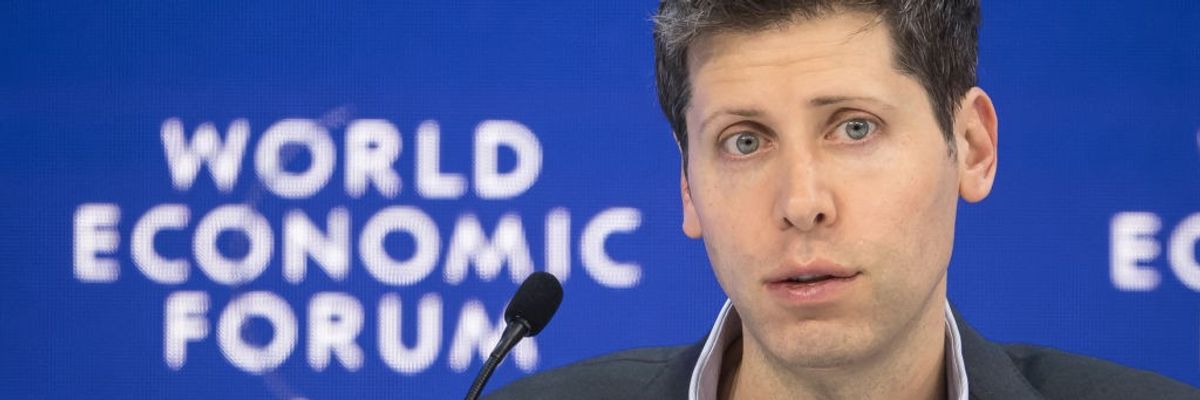
OpenAI CEO Sam Altman attends a session of the World Economic Forum (WEF) meeting in Davos on January 18, 2024. (Photo by Fabrice Coffrini/AFP via Getty Images)

“President Trump will lead our country into the age of AI, and I am eager to support his efforts to ensure America stays ahead,” said OpenAI CEO Sam Altman.

OpenAI CEO Sam Altman became the latest tech titan to make an explicit overture to U.S. President-elect Donald Trump when he confirmed Friday that he intends to make a $1 million to Trump’s inauguration fund.

The news comes after Meta confirmed Wednesday that it has donated $1 million to the fund, and it was reported Thursday that Amazon intends to make a $1 million donation. The Washington Post characterized Altman’s move as “the latest attempt to gain favor from a leading technology executive in an industry that has long been a target of Trump’s vitriol.”

Altman said in a statement that was sent to multiple outlets that “President Trump will lead our country into the age of AI, and I am eager to support his efforts to ensure America stays ahead.”

The donation from Meta follows a trip by Meta CEO and founder Mark Zuckerberg down to Trump’s Mar-a-Lago Club to meet with the president-elect last month. Jeff Bezos, Amazon’s executive chairman, is slated to head to Florida to meet with Trump at Mar-a-Lago next week, according to The Wall Street Journal.

Zuckerberg and Trump have not always been on the best of terms—Meta temporarily booted Trump from Instagram and Facebook following his comments regarding the January 6 insurrection, and Trump threatened Zuckerberg with lifetime incarceration if Trump perceived that Zuckerberg was interfering in the 2024 election—but Zuckerberg made entreaties to the then-candidate this past summer when he described Trump’s response to his assassination attempt as “badass.”

Zuckerberg and Meta refrained from donating to Trump’s inauguration fund in 2017, and to President Joe Biden’s inauguration fund in 2021, according to The Wall Street Journal.

In response to the news that Meta donated to Trump’s inauguration fund this time, the watchdog group Public Citizen wrote: “Shocker! Another tech bro billionaire trying to buy his way into Trump’s good graces. Zuckerberg donated $1 million to Trump’s inaugural fund. $1 million to the man who threatened Zuckerberg with life in prison. Grow a spine.”

Journalists Mehdi Hasan described the move as “bending both knees to Trump.”

https://twitter.com/mehdirhasan/status/1867180307696549914?ref_src=twsrc%5Etfw%7Ctwcamp%5Etweetembed%7Ctwterm%5E1867180307696549914%7Ctwgr%5E58d4184d61198542016c7f701d22c2aa26d27a69%7Ctwcon%5Es1_c10&ref_url=https%3A%2F%2Fwww.commondreams.org%2Fnews%2Ftrump-tech-billionaires-donation

Sorry, this content could not be embedded.
X

Bezos also chafed against Trump during his first presidency. Trump has repeatedly criticized The Washington Post, which is owned by Bezos, for its coverage of him. In legal proceedings, Amazon also accused Trump of swaying the bidding process when the Pentagon chose Microsoft over Amazon for a lucrative contract because of Trump’s disdain for Bezos. However, in a move that was viewed as a signal to Trump, Bezos blocked the Post from endorsing Vice President Kamala Harris just before last month’s election.

Margaret O’Mara, a history professor at the University of Washington who focuses on the high-tech economy, said during an interview with NPR the fact that support for Trump isn’t happening quietly “is something new.”

“It’s just a recognition that there’s not much to be gained in outspoken opposition, but perhaps there is something to be gained by being very clear about your support and hope that Trump does well,” she said.

Original article by Eloise Goldsmith republished from Common Dreams under Creative Commons (CC BY-NC-ND 3.0). 

Continue ReadingTech Billionaires Get in Line to Support Trump Inauguration Fund

Team Trump Wants to Destroy Key Safety Rule Hated by Tesla

Spread the love

https://newrepublic.com/post/189363/trump-team-destroy-crash-reporting-rule-tesla-hates

Brandon Bell/Getty Images

Tesla’s “self-driving” cars may be about to get a whole lot more dangerous.

Elon Musk’s efforts ingratiating himself into Trumpworld are about to pay off.

Donald Trump’s presidential transition team has recommended that the president-elect quash a crash reporting requirement for self-driving vehicles. In an internal document obtained by Reuters, the team described the safety reporting condition as a mandate for “excessive” data collection, advising that the president-elect abolish the requirement entirely.

Doing so would radically alter the playing field for the burgeoning automated vehicle industry, decreasing transparency and making it more difficult for federal regulators to spark inquiries into dangerous practices. And Tesla would be the new policy’s biggest benefactor.

https://newrepublic.com/post/189363/trump-team-destroy-crash-reporting-rule-tesla-hates

Continue ReadingTeam Trump Wants to Destroy Key Safety Rule Hated by Tesla

One year of Milei: hunger and resistance

Spread the love

Original article by Pablo Meriguet republished from peoples dispatch under a Creative Commons Attribution-ShareAlike 4.0 (CC BY-SA) license.

Argentine President Javier Milei. Photo: Milei / X

At one year of Milei’s presidency, we take stock of his economic policies, the impact on the working class, and perspectives for the future

A year ago, what many considered unthinkable a couple of years ago happened: Javier Milei, the eccentric libertarian economist who was almost compulsively invited by the media to increase ratings, was sworn in as president of Argentina. Gone was the neoliberal and demure option of the Argentine right wing that managed to triumph with Mauricio Macri, as well as the always latent Peronist option, which could not overcome the obstacles that the government of Alberto Fernandez left in its path.

Milei became a celebrated outsider who confronted his adversaries directly (often insulting and humiliating them), promising to lift the country out of poverty through a radical liberalization of the economy, with bold, or absurd, proposals to dollarize the economy and the eliminate the central bank. Indeed, his style as a guest on television programs was not too far removed from his actions as president of Argentina.

Erika Giménez, social communicator and a journalist with ARG Medios told Peoples Dispatch that Milei arrived with a promise that he was going to “break the State” and end all state social programs and aid to impoverished sectors because they are “a waste of money that prevents Argentina’s resurgence as a great country.” Did he succeed in his grandiose vision? What did the “lion” of Argentina manage to accomplish in his first year of governance?

Falling inflation and rising poverty

One of Milei’s main obsessions was to reduce inflation at all costs. After several setbacks that ended up increasing inflation, in October it was recorded that inflation had risen by 2.3%, the lowest percentage in several years. To achieve this, he had no qualms about firing tens of thousands of state workers (almost 36,000 according to the National Institute of Statistics and Census) and aggressively cutting the number of ministries (from 18 to 9). Social programs that had been a bulwark of the Republic for several decades were eliminated. Of the state workers who survived the layoffs, almost all have seen a reduction in their purchasing power as a consequence of the economic retrenchment policies.

Similarly, despite the fact that year-on-year inflation stood at 193%, retirees’ pensions only increased by 105%, meaning that retired elderly workers today, thanks to Milei’s government, can buy fewer things than before, because their pension was not adjusted for inflation. This incongruity provoked several mobilizations by retirees.

Likewise, Milei has refused to increase the public education budget so as not to affect the much-desired “fiscal balance”, which has led to a decline in the quality of education in the country. Also, hospital workers (doctors, nurses, and others) have reported that they have lost almost 104% of their purchasing power, which puts the country’s health care system at risk.

During Milei’s administration, poverty increased. According to data from the Observatory of the Argentine Social Debt of the Catholic University of Argentina, in the second half of 2023, 41.9% of the inhabitants of the South American country were poor, while, in the first half of 2024, the figure reached 52.9%. Similarly, private consumption fell by 9.8%.

In addition, according to Erica Giménez, inflation is currently decreasing, among other things, because people are not able to buy goods, which causes stores to reduce prices to sell more. This can lead to a distorted view of inflation as the only measure of economic improvement because, in reality, it is actually masking a more serious problem: people have lost purchasing power. “[The decrease in inflation] is quite a deceptive figure because people cannot consume because their salary is not enough to do so…The macroeconomic meters improve (as Milei wants) by not generating fiscal deficit, but this happens at the cost of the increase of unemployment, of retirement pensions, of the most needy, and of so many who are nowadays below the poverty line,” Giménez affirms.

One of the cases which shone a light on the ridiculous nature of his radical adjustment was what happened with the social kitchens, soup kitchens run oftentimes by left and progressive community organizations. Milei’s government and his Minister of Human Capital Sandra Pettovello were involved in a serious controversy when it was shown that, while the kitchens were subjected to serious budget cuts as part of the fiscal adjustment which made it impossible to feed the increasing number of hungry people, several tons of food were rotting in State warehouses. The Argentine courts had to order the immediate distribution of the food.

The defunding of university education

Probably the most important internal challenge faced by Milei during this first year was the massive demonstrations of students, professors, and university workers against the Executive’s refusal to increase the university budget. The Legislature had passed a law allowing for the budget increase, but Milei refused to comply with it and vetoed it completely. This generated a lot of discontent among Argentine students who took to the streets against the austerity policies of Milei’s libertarian government, and even went so far as to take over dozens of universities and hold university classes in the streets as a form of protest.

Giménez says in this regard, “Those who lose the most with [the veto of the law] are the professors of public universities who today are within the poor population…According to several surveys, the majority of the population agrees with the public character of health, education, etc., and of the Argentine State as protector and benefactor of these areas, so Mieli’s discourse against universities did not work because…public university education has great popular support.”

International relations

Milei has repeatedly stated that Argentina was, at some point in its history, the first world power. Therefore, what his government should do, according to his rhetoric, is to turn it into a great world power again. This “messianic” bet is synthesized in the often-used slogan “Make Argentina Great Again”, which evidently is reminiscent of Trump’s MAGA. “But Argentina never had a geopolitical weight that Milei says it once had as a first power,” Giménez tells us.

During the vote on whether or not to lift the US economic blockade of Cuba, Argentina voted along with almost all countries to call for an end to the blockade. In retaliation, Milei fired his foreign minister for this vote. According to Giménez, Argentina has historically voted against the blockade and supported other progressive international issues because it hopes that other countries will support its intention to recover the Malvinas Islands, which are currently under British control. Milei however, has wanted to assume a Trumpist international logic, says Giménez, and has assumed a fight against LGBTIQ+ groups and measures to curb climate change, while manifesting strong support in favor of Israel and the United States.

That is why the discussions at the UN on the prevention of violence against girls and women, the ceasefire in Palestine, and the withdrawal of the Argentine delegation from COP29, show the rejection of certain political causes which the president himself calls “the Cultural Battle”. As part of this battle he has attacked journalists, politicians and intellectuals, and founded the new think tank Faro Foundation whose objective is to: “To promote the ideas of economic liberalism and the historical values of Argentine culture, in order to contribute to the economic and social development of our Nation, fighting the cultural battle.” This confrontational attitude has led him to have several impasses with regional political leaders such as Colombian President Gustavo Petro.

But this confrontational attitude, more typical of a media commentator, has its limits. For example, Giménez reminds us that after announcing before his presidency that he would never negotiate with China because they are communists, Milei eventually had to negotiate with Beijing because of the importance of that country for the Argentine economy.

Read: Milei and Trump: allies in the battle for “freedom” and to combat “wokeism”

Likewise, Milei has openly positioned himself behind the geopolitical line of US President-elect Donald Trump, attending several select meetings organized by the US president. Milei, according to Giménez, intends to position himself, unsuccessfully, as an international leader who will inspire a global political transformation. Perhaps that is why he has made more trips abroad than within the country, especially to the United States. Likewise, his closeness with the International Monetary Fund stands out.

His revisionist ideological struggle

Milei has also had a significant impact on the ideological dispute in Argentina with his bizarre and aggressive speeches.

For example, he said that he would be delighted to drive the last nail in the coffin of former Peronist president Cristina Fernández, who is the subject of a judicial process that seeks to disqualify her politically and put her in prison.

He has also questioned the figures of human rights organizations on the number of dead and disappeared caused by the last military dictatorship in Argentina. His vice-president, Victoria Villarruel, is a descendant of a military family and before his death, had paid a personal visit to Rafael Videla, head of the last military dictatorship. Milei wants Argentines to forget the dictatorship as if it’s something that can be left behind, says Giménez. In order for Milei to advance his political and ideological project to “make Argentina great again”, he must break certain established and socially consensual notions “and generate other discourses closer to capitalism, revisionist, discuss the importance of the university and public employment…and that includes relativizing one of the darkest periods of Argentine history such as the military dictatorship,” Giménez explains.

Milei has vigorously gone after his ambitious goals of economic liberalization and austerity, without asking “at what cost?” The significant rejection of such policies by broad sectors of the population and the deepening of social conflict will continue and intensify. Milei still has three years left in his presidency, so the future of his government is uncertain. What is certain is that he does not seem to be slowing down his pretensions, but rather accelerating the radical neoliberal program that he defends to the hilt.

Original article by Pablo Meriguet republished from peoples dispatch under a Creative Commons Attribution-ShareAlike 4.0 (CC BY-SA) license.

Continue ReadingOne year of Milei: hunger and resistance

Arctic Tundra Has Turned From ‘Carbon Sink to Carbon Source’ in Dangerous Flip: NOAA

Spread the love

Original article by Julia Conley republished from Common Dreams under Creative Commons (CC BY-NC-ND 3.0).

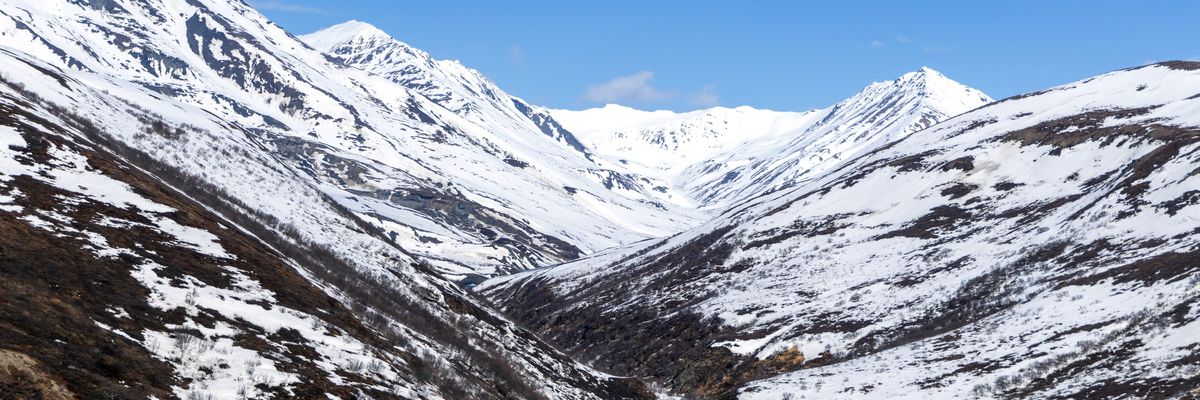
A view of Brooks Range as seen from the Dalton Highway on May 10, 2024 in North Slope Borough, Alaska. (Photo: Lance King/Getty Images)

“This is yet one more sign, predicted by scientists, of the consequences of inadequately reducing fossil fuel pollution,” said one scientist.

Permafrost in the Arctic has stored carbon dioxide for millennia, but the annual Arctic Report Card released by the National Oceanic and Atmospheric Administration reveals a concerning shift linked to planetary heating and a rising number of wildfires in the icy region: The tundra is now emitting more carbon than it is storing.

The report card revealed that over the last year, the tundra’s temperature rose to its second-highest level on record, causing the frozen soil to melt.

The melting of the permafrost activates microbes in the soil which decompose the trapped carbon, causing it to be released into the atmosphere as planet-heating carbon dioxide and methane.

The release of fossil fuels from the permafrost is also being caused by increased Arctic wildfires, which have emitted an average of 207 million tons of carbon per year since 2003.

“Our observations now show that the Arctic tundra, which is experiencing warming and increased wildfire, is now emitting more carbon than it stores, which will worsen climate change impacts,” said Rick Spinrad, administrator of NOAA. “This is yet one more sign, predicted by scientists, of the consequences of inadequately reducing fossil fuel pollution.”

Sue Natali, a scientist at the Woodwell Climate Research Center in Massachusetts and one of 97 international scientists who contributed to the Arctic Report Card, told NPR that 1.5 trillion tons of carbon are still being stored in the tundra—suggesting that the continued warming of the permafrost could make it a huge source of planet-heating greenhouse gas emissions.

Along with the “Arctic tundra transformation from carbon sink to carbon source,” NOAA reported declines in caribou herds and increasing winter precipitation.

The report card showed that the autumn of 2023 and summer of 2024 saw the second- and third-warmest temperatures on record across the Arctic, and a heatwave in August 2024 set an all-time record for daily temperatures in several communities in northern Alaska and Canada.

The last nine years have been the nine warmest on record in the Arctic region.

“Many of the Arctic’s vital signs that we track are either setting or flirting with record-high or record-low values nearly every year,” said Gerald (J.J.) Frost, a senior scientist with Alaska Biological Research, Inc. and a veteran Arctic Report Card author. “This is an indication that recent extreme years are the result of long-term, persistent changes, and not the result of variability in the climate system.”

Brenda Ekwurzel, a climate scientist at the Union of Concerned Scientists, emphasized that the continuous release of fossil fuel emissions from oil and gas extraction and other pollution has caused the Arctic to warm at a faster rate than the Earth as a whole over the past 11 years.

“These combined changes are contributing to worsening wildfires and thawing permafrost to an extent so historic that it caused the Arctic to be a net carbon source after millennia serving as a net carbon storage region,” said Ekwurzel. “If this becomes a consistent trend, it will further increase climate change globally.”

The Arctic Report Card was released weeks before President-elect Donald Trump is set to take office. Trump has pledged to slash climate regulations introduced by the Biden administration and to increase oil and gas production. He has mused that sea-level rise will create “more oceanfront property” and has called the climate crisis a “hoax,” while his nominee for energy secretary, Chris Wright, the CEO of the fracking company Liberty Energy, has claimed that climate warming is good for the planet.

“These sobering impacts in the Arctic are one more manifestation of how policymakers in the United States and around the world are continuing to prioritize the profits of fossil fuel polluters over the well-being of people and the planet and putting the goals of the Paris climate agreement in peril,” said Ekwurzel. “All countries, but especially wealthy, high-emitting nations, need to drastically reduce heat-trapping emissions at a rapid pace in accord with the latest science and aid in efforts of climate-vulnerable communities to prepare for what’s to come and help lower-resourced countries working to decrease emissions too.”

Original article by Julia Conley republished from Common Dreams under Creative Commons (CC BY-NC-ND 3.0).

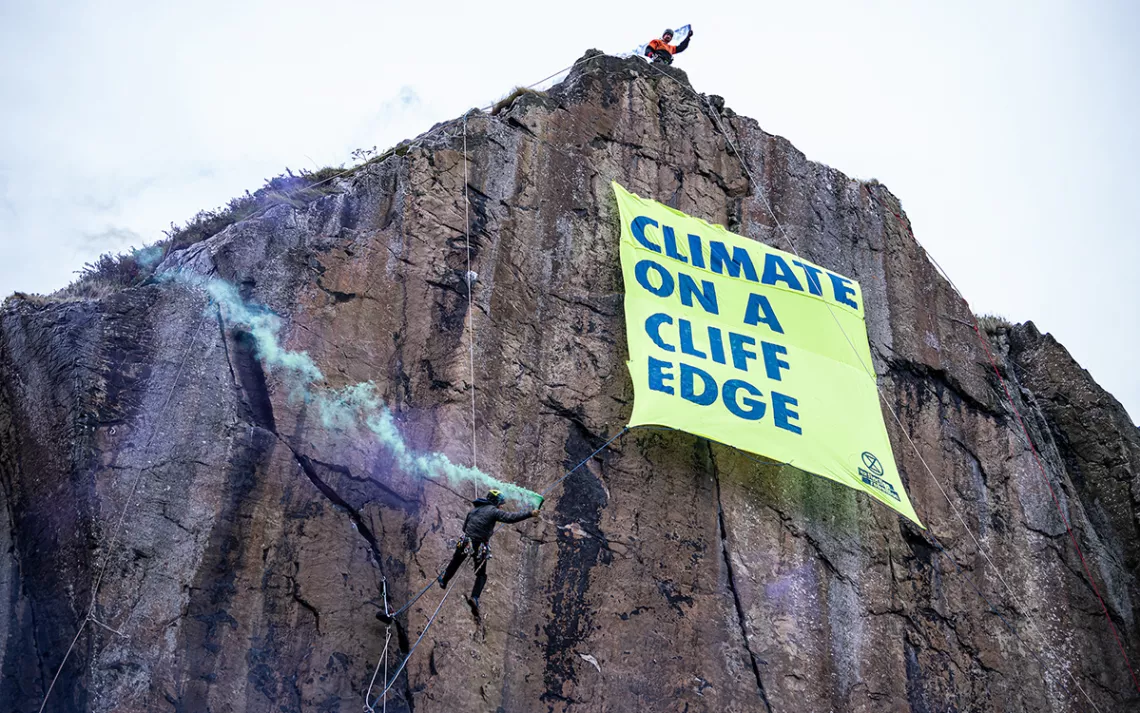
Experienced climbers scale a rock face near the historic Dumbarton castle in Glasgow, releasing a banner that reads “Climate on a Cliff Edge.” One activist, dressed as a globe, symbolically looms near the edge, while another plays the bagpipes on the shores below. | Photo courtesy of Extinction Rebellion and Mark Richards
Continue ReadingArctic Tundra Has Turned From ‘Carbon Sink to Carbon Source’ in Dangerous Flip: NOAA